Contents
- What is the 12 Week Year concept?
- Why 12 weeks work better than 12 months
- How to create a 12 Week Year plan
- 12 Week Year goals: six examples for work and life
- Common 12 Week Year mistakes
- 12 Week Year vs. OKR, SMART goals, annual planning and sprints
- Your 12 Week Year planner: year, quarter, month, week, day
- 12 Week Year FAQ
The 12 week year is a planning method that splits the year into four blocks of 12 weeks and treats each block as a full year, with its own goals, plan and review. It works because a deadline 12 weeks away changes what you do this Tuesday, while a deadline in December changes nothing until November. This page explains the method step by step, with six examples for work and life, a weekly sheet you can copy, the common mistakes and its place in your annual plan.
What is the 12 Week Year concept?
The 12 week year is a goal-setting and execution system with 12 weeks, not 12 months, as your unit of planning. It has four parts: one to three goals with a number and an end date, weekly actions, a weekly score and a review at the end of the block.
The method comes from the book “The 12 Week Year: Get More Done in 12 Weeks than Others Do in 12 Months” by Brian P. Moran and Michael Lennington, published by Wiley in 2013. Its central argument: annualized thinking, the habit of planning in calendar years, creates a false sense of time: a slow start in January, a crush in the fall. A 12-week cycle removes that gap.
Maya, the example for the rest of this page, wants to grow her newsletter from 800 to 2,600 subscribers this year. As a yearly goal, that is 150 a month, and a slow March feels harmless. As a 12 week year goal, 800 to 1,500 by week 12, a slow week costs about 60 subscribers, and she sees it on Sunday, not in November.
The six terms you need
- Vision. Where you want life and work to be in the long run. Maya: a newsletter that pays half her rent.
- 12-week goal. One result with a number and an end date. Maya: 1,500 subscribers by week 12.
- Tactics. The weekly actions that produce the result. Maya: two posts and one newsletter a week.
- Weekly plan. This week's tactics, each assigned to a day, written before the week starts.
- Scorecard. The share of planned tactics you did, calculated weekly. Three of four is 75 percent.
- Week 13. The review week: what worked, what did not, what comes next.
Three principles and five disciplines
The authors name three principles (attitudes) and five disciplines (practices).
- Accountability. You own the result. If the newsletter did not grow, the question is what you did.
- Commitment. You keep the promises you made to yourself, especially the small weekly ones.
- Greatness in the moment. The result comes later; the work happens now, on an ordinary Tuesday.
- Vision. Know why the goal matters to you.
- Planning. Turn the goal into tactics and the tactics into a weekly plan.
- Process control. Protect the routines that make execution likely: time blocks, a weekly review and, if you have people for it, a short weekly accountability meeting.
- Measurement. Score your execution every week.
- Time use. Give the important work fixed slots in your calendar.
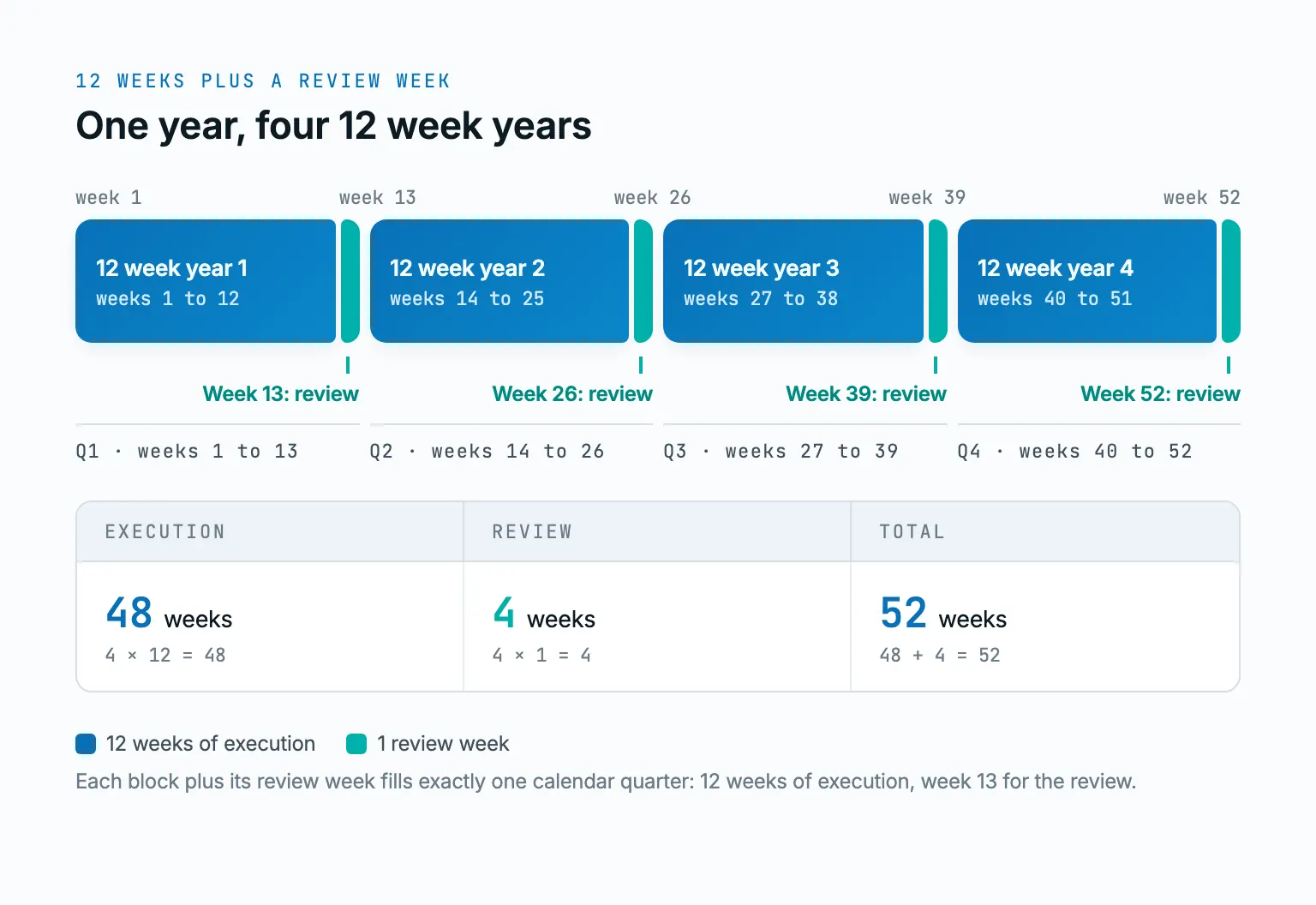
One year holds four blocks: four times 12 weeks is 48 weeks of execution, and four review weeks bring you to 52. The 12 week year is not an alternative to quarters but a way of running them.
Why 12 weeks work better than 12 months
Is the method just a shorter deadline? Yes, and that is the point. Five findings explain why a short cycle holds up; none tested the 12 week year itself, only the mechanisms it relies on.
- Parkinson's law (Parkinson, 1955). Work expands to fill the time available. Give a relaunch a year and it takes a year; give it 12 weeks and it takes 12.
- Goal-setting theory (Locke and Latham, 1990 and 2002). Specific, challenging goals with feedback beat vague “do your best” goals. “1,500 subscribers by week 12, scored every Sunday” is all three.
- Implementation intentions (Gollwitzer, 1999). A plan in the form “when X happens, I will do Y” makes it more likely that you act. “Monday at 7 a.m., write for 45 minutes” is such a plan. “Write more” is not.
- The fresh start effect (Dai, Milkman and Riis, 2014). People start on goals at temporal landmarks such as a new year, a new month or a Monday. Four blocks give you four fresh starts a year.
- The progress principle (Amabile and Kramer, 2011). Visible progress in meaningful work is the strongest driver of motivation during a workday. A weekly scorecard shows it every seven days, even when the subscriber count barely moves.
The book adds the 85 percent rule: if you carry out at least 85 percent of your planned tactics in a week, you will very likely reach your goal. That is the authors' rule of thumb, not a research finding. It sets the bar below perfection: miss one tactic in seven and you are still on track. How to achieve goals covers why goals fail between intention and action.
How to create a 12 Week Year plan
All 12 week year planning comes down to eight steps. The first four happen before the block starts and take about two hours; the rest take 20 to 30 minutes a week. Maya goes through all eight.
Write your vision for three horizons
Long term, three years from now, and this year, a few sentences each. Maya's line for this year: 2,600 subscribers by December 31. Without it, the goal has nothing to lean on in week 6.
Pick one to three 12-week goals with a number and an end date
One is fine for your first block. Each goal needs a start value, a target value and a date. Maya: subscribers from 800 to 1,500 by the last day of week 12. The [SMART goals examples](/en/smart-goals-examples) show how to phrase a goal so it can be checked.
Choose three to five tactics per goal
A tactic is a weekly action you can check off. Maya's: publish two posts, send one newsletter, ask one creator for a cross-promotion, answer reader emails for 30 minutes. “Be more visible” is not a tactic; “send one cross-promotion request on Wednesday” is.
Define a lead indicator and a lag indicator
The lag indicator is the result: Maya's subscriber count, checked every Friday. The lead indicator is the action count you control: her posts, newsletters and requests per week. You measure both, but you manage the lead indicator. Lead high and lag flat for four weeks means the tactics are wrong, not the effort.
Build the weekly plan on Sunday or Monday
Assign each tactic to a day and a time slot, then check the calendar for collisions. Maya: post 1 Tuesday at noon, post 2 Thursday at 7 a.m., request Wednesday, newsletter Friday, reader emails Saturday. Ten minutes, same time every week.
Protect your time blocks
The book names three kinds. The strategic block is about three uninterrupted hours, once a week, for the work that moves the goal. Short daily buffer blocks catch email and small tasks, and a breakout block of a few hours stays away from work. Maya writes both posts in her strategic block, Tuesday, 7 to 10 a.m.
Score every week
Tactics done divided by tactics planned. Maya planned five actions and did four: 80 percent. Aim for 85 or more, and write the number down even when it is bad; the trend over 12 weeks tells you more than any single week.
Use week 13 for the review
Compare the lag indicator with the goal, read the twelve scores, decide which tactics to keep, replace or drop, and set the next block's goals. Maya keeps the posts and the newsletter, swaps the reader emails for a second cross-promotion request, and starts block two from 1,520. Then take a few days off.
Maya's weekly sheet in copyable form: one row per tactic, one score per week.
12 WEEK YEAR, BLOCK 1 (weeks 1 to 12, review in week 13)
Goal: newsletter subscribers 800 to 1,500 by the last day of week 12
Lag indicator: subscribers (every Friday)
Lead indicator: posts, newsletters and requests sent (every Sunday)

WEEK __ PLAN
[ ] Tue 12:00 p.m.  post 1 published
[ ] Wed 8:00 a.m.   cross-promotion request sent
[ ] Thu 7:00 a.m.   post 2 published
[ ] Fri 9:00 a.m.   newsletter sent
[ ] Sat 10:00 a.m.  30 minutes of reader emails answered

SCORE: done __ / planned 5 = __%   (aim: 85% or more)
Subscribers this Friday: ____
One sentence on what to change next week: ____
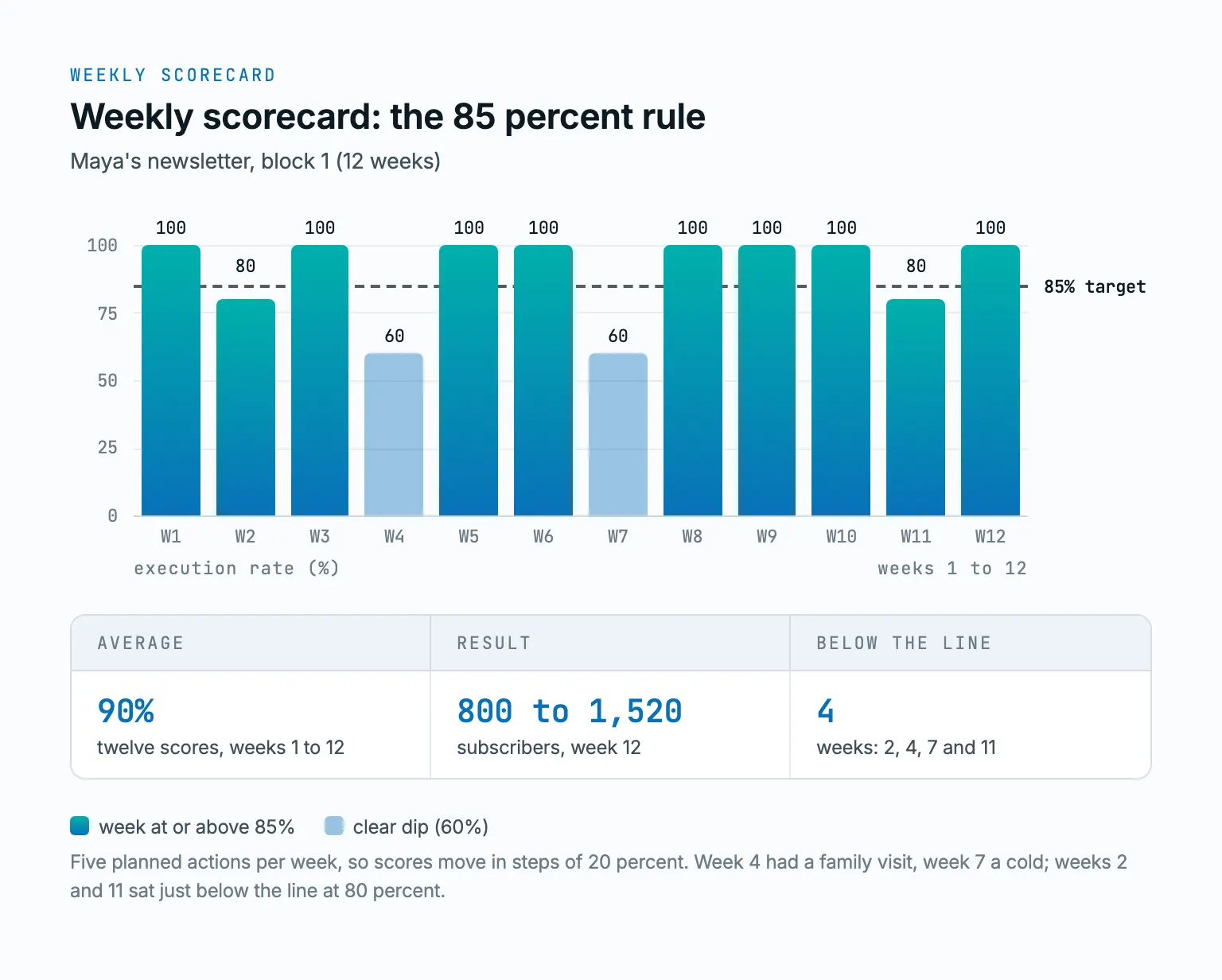
The chart shows Maya's twelve scores: 100, 80, 100, 60, 100, 100, 60, 100, 100, 100, 80 and 100 percent. Week 4 had a family visit, week 7 a cold; weeks 2 and 11 sat just below the line at 80 percent. The average is 90 percent, and the newsletter closes at 1,520 subscribers. The scorecard did not require a perfect week. It required that a bad week stay a single week.
12 Week Year goals: six examples for work and life
A 12-week goal needs four things on paper: start value, target value, weekly tactics and the lead indicator you count. Three examples from work, three from life, and none reads “get healthier”: every goal is true or false on the last day of week 12. Copy the shape, not the numbers.
| 12-week goal | Start value | Target value | Weekly tactics | Lead indicator |
|---|---|---|---|---|
| Win three new clients (freelance) | 0 clients | 3 signed projects | 10 first contacts, 2 proposals, 1 follow-up round | First contacts per week |
| Double the sales pipeline (employed sales rep) | $40,000 | $80,000 | 8 discovery calls, 3 follow-up meetings | Discovery calls per week |
| Grow the newsletter (Maya) | 800 subscribers | 1,500 subscribers | 2 posts, 1 newsletter, 1 cross-promotion request | Posts and requests per week |
| Run a 5K under 30 minutes | 5K in 34:10 | 5K in 29:59 | 3 runs (1 interval session), 1 strength session | Runs per week |
| Build an emergency fund | $0 | $1,800 | $150 automatic transfer, 1 spending check (20 minutes) | Transfer done, yes or no |
| Pass the Spanish A2 exam | A1 | A2 passed | 5 app sessions of 25 minutes, 1 conversation partner call (45 minutes) | Study sessions per week |
The 5K is the hardest row, because the lag indicator, your finishing time, moves only every few weeks. Its scorecard in week 4: four actions planned, a late meeting ate the intervals, three of four is 75 percent, below the line. The lag indicator that week: 5K in 32:40, down from 34:10. The training works, so the fix for week 5 is moving the intervals to the morning, not adding a run.
Common 12 Week Year mistakes
Most first blocks fail for the same seven reasons. Each has a simple fix.
- Too many goals. Four goals with four tactics each are 16 weekly commitments. Fix: one to three goals, one in your first block.
- Tactics written as wishes. “Write more” cannot be scored. Fix: name a day, a duration or a count. “Tuesday, 90 minutes of writing” can be checked off.
- Dropping the scorecard after week 3. The first scores are high and feel unnecessary; then week 4 dips and you stop looking. Fix: scoring goes in the calendar, Sunday at 6 p.m. Bad weeks are what the scorecard exists for.
- Skipping week 13. You reach week 12, feel behind and roll straight into the next block. Fix: put week 13 in the calendar before the block starts; 20 honest minutes save you from repeating the same mistakes for 12 more weeks.
- Not defending time blocks. The strategic block becomes a meeting slot by week 2. Fix: tell people when the block is, and move it rather than cancel it.
- Running it as a permanent sprint. Four blocks back to back with no breakout time lead to a tired week 9 every block. Fix: the breakout block is a tactic too, and week 13 includes rest.
- Starting with tactics and skipping the vision. Tactics without a reason behind them are easy to drop when they get boring. Fix: write the vision first, even three sentences, and read it again in week 6.
One limit sits outside the list: the method fits goals you can move within 12 weeks through actions you control. A promotion is out of your hands, so set the goal on applications sent rather than offers received.
12 Week Year vs. OKR, SMART goals, annual planning and sprints
The 12 week year is one of several ways to slice time and goals. The table shows where each sits.
| Method | Time frame | Who it is for | What is measured | Strength | Weakness |
|---|---|---|---|---|---|
| 12 Week Year | 12 weeks plus a review week | One person or a small team | Weekly execution rate and the result | Urgency, weekly feedback, few goals | Needs a weekly ritual |
| OKR | Quarter | Teams, and individuals too | Key results scored 0 to 1.0 | Aligns many people on the same outcomes | Easy to over-engineer for one person |
| SMART goals | Any | Anyone writing one goal | Whether the goal is met by the date | Clear wording | Silent on the weekly work |
| Annual planning | 12 months | Anyone | Yearly goals and milestones | The big picture | Too far away to guide this week |
| Scrum sprint | One to four weeks | Product teams | Delivered work items | Fast feedback | Team output, not personal goals |
| 90-day plan | 90 days | Managers, new hires, owners | Milestones per month | Familiar in business | Usually no weekly score |
The methods combine well. If you use the OKR framework, the mapping is direct: a quarterly objective is your 12-week goal, the key results are your lag indicators, the initiatives are your tactics. The OKR template gives you that layout, and the OKR software page shows it inside a goal chain. SMART goals examples help with the wording in step two; annual planning supplies the yearly number in step one.
Your 12 Week Year planner: year, quarter, month, week, day
The book tracks nothing above the block; the yearly number lives only in the vision. In practice, a 12 week year planner works best as one chain with five layers. Each answers a different question: where you are going, what you finish next, whether you are on pace, what you do this week, what you do now.
- Year: vision and yearly goal. One sentence with a number. Maya: 2,600 subscribers by December 31.
- Quarter: the 12 week year. One to three goals. Maya: 800 to 1,500 in Q1.
- Month: checkpoints after week 4 and week 8. The method has no months, but in a chain they are where you swap tactics that are not working. Maya's pace is about 230 new subscribers a month; at 950 after week 4 instead of about 1,030, she looks at which tactic is behind.
- Week: plan and scorecard. This week's tactics and the score at the end. Maya: two posts, one newsletter, one request.
- Day: the one action for today. Maya on Monday: 45 minutes of writing before work. Daily goals explains how to keep that layer small.
Why a 12 week year is a quarter
A calendar quarter is 13 weeks. Twelve weeks of execution plus week 13 for review fill it exactly, so a 12 week year and a quarterly plan are the same thing seen from two sides.
Those five layers are the five horizons in Gaapp: year, quarter, month, week and day. Progress per period is the share of its goals that are done, and a thin line shows how much of the period has passed. Read together, they are the scorecard without a spreadsheet: line at 50 percent of the quarter, goals at 30, you are behind.
To be precise, Gaapp does not score tactics in percent and has no week 13 review feature. It counts goals done per period, the same idea one level up, so keep the weekly sheet above for those two jobs. If you have been looking for a 12 week year app, that chain is what you need, and one yearly goal is free.
12 Week Year FAQ
What is the 12 Week Year concept?
The 12 week year is a planning system that treats 12 weeks as a full year. You set one to three goals with a number and an end date, break them into weekly tactics, score your execution every week and review in week 13. The point is urgency: a deadline 12 weeks away changes what you do this week. The definition section above explains the terms, principles and disciplines.
What is the 12 Week Year book about?
“The 12 Week Year: Get More Done in 12 Weeks than Others Do in 12 Months” by Brian P. Moran and Michael Lennington (Wiley, 2013) argues that planning in calendar years creates a false sense of time and replaces the year with a 12-week execution cycle. The book covers the vision work, the three principles, the five disciplines, time blocking, the weekly scorecard and a short weekly accountability meeting. A companion workbook, “The 12 Week Year Field Guide,” turns the method into worksheets. You do not need either to start; this page contains the method.
How to create a 12 Week Year plan?
Eight steps: write your vision, pick one to three goals with a number and a date, choose three to five weekly tactics per goal and define a lead and a lag indicator. Then build the weekly plan on Sunday, protect your time blocks, score every week and review in week 13. The first four steps take about two hours before the block starts. The rest takes 20 to 30 minutes a week.
Can you provide an example of a 12-week year plan?
Maya wants to grow her newsletter from 800 to 1,500 subscribers in 12 weeks. Her tactics, every week: publish two posts, send one newsletter, ask one creator for a cross-promotion and answer reader emails for 30 minutes. She writes in a strategic block on Tuesday morning and scores herself on Sunday; over 12 weeks she averages 90 percent and ends the block at 1,520 subscribers. The full version with all eight steps and the weekly sheet is above.
Is there a 12 week year template?
The five-layer chain in the planner section is the 12 week year template: a yearly goal, the 12-week goal below it, a monthly checkpoint, the weekly tactics and today's action. The weekly sheet in the how-to section is the copyable part; put it on paper or into any tool. The examples table gives you six filled-in versions to adapt. There is no PDF.
Is there a short 12 week year summary?
Plan in blocks of 12 weeks instead of 12 months. Set one to three goals with a target and a deadline and turn each into three to five weekly actions. Score how many of those actions you did each week, aiming for 85 percent. In week 13, review the block and plan the next one. That is the whole method; the page above is the long version with examples.
Read next
- Methods
Annual Planning: A Guide for One Person, With Template and Examples
Three to five yearly goals, broken down to the week. For one person, not a corporation.
- Leadership & Teams
OKR Framework: Examples, Template and Criticism
The OKR framework explained: OKR meaning, objectives and key results, the cycle, scoring, seven examples for work and life, criticism, and a template.
- Methods
SMART Goals Examples: Eight Goals for Work and Life, With a Step-by-Step Method
Eight written-out SMART goals with real numbers, the five criteria explained simply, a five-step method, exercises, and the way from a yearly goal to today's step.
- Methods
Daily Goals: How to Set Them, With 24 Examples
Daily goals are not a to-do list. Derive one to three per day from your weekly goal, pick from 24 examples with real numbers and track them on paper, in a sheet or in an app.