Contents
- Why goals fail: what the research says
- How to set goals: choosing a method
- How to write a goal: examples for work, health, money, learning and life
- How to achieve goals you set: the goal chain from year to day
- The psychology of achieving goals: motivation, habits, setbacks
- Common mistakes when setting and achieving goals
- FAQ: how to achieve goals
How to achieve goals is a different question from how to set them. Most advice on how to achieve your goals treats them as one job, as if reaching a goal followed from writing it down. It does not: anyone can set a goal in an hour, but whether you reach it is decided in the 51 weeks that follow, and for those you need a system.
This page shows you how to choose a method that fits, how to write a goal so it can be measured, and how to track it from the year down to today. No motivational quotes, no list of eleven tips. Instead: a comparison of the methods, five examples with numbers, two complete goal chains, a 15-minute weekly check-in with a template, and only the psychology that has been tested.
One example runs through the whole page: lose 22 pounds and keep the weight off.

Why goals fail: what the research says
The usual explanations are discipline, motivation or willpower. They are convenient because they make you the problem, not your approach. The research points to three other causes, and practice adds a fourth. Each of them is fixable.
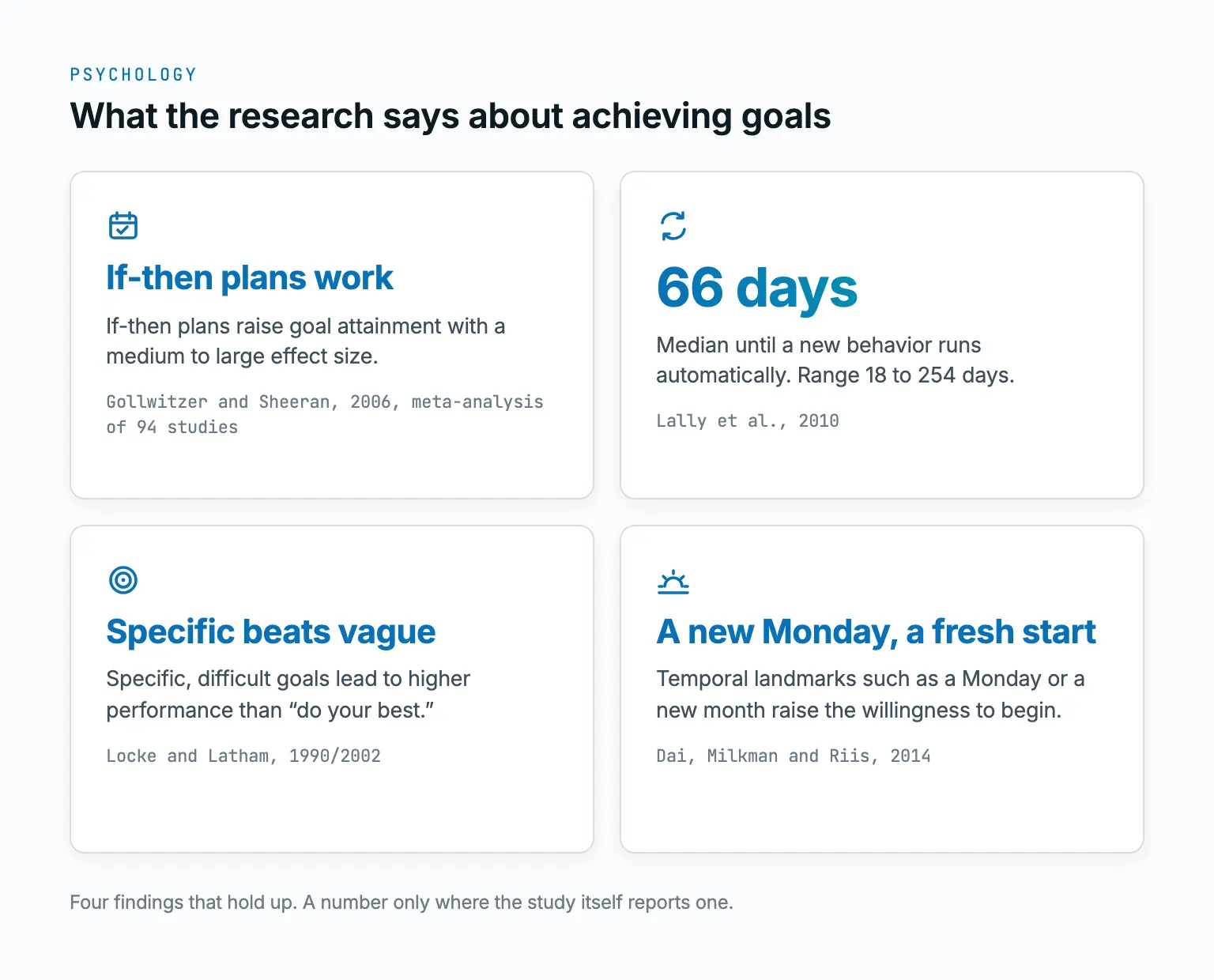
- The goal is too vague. Edwin Locke and Gary Latham showed in their goal-setting theory (1990, review article 2002) that specific, difficult goals lead to higher performance than “do your best.” The conditions: you commit, get feedback and have the ability. “Get in shape” is not specific, so it produces neither feedback nor commitment.
- There is no plan for the moment of action. Peter Gollwitzer (1999) calls the fix implementation intentions, or if-then plans: “If it is Monday at 7 a.m., then I put on my running shoes.” The Gollwitzer and Sheeran meta-analysis (2006, 94 studies) found a medium to large effect on goal attainment.
- There is no rhythm for checking in. Locke and Latham list feedback as a condition. A goal whose status you do not know loses its pull. The fix is not a dashboard but an appointment: once a week, 15 minutes.
- You are chasing too many goals at once. There is no reliable number, and this page will not invent one. Rule of thumb: one yearly goal to start. Rebuild three areas of life at once and you have nine weekly goals, finish four and conclude you lack discipline.
Writing goals down helps too, not because paper is magic, but because the moment you write “exercise more,” you notice a number is missing. What follows: a precise goal, an if-then plan and a weekly appointment. The methods supply the wording, the goal chain supplies the rhythm.
How to set goals: choosing a method
There is no best method, only the one that fits your time frame and type of goal. Three have a track record with individuals: SMART goals (George T. Doran, Management Review, 1981), OKR (Andy Grove at Intel, popularized by John Doerr in “Measure What Matters,” 2018) and the 12 Week Year (Brian P. Moran and Michael Lennington, “The 12 Week Year,” 2013).
| Method | Best for | Time frame | Strength | Weakness | Read more |
|---|---|---|---|---|---|
| SMART goals | one goal, stated cleanly; beginners; health, money, learning | flexible, usually months | every goal becomes measurable and dated | says nothing about the path, no interim steps | SMART goals examples |
| OKR | one objective with two to five measurable key results; freelancers, professionals; known from companies, used here for one person | a quarter | separates direction (objective) from measurement (key results), ambitious | upkeep, tempts you into task lists | OKR framework |
| 12 Week Year | anyone who stalls in annual plans and wants pace | twelve weeks plus a review week | short deadline, weekly scoring, clear execution rate | one focus, little room for several areas of life | 12 Week Year |
Annual planning and daily goals are missing from the table on purpose. Neither is a method; they are the top and bottom of the goal chain. Annual planning describes how you set up the year, daily goals what one day looks like. Each of the three methods fits in between.
The decision in three sentences: Use SMART when you want to state one goal cleanly, say an emergency fund. Use OKR when several measures belong to one goal, say revenue, inquiries and repeat clients. Use the 12 Week Year when you lack pace, not clarity.
None of the three fits when your goal cannot be expressed as a number. “Be calmer” can be bent into a SMART goal, but the result is usually a counter that misses the point. Such goals are process goals: you define a behavior, say 20 minutes with the kids every evening without your phone, and check weekly whether you did it.
How to write a goal: examples for work, health, money, learning and life
You learn how to write a goal fastest from an example, but most goal examples online are the problem: “work out,” “read more,” “save money.” Those are topics, not goals. A goal has four parts. A starting value (203 lb) and a target value (181 lb, a number, not an adjective like “slimmer”). A date (September 30, 2027, not “by summer”). And a first step for this week (three workouts, one meal prep).
| Area | Vague version | Measurable version | First weekly step |
|---|---|---|---|
| Work | “more clients” | Win three new clients worth at least $2,000 each by December 31, 2027; today: zero | Ten first contacts in week 38, two a day |
| Health | “lose weight” | From 203 lb to 181 lb by September 30, 2027, and hold that weight through December 31, 2027 | Three workouts and one meal prep this week |
| Money | “save” | Emergency fund from $1,200 to $6,000 by September 30, 2027 | Automatic transfer of $400 on the first of the month |
| Learning | “learn Spanish” | Hold a 20-minute conversation in Spanish (CEFR level A2) by September 30, 2027 | Four 25-minute sessions this week |
| Life | “read more” | Book count from 5 to 24 by December 31, 2027 | 20 pages a night |
Do the math before adopting an example: $400 a month is $4,800 in twelve months, plus $1,200 makes $6,000. And 20 pages a night are 140 a week, a 300-page book every two weeks and change. A goal that does not add up does not fail because of you.
The same goal looks different in each method. Here it is for the health example:
- SMART: “On September 30, 2027, I weigh 181 lb instead of today’s 203 lb, and I hold that weight through December 31, 2027.” One sentence, measurable, dated. SMART does not say how you get there. The criteria are in SMART goals examples.
- OKR, one quarter: Objective: “I get lighter and stay lighter, without a diet.” Key results: weight from 203 to 196 lb; workouts from 4 to 12 a month; evenings with a home-cooked meal from 2 to 5 a week. Scoring is explained in the OKR framework, the OKR template is ready to fill in, and OKR software shows OKR for one person.
- 12 Week Year: Goal for the twelve weeks: 7 lb down. What you measure each week is not the scale but execution: three workouts, one meal prep, 10,000 steps a day, eleven entries a week. Nine done is 82 percent, the rate the 12 Week Year tracks.
The difference: SMART states the result, OKR separates direction from measurement, the 12 Week Year measures the doing. Which goals can you set? Any that translate into a number, a date and a weekly step.
How to achieve goals you set: the goal chain from year to day
Tracking a goal means measuring, regularly, the distance between the goal and where you stand, and deriving the next step. The tool for that is the goal chain: goals on five time levels, year, quarter, month, week and day, where every goal belongs to exactly one goal on the level above. Results sit at the top, actions at the bottom. A daily goal without a weekly goal is a task, a yearly goal without a quarterly goal is a wish.
Two rules turn this into a system. First: a level’s progress is the share of its goals completed. Three of four weekly goals done, and the week stands at 75 percent. Second: next to that number, you track how much of the period has passed. If 80 percent of the month is gone and 25 percent of the monthly goals are done, you know that now, not at month’s end. If at the end of a week the year is further along than the week, that week did nothing for the yearly goal.
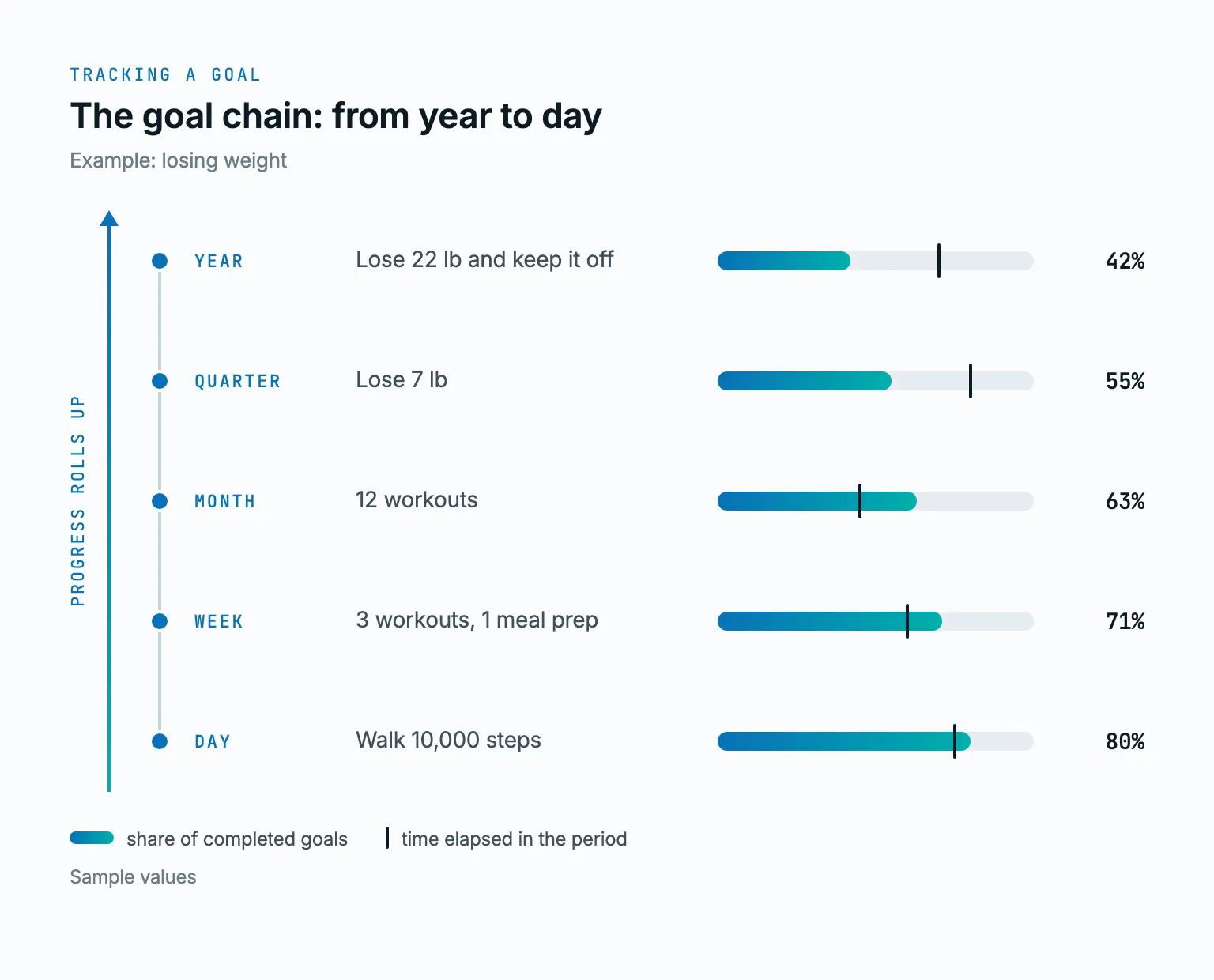
The chain for the health goal (Gaapp offers a goal pack that creates it in one step; the wording is this page’s example):
| Level | Goal | Period |
|---|---|---|
| Year | Lose 22 lb and keep it off | 2027 |
| Quarter | Lose 7 lb | Q1 2027 |
| Month | 12 workouts | January 2027 |
| Week | 3 workouts, 1 meal prep | week 2 |
| Day | Walk 10,000 steps | Monday, January 11, 2027 |
The math: 7 lb per quarter for three quarters, the fourth holds the weight. That makes 21 lb. For the full 22 lb, one quarter has to carry 8 lb, ideally the first. The same chain for the work goal, built from scratch:
| Level | Goal | Period |
|---|---|---|
| Year | Win three new clients worth at least $2,000 each | 2027 |
| Quarter | One contract for $2,000 is signed, twelve first conversations are held | Q1 2027 |
| Month | Hold four first conversations | January 2027 |
| Week | Ten first contacts by email or phone, follow up on one open proposal | week 2 |
| Day | Write to two contacts, answer Friday’s reply | Monday, January 11, 2027 |
Ten contacts a week are 40 a month. One reply in ten makes four first conversations a month, twelve a quarter. One contract in ten conversations lands the first client in the quarter; three quarters make three clients, the fourth is your buffer. After four weeks, check the rates and adjust the weekly number, not the yearly goal.
Achieving goals in this system means one step every week and one to three daily goals every day. You write the yearly goal at the top once, with the guide to annual planning. A goal counts as achieved when the measurable result is met on the target date, not when every task is checked off. You can complete 36 workouts and still weigh 203 lb. Then the plan was wrong, not the execution.
The 15-minute weekly check-in
The check-in decides whether you reach the goal, and it is the part most people drop after three weeks. So: fixed appointment, Sunday evening or Monday morning, on the calendar. Four questions, always the same:
- What was planned? Read last week’s three weekly goals without reinterpreting them.
- What got done? Checked off or not; “almost” does not count. Two of three is 67 percent, a good week.
- How much of the quarter has passed? At the end of week 6, the first quarter is half over. If the quarterly goal stands at 30 percent, the new week has to carry more.
- What are the three goals for the new week? Derived from the monthly goal, not from whatever is loudest, each with a day and a time: “Tuesday at noon, meal prep” instead of “cook something this week.”
The output of the check-in is adjusted weekly goals, not an adjusted yearly goal. If you renegotiate the yearly goal every week, you do not have one. The template, to copy into a notebook or a spreadsheet:
WEEKLY CHECK-IN, WEEK __ (Sunday, 7 p.m., 15 minutes)

Yearly goal:     ______________________________
Quarterly goal:  ______________________________

1. What was planned? (last week)          done?
   [ ] ______________________             yes / no
   [ ] ______________________             yes / no
   [ ] ______________________             yes / no

2. What got done?  Rate: __ of 3
   What slowed me down (one sentence): ______________________

3. How much of the quarter has passed?
   ____ % time vs. ____ % progress on the quarterly goal: on track / behind

4. Three goals for the new week (with day and time)
   [ ] ______________________  When: ____________
   [ ] ______________________  When: ____________
   [ ] ______________________  When: ____________
   Daily goal for tomorrow: ______________________
In Gaapp that is exactly the structure: every goal hangs on a bigger one. The week is called Week 38, the daily focus shows only today’s goals, and next to every progress bar sits the time elapsed. The check-in appointment lives in your own calendar, not in the app. The tool does not do the thinking for you. It only saves you the spreadsheet.
No app? Paper or a spreadsheet works: one page per week, or five tabs, one per level. What matters is the chain and the rhythm, not the tool.
The psychology of achieving goals: motivation, habits, setbacks
The psychology of achieving goals comes with plenty of “science-backed” claims and no footnotes. Here you get only what was studied. If you want to achieve your goals rather than admire them, start with Locke and Latham.
Motivation
Locke and Latham: difficult, specific goals motivate more than easy ones, as long as you commit to them. That contradicts the advice to set small goals so you can collect wins. The step should be small, not the goal.
Sheldon and Elliot (1999) add self-concordance: you pursue goals that fit your values more persistently and reach them more often than goals handed to you. Someone losing weight because the doctor said so quits sooner than someone who wants to keep up with the kids on the soccer field. No appetite for a goal at three check-ins in a row? It probably belongs to someone else.
Dai, Milkman and Riis (2014) describe the fresh start effect: temporal landmarks such as a new year, a new month, a Monday or a birthday raise your willingness to begin. That is why the boundaries in the goal chain are useful: Monday is a small January 1, and you get 52 of them a year. The effect covers starting, not sticking with it.
Habits
Phillippa Lally and colleagues (2010) measured how long it takes for a new behavior to run on autopilot. The median is 66 days, the range 18 to 254 days depending on person and behavior. For the goal chain that means a quarter is a good frame for a new habit: 13 weeks are 91 days.
Setbacks
Lally and colleagues also found that a single missed day did not measurably set back habit formation. The damage comes from the conclusion “well, that’s blown now.” Amabile and Kramer (2011, the progress principle) show with work diaries that visible small progress is the strongest motivator during the workday. A checked-off day is progress, and the chain shows it before the scale does.
Gabriele Oettingen (2014) extends if-then plans with WOOP: Wish, Outcome, Obstacle, Plan. Naming the obstacle in advance is the step almost everyone skips. Add one line “obstacle” to your quarterly goal: “If I work late on Tuesday, then the workout moves to Wednesday at 7 a.m.”
Common mistakes when setting and achieving goals
These are construction flaws, not character flaws, and they happen because most guides stop at setting the goal.
- Too many goals at once. Five yearly goals mean five chains, 15 weekly goals and a check-in that takes an hour and therefore never happens. Start with one; the second comes once the check-in has held for three months.
- A goal without a number and a date. “Exercise more” is as true on December 31 as on January 1. Without a number and a date you can neither fail nor win.
- Tasks instead of results. “Update the portfolio” is a task; “three inquiries a month through the website” is a result. Tasks belong at the week and day level, results at the year and quarter level.
- No fixed time for the review. A check-in that happens when there is time does not happen. A fixed slot on the calendar.
- A yearly goal without a weekly step. The yearly goal sits on a sticky note in January and on the same sticky note in December. In between, no chain.
- Switching methods instead of keeping the rhythm. Six weeks of SMART, then OKR, then the 12 Week Year, and each time habit formation restarts at day one. The method was rarely the problem, the skipped appointment was.
- Quitting after the first setback. One slip costs nothing; deciding to turn it into a lost week does.
- Putting the tool before the method. First the app search, then the template, then a better notebook. If you will not start on paper, you will not start in the app.
Recognizing yourself in three of these is normal. Fix only the most expensive one; usually it is the missing appointment.
FAQ: how to achieve goals
How can I achieve my goals in life?
By treating it as a system rather than a moment of resolve. Pick one goal that is yours and write it with a starting value, a target value and a date. Then break it down into a chain from the year to the quarter, the month, the week and today. Then review it once a week for 15 minutes: what was planned, what got done, how much time has passed, what are the three goals for the new week. Setting a goal takes an hour. Achieving it takes the other 51 weeks, and those need the chain and the check-in, not more motivation.
What are the 5 steps for achieving your goals?
The five steps on this page: choose one goal, write it with numbers (starting value, target value, date), and break it down to the week. Then act on it daily with one to three daily goals and review it weekly for 15 minutes. Steps one and two are what most guides cover. Steps three to five are where goals are actually won. They are the reason this page is built around the goal chain and the weekly check-in rather than a list of tips.
What are the 5 SMART goals?
SMART is not five goals but five criteria for one goal: Specific, Measurable, Achievable, Relevant and Time-bound. In George T. Doran’s original from 1981 the letters stood for Specific, Measurable, Assignable, Realistic and Time-related; the version with Achievable and Relevant is the one in common use today. A goal that meets all five is “from 203 lb to 181 lb by September 30, 2027,” not “lose weight.” Worked examples for work, health, money and learning are in SMART goals examples. What SMART does not cover is the path, and that is what the goal chain adds.
What is the 3 goal rule?
There is no single definition. The most common version of the rule says: limit yourself to three outcomes per period, three for the day, three for the week, three for the month, three for the year. Everything beyond that is a bonus, not a commitment. The goal chain follows the same logic at the bottom: one to three daily goals a day and three weekly goals a week, each derived from the level above. The number three is not magic. It is simply small enough that you can still review it in 15 minutes.
How many goals should I work on at once?
One to start: a single yearly goal with a complete chain down to the day. If you keep that going for three months, raise it to two or three. More than three yearly goals rarely survive the weekly check-in, because three chains already add up to as many as nine weekly goals a week. If you keep the chains in an app, you find the same tiers in Gaapp.io. Free covers one yearly goal, Pro three yearly goals at €15 a month with a 14-day free trial, see Pricing. The limit is a recommendation, not a rule.
Which app helps you achieve your goals?
Any goal setting app that maps the chain from the year down to the day, shows elapsed time next to progress and gets you into a weekly rhythm. A calendar and a spreadsheet can do that too. Gaapp.io tracks goals from the year down to the day on these five levels, and you can start for free with one yearly goal. There is no separate field for key results. You set up an OKR as a quarterly goal with monthly goals underneath and write the starting and target values into the title, for example “Inquiries 2 to 6.”
Read next
- Methods
SMART Goals Examples: Eight Goals for Work and Life, With a Step-by-Step Method
Eight written-out SMART goals with real numbers, the five criteria explained simply, a five-step method, exercises, and the way from a yearly goal to today's step.
- Leadership & Teams
OKR Framework: Examples, Template and Criticism
The OKR framework explained: OKR meaning, objectives and key results, the cycle, scoring, seven examples for work and life, criticism, and a template.
- Methods
How the 12 Week Year Works, and How to Run Your First One
The 12 week year explained in plain words: what it is, why 12 weeks beat 12 months, an eight-step plan with a copyable weekly sheet, six examples with numbers, the common mistakes and how it fits your annual plan.
- Methods
Annual Planning: A Guide for One Person, With Template and Examples
Three to five yearly goals, broken down to the week. For one person, not a corporation.