OKR Framework: Examples, Template and Criticism
The OKR framework explained: OKR meaning, objectives and key results, the cycle, scoring, seven examples for work and life, criticism, and a template.

Contents
- 01What is OKR?
- 02The OKR framework explained: the cycle
- 03Where OKRs come from
- 04Doerr’s four superpowers: why the OKR methodology works
- 05How to write OKRs
- 06OKR examples: seven objectives with key results
- 07OKR vs KPI, SMART goals, and the goal chain: what is the difference?
- 08Criticism of the OKR framework and common mistakes
- 09OKRs for individuals: the goal chain from year to day
- 10OKR template
- 11Frequently asked questions about OKRs
The OKR framework is a way of setting goals. You describe in one sentence where you want to go, and you pick two to five numbers that tell you whether you got there. OKR stands for Objectives and Key Results. The framework comes from companies but works just as well for one person with a quarter ahead of them.
This article explains the OKR framework with one example that runs all the way through: Lena, a freelance designer, planning her fourth quarter. You also get seven OKR examples for work and personal life, how OKRs differ from KPIs and SMART goals, the criticism, a template, and an honest answer to when OKRs are the wrong tool for one person.
What is OKR?
OKR is short for Objectives and Key Results. That is the full meaning of the acronym, and an OKR has two parts.
- Objective, the goal. One qualitative sentence that describes a direction and that you stand behind. It contains no number.
- Key Results, the measures. Two to five metrics with a starting value and a target value that tell you whether the objective is reached.
Lena has been a freelance designer for three years. She has many small jobs and never knows what the next quarter brings. Her objective for the fourth quarter: I build a predictable pipeline of work from clients I want. The key results make that checkable.
- Revenue share from projects over $5,000 rises from 20 to 50 percent.
- Inquiries through her own website rise from 1 to 3 per month.
- Two clients pay a monthly retainer instead of per project. Today it is zero.
“Update the portfolio” is not on the list. That is a task, and tasks come later, in the weekly plan. An OKR describes the result, not the route.
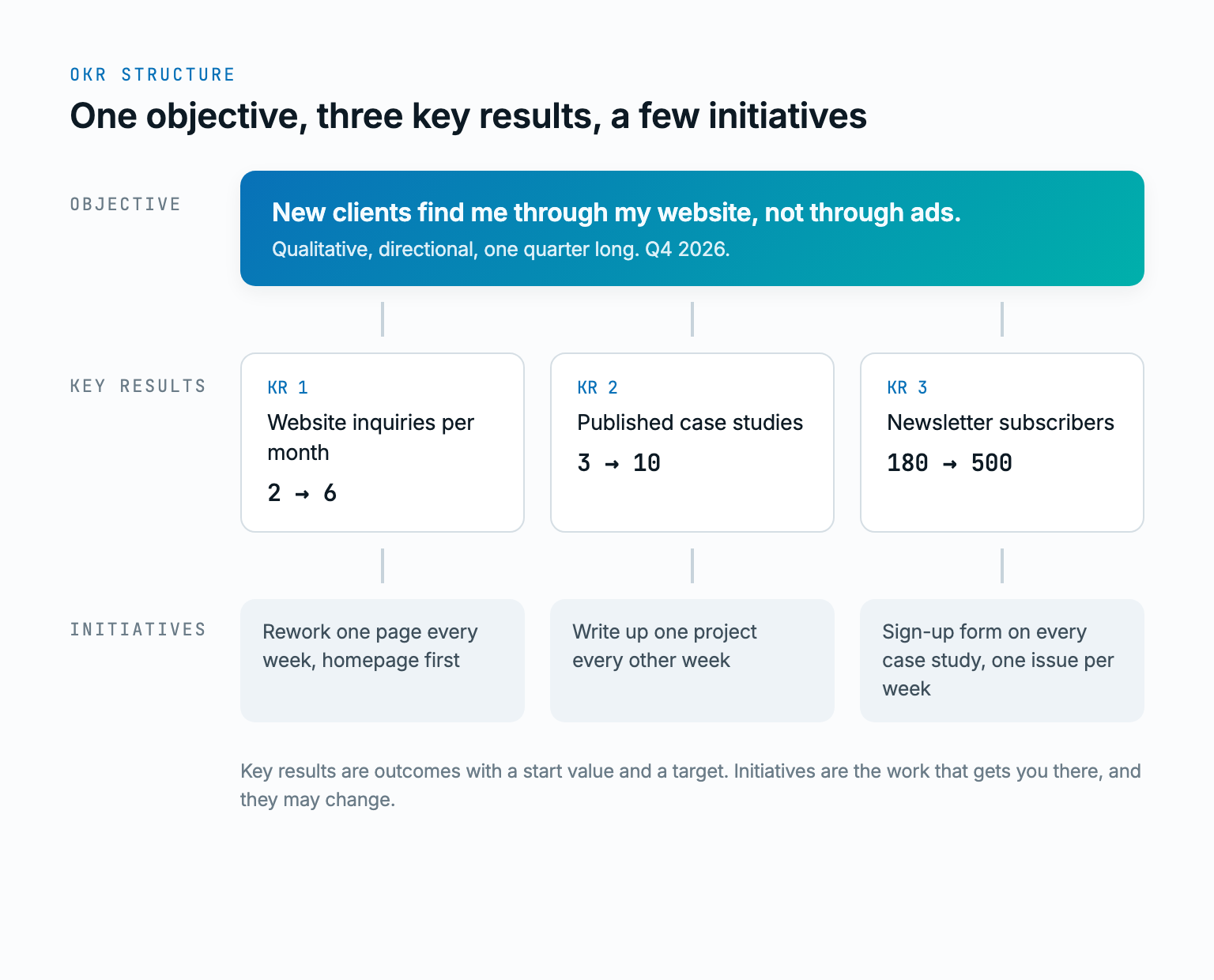
The OKR framework explained: the cycle
The framework is a loop with a fixed rhythm, usually a quarter. Three months is long enough to change something and short enough to correct a mistake. The 12 Week Year works with almost the same length for the same reason.
- Set. At the start of the quarter, write one to three objectives with their key results, each with a starting value. Lena has one. That is enough.
- Check in. Once a week you enter the current value for each key result. A short update, not a meeting.
- Score. At the end of the quarter each key result gets a number between 0 and 1.0.
- Reflect and reset. What moved the number, what did not, and what do you take from it? Then the next cycle starts with new or adjusted OKRs.
Scoring has a formula. Value reached minus starting value, divided by target minus starting value. Lena ends the quarter at 40 percent instead of 50. From 20 to 40 is 20 of 30 points, so 0.67. Divide 40 by 50 instead and you get 0.8, grading yourself too well.
A 0.7 counts as good on ambitious goals. At Google, where the method became known, 0.6 to 0.7 on demanding OKRs counts as success. If you hit 1.0 every time, you aimed too low. That is why the framework separates two kinds of OKRs.
- Committed OKRs are binding, and 1.0 is expected. For Lena that would be a key result like “Quarterly revenue is at least $15,000.” A result with a number, not a checkbox.
- Aspirational OKRs are stretch goals. They describe what is possible if a lot goes right, and 0.7 is a good outcome. Lena’s objective is aspirational. Two retainer clients in three months is ambitious. Winning one is progress, not failure. One of each kind per quarter is a good start.
Where OKRs come from
Andy Grove developed the method at Intel in the 1970s out of Management by Objectives. John Doerr, an investor at Kleiner Perkins, brought it to Google in 1999. In 2018 he described it in the book “Measure What Matters.” It is the one book on the OKR methodology, but it is about companies.
Doerr’s four superpowers: why the OKR methodology works
Search for the pillars of OKR and you find a different list in every source. The best-known version is John Doerr’s, who describes four “superpowers” in his book. They do not explain how an OKR is built. They explain why the method works.
- Focus. Few goals instead of many. Lena could also rebuild her website this quarter and start a course. She does not.
- Alignment. All goals point in the same direction. In a team, the department’s objective rolls up to the company’s objective. For Lena, the quarterly goal rolls up to her yearly goal.
- Tracking. The weekly check-in. Without it, OKRs are a resolution. With it, they are a measurement.
- Stretching. Goals that hang a little higher than is comfortable. That is why 0.7 counts as good and not as a miss.
How to write OKRs
The framework is simple, but the wording decides whether it works. Six rules have proven themselves.
- Few objectives. One person has one to three, a team three to five.
- Key results are results, not tasks. “Send the newsletter” is a task. “Open rate from 28 to 35 percent” is a key result. Ask whether you could check it off without anything having changed.
- Measurable, with a starting value and a target value. “More inquiries” is not a key result. “From 1 to 3 inquiries per month” is.
- Ambitious. If you are sure while writing it down that you will make it, raise the target.
- Public. In a team, everyone sees everyone’s OKRs. On your own, show your goals to at least one person who will ask about them in week six.
- Short cycle. A quarter, or a month for small goals. A year is too long, because you feel no pressure for eleven months.
John Doerr’s formula
“I will (Objective) as measured by (Key Results).” For Lena: I will build a predictable pipeline of work from clients I want, as measured by a 50 percent revenue share from projects over $5,000, 3 website inquiries per month, and 2 retainer clients.
| Task (not this) | Key result (this) |
|---|---|
| Update the portfolio | Website inquiries from 1 to 3 per month |
| Run three times a week | Longest run without stopping from 3 to 9 miles |
| Record an onboarding video | Users who reach step 3 of onboarding from 41 to 70 percent |

OKR examples: seven objectives with key results
Four examples from work, three personal, each for one quarter. The numbers are orders of magnitude, not targets to copy. The sales rep row is an OKR example for an individual employee: the objective rolls up to the team’s objective, and the key results are the rep’s own share of the team’s numbers.
| Area | Objective | Key results |
|---|---|---|
| Marketing | Our blog becomes the most important source of new leads. | Organic visitors per month from 4,000 to 8,000. Newsletter signups per month from 60 to 150. Share of leads from the blog from 10 to 25 percent. |
| Sales (team) | New customers decide faster. | Days from first call to signature from 46 to 30. Proposals that turn into deals from 25 to 40 percent. First calls per week from 12 to 24. |
| Sales rep | My proposals win after the first call. | Proposals sent within 48 hours from 40 to 90 percent. My close rate from 20 to 35 percent. My first calls per week from 3 to 6. |
| Freelancer (Lena) | I build a predictable pipeline of work from clients I want. | Revenue share from projects over $5,000 from 20 to 50 percent. Website inquiries from 1 to 3 per month. Retainer clients from 0 to 2. |
| Health | I am fit enough for a week of hiking in the Rockies. | Longest hike in one go from 5 to 12 miles. Training sessions per week from 0 to 3. Elevation gain in a single day from 1,000 to 3,000 feet. |
| Money | I have my spending under control and a cushion in the bank. | Emergency fund from $800 to $2,000. Fixed monthly savings from $0 to $400. Active subscriptions from 9 to 4. |
| Learning | I can get by in Spanish in everyday situations. | Active vocabulary from 200 to 800 words. Conversations with native speakers from 0 to 12 in the quarter. Placement test level from A1 to A2. |
Personal OKRs
Personal OKRs follow the same rules, but the traps are different. Nobody measures a starting value in private life, so the first step is often a measurement. One objective per quarter is enough alongside a job and a family. Pick key results you can look up in a minute: miles on your watch, the balance in your banking app. A habit like training three times a week can be a key result if a second one measures the outcome, here the 12 miles in one go.
OKR vs KPI, SMART goals, and the goal chain: what is the difference?
OKR vs KPI
A KPI is a key performance indicator. It measures the ongoing state of something and has no end date. An OKR describes a change with an end date, from 20 to 50 percent by the end of December. A KPI becomes a key result the moment it is supposed to change. Lena’s revenue share from large projects is a KPI all year; this quarter it is a key result. The KPI is the thermometer, the OKR is the decision to change the temperature.
OKR vs SMART goals
SMART is a checklist for a single goal, which should be specific, measurable, achievable, relevant, and time-bound. OKR is a framework that connects several goals across a cycle and scores them. A good key result is almost always SMART. But SMART says nothing about how many goals you should have. On one point they contradict each other. SMART demands “achievable.” An aspirational OKR is deliberately not.
OKR vs the goal chain
A goal chain connects time horizons, from the year through quarter, month, and week down to the day, and every smaller goal has exactly one larger goal above it. OKR describes a single link in that chain, the quarter. The goal chain asks what your yearly goal means today. OKR asks how you will know this quarter was a success.
Criticism of the OKR framework and common mistakes
The criticism is justified. Most problems, though, come not from the method but from how it is used.
- Too many OKRs. Five objectives with five key results each is 25 numbers. The method depends on leaving things out, and that is the part most people skip.
- Key results as a to-do list. “Redesign the website, set up the newsletter, write three posts” under an objective is a project plan. At the end everything is done and nothing has changed.
- OKRs tied to pay or bonus. Reward a 1.0 and people set goals they are sure to hit. The 0.7 becomes a bad grade instead of an honest report. Doerr himself advises against it. On your own, that means not punishing yourself for a 0.6.
- A quarterly rhythm for everything. Some goals take two weeks, some take two years. A move or a degree does not fit into three months. Then the quarter is a milestone, not the frame.
- Tool before method. Software with an OKR feature does not turn bad goals into good ones. If the method does not work for you on paper, it will not work in an app.
One more fundamental objection. OKRs were designed for organizations with hundreds of people. Alignment rounds, cascading, and scoring meetings solve problems an individual does not have. On your own, you drop that part. What remains is smaller, but usable.
OKRs for individuals: the goal chain from year to day
Almost every guide explains OKRs for companies. For one person, OKRs fit when the goal can be put into numbers without the number bending it, when you want to change something rather than keep it, and when you will spend fifteen minutes on it once a week. They do not fit habits, where a habit tracker is enough, or “be a better father,” where you would optimize a proxy instead of the goal. If you already know the weekly check will not happen, a goal chain without scoring is the better tool.
Five steps from a yearly goal to today’s action
What the OKR literature lacks is the connection up to the year and down to the month, week, and day. That connection is the goal chain. Each level answers what the level above it means right now.
- Year = direction. One sentence, no number, and it does not get scored. Lena: “I make my living from a few good clients who refer me.”
- Quarter = objective and key results. From the yearly goal, derive the one thing that moves it most in these three months. For Lena that is the predictable pipeline, not the website, not the course. Add three key results with a measured starting value, not an estimate, and a target where 0.7 would already be good.
- Month = checkpoint. For each number, write down where it should stand at the end of the month. For Lena: 30 percent revenue share, 2 inquiries, and one retainer conversation by the end of October. After four weeks you know whether the pace is enough.
- Week = initiatives. Only here do tasks show up. An initiative is an action meant to move a key result, two or three per week. In week one, Lena asks three existing clients about a retainer and publishes a case study. A weekly review then checks what happened to the numbers. It separates activity from progress. If a number did not move, the initiative was wrong, not the goal. Give the review a fixed slot.
- Day = one action. The weekly initiative becomes one concrete step for today. On Monday, an email to the first existing client. A yearly goal rarely fails for lack of will. It fails because on Monday morning nobody knows what it means today. The article on daily goals shows how to pick that step.
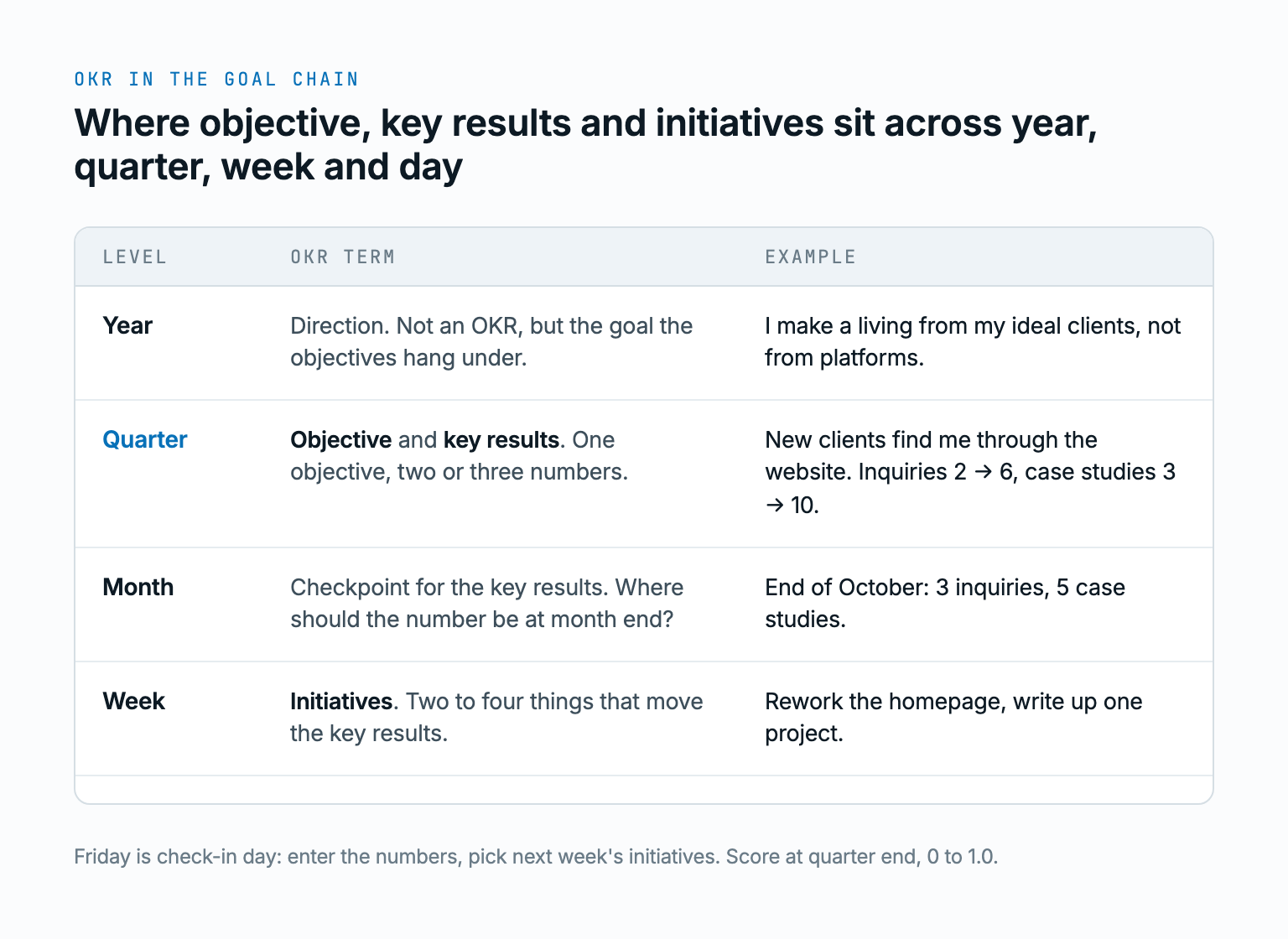
Now every goal rolls up to exactly one larger goal, and that works on paper. If you would rather keep the chain in an app, Gaapp is built for it. Every goal there has exactly one larger goal above it, the weekly review asks where your key results stand, and spaces group goals for you alone, as a couple, a family, or a team.
OKR template
You do not need a blank page to start. The OKR template holds a yearly goal, one objective with three key results (starting value, target, current status), the committed or aspirational label, the weekly initiatives, and the review. It opens in Gaapp, and the structure works on paper too. Enter Lena’s example first, then your own quarter.
Frequently asked questions about OKRs
What does OKR mean?
OKR stands for Objectives and Key Results. The objective is a qualitative sentence that describes a direction. The key results are two to five measurable values with a starting value and a target value that tell you whether the objective has been reached.
What are the four pillars of the OKR framework?
There is no fixed definition, and the lists differ by source. Most often the phrase refers to the four superpowers John Doerr describes in “Measure What Matters”: focus, alignment, tracking, and stretching. They explain why the method works, not how it is built. For an individual, focus and tracking carry the most weight day to day.
What is the difference between OKR and KPI?
A KPI measures an ongoing state, such as revenue per month, and has no end date. An OKR describes a change within a fixed period, such as from 20 to 50 percent by the end of the quarter. A KPI becomes a key result as soon as it is supposed to change within that period.
How long is an OKR cycle?
The usual cycle is a quarter, about 13 weeks. Within the quarter there is a weekly check-in, and at the end a score from 0 to 1.0 and a retrospective. For small goals, many individuals work in monthly cycles. A year as the only cycle is too long, because the pressure only shows up in the last month.
How many OKRs should I have?
For one person, one to three objectives per quarter is enough, and one with three key results to start. A team gets by with three to five objectives. More goals spread your attention, and that is exactly what the method is meant to prevent.
Do OKRs work without a team?
Yes, with two adjustments. You drop the part of the method that aligns people with each other, such as alignment rounds and cascading. You keep the part that creates focus and weekly tracking and place it inside a goal chain from year to day. You replace the visibility of a team by telling a second person about your OKRs.
Read next
 Leadership & Teams
Leadership Styles: Which One Fits Which Situation
Leadership styles are not personality types: 11 types compared, Lewin, Goleman, situational leadership and five steps to find the style that fits you.
14 min read
 Leadership & Teams
Retrospective: How Teams Learn From Every Sprint
A retrospective is not a blame session: what the word means, five phases, seven retrospective examples and action items that stick, shown on one team.
16 min read
 Leadership & Teams
How to Delegate Tasks: Hand Off Work, Keep Results
Delegation is not dumping work: five levels of delegation, seven steps, a handoff script and what to keep, shown on one marketing team.
15 min read