OKR Template for One Quarter: Objective, Key Results, Weekly Check-in
One objective, three key results with starting and target values, initiatives per week, a weekly check-in, and a 0 to 1.0 score at the end of the quarter. Filled in with an example, blank to copy. Free.

This free OKR template is built for one person and one quarter. It appears here twice: filled in with Lena’s fourth quarter, and blank as a text block to copy. With its weekly check-in and end-of-quarter score it doubles as an OKR tracker template; for the method itself, read How the OKR framework works.
What the OKR template includes
- Yearly goal. One sentence as direction, no number. Not scored, but the quarter sits under it.
- One objective for the quarter. Qualitative, no number, marked committed (1.0 expected) or aspirational (0.7 is good).
- Three key results. Each with start, target, and current status.
- Monthly checkpoint. Where each key result should stand at the end of the first month.
- Initiatives per week. Two or three actions to move a key result, each with its KR number.
- Weekly check-in. Date, current value per key result, one line on what moved the number.
- End-of-quarter score. 0 to 1.0 per key result, the average, the formula underneath.
Why three key results and not five? In “Measure What Matters” (2018), John Doerr recommends three to five per objective. For one person, three numbers are enough; a fourth splits your attention.
How to use the OKR tracker template in five steps
Enter the yearly goal as your direction
One sentence, no number. No yearly goal yet? Start with [annual planning](/en/annual-planning).
Derive one objective for the quarter
The one thing that moves the yearly goal furthest in three months. One sentence, no number.
Set three key results with start and target
Measure the starting value; do not estimate it. Pick a target where 0.7 would already be good, and check committed or aspirational. Key results usually read like [SMART goals examples](/en/smart-goals-examples).
Enter weekly initiatives and schedule the check-in
Two or three actions per week, each with a KR number. The check-in is a fixed slot, fifteen minutes a week. The Monday action is one of your [daily goals](/en/daily-goals).
Score at the end of the quarter
Value reached minus start, divided by target minus start. Then a three-line review: What worked? What did not? What changes? After that, the next objective.
Filled-in example: Lena’s fourth quarter
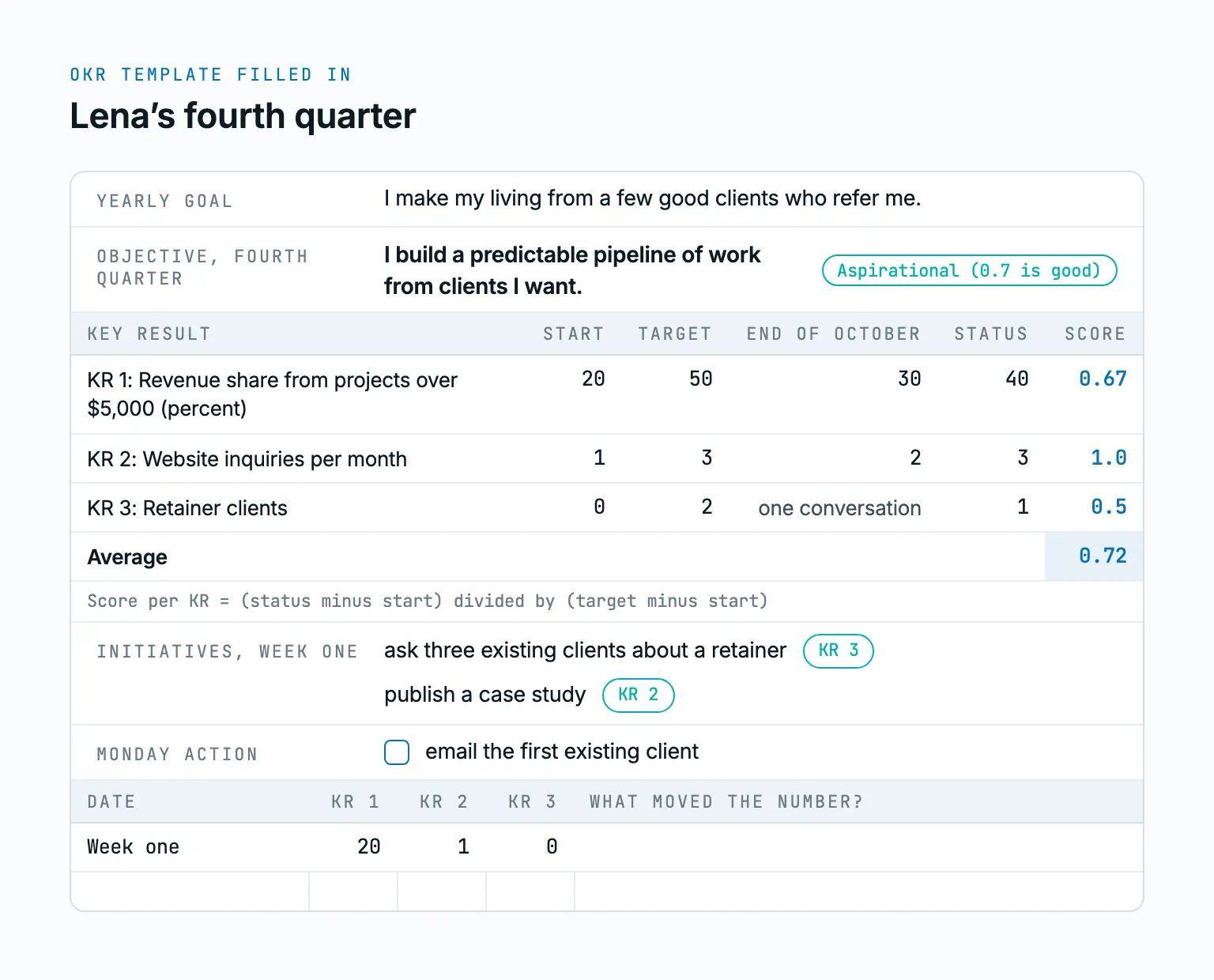
Lena is a freelance designer from the OKR article. Yearly goal: “I make my living from a few good clients who refer me.” Fourth-quarter objective, marked aspirational: “I build a predictable pipeline of work from clients I want.”
| Key result | Start | Target | End of October | Status | Score |
|---|---|---|---|---|---|
| KR 1: Revenue share from projects over $5,000 (percent) | 20 | 50 | 30 | 40 | 0.67 |
| KR 2: Website inquiries per month | 1 | 3 | 2 | 3 | 1.0 |
| KR 3: Retainer clients | 0 | 2 | one conversation | 1 | 0.5 |
| Average | 0.72 |
Week one, the first full week of October: ask three existing clients about a retainer (KR 3), publish a case study (KR 2). Monday action: email the first existing client.
The math: KR 1: 40 minus 20, divided by 50 minus 20, so 0.67. KR 2: 3 minus 1, divided by 3 minus 1, so 1.0. KR 3: 1 minus 0, divided by 2 minus 0, so 0.5. Average 0.72. Google’s re:Work guide “Set goals with OKRs” puts the sweet spot at 0.6 to 0.7; for aspirational OKRs that is the explicit rule in Doerr 2018, while committed OKRs are expected to reach 1.0. So 0.72 is a good quarter. The trap: 40 divided by 50 gives 0.8 and grades you too well.
Who this template is for
Freelancers and solo founders
One quarterly goal that moves revenue, inquiries, or client mix, like Lena’s. The starting value is in your books.
Employees with their own OKR
Your objective sits under the team OKR; your key results are your share of its numbers.
Personal goals
Health, money, learning. Nobody measures a starting value outside of work, so step one is often measuring. See [seven OKR examples](/en/blog/okr-framework).
The template does not fit habits or goals without a number. “Run three times a week” is a habit; “be a better dad” cannot be forced into a score. In that case, a simple goal chain without scoring is the better tool. Common mistakes: key results written as tasks, several objectives in the first quarter, no measured starting value. The 12 Week Year has the same rhythm with different words.
OKR template in Excel, Google Sheets, or Notion?
A spreadsheet is enough if you run one objective, enter the numbers yourself, and keep the weekly check-in in your own calendar. The text template below transfers line by line and works as an OKR Google Sheet template. There are plenty of OKR templates for Excel, Sheets, Miro, Confluence, or Notion; most are built for teams.
It stops being enough when the quarter should link up to a yearly goal and down to weeks and days, when you want progress per period, or when you plan together in one space. Notion can link databases but takes setup. Word, PowerPoint, and PDF are for showing, not for keeping the numbers.
YEARLY GOAL (direction, one sentence, no number):
...

QUARTER: Q_ 20__        Type: [ ] Committed (1.0 expected)  [ ] Aspirational (0.7 is good)
OBJECTIVE (one sentence, no number):
...

KEY RESULTS            Start     Target    End of month 1   Status    Score
KR 1: ...              ____      ____      ____             ____      _.__
KR 2: ...              ____      ____      ____             ____      _.__
KR 3: ...              ____      ____      ____             ____      _.__
Average:                                                              _.__

INITIATIVES PER WEEK (two or three actions, one line each, with KR number)
Week __: ...
Week __: ...

WEEKLY CHECK-IN (one line per week)
Date | KR 1 | KR 2 | KR 3 | What moved the number?

END-OF-QUARTER SCORE
Score per KR = (status minus start) divided by (target minus start)
Review (three lines): What worked? What did not? What changes next quarter?
In Gaapp, the chain year, quarter, month, week, day is already in place. The goal pack “OKR quarter” uses it like this:
- Year: yearly goal as direction.
- Quarter: objective as the quarterly goal.
- Month: key results as one monthly goal with start and target in the title (for example “Inquiries 2 to 6”), renewed each month with the next checkpoint.
- Week: initiatives as the weekly goal.
- Day: Monday’s action as a daily goal.
The pack ships with its own example, currently in German; you replace it with your numbers. There is no key result field and no number entry per goal: you write the status into the title at each check-in; progress comes from checking goals off. More under OKR software for individuals.
Frequently asked questions about the OKR template
What are the 5 elements of OKR?
There is no fixed list of five; sources count differently. Many templates list objective, key results, owner, status, and progress. For one person, owner and status drop out, and three other things matter instead: a measured starting value per key result, a time box of one quarter, and a weekly check-in. A complete OKR has an objective, two to five key results with start and target, that time box, the check-in, and a score at the end.
What is a good OKR example?
Lena’s quarter on this page: objective “I build a predictable pipeline of work from clients I want.” Measured by three numbers: a revenue share from projects over $5,000 rising from 20 to 50 percent, website inquiries from 1 to 3 per month, and retainer clients from 0 to 2. It is good because every number has a measured starting value and the objective has no number in it. Seven OKR examples for work and personal life are in the article on the framework.
What are common OKR mistakes?
Key results written as tasks (“update the portfolio” instead of “website inquiries from 1 to 3 per month”). Then too many objectives in the first quarter, a starting value that was estimated instead of measured, and a check-in without a fixed slot on the calendar. One more from the scoring: dividing the value reached by the target instead of subtracting the start first, which grades you too well. John Doerr also advises against tying OKRs to pay or bonuses.
What is the best OKR tool?
The one whose weekly check-in you actually keep. For a team, tools such as Confluence, Asana, Smartsheet, Miro, Leapsome, or Airtable offer OKR templates built for several departments. For one person, a spreadsheet works as long as one objective is all you run; once the quarter should connect to a yearly goal and to your weeks, a goal chain does the job better. See OKR software for individuals.
Is there an OKR template for Excel or Google Sheets?
Yes. Copy the text template above into a sheet, one line per row, and you have an OKR template in Excel or Google Sheets. It works as long as you run one objective and keep the check-in in your own calendar. When you want the quarter linked to a yearly goal and to your weeks, or progress per period, the sheet becomes a workaround you have to maintain.
How many key results should the template have?
Three, and that is how the template is built; why not five is explained above in the section on what the template includes. If a fourth number matters, swap it for one of the three instead of adding it. For objectives: one to three per quarter, one to start.