Contents
- What are SMART goals? The five criteria, explained simply
- Why SMART goals work (and what they leave out)
- How to write SMART goals in five steps
- SMART goals examples for work and life: eight written-out goals
- Common mistakes with SMART goals
- SMART goals vs. OKRs, the 12 Week Year, and the goal chain
- SMART goals in the goal chain: from the year to today
- Frequently asked questions about SMART goals
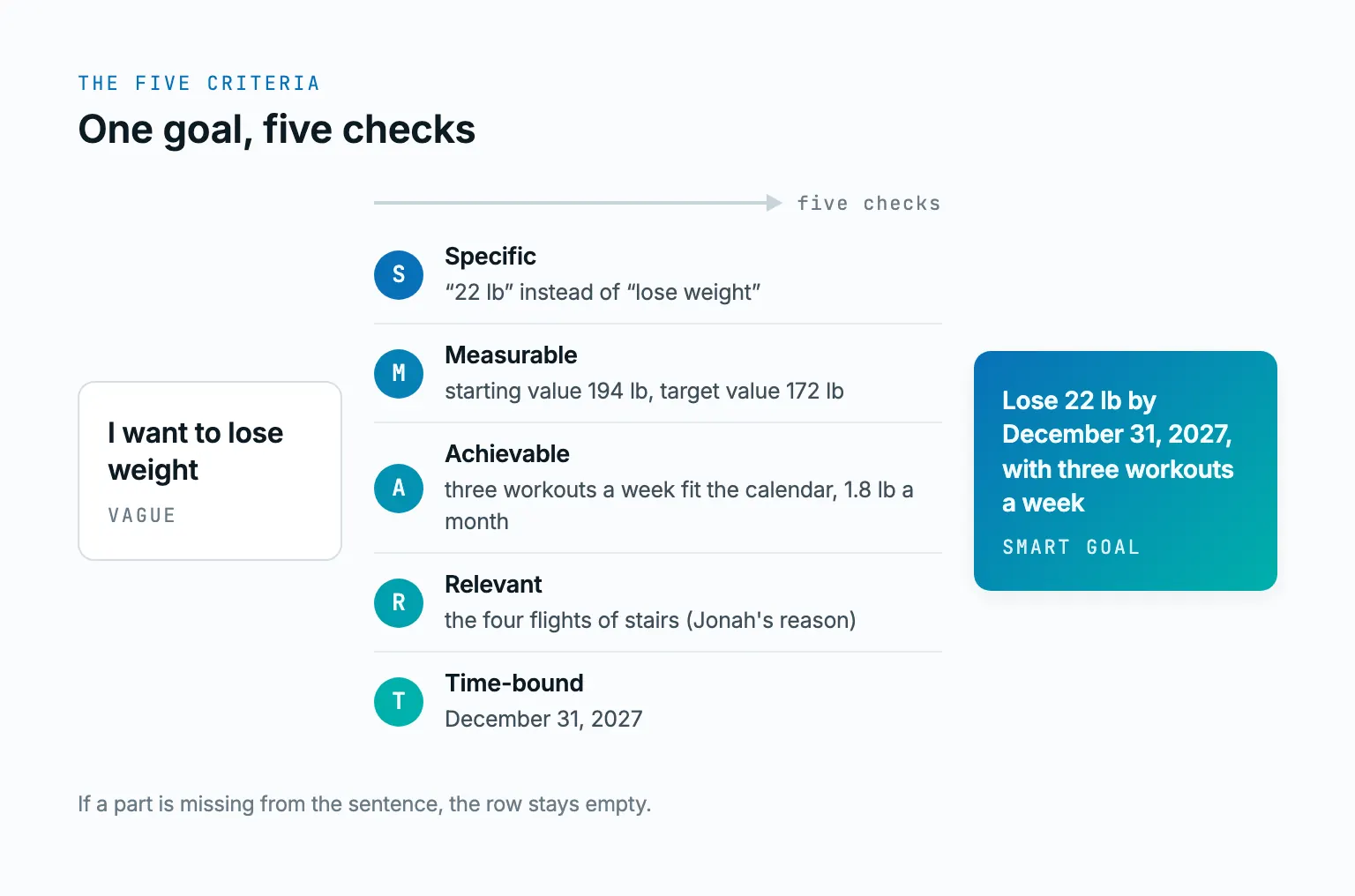
SMART goals examples are everywhere online, and almost all of them stop at the finished sentence. A SMART goal is specific, measurable, achievable, relevant, and time-bound: “I want to lose weight” becomes “Lose 22 lb by December 31, 2027, with three workouts a week.” Here you get eight written-out SMART goal examples for work and life, a five-step method, three exercises, and the part others skip: the way from a yearly goal to today.

What are SMART goals? The five criteria, explained simply
SMART is a memory aid: each letter is one check on a goal. If you searched for “the 5 SMART goals,” you are not looking for five goals but for the five criteria of a single goal. One example runs through the page: Jonah weighs 194 lb and wants to get to 172 lb in twelve months, starting January 1, 2027.
- S for Specific. What exactly should be different at the end? “Lose weight” is a direction; “22 lb lighter” is a result.
- M for Measurable. A number with a starting value and a target value: from 194 to 172 lb.
- A for Achievable. Does the effort fit your life? 22 lb in twelve months is 1.8 lb a month, and three workouts a week fit Jonah's calendar. Some sources say Attainable.
- R for Relevant. Does it matter to you? Jonah wants to climb the four flights to his apartment without stopping; the goal is his, not his doctor's.
- T for Time-bound. By when? A date, not “soon”: December 31, 2027.
Five short examples that pass all five checks: lose 22 lb by December 31, 2027 (194 to 172 lb); save $3,000 by December 31, 2027 ($250 a month); grow quarterly revenue from $40,000 to $50,000 by March 31, 2027; take Spanish from A1 to A2 by December 31, 2027; read twelve books by December 31, 2027.
The acronym comes from George T. Doran, published in Management Review in November 1981 as “There's a S.M.A.R.T. way to write management's goals and objectives.” Doran's letters stood for Specific, Measurable, Assignable, Realistic, and Time-related; Assignable meant it is clear who owns the goal. Today's common reading, Specific, Measurable, Achievable, Relevant, Time-bound, has no single author. Often forgotten: Doran wrote that not every goal has to meet all five criteria. SMART is a checklist, not a law.
Why SMART goals work (and what they leave out)
Edwin A. Locke and Gary P. Latham studied whether clear goals beat good intentions: in 1990 in “A Theory of Goal Setting and Task Performance,” and in 2002 in American Psychologist. The core finding: specific and challenging goals produce better performance than vague goals or “do your best.” The conditions: you are committed, get feedback, and have the ability to reach them. Applied to SMART: S and M provide the specificity, T the deadline, and the starting value is what makes feedback possible.
What SMART does not give you is the next step. Peter M. Gollwitzer described if-then plans in 1999 in American Psychologist, called implementation intentions: “If I unlock my apartment door at 6 p.m. on Wednesday, I put on my running shoes.” In 2006 Gollwitzer and Sheeran reviewed 94 studies in a meta-analysis and found a medium to large effect. SMART phrases the goal; the if-then plan phrases the step.
How to write SMART goals in five steps
The fastest way to write a SMART goal is a fixed order: one letter per step, each answer one part of the sentence.
Name the result (Specific)
Write down the result, not the activity: not “work out more,” but “be 22 lb lighter.”
Set a starting value and a target value (Measurable)
Measure the starting value, do not guess it. Jonah weighs himself on three mornings and takes the average, 194 lb. Target value: 172 lb.
Check the effort against the time (Achievable)
Divide the distance by the time. 22 lb in twelve months is 1.8 lb a month, doable; 22 lb in eight weeks would be 2.75 lb a week, a crash diet. With money: saving $3,000 by December 31 means $250 a month or $58 a week. If $250 is more than 10 percent of your take-home pay, cut the number or extend the date.
Check whether you want it and whether it fits (Relevant)
Would you still chase this goal if nobody was watching? Does it fit next to your other goals for the year? Jonah has his reason, the stairs, and his contribution: one hour each on Monday, Wednesday, and Saturday.
Set a date (Time-bound)
Pick a calendar date and count from the month you start. Jonah starts on January 1, 2027, and sets December 31, 2027, as the deadline; start in September and the deadline moves into the next year. Add an interim date: by March 31, 2027, 7 lb should be gone.
I will [result with a number] by [date] by [action per week or day].
All five answers add up to this sentence. Its third part, the action per week or day, is the part you control: you cannot decide your weight, but you can decide the three workouts.
The weekly check in three lines
Every Sunday, five minutes. First: today's number (say 190.5 lb). Second: actions done (two of three workouts, one of one meal prep). Third: one sentence on what changes next week (move the Monday session to Tuesday because of late office days on Mondays).
Exercises: turn three vague goals into SMART goals
You learn to write SMART goals fastest by doing it. Three vague goals from a New Year's list: cover the right column, write your own version with the formula, and compare.
| Vague goal | Solution with the formula |
|---|---|
| Get fit | I will run 3 miles in 30 minutes (today 38) by June 30, 2027, by running three times a week. |
| Get better with money | I will have a $3,000 emergency fund (today $0) by December 31, 2027, by transferring $250 automatically each month. |
| Grow in my job | I will pass the PMP exam (today not registered) by September 30, 2027, by studying 90 minutes on Tuesdays and Thursdays. |
Every good goal statement has a number with a start and a target, a date, and a rhythm; if one is missing, the sentence is an intention. The third exercise shows a limit of the method: someone else decides about a promotion, you decide about the exam. When a goal depends on other people, phrase the part you control.
SMART goals examples for work and life: eight written-out goals
Four examples from work, four from life. Every row starts vague and becomes a SMART goal with start, target, deadline, and action. These examples of SMART goals are meant to be copied: swap in your numbers, not the structure.
| Area | Vague version | SMART goal | Start → Target | Deadline |
|---|---|---|---|---|
| Sales | “sell more” | Grow quarterly revenue from $40,000 to $50,000 by March 31, 2027, by booking ten discovery calls a week | $40,000 → $50,000 | March 31, 2027 |
| Marketing | “improve the newsletter” | Raise the open rate from 28% to 35% by June 30, 2027, by testing one subject line per issue | 28% → 35% | June 30, 2027 |
| HR | “speed up hiring” | Cut time-to-hire from 45 to 30 days by March 31, 2027, with a two-interview process from February | 45 → 30 days | March 31, 2027 |
| Teaching | “involve parents more” | Hold a progress meeting with all 20 families in my class by June 30, 2027, two a month from September | 0 → 20 meetings | June 30, 2027 |
| Health | “lose weight” | Lose 22 lb by December 31, 2027, and keep it off through March 31, 2028, with three workouts a week | 194 lb → 172 lb | December 31, 2027, keep it off through March 31, 2028 |
| Money | “save” | Build an emergency fund from $0 to $3,000 by December 31, 2027, with a $250 automatic transfer on the first of each month | $0 → $3,000 | December 31, 2027 |
| Learning | “learn Spanish” | Take Spanish from A1 to A2 by December 31, 2027, with 20 minutes a day and one exam at the end | A1 → A2 | December 31, 2027 |
| Reading | “read more” | Read twelve books by December 31, 2027, one a month, 10 pages a day | 0 → 12 books | December 31, 2027 |
Every goal in the third column has two parts: before the comma, a result with a number and a date; after it, an action with a rhythm. The first part is the SMART goal, the second is already the start of the goal chain.
Personal SMART goals: examples for your own life
What are personal SMART goals? The four bottom rows: health, money, learning, and reading. At work someone hands you the number and reminds you of the goal; at home you do both yourself. That is why the starting value is the part most often missing from personal goals. Step on the scale, write down the account balance, take the placement test: that turns a wish into a goal. Even rest fits the pattern: “no screens after 9 p.m. on five nights a week” needs no target value, only a rhythm and a deadline.
SMART goals examples for work and students
In sales, marketing, and HR the numbers are usually already there: revenue, inquiries, open rate, time-to-hire. “Increase revenue by 20 percent” without a baseline is not an agreement, it is a hope.
Students and nurses need the same thing with different units. Student: “Raise my history grade from B to A by the final on May 15, 2027, by studying flashcards 30 minutes a day.” Nursing: “Cut documentation time per shift from 90 to 60 minutes by March 31, 2027, by switching to the new charting template in February.” SMART only captures the countable part: grades, minutes, meetings, not the substance of the care or the teaching.
Common mistakes with SMART goals
Most SMART goals fail for one of six reasons, not because of the wording.
- A goal without a starting value. “More customers” has no baseline. If you do not know you have 14 today, you cannot set a target.
- A deadline without checkpoints. December 31 is on the calendar, but nobody measures on March 31, so you notice in December that half is missing. Divide the distance by four.
- A task instead of a result. “Jog every day” is an action; you can complete it without anything changing. “3 miles in 30 minutes” is a result.
- Too many SMART goals at once. Three yearly goals with three weekly sessions each are nine fixed appointments a week. Do that math before you add a fourth.
- “Achievable” as an excuse. If you set 4 lb as a yearly goal to play it safe, you have a rounding error, not a goal. Achievable means doable, not comfortable.
- Written once and never looked at again. A SMART sentence from January 2 is a good intention by March. It only works with the weekly check.
One objection from the research: in 2009 Ordóñez, Schweitzer, Galinsky, and Bazerman described in “Goals Gone Wild” how narrow numeric targets cause tunnel vision. 172 lb is no success if Jonah fasted for three weeks to get there; that is why “and keep it off” is in the sentence. Next to the goal, write down what it must not cost. And SMART says nothing about tomorrow morning; the practical part does.
SMART goals vs. OKRs, the 12 Week Year, and the goal chain
SMART is not a planning system; it is a check on one sentence. The other methods answer questions SMART never asks: how many goals, what rhythm, and what does this mean today?
| Method | Core idea | Time frame | Best for | Read more |
|---|---|---|---|---|
| SMART | One goal in one sentence with a number and a date | any, usually up to a year | every single goal | this page |
| OKR | One objective with two to five key results | one quarter | goals with several metrics | OKR framework, OKR software |
| 12 Week Year | Twelve weeks instead of twelve months as the planning unit | twelve weeks | anyone who finds a year too long | 12 Week Year |
| Annual planning | Set a direction and one to three yearly goals | one year | the frame before a goal becomes SMART | Annual planning |
| Goal chain | Connect year, quarter, month, week, and day | year down to day | the path from the SMART sentence to today's action | How to achieve goals |
Rule of thumb: SMART phrases the goal, OKRs measure it, the goal chain connects it to today. A SMART goal can be the yearly goal of a goal chain, and a good key result is almost always a SMART goal. If you prefer several metrics, use the OKR template. One difference remains: SMART asks for achievable, an OKR may deliberately aim higher.
SMART goals in the goal chain: from the year to today
In the goal chain, the SMART goal is the yearly goal, and on none of the 365 days does that sentence say what to do right now. Below it sit four levels, each with one rule, shown on Jonah's goal, exactly like the chain in the weight-loss goal pack.
- Year = the SMART goal itself. “Lose 22 lb and keep it off,” 194 to 172 lb, by December 31, 2027. Which goal belongs in the year: annual planning.
- Quarter = a quarter of the distance or a milestone. “Lose 7 lb.” 22 lb divided by four is 5.5 lb; Jonah rounds the first quarter up to 7 lb. By March 31, 2027 he should be at 187 lb.
- Month = the number of sessions. “12 workouts,” three a week for four weeks. The month measures the work, not the weight; weight swings from day to day.
- Week = the rhythm. “3 workouts, 1 meal prep”: Monday, Wednesday, and Saturday, cooking on Sunday. That is the if-then plan on the calendar.
- Day = one action. “Walk 10,000 steps,” something you can check off today. How daily goals stay doable: daily goals.
Each level makes the level above it more likely, not certain; the sessions are the part you control.
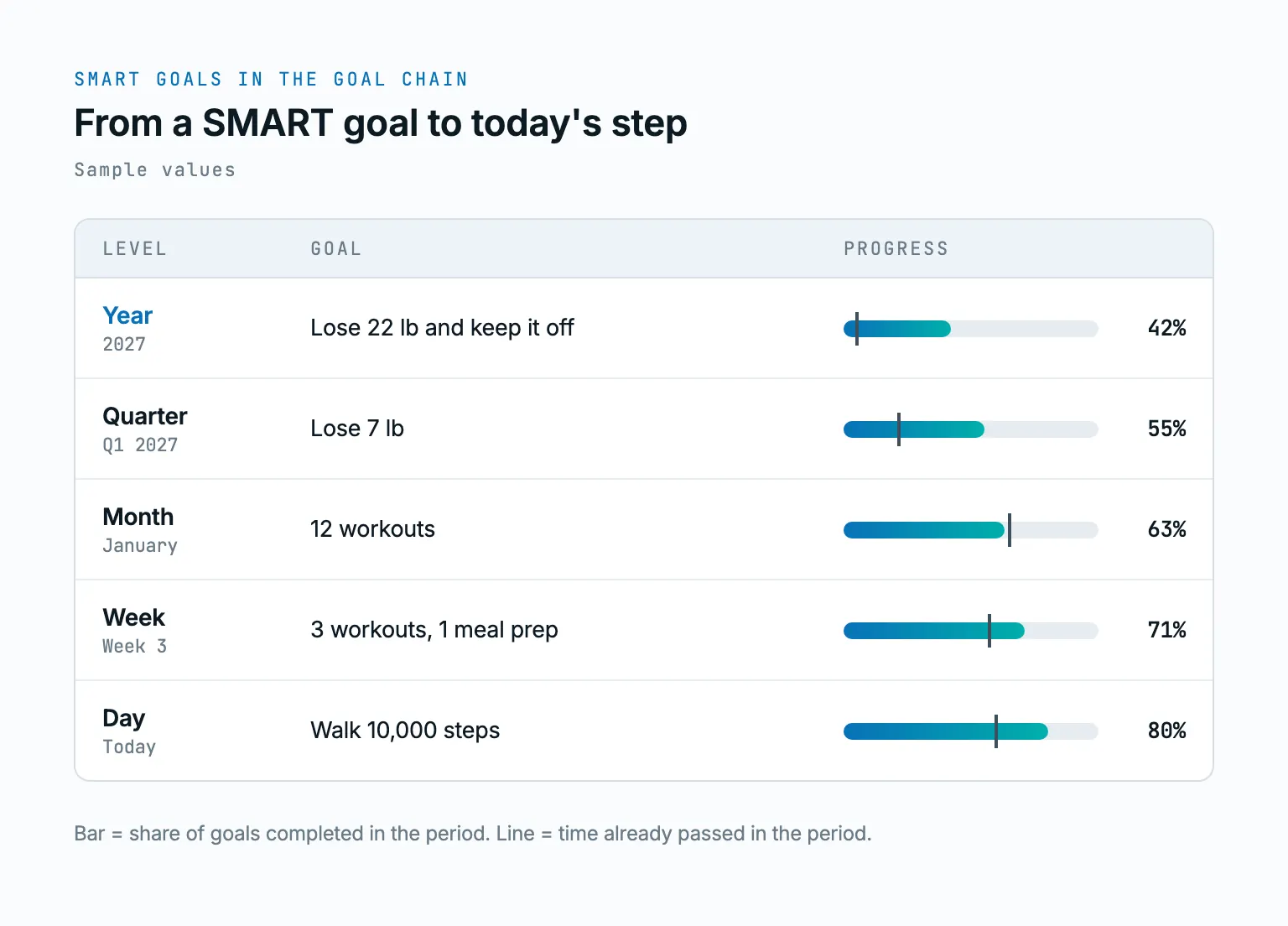
How do you know whether you are on track? On paper, with math: eight of twelve workouts done on January 20 is 67 percent. And 20 of 31 days is 65 percent of the month, so you are on track. In a SMART goals app that breaks a goal down to the day, you skip the math because progress per period is the share of goals you check off. Gaapp is built that way: every daily goal belongs to a week, every week to a month, quarter, and year. As you check things off, progress moves up the chain, and a thin line shows how much of the period has passed. If the bar is behind the line, you know on Wednesday, not on December 31. That is the whole SMART goal tracker.
Two honest notes. First: Gaapp has no number field per goal; the starting value and target value go into the goal's title, such as “194 to 172 lb.” Second: you do not have to type the chain yourself. The goal templates in the app create this exact chain in one step with the weight-loss pack, plus packs for money, learning, and reading. Free covers one yearly goal; three at once come with Pro for 15 € a month, 14-day free trial, details on the pricing page.
Frequently asked questions about SMART goals
What are the 5 SMART goals examples?
The “5” are not five goals but the five criteria of a single goal: Specific, Measurable, Achievable, Relevant, and Time-bound. Each one is a check: what exactly, measured how, whether the effort fits your time, whether it matters to you, and by when. Five short examples pass all five checks. Lose 22 lb by December 31, 2027 (194 to 172 lb); save $3,000 by December 31, 2027 ($250 a month); grow quarterly revenue from $40,000 to $50,000 by March 31, 2027; take Spanish from A1 to A2 by December 31, 2027; read twelve books by December 31, 2027. Doran himself wrote that not every goal has to meet all five.
How do I write my SMART goals?
Go through the five steps in a fixed order: name the result, measure the starting value and set the target value, check the effort against the time, check whether you want it, set a date. Then put everything into the formula “I will [result with a number] by [date] by [action per week or day].” “Save” becomes “I will have a $3,000 emergency fund (today $0) by December 31, 2027, by transferring $250 on the first of each month.” Add at least one interim date, or you will only find out on the last day whether it worked.
Can you give me an example of a SMART goal that is attainable?
Attainable is a calculation, not a feeling. Take “Build an emergency fund from $0 to $3,000 by December 31, 2027.” Divide the distance by the time: $3,000 in twelve months is $250 a month or $58 a week. Compare that with your take-home pay. If $250 is more than 10 percent of it, the goal is not attainable as written: cut the number to $1,800 or extend the date to June 30, 2028. If it fits, add the action: a $250 automatic transfer on the first of each month. The same math works for weight (22 lb in twelve months is 1.8 lb a month) and for sales ($10,000 more per quarter is ten discovery calls a week).
What are some examples of SMART goals for HR?
HR goals are measured in days, rates, and counts. Time-to-hire: “Cut time-to-hire from 45 to 30 days by March 31, 2027, by moving to a two-interview process starting in February.” Retention: “Reduce first-year turnover from 18 to 12 percent by December 31, 2027, by holding a 30-day and a 90-day check-in with every new hire.” Onboarding: “Get every new hire through the onboarding checklist within their first ten workdays by June 30, 2027, starting with the March cohort.” Each one has a baseline, a target, a date, and one change in the process.
What are good SMART goals examples for students?
Students measure in grades, pages, and hours. “Raise my history grade from B to A by the final on May 15, 2027, by studying flashcards 30 minutes a day.” “Finish the 40-page thesis draft by April 1, 2027, by writing 500 words every weekday.” “Raise my GPA from 3.1 to 3.5 by May 15, 2027, the end of the spring semester, by going to office hours every week in my two hardest classes.” What makes them work is the same as at work: a starting value you actually measured, a date, and a daily or weekly action you control.
Do I need a PDF or a SMART goals template?
You do not. The formula “I will [result with a number] by [date] by [action per week or day]” is the whole template; copy it into a note and fill in the brackets. The table with the eight examples shows the five columns a worksheet would have. If you also want to break the goal down to today's step and see your progress, enter it as a yearly goal in the app. There are ready-made goal templates for weight loss, money, learning, and reading.
Read next
- Methods
How to Achieve Goals: Methods, Examples and a System From Year to Day
How to choose a method, write a goal with real numbers and track it from the year down to today. With five examples, two complete goal chains and a weekly check-in that takes 15 minutes.
- Leadership & Teams
OKR Framework: Examples, Template and Criticism
The OKR framework explained: OKR meaning, objectives and key results, the cycle, scoring, seven examples for work and life, criticism, and a template.
- Methods
Annual Planning: A Guide for One Person, With Template and Examples
Three to five yearly goals, broken down to the week. For one person, not a corporation.