Contents
- What is a daily goal, and how is it different from a to-do?
- Why daily goals work
- Daily goal setting: how to derive daily goals from weekly goals
- Daily goals examples: 24 concrete goals by life area
- Daily goal tracker: paper, spreadsheet or app
- Common mistakes with daily goals
- Daily goals in Gaapp: the day level of your goal chain
- Daily goals FAQ
Daily goals are the smallest unit of a plan that actually gets done. One outcome you reach today because it serves your goal for the week, which serves the month, quarter and year. This page is not a list of habits like “drink more water”. It shows you how to derive one to three daily goals from your weekly goal. You get 24 examples with real numbers, each tagged with the weekly goal it serves, and a comparison of paper, spreadsheet and app for tracking them.

What is a daily goal, and how is it different from a to-do?
A daily goal is an outcome you want to reach today that serves a bigger goal. Finished, not just worked on, and it moves a weekly or monthly goal forward.
A to-do is a task that has to get done whether or not it moves you forward. A habit repeats without an end state, like walking 20 minutes every day. Only the daily goal tells you whether the week is on track.
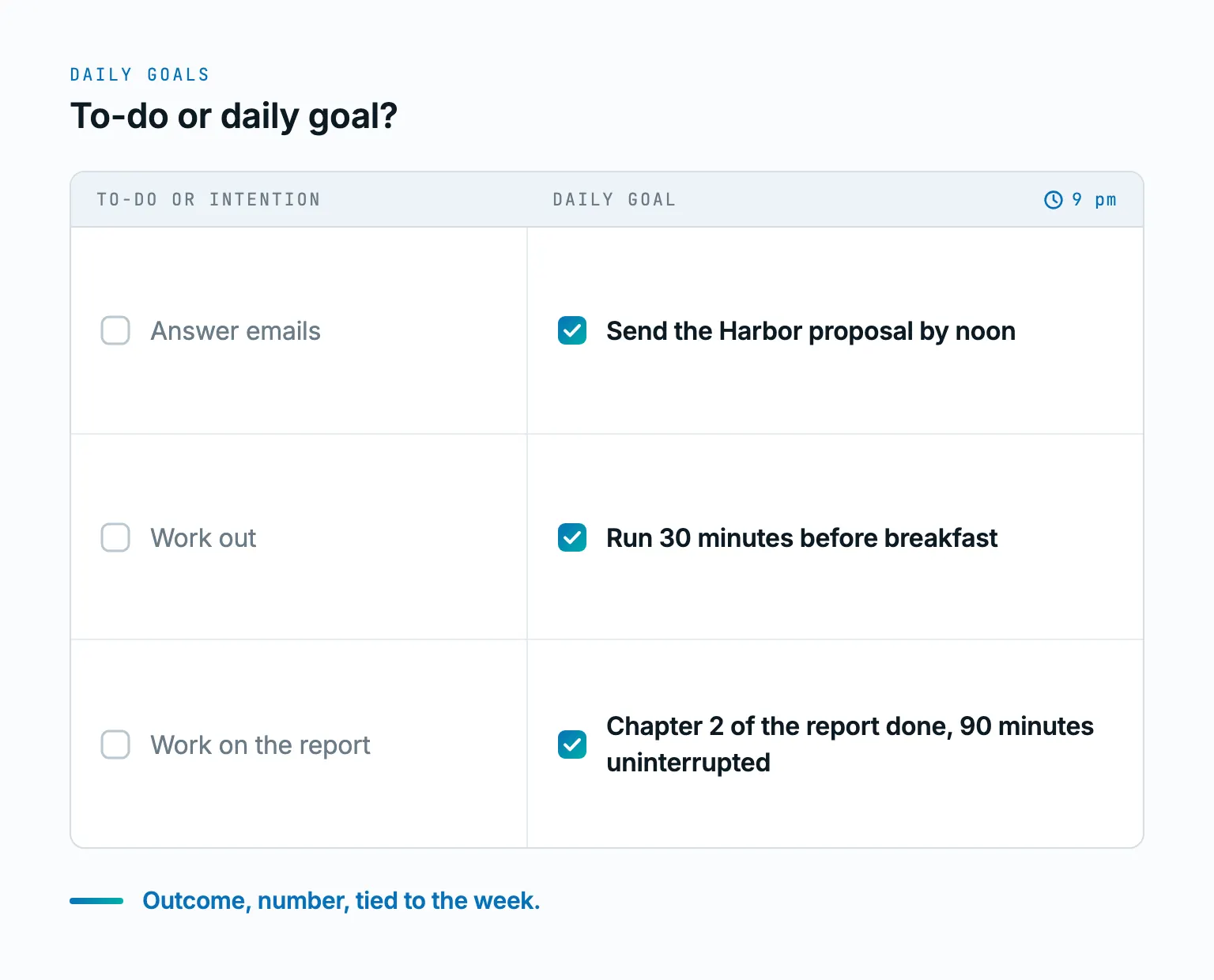
| To-do or intention | Daily goal |
|---|---|
| Answer emails | Send the Harbor proposal by noon |
| Work out | Run 30 minutes before breakfast |
| Work on the report | Chapter 2 of the report done, 90 minutes uninterrupted |
Three traits mark the right column.
- Outcome, not activity. “Sent the proposal” is a yes or a no. “Worked on the report” is true after ten minutes and after eight hours.
- Measurable or clearly checkable. A number, a time or a plain yes or no, the same test the SMART goals examples apply to bigger goals.
- Tied to a weekly or monthly goal. No weekly goal needs it? Then it is a to-do.
Most lists of daily goals online are lists of habits. “Walk 20 minutes” is a habit. “Walk 10,000 steps today, because this week is three workouts and one meal prep” is a daily goal.
Why daily goals work
- Specific and challenging beats vague. Edwin Locke and Gary Latham showed that specific, demanding goals outperform “do your best” goals (1990; American Psychologist, 2002).
- If-then plans raise follow-through. Peter Gollwitzer’s implementation intentions (American Psychologist, 1999) tie a situation to an action: if 7 am, then running shoes. Gollwitzer and Sheeran’s meta-analysis of 94 studies (2006) found a medium to large effect.
- Small visible progress is the strongest motivator at work. Teresa Amabile and Steven Kramer analyzed close to 12,000 diary entries from 238 people in seven companies (The Progress Principle, 2011). Of all influences on motivation during a workday, progress in meaningful work ranked first.
- A concrete plan stops the mental loop. Unfinished tasks stay active in memory (Bluma Zeigarnik, 1927). E. J. Masicampo and Roy Baumeister showed in 2011 that a concrete plan for an unfinished goal ends the intrusive thoughts before the goal is done.
What the evidence does not say: that writing goals down makes you a fixed percentage more likely to reach them. The studies quoted for that are either untraceable or were never peer reviewed.
Daily goal setting: how to derive daily goals from weekly goals
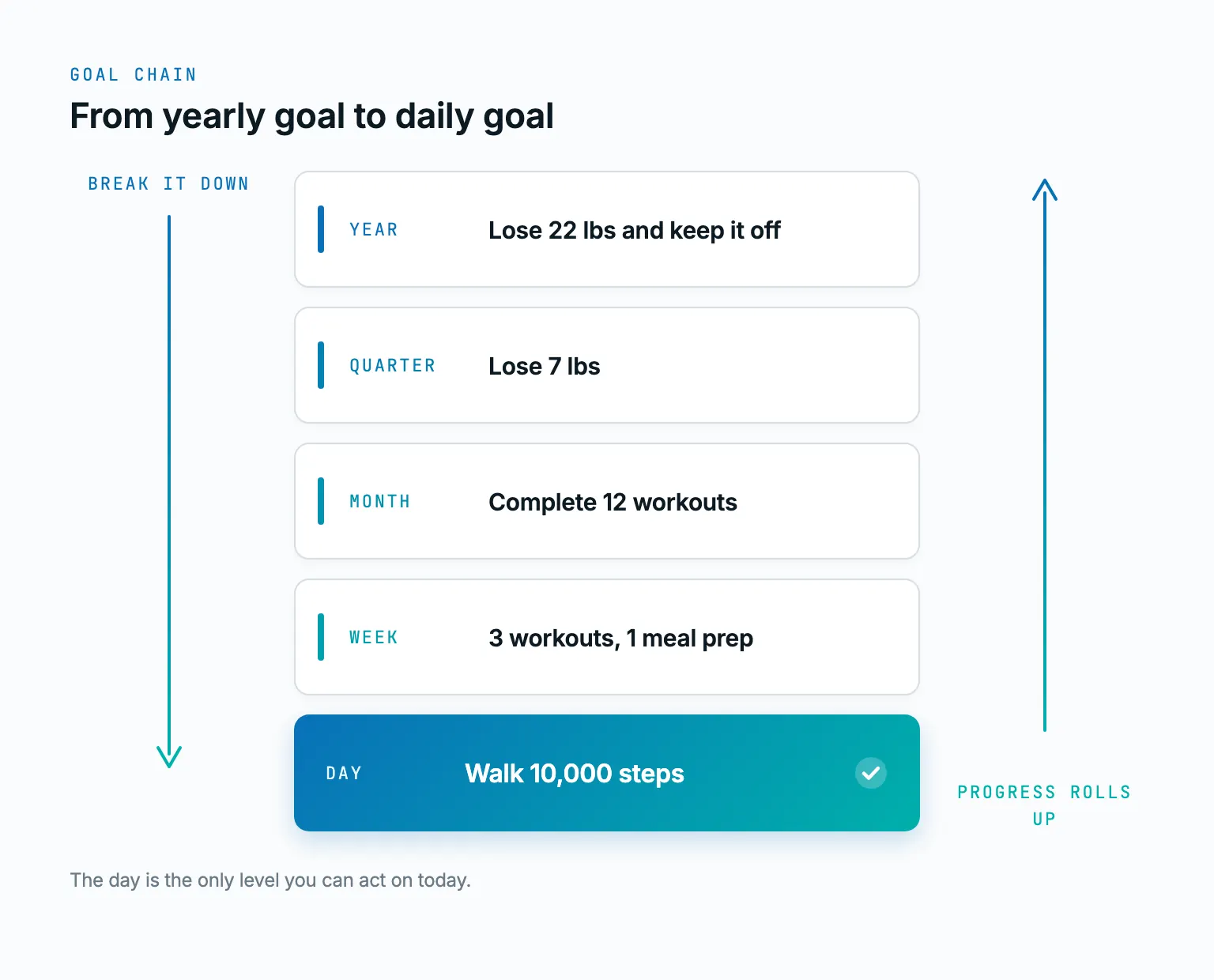
Daily goals come from a chain, not from a blank page. The year sets the direction, the quarter picks the one big thing, the month sets a milestone, the week sets the stage, and the day is the action. The year level is covered in how to achieve goals and annual planning.
| Level | Goal |
|---|---|
| Year | Lose 22 lbs and keep it off |
| Quarter | Lose 7 lbs |
| Month | Complete 12 workouts |
| Week | 3 workouts, 1 meal prep |
| Day | Walk 10,000 steps |
Bottom up: 10,000 steps is one of three workouts, three a week gets you to twelve this month, and twelve a month is how 7 lbs come off this quarter. Top down: on Sunday evening, read the monthly goal, write the weekly goal, pick Monday’s daily goal.
When daily goals are the wrong tool
Your week has no goal: set one first. Your day belongs to other people, on shift work or with a newborn: one goal of 20 minutes, not three of 90. Your work is open-ended, like a first draft: set a time box and treat finishing it as the outcome.
How many daily goals should you set?
One to three. J. D. Meier built Getting Results the Agile Way (2010) on the Rule of 3, and Chris Bailey adopted it in The Productivity Project (2016). Leo Babauta’s Most Important Tasks stop at the same limit. With three you have to choose.
Small daily goals beat big vague ones. Too big for the day? Cut it: not “chapter 2 done” but “the first 800 words”. A finished goal moves the weekly count. A daily goal has to be reachable on a normal day, next to everything you have to do anyway.
When to set daily goals: the night before or in the morning?
- The night before. Five minutes at the end of the workday: read the weekly goal, write one to three lines for tomorrow. Cal Newport calls that a shutdown ritual (Deep Work, 2016). The cost: a sick child or a canceled meeting rewrites the plan.
- In the morning. Five minutes before the first email, the same three lines. Less context, and whoever wrote to you last night is one click away from deciding your day.
Recommendation: the night before, morning as the fallback. In a weekly rhythm like the 12 Week Year, the Friday review sets Monday’s goal.
The formula
One sentence for every daily goal
Today I will [outcome with a number or a clear end state] so that [weekly goal].
- Today I will walk 10,000 steps so that this week has three workouts and one meal prep.
- Today I will send the Harbor proposal by noon so that two proposals are out this week.
- Today I will learn 20 new vocabulary words and test myself tonight so that this week ends at 100 words.
The second half is the test. If it stays empty, the line is a to-do.
Daily goals examples: 24 concrete goals by life area
Six areas, four goals each, every one checkable at 9 pm; the parentheses name the weekly or monthly goal it serves. If you are a student, start with the Learning list. If you are here for self-improvement, the Health and Relationships lists are the ones to copy. Swap the numbers, but do not make them vaguer.
Work
- Send the Harbor proposal by noon (week: two proposals out).
- Write 90 minutes without interruption, chapter 2 of the report done (week: report draft complete).
- Make three customer calls and log the outcome of each (week: ten calls).
- Inbox under 20 emails before I log off (week: keep the inbox under 20).
Health
- Walk 10,000 steps (week: three workouts, one meal prep).
- Run 30 minutes before breakfast (week: three runs).
- Drink 64 oz of water, counted in bottles (week: 64 oz every day).
- In bed by 10:30 pm, phone charging in the kitchen (week: asleep before 11 pm seven times).
Learning
- Learn 20 new vocabulary words and test myself tonight (week: 100 words).
- Finish one lesson of the online course, exercise submitted (week: three lessons).
- Read 25 pages of the textbook and write three notes (week: one chapter).
- 30 minutes of piano, measures 1 to 16 without mistakes (week: first page of the piece).
Money
- Enter every expense of the last three days into the budget sheet (week: budget sheet complete).
- Set up a $200 automatic transfer to savings (month: emergency fund started).
- Compare two electricity plans and write down the result (week: decision on switching made).
- No purchase over $10 today without a list (week: stay $50 under budget).
Relationships
- Call my mother, at least 15 minutes (week: two family calls).
- Dinner with no phones at the table, everyone (week: five phone-free dinners).
- Text a friend with a specific day and time to meet next week (month: two meetups).
- Ask my partner one question at dinner and listen without interrupting (week: 20 minutes of conversation every evening).
Home
- Kitchen empty and wiped before bed (week: clean kitchen every night).
- Declutter one drawer, donation bag packed (month: five drawers).
- Weekly grocery run from the list, nothing extra (week: one trip instead of four).
- Laundry washed, dried and folded the same day (week: two full loads done).
Every example has a number or an end state. “Exercise more” fails at 9 pm because you cannot tell whether you did it. “Run 30 minutes before breakfast” is done at 7:15 am. A repeated goal is still a daily goal as long as the week counts it. Once “kitchen empty and wiped before bed” runs on its own, take it off the list.
Daily goal tracker: paper, spreadsheet or app
Daily goal tracking has one job: show you tonight whether the day served the week, and after four weeks whether the weeks served the month.
| Paper | Spreadsheet | App | |
|---|---|---|---|
| Setup effort | None | Build the sheet once | Enter the chain once |
| Link to the weekly goal visible | Only if you write it down | As a column, filled by hand | Built in |
| Progress over weeks visible | Flip back and count | With a formula, if maintained | Calculated per period, history often in the paid plan |
| Repeats every day | New page | New row | Add the goal to the new day |
| Always with you | Only if the notebook is | On the phone, small cells | Browser on phone, tablet, desktop |
| Cost | A notebook | Free with tools you have | Free tiers exist, paid plans for more |
Paper wins at setup and focus, and loses at review, because nobody adds up checked boxes across six weeks by hand. A spreadsheet is free and flexible, and it dies the week you stop maintaining it. An app for daily goals links the levels, but you enter the chain first. Without weekly goals, an app is a to-do list with a nicer icon.
This layout doubles as a daily goals checklist: one row per goal, check the last column in the evening.
Day | Daily goal                          | Serves weekly goal      | Done
Mon | Walk 10,000 steps                   | 3 workouts, 1 meal prep | yes
Mon | Harbor proposal sent by noon        | 2 proposals out         | yes
Mon | 20 vocabulary words, tested tonight | 100 words this week     | no
Tue |                                     |                         |
On Sunday, count the yes rows per weekly goal. Three of three workouts is a green week. One of three means the goals were too big or the week had no slot.
Common mistakes with daily goals
Most failures are design problems, not discipline problems.
- Ten goals instead of three. That is a to-do list with ambition.
- Activity instead of outcome. “Work on the report” can fill a day with nothing finished. Write what is finished. The OKR framework draws the same line: key results are outcomes, not tasks.
- No link to a weekly goal. “Clean the garage” may be worth doing. If no weekly goal needs it, it is a task.
- Goals you cannot reach alone. “Get the client’s yes” depends on the client. “Send the revised proposal and ask for a decision by Friday” depends on you.
- Logging habits that already run. Checking off something you have done for years measures only your fondness for checkboxes.
- Quietly dropping missed goals. A missed goal is information. Spend one minute on what got in the way: too big, day hijacked, or wrong weekly goal.
- Setting daily goals inside the inbox. Open email first and other people set your goals. Write the three lines before the first message.
Daily goals in Gaapp: the day level of your goal chain
Everything on this page works with a notebook. The chain above is how Gaapp is built: five levels in a fixed order, Year, Quarter, Month, Week, Day. Every daily goal belongs to a week, every week to a month, quarter and year. Nothing stands alone.
Progress rolls up
Check off a daily goal and progress rolls up automatically. Progress per period is the share of completed goals; a thin line shows how much of the period has passed.
Daily focus
The daily focus shows the few things that matter today. Check off and move on.
Goal packs
One pack creates a whole chain from year to day. The weight loss pack builds this page’s chain in kilograms: 10 kg for the year, 3 kg for the quarter.
What to expect from a daily goals app
A habit tracker asks whether you repeated something. A goal app asks whether today’s outcome served this week’s goal. Expect the five levels, the link from each daily goal to its week, progress per period, and a view that shows only today.
The Free plan includes one yearly goal with quarterly, monthly, weekly and daily goals below it. Pro costs €15 per month or €144 per year, includes three yearly goals and adds the history of past periods, with a 14-day free trial and no payment to start. Prices are in euros; see the pricing page. It runs in the browser on phone, tablet and desktop.
Daily goals FAQ
What is a daily goal?
A daily goal is an outcome you want to reach today that serves a bigger goal, usually your goal for the week. It has a number or a clear end state, so you can check it off in the evening. “Send the proposal by noon” is a daily goal. “Answer emails” is a to-do, and “walk 20 minutes every day” is a habit; neither tells you whether the week is on track.
What is your goal for the day?
Answer it in one sentence with the formula: today I will [outcome with a number] so that [weekly goal]. For example: today I will walk 10,000 steps so that this week has three workouts and one meal prep. If you cannot fill in the second half, you have a task, not a goal.
What are 5 good goals in life?
That is a question for the year level, not the day. Good life goals are the ones you would still want after a bad week, and there is no universal list of five. Set one to three yearly goals first, one direction per area such as health, money, work or relationships, then break them down to quarters, months, weeks and days. The guide on how to achieve goals covers that level.
What are the top 10 goals in life?
There is no universal top ten, and ten yearly goals at once is too many for one person anyway. Any list of the top ten goals in life describes other people’s priorities. Pick the one to three that are yours for the coming year and derive quarters, months, weeks and days from them. Annual planning is where that starts.
How many daily goals should you set?
One to three. The Rule of 3 and the Most Important Tasks approach both land there for the same reason: three outcomes stay visible next to a full day of obligations. On a day shaped by other people, one is enough. If you consistently finish all three before lunch, make them bigger, not more.
Should you set daily goals in the morning or the night before?
The night before, in five minutes at the end of the workday. The weekly goal is still in your head, and the next morning’s inbox cannot hijack the decision yet. Adjust in the morning only if something real has changed. If evenings are impossible, five minutes before the first email is the fallback.
Read next
- Methods
How to Achieve Goals: Methods, Examples and a System From Year to Day
How to choose a method, write a goal with real numbers and track it from the year down to today. With five examples, two complete goal chains and a weekly check-in that takes 15 minutes.
- Methods
Annual Planning: A Guide for One Person, With Template and Examples
Three to five yearly goals, broken down to the week. For one person, not a corporation.
- Methods
How the 12 Week Year Works, and How to Run Your First One
The 12 week year explained in plain words: what it is, why 12 weeks beat 12 months, an eight-step plan with a copyable weekly sheet, six examples with numbers, the common mistakes and how it fits your annual plan.
- Methods
SMART Goals Examples: Eight Goals for Work and Life, With a Step-by-Step Method
Eight written-out SMART goals with real numbers, the five criteria explained simply, a five-step method, exercises, and the way from a yearly goal to today's step.