Contents
- What a good annual plan looks like
- Year in review: questions to ask before yearly planning
- How to do annual planning: step by step
- Yearly goals template: a simple annual plan example
- Annual planning examples: yearly goals with numbers
- Common annual planning mistakes
- What annual planning looks like in the app
- Annual planning FAQ
Annual planning, or yearly planning, means deciding once a year which three to five results you want in hand on December 31. Then you set what has to happen in each quarter, month and week to get there. This page shows you how: a guide in four steps, a filled-in template as a table, and examples of yearly goals with numbers. It is written for one person planning their own year, not for a company with budgets and departments.
One example runs through the whole page: the yearly goal of losing 20 lbs and keeping it off, from 190 lbs to 170 lbs. By the end you will know what it asks of you in the second week of January 2027, and that it takes about 25 minutes a week.

What a good annual plan looks like
A good annual plan is not a wish list and not a calendar. It is a short list of goals with five traits. Check your finished plan against them.
- Few goals. Three to five, each from a different area of your life. Ten goals make a wish list, because each one needs a slot every week.
- Every goal has a number. A start value, a target value and a date. “Get in shape” is a wish. “From 190 lbs to 170 lbs by December 31” is a goal, because every month you see where you stand.
- Every goal has a chain down to the week. Yearly goal, quarterly goal, monthly goal, three things for this week. If one level is missing, the plan ends on January 2.
- A fixed rhythm for checking in. A weekly slot of 15 minutes, a monthly check of 20 minutes, a quarterly check of 45 minutes. All on the calendar, not in your head.
- Room for the unexpected. A year brings illness, a move or a new client. A plan that needs 52 perfect weeks is no plan. Plan for 45.
Goals with a number work better, and that is well documented. Edwin Locke and Gary Latham showed in their goal-setting theory (1990) that specific, challenging goals beat being told to do your best.
When companies say annual planning, they mean budgets, headcount and a fiscal year, which for the US federal government runs from October 1 to September 30. This page plans a calendar year with your own numbers.
Year in review: questions to ask before yearly planning
The year in review is the first step of annual planning, not a ritual on the side. It keeps you from setting last year's goals again for last year's reasons. Set aside 60 to 90 minutes in December, open last year's calendar, and answer these ten questions in writing, one to three sentences each.
- What did I achieve that I had planned?
- What did I achieve that I had not planned?
- Which goal did I drop, and was that the right call?
- Where did most of my time go?
- What gave me energy, and what drained it?
- Which habit stuck, and which one did not?
- Which number changed: weight, savings, revenue, books read?
- What would I do exactly the same way again?
- What will I stop doing?
- Who helped me, and did I tell them?
Most people skip question three: if you dropped a goal because you were overloaded, the plan was too full. Question seven gives you your start values: 190 lbs in December is the start value for the new yearly goal.
How to do annual planning: step by step
Now comes the plan, ideally in the first week of January. Budget 30 to 60 minutes for the four steps. You do step one once, steps two and three again at every quarter's end; the fourth becomes your weekly rhythm.
Pick three to five yearly goals
A yearly goal is a result that is reached on December 31 and that you can measure with a number. Pick three to five, each from a different area of life, each with a start value, a target value and a date. Written like a [SMART goal](/en/smart-goals-examples), that reads: “Lose 20 lbs and keep it off, from 190 lbs to 170 lbs, by December 31, 2027.” Measure the start value, do not guess it. The test: if you cannot say in July whether you are on track, the goal lacks its number.
Break each goal into quarters
A quarter is three months; the first ends on March 31. Spread the yearly goal roughly across four quarters, each with a number. Dividing by four gives 5 lbs per quarter. Uneven is often smarter: Q1 front-loads 6 lbs (190 lbs → 184 lbs), Q2 and Q3 6 lbs each, Q4 only 2 lbs and holding. You commit only to the current quarter and confirm the next number at the quarterly check. A quarter gets a result, not a task: “lose 6 lbs” is a result, “join a gym” is a task. The [12 Week Year](/en/12-week-year) and the [OKR framework](/en/blog/okr-framework) are two quarterly rhythms that plug in here.
Break quarters into months
The quarterly goal becomes three monthly goals. A monthly goal is a quantity you can count, not an intention: “work out regularly” is an intention, “12 workouts in January, from 0 to 12” is a quantity. More examples: $375 into the emergency fund, four chapters of the textbook, two client calls. Pick a quantity that lets you make up one lost week in the other three: twelve workouts are three a week, 20 are not.
Set a weekly rhythm
The weekly rhythm is the step most annual plans skip, which is why they fail. Set a fixed slot, Sunday evening or Monday morning, 15 minutes. Three things happen: check off last week, write down the current number, pull three things for the new week from the monthly goal. For January 2027 that means, in week 2: “3 workouts, 1 meal prep.” How you keep going is in the guide on [how to achieve goals](/en/how-to-achieve-goals); how the three things become [daily goals](/en/daily-goals) is on the day-level page.
Weeks are counted as ISO weeks
Many US calendars start the week on Sunday and count week 1 from January 1. This page and the app follow ISO 8601: weeks start on Monday, week 1 holds the year's first Thursday, a year has 52 or 53 weeks. 2027 has 52; week 1 starts Monday, January 4, and week 2 runs January 11 to 17.
The fixed slot is an if-then plan: “If it is Sunday at 6 p.m., then I open my plan.” Peter Gollwitzer described in 1999 how reliably such plans get carried out; Gollwitzer and Sheeran found a medium to large effect in a 2006 meta-analysis of 94 studies.
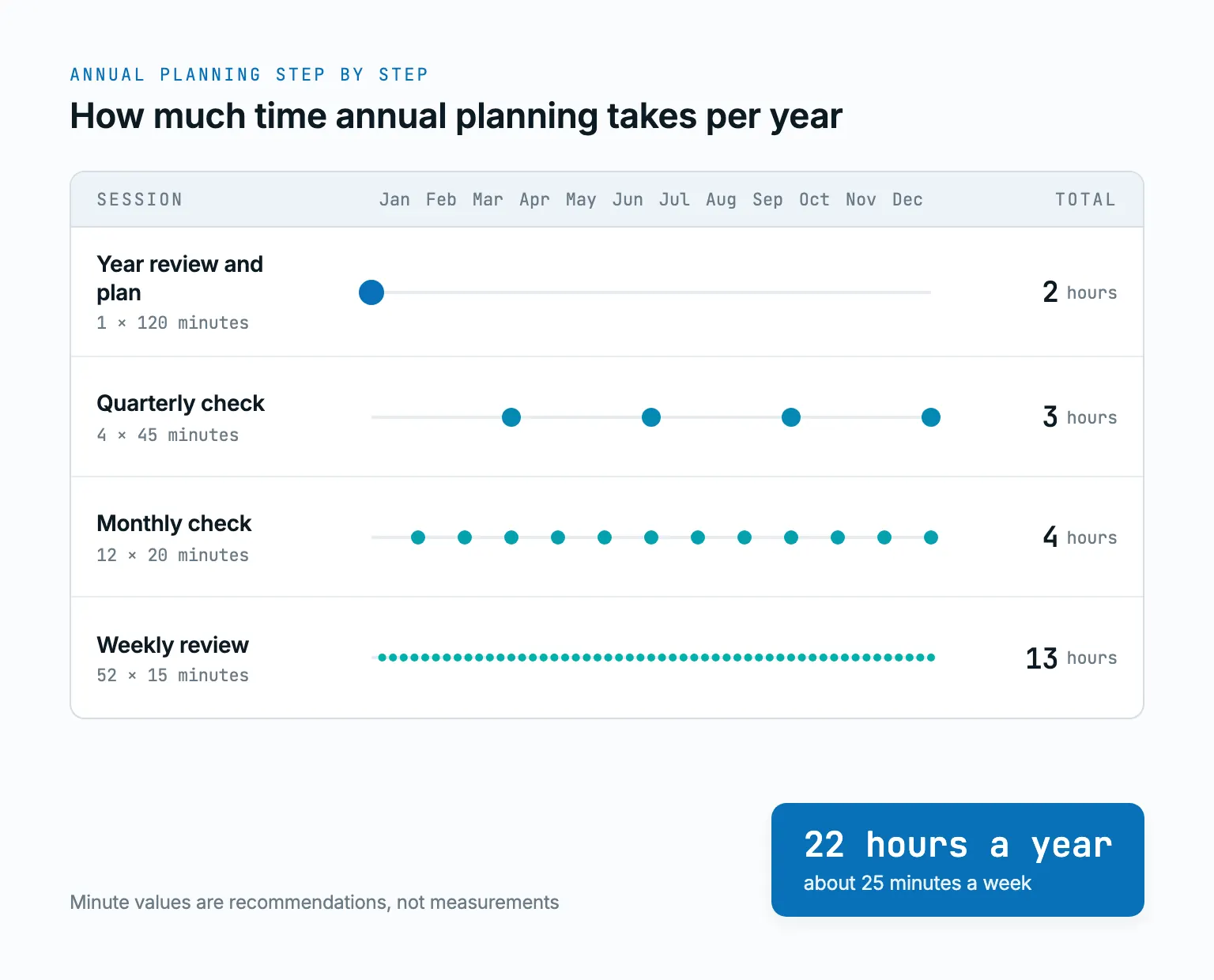
How much time does this take in a year? The minutes are recommendations, not measurements. Review and plan: once, about 120 minutes. Quarterly check: four times 45 minutes. Monthly check: twelve times 20 minutes. Weekly rhythm: 52 times 15 minutes. That is two, three, four and 13 hours, so 22 hours a year or about 25 minutes a week. If you cannot spare that, you have too many goals.
Yearly goals template: a simple annual plan example
The yearly planning template for your personal annual plan is a table with four columns: level, period, goal, and the number as start value → target value. No Word, no Excel, no printable calendar. Here it is, filled in with the example from the top. The 190 lbs starting point is invented, not a recommendation.
| Level | Period | Goal | Number (start → target) |
|---|---|---|---|
| Year | 2027 | Lose 20 lbs and keep it off | 190 lbs → 170 lbs |
| Quarter | Q1 2027 | Lose 6 lbs | 190 lbs → 184 lbs |
| Month | January 2027 | Complete 12 workouts | 0 → 12 |
| Week | Week 2 (Jan 11 to Jan 17, 2027) | 3 workouts, 1 meal prep | 0 → 3 and 0 → 1 |
| Day | Tuesday, Jan 12, 2027 | Walk 10,000 steps | 0 → 10,000 |
Read the table top to bottom and check every row: does it answer what the row above means for this period? 6 lbs in a quarter is a bit more than a quarter of 20 lbs, leaving Q4 as a buffer. Twelve workouts are the month's share, three workouts and one meal prep the week's portion. If the logic breaks at one row, that row is wrong, not the yearly goal. The day row is optional.
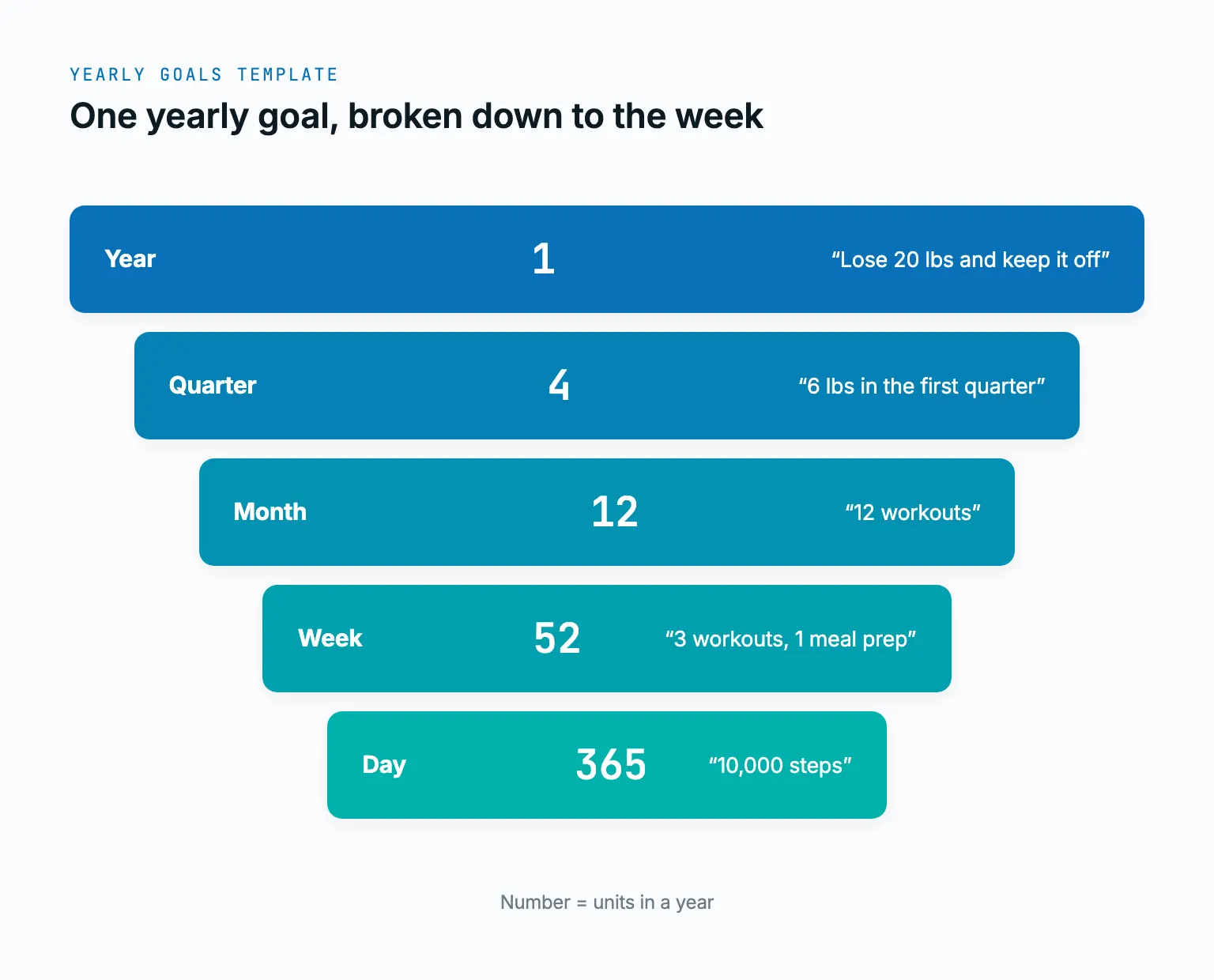
The diagram shows the same chain as a pyramid: one yearly goal at the top, then four quarters, twelve months, 52 weeks and 365 days. The lower the level, the smaller the goal and the more often it recurs.
Here is the same annual goals template empty, with room for three yearly goals. Fill in the year rows first, then the four quarterly numbers, then the months of the first quarter; the months from April on wait for the quarterly check. The week block is refilled every week; its last line is your if-then plan.
ANNUAL PLAN 2027

Year in review (December, 60 to 90 minutes): done on ______

YEARLY GOAL 1: ______________________  Number: ______ → ______
  Q1 (by Mar 31): ____________________  Number: ______ → ______
    January:  ______________________  Number: 0 → ______
    February: ______________________  Number: 0 → ______
    March:    ______________________  Number: 0 → ______
  Q2 (by Jun 30): ____________________  Number: ______ → ______
  Q3 (by Sep 30): ____________________  Number: ______ → ______
  Q4 (by Dec 31): ____________________  Number: ______ → ______

YEARLY GOAL 2: ______________________  Number: ______ → ______
  Q1 (by Mar 31): ____________________  Number: ______ → ______
    January:  ______________________  Number: 0 → ______
    February: ______________________  Number: 0 → ______
    March:    ______________________  Number: 0 → ______
  Q2 (by Jun 30): ____________________  Number: ______ → ______
  Q3 (by Sep 30): ____________________  Number: ______ → ______
  Q4 (by Dec 31): ____________________  Number: ______ → ______

YEARLY GOAL 3: ______________________  Number: ______ → ______
  Q1 (by Mar 31): ____________________  Number: ______ → ______
    January:  ______________________  Number: 0 → ______
    February: ______________________  Number: 0 → ______
    March:    ______________________  Number: 0 → ______
  Q2 (by Jun 30): ____________________  Number: ______ → ______
  Q3 (by Sep 30): ____________________  Number: ______ → ______
  Q4 (by Dec 31): ____________________  Number: ______ → ______

WEEKLY SLOT: ______day at ______, 15 minutes
QUARTERLY CHECK: Mar 31 / Jun 30 / Sep 30 / Dec 31, 45 minutes each

WEEK __ (Mon ______ to Sun ______)
  Last week checked off: [ ]   Number in the monthly goal: __ of __
  1. ______________________
  2. ______________________
  3. ______________________
  Biggest obstacle: ______________________
  If ______________________, then ______________________
This annual planning template works as a note or on paper, as long as you open it every week. Digitally, the same structure is a weight-loss goal pack under goal templates, in German and in kilograms for now, set up for the current periods. To plan a quarter with key results, use the OKR template.
Annual planning examples: yearly goals with numbers
Yearly goals are usable when they have a start value, a target value and a first quarterly goal. Here are seven examples from five areas of life. The numbers are rough assumptions; they show the form, not the content. Weight loss is already in the template, so health gets the half marathon.
| Area | Yearly goal 2027 | Number (start → target) | First quarterly goal (by March 31) |
|---|---|---|---|
| Career, freelance | Grow freelance revenue | $60,000 → $75,000 a year | Two new clients at $5,000 or more each |
| Career, employed | Ask for a raise | Current salary → plus $4,000 a year | Case prepared, meeting scheduled |
| Health | Half marathon under 2:15 in October | Longest run 3 miles → 13.1 miles | Run three times a week, 6 miles nonstop |
| Finances | Build an emergency fund | $1,500 → $6,000 ($375 a month) | $1,125 saved, automatic transfer on the 1st |
| Learning | Spanish from A1 to B1, exam in November | A1 → B1 | 36 sessions of 30 minutes, three a week |
| Learning | Twelve books a year, one a month | 0 → 12 | Three books read |
| Personal | Work-free weekends with friends or family | 0 → 12, one a month | Three weekends on the calendar |
Two examples double as rules. Revenue is only partly in your control, so the quarterly goal is not “$18,750 in revenue” but “two new clients,” the part you can do yourself. With weight it is the reverse: the scale swings from day to day, so the week counts workouts, not pounds. The year level holds the result, the week level the behavior.
So planning yearly goals is not writing a goal down. It is goal, chain and rhythm. A yearly goal without a chain is a resolution, a chain without a weekly slot is a document. And if $375 a month does not fit, lower the target to $4,500, or $250 a month. A smaller goal still standing in December beats one you reset to zero in February.
Common annual planning mistakes
Six mistakes sit in almost every annual plan that ends up in a drawer by February. None is a character flaw. All are planning errors.
Too many goals
Eight yearly goals mean eight monthly counters and 24 weekly items every week. Nobody keeps that up on top of a job. Three to five is enough; the rest waits for next year's list.
Goals without a number
“Get in shape” cannot be checked in July, and if you do not know whether you are on track, you quietly stop. Every goal gets a start value and a target value; the target can be rough, the start value is measured.
A yearly goal with no quarter and no month
The plan is one sentence and ends on January 2, because nobody knows what to do today. The chain is not an add-on. It is the plan.
Planning without a review
The same goals as last year, for the same reasons, with the same obstacles. 90 minutes in December save you a second year of that.
No fixed weekly slot
“I'll check in regularly” means never. A weekly plan needs a weekday and a time, or daily life pushes it aside.
The plan lives in a file nobody opens
A spreadsheet in a folder called “Misc” gets opened for the last time in February. Put the plan where you look every week anyway: in your notebook, on the wall, or in an app that shows the current week.
A seventh point, a misunderstanding rather than a mistake: an annual plan is not a contract. If a goal was wrong, cross it out at the quarterly check and set a new one. Adjusting happens at a quarter's end with a reason. Quitting happens on a Tuesday in February without one.
What annual planning looks like in the app
The chain from the table above can run in Gaapp as a digital yearly goal planner. The app has five levels in a fixed order: Year, Quarter, Month, Week, Day. In the app's words, “Every daily goal belongs to a week, every week to a month, quarter and year. Nothing stands alone.” Weeks are ISO weeks, so “Week 37,” exactly like the template.
Progress per period is the share of goals completed. A thin line next to it shows how much of the period has already passed. Three goals in a week, two checked off: the week shows two thirds, and if the line sits further right, you are behind. Check something off and, as the app puts it, “Progress rolls up automatically.”
The three steps are called “Set yearly goals,” “Break them down” and “Check off daily.” Or pick a ready-made goal pack from five categories, labeled in German for now: health, business, finances, learning, and a fifth for calm and focus. A pack creates one yearly goal with a quarter, a month, a week and a day below it; you can rename or delete every goal afterward. The weight-loss pack follows the chain from the template above, in kilograms instead of pounds.
Two things, said plainly. Free allows one yearly goal, Pro three; details on the pricing page. And as a yearly goals app, Gaapp replaces the table, not the weekly slot. It shows you where you stand; the review, the choice of goals and the 15 minutes on Sunday stay yours. If you do not plan alone, you can plan the same structure together in a shared space; quarterly OKRs under a yearly goal are on the OKR software page.
Annual planning FAQ
How do you do annual planning?
In four steps. First the review of the old year, 60 to 90 minutes in December. Then three to five yearly goals, each with a start value, a target value and a date. You spread each goal roughly across four quarters and plan the first quarter as three monthly goals, each a countable quantity. Finally you set a fixed weekly slot of 15 minutes in which you check off last week and pick three things for the new one. The template on this page is a filled-in example of exactly that.
What is annual planning?
Annual planning is deciding once a year which three to five results you want to reach by December 31. Then you break them down into quarters, months and weeks, so that every week you know what to do next. For one person that means a review, a short list of goals with numbers, and a weekly slot. Companies use the same term for something else: setting budgets, headcount and targets for a fiscal year.
What does “yearly planner” mean?
A yearly planner is an object: a paper or digital calendar with twelve months, sometimes a PDF or Excel file with one page per month. Annual planning is the method: choosing goals and breaking them down. A planner without goals is a calendar. This page covers the method, and the app section shows a digital yearly goal planner that holds the goals themselves, from the year down to the day. There is no PDF, Word or Excel file here on purpose; the template is a table you can copy anywhere.
Do I need a 5-year plan before an annual plan?
No. One sentence of direction is enough: where you want to be in a few years, in rough terms. The year is the unit you plan in, because twelve months are long enough for a real result and short enough to put a number on every month. A detailed five-year plan with milestones usually gets rewritten after year one anyway. Write the sentence down, then plan the year.
When is the best time for annual planning?
December for the review, the first week of January for the plan. The old year is still fresh, and the new one has no appointments in it yet. A planning year can also start in March or September: twelve months from today are just as much a year. More important than the date is that the quarterly checks and the weekly slot are on the calendar from day one.
How is annual planning different from OKRs and the 12 Week Year?
Annual planning sets the direction for twelve months and breaks it down into quarters, months and weeks. The OKR framework and the 12 Week Year are quarterly rhythms beneath it. OKRs describe a quarterly objective with two to five key results; the 12 Week Year treats every quarter like a full year with its own weekly plan. Both fit under a yearly goal; neither replaces it.
Read next
- Methods
How to Achieve Goals: Methods, Examples and a System From Year to Day
How to choose a method, write a goal with real numbers and track it from the year down to today. With five examples, two complete goal chains and a weekly check-in that takes 15 minutes.
- Methods
SMART Goals Examples: Eight Goals for Work and Life, With a Step-by-Step Method
Eight written-out SMART goals with real numbers, the five criteria explained simply, a five-step method, exercises, and the way from a yearly goal to today's step.
- Methods
How the 12 Week Year Works, and How to Run Your First One
The 12 week year explained in plain words: what it is, why 12 weeks beat 12 months, an eight-step plan with a copyable weekly sheet, six examples with numbers, the common mistakes and how it fits your annual plan.
- Leadership & Teams
OKR Framework: Examples, Template and Criticism
The OKR framework explained: OKR meaning, objectives and key results, the cycle, scoring, seven examples for work and life, criticism, and a template.