How to Motivate Employees: What Actually Drives a Team
Employee motivation is not a perk program: four drivers from the research, five steps, twelve ways to motivate employees and a worked example.

Contents
- 01What employee motivation is, and what it is not
- 02Why the gift cards did not work: rewards buy behavior, not motivation
- 03What motivates employees: four drivers you can influence
- 04Intrinsic vs extrinsic motivation: a spectrum, not a switch
- 05How to motivate employees in five steps
- 0612 best ways to motivate employees, with and without a budget
- 07What to say: phrases that motivate and phrases that drain
- 08The three mistakes nobody notices
- 09Motivating employees through the goal chain: year to day
- 10Frequently asked questions about employee motivation
Employee motivation is not a perk program. It is your team's willingness to put real effort into their work and the team's goals on their own, and it grows fastest where people can see their work moving forward. Knowing how to motivate employees therefore starts with a question most managers skip: what is getting in the way? A bonus can buy a behavior. It cannot buy the drive behind it, and sometimes it shrinks it.
Three things do most of the work: fewer obstacles, one shared goal with a number, and progress people can see every week. This guide works through all three with Tasha, 42, who runs the front desk and billing team for a dental group with four offices: eight people who check in about 260 patients a day and file the insurance claims behind every visit. You also get the four types of motivation, five steps, twelve ways to motivate employees with and without a budget, phrases that work, and the three mistakes that sink well-meant programs.
What employee motivation is, and what it is not
Motivation is the reason someone does something and the energy they bring to it. Employee motivation is both, applied to a workday: why does someone try hard, and how long does it last? The research answer is short. It lasts longer when the reason comes from inside. It fades faster when it is pushed from outside.
That leads to an uncomfortable point for managers. You cannot motivate someone the way you start an engine. You can only build the conditions in which motivation grows and remove the things that drain it every day. Anyone who mixes those up buys pizza for the break room and wonders why nothing changes.
What Herzberg called KITA
In 1968, the psychologist Frederick Herzberg published “One More Time: How Do You Motivate Employees?” in Harvard Business Review, and it became one of the most reprinted articles the magazine has ever run. His target was what he called KITA, short for a kick in the pants: pressure or rewards that get people moving for a while. KITA produces movement, he argued, not motivation. Once the push stops, so does the movement. That distinction runs through every step below.
Perks are not wrong. Free lunch is a nice gesture. It is built for something other than drive. That means: perks make a workplace more pleasant, while motivation happens inside the work itself.
Why the gift cards did not work: rewards buy behavior, not motivation
Rewards work. That is what makes them tricky. They change what people pay attention to right away, and that is exactly why they sometimes change the wrong thing.
Here is what that looked like for Tasha. Two people on her team quit last year. In the last week of every month, when claims pile up, each person works about 8 hours of overtime. And 11 percent of insurance claims come back denied, which means rework, phone calls and late payments. The practice owner wanted to do something, so for the first quarter she launched an Employee of the Month award: a $100 gift card for whoever had the fewest denied claims.
By the end of the quarter, the denial rate had barely moved, from 11 to 10.4 percent. Three people had won a gift card, five had not, and two of the five had stopped helping colleagues with tricky claims, because helping someone else win made no sense. Why did it backfire? Tasha pulled the numbers. Most denials came from insurance eligibility that was never verified before the visit, and verification happened at the front desk between patients, with phones ringing. The award paid for an outcome the team could not control, and it turned eight colleagues into competitors. Maya, the longest-serving biller, put it plainly in a one-on-one: “We're competing for a gift card none of us can really earn.”
Behind this sits one of the best known experiments in motivation research. In 1971, Edward Deci had college students solve tricky puzzles. One group was paid a dollar per solved puzzle, the other was not. Once the payment stopped, the paid students spent less of their free time on the puzzles than the unpaid group. The reward had turned play into work. Researchers call it the overjustification effect, and it hits hardest on tasks people used to enjoy.
Herzberg's two factors: what prevents frustration and what motivates
Herzberg's earlier study, published in 1959 as “The Motivation to Work”, asked about 200 engineers and accountants in Pittsburgh when they had felt especially good or especially bad about their jobs. The answers split into two groups. Some factors prevent dissatisfaction but never create satisfaction. Herzberg called them hygiene factors. Others create real satisfaction and drive. He called them motivators.
| Hygiene factors: prevent frustration | Motivators: create drive |
|---|---|
| Pay and bonuses | Achievement, like a week with zero denied claims |
| Working conditions, tools, software | Recognition for a specific result |
| Policies and procedures | The work itself, when it makes sense |
| Relationship with the manager and coworkers | Responsibility, like owning one office's claims |
| Job security | Growth and new skills |
That explains Tasha's first quarter. Pay is a hygiene factor. Fair pay is non-negotiable, and anyone who pays below market loses people no matter how well they lead. More money on top, though, does not make anyone lastingly more motivated. In short: fix the hygiene factors, then make the motivators possible.
What motivates employees: four drivers you can influence
Fifty years of research boil down to surprisingly few drivers. Edward Deci and Richard Ryan named three basic needs in their self-determination theory: autonomy, competence and relatedness. Daniel Pink translated them for managers in his 2009 book “Drive” as autonomy, mastery and purpose. Add a fourth driver that most managers underrate: progress.
- Progress. Seeing your work move forward, even in small steps. For Tasha's team: a full week without a single denial at the busiest office.
- Autonomy. Having a say in how the work gets done, even when the goal is fixed. For Tasha's team: deciding themselves when the phones are covered.
- Mastery. Getting better at something and being seen for it. For Tasha's team: a dental coding course two billers had asked about for a year.
- Belonging. Being part of a team that has each other's backs and a shared goal. For Tasha's team: one team goal instead of eight individual rankings.
The progress principle
For “The Progress Principle”, published in 2011, Teresa Amabile and Steven Kramer analyzed nearly 12,000 daily diary entries from 238 employees in seven companies. The event most often linked to good workdays was making progress in meaningful work. When they asked 669 managers to rank what motivates employees most, only 35 put progress first. That is the biggest blind spot in the topic: managers look for motivation in recognition and incentives, while their teams find it in work that gets done.
The top three motivators for employees
If you need a short answer, take the three from self-determination theory: autonomy, competence and relatedness, or in Pink's words autonomy, mastery and purpose. Underneath all three sits progress, because people can only feel competent and connected when the work actually moves. Is pay on the list? As a floor, yes. As a motivator, no.
What does that mean for you? The strongest tool for motivating employees is not a program but a clear goal where progress shows. Edwin Locke and Gary Latham summarized decades of studies in 1990 in “A Theory of Goal Setting and Task Performance”: specific, challenging goals lead to better performance than being told to do your best. A goal with a number makes progress measurable. Whoever can measure progress can also show it and recognize it.
Intrinsic vs extrinsic motivation: a spectrum, not a switch
The best known split is intrinsic versus extrinsic motivation. Intrinsic means the work itself drives you. Extrinsic means something outside the work does, like money, praise or fear of trouble. Deci and Ryan showed that there is a range between the two poles, and where someone sits on it decides how long their effort lasts.
| Type | What drives it | How it sounds on Tasha's team | How long it lasts |
|---|---|---|---|
| External | Rewards or punishment from outside | “I hit my numbers so I get the gift card.” | As long as the reward runs |
| Introjected | Guilt, pride, other people's expectations | “I stay late because I don't want to let the others down.” | Until burnout |
| Identified | Seeing that the work matters | “I verify coverage twice because a denial means a patient gets a surprise bill.” | Long, while the purpose stays visible |
| Intrinsic | Enjoying the activity itself | “I like it when a messy claim finally goes through.” | Longest, but you cannot schedule it |
Research adds one more step between identified and intrinsic, called integrated motivation, where a task has become part of who someone is: “I'm the one whose claims never bounce.” For everyday management, the four rows are enough. You cannot order someone to enjoy their work. You can help people move down the table by making the purpose of a task visible. Anyone who knows why a task matters needs less pressure from outside.

How to motivate employees in five steps
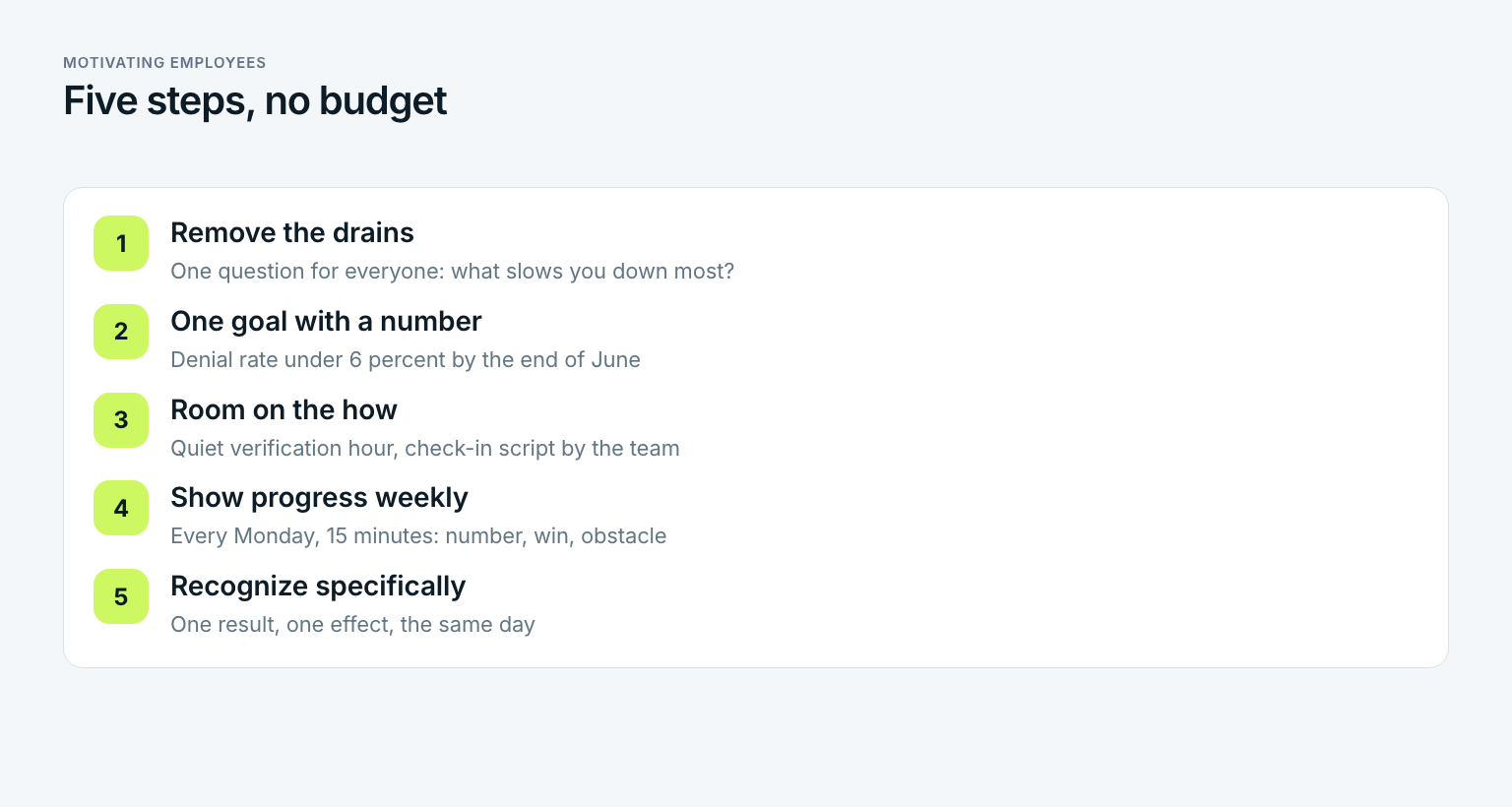
The five steps follow the logic above: remove obstacles, set one goal, give room, show progress, recognize it. Tasha ran them in the second quarter with no budget and about an hour of prep.
Find and remove the drains
Ask everyone on the team the same question in a one-on-one: What slows you down most at work? Write the answers down and count what comes up more than once. On Tasha's team, three things kept coming back: phones ringing during verification, insurance details missing at check-in, and no feedback when something went well. Removing one drain does more than any reward.
Set one shared goal with a number
Agree with the team on a goal everyone can influence, with a number and a date. Tasha dropped the award and set a quarterly goal with the team: denial rate under 6 percent by the end of June, month-end overtime cut in half. What was new: the team could now affect every part of that number, because verification moved out of the busy hours.
Give room on the how
The goal is fixed, the path belongs to the team. Tasha's team decided two things on their own. Eligibility checks for the next day happen from 7:30 to 8:30 a.m., before the first patient, with phones forwarded. And Maya wrote a one-page check-in script so the front desk asks for the right insurance details every time. Anyone who picks the path will also defend it.
Make progress visible every week
A goal nobody can see does not motivate. Every Monday, Tasha runs a 15-minute huddle: last week's denial rate, one win, one obstacle. The number lives where the whole team sees it, not in a report only she opens.
Recognize specifically and soon
Praise works when it names a result and comes the same day. “Thanks for the check-in script. Since Wednesday, not one claim from the north office has bounced for missing details” carries further than “Great job, everyone.” Recognition is a motivator in Herzberg's sense, but only when it shows you were paying attention.
The example: Tasha's team, one quarter later
After three months, the gift cards were gone. The $1,200 a year they would have cost went into the coding course two billers had asked for.
| Billing team metric | Before the award | Q1 with the award | Q2 with the five steps |
|---|---|---|---|
| Claim denial rate | 11 percent | 10.4 percent | 5.8 percent |
| Denials from missing eligibility checks | 7 percent | 6.8 percent | 2.9 percent |
| Denials from coding or data errors | 4 percent | 3.6 percent | 2.9 percent |
| Overtime in the last week of the month, per person | 8 hours | 9 hours | 3 hours |
| Days until a claim is paid, average | 41 | 40 | 33 |
| People who quit | two last year | none | none |
None of these numbers is a miracle. Eligibility denials fell by more than half because verification moved to a quiet hour before the first patient. Data errors dropped because the check-in script catches the details billers used to chase. And overtime shrank because an hour without phones gets more done than a day of interruptions. That means: the motivation did not come from an incentive. It came from work that moved again.
12 best ways to motivate employees, with and without a budget
Good ways to motivate employees look unremarkable at first. Most cost nothing but attention. The table matches twelve of them to the driver they feed and names the condition under which each one works.
| Way to motivate | Driver | Cost | Works when … |
|---|---|---|---|
| One team goal with a number and a date | Progress, belonging | none | the team can influence every part of the number |
| A 15-minute weekly huddle | Progress | none | it happens every week, quiet weeks included |
| Specific praise the same day | Mastery | none | it names a result, not a personality |
| Protected focus time | Progress, autonomy | none | the manager respects it too |
| A say in how the work is done | Autonomy | none | the goal is set first |
| Ownership of one area | Autonomy, mastery | none | decisions there really are theirs |
| One-on-ones every two weeks | Belonging | 30 minutes | the employee sets the agenda |
| Training the team chooses | Mastery | budget | the new skill gets used right after |
| Passing on customer feedback | Purpose | none | it is shared word for word, with names |
| Blameless reviews of mistakes | Belonging, mastery | none | every mistake turns into a rule or a checklist item |
| Flexible hours or remote days | Autonomy | low | results count, not presence |
| Fair pay, openly explained | Hygiene factor | budget | it is meant to prevent frustration, not to buy effort |
Eight of the twelve cost no money. What drives people mostly lives in how the work is done, not in what gets added on top. Anyone who only knows motivation ideas with a price tag has mostly been thinking about hygiene factors.
How to motivate your team without money: three things for tomorrow
You do not need a program to start tomorrow. Three items from the table need no approval and no budget:
- Ask the one question. In your next one-on-ones, ask everyone what slows them down most. Write the answers down word for word.
- Show one number every week. Pick a number the team can influence and show it every Monday. Even when it looks bad.
- Give one specific piece of praise a day. One sentence, one person, one result with its effect. After two weeks you will notice how rarely you really looked before.
What to say: phrases that motivate and phrases that drain
A poster on the wall does no harm. It just moves nothing. Words motivate in conversation when they hold three things: a specific observation, its effect on the goal, and trust in the next step. These worked on Tasha's team:
- “Since you started using the script, the north office hasn't had a single denial for missing details. That saves us half a day of calls every week.”
- “You took the orthodontics claims even though they're the hardest. I noticed.”
- “How would you solve this? You know these insurers better than I do.”
- “We're at 7.2 percent. Six weeks ago we were at 10.4. That's your work.”
- “What do you need from me to finish by Thursday?”
- “The mistake happened. What do we change so it doesn't happen again?”
- “I trust you with the appeals. Tell me if you want a second opinion.”
- “A patient called today to say her bill was right the first time. That's on all of you.”
And these are better left unsaid, even when they are well meant:
- “Great job, keep it up.” Too general to show you were paying attention.
- “Other teams manage it.” A comparison instead of a goal, and it costs belonging.
- “That's just the job.” It treats every effort as a given.
- “Hit the number and lunch is on me.” It turns meaningful work into a trade.
See the pattern? The good phrases talk about a result, a goal or a next step. The bad ones talk about rewards, comparisons or duty. In short: a phrase motivates when it shows that work is moving.
The three mistakes nobody notices
Most employee motivation programs do not fail from bad intent. They fail from mistakes that feel like good leadership in the moment.
- Motivating instead of removing drains. A team outing is easy to plan, and it hurts no one. The phone that rings every ten minutes stays untouched. Whoever tries to motivate first and clean up later builds on sand.
- Rewarding what the team cannot control. Victor Vroom described in “Work and Motivation” in 1964 that people try hard when they expect effort to lead to a result and the result to bring something they value. Break the first link and motivation drops to zero, no matter how big the reward. That is exactly what happened to Tasha's team in the first quarter.
- Keeping progress invisible. Goals get set in January and graded in December. In between, nobody knows where the team stands. Anyone who shows progress once a year wastes eleven months of the strongest driver there is.
The most common mistake: trying to buy motivation
Most managers reach for money first because it is fast and feels fair. Bonuses do work, for simple, easy-to-measure tasks and for a short time. For work that takes thinking, Deci's puzzle study shows the risk: the reward crowds out the drive the work had on its own. Fair pay belongs in the picture without question. But whoever tries to buy motivation gets exactly the effort they pay for, and not one bit more.
Motivating employees through the goal chain: year to day
A team goal only motivates when it translates all the way down to a workday. A yearly goal alone is too far away to change anything tomorrow morning. A daily task alone has no meaning if nobody knows what it serves. The goal chain connects the two: year, quarter, month, week, day. Each level feeds the one above, and that is how progress becomes visible every day. Here is the chain for Tasha's team:
- Year: Denial rate under 5 percent on average, and nobody on the team quits.
- Quarter: Denial rate under 6 percent by the end of June, month-end overtime cut in half.
- Month: In April, the check-in script is live in all four offices and the 7:30 a.m. verification block is on every calendar.
- Week: Maya tests the script at the north and east offices, Tasha sets up phone forwarding to the main line.
- Day: Tuesday, 7:30 to 8:30 a.m.: verify coverage for Wednesday's 70 patients, phones forwarded.
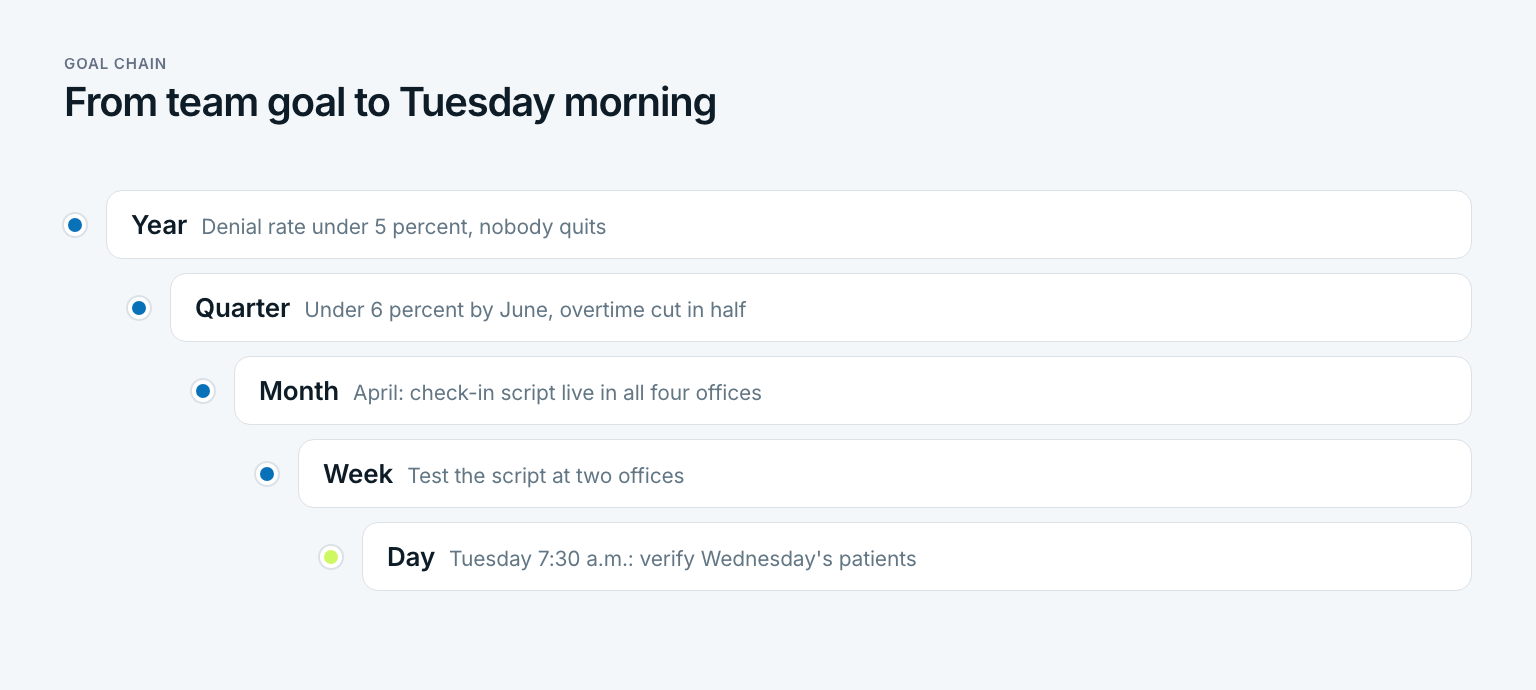
Everyone on the team can see how their Tuesday morning connects to the yearly goal. That is purpose at a small scale, and it needs no speech at the holiday party. The guide on how to achieve goals shows how to break a yearly goal down so every level feeds the next. For what a daily goal looks like when you can check it off by evening, see daily goals.
In Gaapp, this chain is the core: five levels from year to day, and progress at each level is the share of goals completed. When Tasha shares the goals with her team in a shared space, everyone sees the same status on Monday. Teams that work with OKRs turn the quarterly goal into key results, as described in the OKR framework guide.
Three questions to close, about your own team:
- Can everyone on your team name the most important team goal in one sentence, with a number?
- Does your team know where it stands on that goal today without asking you?
- Which obstacle has your team complained about for months that you have not removed yet?
Anyone who answers no to one of these does not need a motivation program. They need a clear goal and fewer obstacles. In short: employee motivation is not something you hand out. It is what is left when work is allowed to move.
Frequently asked questions about employee motivation
What are the 5 P's of motivation?
There is no single research-backed model called the 5 P's. Coaches and HR blogs use different sets, often built from words like purpose, people, progress, pay and pride. If you want a version that holds up, map them to the research: purpose and progress motivate, people feeds belonging, and pay is a hygiene factor that prevents frustration but does not create drive.
What are the top 3 motivators for employees?
Self-determination theory names autonomy, competence and relatedness, and Daniel Pink's version is autonomy, mastery and purpose. Underneath all three sits progress in meaningful work, which Amabile and Kramer found was the event most often linked to good workdays. Fair pay matters as a baseline but does not motivate on its own.
What are the top 3 things that motivate people?
Having a say in how they work, getting better at something that matters to them, and seeing that their effort moves something forward. Those three show up across Deci and Ryan, Pink, and Amabile and Kramer. At work, one clear goal with visible progress feeds all three at once.
What are the 7 rules of motivation?
The list shared most often is a self-help list, not a management model: set a major goal and follow a path, finish what you start, spend time with people who share your interests, learn how to learn, match talent with interest, deepen your knowledge, and take risks. For a team, the first two translate directly into one shared goal and a weekly check on progress. The rest describe personal habits more than leadership.
Can you really motivate employees?
Only indirectly. Herzberg argued in 1968 that pressure and rewards create movement, not motivation, and that real drive comes from the work itself. What you can do is build the conditions: a clear goal, room on the how, visible progress and fewer obstacles.
Do bonuses improve employee motivation?
For simple, easy-to-measure tasks and for a short time, often yes. For work that requires thinking, they can crowd out the drive the work had on its own, as Deci's 1971 puzzle study showed. Bonuses do the most harm when they reward outcomes the team cannot control or turn colleagues into competitors.
Last updated: 14 October 2026
Read next
 Leadership & Teams
Leadership Styles: Which One Fits Which Situation
Leadership styles are not personality types: 11 types compared, Lewin, Goleman, situational leadership and five steps to find the style that fits you.
14 min read
 Leadership & Teams
Retrospective: How Teams Learn From Every Sprint
A retrospective is not a blame session: what the word means, five phases, seven retrospective examples and action items that stick, shown on one team.
16 min read
 Leadership & Teams
How to Delegate Tasks: Hand Off Work, Keep Results
Delegation is not dumping work: five levels of delegation, seven steps, a handoff script and what to keep, shown on one marketing team.
15 min read