Leadership Styles: Which One Fits Which Situation
Leadership styles are not personality types: 11 types compared, Lewin, Goleman, situational leadership and five steps to find the style that fits you.

Contents
- 01What Leadership Styles Are and What They Are Not
- 02Types of Leadership Styles at a Glance
- 03Lewin's Three Leadership Styles: The 1939 Experiment
- 04Transformational vs. Transactional Leadership
- 05Servant, Democratic and Coaching Leadership
- 06Situational Leadership: Matching the Style to the Moment
- 07Leadership Styles for Managers: Find Yours in Five Steps
- 08Three Mistakes Nobody Notices
- 09Leadership Styles in Your Goal Chain: From Year to Tuesday
- 10Your Self-Audit: Five Questions About Your Leadership Style
- 11Leadership Styles FAQ
Leadership styles are not personality types. A leadership style is the recurring pattern in how a manager makes decisions, hands out work and talks to the team. The most common leadership styles range from autocratic through democratic to laissez-faire, with newer models such as transformational, servant and coaching leadership on top. No single style is right every time. What matters is whether it fits the situation, the task and the person in front of you.
Finding your own style takes three things: a clear map of the options, an honest look at your own decisions and a rule for when you use which style. All of it is worked through with Priya, who went from senior developer to engineering manager four months ago. Along the way you get eleven types of leadership styles in one table, the experiment Kurt Lewin ran in 1939, five steps to find your style and a way to turn it into goals from the year down to the day.
What Leadership Styles Are and What They Are Not
A leadership style describes behavior, not character. A quiet, introverted team lead can give very clear direction. An outgoing, sociable director can still make every call alone. That is why you cannot read a style from someone's manner. You read it from three questions: Who decides? Who sets how the work gets done? And how much gets explained beforehand?
Personality quizzes about leadership are popular, and they are a decent way to start thinking about your habits. They only measure how you see yourself. Your team experiences your style in specific moments: the outage at 2 a.m., the one-on-one after someone shipped a bug, the planning meeting where a question is still open. That means: your leadership style is whatever those moments have in common, not what you checked on a form.
Priya is 33 and has managed a team of seven engineers at a logistics software company since June. Until then she was the developer everyone asked when something broke, which is why she got the job. Her director gave her a team target: deliver 85 percent of sprint commitments, up from 70 today, and ship the new billing module by the end of the first quarter. Priya would describe her style as collaborative. Her team would describe it differently.
Leadership style, leadership model, leadership tool
A leadership style is your behavior, for example whether you decide alone or together. A leadership model is a theory that sorts styles, such as Lewin's three styles or situational leadership. A leadership tool is something you use, like a one-on-one or a goal agreement. Anyone who mixes up the three tends to memorize a model in a workshop and then behave exactly as before on Monday.
Types of Leadership Styles at a Glance
Most lists mix styles from different decades and different models. That is not wrong, but it is confusing, because every source counts differently. The table below sorts the eleven different leadership styles that show up most often in textbooks and management articles by a single question: Who makes the decision?
| Leadership style | Who decides | Strength | Risk |
|---|---|---|---|
| Autocratic | the manager alone | fast and clear, especially in a crisis | little initiative, work stalls without supervision |
| Bureaucratic | rules and procedures | consistent and fair | slow, no room for exceptions |
| Charismatic | the manager, carried by personal appeal | energy behind a direction | depends on one person, hard to succeed |
| Pacesetting | the manager, by example | high standards, fast results short term | burnout and quiet frustration |
| Democratic | manager and team together | better calls on complex questions | slower, accountability can blur |
| Delegative | the team or one person within agreed limits | frees up the manager, grows people | needs skill and clear boundaries |
| Laissez-faire | nobody in particular | space for very experienced people | confusion and conflict |
| Transactional | the manager sets targets and rewards | clear expectations | people do exactly what is paid for |
| Transformational | the manager sets direction, the team shapes the path | purpose and engagement | drifts without structure |
| Servant | the team, the manager clears obstacles | trust and growth | mistaken for being a pushover |
| Coaching | the person, guided by questions | skills that last | too slow when something is on fire |
Read the second column from top to bottom and you see a shift. The decision moves from one person to rules, then to the group, then to the individual. The styles further down are not upgrades of the ones above. They answer different questions. Transformational leadership says something about purpose and direction, not about who approves Tuesday's deploy. In short: many styles do not exclude each other. They sit on different axes.
Three, Six or Seven: Why Every List Counts Differently
Three styles come from Kurt Lewin: autocratic, democratic and laissez-faire. They are the oldest list still in use and the subject of the next section.
Six styles come from Daniel Goleman. In a 2000 Harvard Business Review article called “Leadership That Gets Results”, he drew on data from 3,871 executives. His six styles are coercive, authoritative, affiliative, democratic, pacesetting and coaching. His most useful finding is not about any single style. Leaders who had mastered four or more styles had the best climate and the best results. Coercive and pacesetting had a negative effect on climate overall, and coaching was the style used least often.
Seven steps come from Robert Tannenbaum and Warren Schmidt, who described a continuum in the Harvard Business Review in 1958. At one end the manager decides and announces. At the other the team decides within limits the manager has set. In between, the manager sells a decision, presents ideas and invites questions, presents a tentative decision, presents a problem and asks for suggestions, or defines limits and lets the group choose. The continuum is the most practical of the three, because it asks about each decision rather than about you as a person: At which step am I making this one?
Lewin's Three Leadership Styles: The 1939 Experiment
Kurt Lewin, Ronald Lippitt and Ralph White published a study in 1939 that still appears in almost every management textbook. They set up after-school clubs for boys around ten years old, who did hobby work such as making masks. Adult leaders ran the clubs in one of three styles and later switched. The study is short on sample size and long on influence.
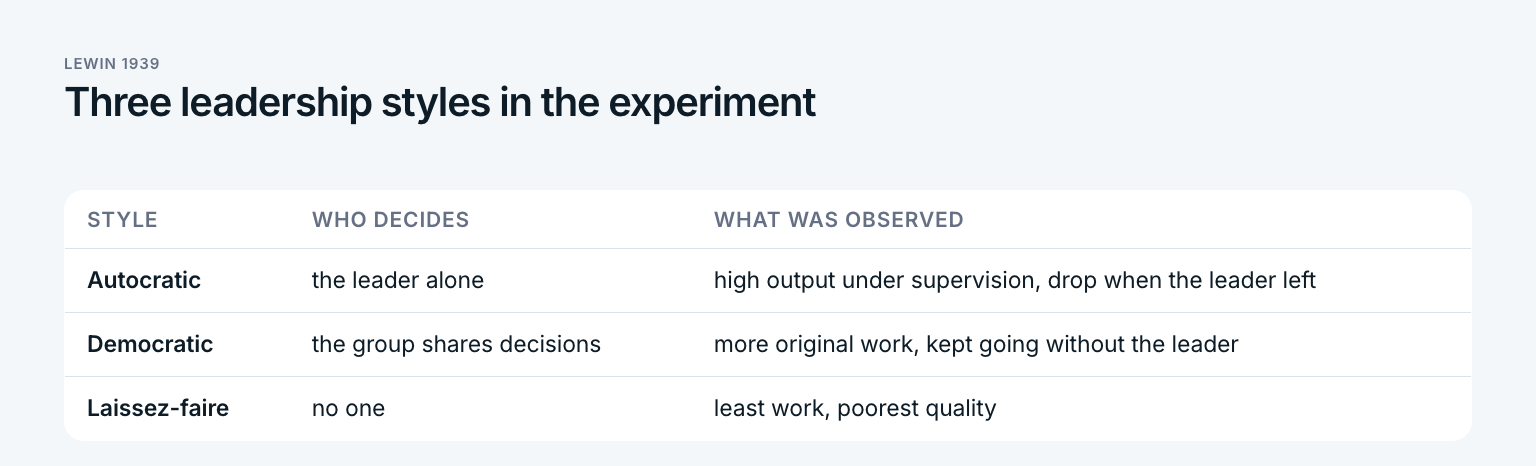
The results are often told in shortened form. The autocratic groups were not lazy. While the leader was in the room, they produced a lot. When the leader stepped out, work dropped sharply, and some groups turned hostile or apathetic. The democratic groups produced somewhat less but more original work, and they kept going when the leader was gone. The laissez-faire groups did the least, and what they did was the weakest.
Of course, a craft club from the 1930s does not map neatly onto a software team. The groups were small, the members were children and the tasks were simple. Still, the core has held up in many later studies: a team that only works under supervision works for the supervisor. Whoever has to be present for things to run does not have a team. They have a dependency.
Priya saw exactly this without calling it that. During her week at a conference in August, 14 pull requests waited more than two days for review. Nobody slacked off. But every merge to the main branch needed her approval, and she was not there. The sprint missed its commitment by four stories. Is Priya an autocratic manager? Not in tone. In pattern, yes.
Transformational vs. Transactional Leadership
Transformational leadership is a style in which the manager changes what people want to achieve by giving them a direction bigger than the task at hand. Transactional leadership is an exchange: performance for pay, recognition or a bonus. James MacGregor Burns drew the line between the two in his 1978 book “Leadership”. Bernard Bass applied it to organizations in 1985 in “Leadership and Performance Beyond Expectations” and named four parts of transformational leadership: being a role model, communicating an inspiring direction, challenging people to think for themselves and treating each person as an individual.
Sounds like a keynote speech? The research says otherwise. Timothy Judge and Ronald Piccolo published a meta-analysis in 2004 that pooled a large number of studies. Transformational leadership was clearly linked to satisfaction, motivation and performance. The reward side of transactional leadership, meaning clear targets with clear recognition, was linked almost as strongly. Laissez-faire leadership was linked negatively to the same outcomes.
That is an important correction. Transactional leadership has a bad name because it sounds like carrots and sticks. It is simply built for something else: clarity about what is expected and what follows from it. Without that clarity, even the best vision is a poster on the wall. Anyone who leans only on vision will find the team inspired on Monday and unsure by Wednesday. What drives a team beyond pay and praise is covered in the guide on how to motivate employees.

Servant, Democratic and Coaching Leadership
Three styles put the team at the center, and each one is often misunderstood. Servant leadership goes back to an essay by Robert Greenleaf from 1970. The manager sees the job as helping people grow and do their best work. That does not mean granting every wish. It means removing obstacles the team cannot remove alone. Whoever leads as a servant still says no, just with the team's interest in mind rather than their own comfort.
Democratic leadership, also called participative leadership, means the team shapes decisions while the manager keeps the accountability. It fails in two ways. The first is fake participation: the manager asks for input after the decision is already made. Every team notices, usually the second time. The second is endless consensus: every small question goes to a vote, nothing gets decided, and the people who just want to work stop showing up mentally.
Priya fell into the first trap. She asked the team in a planning meeting how they wanted to handle on-call rotations. She had already built the rotation the night before, and that rotation went into the calendar. Two engineers did not suggest anything in the next three meetings. On the following topic, code review rules, she stated the rule up front: you decide by Friday, I only require that every change gets one peer review. That means: a style becomes democratic not by asking, but by being clear about what happens with the answer.
Coaching leadership is the style Goleman found used least. The manager helps a person solve the problem instead of solving it for them, mostly by asking questions. It is slow in the moment and fast over a year. Is it right for everything? No. During an outage, nobody needs a thoughtful question. They need someone to say who rolls back what.
Situational Leadership: Matching the Style to the Moment
Situational leadership is the idea that the right style depends on the situation and on how ready the person is for the specific task. Paul Hersey and Ken Blanchard introduced it in 1969 with four styles: telling, selling, participating and delegating. Research has only partly confirmed the model. The basic idea, though, matches Goleman's finding: good managers have several styles and switch on purpose. In practice, two questions are enough. How much time and room for error does the situation allow? And how much experience does the person have with exactly this task?
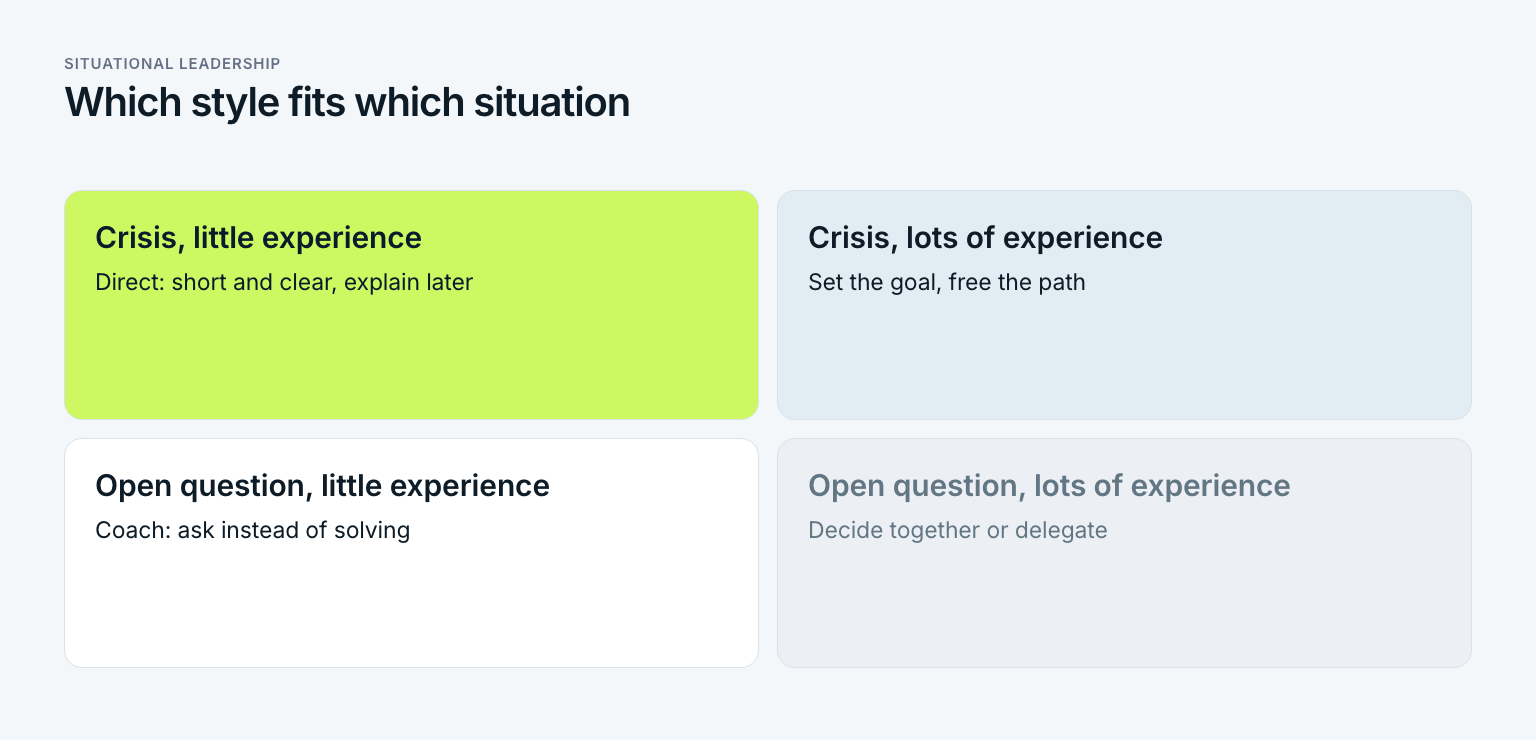
For Priya, the four boxes showed up in a single week. On Monday at 2 a.m., the route planning service went down for 300 customers. She did not open a discussion. She named an incident lead, assigned the rollback and explained her reasoning in the review the next day. On Wednesday, Tomás, three weeks into the job, had his first on-call ticket. She did not give him the fix. She asked three questions and let him propose it.
Dana has twelve years of experience and knows the database better than Priya does. For the migration, Priya set only the goal, zero downtime and done by December, and left the path to Dana. And the code review rules, which affect all seven engineers, the team decided within the limit Priya had named. Four styles in one week, none of them random. Situational does not mean improvised. It means having a rule the team can see.
Leadership Styles for Managers: Find Yours in Five Steps
Five steps take you from gut feeling to a style you can explain. Together they take about six weeks, and most of that time runs in the background. Priya started in September.
Log your decisions for two weeks
For two weeks, write down every decision that affects your team and tag it: decided alone, decided after input or decided by the team. It takes about three minutes a day. Priya logged 52 decisions, 38 made alone, ten after input and four by the team.
Ask your team three questions
Ask your team three questions, ideally anonymously: When did you last feel overruled? Where do you want clearer direction from me? Where do you want more room? Priya got the same answer twice: code reviews. The team wanted more room there and clearer direction during incidents.
Sort your recurring situations
List the ten situations that come up every week and place each one in a box of the matrix. Next to it, note where on the Tannenbaum and Schmidt continuum you decide it today and where it should sit. For Priya, four situations sat too close to the decide-alone end.
Announce a decision rule
Tell your team which decisions get made which way from now on. One page is enough. Priya wrote three rules: any engineer can merge after one peer review, whoever is on call leads the incident, and changes that touch more than one service come to her.
Count again after four weeks
Repeat step one for two weeks and compare. Priya's new log showed 24 decisions made alone, 16 after input and twelve by the team. The number itself matters less than whether the mix matches your rule.
The goal is not to stop deciding alone. Whoever calls a meeting during an outage keeps 300 customers waiting so the team can feel included. The goal is that every solo decision is a deliberate one and not a habit left over from the old role. Which personal goals fit a manager's job is laid out in the piece on goals for managers.
Three Mistakes Nobody Notices
All three mistakes look reasonable from the inside. They only show up in the mood of the team or in a number that will not move no matter how hard everyone works.
The most common mistake: turning one style into a principle
“I'm a collaborative leader” sounds like a good stance. As a principle, it becomes a trap: the team votes even during an outage and experiences uncertainty instead of involvement. In the other direction, “I'm just direct” turns into an excuse to make every call alone. Whoever makes one style a principle picks it by self-image rather than by situation.
Second: fake participation. Asking without intending to use the answer is worse than not asking. Anyone who wants to decide alone should say so. A team forgives a clear solo decision far more easily than a meeting whose outcome was settled in advance. Priya named her on-call mistake openly in the next retro. That built more trust than any framework.
Third: confusing absence with delegation. Whoever hands a task to an experienced engineer and never checks in again is not delegating. They are letting it drift. Delegation has three parts: a goal, limits and a date when you look at the result together. Leave out one of them and the style slides into laissez-faire without anyone noticing, which is exactly the version that performs worst in the research.
Leadership Styles in Your Goal Chain: From Year to Tuesday
A leadership style shows most clearly in who sets the goals. Under autocratic leadership, goals are handed down. Under democratic leadership, they are agreed. Under delegative leadership, the team sets its own goals within a frame. Anyone who wants to change their style can start with goals, and not once a year but every week.
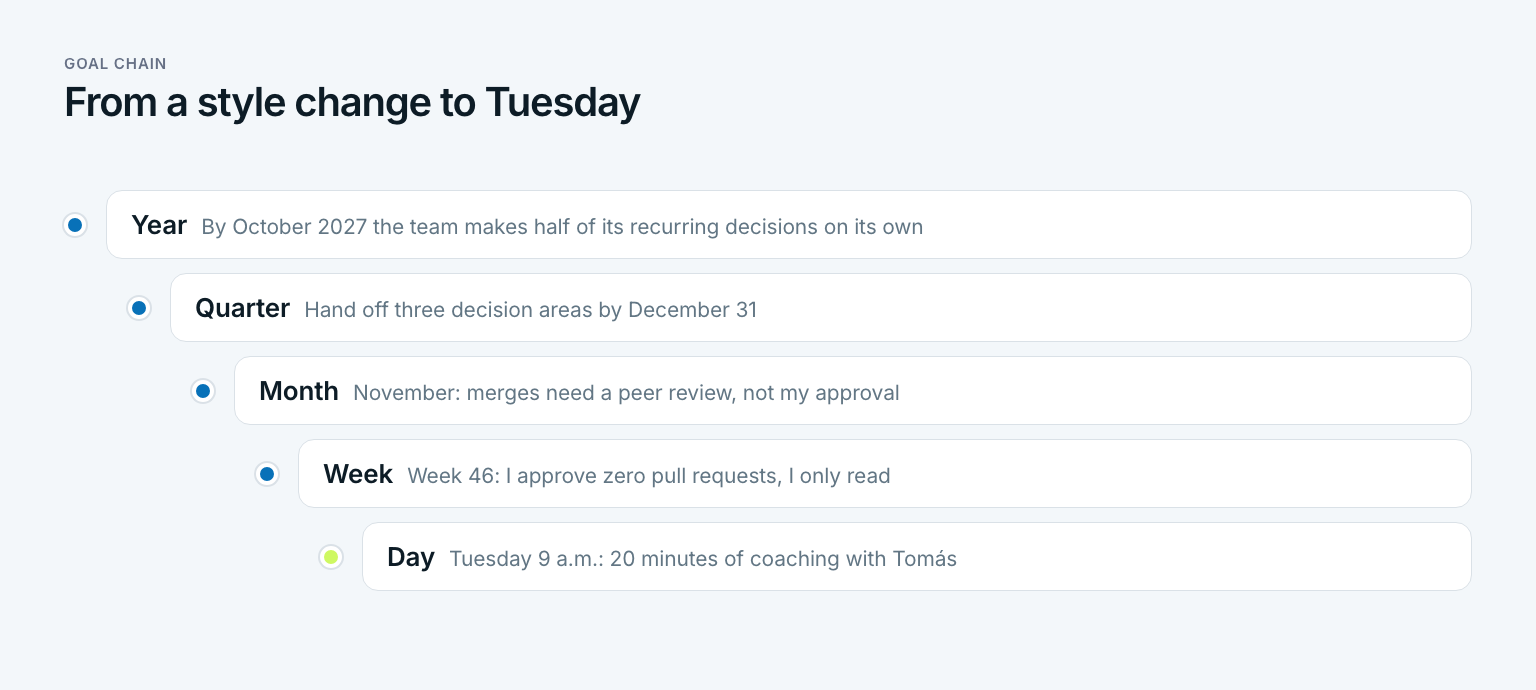
The yearly goal puts the style Priya wants into a number: by October 2027, the team makes half of its recurring decisions without her. The quarterly goal is the first stage: hand off three decision areas by December 31, namely merges, incident calls and sprint scope trades. In November, merges are up first. In week 46, Priya approves zero pull requests and only reads them. And on Tuesday at 9 a.m., she spends 20 minutes with Tomás on incident triage so he can lead his next on-call shift.
This is a leadership goal, not a team goal. The team target, 85 percent of sprint commitments, is now set with the team, as described in the guide to team goals. How to agree on individual goals with each engineer is covered in goal setting for employees. In Gaapp, both kinds of goals sit side by side, and the chain from year to day stays visible instead of vanishing until the annual review.
After ten weeks, the team delivers 79 percent of its sprint commitments. The target of 85 is not reached yet. But during Priya's vacation week in December, no pull request waited more than a day. Is that proof her new style is better? Not proof. But a strong sign that the team no longer works only under supervision.
Your Self-Audit: Five Questions About Your Leadership Style
Five questions show you which style your team is actually experiencing. Answer them in writing, with real examples from last week:
- Which three decisions did you make alone last week that someone on your team could have made?
- When did you last ask for input after you had already decided?
- What happens on your team when you are unreachable for a week?
- Does your team know which decisions it can make on its own, and could it list them?
- In which situation does your team want clearer direction from you?
Whoever hesitates on the third question should start with step one: two weeks of logging decisions. Leadership styles are not a label you choose once. They are the answer you give your team every single day.
Leadership Styles FAQ
What is situational leadership?
Situational leadership is a model by Paul Hersey and Ken Blanchard from 1969. It says the right style depends on how ready a person is for a specific task, and it names four styles: telling, selling, participating and delegating. Research supports the model only in part, but the core idea of switching styles on purpose holds up well.
What's the difference between leadership and management?
John Kotter described the difference in 1990: management copes with complexity through planning, budgeting and control, while leadership copes with change through direction, alignment and motivation. Most managers need both every week. A leadership style describes how you handle the people side of that work.
What is transformational leadership?
Transformational leadership is a style in which the manager motivates people through a shared direction, a personal example, intellectual challenge and individual attention. The idea comes from James MacGregor Burns in 1978 and Bernard Bass in 1985. Research links it to higher satisfaction and performance, especially when combined with clear targets.
Why is leadership style important?
Your style shapes how your team works when you are not in the room. Goleman found that leadership style had a measurable effect on team climate, and climate affected results. Gallup reported in 2015 that managers account for at least 70 percent of the variance in employee engagement across business units.
What are the main types of leadership styles?
The most cited types are autocratic, democratic and laissez-faire from Lewin, the six styles from Goleman, and transformational, transactional and servant leadership. Lists differ because they come from different models. Sorting them by who makes the decision makes them easier to compare.
What is the best leadership style for managers?
No style is best in every situation. Direct instruction helps in a crisis and with new people, while shared or delegated decisions work better with open questions and experienced teams. The style that performs worst in research is laissez-faire, meaning leadership that does not happen at all.
Last updated: 22 October 2026
Read next
 Leadership & Teams
Retrospective: How Teams Learn From Every Sprint
A retrospective is not a blame session: what the word means, five phases, seven retrospective examples and action items that stick, shown on one team.
16 min read
 Leadership & Teams
How to Delegate Tasks: Hand Off Work, Keep Results
Delegation is not dumping work: five levels of delegation, seven steps, a handoff script and what to keep, shown on one marketing team.
15 min read
 Leadership & Teams
Micromanagement: Signs, Causes and How to Stop It
Micromanagement is not attention to detail: nine signs, real examples, causes, effects and five steps out, for managers and the people they manage.
15 min read