How to Delegate Tasks: Hand Off Work, Keep Results
Delegation is not dumping work: five levels of delegation, seven steps, a handoff script and what to keep, shown on one marketing team.

Contents
- 01What Delegation Means and What It Is Not
- 02Why Leaders Hold On: Three Reasons, Weighed Fairly
- 03Which Tasks to Delegate and Which to Keep
- 04The Five Levels of Delegation
- 05How to Delegate Tasks in Seven Steps
- 06Who's Got the Monkey: How to Stop Reverse Delegation
- 07How to Delegate as a Leader: From Yearly Goal to Tuesday
- 08Delegation Examples by Role
- 09How to Delegate Effectively: Three Quiet Mistakes
- 10Self-Check: Are You Delegating Well?
Delegation is not dumping work on someone else. Knowing how to delegate tasks means handing over a piece of work together with the authority to make decisions about it and the responsibility for the result. Anyone who only passes along tasks spreads the load. Anyone who delegates spreads decisions, and that is what makes a team faster than its manager.
Three things decide whether delegation works: picking the right task, agreeing on how much independence comes with it, and setting a check-in before anyone starts. This guide walks through all three with Dana, 37, marketing manager at a regional credit union in Minneapolis. She leads five people and works 55 hours a week. Along the way you get the five levels of delegation, seven steps you can copy, a handoff conversation in five sentences, the tasks you should never hand off and examples by role.
What Delegation Means and What It Is Not
Delegation is the transfer of a task, the authority to act on it and the responsibility for the outcome from one person to another. All three have to travel together. Hand over the task without the authority and you have given an instruction, not a delegation. Hand over the authority without a clear outcome and you have given away control.
Management writers have long called this the parity principle: authority should match responsibility. Whoever is asked to resolve a vendor dispute but cannot approve a $200 credit will bring every single case back to your desk. That is not a people problem. It is a design problem.
It also helps to be clear about what stays with you. The person who takes on the task owns doing it well. You still own the choice of person, the briefing and the check-ins. That means: you can hand off the work, but not the responsibility for having handed it off well.
| Term | What gets handed over | What stays with you |
|---|---|---|
| Assigning | An activity with a fixed process | Every decision |
| Delegating | Task, authority and responsibility for the result | Choosing the person, briefing, check-ins |
| Dumping | Unpleasant work with no goal and no authority | Nothing, until it goes wrong |
| Reverse delegation | Nothing, the task comes back to you | Everything, including the work |
Dana knew the difference in theory. In practice, her version of delegation was a message in the team chat saying who takes which request. She still made every call herself, from the color of a banner to the wording of a member email.
Why Leaders Hold On: Three Reasons, Weighed Fairly
The reasons managers give for not delegating are not foolish. Most of them are true. They are just true for a week, not for a year. Three come up on almost every team:
- “It is faster if I do it myself.” True the first time. Dana builds the weekly dashboard for the executive team in three hours. Marcus, her analyst, would need five at first. By the tenth week, the math looks very different.
- “Nobody will do it as well as I do.” Often true at the start. The real question is whether the result is good enough. A dashboard that matches Dana's version 90 percent of the way does its job completely.
- “My team is already at capacity.” Sometimes correct. Then delegation also means deciding what to drop. More often the team is busy with work that sits below what they can do.
Peter F. Drucker suggested in The Effective Executive, published in 1967, that managers log their time for a few weeks and then test every activity with a handful of questions. One of them asks, in essence, which of these activities could be done by somebody else just as well, if not better. Whoever answers that question honestly almost always finds more than expected.
Here is what the dashboard handoff looks like over one quarter. In the first two weeks Dana builds it together with Marcus, which costs her one extra hour each week. From week three she spends 30 minutes reviewing instead of three hours building. That saves 2.5 hours a week. After 13 weeks she is up about 25 hours net. Anyone who only looks at week one sees only the cost.
Then there is the part no time sheet captures. Hackman and Oldham described in their Job Characteristics Model in 1976 how autonomy raises the sense of being responsible for one's own results. Daniel H. Pink brought the idea to a wide audience in Drive in 2009. Delegation is not only relief for the manager. It is one of the most direct answers to the question of how to motivate employees.
Which Tasks to Delegate and Which to Keep
Dana took Drucker's advice and logged her time in 30-minute blocks for two weeks. The result: 55 hours a week, about 11 of them spent on work someone else on the team could do just as well. She sorted each item with three questions. Do I have to do this because I am the manager? Could someone on the team do it after a short handoff? Would it help that person grow?
| Task | Hours per week | Decision | To whom |
|---|---|---|---|
| Weekly dashboard for the executive team | 3 | delegate | Marcus, wants more leadership exposure |
| Social media calendar | 3 | delegate | Kevin, already writes most posts |
| Vendor invoice checks under $2,500 | 2 | delegate | Rosa, manages the vendor list |
| Logistics for member events | 2 | delegate | Rosa |
| Newsletter proofreading | 1 | delegate | Kevin |
| One-on-ones and feedback | 5 | keep | Leadership task |
| Hiring and performance reviews | 2 | keep | Leadership task |
| Budget meetings with the executive team | 4 | keep | Leadership task |
For a first pass, the Eisenhower Matrix helps: urgent but less important tasks are the classic candidates. It is built for deciding what you do first, though, not who does it. That is why a second look pays off. Some important tasks belong with someone else too, because for them the task is the next step in their development.
Tasks you should not delegate
Drucker argued that an executive is paid to make a contribution only that role can make. Applied to delegation, a short list stays with you no matter how busy you are:
- Setting direction and priorities. You can involve the team, but you own the decision about where it goes.
- Feedback and performance reviews. Whoever judges a person's work needs the role to do it.
- Hiring, promotion and termination. These decisions carry legal and human weight that belongs with the manager.
- Confidential matters. Pay, health issues and personal crises of team members stay in your hands.
- Conflicts and crises. When things go wrong, the team expects to hear from its leader, not a stand-in.
In short: you can delegate the doing, almost never the judging.
The Five Levels of Delegation
Delegation is not an on or off switch. Between “do exactly this” and “decide for yourself” there are several levels. Robert Tannenbaum and Warren Schmidt described a continuum of leadership behavior in Harvard Business Review back in 1958, ranging from a manager who decides alone to a team that decides freely within limits. The levels mirror the familiar leadership styles, from autocratic to democratic, applied to a single task. For daily use, a simple five-level model works well, such as the one Michael Hyatt uses in Free to Focus.
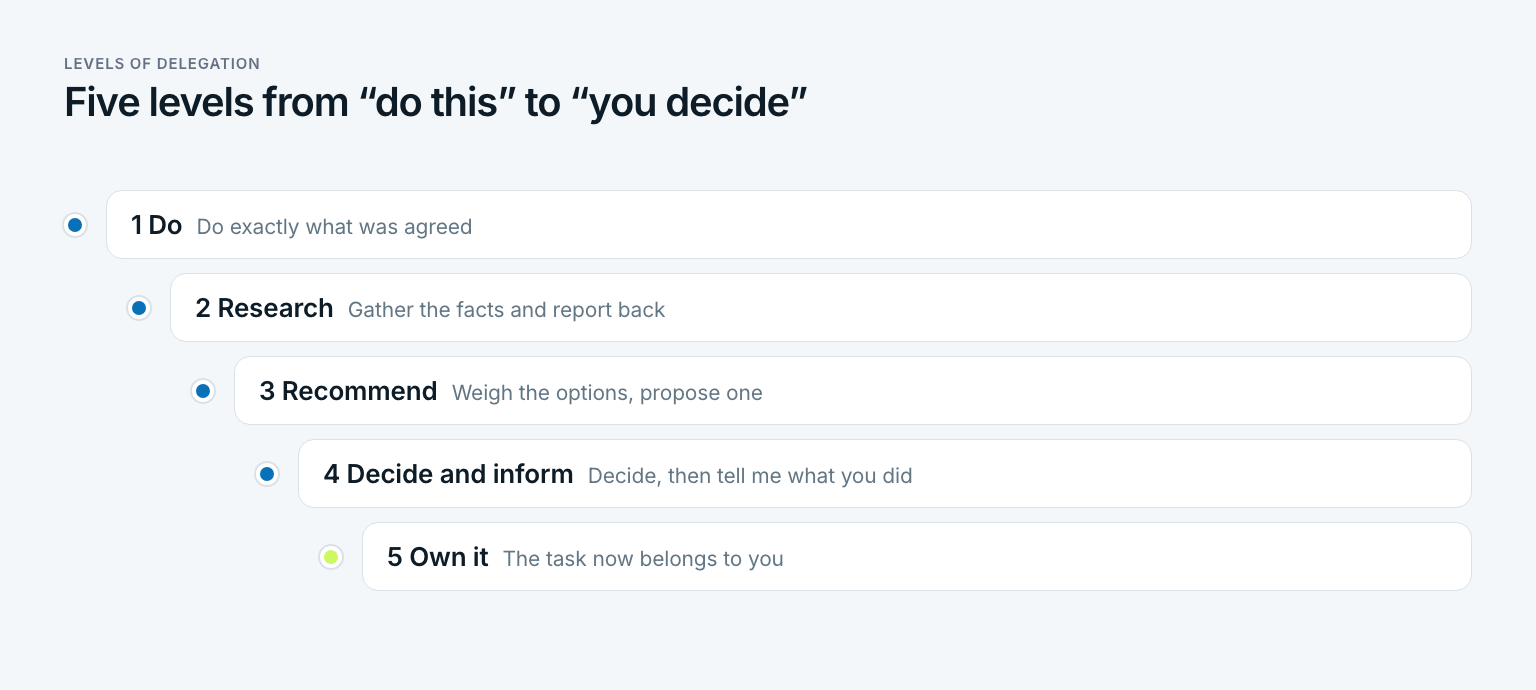
| Level | What you say | When it fits | On Dana's team |
|---|---|---|---|
| 1 Do | Do it exactly this way. | New person, task with a fixed process | Marcus builds the first dashboard from Dana's template |
| 2 Research | Look into it and report back. | You need facts but want to decide yourself | Kevin checks which channels actually drive sign-ups |
| 3 Recommend | Look at the options and recommend one. | The person knows the topic, you know the consequences | Rosa recommends a venue for the spring member event |
| 4 Decide and inform | Decide, then tell me what you did. | Experience is there, the stakes are manageable | Rosa approves vendor invoices under $2,500 |
| 5 Own it | Do what you think is best. | Full experience, the task now belongs to them | Kevin runs newsletter proofreading on his own |
The right level does not depend on the person in general. It depends on the person with this particular task. Andrew S. Grove called this task-relevant maturity in High Output Management in 1983: the same employee can be at level four with vendors and level one with reporting. Anyone who gives a person one fixed level for everything will underchallenge them on one task and overwhelm them on another.
Jurgen Appelo proposed a finer scale of seven levels in Management 3.0, running from simply telling to fully delegating. It is useful for teams that make many decisions together. For a manager's first round of delegation, five levels are enough. What matters is that both sides mean the same level.

How to Delegate Tasks in Seven Steps
How to delegate tasks well comes down to describing the result so clearly in advance that nobody has to argue about it at the end. Edwin A. Locke and Gary P. Latham summarized in 1990 that specific, challenging goals lead to better performance than being told to do your best. That holds for a delegated task as much as for a yearly goal, as the article on goal setting theory shows. Dana ran the seven steps first with the weekly dashboard.
Pick the task, 10 minutes
Choose a recurring task from your time log that would be a step up for someone on the team. Dana chose the weekly dashboard: three hours a week, a clear format, and Marcus had told her in his last review that he wanted more exposure to senior leadership.
Define the result, not the method, 15 minutes
Write down how you will know the task is done well. For Dana: the dashboard reaches the executive team every Monday by 9 a.m., shows new members, email sign-ups and cost per lead against the prior week, and explains every change above 5 percent in one sentence.
Choose the person, 5 minutes
Match the task to interest and capacity, not just skill. Marcus had room after a project ended, and the dashboard would put his work in front of the people he wanted to learn from.
Set the level, 5 minutes
Name the level out loud. Marcus started at level one for the first dashboard and was meant to reach level four within three months, deciding on layout and commentary himself.
Grant authority and resources, 10 minutes
Clarify what the person can do without asking: access, budget, contacts. Marcus got access to the analytics account, permission to contact the finance team directly and freedom to rebuild the template as long as the three core numbers stayed.
Hold the handoff conversation, 45 minutes
Walk through result, purpose, deadline, level and check-ins, then ask the person to explain the assignment back in their own words. The read-back showed that Marcus would have counted cost per lead differently from the finance team.
Check in and give credit, 15 minutes each
Agree on fixed dates to look at progress and keep them. Dana and Marcus met every Friday afternoon for the first two months. After the sixth dashboard she told him in a short feedback conversation what worked and moved him up a level.
The handoff conversation in five sentences
Most delegations succeed or fail in this one conversation. Five sentences are enough if none is missing:
- Result: By the end, this is what exists, and this is how we will know it is good.
- Purpose: It matters because the executive team uses it to decide where next month's budget goes.
- Deadline: It is due Monday at 9 a.m., and I would like to see a draft on Friday at 3 p.m.
- Level and authority: You decide on layout and commentary, the three core numbers stay.
- Read-back: Tell me in your own words what you will do and when we will look at it together.
The last sentence feels awkward at first. It is the most important one. Whoever skips it finds out on the due date that two people had two different tasks in mind. If you want help with the conversation after the first round, the guide on how to give feedback to employees walks through it step by step.
Who's Got the Monkey: How to Stop Reverse Delegation
A delegated task has a habit of finding its way back. William Oncken and Donald Wass described this in Harvard Business Review in 1974 with an image that still shows up in leadership training: the monkey on your back. An employee comes in with a problem, the manager says “let me think about it,” and the monkey has jumped from the employee's back to the manager's.
It happened to Dana in week two. Rosa stopped by with an invoice that was 12 percent above the quote. Dana listened, said “leave it with me,” and by evening had a task back on her desk that she had just handed off. Why does this happen so easily? Because helping feels good and acts faster than asking a question.
The fixes are simple. End every one of these conversations by asking what the person will do next and when you will talk again. Ask people to bring a recommendation, not only the problem. And check the level: frequent questions often show that the authority is too small, not the person.
The most common mistake: half a delegation
The task is handed over, the decisions stay with the manager. Rosa was supposed to handle vendor invoices but could not approve anything above $500. So she asked about every invoice, and Dana felt confirmed that nothing ran without her. Anyone who hands off work without authority gets questions instead of relief. Since Rosa approves up to $2,500 on her own, about one invoice a week still reaches Dana.
Grove put the other side of the problem plainly: delegation without follow-through is abdication. The craft sits between two extremes. Whoever checks in constantly is quietly taking the task back. Whoever never checks in leaves the person alone with it. Agreed check-ins solve this, because both sides know in advance when you will look.
How to Delegate as a Leader: From Yearly Goal to Tuesday
Learning how to delegate as a leader means planning it like any other goal. Anyone who resolves to hand off more someday will do everything themselves again at the next crunch. Anyone who writes the handoffs into their goal chain has a date for them. Dana broke her plan down across all five levels.
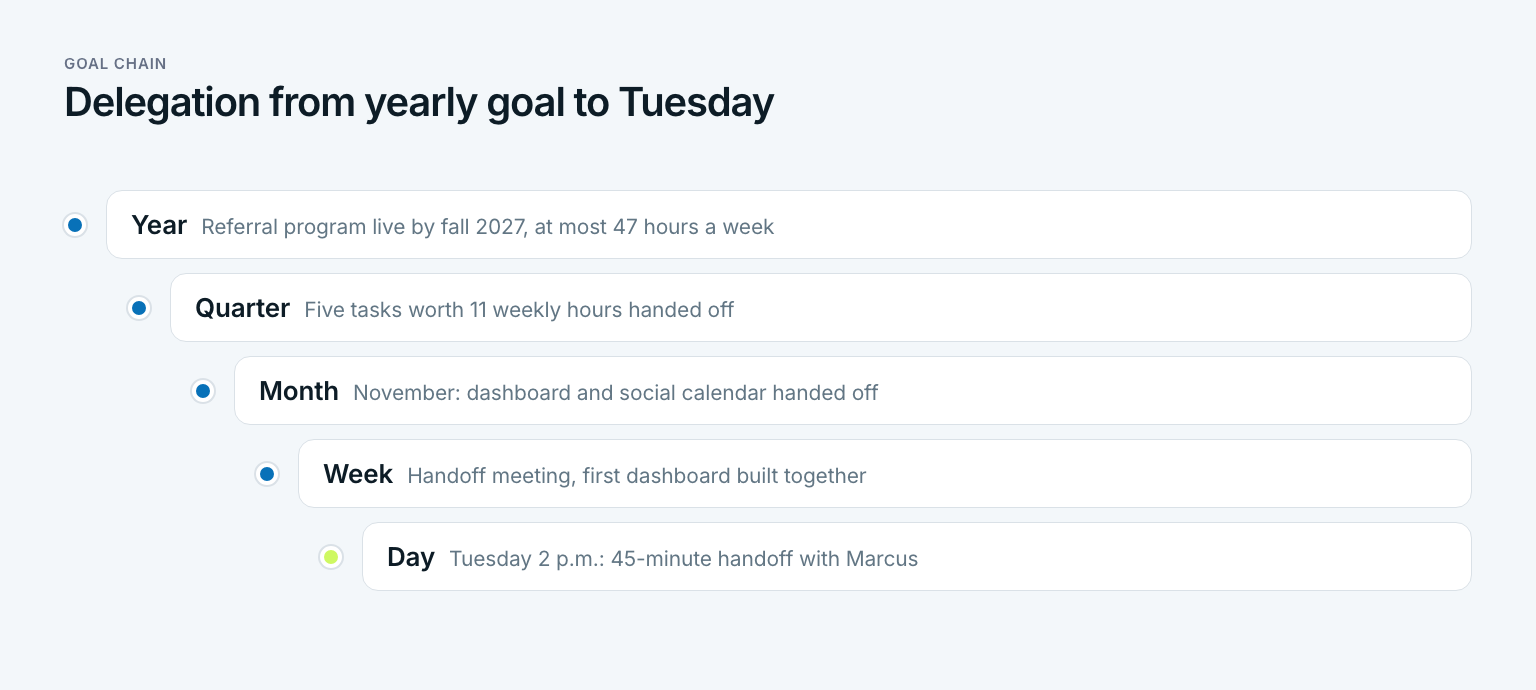
| Level | Dana's goal | How she measures it |
|---|---|---|
| Year | By fall 2027 the member referral program is live, and Dana works no more than 47 hours a week | Launch date, her own time tracking |
| Quarter | Five tasks worth 11 weekly hours are handed off and run without her | List of handoffs with their level |
| Month | November: dashboard to Marcus, social calendar to Kevin | First dashboard on time on a Monday at 9 a.m. |
| Week | Handoff meeting with Marcus, first dashboard built together | Marcus has explained the assignment back |
| Day | Tuesday 2 p.m., 45-minute handoff | On the calendar, not moved |
The yearly goal does not mention delegation at all. It describes the state Dana wants to reach. Delegating is the route there, so it lives at the quarterly and monthly level. She did not leave the freed hours open. She blocked three of them every week for the referral program. Otherwise free time fills up with new small work within days.
If you plan several handoffs at once, stagger them. Two a month is plenty for most teams. The article on goals for managers shows how to turn plans like this into your own leadership goals. In Gaapp you add the quarterly goal once, and the handoffs show up as weekly and daily goals where they belong.
Delegation Examples by Role
The principle is the same everywhere. The tasks are not. These examples show what task, level and check-in can look like in different roles:
| Role | Delegated task | Level | Check-in |
|---|---|---|---|
| Sales team lead | Pricing and sending quotes up to $5,000 | 4 | Friday list of quotes sent |
| Restaurant owner | Weekly produce order from two suppliers | 4 | Monday glance at the order and food cost |
| Dental office manager | Scheduling and no-show follow-up | 5 | Monthly no-show rate |
| Software engineering manager | Choosing a testing tool | 3 | Recommendation with two options by sprint end |
| New first-time manager | Running the weekly team meeting on rotation | 4 | Joint review after four weeks |
| Parent | Weekly grocery run by a 15-year-old with a fixed budget | 4 | Receipt on Saturday |
The last example is not a joke. Delegation works at home by the same rules as at work: a clear result, real authority, a check-in. Whoever hands a teenager the grocery list but dictates every brand has delegated only halfway.
Most teams start with routine tasks that are already documented. That makes sense. The second round should include tasks that are a genuine step up for someone. Only then does relief for the manager also become growth for the team.
How to Delegate Effectively: Three Quiet Mistakes
Half a delegation is the obvious mistake. Three more hardly get noticed, because they feel like good management:
- Always the same person. The most reliable team member gets everything. Six months later she is overloaded and nobody else has learned anything. That is why Dana spread her handoffs across three people.
- Handing over the method too. Whoever spells out exactly how to do the task keeps the person stuck at level one. Describe the result and leave the method open once the person knows the ground.
- No end to the handoff. If nobody ever says the task now belongs to the other person, it still feels like yours. Name the moment level five begins.
Behind all three sits the same cause: the manager hands off the task but not in their head. A regular one-on-one is a good place to talk about exactly that. Ask which task the person would like to take over completely.
Self-Check: Are You Delegating Well?
Five questions to ask yourself at the end of each month. If you hesitate on two of them, you have found your next step:
- Which three tasks did I do this month that someone on the team could do just as well?
- Does everyone who holds a task from me know which level they decide at?
- How often did a delegated task come back to me this month, and why?
- Does every delegated task have an agreed check-in with a date?
- Which task would help someone on my team take their next step?
Dana asks herself these questions on the last Friday of every month. After three months she was at 48 hours a week, one hour above target. The bigger change was elsewhere: Marcus now presents the dashboard to the executive team himself. In short: delegating does not mean leading less. It means letting more people take part in leading.
How do you say you can delegate tasks in a fancy way?
On a resume or in a review, phrases like “entrusted team members with ownership of,” “empowered direct reports to make decisions on” or “assigned and coached” sound stronger than “delegated.” Pair them with a result, for example: “Handed weekly executive reporting to an analyst, freeing three hours a week for the referral program launch.” The result is what makes the phrase credible.
What are the 7 steps of delegation?
There is no single official list, but a practical sequence is: pick the task, define the result, choose the person, set the level of authority, grant resources, hold a handoff conversation with a read-back, then check in and give credit. Each step closes a gap where delegations usually fail. The read-back in step six is the one most managers skip.
What are the 5 principles for effective delegation?
Five principles carry most of the weight: a clear result instead of a method, authority that matches the responsibility, the right person for this specific task, check-ins agreed in advance and credit that goes to the person who did the work. Missing any one of them usually leads to reverse delegation.
What is the best way to assign tasks to employees?
Match the task to the person's interest and capacity, describe the result and the deadline, and say how much they can decide on their own. Then ask them to explain the assignment back in their own words and set a first check-in date. That takes about 15 minutes and saves far more later.
What tasks should a manager not delegate?
Keep setting direction, feedback and performance reviews, hiring and termination decisions, confidential matters and handling conflicts or crises. These depend on the authority of the manager's role. Almost everything else can be delegated at some level.
What is reverse delegation?
Reverse delegation happens when a task you handed off lands back on your desk, usually through questions like “can you take a look at this?” Oncken and Wass called it the monkey jumping onto the manager's back in 1974. End each such conversation with the other person's next step and check whether their authority is large enough.
Last updated: 22 October 2026
Read next
 Leadership & Teams
Leadership Styles: Which One Fits Which Situation
Leadership styles are not personality types: 11 types compared, Lewin, Goleman, situational leadership and five steps to find the style that fits you.
14 min read
 Leadership & Teams
Retrospective: How Teams Learn From Every Sprint
A retrospective is not a blame session: what the word means, five phases, seven retrospective examples and action items that stick, shown on one team.
16 min read
 Leadership & Teams
Micromanagement: Signs, Causes and How to Stop It
Micromanagement is not attention to detail: nine signs, real examples, causes, effects and five steps out, for managers and the people they manage.
15 min read