Family Weekly Planner: Schedules, Dinners, Chores
A family weekly planner is not a calendar: a six-column family schedule template, six Sunday steps with kids and seven dinners, worked through one week.

Contents
- 01What a family weekly planner is and what it is not
- 02What actually happens in a family week: 34 texts by Friday
- 03The family schedule template: seven days, six columns
- 04How to make a weekly family schedule with kids: six steps on Sunday
- 05Dinner plan for the week: seven nights, one grocery run
- 06The worked example: Dana's family weekly planner for one week
- 07The three mistakes nobody notices
- 08The family weekly planner in the goal chain: from beach trip to Wednesday dinner
- 09Three questions before the plan goes on the fridge
- 10Frequently asked questions about family weekly planners
A family weekly planner is not a calendar. It is one page with seven days on which every appointment, ride, dinner, kids' chore and block of family time for the coming week sits side by side, with a name next to each task. A calendar answers when something happens. A family weekly planner answers who handles it, and it gets filled in together on Sunday, not by one parent at the kitchen counter at 10 pm.
That sounds like more work than it is. A 20-minute family meeting on Sunday is enough, plus a family schedule template with six columns. Everything below is worked through on one family: Dana, 41, a pharmacist in Columbus, Ohio, her husband Chris and three kids with soccer, piano, Cub Scouts and a preschool pickup at 3 pm. You get the template, six steps with kids, a dinner plan, a filled-in week and the three mistakes that end most family planners by week three.
What a family weekly planner is and what it is not
A family weekly planner has three fixed parts: one week, every family member on the same page and a name behind every task. Take one away and you have a different tool. Each of those tools is good. It is just built for something else.
| Tool | What it is built for | What it misses |
|---|---|---|
| Shared family calendar | Appointments with time and place, with reminders | Who drives, who cooks, anything a four-year-old can see |
| Meal plan | Seven dinners decided in advance, one grocery run | Everything except food |
| Chore chart | Fixed jobs for kids, often with stickers | The days and the schedule around the chores |
| Family weekly planner | All of it for seven days, each with a name | The long view, which comes from a goal |
Most families run two or three of these side by side. The meal plan is on the fridge, the calendar lives in a phone, the chore chart is taped to a bedroom door. The trouble sits in the gaps between them: whoever cooks on Wednesday should not be the same person who drives to Cub Scouts at 6:15 pm. Only a page that holds all of it shows that conflict before Wednesday arrives.
Mental load: the work no calendar shows
Mental load is the invisible thinking work of family life: remembering that the soccer uniform needs washing, that preschool closes early on Friday, that the milk is almost gone. It often lands on one person. A family weekly planner with a name next to every task moves that thinking work onto paper, where everyone can see it and where it can be shared.
What actually happens in a family week: 34 texts by Friday
Family weeks rarely fall apart over big things. They fall apart over small arrangements made fresh every day. Who picks up June? What is for dinner? Did anyone buy a present for Saturday's birthday party? Each question is tiny. Together they fill a week.
Here is how that looks for Dana. She works 30 hours a week across four day shifts, Monday to Thursday from 7 am to 2:30 pm. Chris works full time on a hybrid schedule. On Mondays and Wednesdays he is home by 4:30 pm, on Fridays by 2 pm, on Tuesdays and Thursdays not before 7 pm. Ava, eleven, plays travel soccer twice a week plus a Saturday game. Leo, eight, has piano on Tuesday and Cub Scouts on Wednesday. June, four, goes to preschool until 3 pm and has tumbling on Saturday morning. For the week of September 28, Dana kept a tally.
| What happened that week | Count | Who organized it |
|---|---|---|
| Fixed kids' activities | 7 | Dana |
| Rides and pickups | 16 | Dana 12, Chris 4 |
| Dinners with all five at the table | 3 of 7 | decided fresh every evening |
| Takeout orders | 3, $142 in total | decided around 6 pm |
| Messages in the family group text, Monday to Friday | 34 | Dana sent 26 |
| Forgotten things | 2 | a permission slip and a birthday present |
The week worked. Still, the table shows three things Dana had only felt before. First, most of the organizing sat with her: twelve of 16 rides and 26 of 34 messages. Second, dinner was the question that came back every single day, and three times the answer was takeout. Third, both forgotten things were simply on nobody's list.
Is that a problem? For one week, no. For a year, yes. $142 a week in unplanned takeout adds up to more than $7,000 over 50 weeks, and that is exactly the money the family is missing for the beach trip they want to take in summer 2027. That means: the family weekly planner is not about being tidy here. It is the place where a family goal either gets paid for or quietly eaten.
The family schedule template: seven days, six columns
The template is a table with seven rows and six columns, plus a header with three lines for the whole week. It fits on one landscape sheet and hangs on the fridge, where everyone walks past. More fields only make it fuller.
The header: three lines for the whole family
- Week and grocery day. For example “Week of October 12, groceries Monday 5 pm, Chris.”
- Family goal of the month. One sentence an eight-year-old understands. For Dana: “In October, $320 goes into the beach fund.”
- The one thing this week. Something you can answer with yes or no on Friday. For Dana: “Seven dinners planned, one grocery run, one takeout night.”
The six columns for each day
The day column explains itself. The other five follow the order in which a family week asks its questions: fixed times first, then food, then chores and last the time that stays free for everyone.
- Appointments and who drives. “5 pm soccer Ava, Chris drives” is an entry. “Soccer” alone is a reminder, not a plan.
- Dinner and who cooks. One dish and one name. Whoever cooks does not shop separately, because the weekly grocery run already covered it.
- Kids' chores. One job per kid per day, matched to age. For small kids, a picture instead of a word. The age table further down shows what fits when.
- Family time. At least two slots a week, with a time and without screens.
- Done. A check mark in the evening, a cross for whatever fell through. That takes one minute, and on Friday it is the only data you need.
| Day | Appointments and who drives | Dinner and who cooks | Kids' chores | Family time | Done |
|---|---|---|---|---|---|
| Monday | |||||
| Tuesday | |||||
| Wednesday | |||||
| Thursday | |||||
| Friday | |||||
| Saturday | |||||
| Sunday |
Parents who also plan their own week will find the personal layer in the guide to weekly planning.
Paper on the fridge or a family planner app?
Shared digital calendars are strong at appointments. They remind and sync to every phone. For the weekly plan they have one weakness: June cannot read and does not have a phone. Who sees the plan if it only lives inside an app? The adults, when they open it. A sheet on the fridge is seen by everyone, every morning.
Dana's family settled on a split. Appointments with times still go into the shared calendar, because it reminds. The family weekly planner hangs on paper on the fridge, because it gets seen. On Sunday both are matched in five minutes. In short: the calendar reminds, the family planner decides.
What an ADHD-friendly family planner looks like
Leo was diagnosed with ADHD last spring, and his row taught the family the most. Psychologist Russell Barkley describes ADHD in Taking Charge of ADHD as a problem less of knowing what to do than of doing it at the right moment. A planner cannot fix that. It can make the right moment visible.
- Colors before words. Every green entry is Leo's, so he finds his day in two seconds.
- One job, not a list. One chore per day, written as a verb: “Feed the cat.” Three chores in one box turn into zero.
- Time you can see. A start time next to every task and an analog clock next to the fridge. “Before dinner” is vague. “6 pm” is not.
- Checking off at the fridge. The check mark happens where the plan hangs, right after the task.
It is the same template with less text and more structure. Anyone who plans for a child with ADHD ends up with a page that works better for the rest of the family too.
How to make a weekly family schedule with kids: six steps on Sunday
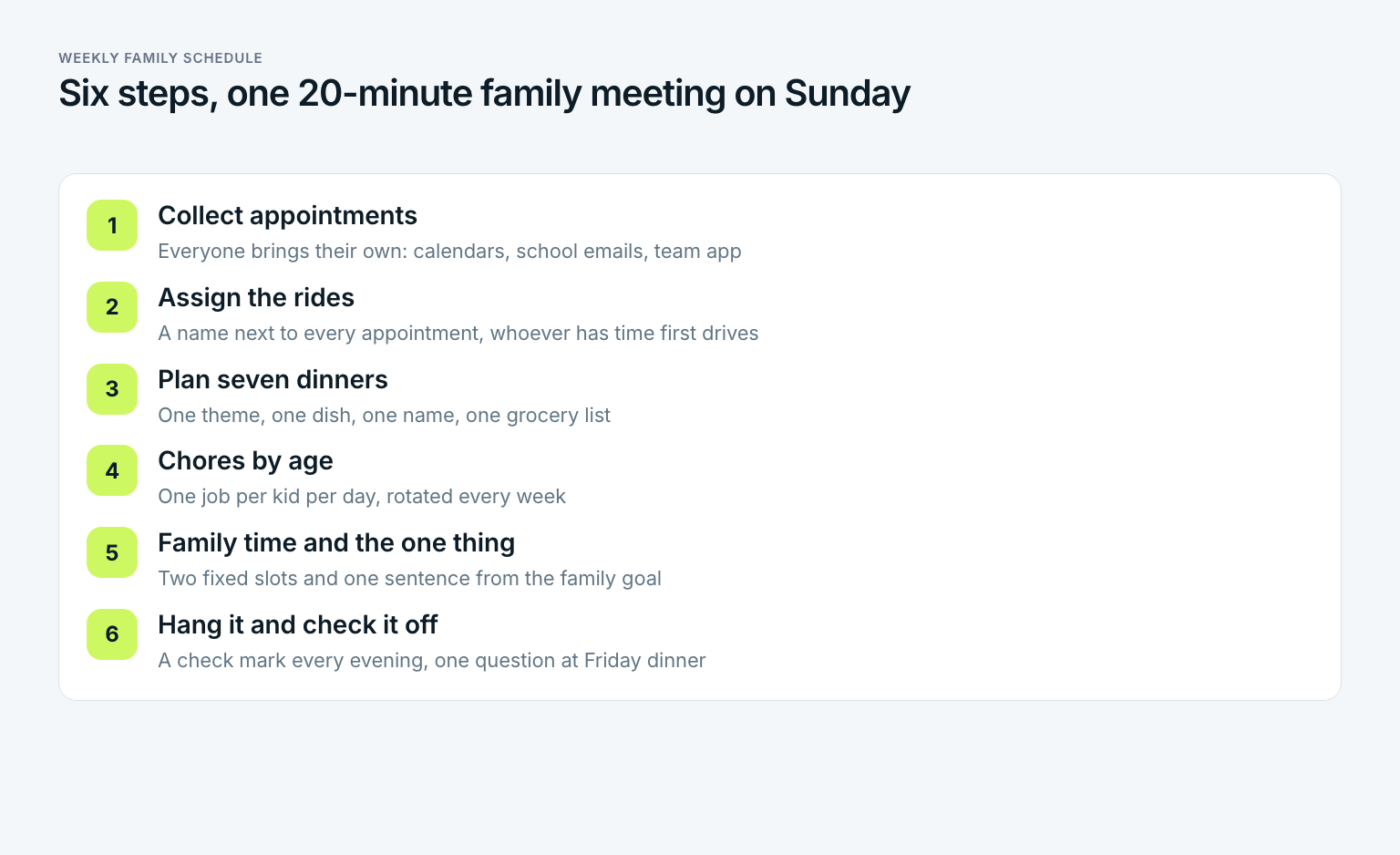
The plan gets made in a family meeting on Sunday, at Dana's at 5:30 pm before dinner. Everyone sits at the table, including June with her stickers. It takes 20 minutes, no longer. Whoever brings the kids to the table has less to explain during the week.
Collect appointments, five minutes
Everyone brings their own: calendars, school emails, the soccer team app. Everything goes into the appointments column with a time. For the week of October 12, Dana's family had nine entries, including a parent-teacher conference on Wednesday that only Chris had known about.
Assign the rides, three minutes
Next to every appointment goes a name. The rule at Dana's: whoever has time first, drives. Chris took Monday's soccer practice, because he is home by 4:30 pm, and both Wednesday rides. Dana went from twelve rides to eight.
Plan seven dinners, five minutes
One theme per night, one dish per theme, one name per dish. Each kid picks one dish for the week. Out of this comes one grocery list for Monday.
Hand out chores by age, three minutes
One chore per kid per day, rotated every week so nobody is stuck with the trash for good. The age table below shows what works when.
Set family time and the one thing, two minutes
Two fixed slots with a time: at Dana's, a bike ride Saturday at 4 pm and a pancake breakfast Sunday at 9 am. Then the one thing for the week goes into the header. It comes from the family goal of the month and gets checked on Friday.
Hang it, check it off, look back on Friday, two minutes
The sheet goes on the fridge. Every evening, whoever walks past checks off the day. On Friday at dinner there is one question: did the one thing work? If not, the answer goes into next Sunday's plan.
What kids can own at each age
A weekly family schedule only works if the kids are in it, not just their appointments. What they can take over depends mostly on age and less on mood. At Dana's it looks like this:
| Age | What the kid does in the planner | Example at Dana's |
|---|---|---|
| three to five | Pictures instead of words, small jobs like setting out spoons | June puts a spoon sticker on her days |
| six to eight | Own color, one fixed chore, one dinner wish per week | Leo picks Wednesday's baked ziti |
| nine to twelve | Writes own appointments in, two chores, cooks once a week | Ava writes in her soccer times |
| 13 and up | Plans their own week, takes over one dinner alone | Not yet at Dana's. Ava's turn comes in two years |
The table is a guide, not a rule. What matters is the direction: every year, a piece of planning moves from the adult to the kid. That means: the family weekly planner does not just take load off the parents. It teaches kids to plan, one column at a time.
Dinner plan for the week: seven nights, one grocery run
The dinner column is the one that saves the most time. Many families fill it in first, and sometimes only. That is a fine start. It works best with theme nights, because the question stops being what is for dinner and becomes which pasta.
| Day | Theme | Example from Dana's plan | Who cooks |
|---|---|---|---|
| Monday | Pasta night | Spaghetti with marinara and zucchini | Dana, 20 minutes |
| Tuesday | Soup or chili | Turkey chili, double batch for Thursday | Dana |
| Wednesday | Kids cook | Baked ziti with broccoli | Leo and Chris |
| Thursday | Leftovers | Chili from Tuesday with cornbread | Ava heats it up |
| Friday | Takeout night | Pizza, ordered at 5 pm | Chris orders |
| Saturday | Sheet pan | Sheet-pan chicken with potatoes | Chris |
| Sunday | Long family dinner | Tacos with everything on the table | everyone |
Two nights carry this plan. Tuesday cooks for Thursday, the night Chris gets home late and Ava has soccer until 6:30 pm. And Friday is takeout night. Sounds like cheating? It is the opposite. One planned order replaces three spontaneous ones, and the kids know there is pizza on Friday, so nobody asks on Tuesday.
Family dinner ideas everyone will eat
Dana's week rotates through about 15 dishes that all five of them like. That is not a lack of imagination. Familiar dishes go faster and actually get eaten. So the plan only needs a fixed list to pick from each week. At Dana's it hangs inside a cabinet door.
- Fast, under 20 minutes: pasta with marinara, pancakes for dinner, quesadillas, build-your-own wraps.
- Good for two nights: turkey chili, lentil soup, meat sauce that turns into lasagna.
- Kids can cook along: baked ziti, sheet-pan pizza, baked potatoes with toppings.
- For the long weekend dinner: roast chicken, tacos, oven-baked fish.
A seven-day dinner plan comes out of this in five minutes: set the themes, pick from the list, let each kid choose one dish, write the grocery list. Whoever plans this way shops once a week instead of five times. For the week of October 12, Dana's family had one big grocery run on Monday and one short stop for milk on Thursday.
The worked example: Dana's family weekly planner for one week
This is what the template looked like at Dana's after the Sunday meeting. The header reads “Week of October 12, groceries Monday 5 pm, Chris,” the family goal “In October, $320 goes into the beach fund” and the one thing “Seven dinners planned, one grocery run, one takeout night.”
| Day | Appointments and who drives | Dinner and who cooks | Kids' chores | Family time | Done |
|---|---|---|---|---|---|
| Monday | 3 pm preschool, Dana. 5 pm soccer Ava, Chris drives and shops with Leo | Spaghetti with marinara, Dana | June sets out spoons, Leo takes out the recycling | none | yes |
| Tuesday | 3 pm preschool, Dana. 4:30 pm piano Leo, Dana drives with June | Turkey chili, double batch, Dana | Ava empties the dishwasher, June feeds the cat | none | yes |
| Wednesday | 3 pm preschool, Dana. 5:30 pm parent-teacher conference, Dana. 6:15 pm Cub Scouts Leo, Chris | Baked ziti, Leo and Chris | June sorts socks, Ava sets the table | none | yes |
| Thursday | 3 pm preschool, Dana. 5 pm soccer Ava, Dana | Chili and cornbread, Ava heats it up | Leo feeds the cat, June waters the plants | none | partly |
| Friday | 3 pm preschool, Chris | Pizza, Chris orders at 5 pm | Ava empties the backpacks, Leo sets the table | 5:30 pm pizza and one question | yes |
| Saturday | 9 am tumbling June, Dana. 11 am game Ava, Chris. 2 pm birthday party Leo, Dana | Sheet-pan chicken, Chris | Everyone tidies their room for ten minutes | 4 pm bike ride | yes |
| Sunday | 5:30 pm family meeting | Tacos, everyone | June and Leo set the table | 9 am pancake breakfast | yes |
On Friday at dinner the answer to the one thing was: yes, so far. On Sunday Dana counted. Seven dinners were planned, six ran as planned and Thursday only partly, because the chili did not stretch for five and Ava made grilled cheese on top. The family group text had eleven messages from Monday to Friday instead of 34. Dana drove eight times, Chris six. Nobody forgot anything.
Then there is the money. Instead of $142 for three takeout orders, there was one for $42. The grocery run cost $16 more than usual. That left $84, which Dana moved into the beach fund with Ava on Sunday. Four weeks like that make $336, just over the monthly goal. That means: the family weekly planner did not just bring quiet into the week. It paid for a piece of next summer.
The three mistakes nobody notices
Family planners rarely fail on the first Sunday. They fail in week three, quietly, from mistakes that do not feel like mistakes.
- One person plans for everyone. The plan exists, but the responsibility stays where it was. Whoever did not help make the plan does not feel that it is theirs.
- Every afternoon is booked. A plan that fills every hour lasts until the first kid gets sick. Dana's rule: every kid gets at least two afternoons a week with nothing on them. Time management author Lothar Seiwert gives adults a similar rule: plan about 60 percent of your time.
- The plan hangs, but nobody looks back. After three weeks the sheet is decoration. Nobody checked whether the one thing worked, so nobody knows whether the plan helps. The Friday question turns a sheet into a habit. The ten-minute weekly review is the adult version of that question.
The most common mistake: one parent plans for everyone
The most common mistake is a plan that one adult writes alone on Sunday night and tapes to the fridge on Monday. It looks tidy, and it is well meant. But anyone who did not plan along does not feel responsible for the plan, and the questions still come, only by text. The fix costs 20 minutes: plan at the table, with everyone, and write a name next to every task.
All three mistakes share one root. The plan gets treated as a result instead of a conversation. Is a weekly plan nobody talks about still a plan? It is a notice board.
The family weekly planner in the goal chain: from beach trip to Wednesday dinner
A family weekly planner without a goal organizes the week. A family weekly planner with a goal moves something. The difference sits in a single line in the header of the template, the family goal of the month. Where does that line come from? From a chain that starts with the year and ends on a Wednesday night. Dana's family is saving for a beach house week on the Outer Banks in summer 2027. They started in July and fell behind: on October 1, only nine of 50 squares were filled.
| Level | Dana's family | Where it lives |
|---|---|---|
| Year | $4,000 for a week at the beach by June 30, 2027, without a credit card | Poster in the hallway with 50 squares worth $80 each |
| Quarter Q4 | $1,040 more, 13 squares by New Year's Eve | Poster, 13 squares to fill by December 31 |
| Month October | $320, mostly from the takeout budget | Header of the family weekly planner |
| Week of October 12 | Seven dinners planned, one grocery run, one takeout night | The one thing in the header |
| Wednesday | Leo and Chris cook baked ziti at 5:30 pm | Dinner column, Wednesday row |
For kids, a yearly goal is abstract. A square on a poster is not. Every Sunday Ava colors in a square when the week brought in its $80, and Leo knows that Wednesday's baked ziti is a small piece of the beach. Anyone who wants to explain a family goal to kids shows them the square, not the spreadsheet.
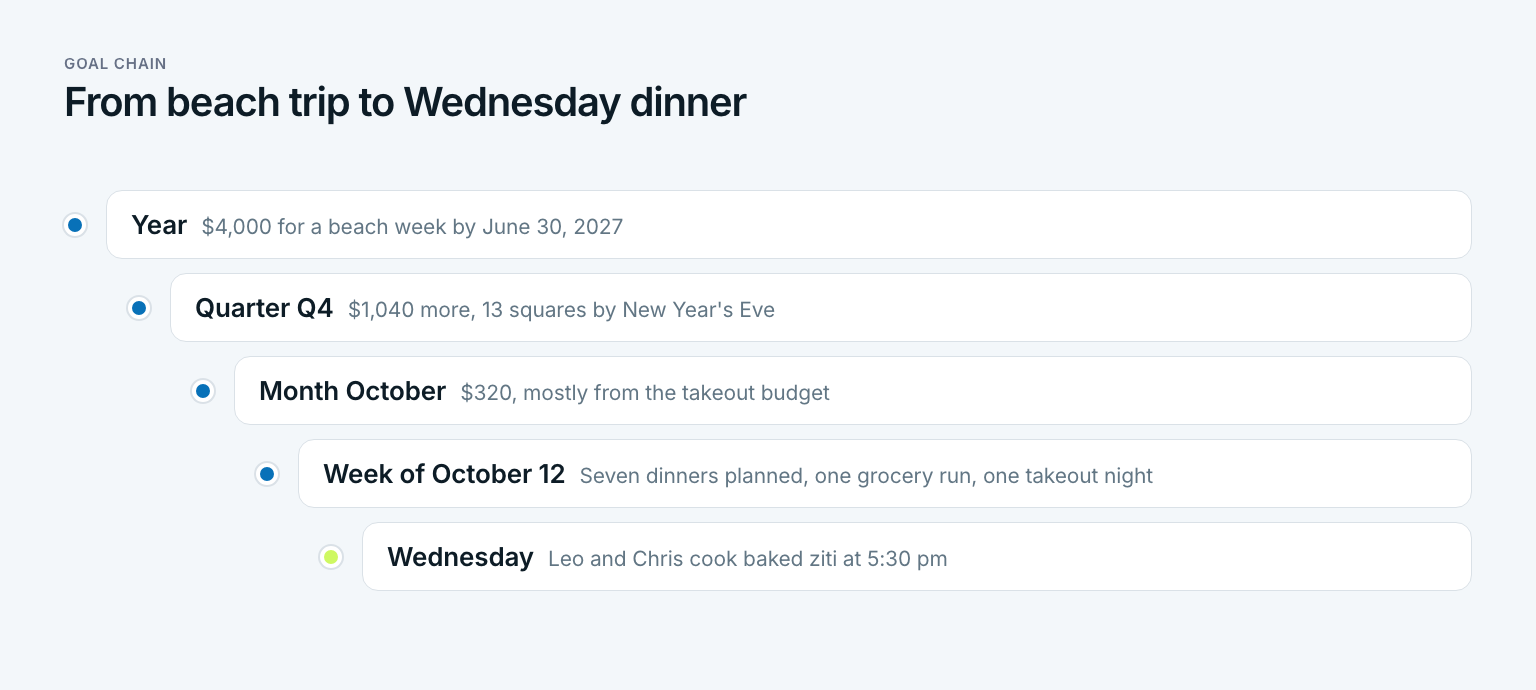
This chain can live in Gaapp: one family goal for the year with quarter, month and week below it, in a shared space both parents can see and check off. How a space for several people works is explained in the article on shared goals in a space. If the year itself still needs a plan, annual planning is the place to start.
Three questions before the plan goes on the fridge
At the end of the family meeting, before the sheet goes up, Dana checks three things. Each question takes ten seconds.
- Is there a name next to every appointment, and is it not the same name everywhere?
- Does every kid have at least two afternoons with nothing on them?
- Can the one thing for this week be answered with yes or no on Friday?
If any answer is no, the family fixes it right there, at the table, together. Whoever settles it in the meeting does not have to settle it by text during the week.
In short: a family weekly planner is not a list that one person writes and everyone else follows. It is a 20-minute conversation on Sunday that saved Dana 23 texts during the week.
Frequently asked questions about family weekly planners
What is the best family calendar planner?
The best family calendar planner is the one everyone in the family can see without opening anything. For most families that means two tools: a shared digital calendar for appointments with reminders and a paper family weekly planner on the fridge for rides, dinners and chores. The calendar reminds, the planner decides who does what.
What does an ADHD planner look like?
An ADHD-friendly planner uses less text and more structure: one color per person, one task per box, a clock time next to every task and a place to check off right where the plan hangs. It shows one week at a time, not a month. For a family, the same template works, with colors and pictures in place of sentences.
Is there a free weekly schedule planner available?
Yes. The family schedule template in this article is free: seven rows for the days and six columns for appointments and rides, dinner, kids' chores, family time and a done check. Copy it onto a sheet of paper or into a spreadsheet and print it in landscape format.
What is the best free app for managing family schedules?
For appointments, the shared calendars that come with Google and Apple accounts are free and sync to every phone in the family. They handle times and reminders well, but not who cooks or which chore belongs to which kid. Many families pair a free shared calendar with a paper weekly planner and match the two on Sunday.
How do I make a weekly family schedule?
Sit down together on Sunday for 20 minutes and go through six steps: collect appointments, assign rides, plan seven dinners, hand out chores by age, set family time and the one thing, then hang the plan and check it off each evening. The key is a name next to every task. On Friday, one question tells you whether the plan worked.
How do I get kids to actually use a family planner?
Let them write in it. Kids who mark their own activities, pick one dinner and check off their own chores treat the planner as theirs. Small kids work with stickers and pictures, older kids with their own color and their own entries.
Last updated: 6 October 2026
Read next
 Planning
Cleaning Schedule: Daily, Weekly and Monthly Tasks
A cleaning schedule is not a Saturday to-do list: daily, weekly and monthly tasks, a printable template and a fair split for families.
15 min read
 Planning
Study Plan: How to Make One You Can Actually Follow
A study plan is not a schedule. Make one in six steps: inventory, hours math, buffer, a sample study schedule and a template, with a worked example.
17 min read
 Planning
Bullet Journal: How to Start One You'll Actually Keep
A bullet journal is not an art project. Learn the bullets, four core modules, migration and a six-step setup, with an example, 12 ideas and a goal chain.
15 min read