Cleaning Schedule: Daily, Weekly and Monthly Tasks
A cleaning schedule is not a Saturday to-do list: daily, weekly and monthly tasks, a printable template and a fair split for families.

Contents
- 01What a Cleaning Schedule Is and What It Isn't
- 02What Actually Happens in a Cleaning Week
- 03Daily, Weekly and Monthly Cleaning Schedule: Three Speeds
- 04How to Make a Household Cleaning Schedule in Five Steps
- 05A Household Cleaning Schedule for Families: Chores by Age
- 06Printable Weekly Cleaning Schedule Template
- 07Three Mistakes Nobody Notices
- 08Your Cleaning Schedule in the Goal Chain
- 09Three Questions Before the Schedule Goes on the Fridge
- 10Cleaning Schedule FAQ
A cleaning schedule is not a to-do list for Saturday. It is a table that gives every household task a rhythm and an owner: what needs doing daily, weekly and monthly, who does it and how long it takes. That turns the weekend cleaning marathon into a series of short sessions that nobody dreads.
That sounds like paperwork for a mop. It is the opposite. Anyone who spends 30 minutes on a schedule once stops asking every week whose turn it is. Here is what it takes: three rhythms with concrete tasks, five steps to build your own schedule and a printable template. The worked example comes from Dana, Marcus and their two kids, who wanted their Sundays back.
What a Cleaning Schedule Is and What It Isn't
A cleaning schedule has three parts: a complete list of tasks, a fixed rhythm for each task and a name next to it. Drop any one of them and it stops working. A list without a rhythm becomes a checklist you finish once and forget. A rhythm without a name becomes a reminder that always lands on the same person.
Most households already use one of three tools that look like a cleaning schedule. Each one is useful. Each one is simply built for something else.
| Tool | What it's built for | What it's missing |
|---|---|---|
| Sunday deep clean | Getting the whole house spotless in one long session, so it looks great for a day | Spread across the week. By Wednesday the counters look like Sunday never happened, and the weekend is gone |
| Printable checklist | Collecting every task a home could need so nothing gets forgotten | Your actual week. It doesn't know you work late on Tuesdays and Thursdays |
| Kids' chore chart | Splitting small jobs among kids and rotating them | The adult jobs. Bathrooms, floors and the kitchen rarely show up on it |
| Cleaning schedule | Every task with a rhythm, a time estimate and an owner, matched to real work hours | Nothing essential, as long as you review it every four weeks |
The difference isn't the format. A cleaning schedule can be a sheet on the fridge, a shared spreadsheet or a whiteboard by the back door. What matters is that it fits your own week. That means: whoever copies another family's schedule also copies their work hours, and those almost never match.
What Actually Happens in a Cleaning Week
Homes rarely get messy because nobody cleans. They get messy because cleaning happens only when it can't wait any longer. Then it happens all at once, and usually by the same person.
That was the pattern for Dana, 39, a dental hygienist who works four days a week. She lives with her husband Marcus, 41, a software tester who works from home three days a week, and their kids Ava, 13, and Noah, ten, in a 1,800 square foot house outside Columbus, Ohio. Sunday was cleaning day, roughly from nine until two. In October, Dana tracked one ordinary week. Not to prove a point, just to see the numbers.
| What happened in one October week | Time | Who |
|---|---|---|
| Sunday deep clean: bathrooms, kitchen, floors, dusting | 5 hours | Dana 3.5 hours, Marcus 1.5 hours |
| Dishwasher, counters, wiping the stove | 2 hours across the week | Dana 1.5 hours, Marcus 30 minutes |
| Laundry: wash, dry, fold | 2.5 hours | Dana 1.5 hours, Marcus 1 hour |
| Trash and recycling | 20 minutes | Noah |
| Noticing that dish soap, trash bags and filters are running out | not measured | Dana |
| Conversations about whose turn it was | four, two of them tense | everyone |
The week wasn't a disaster. The house was clean by Sunday afternoon, and everyone had clean clothes. Still, one number surprised them both. Dana carried six and a half of close to ten hours. Marcus had guessed it was about even.
That gap isn't unusual. The American Time Use Survey, run every year by the Bureau of Labor Statistics, has consistently found that women spend more time on housework than men, even when both work full time. A household cleaning schedule won't fix that on its own. It does make the split visible, and you can only rebalance what you can see.
Mental load: the work before the work
Sociologist Allison Daminger described in the American Sociological Review in 2019 that housework has a cognitive side: noticing a need, weighing options, deciding and following up. None of it shows up in a time log, and it often sits with one person. A schedule with rhythms and names takes some of that load off. Anyone who can look up what's due no longer has to keep it in their head.
Daily, Weekly and Monthly Cleaning Schedule: Three Speeds
Every household task has a natural rhythm. It comes from two questions: how fast does it get dirty again, and how bad is it if it waits? A daily, weekly and monthly cleaning schedule simply maps those three speeds.
| Rhythm | Typical tasks | Time in Dana's house |
|---|---|---|
| Daily | Dishes or dishwasher, wipe counters and stove, clear the table, check trash, quick wipe of the bathroom sink, ten minutes of pickup in shared rooms | 15 to 20 minutes after dinner, split among three or four people |
| Weekly | Bathrooms: toilet, shower, mirror, floor. Vacuum and mop. Dust. Change sheets. Clear out the fridge. Wash towels | about three hours, split into four short sessions |
| Monthly | Wipe out the fridge, clean the oven and microwave, descale the coffee maker, baseboards, drains, vacuum mattresses, wash trash cans | about two hours, one task per week |
| Seasonal | Windows inside and out, clear and wipe closets, light fixtures, wash curtains, garage, gutters | two fixed weekends a year, in April and October |
What to clean every day
The daily reset is short and has a single job: stop things from piling up. Dishes, counters and a quick look at the bathroom are enough. Whoever plans more than that overloads the week and quits by Thursday. In Dana's house the reset starts at 7:30 pm, right after dinner. Noah clears, Ava loads the dishwasher, Marcus wipes the stove and counters, and Dana does the bathroom sinks.
A fixed time is what makes it stick. A task without a time depends on motivation, and motivation is thin after a long workday. A task that follows dinner depends on a habit instead. This is called habit stacking: you attach a new routine to one that already exists. Small jobs that take less than two minutes follow a rule from David Allen's Getting Things Done: do them now instead of writing them down.
The weekly cleaning schedule: four short sessions beat one long Sunday
The weekly cleaning is the part that eats the weekend. It can be split. Instead of doing everything on one day, each area gets its own weekday. Bathrooms on Monday, floors on Wednesday, dusting and sheets on Thursday, kitchen deep clean on Friday. Each session takes 30 to 45 minutes and fits into a normal evening.
Isn't that the same amount of work? In minutes, almost exactly. The difference is how it feels. Four sessions of 40 minutes are not the same as five hours in a row, and you can put them on days when someone actually has time. For Marcus, that means his work from home days.
Monthly tasks: one per week
Monthly tasks are the ones most often forgotten, because they come around just rarely enough to slip your mind. The simplest fix: each week of the month gets exactly one. Week one is the fridge, week two the oven, week three descaling and drains, week four baseboards and mattresses. The schedule never shows more than one extra task, and after four weeks everything has been done once.
How to Make a Household Cleaning Schedule in Five Steps
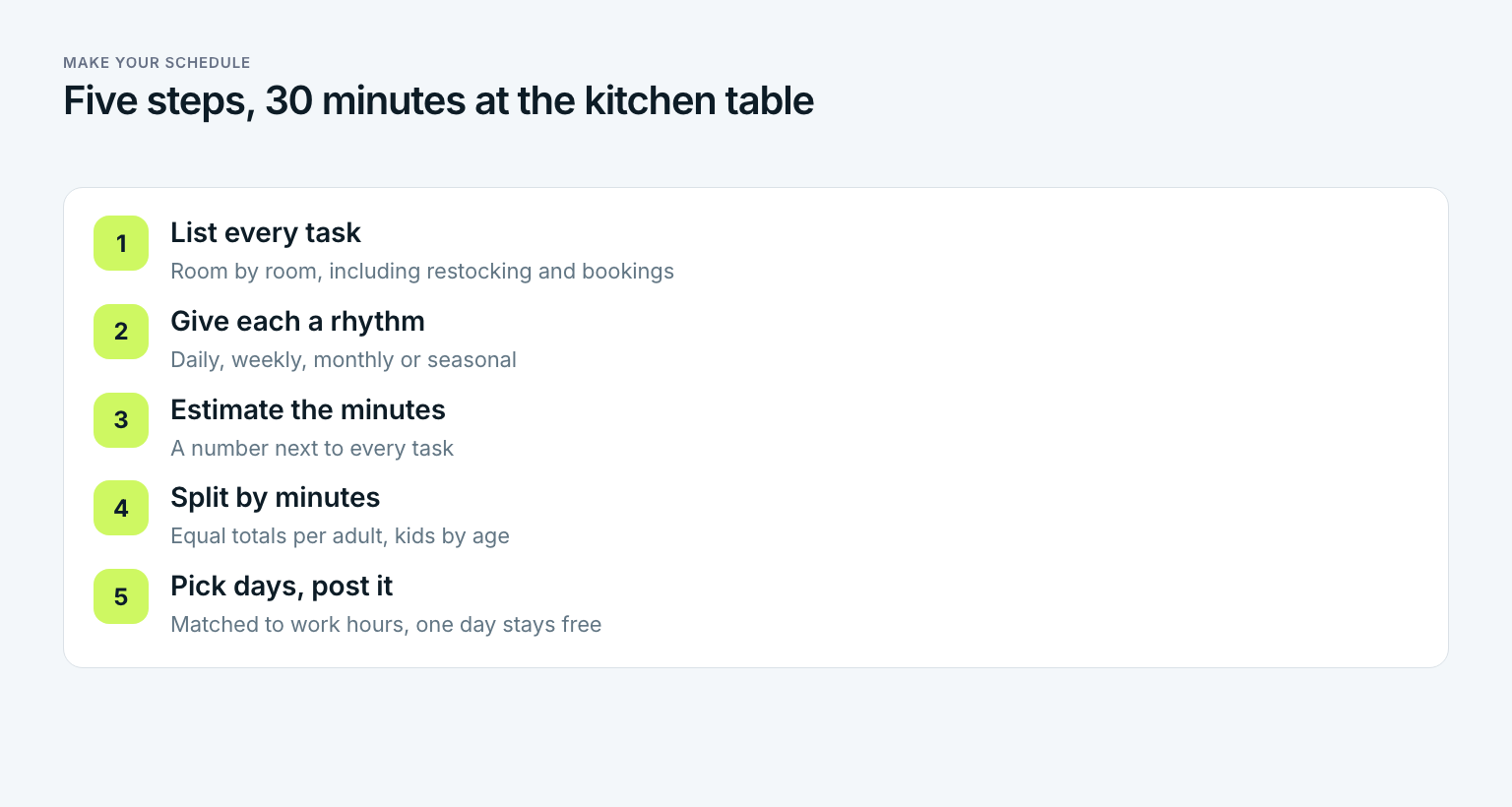
A good household cleaning schedule isn't written by one person at a desk. It's built at the kitchen table by everyone who lives there. Dana and Marcus took 30 minutes on a Sunday afternoon, and the kids joined for the last ten. The order matters, because each step depends on the one before.
List every task, ten minutes
Walk through each room in your head and write down everything that comes up regularly. Include the invisible work: restocking supplies, changing the furnace filter, booking the gutter cleaner. Dana and Marcus ended up with 38 tasks. Marcus had expected about 20.
Give each task a rhythm, five minutes
Daily, weekly, monthly or seasonal. The question isn't how often would be ideal, but how often is necessary. A weekly bathroom clean is enough for most homes. The mirror doesn't need to sparkle every day.
Estimate the minutes, five minutes
Put a number of minutes next to every task. Most templates skip this step, and it matters most. Only minutes show whether the split is fair. For Dana's house, the total came to just under four hours a week without laundry, more than three hours less than before, because the daily reset shrinks the big clean.
Split by minutes, not by number of tasks, five minutes
Three small tasks are not necessarily more work than one big one. So you split by time. Dana and Marcus agreed on about 80 minutes each per week. Ava takes 45 minutes and Noah 30. Laundry is handled separately and rotates between the adults by week.
Pick weekdays and post it, five minutes
Every weekly task gets a day that fits the work schedule. Whoever works late that day doesn't clean that day. The finished schedule goes where everyone sees it. In Dana's house that's the side of the fridge, with a pen on a string for checking things off.
After four weeks there is a short review. Which task kept getting pushed back? Who did more than planned? The schedule isn't a contract. It's a draft that adapts to real life. In Dana's case, floors had to move from Wednesday to Tuesday after the first month, because Wednesday turned out to be Noah's late soccer practice.
A Household Cleaning Schedule for Families: Chores by Age
A family cleaning schedule differs from a couple's in one way: kids get real jobs, not busywork. That doesn't only take pressure off the adults. Kids learn that a home is a shared project. If you also want to organize appointments, rides and dinners, the family weekly planner covers that. This section is only about cleaning.
| Age | What kids can own on a cleaning schedule | Example |
|---|---|---|
| three to five | Put toys in bins, match socks, wipe the table with a cloth, put away silverware | Five minutes of pickup before dinner, timed with one song |
| six to eight | Set and clear the table, dust low surfaces, tidy their own room, sort recycling | One fixed job for the whole week, swapped on Sunday |
| nine to twelve | Vacuum one room, empty the dishwasher, clean a bathroom sink, fold their own laundry | Noah, ten, takes out trash and recycling and clears the table every night |
| 13 and up | Clean a bathroom, mop floors, do their own laundry, own one weeknight in the kitchen | Ava, 13, vacuums upstairs on Wednesdays and cleans the kids' bathroom on Saturdays |
Treat the table as a guide. Some seven year olds love to vacuum, some twelve year olds still need a hand. More important than age is one rule: a job belongs to the child completely. Whoever is only allowed to help doesn't feel responsible for the result.
For Noah, one small change worked. His jobs sit on the schedule with a checkbox he fills in himself. On Sunday he counts them. There's no reward attached, just a sentence at dinner. A ten year old often doesn't need more than that.
A cleaning schedule for roommates: rotate, don't assign
Roommates use the same logic with one twist: the jobs rotate weekly. With three people there are three zones, for example bathroom, kitchen, and living room plus trash. Each week everyone moves one zone over. Nobody is stuck with the bathroom forever, and after three weeks everyone knows how much work each zone really takes.
Printable Weekly Cleaning Schedule Template
The template is a table with seven rows and four columns. It fits on one letter-size sheet in landscape and works just as well in a spreadsheet. Above it goes one header line with the week and that week's monthly task.
| Day | Daily reset, who | Weekly task, who, minutes | Done |
|---|---|---|---|
| Monday | |||
| Tuesday | |||
| Wednesday | |||
| Thursday | |||
| Friday | |||
| Saturday | |||
| Sunday |
Here is Dana's schedule for the first week of November, filled in. The 7:30 pm reset appears in every row. Weekly tasks sit on days when someone gets home early.
| Day | Daily reset, who | Weekly task, who, minutes | Done |
|---|---|---|---|
| Monday | all four, 15 minutes | Main bathroom, Dana, 35 minutes | yes |
| Tuesday | all four, 15 minutes | Floors downstairs, Marcus, 45 minutes | yes |
| Wednesday | Marcus and kids, Dana works late | Vacuum upstairs, Ava, 25 minutes | yes |
| Thursday | all four, 15 minutes | Dusting Noah, sheets Dana, 30 minutes | yes |
| Friday | all four, 15 minutes | Kitchen deep clean and monthly oven task, Marcus, 50 minutes | oven moved to Saturday |
| Saturday | light | Kids' bathroom, Ava, 20 minutes. Oven, Marcus, 20 minutes | yes |
| Sunday | off | off |
Sunday is empty on purpose. A schedule that fills every day has no buffer. As soon as a shift changes or a kid gets sick, the whole week tips over. An empty day absorbs that. Kevin Kruse argues in his book on time management that whatever isn't on the calendar tends not to get done, and the same is true of free time. Put the day off on the schedule, or it gets eaten.
Three Mistakes Nobody Notices
Cleaning schedules rarely fail in the first week. The first week almost always works, because everyone is motivated. They fail in week three or four, quietly and without a fight. Three mistakes are almost always behind it.
The most common mistake: a schedule without minutes
Most cleaning schedules split tasks, not time. On paper that looks fair: five tasks for you, five for me. But scrubbing a shower and taking out the recycling are not the same job. Anyone who feels after a month that they do more is usually right. The fix takes five minutes: put a minute estimate next to each task and split by the total.
- A schedule without minutes. It looks fair and isn't. After a few weeks the mood shifts, and nobody can say exactly why.
- A schedule written by one person. It's well meant and usually thorough. But whoever didn't help build it feels like staff, not like an owner. And the question “What should I do?” still goes to the person who wrote it.
- A schedule without a buffer. Every day is full, every minute assigned. It works until the first week doesn't go to plan. Then tasks pile up, and the big Sunday clean is back.
All three mistakes share a root. The schedule is treated as a finished document rather than an agreement you revisit. In short: a schedule that never changes is, after a month, a schedule for a household that no longer exists.
Why bother at all? Psychologists Darby Saxbe and Rena Repetti published a small study of couples in 2010. Women who described their homes with words like cluttered or unfinished showed a less healthy daily pattern of the stress hormone cortisol. That doesn't prove a cleaning schedule lowers stress. It does suggest that the state of your home is about more than looks.
Your Cleaning Schedule in the Goal Chain
A cleaning schedule without a goal keeps the house clean. A cleaning schedule with a goal protects something your family cares about. For Dana and Marcus that wasn't a spotless kitchen. It was Sunday. They wanted it back for Noah's games, for hikes at Hocking Hills, for a day without a list.
So they didn't set up the schedule as a chore project. They set it up as part of a yearly goal. The chain runs from the year down to a single evening.
| Level | Dana and Marcus | How they measure it |
|---|---|---|
| Year 2027 | Sundays belong to the family, cleaning under four hours a week and split evenly by minutes | Number of free Sundays, target 40 of 52 |
| Quarter Q4 2026 | Schedule in place and reviewed twice, the Sunday deep clean is gone | Sundays without cleaning since October |
| Month November | Every monthly task done once, nothing pushed back twice | Checkmarks on the schedule |
| Week of November 2 | Four weekly sessions plus the oven, Sunday off | Done column on Saturday night |
| Day Wednesday | Ava vacuums upstairs, Noah clears, reset at 7:30 pm | One checkmark that evening |
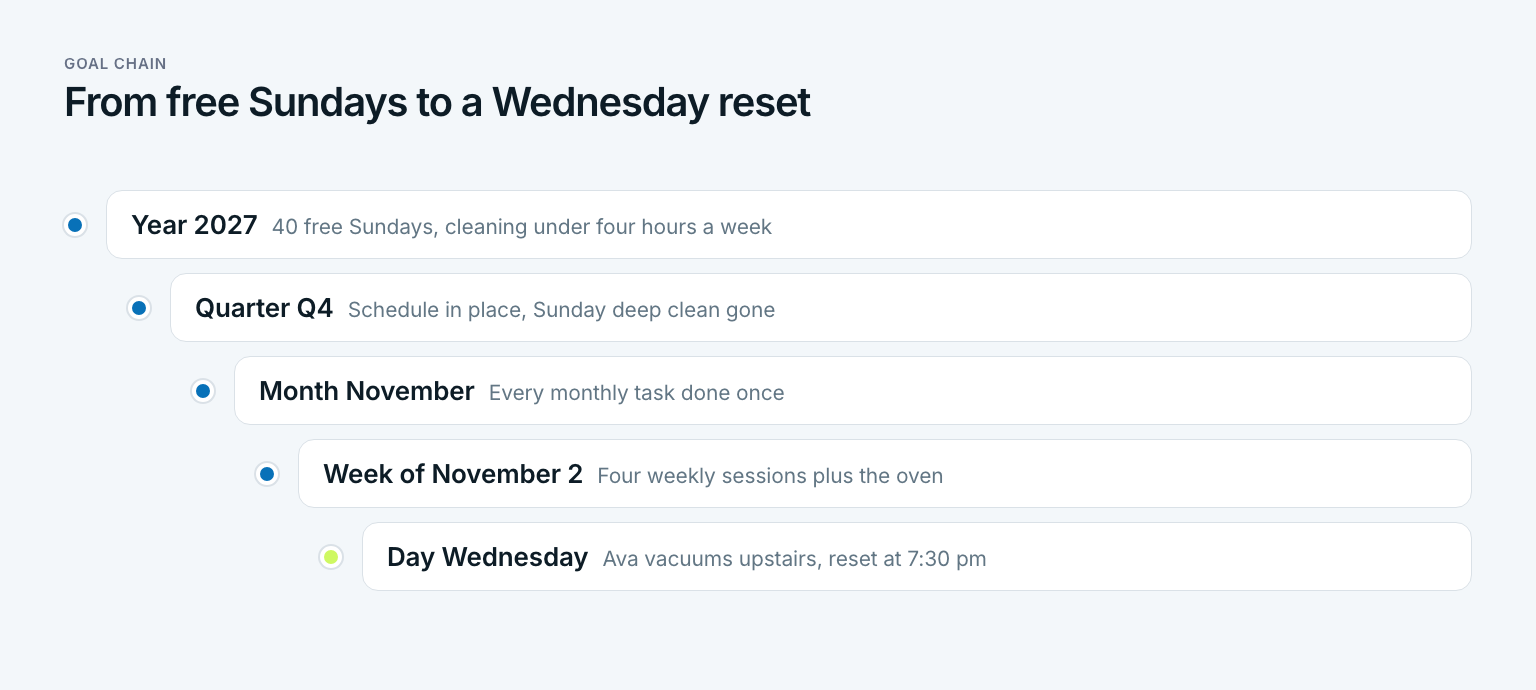
The chain changes the question people ask in the evening. Not “Do I have to clean tonight?” but “Are we keeping Sunday free?” That's a different motive. Whoever knows why they're scrubbing the bathroom for 35 minutes tonight puts it off less often. After eight weeks, Dana and Marcus had seven free Sundays. The one exception went to helping friends move, not to the mop.
You can keep the chain on paper or in an app. In Gaapp the yearly goal sits at the top, with quarter, month and week below it, and the Wednesday checkmark visibly adds up to the year. If you'd rather keep the sheet on the fridge, just add one line above it: the goal the schedule is there to protect. How a weekly task becomes an automatic part of the day is covered in daily routine. How long that roughly takes is explained in how long it takes to form a habit.
Three Questions Before the Schedule Goes on the Fridge
Before you post the cleaning schedule, run a quick check. Dana and Marcus ask these three questions again every month, during the review on the first Sunday.
- Does every task have a name and a minute estimate, and is the total per adult roughly equal?
- Is there at least one day with nothing on it, as a buffer?
- Does everyone in the house know what the schedule is for, meaning which goal it protects?
If any answer is no, fix it right away, together. It takes five minutes and saves a month of quiet resentment. Anyone who answers these three honestly ends up with a schedule that lasts longer than three weeks.
In short: a cleaning schedule isn't a way to clean more. It's a way to think about cleaning less.
Cleaning Schedule FAQ
What is the best weekly cleaning schedule?
The best weekly cleaning schedule spreads the work over four short sessions instead of one long day, for example bathrooms Monday, floors Wednesday, dusting and sheets Thursday, kitchen Friday. Each task has an owner and a minute estimate. At least one day stays empty as a buffer.
What is the 3:30 rule for cleaning?
There is no single agreed definition. The versions shared on social media describe a short, fixed cleaning window built into the day so mess never piles up. Whatever the exact numbers, the principle is the same as the daily reset: a set time, a short window and a clear stop.
Is a cleaning service every 3 weeks often enough?
For many small households it is, as long as the basics happen in between: dishes, counters, trash and a quick bathroom wipe every day. With kids or pets, most homes need weekly bathroom and floor care, either from the service or from your own schedule. A schedule shows which tasks stay with you between visits.
What should you clean every day?
Daily cleaning covers dishes, kitchen counters and stove, a quick bathroom sink wipe and about ten minutes of pickup in shared rooms. That takes 15 to 20 minutes and keeps work from piling up for the weekend. Tie it to a fixed habit like dinner so it doesn't depend on motivation.
How do you split a household cleaning schedule fairly?
Split by minutes, not by number of tasks. Estimate the time for each task and make sure each adult's total is about the same. Kids get age-appropriate jobs that belong to them completely.
How often should you clean the bathroom?
A thorough clean once a week is enough for most homes, plus a quick daily wipe of the sink. Larger households or homes with small kids may need a second pass on the toilet midweek. A fixed day on the schedule matters more than the exact number.
Last updated: 22 October 2026
Read next
 Planning
Study Plan: How to Make One You Can Actually Follow
A study plan is not a schedule. Make one in six steps: inventory, hours math, buffer, a sample study schedule and a template, with a worked example.
17 min read
 Planning
Bullet Journal: How to Start One You'll Actually Keep
A bullet journal is not an art project. Learn the bullets, four core modules, migration and a six-step setup, with an example, 12 ideas and a goal chain.
15 min read
 Planning
Family Meeting: Agenda, Guidelines and Ideas
A family meeting is not a lecture: a weekly agenda in five parts, guidelines by age, 20 family meeting ideas and a worked example.
13 min read