Bullet Journal: How to Start One You'll Actually Keep
A bullet journal is not an art project. Learn the bullets, four core modules, migration and a six-step setup, with an example, 12 ideas and a goal chain.

Contents
- 01What a bullet journal is, and where the method came from
- 02The bullet journal method: bullets, modules and migration
- 03How to start a bullet journal in six steps
- 04Minimalist bullet journal vs. creative spreads
- 05What to put in your bullet journal: 12 collections with a job
- 06Digital bullet journals: where to keep one online
- 07Journaling vs. bullet journaling: what is the difference
- 08The three mistakes that end a bujo by March
- 09Your bullet journal in the goal chain: year, quarter, month, week, day
- 10Frequently asked questions about bullet journals
A bullet journal is a notebook system in which you log tasks, events and notes as short bullets with simple symbols, organize them by day and month, and rewrite unfinished tasks by hand at the end of each month. A bullet journal is not an art project. The watercolor calendars and hand-lettered headers you see online are one way to do it, but they are not the core. The core is a fast log that asks you one honest question every month: is this task still worth doing?
To make the method concrete, this guide follows Jordan. Jordan is a freelance web designer with four regular clients, a shared studio space two days a week and a goal that keeps slipping: launching a paid online course on accessible web design by the end of June. Client deadlines live in email, course ideas live in a notes app, and invoices live on sticky notes. Jordan does not need a prettier planner. Jordan needs one place where everything lands. You will see the symbols, the four core modules, six setup steps, twelve collections worth adding and how the whole thing fits a goal chain from year to day.
What a bullet journal is, and where the method came from
The bullet journal method was created by Ryder Carroll, a digital product designer based in New York. In his book, Carroll describes struggling with learning disabilities and attention problems as a child. Over many years he built a paper system that was fast enough to keep up with a restless mind. He shared it on his own website in 2013, and in 2018 he published The Bullet Journal Method, which explains both the mechanics and the thinking behind them.
The name comes from the bullet point. Every entry is one short line with a symbol in front of it. The symbol tells you what kind of entry it is: a task, an event or a note. That makes it possible to capture a whole day in two minutes and scan it in ten seconds. Anyone who has tried to keep a traditional diary knows the opposite experience: long paragraphs that stop after a week.
Why did such a simple idea spread so far? Because it is open. Carroll defines a small framework and leaves the rest to you. That explains the huge range between a plain notebook full of bullets and the elaborate spreads that fill social media feeds. Both are bullet journals. Only the framework is required.
Key term: rapid logging
Rapid logging means writing each thought as a short phrase with a symbol in front of it, instead of a full sentence. "Ask printer for quote" instead of "I need to remember to ask the printer for a quote today." For a bullet journal, that means: the method runs on speed, not on decoration.
The bullet journal method: bullets, modules and migration
The bullet journal method has three parts. The symbols organize each entry. The modules organize the pages. Migration organizes your priorities. Whoever adopts only the symbols gets a better to-do list. Whoever uses all three gets a system.
The bullets and what they mean
Carroll works with three basic marks and changes them as an entry's status changes. A dot becomes an X when the task is done. The dot becomes an arrow when the task moves to next month. Two optional signifiers mark priority and inspiration. Jordan copied the key below onto the first page of the notebook and stopped needing it after about two weeks.
| Bullet | Meaning | Example from Jordan's week |
|---|---|---|
| • | Task, still open | • Send homepage wireframes to the bakery client |
| × | Task completed | × Invoice March retainer, dental clinic |
| > | Task migrated to next month | > Update portfolio case study |
| < | Task scheduled into the future log for a later month | < Renew business license, due in August |
| struck through | Task dropped because it no longer matters | Redesign own logo |
| ○ | Event | ○ Client call, nonprofit site, 2:30 p.m. |
| - | Note, thought or observation | - Bakery owner prefers feedback by phone |
| * | Priority, placed in front of a bullet | * • Record course module 1 intro |
| ! | Inspiration or idea | ! Turn client FAQ into a course lesson |
The four core modules: index, future log, monthly log, daily log
Modules are fixed pages with a fixed job. They are what makes a notebook with 200 pages searchable three months later.
- Index. The first two to four pages stay blank for a table of contents. Every page gets a number, and every module and collection goes into the index with its page number.
- Future log. A two-page spread for the next six to twelve months. Events and tasks that are not due yet go here, like a conference in September or a tax payment in June.
- Monthly log. A new spread at the start of every month. The left page lists the days of the month with events, the right page lists the tasks you plan to finish that month.
- Daily log. Each day gets a date as a heading and everything the day brings below it. No fixed layout, no empty boxes. A quiet day takes four lines, a busy one takes a full page.
Everything else is what Carroll calls a collection. A collection is a page on one topic, such as a reading list, a project plan or Jordan's course outline. It goes into the index and can sit anywhere in the notebook. When a collection continues later, you write the next page number beside it. Carroll calls this threading.
Migration: the part most people skip
At the end of every month, you set up a new monthly log. Then you go through every open task from the old month and make a decision about each one. If it is done, it gets an X. If it is still worth doing, you rewrite it by hand in the new month and mark the old one with an arrow. If it is no longer worth doing, you strike it out.
The rewriting is deliberate. It is tedious, and that is the point. A task you are copying for the third time asks a question no app asks: why are you not doing this, and why are you not dropping it? That means: migration is a monthly review built into the routine itself.
Jordan's first full month looked like this. In March, Jordan logged 96 tasks. 61 got done, 22 moved into April and 13 were struck out. Six of the dropped tasks had been floating around on sticky notes since January. Only while rewriting them did Jordan notice that nobody was waiting for any of them anymore.
How to start a bullet journal in six steps
To start, you need a notebook, a pen and about an hour. Whether the paper is dotted, lined or grid is a matter of taste. Dot grid paper is popular because it supports lines and tables without getting in the way. The order of the steps matters more than the notebook.
Pick a notebook and number the pages
Choose an A5 or similar notebook with at least 150 pages that lies flat when open. Number every page if it is not numbered already. Jordan did this in 20 minutes on a Sunday evening.
Set up the index
Leave the first four pages blank and write Index at the top. Every module and collection goes in here with its page number as soon as you create it.
Build a six-month future log
Divide a two-page spread into six boxes, one per month. Copy every fixed date and deadline from your calendar, your clients and your family. Jordan added two quarterly tax payments, a conference and the planned course launch in June.
Create your first monthly log
Days of the month with events on the left, tasks for the month on the right. Keep the task list to 15 items or fewer. Anything that does not fit this month goes into the future log.
Start the daily log
Write the date each morning and list what is due. Add new bullets during the day as they come up. In the evening, spend five minutes marking each one with an X, an arrow or a strike.
Migrate at the end of the month
Block 30 to 45 minutes on the last day of the month. Set up the new monthly log, decide on every open task and add the new month to the index.
You only do steps one through four once per notebook. After that, a bullet journal takes about ten minutes a day and just under an hour a month. Jordan tied the morning minutes to the first coffee and the evening minutes to closing the laptop. If you want to build that kind of link on purpose, the guide to the habit tracker shows how, and a habit tracker happens to be one of the most popular bujo pages anyway.
What if you miss a few days? Then you miss them. A bullet journal has no preprinted boxes waiting to judge you. You write tomorrow's date and keep going. Anyone who simply continues after three blank days, instead of starting a fresh notebook, tends to stick with the method for months.
Minimalist bullet journal vs. creative spreads
Search results for bullet journal ideas are full of layouts, lettering styles and color palettes. That is a lovely side of the method. Many people find designing pages relaxing, and a notebook you enjoy opening gets opened more often. It is simply built for something else than the original system. A creative bullet journal is a hobby with some planning in it. A minimalist bullet journal is a planning tool.
How do you know which one you need? Ask what the notebook is for. Whoever wants to unwind in the evening and do something with their hands should go ahead and design. Whoever wants to run their week and move toward a goal should start minimalist and decorate later, if at all. Jordan chose black ink and no headers on purpose. Designing pages for clients all day, Jordan knew a Sunday layout session would eat the hour meant for recording course videos.
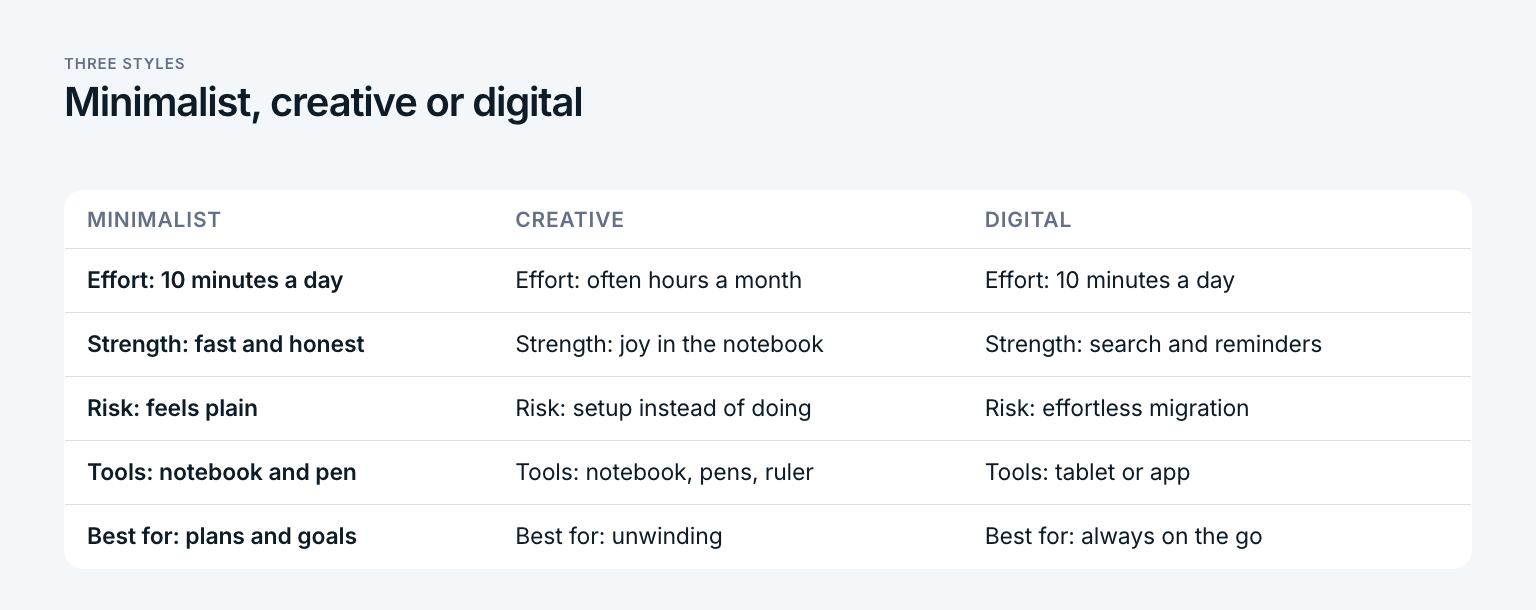
A minimalist bullet journal follows Carroll's original almost exactly. One pen, no rulers, no stickers, a short line at the top of each day. The pages look plain, and that is the feature. In short: the less time the layout takes, the more time is left for the tasks on it.
What to put in your bullet journal: 12 collections with a job
What belongs in a bullet journal? Every page you actually use. The twelve collections below have earned their place because each answers a question that otherwise stays open. Start with no more than two of them and add more only once the core modules run on their own.
- Yearly goals. Three to five goals with a number and a date, on one page right after the future log.
- Habit tracker. A monthly grid with three to five habits that feed a goal. Jordan tracks course recording time, daily walks and phone off by 10 p.m.
- Project page. One project with milestones and dates, such as a course launch or a home renovation.
- Client or work log. Each client with open deliverables, next deadline and last invoice date.
- Weekly review. Three questions every Friday: what worked, what did not, what changes next week?
- Reading list. Books with the date finished and one line on what stuck.
- Budget page. Fixed costs and a column for unplanned spending this month.
- Meal plan. Seven dinners and one grocery list for the week.
- Birthdays. One yearly page, copied into the future log every January.
- Idea list. Everything marked with an exclamation point lands here if it survives more than a day.
- Meeting notes. One page per important conversation, with the outcome and the next step.
- One line a day. A single sentence each evening about the best moment, if that helps you close the day.
All twelve share one thing: a purpose you can state in a sentence. A page titled March mood is only useful if you know what you will do with the result. That means: a collection without a question turns into decoration.
Digital bullet journals: where to keep one online
A digital bullet journal moves the modules onto a device. The closest version to paper is a tablet with a stylus and a planner PDF in which the index, future log and monthly pages are linked. The second route is a note-taking app where each day gets its own note and the bullets become checkboxes and tags. Both work, and many digital planner templates are built around Carroll's modules.
What you gain is obvious: search, reminders, copy and paste, no full notebooks. What you lose is less obvious. When migration is a copy and paste, it costs nothing, and the question of whether a task is still worth it disappears. Whoever keeps a digital bujo should slow migration down on purpose and retype each task one by one instead of dragging the whole list forward. For a full walkthrough of setting one up, see the guide to the digital planner.
Journaling vs. bullet journaling: what is the difference
Journaling is the umbrella term for writing with intention, whether about feelings, goals, gratitude or a problem you are working through. Bullet journaling is one specific form of it. It combines looking back with planning ahead, and it writes almost entirely in short bullets. The difference becomes clear when you ask which question each one answers.
- Diary: What happened today?
- Journal: What is on my mind, and what will I do with it?
- Bullet journal: What is due, what is done, and what am I letting go?
Many people keep both: a bullet journal for the week and a few lines of reflective writing on the side. The guide to journaling covers the other formats and how to keep going past the first two weeks. Among all of them, the bullet journal is the one built most clearly around tasks and dates.
What is the 3-3-3 journal method?
The 3-3-3 journal method has no single author and no study behind it. The label circulates online in several versions. Most of them ask for three short lists of three items, such as three things you are grateful for, three priorities for the day and three things that went well. It fits neatly into a daily log as a small collection. It is a different thing from the 3-3-3 rule for anxiety, a grounding exercise in which you name three things you see, three sounds you hear and move three parts of your body.
Does writing things down actually help?
Research on expressive writing, which James Pennebaker and Sandra Beall began in 1986, shows small positive effects on average, and not for everyone. For a bullet journal, a more direct finding matters. E. J. Masicampo and Roy Baumeister showed in 2011 that unfinished goals cause fewer intrusive thoughts once people write down a specific plan for them. Michael Scullin and colleagues found in 2018 that people who spent five minutes writing a to-do list for the next day before bed fell asleep faster than a comparison group who wrote about tasks they had already finished. A notebook is not a substitute for professional care. If you are in crisis, you can call or text 988 in the US at any time.
The three mistakes that end a bujo by March
Most bujos do not end with a decision. They end with one empty month, after which starting again no longer seems worth it. Almost always, one of three mistakes is behind it.
The most common mistake: setup becomes the project
Whoever designs a year at a glance, a monthly cover page, weekly spreads, a mood tracker and a reading list before the first real entry ends up with a beautiful notebook after three weekends and not a single finished task. Jordan did exactly that on a first attempt two years ago. That means: run four weeks with only the index, future log, monthly log and daily log, then add one collection.
- Skipping migration. Without migration, a bullet journal becomes an endless list. Open tasks from February are still sitting there in May, and nobody looks at them. Put migration in your calendar like any other appointment.
- Overloading the monthly log. Forty tasks for one month look ambitious. They also mean that 25 roll over and the new month starts full. Fifteen tasks is a good ceiling. For a realistic way to size a month, see the guide to monthly planning.
- No goal above the month. A bullet journal is excellent at organizing tasks. It does not tell you which tasks matter. Anyone who never sets goals for the year and the quarter can migrate diligently every month and still not move forward.
The third mistake is the quietest. It shows up after six months, when the notebook is full and the big plans are exactly as open as they were in January. That is why a bullet journal needs a layer above it that Carroll's core modules only touch on.
Your bullet journal in the goal chain: year, quarter, month, week, day
The bullet journal modules translate almost one to one into a goal chain. The future log covers the year, the monthly log covers the month, the daily log covers the day. Two levels are missing from the original: the quarter and the week. Many bullet journalists add a weekly spread for that reason. Whoever also sets a quarterly goal closes the gap between the big plan and today's list.
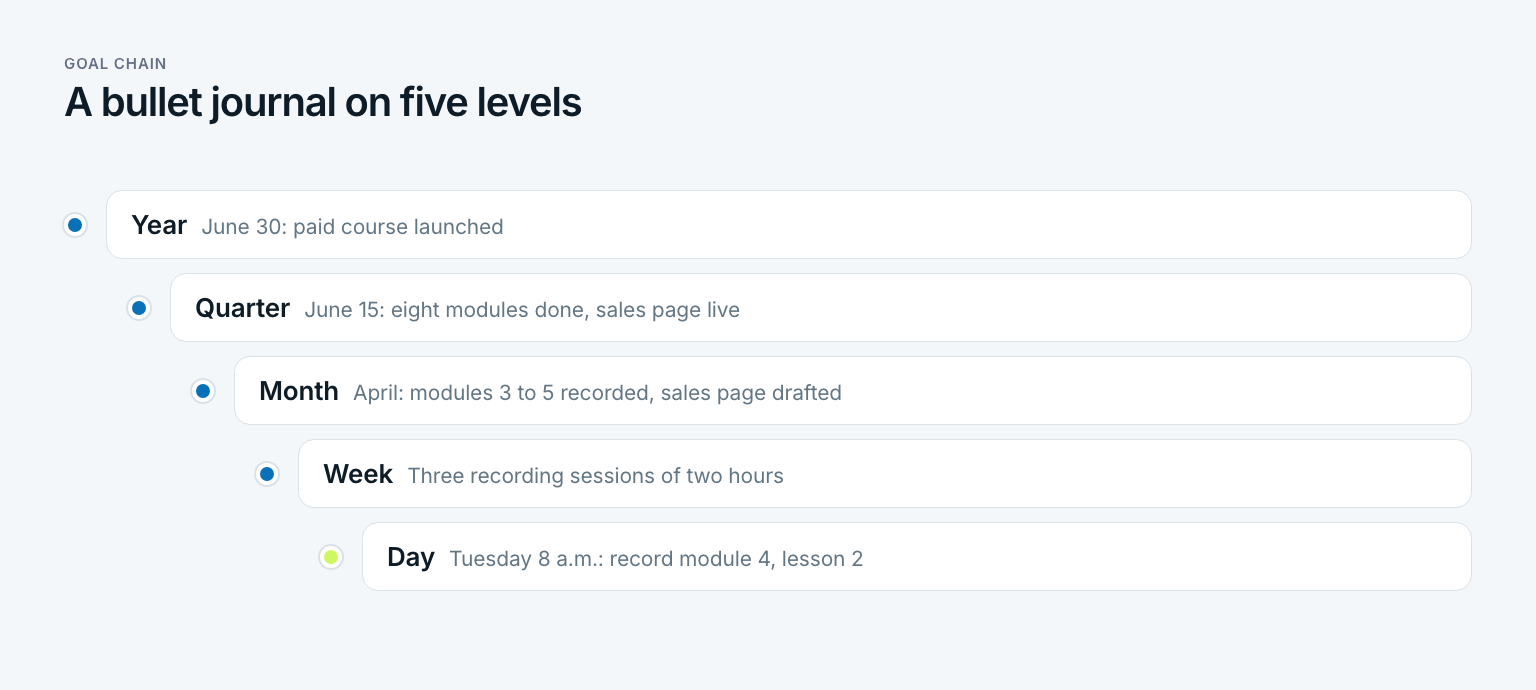
- Year, in the future log and on a goals page: Paid course on accessible web design launched by June 30.
- Quarter, as one line above the future log: From April to June, all eight course modules recorded and edited and the sales page live by June 15.
- Month, in the monthly log: In April, modules 3 to 5 recorded and the sales page drafted.
- Week, on a weekly spread: Three recording sessions of two hours each, Tuesday, Thursday and Saturday.
- Day, in the daily log: Tuesday 8 a.m., record module 4, lesson 2, then an X.
The chain works in reverse too. During migration, Jordan no longer asks only whether a task is worth it, but whether it feeds a goal. That turns striking a task out into a decision with a yardstick. If you would rather keep the upper levels digital and the notebook for the day, you can set yearly and quarterly goals in Gaapp with a starting value and a date and use the bullet journal only for the week and the day.
Before you open your notebook again, check it with three questions:
- Is there a page that says which goal this notebook is moving forward this year?
- Do you have a fixed appointment for migration on the last day of the month?
- How many tasks did you strike out last month, and what does that number tell you?
Anyone who can answer all three is no longer keeping a pretty notebook but a planning tool. In short: a bullet journal is a list that makes you decide, every single month.
Frequently asked questions about bullet journals
What to put in your bullet journal?
Start with the four core modules: index, future log, monthly log and daily log. Then add collections with a clear job, such as yearly goals, a habit tracker, project pages, a weekly review, a reading list or a budget page. Add no more than one new page a month so the system stays fast.
What is the 3-3-3 journal method?
It is an informal format without a single source or study behind it, and versions differ. Most ask for three lists of three items, for example three things you are grateful for, three priorities and three things that went well. It is not part of Ryder Carroll's original bullet journal method.
Where can I find online bullet journals?
You can keep a bullet journal on a tablet with a stylus and a linked planner PDF, or in a note-taking app with one note per day. Many digital planner templates follow Carroll's modules. Whatever tool you choose, retype tasks during migration instead of copying the whole list.
What is the difference between journaling and bullet journaling?
Journaling is the umbrella term for intentional writing about thoughts, feelings, goals or gratitude, usually in full sentences. Bullet journaling is a planning-focused form that logs tasks, events and notes as short bullets and reviews them every month. Many people combine the two in one notebook.
What does bujo mean?
Bujo is the common short form of bullet journal. It refers to the same method and is used mostly in online communities and hashtags. A bujo can be minimalist or highly decorated, and both follow the same core modules.
How long does a bullet journal take each day?
In a minimalist style, about five minutes in the morning and five in the evening, plus 30 to 45 minutes for migration at the end of the month. Creative spreads take considerably longer. If designing takes more time than doing, simplify the layout.
Last updated: 22 October 2026
Read next
 Planning
Cleaning Schedule: Daily, Weekly and Monthly Tasks
A cleaning schedule is not a Saturday to-do list: daily, weekly and monthly tasks, a printable template and a fair split for families.
15 min read
 Planning
Study Plan: How to Make One You Can Actually Follow
A study plan is not a schedule. Make one in six steps: inventory, hours math, buffer, a sample study schedule and a template, with a worked example.
17 min read
 Planning
Family Meeting: Agenda, Guidelines and Ideas
A family meeting is not a lecture: a weekly agenda in five parts, guidelines by age, 20 family meeting ideas and a worked example.
13 min read