Study Plan: How to Make One You Can Actually Follow
A study plan is not a schedule. Make one in six steps: inventory, hours math, buffer, a sample study schedule and a template, with a worked example.

Contents
- 01What a study plan is, and what it isn't
- 02How to make a study plan in six steps
- 03Take inventory: what is actually on the exam
- 04The hours math: demand, supply and buffer
- 05Build your study schedule backward from finals week
- 06What goes inside each block: retrieval, spacing, mixing
- 07A study plan template you can copy
- 08The 7-3-2-1 method and how to study in seven days
- 09Three mistakes that sink a study schedule
- 10Your study plan as a goal chain: year, quarter, month, week, day
- 11Study plan FAQ
A study plan is a list of study tasks with dates: you break each exam into topics, estimate how many hours they take, and schedule those hours backward from the exam date into fixed blocks on your calendar. A study plan is not a calendar with the word “study” written in every afternoon. It tells you, for every block, which topic is up and how you will know it stuck. A schedule hands out time. A study plan hands out material.
Three numbers hold up every good study plan: how many topics there are, how many hours they need, and how many hours you actually have. Everything below is worked through with Diego, a sophomore on the pre-med track who works 15 hours a week at the campus library and has four finals in seven days in December. Along the way you get six steps, a sample study schedule, a template, the study methods with the strongest research behind them, an honest look at the 7-3-2-1 method and the three mistakes that sink most plans by the second week.
What a study plan is, and what it isn't
A study plan connects three levels that usually stay apart. At the top sits the exam date. In the middle sit the topics. At the bottom sits the block on Tuesday at 7 pm. Most students only have the top and the bottom. They know when the final is, and they know they will be at the library on Tuesday. What they lack is the middle, and that is exactly where the plan either works or quietly fails.
A weekly study schedule with “Chem 7 to 9 pm” every night is a good start. It creates a fixed time and removes the daily decision about whether to study at all. It just doesn't answer the real question: is there enough time for the material? Anyone who plans hours without topics has a plan for sitting at a desk, not a plan for learning organic chemistry.
A study plan is also different from a study goal. The goal says what should be true at the end, like passing Calculus II with a B or better. How to write goals like that with a number and a date is covered in SMART goals for students. The study plan starts where the goal stops. It is the route, not the destination.
How to make a study plan in six steps
The order matters more than the tool. Paper, spreadsheet or app, it makes little difference. Whoever starts with the calendar hands out time before knowing how much is needed. That's why the numbers come before the calendar.
Collect every exam date and format
Write down each final with date, time, length and format: problem sets, multiple choice, essay, lab practical. The format decides the method. For a calculus final you practice problems. For a multiple choice psych exam you practice terms and the differences between similar ones.
Take inventory of the material
Break each course into topics, most easily by following the syllabus, the lecture slides or the textbook chapters. Then count the practice exams and problem sets you have. Diego ends up with 38 topics and twelve practice exams across four courses.
Estimate the hours you need
Give each topic an hour estimate for a first full pass and add 2.5 hours for every practice exam: two hours under time, 30 minutes to grade it. The total is your demand. For Diego it comes to 115 hours.
Count the hours you have and add a buffer
Count the hours you can realistically study until your last final, week by week, after classes, work, commuting and holidays. Your supply should beat your demand by at least 20 percent. If it doesn't, start earlier or cut scope.
Schedule backward
Start from your last exam day and decide when each course has to be fully covered once. Then plan phases, and only at the end the individual weeks. Every block gets a course, a topic and an outcome.
Check every week and adjust
On Sunday, spend 20 minutes comparing plan and reality: which topics stuck, which didn't, how many hours did you actually study? Next week's plan comes out of that answer. A study plan that never changes is usually a study plan nobody follows.
Steps one to four take about two hours the first time. That sounds like a lot of setup for a plan. Diego did them on a Sunday in late October, and the math showed him that his original start date in November would have left him short before finals even began. That means: two hours of counting bought him two extra weeks.
Take inventory: what is actually on the exam
The inventory is the step almost everyone skips. It doesn't feel like studying. Yet it decides everything after it, because without a topic list you can neither estimate nor schedule. Anyone who doesn't count the material underestimates it.
Diego gives each course one row and fills five columns: exam date, credits, number of topics, number of practice exams and an honest read on where he stands. The topics come from the syllabus. His read on where he stands rests on a number, not a feeling. He skimmed one old exam in each course without preparing and marked the questions he could answer right away.
| Course | Final | Credits | Topics | Practice exams | Where he stands | Hours needed |
|---|---|---|---|---|---|---|
| Calculus II | Tue, Dec 8 | 4 | 8 | 4 | shaky, about 40% of questions solvable | 30 |
| Organic Chemistry I | Thu, Dec 10 | 4 | 10 | 4 | weakest, about 30% | 40 |
| Biology II | Fri, Dec 11 | 4 | 10 | 2 | solid on concepts, weak on pathways | 30 |
| Intro to Psychology | Mon, Dec 14 | 3 | 10 | 2 | good, mostly terms to memorize | 15 |
| Total | seven days | 15 | 38 | 12 | 115 |
The hours come from a simple formula: topics times hours per topic, plus practice exams times 2.5. In organic chemistry Diego budgets three hours per topic, because that's where his gaps are biggest, so 30 hours plus ten for four practice exams. In psychology one hour per unit is enough, since he understands the ideas and mostly needs to lock in terms. The numbers are estimates. They don't have to be precise. They have to be honest.
Where does the hours-per-topic number come from? The most reliable source is a test run. Diego works through one medium-hard topic per course and times himself. In organic chemistry it takes him three hours to get from the textbook section to solving three mechanism problems without the answer key. He uses that number for all ten topics. A test run beats any rule of thumb.
The hours math: demand, supply and buffer
Supply is the number of hours you can actually study before your last final. Not the hours that are technically free, but the ones left after classes, work, meals, travel and sleep. Diego counts week by week and treats Thanksgiving honestly.
| Period | Weeks | Study hours per week | Total |
|---|---|---|---|
| Oct 26 to Nov 22, regular semester | 4 | 15 | 60 |
| Nov 23 to Nov 29, Thanksgiving week | 1 | 8 | 8 |
| Nov 30 to Dec 6, dead week | 1 | 40 | 40 |
| Dec 7 to Dec 14, finals | 1 | 30 | 30 |
| Supply | 7 | 138 | |
| Demand from inventory | 115 | ||
| Buffer | 23, about 20% |
His first draft looked different. Diego planned to start on November 9. That would have given him 108 hours of supply against 115 hours of demand, seven hours short before a single cold or a surprise lab report. So he moved the start two weeks forward, to October 26. The plan didn't get harder. It got possible.
Term: the planning fallacy
Daniel Kahneman and Amos Tversky described in 1979 that people systematically underestimate how long their own projects will take, even when they know similar projects ran long before. Roger Buehler, Dale Griffin and Michael Ross showed it in 1994 with students predicting when they would finish their senior thesis. Most were far too optimistic. That means: the buffer in your study plan is not a sign of doubt. It is the correction for a well-documented thinking error.
How big should the buffer be? Research doesn't give a fixed number. A fifth of your demand is a practical rule, because it absorbs one lost week during the semester. Anyone who works more hours or cares for family should plan more. And whoever spends the buffer before starting doesn't have one.
Build your study schedule backward from finals week
A study schedule is built from the end. You don't start with what to study tomorrow. You start with what has to be true the day before each exam. Diego sets one readiness target per course: two practice exams in a row, under time, at 75 percent or better. That result has to be in place at least two days before the final.
Those targets produce four phases. Each phase has a different purpose, and each needs a different kind of block. Anyone who treats October like dead week burns out early, and anyone who treats dead week like October runs out of time.
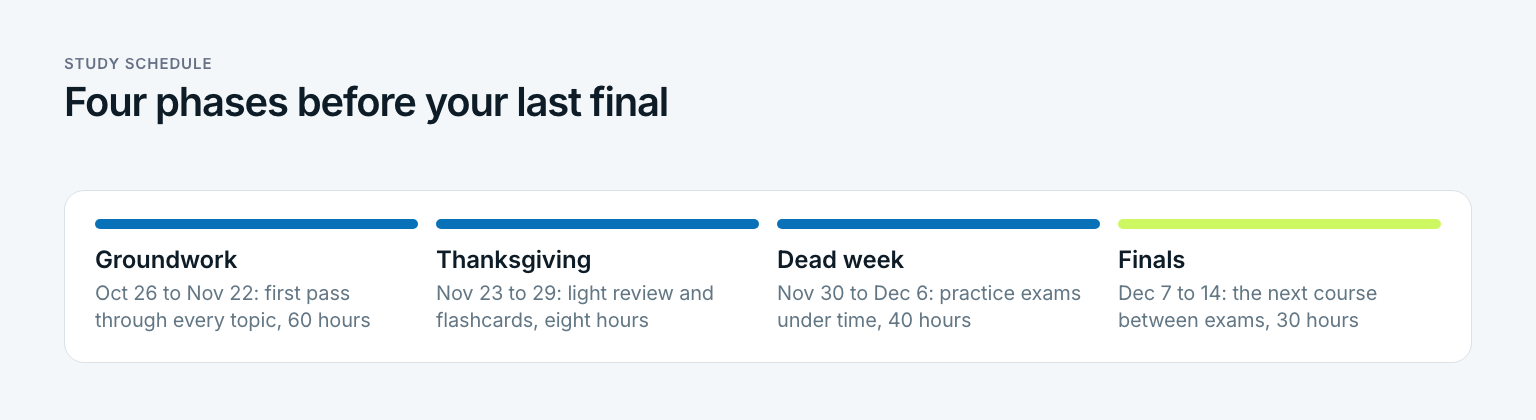
- Groundwork, October 26 to November 22, 60 hours. A first full pass through every topic covered so far, with practice problems. Flashcards for psychology terms and biology pathways start here, a few minutes a day.
- Thanksgiving week, eight hours. Light review only: flashcards on the plane and one timed calculus problem set. No new material. The point is to keep what's there from fading.
- Dead week, November 30 to December 6, 40 hours. Finish the last topics, then switch to practice exams under real conditions. After each one, sort the mistakes by topic and rework only those topics.
- Finals week, December 7 to 14, 30 hours. Between exams, the next course comes up. After each final there's a half day off, then two practice exams in the next subject.
The buffer of 23 hours doesn't belong to any course. Diego enters it as empty blocks: one hour on every Saturday in November and the rest during dead week. He fills them only when it's clear which course needs them. That's the difference between a buffer and hidden study time.
A sample study schedule for one week
At the weekly level, the plan becomes a calendar. Diego spreads his 15 hours over blocks of 60 to 120 minutes, mixes two courses per day and puts the hardest topics where he is most awake. Inside each block he uses a longer version of the Pomodoro Technique, 50 minutes on and ten minutes off.
| Day | Block 1 | Block 2 | Hours |
|---|---|---|---|
| Monday | 7 to 8 pm: Orgo, topic 5, SN1 and SN2, three mechanisms | 8 to 9 pm: Psych flashcards, 40 cards | 2 |
| Tuesday | Library shift | 7 to 9 pm: Calc II, topic 4, integration by parts, six problems | 2 |
| Wednesday | 4 to 5 pm: Bio, topic 6, cellular respiration, draw the pathway from memory | 7 to 8 pm: Orgo, topic 5, end-of-chapter problems | 2 |
| Thursday | Library shift | 7 to 9 pm: Calc II, topic 5, mixed problems | 2 |
| Friday | 2 to 3:30 pm: Bio, topic 7, practice questions | 1.5 | |
| Saturday | 10 am to 12:30 pm: recall round, every topic of the week without notes | 1 to 2 pm: buffer | 3.5 |
| Sunday | 4 to 5:40 pm: Orgo, topic 6, first pass | 6 pm: weekly review, 20 minutes | 2 |
Two details carry this week. First, every block names a topic and an outcome, not just a course. Second, Saturday holds a recall round in which Diego writes down, without notes, what he remembers from the week. How to lock blocks like these into your calendar so they survive a busy week is covered in time blocking.
What goes inside each block: retrieval, spacing, mixing
The best calendar won't help if the blocks are filled with the wrong methods. Here the research is unusually clear. John Dunlosky and colleagues reviewed ten common study techniques in 2013, drawing on hundreds of studies. Two earned the top rating: practice testing and distributed practice. Two of the most popular earned the lowest: highlighting and rereading.
Highlighting and rereading aren't useless. They give an overview, and they feel good, because the text looks familiar the second time. But familiarity isn't knowledge. Henry Roediger and Jeffrey Karpicke showed in 2006 that students who read a passage once and then wrote down what they remembered recalled clearly more a week later than students who read it several times. That means: every block should end with a stretch where you produce something without your notes. A simple version is the Feynman technique for studying: explain a topic in plain words as if to a beginner, and the gaps show up right away.
Term: spaced practice
Spaced practice means spreading study of the same material over several sessions with gaps in between, instead of cramming it in one sitting. Nicholas Cepeda and colleagues confirmed in a 2006 meta-analysis of hundreds of experiments that gaps between reviews improve long-term retention. For your study plan this means: a topic doesn't get one long block. It gets a first pass and two or three short reviews in the weeks that follow.
For Diego's plan, this translates into four rules:
- Test instead of reread. Every block ends with 15 minutes of problems without the answer key, or a blank page where he sketches the topic from memory.
- Build in gaps. A topic from the first week of November shows up again in a Saturday recall round two weeks later and in a practice exam during dead week.
- Mix problem types. Doug Rohrer and Kelli Taylor showed in 2007 that shuffled math problems led to better test scores than blocks of the same problem type. From dead week on, Diego practices mixed sets from old exams instead of chapter by chapter.
- Flashcards with a Leitner box. For psychology terms he uses a five-box system based on Sebastian Leitner: cards he knows move back and come up less often.
None of these methods take more time than rereading. They just feel harder. Whoever notices that a block feels like a struggle is usually right at the point where learning happens.
A study plan template you can copy
A study plan needs two layers: a header for the whole exam period and a weekly row you fill in fresh every Sunday. The header gets written once per semester. The weekly row takes 20 minutes a week. No study plan needs more admin than that.
| Field | Question | Diego's entry |
|---|---|---|
| Exams | Which finals, when, in what format? | four finals from Dec 8 to Dec 14, two problem-based, two mostly multiple choice |
| Readiness target | What has to be true two days before each exam? | two practice exams in a row at 75% or better |
| Inventory | How many topics and practice exams per course? | 38 topics, twelve practice exams |
| Demand | How many hours by your estimate? | 115 hours |
| Supply | How many hours until your last exam? | 138 hours from October 26 |
| Buffer | How much slack is left? | 23 hours, as empty blocks |
| Week | Which topics in which blocks? | fresh every Sunday, with course, topic and outcome |
| Measure | How do you know where you stand? | scores on practice exams and recall rounds, not hours logged |
The weekly row takes the columns from Diego's sample week: day, block, course, topic, outcome, done. Whether you keep it in a spreadsheet, a paper planner or an app matters less than one habit: comparing it with the header every Sunday. If you already plan your week on one page, the method in weekly planning works the same way, with study blocks in place of meetings.
For high school students the same template works with smaller numbers. A unit test might have five topics and one practice quiz, and the whole plan fits into a week or two. Younger kids need shorter blocks of 20 to 30 minutes, a fixed time of day and a plan they can see and check off themselves.
The 7-3-2-1 method and how to study in seven days
The 7-3-2-1 method is a review rule of thumb that circulates on study blogs and social media. In its most common version you review the material seven days, three days, two days and one day before the exam. It doesn't come from a specific study, and the versions you'll find online differ. What it gets right is the core idea of spaced practice: several short reviews with gaps beat one long session the night before.
Its weak spot is the start. The rule assumes you already covered the material once, at least a week before the exam. For Diego's psychology final it fits well, because the material is mostly terms and he finished the first pass in November. For organic chemistry it would come far too late. Use it as the last phase of a study plan, not as the whole plan.
How to study for an exam in seven days
Seven days isn't a study plan anymore. It's triage. The six steps still apply, just faster:
- Inventory in 30 minutes. List the topics and mark each one green, yellow or red based on one old exam or the review sheet.
- Weight by points. Topics that carry the most points on the exam and sit in red get the first blocks. Green topics only get flashcards.
- Test from day one. Do a timed practice exam on day two, not day six. The mistakes tell you where the next blocks go.
- Protect sleep. The night before the exam is for a short review and sleep, not for new material.
Three mistakes that sink a study schedule
Most study plans don't fail for lack of discipline. They fail because of a design flaw that only shows up in the second or third week. Three come up again and again.
The most common mistake: scheduling hours instead of topics
“Four hours of chem every day” looks disciplined and measurable. But it only measures time at the desk. Diego had exactly that plan for general chemistry his freshman year, logged more than 60 hours and still discovered on exam day that he had never practiced two of the topics. That means: every block needs a topic and an outcome. Otherwise you can't check on Sunday whether the week was enough.
- No buffer. A plan that assigns every hour collapses at the first cold. After that, every day feels like falling behind, and many students drop the plan entirely. A buffer of one fifth prevents exactly that.
- One course at a time. Anyone who finishes calculus completely before starting biology will have forgotten part of the calculus by finals. Two courses a day and weekly recall rounds keep everything warm.
- No measurement. Without a practice exam before dead week you don't know whether the plan is working. The first timed practice exam belongs in mid November, not the night before the final.
And if the plan breaks anyway? Then that's a data point, not a failure. On Sunday you redo the math: how many topics are left, how many hours remain? Sometimes the honest answer is talking to your professor about an incomplete. If the real problem is that you keep putting off the first block, how to stop procrastinating has a plan for exactly that. If exam stress keeps you from sleeping for weeks or turns into panic, talk to your campus counseling center, and in a crisis call or text 988.
Your study plan as a goal chain: year, quarter, month, week, day
A study plan is one section of a longer chain. At the top sits a yearly goal that reaches past single exams. At the bottom sits the block on Tuesday. Whoever writes this chain down once can see why the Tuesday block matters. Diego's chain looks like this:
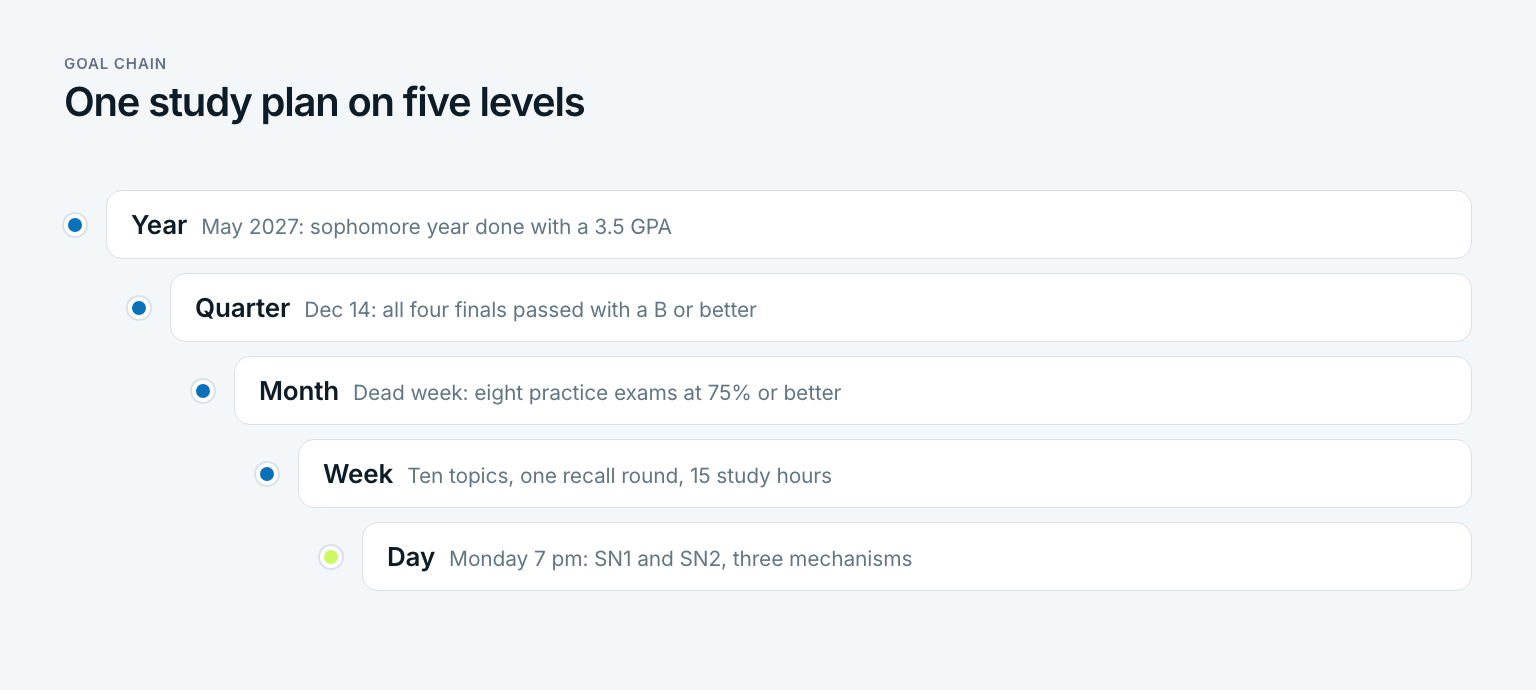
- Year: Finish sophomore year in May 2027 with a 3.5 GPA, on track for the MCAT the following year.
- Quarter: Pass all four fall finals by December 14 with a B or better.
- Month: In dead week, eight practice exams under time, each at 75 percent or better.
- Week: Ten topics in a first pass, one Saturday recall round, 15 study hours.
- Day: Monday at 7 pm, SN1 and SN2, three mechanisms without the answer key.
The chain runs both ways. Top down, it builds the plan. Bottom up, it builds the measurement: if the week covered its ten topics, the month moves forward and the quarterly goal stays within reach. In Gaapp you set the finals as a quarterly goal with a start value and a date and see every Sunday whether the week paid into it.
Before you start your plan, check it with three questions:
- Does every block name a topic and an outcome, not just a course?
- Does your supply beat your demand by at least one fifth?
- When is your first timed practice exam, and is it on your calendar?
Anyone who can answer yes to all three no longer has a schedule. They have a study plan. In short: a study plan is a piece of math you check every week.
Study plan FAQ
How do I create a study plan?
List every exam with its date, break each course into topics and count your practice exams. Estimate the hours you need, compare them with the hours you actually have, and keep about 20 percent as a buffer. Then schedule backward from your last exam into weekly blocks that each name a course, a topic and an outcome.
What is the best free study planner app?
For most students the best free option is the calendar they already open every day, combined with a simple spreadsheet for the inventory and hours math. For memorization, a flashcard tool with spaced repetition such as Anki helps, and it's free on desktop and Android. An app is only as good as the numbers you give it, so do the math once by hand first.
What is the 7-3-2-1 study method?
It's a review rule of thumb from study blogs: you go over the material seven, three, two and one day before the exam. It isn't based on a specific study, but it follows the idea of spaced practice, which research supports. It works as the last phase of a plan once you've covered the material at least once.
How to study in 7 days?
Treat it as triage. Spend 30 minutes listing topics and rating them, then put your first blocks on the topics that carry the most points and that you know least. Take a timed practice exam on day two, rework your mistakes, and keep the last night for a short review and sleep.
How far in advance should I start studying for finals?
Let the hours math decide, not a rule of thumb. Estimate your demand from topics and practice exams, divide it by the study hours you realistically have each week, and add a fifth as buffer. For Diego's four finals that came to about seven weeks. A single midterm often needs two to three.
What is the difference between a study plan and a study schedule?
A study schedule tells you when you study. A study plan also tells you what you study in each block and how you'll know it worked. You need both, but the plan comes first, because it tells you whether the schedule has enough hours for the material.
Last updated: 22 October 2026
Read next
 Planning
Cleaning Schedule: Daily, Weekly and Monthly Tasks
A cleaning schedule is not a Saturday to-do list: daily, weekly and monthly tasks, a printable template and a fair split for families.
15 min read
 Planning
Bullet Journal: How to Start One You'll Actually Keep
A bullet journal is not an art project. Learn the bullets, four core modules, migration and a six-step setup, with an example, 12 ideas and a goal chain.
15 min read
 Planning
Family Meeting: Agenda, Guidelines and Ideas
A family meeting is not a lecture: a weekly agenda in five parts, guidelines by age, 20 family meeting ideas and a worked example.
13 min read