Weekly Planning: Plan Your Week in 20 Minutes
Weekly planning means deciding which three results the next seven days must produce. Six steps, a weekly schedule template, and one worked week.

Contents
- 01What weekly planning is and what it is not
- 02What should you include in a weekly plan? Five parts, one page
- 03How to plan your week in six steps
- 04Weekly schedule template: seven days on one page
- 05Marcus's week in numbers: what 24 hours actually buy
- 06The three mistakes nobody notices
- 07Weekly planning in the goal chain: from year to day
- 08Paper, app, or planner system: which tool fits weekly planning
- 09Three questions before you close the week
- 10Frequently asked questions about weekly planning
Weekly planning is not a to-do list. It is a fixed appointment of about 20 minutes, once a week, in which you decide three things: which results the next seven days must produce, which day gets which result, and which hours stay empty. A to-do list collects everything you could do. A weekly plan decides what you will do, and when.
You need three things for it: a measure, a routine, and a page. The measure is your monthly goal. The routine has six steps and fits between Sunday dinner and the first episode of whatever you watch. The page is the weekly schedule template below, seven days on one sheet. All of it is worked through on one week of Marcus, 34, an emergency room nurse in Denver who works three 12-hour shifts and is building a furniture business on the side. His numbers are in the tables, including the ones that did not work out.
What weekly planning is and what it is not
Weekly planning is the moment you look at the next seven days as a whole and decide what they are for. Three parts are fixed: one monthly goal as the measure, no more than three weekly goals as the result, and one daily goal per free day as the path. The plan is not the list of what you have to do. It is the decision about what you will have done by Sunday.
A to-do list is a good habit. It keeps your head empty and nothing gets lost. It just does not decide anything. Forty items on a list all have the same weight, the dentist appointment next to the business plan, and the list grows faster than you can shrink it. A calendar is also a good tool. It knows where you have to be at 10 a.m. It does not know what the hour at 10 a.m. is supposed to produce. Weekly planning sits between the two: It takes three results from your goals, gives each one a day, and leaves the list for the rest.
Whoever plans a week without a monthly goal is sorting tasks, not planning. Whoever plans a week with ten goals has written a wish list. Whoever plans a week with three goals and a free Friday afternoon has a plan that survives Wednesday. That means: The quality of your weekly plan is decided before you write the first task, by what you measure it against.
Weekly plan, weekly schedule, weekly planner: three words, three jobs
A weekly plan is the decision: three results for seven days. A weekly schedule is the layout: which hours are already taken by shifts, classes, or meetings. A weekly planner is the tool, paper or app, that holds both. Most people buy the third, fill in the second, and skip the first. The order has to be the other way around.
What should you include in a weekly plan? Five parts, one page
A complete weekly plan has five parts and fits on one page. Anything that does not fit on one page is not a plan, it is a backlog. The five parts answer five questions, and the order matters, because each part narrows the next.
| Part | Question it answers | Marcus, week of October 5 |
|---|---|---|
| Monthly goal | What must be true on the last day of the month? | Online shop live with eight listed pieces, two sold |
| Three weekly goals | Which three results bring the monthly goal closer this week? | Finish the walnut bench, photograph three pieces, write four listing texts |
| Fixed commitments | Which hours are already gone? | Three 12-hour shifts on Tuesday, Wednesday, and Saturday, plus one dentist visit |
| One daily goal per free day | What is the one thing each free day must produce? | Monday: bench glue-up. Thursday: photos. Friday: listing texts. Sunday: sanding and oil |
| Buffer | Where does the week absorb surprises? | Friday after 3 p.m. and Sunday morning stay empty |
The monthly goal comes first because it is the only measure the week has. Without it, every task looks equally important. Where the monthly goal comes from is covered in the guide to monthly planning. The three weekly goals come second and are results, not activities: finish the bench, not work on the bench. Fixed commitments come third, before daily goals, because a daily goal on a shift day is a daily goal you will not reach. Daily goals come fourth, one per free day, small enough to finish. The buffer comes last and is the part most plans leave out. Which part do you usually skip?
Three things do not belong in a weekly plan: habits, routine chores, and the long list. Habits have their own tracker and need no weekly decision. Routine chores happen anyway and would only make the page look full. The long list of everything you might do someday stays where it is. The weekly plan draws from it. It does not become it.
How to plan your week in six steps
Twenty minutes is a budget, not an estimate. Sunday at 6 p.m. works for most people, Friday at 4 p.m. for anyone whose weekend belongs to the family. Before you start, three things lie on the table: your monthly goal, last week's plan with its check marks, and the calendar for the next seven days. Then you work through six steps.
Check last week, three minutes
Go through last week's weekly goals and mark each one: done, open, or dropped. Half done is open. Count how many you reached. Marcus's first attempt, the week before this one, had five weekly goals and reached one. That number told him the plan was wrong, not the week. It also told him why: two of the five were activities, not results, and could never be checked off. If you want the longer version of this step, the [ten-minute weekly review](/en/blog/ten-minute-weekly-review) is its own routine.
Read the monthly goal out loud, one minute
Literally. Read it and ask two questions: How much of the month is gone, and how much of the goal is done? On October 5, Marcus had used 16 percent of the month and had zero of eight pieces listed. The shop existed, the listings did not. That one sentence decides what the whole week is about.
Write three weekly goals as results, four minutes
Each goal is a sentence you can answer with yes or no next Sunday. Finish the walnut bench is a result. Work on furniture is not. Three is the ceiling, not the quota. Marcus wrote: bench finished, three pieces photographed, four listing texts written. Whoever needs a fourth goal splits a goal that was too big or drops one that was not important. Why three? Because two of your free days will not go as planned, and three goals leave room for that.
Mark the fixed hours, two minutes
Block every hour that is already gone: shifts, meetings, school pickup, the dentist. Marcus blocked Tuesday, Wednesday, and Saturday completely, 36 hours plus commute. What remains is the real week: Monday, Thursday, Friday, and Sunday, 24 usable hours. Planning starts with what is left, not with the week you wish you had.
Give each free day one daily goal, six minutes
Take the three weekly goals and distribute them across the free days, one daily goal per day, each small enough to finish in the hours that day has. Marcus put the bench glue-up on Monday, because glue needs 24 hours and Sunday was the next free day for sanding. Photos went to Thursday at 2 p.m., the only free afternoon with daylight. Listing texts went to Friday morning. A daily goal that needs four hours does not go on a day with two. How to size them so you can check them off in the evening is covered in the guide to [daily goals](/en/daily-goals).
Leave the buffer empty, and write it down, four minutes
Choose one half day that stays unplanned and write the word buffer into it, so you do not fill it on Tuesday. Marcus kept Friday after 3 p.m. and Sunday morning. In the week below, the buffers absorbed a split bench leg and a colleague's shift. Without them, the plan would have been dead by Friday noon. Then close the page. The plan is done when it fits on one sheet and every weekly goal has a day.
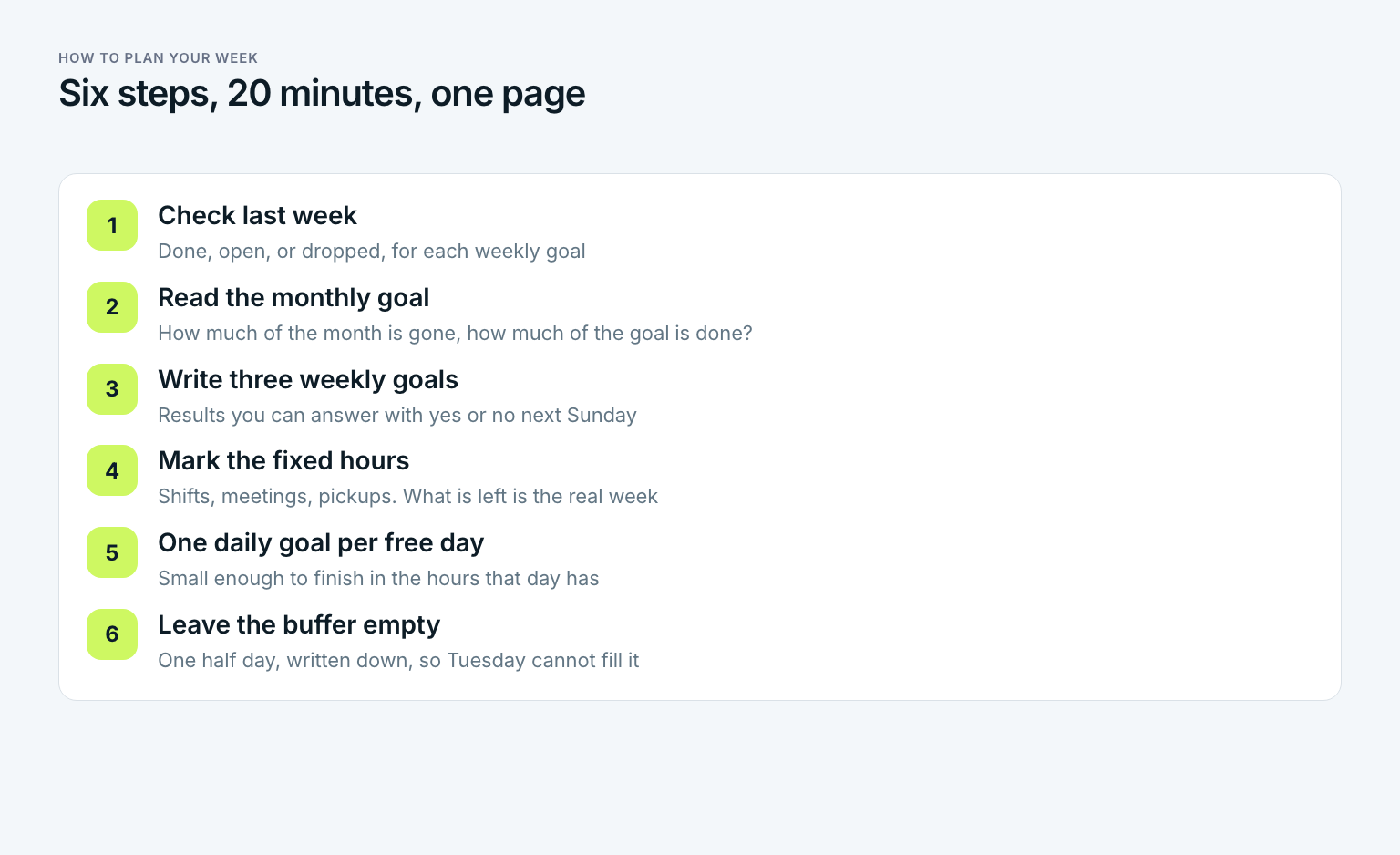
Twenty minutes, six steps, one page. That means: Anyone who spends an hour on weekly planning is not planning more carefully. They are planning the list instead of the week.
Weekly schedule template: seven days on one page
The weekly schedule template has one row per day and four columns: the fixed hours, the usable hours, the one daily goal, and the weekly goal it serves. The fourth column is the one most templates lack, and it is the only one that matters. A daily goal without a weekly goal behind it is a task that snuck in. The template below is filled with Marcus's week of October 5 to 11. The blank version is the same table with the last three columns empty and your monthly goal written above it.
| Day | Fixed hours | Usable hours | Daily goal | Serves weekly goal |
|---|---|---|---|---|
| Monday | none | 8 | Glue up the walnut bench, cut the stretchers | 1: Bench finished |
| Tuesday | Shift, 7 a.m. to 7:30 p.m. | 0 | none | |
| Wednesday | Shift, 7 a.m. to 7:30 p.m. | 0 | none | |
| Thursday | Dentist, 10 a.m. | 6 | Photograph three pieces, 2 p.m. in the garage with the door open | 2: Three pieces photographed |
| Friday | none | 6, buffer after 3 p.m. | Write four listing texts, 9 a.m. to noon | 3: Four listing texts |
| Saturday | Shift, 7 a.m. to 7:30 p.m. | 0 | none | |
| Sunday | Family lunch | 4, buffer in the morning | Sand and oil the bench, then 6 p.m. weekly planning | 1: Bench finished |
Twenty-four usable hours, three weekly goals, four daily goals, two buffers. Three of the seven days have no daily goal at all, and that is correct. A 12-hour shift is a full day. Whoever writes a daily goal onto a shift day is writing a reproach for the evening. The template makes the empty days visible, so they stop feeling like failures.
Weekly planner template for a Monday to Friday job
If your week has a fixed shape, the template gets simpler, not different. Fixed hours are the same five blocks every week, so you fill them in once. Usable hours are the evenings and the weekend, usually 15 to 20 in total. Every daily goal still points to one of the three weekly goals. One change is worth making: Put the buffer on Friday afternoon, not Sunday evening. Sunday evening is where next week's plan gets written. Anyone who uses it as a buffer plans in a hurry at 10 p.m., or not at all.
Ready-made goal packages that break a yearly goal down to weekly and daily goals are collected under templates. Rename or delete any goal in them.
Marcus's week in numbers: what 24 hours actually buy
Plans are judged on Sunday, not on Monday. Here is what Marcus's week produced, hour by hour, against the three weekly goals. The table includes the hours that went elsewhere, because those are the hours a plan exists to catch.
| What Marcus did | Hours | Serves which weekly goal |
|---|---|---|
| Bench: glue-up, stretchers, sanding, two coats of oil | 9 | Goal 1, done |
| Photos: three pieces, 41 shots, 12 kept | 2.5 | Goal 2, done |
| Listing texts: two of four written, Friday after 3 p.m. | 2 | Goal 3, open |
| Replacing a split bench leg, Friday morning, unplanned | 3 | Goal 1, took the listing text slot |
| Covering four hours of a colleague's shift, Sunday morning | 4 | none, took the Sunday buffer |
| Browsing other makers' shops for pricing, Monday evening | 2.5 | none |
| Total | 23 | 13.5 hours on goals, 7 hours of surprises, 2.5 hours beside the plan |
Two of three weekly goals done, 67 percent. The third is half done, and the reason is visible in the table: Friday morning was supposed to produce four listing texts and went to a bench leg instead. The texts got two hours in the Friday buffer and came out half finished. The leg was the right call, because goal one carries more of the monthly goal than goal three. The 2.5 hours of browsing other shops were not the right call. They felt like research. They produced no listing. That is what a weekly plan does that a to-do list cannot: It shows you on Sunday which hours bought something and which only felt busy.
Next week's plan writes itself from this table. The two missing listing texts become the first weekly goal, and browsing gets a 30-minute slot with a question attached, what do walnut benches sell for, so it ends with a number instead of a feeling. In short: The week was not perfect. It was measured, and that is the point.
The three mistakes nobody notices
Most weekly plans do not fail at the method. They fail quietly at one of three mistakes, and none of them feels like a mistake while you are making it. Which one is yours?
The most common mistake: planning the week you wish you had
The plan assumes five free evenings, no shift swap, no sick child, no split bench leg. Then Tuesday happens, the plan is a day behind by Wednesday, and by Thursday it is abandoned because it was wrong. The fix is not a smaller plan. It is a plan that starts from the hours that are actually free and leaves one half day empty on purpose. Marcus planned 24 hours and kept two half days empty. Seven hours of surprises landed in his week. The buffers caught them, and the plan held anyway.
- Goals written as activities. Work on the shop can never be done, so it is never checked off, so the week never feels finished. Write every weekly goal as a result you can answer with yes or no: eight pieces listed. Activity is a good sign. It is just not a measure.
- No weekly goal behind the daily goal. A daily goal that does not point to one of the three weekly goals is a task that got promoted. Keep the fourth column of the template honest. If the daily goal serves no weekly goal, it waits, or it replaces a weekly goal on purpose.
- Planning on Monday morning. Monday morning plans from the inbox, not from the goal. Whatever arrived over the weekend sets the week. Whoever plans on Sunday evening or Friday afternoon plans from the measure. Twenty minutes earlier changes what the whole week is about.
Weekly planning in the goal chain: from year to day
The week is the level between month and day, and it is the level most people skip. The year is too far away to act on. The day is too short to show progress. The month shows whether something moved, but it is too long to steer. The week is the only level where you can both act and correct. That is why the weekly plan carries the chain: It translates a monthly goal into something a Thursday can do.
Marcus's chain looks like this. Yearly goal for 2026: $24,000 in furniture revenue and a shop that runs between his shifts instead of around them. Quarterly goal for October to December: online shop launched, twelve pieces sold. Monthly goal for October: shop live with eight listed pieces, two sold. Weekly goals for October 5 to 11: bench finished, three pieces photographed, four listing texts written. Daily goal for Thursday: photograph three pieces at 2 p.m. Every level is a sentence you can answer with yes or no, and every level hangs on the one above it. How you get from the yearly goal to the quarterly and monthly ones is covered in the guide to annual planning.
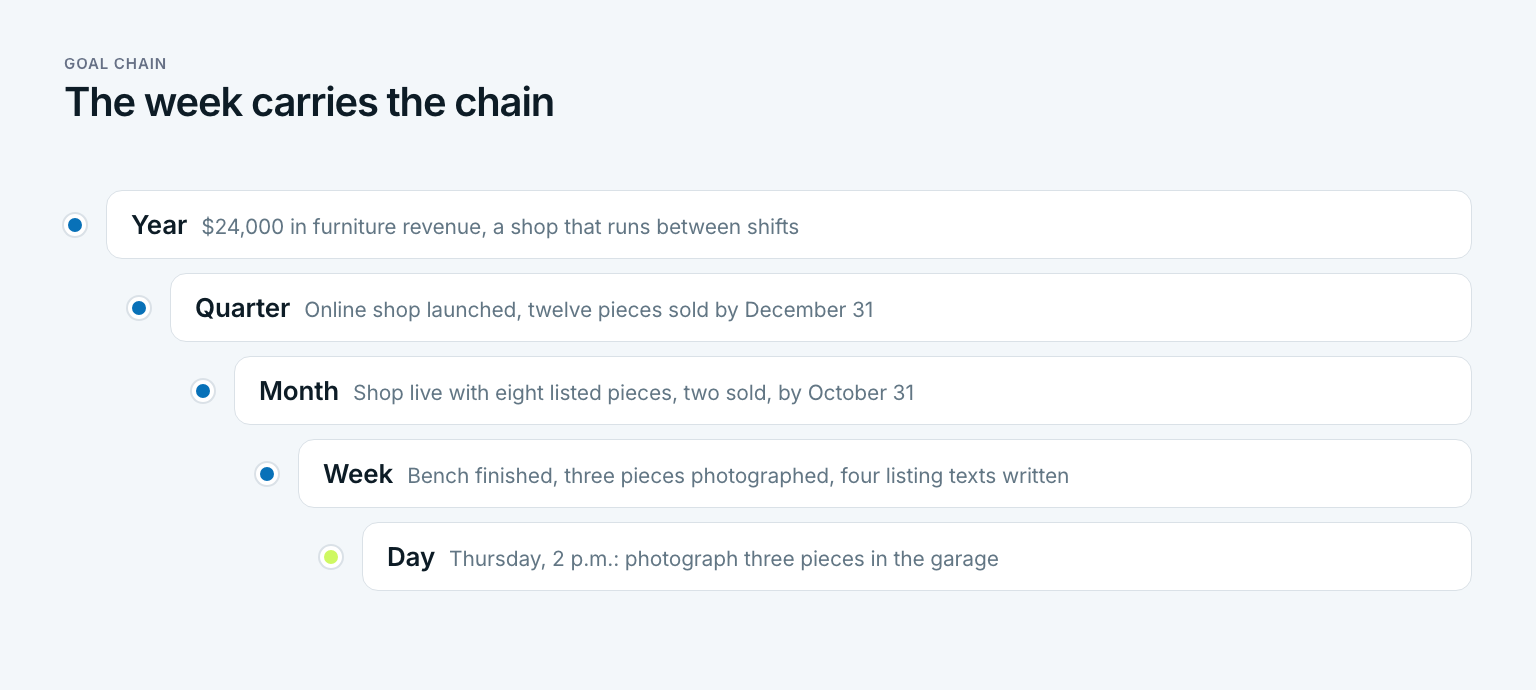
The chain also answers the hardest question in weekly planning: Which of the twenty things on my list become the three weekly goals? The ones that move the monthly goal. Not the most urgent, not the most fun, not the one someone asked for. Marcus had build a website footer on his list for three weeks. It moved nothing on the monthly goal, because the shop platform already had one. It got dropped, and dropping it was progress.
In Gaapp this chain is the structure: five levels from year to day, each goal attached to a larger one, progress per period shown as the share of goals done next to the share of time passed. Weekly planning there is the moment you create next week's three goals under the monthly goal and give each one a day. Open goals do not roll over by themselves. You decide each Sunday whether they return, and that decision is the plan. The full method, from a yearly goal down to Thursday at 2 p.m., is laid out in how to achieve goals.
Weekly planning for two, for a family, for a team
The method does not change when more people share the week. The page does. A couple plans the shared goals first, who covers which evening, which weekend has the one project, and then each plans their own three. A family with school-age kids adds a column for pickups and practices and treats them as fixed hours, because they are. A team plans its three weekly goals together, Friday afternoon or Monday morning at the latest, and each person takes daily goals from them. In all three cases one rule holds: three shared weekly goals, not three per person plus three shared. Anyone who plans nine shared goals for a family of three has planned a conflict. A full family weekly planner adds dinners and chores to the same page.
Paper, app, or planner system: which tool fits weekly planning
The tool is the least important decision in weekly planning, and the one people spend the most time on. Four options cover almost everyone, and each one is good at something the others are not.
| Tool | Good at | Where it breaks |
|---|---|---|
| Paper weekly planner | One page, no notifications, and writing by hand slows you down enough to decide | No link to the monthly goal, last week's page is gone, nothing adds up |
| Calendar app | Fixed hours are already there, reminders work, sharing with a partner is easy | Every entry looks the same, a daily goal next to a dentist visit, and nothing shows progress |
| Goal app with a goal chain | Weekly goals hang on the monthly goal, progress is visible, open goals are a decision | Needs the monthly goal to exist first, and a free plan limits how many chains you run |
| Planner system such as the 7 Habits weekly planner | Forces you to think in roles and in important over urgent, strong weekly ritual | Paper, 30 to 60 minutes a week, and the link to a yearly goal is yours to maintain |
The 7 Habits weekly planner comes from Stephen R. Covey's work, The 7 Habits of Highly Effective People from 1989 and First Things First from 1994. Its idea is sound: Plan the week, not the day, start with your roles and your most important goals, and put the big rocks in before the gravel of small tasks fills the jar. Covey's Quadrant II, important but not urgent, is where he wants your week to live. It takes longer than 20 minutes and lives on paper, and both are fine. What it shares with the template above is the one thing that matters: The week is planned from the goals down, not from the list up.
Is there a free weekly planner app? Yes, several, and the question is the wrong one. Any calendar app is a free weekly planner. The question is whether the app knows what your monthly goal is. If it does not, the weekly goals are notes, and notes do not show progress. The same test decides which is the best to-do list app for you. Whoever already has a goal chain picks a tool that holds it. Whoever has none picks paper and writes the monthly goal at the top of the page first. Whoever wants a digital version can start with the guide on how to set up a digital planner.
Three questions before you close the week
Weekly planning is a habit, and habits are checked, not admired. Three questions, every Sunday, before you write next week's three goals:
- Can you say your monthly goal in one sentence without looking it up?
- Do you know how many of last week's three weekly goals you reached, as a number, not as a feeling?
- Did at least one half day of last week stay empty on purpose?
Whoever answers one of the three with no has not planned too little. They have measured too little. The fix is never a longer list. It is a monthly goal at the top of the page, three results under it, and one buffer that nobody touches. In short: Weekly planning is not writing down what you have to do. It is deciding what the next seven days are for.
Frequently asked questions about weekly planning
How do I make a weekly plan?
Take 20 minutes on Sunday evening or Friday afternoon. Check last week's goals, read your monthly goal, write three weekly goals as results you can answer with yes or no, block the hours that are already taken, give each free day one daily goal, and leave one half day empty as a buffer. The plan is finished when it fits on one page and every weekly goal has a day.
What should I include in a weekly plan?
Five parts: your monthly goal as the measure, three weekly goals as results, your fixed commitments, one daily goal per free day, and a buffer. Habits, routine chores, and the long list of someday tasks stay off the page. A plan that includes everything decides nothing.
Is there a free weekly planner app?
Yes. Any calendar app is a free weekly planner, and most goal apps have a free plan with at least one goal chain. The useful question is whether the app knows your monthly goal. If it does not, your weekly goals are notes, and notes do not show progress. Pick a tool that holds the chain from year to day, or pick paper and write the monthly goal at the top.
What is the 7 Habits weekly planner?
It is the paper planning system based on Stephen R. Covey's The 7 Habits of Highly Effective People from 1989 and First Things First from 1994. You plan one week at a time, start from your roles and most important goals, and schedule those big rocks before small tasks fill the week. It is a strong ritual that takes 30 to 60 minutes. The template in this article keeps the same order, goals before tasks, and cuts the time to 20 minutes by measuring against one monthly goal.
When is the best time for weekly planning?
Sunday around 6 p.m. or Friday around 4 p.m. Sunday evening gives you the clearest view of the coming week. Friday afternoon lets you close the week while it is fresh and start the weekend with the decision already made. Monday morning is the worst time, because the inbox plans the week instead of you. More important than the day is that it repeats: same day, same time, as a recurring appointment.
How many goals should a weekly plan have?
Three weekly goals at most, and one daily goal per free day. Three is a ceiling, not a quota, because two of your free days will not go as planned. Whoever needs a fourth goal splits one that was too big or drops one that was not important. Marcus, the nurse in this article, reached two of three, and that was a good week.
Last updated: 19 October 2026
Read next
 Planning
Cleaning Schedule: Daily, Weekly and Monthly Tasks
A cleaning schedule is not a Saturday to-do list: daily, weekly and monthly tasks, a printable template and a fair split for families.
15 min read
 Planning
Study Plan: How to Make One You Can Actually Follow
A study plan is not a schedule. Make one in six steps: inventory, hours math, buffer, a sample study schedule and a template, with a worked example.
17 min read
 Planning
Bullet Journal: How to Start One You'll Actually Keep
A bullet journal is not an art project. Learn the bullets, four core modules, migration and a six-step setup, with an example, 12 ideas and a goal chain.
15 min read