Habit Tracker: How to Track Habits That Feed a Goal
A habit tracker records whether a daily action happened and which goal it feeds. Three habits, five steps, a template, and a worked example with numbers.

Contents
- 01What a habit tracker is, and what it is not
- 02Do habit trackers actually work? What the research says
- 03Which habits to track: three, not eight
- 04How to make a habit tracker in five steps
- 05Habit tracker template: one page, three rows, one goal line
- 06Habit tracker app or paper: the one you will still open in March
- 07Marcus's habit tracker, six weeks with numbers
- 08The three mistakes that turn a habit tracker into a guilt list
- 09The habit tracker in the goal chain: year, quarter, month, week, day
- 10Frequently asked questions about habit trackers
A habit tracker is not a streak counter. It is a daily record of one question, asked about a small action you have decided to repeat: did it happen today? Most trackers are a grid, habits in rows, days in columns, a check mark in every cell where the answer is yes. The streak is a side effect. The record is the point, because the record tells you whether the action is actually happening and, if you set it up right, which goal it is feeding.
Three things make a habit tracker work: a goal the habit serves, a short list of at most three habits, and a fixed moment each day when you mark the box. The goal gives the check mark a reason. The short list keeps the grid honest. The fixed moment is what separates a tracker you still use in March from one you abandon in week three. The whole thing is worked through with Marcus, a high school teacher in Austin who has started a habit tracker five times. Four attempts died within 21 days. The fifth is still running, and the difference is this article.
What a habit tracker is, and what it is not
A habit tracker has three parts: a list of behaviors you want to repeat, a row of days, and a mark for every day you did the behavior. That is the entire mechanism. Paper or app, printable or spreadsheet, the structure is the same. The grid does not change your behavior. It makes your behavior visible, and visibility is what changes it.
Streaks deserve a fair word first. A chain of unbroken check marks is motivating, and the story software developer Brad Isaac told in 2007 about Jerry Seinfeld crossing off a wall calendar for every day he wrote jokes has sent a lot of people to their own calendars for good reason. The chain works, because nobody wants to be the person who breaks it. Only, a streak measures one thing: continuity. It says nothing about whether the thing you are continuing is worth continuing. Anyone who has kept a 90-day streak on a habit that stopped serving any goal knows the feeling. The chain is intact. Nothing moved.
That means: a habit tracker is a measuring instrument, and an instrument needs a reference point. The reference point is not the streak. It is the goal above the habit. Run three times a week is a habit. Finish a half marathon under two hours in February is the goal it feeds. Without the second line, the first one is a ritual. With it, every check mark is a unit of progress you can count.
Habit, routine, goal: three words, three jobs
A goal is an outcome with a date: a half marathon under two hours on February 14. A habit is a repeated action that moves you toward it: run on Tuesday, Thursday, and Saturday. A routine is a sequence of habits anchored to a time: the Tuesday run with gear laid out the night before. Charles Duhigg described the loop under every habit in The Power of Habit in 2012 as cue, routine, reward. The check mark is the small reward. The goal is the big one.
Do habit trackers actually work? What the research says
Yes, with a condition. In 2016 Benjamin Harkin and colleagues published a meta-analysis in Psychological Bulletin covering 138 studies and almost 20,000 participants. The question was whether monitoring progress toward a goal helps you reach it. The answer: yes, and the effect was larger when progress was physically recorded rather than just noticed, and larger again when the record was visible to someone else. A habit tracker is a physical record. That is exactly the version of monitoring that worked best.
The condition is in the word progress. The studies measured monitoring of movement toward a goal. A grid of check marks for actions that lead nowhere is not progress monitoring. It is bookkeeping. Anyone who tracks eight habits and cannot say which goal any of them serves has the mechanism without the reference point, and the research does not promise them anything.
How long does it take? Phillippa Lally and her team at University College London followed 96 people for twelve weeks in 2010 while each tried to build one new daily habit. The average time until the behavior felt automatic was 66 days, with a range from 18 to 254. Two details matter more than the headline number. First, the simplest habits formed fastest: a glass of water with lunch beat 50 sit-ups after coffee by weeks. Second, missing a single day did not measurably slow the process. One miss is noise.
James Clear turned that second finding into a rule in Atomic Habits in 2018: never miss twice. One missed day is an accident. Two in a row is the start of a new habit, the habit of not doing it. For a habit tracker this means the empty cell is information, not failure. The only question after an empty cell is: what happens tomorrow? Never miss twice is one of the book's smaller tools. A full Atomic Habits summary shows where it sits next to the four laws and the 1% rule.
In short: habit trackers work when they record small, repeatable actions that feed a named goal, and when you keep going after a miss. They do not work as a scoreboard for outcomes. Lose ten pounds is not a habit. Walk 30 minutes after dinner is. Track the second kind.
Which habits to track: three, not eight
Three habits at a time, each one an action you can finish in a day, each one attached to a goal. That is the whole selection rule, and it is where most trackers go wrong before the first check mark. Marcus's fourth attempt is the standard failure. He started on January 5, a Monday, with eight habits and a printable he found online. His grid had 56 boxes a week.
| Marcus's eight habits in January | Action or outcome? | Which goal does it feed? | Verdict |
|---|---|---|---|
| Run | Action, but no days set | Half marathon in February | Keep, with fixed days |
| 10,000 steps | Outcome, depends on the day | None named | Drop |
| No sugar | Outcome, all-day vigilance | Vague, feel better | Drop |
| Read 20 pages | Action | None this year | Park for later |
| Meditate 10 minutes | Action | None named | Park for later |
| Eight glasses of water | Count, hard to verify | None named | Drop |
| Journal | Action, no length defined | None named | Park for later |
| In bed by 10 | Action with a time | Running, recovery | Keep, sharpen to lights out 10:15 |
Week one: 31 of 56 boxes checked, 55 percent. Week two: 19 boxes, 34 percent. Week three ended on a Wednesday, when he stopped opening the sheet. The grid did its job. It showed him that he had taken on more than his days could hold. The lesson he drew was the wrong one: I am not a habit person. The right lesson sits in the table. Two of the eight habits fed a goal. Six were somebody else's list.
Four tests a habit has to pass before it earns a row on your tracker:
- It is an action, not an outcome. Run 3 miles is an action. Lose weight is a result of actions. You can check off the first. You can only hope for the second.
- It fits in one day and has a yes or no answer. Lights out by 10:15 pm is yes or no. Sleep better is not. If you have to think about whether it counts, the habit is not defined yet.
- It has fixed days. Daily, or on named days of the week. Three times a week with no days attached means Sunday night with three runs still to go.
- It feeds a goal you can name in one sentence. Anyone who cannot finish the sentence I do this because by December I want to has a habit without a job.
The 3-3-3 rule for habits, and what it is good for
The 3-3-3 rule for habits has no single author, and the versions online do not agree. The most quoted source is the writer Oliver Burkeman, whose 3/3/3 method is actually about a workday: three hours on your most important project, three shorter urgent tasks, three maintenance activities. Habit blogs have borrowed the shape and turned it into something like this: three habits at a time, three weeks before you add a fourth, and a starting version small enough to begin in three minutes.
As a rule of thumb, that is good advice and matches the selection rule above. As a law, it is nothing. Lally's data says three weeks is far too early to call a habit automatic, so read the three weeks as a waiting period before you grow the list, not as a finish line. The three threes are a cap on the list, a brake on adding, and a reminder to start small.
How to make a habit tracker in five steps
Twenty minutes on a Sunday, one sheet of paper or one blank spreadsheet, and the goal you are working toward written at the top before anything else. The order of the steps matters. Most people start with step three and never get to step one.
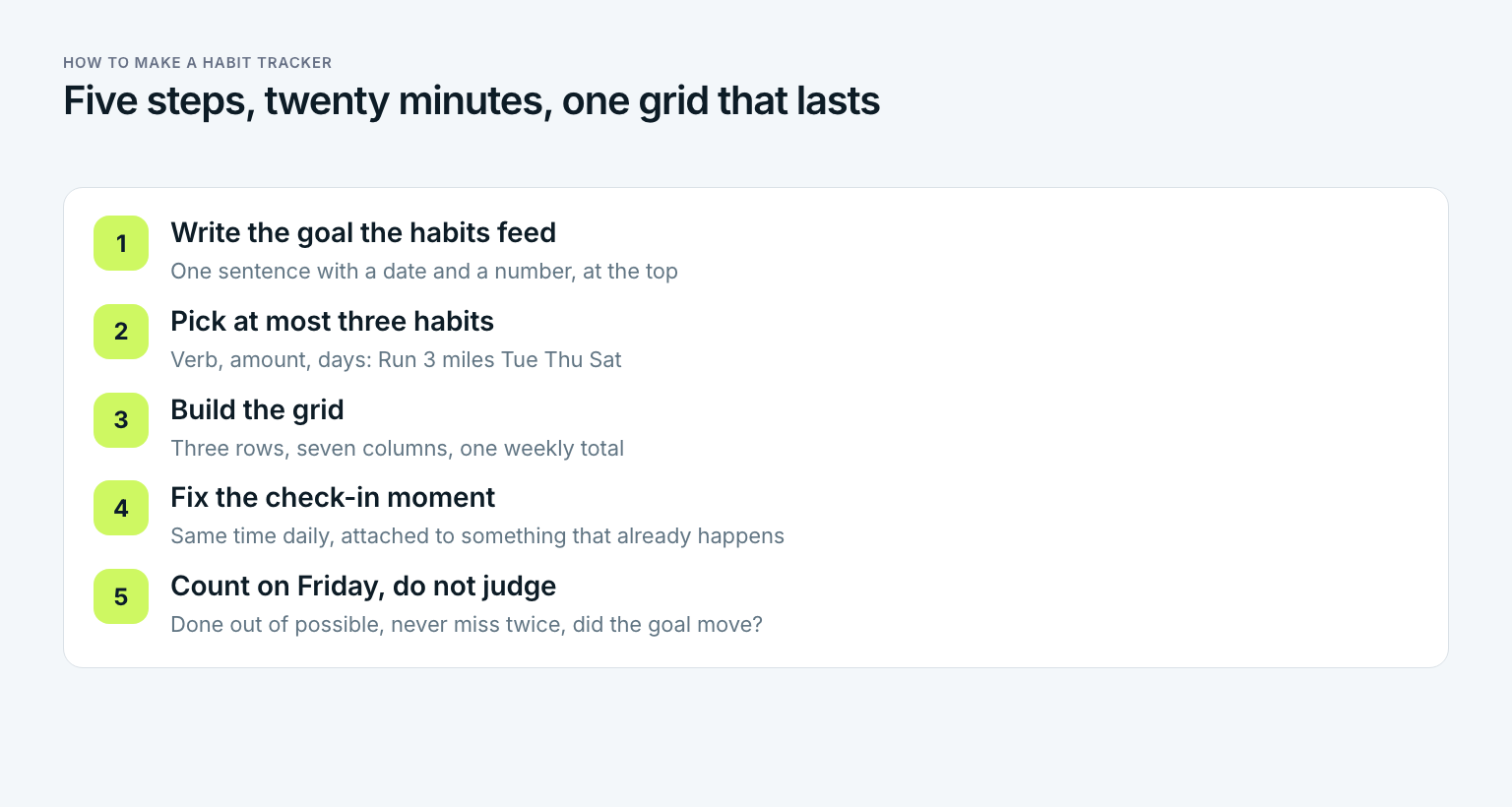
Write the goal the habits will feed, 3 minutes
One sentence with a date and a number, at the top of the page. Marcus: Austin Half Marathon, February 14, under two hours. If you cannot name the goal, you are not ready for a tracker yet.
Pick at most three habits and write them as actions with days, 5 minutes
Verb, amount, days. Run 3 miles Tue Thu Sat. Lights out 10:15 pm daily. Gear by the door Mon Wed Fri evening. Anyone who cannot answer yes or no to the habit at the end of the day has not finished this step.
Build the grid: three rows, seven columns, one total, 5 minutes
Habits down the left, Monday to Sunday across the top, a column on the right for the weekly count against the possible total. Marcus's possible total is 13: three runs, seven nights, three gear evenings.
Fix the check-in moment, 2 minutes
The box gets marked at the same moment every day, attached to something that already happens. Marcus marks his sheet when he plugs in his phone at night. Not the moment you did the habit. The moment you review the day.
Count on Friday, do not judge, 5 minutes
Once a week, add up the row: 11 of 13. Below 70 percent two weeks running, shrink the habit, not your opinion of yourself. One empty cell, apply never miss twice. Then ask the only question that matters: did the goal move?
Habit tracker template: one page, three rows, one goal line
The template below is the one Marcus uses on paper, and it fits on a single page or in the first ten rows of a spreadsheet. The goal line at the top is the part most printables leave out, and it is the only part that is not optional. Everything under it is a grid.
| Field | What goes there | Marcus, week of September 7 |
|---|---|---|
| Goal | One sentence, date, number | Austin Half Marathon, February 14, under 2:00 |
| Quarter check | What has to be true in 13 weeks | 20 miles a week, long run 8 miles, by December 31 |
| Habit 1 | Verb, amount, days | Run 3 miles, Tue Thu Sat |
| Habit 2 | Verb, amount, days | Lights out by 10:15 pm, daily |
| Habit 3 | Verb, amount, days | Gear by the door, Mon Wed Fri evening |
| Grid | Mon to Sun, one cell per habit per day | 13 possible boxes |
| Weekly count | Done out of possible | 10 of 13, 77 percent |
| One note | What got in the way, one line | Thursday: parent night ran to 9:40, ran Friday instead |
| Friday question | Did the goal move? | Yes: 9 miles this week, up from 7 |
Printable or spreadsheet makes no difference to the fields. A printable on the fridge wins on being seen. A spreadsheet wins on the Friday count, because the percentage calculates itself and six weeks sit side by side. Marcus started on paper and moved the weekly totals into a sheet after the first month to see the trend. Ready-made goal packages that break a yearly goal down to weekly and daily goals are collected under templates. Rename or delete whatever does not fit.
Habit tracker app or paper: the one you will still open in March
The best habit tracker is the one you look at at the same moment every day, and that has almost nothing to do with features. The comparison below is about friction and visibility, the two things that decide whether a tracker survives week three. Which habit tracker app is best depends on one question only: does it still get opened on a Tuesday in March, when nothing about it is new anymore?
| Paper or printable | Spreadsheet | Habit tracker app | |
|---|---|---|---|
| Seen without asking | High, if it hangs where you pass | Low, you have to open it | Medium, with one reminder a day |
| Friction to check a box | A pen, two seconds | Open the laptop, find the row | Unlock, open, tap |
| Weekly count | Count by hand | Calculates itself | Shown, often as a streak instead |
| Six weeks side by side | Flip pages | Yes, that is its strength | Depends, often a chart |
| Link to a goal | Written on the goal line | A column you add | Rare, most apps stop at the habit |
| How it dies | Buried under mail on the counter | Forgotten after one busy week | Streak breaks, app gets deleted |
If you go the app route, want four things: a cap on habits, a weekly ratio shown as plainly as the streak, a link from each habit to its goal, and a check-in under ten seconds including unlocking the phone. Anyone who needs 40 seconds to mark a box will stop by the second week. The rest is design, and design is not what keeps a tracker alive.
Marcus's answer is both. The paper sheet hangs inside the pantry door, where he stands every evening packing lunches. The weekly total goes into a spreadsheet on Friday. The phone is not involved, because the phone at 9:30 pm is exactly what his lights-out habit is fighting.
Marcus's habit tracker, six weeks with numbers
Marcus is 34, teaches tenth-grade history in Austin, and has two kids under six. He ran in college and has not run regularly in eight years. His yearly goal is the Austin Half Marathon in February under two hours, a pace just under 9:10 per mile for 13.1 miles. Attempt five started on Monday, August 24, 2026, with the three habits from the template. Here is the grid after six weeks, counted every Friday.
| Week | Boxes checked | Rate | What the note said | Miles run |
|---|---|---|---|---|
| 1, from Aug 24 | 11 of 13 | 85% | Friday lights out slipped, gear not laid out Wednesday | 6 |
| 2, from Aug 31 | 12 of 13 | 92% | Saturday night out, lights out at 11:30 | 7 |
| 3, from Sep 7 | 10 of 13 | 77% | Parent night Thursday until 9:40, ran Friday instead, Thursday box stays empty | 9 |
| 4, from Sep 14 | 12 of 13 | 92% | Gear forgotten Monday, Tuesday run happened anyway | 10 |
| 5, from Sep 21 | 13 of 13 | 100% | Nothing to report | 12 |
| 6, from Sep 28 | 11 of 13 | 85% | Youngest sick two nights, lights out missed twice | 12 |
Six weeks, 69 of 78 boxes, 88 percent. Seventeen of eighteen runs happened. Weekly miles doubled from six to twelve, the long run went from two miles to five. Compare that with attempt four: eight habits, 55 percent in week one, 34 percent in week two, nothing in week three. The difference is not willpower. Marcus is the same person with the same kids and the same school year. The difference is 13 boxes instead of 56, and a goal line that made six of the January habits unnecessary.
Look at week three. The Thursday box is empty and stays empty, because the box asks whether the plan happened and the plan said Thursday. The note says he ran Friday. The Friday question says nine miles, more than any week before. All three are true at once. Anyone who only looks at the box sees a miss. Anyone who only looks at the miles sees the best week so far. The tracker shows both, so the Friday decision rests on facts: the habit holds, the schedule needs a rule for parent nights, and the goal moved. Week six, two nights lost to a sick child, is the other kind of miss. Never miss twice applies to the pattern, not to a sick child. You mark the cells, write one line, and the return on Saturday is what the tracker is there to show.
The three mistakes that turn a habit tracker into a guilt list
Most trackers do not fail because of a bad week. They fail because of a design decision made on day one, and the week three collapse is only the moment the decision comes due. Three mistakes do nearly all the damage. Which one killed your last attempt?
The most common mistake: eight habits on day one
A fresh grid invites a long list, and a long list produces a low percentage within days, because no life has room for eight new things at once. The low number reads as a verdict on you instead of a verdict on the list. Marcus's 34 percent in week two of attempt four was not a character flaw. It was arithmetic. Start with three.
- Tracking outcomes instead of actions. Lose weight, be more productive, sleep better. None of these can be checked at 9:30 pm with a yes or no, so the cell becomes a judgment call and the judgment is usually no. Rewrite every outcome as the action most likely to produce it, with an amount and a time.
- Worshipping the streak. The streak is a fine motivator until it breaks, and then it becomes the reason to quit, because the number on the screen says zero while the real number says 88 percent. Track the weekly ratio next to the streak, or instead of it. A ratio survives a missed Thursday. A streak does not.
- Checking boxes with no goal above them. A tracker with no goal line measures compliance with a list you wrote in a motivated hour. By March the list is stale and the tracker is a daily reminder of someone you planned to be. Attach every habit to a goal with a date, and review the habit when the goal is reached or dropped.
None of the three is about the tool. Paper, spreadsheet, app, printable from a blog: the tool does not decide whether the tracker lives. The list, the goal line, and the Friday count do.
The habit tracker in the goal chain: year, quarter, month, week, day
A habit tracker lives on the bottom rung of a chain. The year names the outcome. The quarter says what has to be true in 13 weeks. The month sets a count. The week sets at most three goals. The day has one task, and the habit tracker is where that task gets its check mark. Most trackers float free of this chain, which is why they feel pointless by February. Marcus's chain for the running goal looks like this.
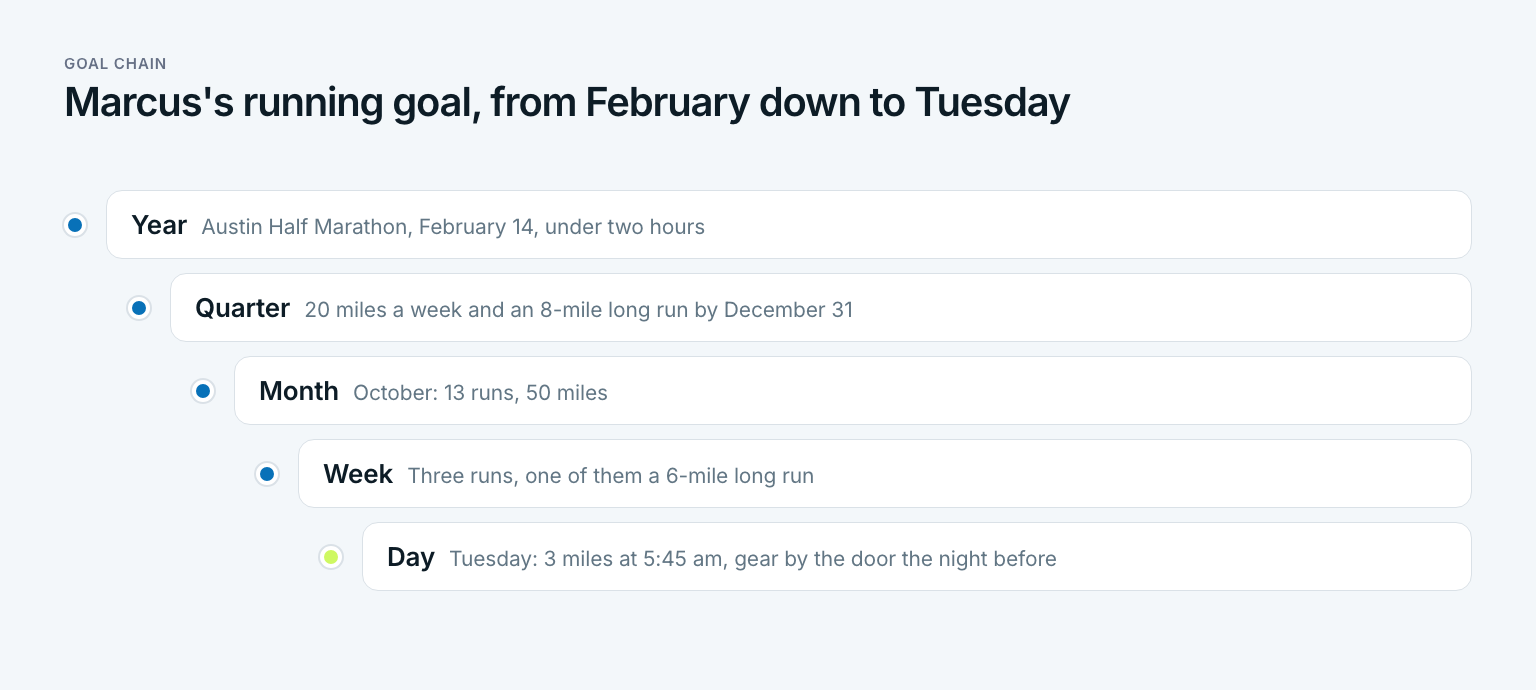
Read it from the bottom. Tuesday's check mark is one of three this week. Three runs this week are one of four weeks this month. Fifty miles this month are one step toward a body that can hold 20 miles a week. Twenty miles a week in December is what makes two hours in February possible. Every box on the sheet has an address in that chain. That means: when Marcus checks Tuesday, he is not keeping a streak alive. He is moving a number that has a number above it.
In Gaapp this chain is the structure: five levels from year to day, every goal attached to the one above it, progress per period shown as the share of goals checked off next to the time already gone. A habit sits at the week and day level as a repeating goal. Whoever has run a habit tracker for a year without once asking what it was for has the bottom rung without the ladder. How the chain is built from the yearly goal down is laid out in the guide on how to achieve goals, and the daily level, one task you can check off tonight, has its own guide under daily goals.
The Friday count is where the tracker meets the chain. Ten minutes, the same three questions every week: Which boxes got checked, and did the goal move? Which stayed empty, and was it the plan or the week? What is the one thing for next week? That is the ten-minute weekly review, and a habit tracker without one is a grid without a reader. Whoever plans in twelve-week blocks, the way the 12 week year does, gets twelve Friday counts per block, and each one weighs more.
Three questions about the tracker on your wall or in your phone:
- Can you name the goal each of your habits feeds, in one sentence, without looking?
- Do you know last week's ratio as a number and not as a feeling?
- Have you dropped a habit from the grid in the last eight weeks?
Anyone who answers no to one of the three does not have a motivation problem. They have a streak counter with the wrong name, and the fix is a goal line at the top and a Friday on the calendar. In short: a habit tracker is not a record of how consistent you are. It is a record of whether the small thing you do every day is still the right small thing.
Frequently asked questions about habit trackers
What is the best habit tracker?
The best habit tracker is the one you mark at the same moment every day without thinking about it. For most people that is a sheet of paper where they already stand each evening, or a spreadsheet they open on Friday anyway. If you choose an app, look for a cap on the number of habits, a weekly ratio shown as clearly as the streak, and a way to attach each habit to a goal. Features beyond that rarely decide whether you are still using it in March.
What is the 3-3-3 rule for habits?
The 3-3-3 rule has no single author and several versions. The best known is Oliver Burkeman's 3/3/3 method for a workday: three hours on your most important project, three shorter urgent tasks, three maintenance activities. For habits it is usually read as three habits at a time, three weeks before adding a fourth, and a starting version small enough to begin in three minutes. Treat it as a cap on your list, not as a schedule for when a habit becomes automatic.
Do habit trackers actually work?
Yes, when they record small actions that feed a named goal. A 2016 meta-analysis by Benjamin Harkin and colleagues across 138 studies found that monitoring progress toward a goal increases the chance of reaching it, and the effect was strongest when progress was physically recorded. A tracker fails when it tracks outcomes you cannot check off, or when a long list produces a low percentage that reads like a verdict. Three habits, a goal line, and a weekly count are the conditions under which the research applies.
What are the 7 daily habits?
There is no official list. Stephen Covey's seven habits from 1989 are principles for working and living, not daily actions. The daily lists that circulate online usually mix sleep, movement, water, reading, planning the day, a few minutes of reflection, and time outdoors. Any of them can be good. None of them belongs on your tracker unless it feeds a goal you are working toward this quarter.
How many habits should I track at once?
Three at most, and one is fine. Every habit you add lowers the percentage for all of them, because your day does not get longer. Marcus went from eight habits and 34 percent in week two to three habits and 88 percent over six weeks, with the same job and the same kids. Add a fourth only after three weeks above 80 percent, and only if it serves the same goal.
What should I do when I miss a day on my habit tracker?
Mark the empty cell, write one line about why, and do the habit the next day. Phillippa Lally's 2010 study found that a single missed day did not measurably slow habit formation, and James Clear's rule in Atomic Habits is never miss twice. Do not restart a streak at zero and do not fill the cell in after the fact. The gap is information. The return is what the tracker is there to show.
Last updated: 19 October 2026
Read next
 Habits
75 Hard: Rules, Risks and a Version You Can Finish
75 Hard is not a fitness program. The full rules, four health risks, 75 Soft compared and a custom version built around a real goal.
15 min read
 Habits
Digital Detox: A 7-Day Plan to Reduce Screen Time
A digital detox isn't a weekend offline. What the research shows, how to measure and reduce screen time, plus a 7-day plan with a worked example.
15 min read
 Habits
Delayed Gratification: Meaning, Examples, How to Build It
Delayed gratification isn't self-denial, it's a trade: what the marshmallow test really showed, everyday examples, five proven strategies and a plan.
15 min read