75 Hard: Rules, Risks and a Version You Can Finish
75 Hard is not a fitness program. The full rules, four health risks, 75 Soft compared and a custom version built around a real goal.

Contents
- 01What 75 Hard Is and What It Is Not
- 02The 75 Hard Rules: Five Tasks, Every Day for 75 Days
- 03What the 75 Hard Challenge Gets Right
- 04Is 75 Hard Unhealthy? Four Rules Checked Against the Guidelines
- 05Does Walking Count? Gray Areas in the Rules
- 06What Actually Happened in Jordan's First 23 Days
- 0775 Soft and Other Versions Compared
- 08Build Your Own 75 Day Hard Challenge in Five Steps
- 0975 Days in a Goal Chain: From Yearly Goal to Today
- 10Three Questions Before You Start Day One
- 11Frequently Asked Questions About 75 Hard
75 Hard is not a fitness program, even though it looks like one. It is a 75-day challenge created by entrepreneur Andy Frisella in which you follow five rules every single day: two 45-minute workouts, one of them outdoors, a diet with no cheat meals and no alcohol, a gallon of water, ten pages of a nonfiction book and a daily progress photo. Miss any rule on any day, and you start over at day one.
The rules take a minute to explain. Whether they fit your life and your goal is the harder question. So everything here runs through one person: Jordan, 34, an operations manager at a distribution center outside Columbus, Ohio, who works four 10-hour shifts a week and coaches his daughter's soccer team on Saturdays. He started 75 Hard on January 5, made it to day 23 and then to day six of his second try. What came next was a version with his own rules that he kept for 75 days.
What 75 Hard Is and What It Is Not
75 Hard is a commitment program with a fixed length. Andy Frisella, founder of the supplement company 1st Phorm, introduced it on his podcast in 2019. It spread from there, mostly through TikTok and Instagram, where people post their way from day one to day 75. Frisella himself calls it a mental toughness program, not a workout plan. It is the first phase of his larger Live Hard program.
The logic is simple. Anyone who does what they promised themselves for 75 straight days, in a snowstorm and on a bad day, learns that their word to themselves counts for something. The physical rules are the training equipment, not the goal. That explains why they are so strict. Hardness is the product.
It also means there are three things 75 Hard is not. It is not a workout plan, because nobody tells you which exercises to do. It is not a diet, because the nutrition rule only says you follow some plan of your choosing. And it is not a medically tested program. There is little solid research on the challenge itself. What doctors and clinics say about it draws on general knowledge about exercise, hydration and sleep.
Term: a fixed-length challenge
A fixed-length challenge starts on a set day, ends on a set day and applies the same rules to every day in between. That makes it easy to start and easy to measure. For a goal, though, it is only one block. The challenge says nothing about day 76, and that turns out to matter.
The 75 Hard Rules: Five Tasks, Every Day for 75 Days
The official 75 Hard rules fit on an index card. Frisella lays them out on his website and in his book “75 Hard: A Tactical Guide to Winning the War with Yourself.” Every rule applies every day, with no rest day and no exceptions:
- Follow a diet. You pick it, based on your goal. No cheat meals and no alcohol for 75 days.
- Do two 45-minute workouts. They have to be separate sessions, and one of them has to be outdoors, whatever the weather.
- Drink one gallon of water. That is 128 ounces, or about 3.8 liters.
- Read ten pages. It has to be a nonfiction or personal development book. Audiobooks do not count.
- Take a progress picture. One every day, as a record of the change.
Then comes the rule that really defines the challenge: Miss any of the five tasks on any day, and you go back to day one. That applies on day 74 too. A forgotten bottle of water is enough. So is one glass of champagne at a wedding.
What does all that cost in time? Two workouts are 90 minutes. Changing, showering and getting outside add another 30 without trying. Ten pages take about 15 minutes, and the meals on your plan have to be bought and prepped. A realistic total is two and a half hours a day, every day. Over 75 days that is about 187 hours, more than four full 40-hour work weeks.
What the 75 Hard Challenge Gets Right
75 Hard has plenty of critics, and some of the criticism is fair. Still, the 75 Hard challenge gets four things right that most resolutions get wrong.
- Clear rules. Every task is yes or no. By evening you know whether the day counts. A vague resolution like “exercise more” never tells you that.
- No decisions in the morning. Whether you work out today is already settled. That removes the daily negotiation with yourself that sinks most voluntary plans.
- A length that fits habit formation. In a 2009 study in the European Journal of Social Psychology, Phillippa Lally and colleagues found that new behaviors took a median of 66 days to become automatic, with a range from 18 to 254 days. 75 days sits just above that median.
- Visible progress. A counter that goes up by one every day is motivating. Anyone standing on day 40 does not want to go back to zero.
Why 66 days is a median and not a rule is covered in how long it takes to form a habit. For 75 Hard, it means the length is well chosen. Whether the rules inside that length are well chosen is a separate question.
The core idea holds up too. Keeping a promise to yourself builds trust in your own ability to act. Psychologists call that self-efficacy, and Albert Bandura argued as early as 1977 that your own past successes are its strongest source. The catch is that successes only come from tasks you can actually complete. That is where the risks start.
Is 75 Hard Unhealthy? Four Rules Checked Against the Guidelines
For healthy adults, 75 Hard is rarely dangerous, but it is stricter than mainstream guidelines in several places. Cleveland Clinic, for example, pairs its overview of the rules with healthier alternatives. The yardstick here is official guidance, not forum opinions.
| Rule | What 75 Hard asks | Guideline | Risk |
|---|---|---|---|
| Exercise | 2 × 45 minutes daily, 630 minutes a week | HHS 2018: 150 to 300 minutes of moderate activity a week | No rest day, overuse injuries for beginners |
| Water | One gallon, about 3.8 liters, daily | National Academies 2004: about 2.7 liters for women, 3.7 for men, from all food and drinks | Too much too fast, risky with heart or kidney disease |
| Diet | Any plan, zero exceptions | None set | Very restrictive diets without professional support |
| Photo | A progress picture every day | None set | Fixation on body image |
| Sleep | No rule | AASM 2015: at least seven hours for adults | The program often comes out of sleep time |
Exercise: 630 minutes with no days off
The Physical Activity Guidelines for Americans, published by the U.S. Department of Health and Human Services in 2018, recommend 150 to 300 minutes of moderate activity or 75 to 150 minutes of vigorous activity a week, plus muscle strengthening on two days. 75 Hard asks for 630 minutes, without a single rest day. Anyone who barely trained before jumps from the couch to more than twice the upper recommendation. That means: At least one of the two sessions should be easy, like a brisk walk, or your body never gets to recover.
Water: more is not automatically better
In 2004, the National Academies set the adequate intake of total water at about 2.7 liters a day for women and 3.7 liters for men, counting water from food. A gallon of plain water on top of food and coffee goes well beyond that. Spread across the day, healthy kidneys usually handle it. Anyone who chugs half the gallon at 9 p.m. to finish on time risks, in rare cases, a dangerously low blood sodium level called hyponatremia. If you have heart or kidney disease, clear the amount with your doctor first.
Diet and photos: when control tips over
A diet with zero exceptions and a daily photo of your body are, for most people, an exercise in consistency. For people with a history of disordered eating, those two rules can wake old patterns. Warning signs are thoughts that keep circling food, weight and exercise, or guilt after every meal. Anyone who notices that in themselves should talk to a doctor or counselor, and in a crisis you can call or text 988 at any hour.
Sleep: the missing rule
75 Hard regulates exercise, water, food, reading and photos, but not sleep. The American Academy of Sleep Medicine has recommended at least seven hours a night for adults since 2015. Whoever squeezes two and a half extra hours into a full day almost always takes them from the night. In short: A mental toughness challenge that costs you sleep mostly trains fatigue.
Does Walking Count? Gray Areas in the Rules
The rules are short, which leaves room for questions. Three come up more than any others.
Do two walks count? The rules set length and location, not intensity. Two separate 45-minute walks, one of them outside, meet the rules as written. Whether they move you toward your goal is a different question. For someone starting from zero, a daily walk is a smart way to make the second session the easy one.
Can you lose weight on 75 Hard? Many people do, but the challenge itself does not cause it. Weight loss depends on an energy deficit, and 75 Hard leaves the diet up to you. Daily movement and no alcohol help. How much anyone loses in 75 days varies widely and cannot be promised.
Can a workout move indoors on bad days? Only one of them. The outdoor session is meant to happen in rain, heat and snow. For people who live where January brings ice storms, this rule decides more attempts than any other, as Jordan found out.
What Actually Happened in Jordan's First 23 Days
Jordan's shifts run from 6 a.m. to 4:30 p.m., Monday through Thursday. His goal for 2026 is a half marathon in October. On the way there, he wanted to run a 10K without walking by late May. In December, he could run about 1.5 miles before he had to stop. 75 Hard looked like the push he needed. He started on Monday, January 5.
The first two weeks went well. Workout one was a run or walk before his shift, in the dark. Workout two was a weight session at the gym on the way home. He read on his lunch break and took the photo in the bathroom mirror. After day 23, he added up what the days had cost him:
| Period | Program per day | Average sleep | Longest run without stopping |
|---|---|---|---|
| Week 1 | 2 hr 45 min | 6 hr 40 min | 1.5 miles |
| Week 2 | 2 hr 35 min | 6 hr 15 min | 2 miles |
| Days 15 to 23 | 2 hr 40 min | 5 hr 50 min | 2 miles |
On Tuesday, January 27, day 23, an ice storm closed the roads. Jordan did both workouts in his basement. By the rules, that put him back at day one. He restarted the next morning, made it six days and then missed his reading after a 12-hour inventory shift. Back to day one again. He quit and did not run once for the next five weeks. How often does a plan end not because willpower ran out, but because one day went differently than planned?
His count shows three things. First: The program cost him more sleep every week, almost 50 minutes a night by the end. Second: His real goal, running farther without stopping, barely moved, because two workouts a day left no recovery between runs. Third: It was not the ice storm that ended the challenge. It was the restart rule.
The most common mistake: confusing the restart rule with discipline
The rule “miss once, back to day one” feels like accountability. It contradicts what research shows about habits. In the Lally study from 2009, missing a single opportunity did not materially affect habit formation. The danger is what happens after a miss: Anyone who loses everything is likely to quit altogether.
That pattern is well documented. In a 1975 study, psychologists C. Peter Herman and Deborah Mack found that dieters who were made to break their diet with a milkshake went on to eat more ice cream than dieters who had no milkshake. The pattern later became known as the what-the-hell effect: If the day is already ruined, the rest of it no longer counts. 75 Hard builds that effect into its rules. One miss becomes a total loss, and a total loss is the best reason to stop.
75 Soft and Other Versions Compared
Because the original rules are too much for many people, variations have spread. The best known is 75 Soft, which did not come from Frisella but took off on TikTok. In its most common form, the rules are: eat well and drink alcohol only on social occasions, exercise 45 minutes a day with one active recovery day a week, drink three liters of water and read ten pages of any book. There is no daily photo, and a missed day does not send you back to the start.
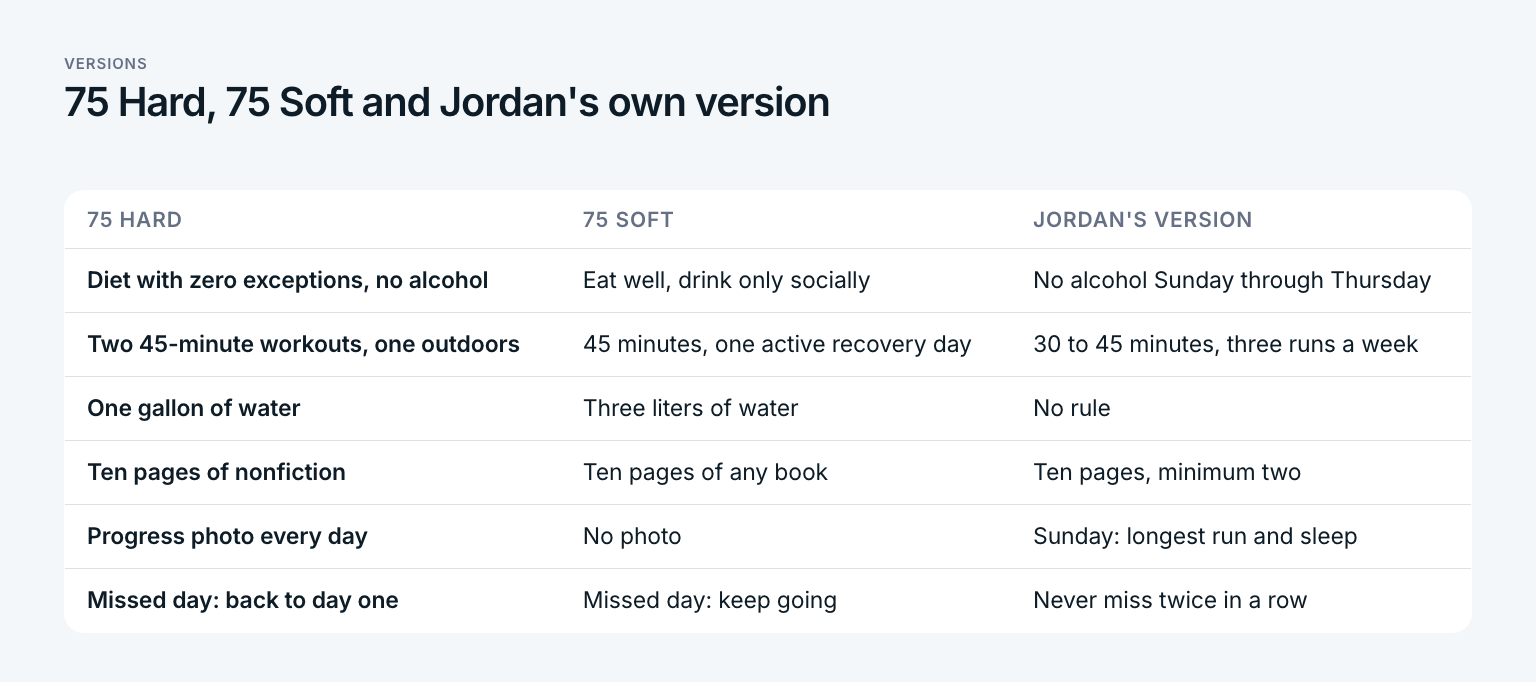
75 Soft is built for something different than 75 Hard. It aims to build habits, not to prove toughness. For most beginners, that makes it the better choice. Both versions share the same gap, though. None of their rules asks what result should be standing at the end of day 75. The third column in the chart closes that gap. It shows Jordan's own version, and how to build yours comes next.
Anyone who still wants the original can make it safer without losing its core. Three changes are enough: Make one of the two sessions easy every day, like a walk. Spread the water evenly across the day and never chug the rest at night. And treat a fixed lights-out time as an unwritten sixth rule. If you have a medical condition, talk to your doctor before day one.
Build Your Own 75 Day Hard Challenge in Five Steps
At the end of Jordan's five-week break, one question was left: What were the 75 days supposed to do? His answer was a 10K without walking at a local Memorial Day race on May 25. He worked the rules backward from that, not the other way around. Here is how:
Set a result for day 75
One outcome with a number and a date that you can check after 75 days. For Jordan: run 6.2 miles without stopping on Monday, May 25. Whoever skips this step only measures whether they survived.
Pick three to five daily rules
Each rule either moves the goal or protects recovery. Jordan chose four: 30 to 45 minutes of movement a day with three planned runs a week, ten pages of reading, no alcohol Sunday through Thursday and lights out at 10 p.m. on work nights.
Define a minimum version of each rule
What counts on a day when everything goes wrong? For Jordan: a ten-minute walk instead of a run, two pages instead of ten. The minimum version decides whether one ice storm ends the whole challenge.
Replace the restart rule
Instead of going back to day one, the rule is: never miss twice in a row. The counter keeps running. A miss shows up, but it is not punished.
Measure once a week instead of photographing every day
Every Sunday, Jordan logs his longest run without stopping and his average sleep. That tracks progress toward the goal, not just toward the mirror.
Never miss twice comes from James Clear's 2018 book “Atomic Habits.” It keeps the strictness of the challenge but removes the total loss. Anyone who slips on one day has a clear job the next day instead of a reason to quit. If you want your daily rules to show more than checkmarks, the guide to the habit tracker shows how to set one up.
What Jordan's second attempt delivered
Jordan started again on Thursday, March 12. Day 75 fell on Memorial Day, Monday, May 25. On 70 of the 75 days, he kept all four rules in full. On four days, the minimum version kicked in, mostly after inventory shifts. On one day, a Saturday with a stomach bug, he did nothing at all and simply picked up again on Sunday. His sleep averaged seven hours and five minutes, more than an hour above the last stretch of his January attempt.
On May 25, he ran the 10K without stopping in 1 hour and 4 minutes. That does not prove his version is better for everyone. It is an example of what happens when the rules serve a goal instead of a test of toughness. That means: Strictness is not the problem with 75 Hard. Strictness without direction is.
75 Days in a Goal Chain: From Yearly Goal to Today
75 days is just under 11 weeks, nearly a quarter. That lets a challenge fit neatly into one level of a goal chain. The yearly goal becomes a quarterly goal, the quarterly goal a monthly goal, then a weekly goal and a daily goal. The challenge frames the quarter, and the daily rules are the bottom rung.
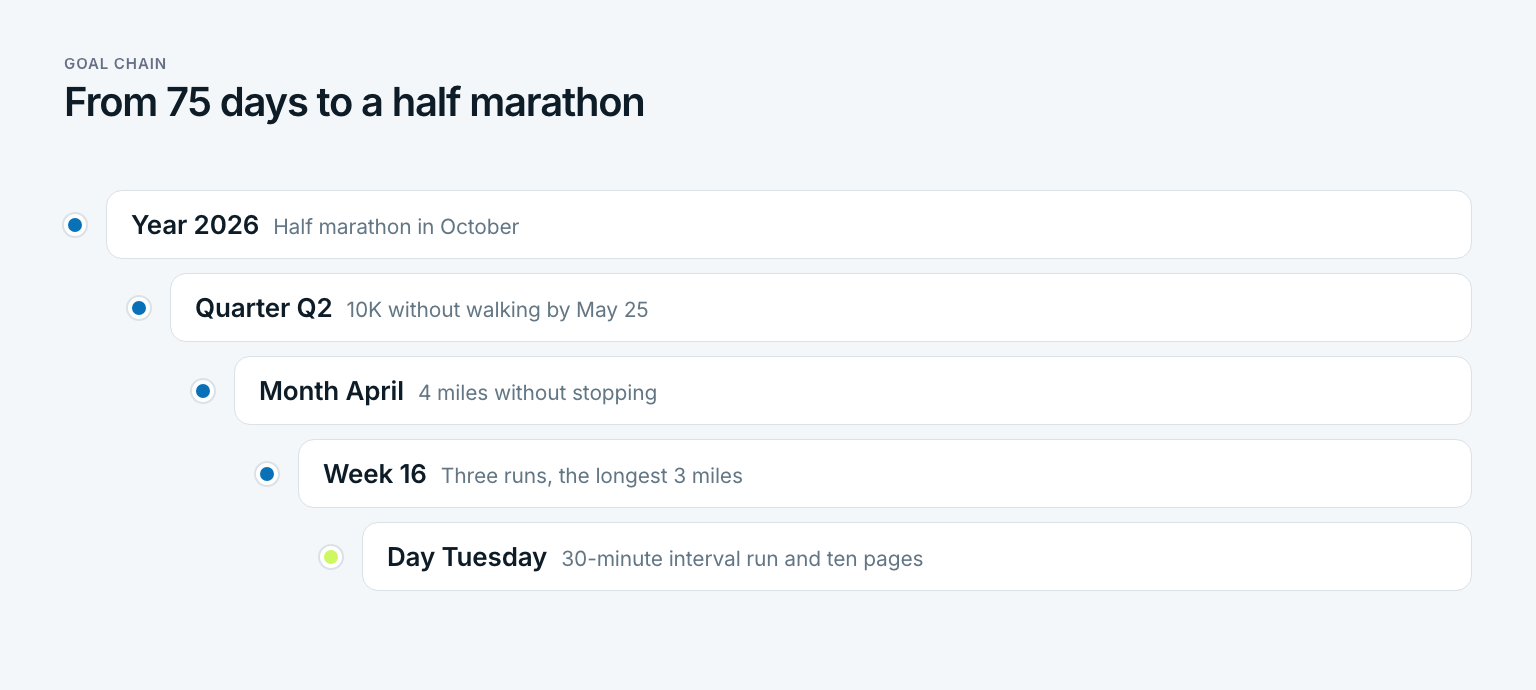
Here is Jordan's chain. Year 2026: half marathon in October. Quarter Q2: 10K without walking by May 25, then 8 miles by June 30. Month April: 4 miles without stopping. Week 16: three runs, the longest 3 miles. Day Tuesday: 30-minute interval run and ten pages. Each rung answers the question of what the rung below it is for.
In Gaapp, every daily goal hangs on a weekly goal and every weekly goal on a monthly goal. For Jordan, that means on Sunday he sees not just how many days he trained, but whether the week made his longest run longer. Anyone who embeds a challenge this way also knows what comes on day 76. For Jordan, it is the next block toward the half marathon.
If you prefer planning in fixed blocks of twelve weeks, the 12 week year explains the method. 75 days and twelve weeks are close. The difference is the 13th week, which the 12 week year reserves for review and rest. That built-in pause is exactly what 75 Hard lacks.
Three Questions Before You Start Day One
Before you buy the gallon jug and set the counter to one, answer three questions:
- What result, with a number and a date, should be standing on day 75?
- How many hours a day can you give for 75 days without cutting sleep?
- What is the minimum version of each rule for the day an ice storm closes the roads?
Anyone who cannot answer the first question gets a test of toughness from 75 Hard, but no progress. Whoever honestly finds less than two and a half hours in the second needs a custom version. And anyone who leaves the third open will see their challenge end on the first day that goes sideways. Why self-discipline comes from good systems more than from willpower is covered in the guide to self-discipline. In short: 75 Hard is not proof of character. It is a tool, and a tool is only worth as much as the goal you point it at.
Frequently Asked Questions About 75 Hard
What are the 75 Hard rules?
Every day for 75 days, you follow a diet of your choice with no cheat meals and no alcohol, do two separate 45-minute workouts with one outdoors, drink a gallon of water, read ten pages of a nonfiction book and take a progress photo. If you miss any of these on any day, you start over at day one. There are no rest days.
Is 75 Hard unhealthy?
For healthy adults it is rarely dangerous, but it goes beyond mainstream guidance: 630 minutes of exercise a week with no rest day, a gallon of water and no rule for sleep. People with heart or kidney disease or a history of disordered eating should talk to a doctor first. A version with a rest day and minimum rules is the better choice for most people.
Does 2 walks count for 75 Hard?
The rules set the length of each session and require one of them to be outdoors, but they do not set the intensity. Two separate 45-minute walks meet the rules as written. If your goal is fitness or a race, make one session a real workout and keep the walk as the easy one.
Can I lose weight on 75 Hard?
Possibly, but it depends almost entirely on the diet you choose, because 75 Hard does not prescribe one. Daily exercise and no alcohol help, yet weight loss only happens with an energy deficit. Results vary widely and cannot be promised.
What is 75 Soft?
75 Soft is a gentler version that spread on TikTok and does not come from Frisella. In its common form, you eat well and drink only on social occasions, exercise 45 minutes a day with one active recovery day a week, drink three liters of water and read ten pages of any book. There is no daily photo and no restart rule.
What happens if you miss a day of 75 Hard?
Under the official rules, you start over at day one, even on day 74. Habit research suggests a single miss does little harm, while losing all progress often makes people quit. In a custom version, the rule never miss twice in a row keeps you accountable without the total reset.
Last updated: 22 October 2026
Read next
 Habits
Digital Detox: A 7-Day Plan to Reduce Screen Time
A digital detox isn't a weekend offline. What the research shows, how to measure and reduce screen time, plus a 7-day plan with a worked example.
15 min read
 Habits
Delayed Gratification: Meaning, Examples, How to Build It
Delayed gratification isn't self-denial, it's a trade: what the marshmallow test really showed, everyday examples, five proven strategies and a plan.
15 min read
 Habits
Willpower: What It Is and How It Really Works
Willpower is not a tank that runs dry. The definition, the honest state of ego depletion research, and six steps that work before temptation hits.
16 min read