Delayed Gratification: Meaning, Examples, How to Build It
Delayed gratification isn't self-denial, it's a trade: what the marshmallow test really showed, everyday examples, five proven strategies and a plan.

Contents
- 01Delayed gratification meaning: a trade, not a sacrifice
- 02The marshmallow test: what it showed and what it didn't
- 03Why now almost always wins
- 04Benefits of delayed gratification, and when waiting is the wrong call
- 05Delayed gratification examples from everyday life
- 06How to practice delayed gratification: five strategies with evidence
- 07A five-step delayed gratification plan
- 08The most common mistake: waiting with no end in sight
- 09Delayed gratification in your goal chain: from year to tonight
- 10Three questions before your next temptation
Delayed gratification is not about denying yourself. Delayed gratification means turning down a small reward now so you can get a bigger one later: skipping tonight's takeout because that money becomes a trip to Japan next fall. Psychologist Walter Mischel studied it starting in the late 1960s with what became known as the marshmallow test. Anyone who can wait isn't giving something up. They're making a trade.
The research that followed Mischel holds the good news. Waiting turns out to depend less on character and more on your surroundings, your planning and whether you trust the bigger reward to show up. You can shape all three. The worked example is Maya, 29, a dental hygienist in Columbus, Ohio. She wants two weeks in Japan in November 2027 and needs $7,200 for it, saved from November 2026 through October 2027. That's $600 a month. She currently saves $250. The missing $350 leaks out every month through food delivery, drive-thru coffee and impulse orders. Below you'll find what the marshmallow test really showed, everyday delayed gratification examples, five strategies with evidence and a plan you can start this Sunday.
Delayed gratification meaning: a trade, not a sacrifice
Delay of gratification is the ability to resist an immediately available reward in favor of a later one you value more. Three parts are always present: a temptation in the present, a reward in the future and a stretch of time in between that you have to get through. Remove one of the three and you have something else. Whoever gives something up with no later reward in mind is practicing abstinence, not delay.
Sigmund Freud described the same tension in 1911 as the pleasure principle versus the reality principle. A toddler wants it now. An adult learns that reality sometimes asks you to wait. Modern psychology calls it self-control and is a little less dramatic about it. The core problem hasn't changed. The present is loud. The future is quiet, and it never rings your doorbell at 8 p.m. with a bag of food.
Delayed gratification, self-denial, self-discipline and procrastination
Four ideas often get lumped together. None of them is wrong, but each one is built for something different:
| Term | What you do | What comes after |
|---|---|---|
| Delayed gratification | Turn down a small reward now | A bigger reward later that you can name |
| Self-denial | Give something up for good | Nothing specific, the giving up is the goal |
| Self-discipline | Do a planned action even when you don't feel like it | Progress on a goal |
| Procrastination | Put off something unpleasant and take the relief now | Higher costs later |
Procrastination is delayed gratification in reverse. Anyone who procrastinates takes the small reward of relief right away and pays for it later. Self-discipline is the tool that connects both sides, and the article on self-discipline shows how to build it as a system instead of a mood. This article covers the question that comes first: how do you get yourself to value the later reward more than the one in front of you?
The marshmallow test: what it showed and what it didn't
The best-known experiment on delayed gratification comes from Walter Mischel. Starting in the late 1960s, at the preschool on the Stanford University campus, he seated children of about four years old in front of a treat such as a marshmallow or a pretzel. The rule was simple. Wait until the researcher comes back and you get two. Ring the bell earlier and you get one right away. Some children held out for around fifteen minutes. Others lasted a few seconds.
The test became famous because of the follow-ups years later. Yuichi Shoda, Walter Mischel and Philip Peake reported in 1990 that children who had waited longer went on to score higher on the SAT on average and were described by their parents as better at concentrating. That turned into a popular story: kids who can wait end up successful. The story is catchy. It's also too simple.
Two later studies corrected it. Celeste Kidd, Holly Palmeri and Richard Aslin showed in 2013 that children wait far longer when they've just experienced the researcher as reliable. After a kept promise, they waited about twelve minutes on average. After a broken one, about three. Tyler Watts, Greg Duncan and Haonan Quan repeated the long-term analysis in 2018 with more than 900 children from a broader sample. The link to later academic achievement was only about half as strong as in the original study, and it shrank further once family background and early abilities were taken into account.
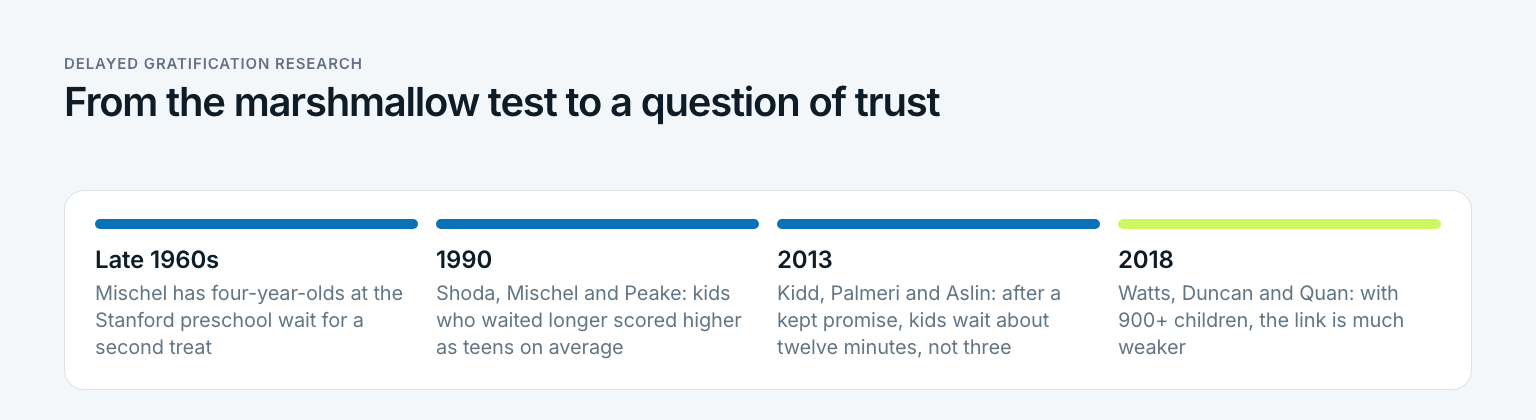
That means: delayed gratification is not a fixed trait that decides your life at age four. It depends heavily on whether the later reward is believable and how the situation is set up. A child who has learned that promises fall through is acting sensibly when they eat the one marshmallow now. For adults, that's encouraging. Believability and situation are both things you can design.
Why now almost always wins
A reward loses value the further away it is. Economists call this discounting. Psychiatrist George Ainslie described in 1975 that people don't discount evenly over time. Right before the temptation, the scales tip. On Monday morning, $7,200 for Japan matters more to Maya than a delivery dinner. On Thursday at 8 p.m., hungry after a long shift, it's the other way around.
Mischel and psychologist Janet Metcalfe found an image for this in 1999: a hot system and a cool system. The hot system is fast, emotional and reacts to whatever is right in front of you. The cool system is slow, abstract and thinks in goals. Stress, fatigue and hunger hand control to the hot system. Whoever negotiates big decisions at night after work is negotiating with the wrong system.
Maya's own numbers make this visible. For one week in October she wrote down every purchase that wasn't rent, groceries or a fixed bill:
| Spending in one week | Amount | When |
|---|---|---|
| Food delivery, twice | $58 | Tuesday and Thursday after 8 p.m. |
| Drive-thru coffee and a snack | $27 | every workday on the way in |
| Impulse online orders | $36 | Sunday night on the couch |
| Streaming service she barely uses | $4 per week | automatic |
| Total | $125 | almost all of it at night or on the go |
No single line is a problem. Together they add up to about $540 a month, more than the $350 Maya is missing. The column on the right is what stands out. Nearly every purchase happens at night or on the road, exactly when the hot system is in charge. Promising herself more willpower would be fixing the wrong end. In short: Maya doesn't have a willpower problem. She has a timing problem.
Benefits of delayed gratification, and when waiting is the wrong call
The benefits of delayed gratification are real, even after the marshmallow test was scaled back. Terrie Moffitt and her team followed more than 1,000 children from Dunedin, New Zealand, until age 32 and published the results in 2011. Children with more self-control grew into adults with better health, more stable finances and fewer criminal convictions on average. Angela Duckworth and Martin Seligman found in 2005 that self-discipline predicted eighth graders' grades better than IQ did. Self-control in these studies was measured across many situations, not with one treat on one afternoon.
Is delayed gratification always good?
Not always. Kidd's study shows that taking the reward now can be the rational choice when the future is unreliable. Ran Kivetz and Anat Keinan found in 2006 that people regret giving in to temptation in the short term, but looking back over years they more often regret the pleasures they never allowed themselves. Delayed gratification is a tool for goals you care about, not a rule to skip every joy.
That gives you a simple test. Waiting makes sense when three things are true: the later reward is real, it's likely to arrive and you actually want it more than the one in front of you. Goals that come from intrinsic motivation pass that third test more easily, because the later reward is something you want for its own sake. If one of the three is missing, the honest answer may be to take the smaller reward and enjoy it without guilt. Anyone who saves every dollar and never takes the trip hasn't mastered delayed gratification. They've only mastered the delay.
Delayed gratification examples from everyday life
Delayed gratification shows up in almost every area of life. These examples all share the same structure: a small, certain reward right now against a larger one that needs time.
| Area | Instant option | Delayed option | Later reward |
|---|---|---|---|
| Money | Takeout on a tired Thursday | Heat up a meal you cooked on Sunday | A trip, an emergency fund, a down payment |
| Health | Hit snooze and skip the run | Run three mornings a week | Finishing a 10K in the spring |
| Career | Scroll for an hour after work | One hour on a certification course | A raise or a new role next year |
| Learning | Watch another episode | Twenty minutes of language practice | Ordering dinner in Japanese |
| Debt | Buy now, pay later | Wait until you can pay in cash | No interest and no monthly drag |
| Relationships | Win the argument tonight | Sleep on it and talk tomorrow | Trust that lasts |
Look at the middle column. None of the delayed options is heroic. Each one is a small, specific action that someone decided on ahead of time. That's the pattern behind every one of these delayed gratification examples, and it's the pattern the next five strategies build on. Which row looks most like your week?
How to practice delayed gratification: five strategies with evidence
The research after Mischel agrees on one point that surprises most people. Whoever is good at waiting fights temptation less often, not harder. The five strategies below are well studied, and none of them asks for more willpower. Each one changes the situation before the temptation shows up.
1. Move the temptation out of sight
Wilhelm Hofmann, Roy Baumeister and colleagues asked about 200 adults several times a day for a week about the temptations they were facing. They published the results in 2012. People high in self-control didn't resist better. They ran into temptation less often. Angela Duckworth, Tamar Gendler and James Gross reached the same conclusion in a 2016 review: strategies that change the situation work more reliably than willpower in the moment. Maya deletes the delivery app from her phone. She can still order. It just takes more than two thumbs on the couch.
2. Cool it down instead of white-knuckling it
In Mischel's studies, children waited longer when the treat was covered or when they distracted themselves by singing or playing games with their hands. Some imagined the marshmallow as a fluffy cloud, which took away its pull. For adults, that means not staring at the temptation and changing the subject instead. Whoever is sitting in front of a full online cart can close the tab and put the item on a list with a date. Maya gives herself a fixed three-day wait. If she still wants it then, she decides again with a cool head.
3. Set if-then plans
Peter Gollwitzer described in 1999 how implementation intentions work: if situation X happens, then I'll do Y. A meta-analysis by Gollwitzer and Paschal Sheeran in 2006 found medium to large effects on goal attainment across 94 studies. The plan takes the decision away from the hot system because it has already been made. Maya writes: if I'm hungry after 8 p.m., then I heat up one of the three meals I cooked on Sunday.
4. Make the future concrete
Jan Peters and Christian Büchel showed in 2010 that people made more patient choices when they pictured a specific upcoming event from their own calendar while deciding. An abstract number doesn't pull much. A picture does. So Maya doesn't tape a savings target to her fridge. She tapes a photo of the Kyoto street she wants to walk down, with the departure date written on it: November 6, 2027. Every glance brings November a little closer to Thursday night.
5. Bundle what you should do with what you want to do
Katherine Milkman, Julia Minson and Kevin Volpp ran a study in 2014 where gripping audiobooks were only available at the gym. Anyone who wanted the next chapter had to work out, and participants went noticeably more often in the first weeks. The researchers call it temptation bundling. It turns a chore with a distant reward into a chore with an immediate one. Maya now listens to her favorite true-crime podcast only while she meal-preps on Sunday.
A five-step delayed gratification plan
Strategies only help once they're in a fixed order. Maya builds her plan on a Sunday evening in about 30 minutes. She has a notepad, her last four weeks of bank statements and her calendar through next fall in front of her:
Write down the big reward
One sentence with a number and a date: $7,200 in the travel account by October 31, 2027, flight on November 6. The more specific the reward, the more believable it is to you.
Track your temptations for one week
Don't judge, just note what, how much and when. Maya's list shows that nearly every purchase happens after 8 p.m. or on the go.
Defuse your three biggest triggers
Change the environment for each one: delete the app, make coffee at home in a travel mug, route every online purchase through a list with a three-day wait.
Write if-then sentences
One sentence per trigger that makes the decision in advance. If I'm hungry after 8 p.m., then I eat a meal I already cooked. If I want to buy something online, then it goes on the list.
Make progress visible and set milestone rewards
On the first of each month, $600 moves to the travel account automatically. Every Sunday, Maya checks off whether the week stayed on budget. After each full quarter there's a reward that fits the goal.
Step five is the one most people skip. It turns waiting into a series of small, visible wins. If you want a simple way to measure a week against a goal, the guide to the habit tracker walks through it.
Maya's first four weeks, in numbers
Here is the plan in November. Only the impulse spending she had identified as the gap is counted:
| Week | Impulse spending | If-then plan kept | What happened |
|---|---|---|---|
| Week 1 | $49 | 4 of 6 evenings | App deleted, ordered once through the browser |
| Week 2 | $36 | 5 of 6 evenings | Meal prep with podcast, coffee from home |
| Week 3 | $62 | 3 of 6 evenings | Coworker's birthday, two impulse buys after a double shift |
| Week 4 | $27 | 6 of 6 evenings | Two of three items on the list dropped after three days |
| Total | $174 instead of about $500 | 18 of 24 evenings | Streaming canceled, $600 moved on December 1 |
Week three is the interesting one. Maya broke her plan on three of six evenings and kept going anyway. Anyone who reads a bad week as proof of weak willpower quits around week three. Anyone who reads it as data adjusts the plan. Maya adds one sentence: if I get home after 9 p.m., then it's toast and soup from the pantry. With about $326 less impulse spending and the $18 streaming plan canceled, the $350 gap is almost closed in the first month.
The most common mistake: waiting with no end in sight
The most common mistake: treating delayed gratification as permanent denial
Whoever confuses delayed gratification with permanent denial cuts out everything enjoyable and waits for a day that's too far away. After three weeks the plan collapses, and going back to old habits feels like freedom. The problem isn't willpower. There's no reward close enough to carry you. Set milestone rewards that fit the big goal and keep them as reliably as the savings transfer itself.
Kidd's study explains why this works. Children waited longer when they could trust the world around them. Adults aren't so different. Whoever promises themselves a milestone reward and then cancels it because they could save even more is teaching themselves that waiting doesn't pay. That means: keep the promises you make to yourself, especially the small ones.
Two other mistakes are less common but just as costly:
- Changing everything at once. Whoever overhauls food, exercise, money and screen time on the same Monday spreads their attention across four projects. Start with the area where the big reward lives and add the next one only when the first one runs on its own.
- Negotiating in the moment. Decisions about temptation belong in a calm moment, not on Thursday night. The Sunday planning session exists for exactly this. What's decided there doesn't need to be argued about at 8 p.m.
How an if-then sentence turns into something automatic after a few weeks is covered in how to build good habits. That's the point where delayed gratification gets easy. The temptation is still there, but it no longer asks a question.
Delayed gratification in your goal chain: from year to tonight
The biggest reward is usually the furthest away. That's the weak spot of every yearly goal. In November, next November feels like a rumor. The fix isn't more patience. It's a shorter distance to the next visible reward. A goal chain gives you that, because every level has its own, smaller milestone.
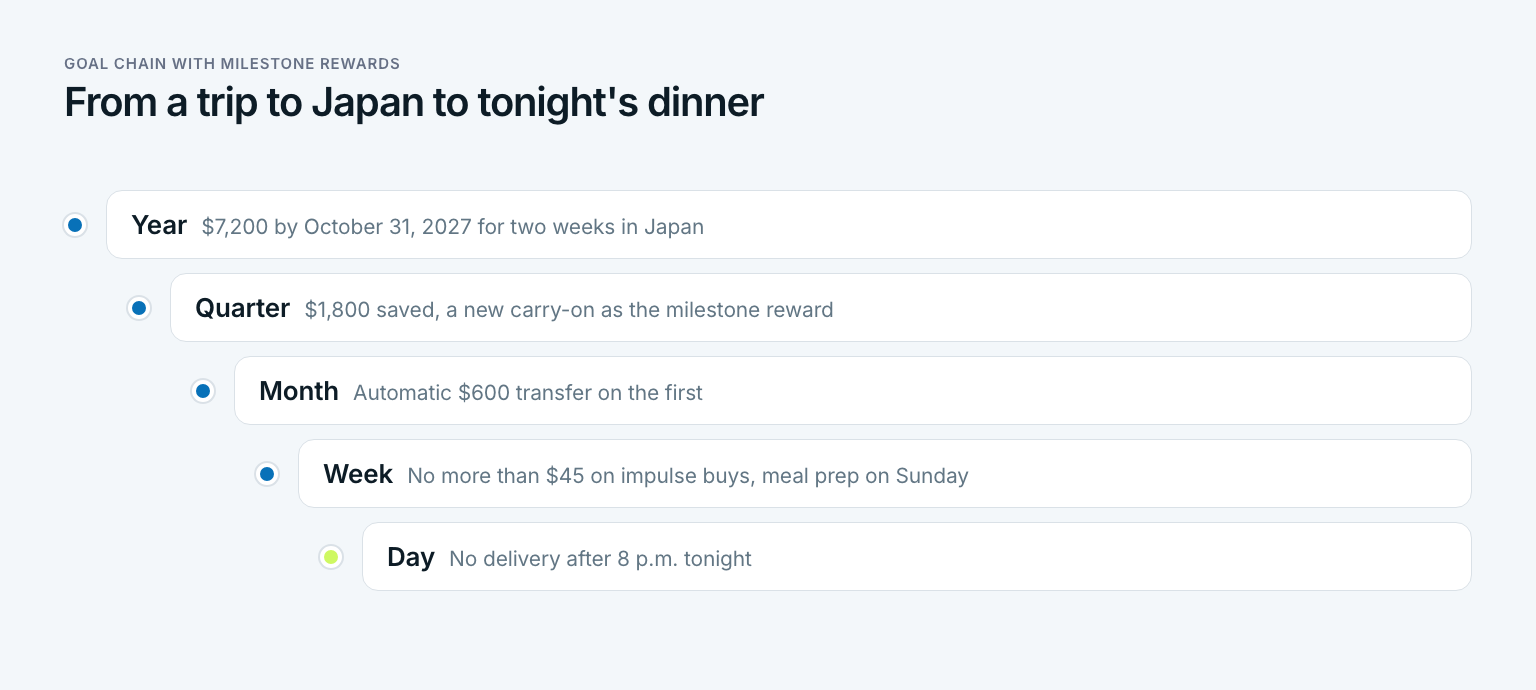
For Maya, it looks like this. The year holds the trip. The quarter holds $1,800 and a new carry-on bag as the milestone reward. The month holds the $600 automatic transfer. The week holds a $45 budget for impulse spending and the Sunday meal prep. The day holds one sentence: no delivery tonight. To break a yearly goal down like this, see how to turn yearly goals into daily steps.
In Gaapp, you set one yearly goal and break it down through quarter, month and week to today. Every day you check off is a small, immediate signal on the way to the big reward. For the full method behind the goal chain, read the guide on how to achieve goals. The core idea is simple: delayed gratification gets easier when the waiting itself shows progress.
Three questions before your next temptation
Before you build a plan, check where you stand. Three questions are enough:
- Do I know my big reward well enough to write it down with a number and a date?
- Do I know when and where my temptations show up, or am I guessing?
- Is there a reward between today and the big goal that I can reach in the next four weeks?
Anyone who answers no to one of these knows where to start. Anyone who answers yes to all three doesn't need another resolution, just a Sunday evening and the five-step plan. In short: delayed gratification isn't about how long you can hold out. It's about how well you build the wait.
Is delayed gratification good?
Usually, yes. Long-term studies such as Moffitt and colleagues in 2011 link self-control to better health and more stable finances. But waiting only pays when the later reward is real and likely. Research by Kivetz and Keinan in 2006 also shows that people often regret, years later, the pleasures they never allowed themselves.
Do people with ADHD struggle with delayed gratification?
Often, yes. Psychologist Edmund Sonuga-Barke describes a strong dislike of waiting in ADHD, which he calls delay aversion. That is not a lack of character or discipline. If you suspect ADHD, a doctor or licensed psychologist can assess it, and practical strategies like short milestones and visible rewards help either way.
What does the Bible say about delayed gratification?
Several passages touch on it. The story of Esau in Genesis 25, who trades his birthright for a bowl of stew, is a classic warning about choosing now over later. Hebrews 12:11 says discipline feels painful at the time but later yields a harvest, and Galatians 6:9 encourages not giving up because the harvest comes in due season.
What is meant by delay of gratification?
Delay of gratification is the psychological term for resisting an immediate reward in favor of a larger or more valued one later. Walter Mischel made it famous with the marshmallow test. Today it's studied as part of self-control.
What are some examples of delayed gratification?
Cooking at home instead of ordering takeout to save for a trip, running three mornings a week to finish a race in the spring, and studying for a certification instead of scrolling after work. Paying in cash instead of buying now and paying later is another common one. Each trades a small reward now for a larger one later.
Can you learn delayed gratification as an adult?
Yes, mostly by changing your situation rather than relying on willpower. Well-supported methods include removing triggers, if-then plans, distraction in the moment and picturing the future reward concretely. Milestone rewards make long waits manageable.
Last updated: 22 October 2026
Read next
 Habits
75 Hard: Rules, Risks and a Version You Can Finish
75 Hard is not a fitness program. The full rules, four health risks, 75 Soft compared and a custom version built around a real goal.
15 min read
 Habits
Digital Detox: A 7-Day Plan to Reduce Screen Time
A digital detox isn't a weekend offline. What the research shows, how to measure and reduce screen time, plus a 7-day plan with a worked example.
15 min read
 Habits
Willpower: What It Is and How It Really Works
Willpower is not a tank that runs dry. The definition, the honest state of ego depletion research, and six steps that work before temptation hits.
16 min read