Atomic Habits Summary: Four Laws and the 1% Rule
Atomic Habits is not a motivation book but a manual: the 1% rule, the four laws, the two-minute rule, the criticism, and one runner's first eight weeks.

Contents
- 01The Atomic Habits summary in five main points
- 02The 1% rule: why tiny habits compound
- 03The habit loop: cue, craving, response, reward
- 04The four laws of Atomic Habits at a glance
- 05What the book says about talent, boredom, and limits
- 06Criticism of Atomic Habits: three objections and what holds up
- 07How to apply Atomic Habits: six steps for your first habit
- 08The 1% rule in a goal chain: from yearly goal to Tuesday morning
- 09Three questions before you close the book
- 10Frequently asked questions about the Atomic Habits book summary
Atomic Habits is not a motivation book but a manual for habits: James Clear shows that big results come from tiny actions that compound over months, and that you can steer any habit with four laws. Make it obvious, make it attractive, make it easy, make it satisfying. To break a bad habit, you turn each law around. That is the Atomic Habits summary in three sentences. The rest of the book is tooling.
The book came out in October 2018 and has 20 chapters. This summary follows its structure and adds what most summaries leave out: the criticism, a step plan, and real numbers from one person. Marcus, 41, is an operations manager at a distribution center outside Columbus, Ohio. He wants to finish the Columbus half marathon in October 2027. Today he can run about one mile before he has to walk, and most nights he is still scrolling his phone in bed at eleven.
The Atomic Habits summary in five main points
The book has 20 chapters, but it rests on five ideas. Whoever knows these five can place every chapter:
- Small habits compound. Getting 1% better each day is invisible on any given day. Over a year it adds up to a difference nobody can miss.
- Systems beat goals. Goals set the direction, but the system of daily actions decides whether you arrive.
- Identity comes before outcome. A habit lasts when it fits the picture you have of yourself. Every repetition confirms that picture.
- Every habit runs in four stages. Cue, craving, response, reward. Each of the four laws targets one stage.
- The four laws are dials, not virtues. Obvious, attractive, easy, satisfying. For a bad habit, you turn each dial the other way.
In short: Clear moves the problem from your character to your environment. You are not too weak for a good habit. Your day just is not built yet so that the habit happens on its own.
How Atomic Habits by James Clear is built
Many readers want a chapter by chapter summary. The structure itself is the best map:
| Part | Chapters | Core question |
|---|---|---|
| The Fundamentals | 1 to 3 | Why do tiny changes matter, and how do habits work? |
| The 1st Law: Make It Obvious | 4 to 7 | How do you make the cue impossible to miss? |
| The 2nd Law: Make It Attractive | 8 to 10 | How do you make yourself want to do it? |
| The 3rd Law: Make It Easy | 11 to 14 | How do you lower the effort until starting is trivial? |
| The 4th Law: Make It Satisfying | 15 to 17 | How do you get a reward now instead of in a year? |
| Advanced Tactics | 18 to 20 | What about talent, boredom, and the downside of habits? |
The 1% rule: why tiny habits compound
The 1% rule is Clear's picture of compound interest for habits. Get 1% better every day for a year and you end up about 37 times better, because 1.01 to the power of 365 is 37.8. Get 1% worse every day and 0.99 to the power of 365 leaves you close to zero. Nobody measures a life in daily percentages. The picture still makes the point: the direction of small actions matters more than their size.
Clear opens the book with British Cycling. From 2003, coach Dave Brailsford bet on many tiny improvements instead of one big leap: better saddles, better hand washing against colds, the right pillow in every hotel room. Each change was almost laughably small. Together, as Clear tells it, they led to Olympic gold medals and Tour de France wins.
The hard part is the time in between. Clear compares it to an ice cube in a room at 25 degrees Fahrenheit. The room warms one degree at a time, and nothing visible happens. At 32 degrees the ice starts to melt, and it looks as if the last degree did all the work. Clear calls the stretch before that the plateau of latent potential. Anyone who quits there is confusing a delayed effect with no effect.
For Marcus, the math looks like this. Twenty minutes of running on four mornings a week feels like nothing. Over 48 weeks it adds up to 64 hours of running, on mornings that used to start with the snooze button. No single morning makes him a half marathoner. The sum can.
Systems versus goals: what Clear actually means
The second idea of chapter one is the most misquoted. Clear does not say goals are useless. He observes that winners and losers often share the same goals, so the goal alone cannot explain the difference. The system can, the chain of small actions that happens every day. That means: a goal without a system stays a wish. A system without a goal stays busywork.
Identity-based habits: who you want to become
Clear describes change in three layers: outcomes on the outside, process in the middle, identity at the core. Most people start on the outside and ask what they want to achieve. Clear reverses the order and asks first who you want to be.
Each repetition works like a vote. One vote decides nothing. Many votes in the same direction shift your self-image until the habit stops feeling like effort and starts feeling like you. Marcus wrote his sentence: I am a runner who is building toward 13.1 miles. A little grand for a man who walks after one mile? Maybe. But it turns the question of whether he feels like running into the question of whether running fits who he is.
The habit loop: cue, craving, response, reward
According to Clear, every habit runs in four stages. Charles Duhigg described a loop of three parts in The Power of Habit in 2012: cue, routine, reward. Clear adds craving as its own stage. You do not want your phone. You want the distraction it promises.
- Cue. A signal that a reward is near: a time, a place, a feeling, a previous action. For Marcus, it is the alarm at 5:45 and the coffee maker.
- Craving. The wish for a changed state. At night Marcus does not want Instagram. He wants to switch off after a ten-hour shift.
- Response. The action itself. Whether it happens depends on the effort it takes and how strong the craving is.
- Reward. The result that satisfies the craving and tells the brain: this was worth it, remember the cue.
From the four stages Clear derives the four laws, one per stage. That is the real trick of the book. Instead of fighting a habit as a whole, you check each stage. Is the cue invisible, the craving weak, the action too big, or the reward too far away? In short: whoever knows the stage where a habit fails no longer has to doubt the whole plan.
The four laws of Atomic Habits at a glance
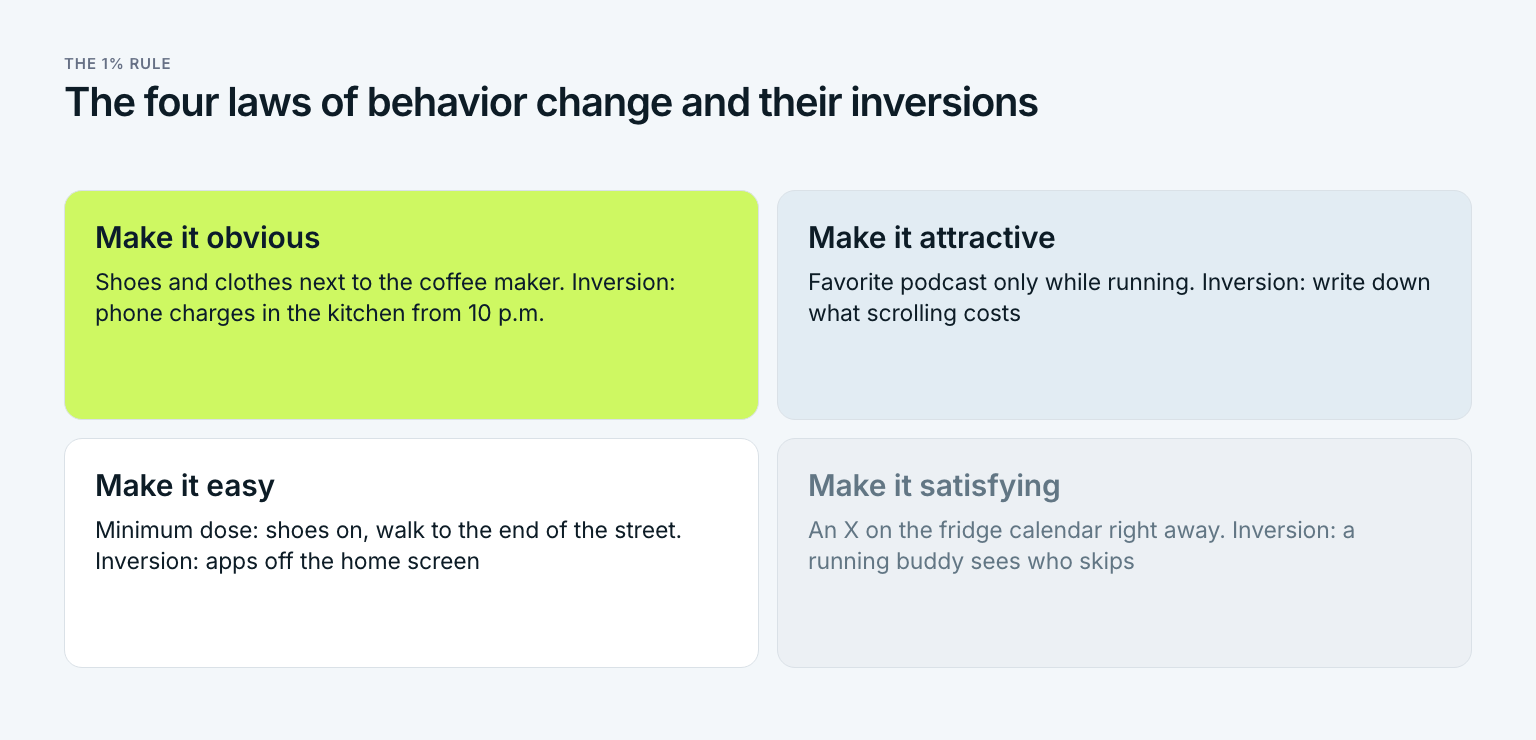
The four laws of behavior change are the core of the book, each with an inversion for bad habits. Here is what Marcus did with both directions:
| Stage | Build a good habit | Break a bad habit | What Marcus did |
|---|---|---|---|
| Cue | Make it obvious | Make it invisible | Shoes and running clothes laid out next to the coffee maker, phone charges in the kitchen from 10 p.m. |
| Craving | Make it attractive | Make it unattractive | His favorite podcast only while running, a Saturday group run at a local running store |
| Response | Make it easy | Make it difficult | Minimum dose: shoes on and a walk to the end of the street, social apps moved off the home screen |
| Reward | Make it satisfying | Make it unsatisfying | An X on the calendar on the fridge, a running buddy who notices when he skips |
The 1st law: make it obvious
Many habits fail before they start because the cue is missing. I will run more has no moment when it begins. Clear recommends an implementation intention with a time and a place. He cites a British study by Sarah Milne, Sheina Orbell, and Paschal Sheeran from 2002. Of the participants who wrote down when and where they would exercise, 91 percent exercised at least once a week. In the two comparison groups, it was 35 and 38 percent.
The plan gets stronger when you attach it to something you already do. Clear calls this habit stacking, a formula he credits to BJ Fogg. Marcus wrote his on a sticky note on the coffee maker: After I pour my first coffee, I put on my running shoes. The shoes no longer live in the hall closet. They sit next to the coffee maker, with shorts and shirt folded on top. Whoever can see the cue does not need to remember it.
For the late night phone, the inversion applies. Marcus's phone now charges on the kitchen counter from 10 p.m., not on the nightstand. Clear treats self-control as a short-term strategy. Anyone who removes the temptation from sight never has to resist it in the first place.
The 2nd law: make it attractive
The more an action promises a reward, the more likely it happens, because the brain responds to the expectation of a reward, not only to the reward itself. Clear's technique for this is temptation bundling: you pair something you should do with something you want to do. Marcus's favorite true crime podcast now only plays on a run.
The second lever is the group. People copy the habits of those close to them, of the many, and of those they admire. Whoever wants to build a habit should find a group where it is normal. Marcus joined the free Saturday group run at a running store ten minutes from his house. Nobody there asks whether he feels like running.
And the inversion? Clear suggests spelling out what the bad habit costs. Before he started, Marcus checked his screen time: 75 minutes a night after 10 p.m., almost nine hours a week. That one number took more shine off the phone than any resolution.
The 3rd law: make it easy
The third law is the most effective and the least comfortable, because it slows down ambition. Clear separates motion from action. Comparing training plans and testing three running apps is motion. It feels like progress and produces none.
How many repetitions does it take? Clear counts repetitions, not days. A study led by Phillippa Lally at University College London, published in 2010, found a median of 66 days until a new behavior ran automatically, with a range from 18 to 254 days. The timeline is individual. The repetition is not.
The best known tool in the book is the two-minute rule: a new habit starts with a version that takes less than two minutes. Not run three miles, but put on your running shoes. Marcus's version is shoes on and a walk to the end of the street. It sounds like cheating. It is the opposite, because the rule trains showing up, not performance. Whoever is out the door every morning can extend the distance later.
For the bad habit, Marcus added friction. Social apps moved to the third screen of his phone, and a downtime setting locks them from 10 p.m. Nothing is forbidden. The extra seconds are often enough for the hand to put the phone down. Our guide on how to break bad habits compares friction with three other levers.
The 4th law: make it satisfying
The brain judges an action by its immediate result. Clear calls this the cardinal rule of behavior change: what is rewarded right away gets repeated. Good habits pay late. The half marathon is a year away, while scrolling pays out in seconds. So Clear recommends a small immediate reward plus visible proof of progress.
That proof is the habit tracker. Marcus hung a paper calendar on the fridge and draws a big X after every run. How to set up a habit tracker that measures instead of only counting is covered in its own guide. Clear's key rule for it is short: never miss twice. Missing once happens to everyone. Whoever misses twice in a row is already practicing the opposite habit.
The inversion is a habit contract or a person who is watching. Marcus and a man from the Saturday run made a deal: whoever skips two planned runs in a row buys the coffee after the next group run. It does not hurt. It just makes skipping visible and a little awkward, and that is enough.
What the book says about talent, boredom, and limits
In the last part, Clear goes beyond the four laws. Three ideas from it matter in practice:
- Talent picks the field, not the effort. Genes and personality make some habits easier than others. Whoever picks a habit that fits his strengths works less against himself.
- Boredom is the real enemy. Clear's Goldilocks rule says motivation peaks when a task sits right at the edge of your ability. Too easy gets boring, too hard leads to failure.
- Habits have a downside. What runs automatically, you stop checking. Clear recommends regular reflection and review, so a good habit does not turn into a routine without direction.
Marcus felt the Goldilocks effect in week six. The same two-mile loop had become dull, and two mornings he simply did not feel like it. He swapped one easy run a week for short intervals on the high school track. The habit stayed the same, the content got harder. That means: whoever is bored needs a harder version of the old habit, not a new one.
Criticism of Atomic Habits: three objections and what holds up
Is the book as good as its reputation? It is well built, clearly written, and full of practical tools. Three objections still come up again and again in reviews, and all three are fair.
First: much of it is not new. The loop of cue and reward comes from Duhigg, the idea of tiny starts from Stanford researcher BJ Fogg, implementation intentions from the psychologist Peter Gollwitzer. Clear names his sources in the endnotes. His achievement is the order, not the discovery.
Second: the 1% math is a metaphor, not a measurement. Skills do not grow like a savings account at a fixed rate. Early progress is fast, later progress is slow. Whoever takes the 37 times literally will be disappointed.
Third: stories instead of evidence. Many chapters open with success stories told in hindsight. People who used the same methods and failed do not appear in them. Clear backs some claims with studies and many only with plausibility.
A fourth objection is a misreading: that Clear dismisses goals. He puts them below the system, which is something else. Readers who drop goals entirely end up with a system that does not know where it is going. In short: the criticism hits the packaging, not the tool.
How to apply Atomic Habits: six steps for your first habit
The four laws are not a menu to order from all at once. They work best on one habit that feeds a goal. The first ten weeks after that are covered in the guide on how to build good habits.
Pick one habit that carries a goal
Not the habit that sounds good, but the one your most important goal depends on. For Marcus: no runs, no half marathon.
Write your identity sentence
One sentence in the present tense that starts with I am someone who. It reminds you on bad mornings why you start anyway.
Set the cue
One sentence on the pattern: After I do X, I will do Y. X already happens every day. Put the sentence where you will see it.
Define the two-minute version
The smallest form you can do on any day, even sick or tired. It is the floor, not the goal. Marcus's floor is shoes on and a walk to the end of the street.
Redesign your space
Make the good habit visible and within reach, the bad one hidden and tedious. One change per law is enough to start.
Mark it and count on Sunday
An X right after the action, the weekly rate on Sunday. Below 60 percent, check the rule, not yourself. And never miss twice.
The most common mistake: reading the book as a checklist
Anyone who has just finished Atomic Habits often wants everything at once: five new habits, each with a tracker, a reward, and an accountability partner. After two weeks the system costs more energy than the habits, and everything collapses together. Clear's tools are built for one habit that is just forming. Whoever adds the second only when the first runs without thinking has more after a year than someone with five fresh starts.
Marcus's first eight weeks in numbers
Marcus started in early August. In the eight weeks before, he had run three times, all on weekends. He planned four runs a week:
| Week | Runs of 4 | Minutes run | Phone after 10 p.m. | What Marcus changed |
|---|---|---|---|---|
| 1 | 2 | 40 | 70 minutes | Shoes still in the hall closet, snoozed twice |
| 2 | 3 | 60 | 60 minutes | Shoes and clothes next to the coffee maker |
| 3 | 4 | 85 | 40 minutes | Phone charges in the kitchen from 10 p.m. |
| 4 | 3 | 50 | 45 minutes | Daughter sick, two mornings only the two-minute walk |
| 5 | 4 | 100 | 30 minutes | Joined the Saturday group run |
| 6 | 3 | 80 | 35 minutes | Work trip, one hotel treadmill run, back on the day after |
| 7 | 4 | 110 | 25 minutes | One interval session per week instead of the same loop |
| 8 | 4 | 125 | 20 minutes | Two runs longer than 30 minutes |
| Total | 27 of 32 | 650 | from 75 to 20 minutes | Rate 84 percent |
Three things stand out. The biggest jumps came from changes to his surroundings, not from willpower: the shoes by the coffee maker in week two, the phone in the kitchen in week three, the group in week five. The sick child in week four did not end the streak, because the minimum dose was small enough. And the late night scrolling dropped without Marcus banning anything.
A rate of 84 percent sounds unspectacular, and that is exactly the point. After eight weeks Marcus runs two miles without walking, up from one. That is no breakthrough. It is the ice cube at 31 degrees.
The 1% rule in a goal chain: from yearly goal to Tuesday morning
Systems move you forward, goals give the direction. A goal chain connects both, with three levels in between that show every week whether the system still fits the goal. For Marcus it looks like this:
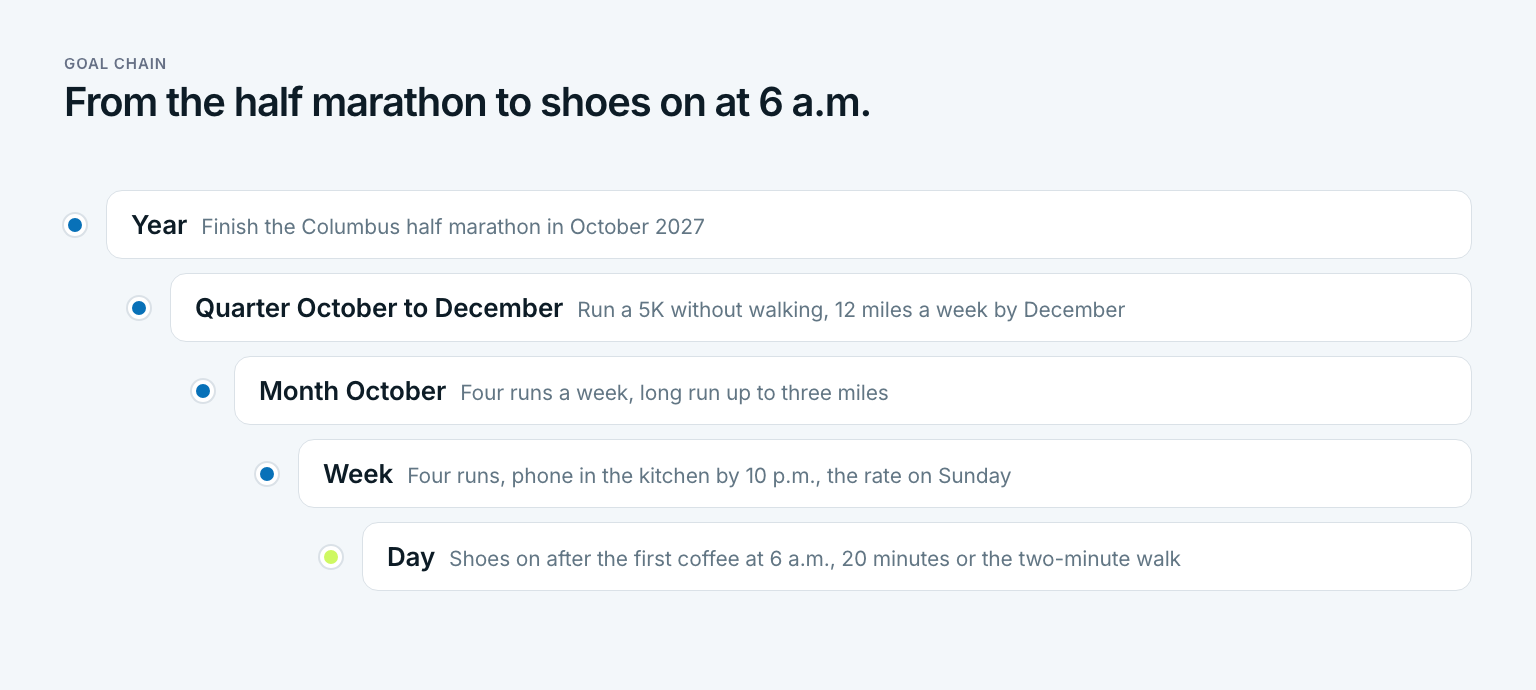
- Year: finish the Columbus half marathon in October 2027 in under two hours and 30 minutes.
- Quarter October to December: run a 5K without walking, build to 12 miles a week by December.
- Month October: four runs a week, long run up to three miles.
- Week: four runs, phone in the kitchen by 10 p.m. on at least five nights, the rate on Sunday.
- Day: shoes on after the first coffee at 6 a.m., at least 20 minutes or the two-minute walk.
The habit sits on the lowest level as a daily goal. Each level above it checks whether the mornings add up. If his long run grows by a fifth of a mile a week, it reaches about ten miles by June, which leaves the summer for the last three. If Marcus falls behind in October, he sees it at the end of October, not next September. That means: the habit delivers the repetitions, the goal chain checks whether they are enough.
In Gaapp you set a yearly goal, break it down through quarter, month, and week, and check off the habit as a daily goal. How to turn a big ambition into such a chain is explained in the guide on how to achieve goals.
Three questions before you close the book
A summary changes nothing as long as it is only read. Three questions check whether reading turns into a habit:
- Which one habit would carry my most important goal this year the furthest?
- After which existing action do I start it, and what is its two-minute version?
- How will I know on Sunday whether it happened this week?
Whoever can answer all three in one sentence each does not need a second read. Whoever gets stuck knows where to start. In the end, Atomic Habits is not a book about willpower but about how you design your mornings.
Frequently asked questions about the Atomic Habits book summary
What are the main points of Atomic Habits?
Small habits compound over time, systems matter more than goals, and lasting change starts with identity rather than outcomes. Every habit runs through cue, craving, response, and reward. The four laws of behavior change target those stages: make it obvious, attractive, easy, and satisfying, and invert them to break bad habits.
What are the four laws of Atomic Habits?
The four laws are make it obvious, make it attractive, make it easy, and make it satisfying. Each one targets a stage of the habit loop. To break a bad habit, you use the inversions: make it invisible, unattractive, difficult, and unsatisfying.
What is the 2 minute rule in Atomic Habits?
The two-minute rule says a new habit should start with a version that takes less than two minutes. Instead of run three miles, you put on your running shoes. The rule trains the act of showing up first, and the duration grows once the habit is established.
What is the 1% rule in Atomic Habits?
The 1% rule says that small improvements compound like interest. Getting 1% better every day makes you about 37 times better after a year, while getting 1% worse every day brings you close to zero. The number is a metaphor, and the message is the direction of your daily actions.
What is habit stacking?
Habit stacking means attaching a new habit to one you already do every day, using the formula after I do X, I will do Y. James Clear uses it as part of the first law, make it obvious. The existing habit becomes the cue, so you no longer need to remember the new one.
Is Atomic Habits worth reading if I have read a summary?
To get started, the four laws and the two-minute rule are enough. The full book is worth it if you want the many examples, the variations of each technique, and the reasoning behind them. If you only want to start one habit, you can begin today and read the book later.
Last updated: 14 October 2026
Read next
 Habits
75 Hard: Rules, Risks and a Version You Can Finish
75 Hard is not a fitness program. The full rules, four health risks, 75 Soft compared and a custom version built around a real goal.
15 min read
 Habits
Digital Detox: A 7-Day Plan to Reduce Screen Time
A digital detox isn't a weekend offline. What the research shows, how to measure and reduce screen time, plus a 7-day plan with a worked example.
15 min read
 Habits
Delayed Gratification: Meaning, Examples, How to Build It
Delayed gratification isn't self-denial, it's a trade: what the marshmallow test really showed, everyday examples, five proven strategies and a plan.
15 min read