Digital Detox: A 7-Day Plan to Reduce Screen Time
A digital detox isn't a weekend offline. What the research shows, how to measure and reduce screen time, plus a 7-day plan with a worked example.

Contents
- 01What a digital detox is, and what it isn't
- 02Do digital detoxes actually work? What the research shows
- 03Why your phone is so hard to put down
- 04How to reduce screen time: measure first, then cut
- 05Digital detox how to: a 7-day plan for your phone
- 06Why not check your phone first thing in the morning
- 07The three mistakes that sink a digital detox
- 08Digital detox and your goals: give the freed hours a job
- 09Three questions for your screen time
- 10Digital detox FAQ
A digital detox is not a weekend in a cabin with no signal. It is a deliberate break from, or limit on, your phone, social media and other screens, so that your time, attention and sleep belong to you again. Oxford Dictionaries added the term in 2013, and it now covers everything from a week offline to an app that locks TikTok after 30 minutes. What tends to work is the unglamorous part: measuring, cutting back, and setting fixed places and times where the phone does not go.
A phone-free weekend feels great. By Tuesday, screen time is usually right back where it was. So this guide follows one person the whole way through. Maya is 29, an account manager in Austin, and she is training for her first half marathon in early March. Her plan calls for four runs a week and seven and a half hours of sleep. She manages two runs and about six hours. Her phone reports 4 hours and 48 minutes a day. Here is what the research says, how she cut that number in seven days, and where the hours went.
What a digital detox is, and what it isn't
A digital detox is an umbrella term. It means any conscious decision to use digital devices less, or not at all, for a period of time. That might be a day without your phone, a month off Instagram, a bedroom with no charger, or one evening hour when the phone sits in the kitchen. Every version shares one rule: you decide in advance, not in the moment the screen lights up.
Three things a digital detox is not. It is not detoxing in any medical sense, since a phone leaves no toxins for your body to flush out. It is not a rejection of technology, because the same Maya who scrolls past midnight uses a running app to plan her training. And it is not a one-time cleanse. Whoever spends a week offline and then slides back into the old pattern has taken a break, but changed nothing.
Term: detox
The word comes from medicine, where it means removing toxins from the body or supervised withdrawal from a substance. Applied to phones it is a metaphor. It is catchy, but it puts the focus on giving something up. What decides the outcome is something else: what you do with the time that opens up.
Four types of digital detox
The types differ in how drastic they are and how long they last. The full break gets the most attention. Real life rarely allows it. Anyone who has to be reachable for work, or whose kids' school sends updates by text, cannot lock the phone in a drawer for a week. For most people, the other three types go further.
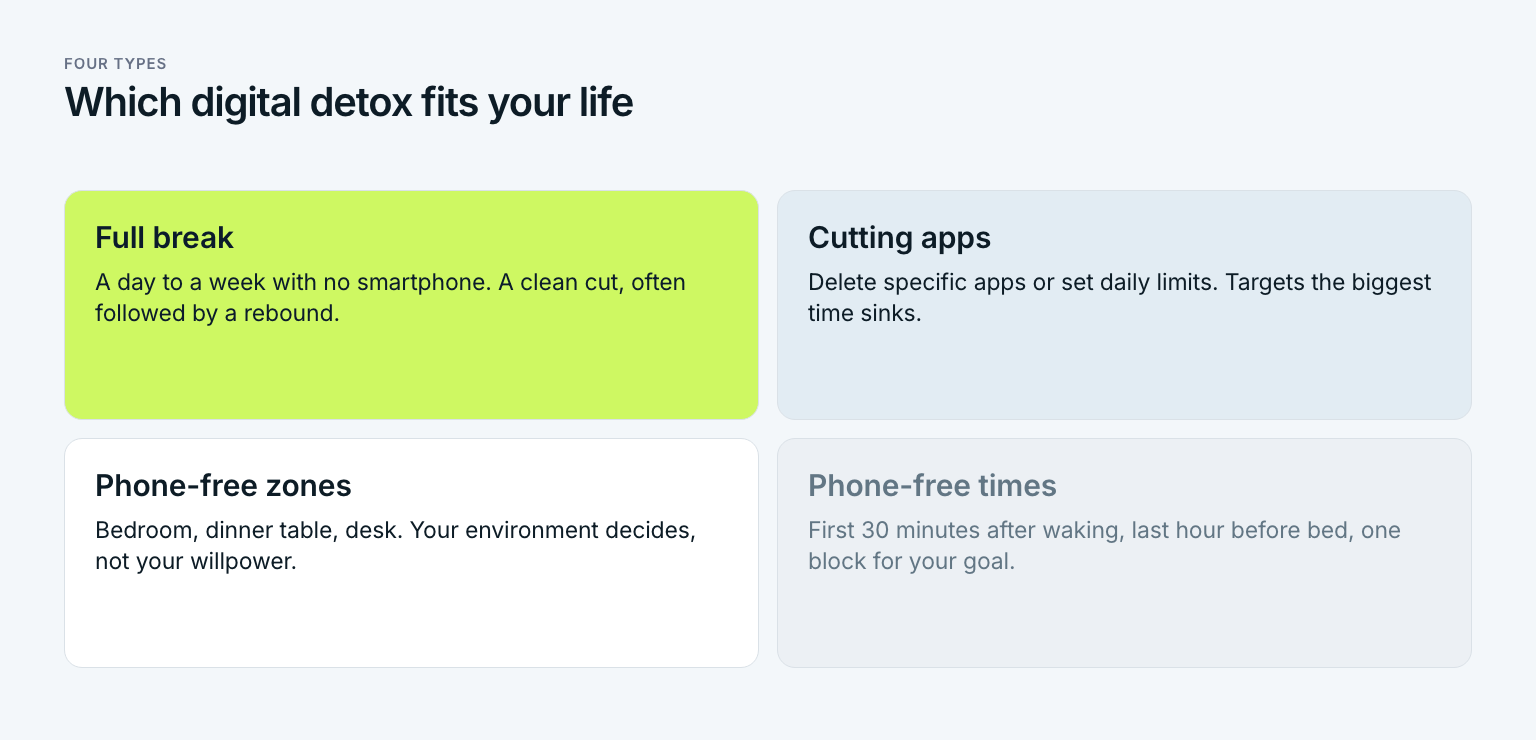
The types are not exclusive. Maya combines three of them: TikTok and Instagram get a daily limit, the bedroom goes phone-free, and the hour before her early runs has no screen at all. She tries a full break only once, on a Sunday, as a test. What she notices matters more than the day itself. Her hand keeps reaching for an empty pocket, almost always in moments of waiting: the coffee line, the elevator, the walk to her car.
Do digital detoxes actually work? What the research shows
The honest answer is: partly, and it depends on the type. The research is younger than the advice columns, and many studies are small. Still, a handful of findings are solid enough to build on. Here are the ones worth knowing:
| Study | What was tested | Result |
|---|---|---|
| Hunt and colleagues, 2018 | Social media limited to ten minutes per platform per day for three weeks, 143 college students | Less loneliness and fewer depressive symptoms than the control group |
| Allcott and colleagues, 2020 | Facebook deactivated for four weeks, large US sample | Small gain in well-being, about an hour of free time a day, lower use afterward |
| Brailovskaia and colleagues, 2023 | One week with no smartphone, or one hour less per day, 619 participants | Both groups improved, and the reduction held up better four months later |
| Kushlev and Dunn, 2015 | Email checked only three times a day for one week | Lower daily stress than unlimited checking |
| Ward and colleagues, 2017 | Phone on the desk, in a bag, or in another room during tests | Better scores with the phone in another room, though replications vary |
| Radtke and colleagues, 2022 | Systematic review of 21 digital detox studies | Mixed results, effects depend on the type, length and person |
Two patterns stand out. First, cutting back often works about as well as quitting outright, and it lasts longer. In the German study led by Julia Brailovskaia, using the phone one hour less per day was more stable after four months than a full week without it. Second, the effects are real but modest. Whoever expects to be a new person after seven days will be disappointed. Whoever expects to feel a little calmer and get an hour of the day back is closer to what the studies actually find.
The review by Theda Radtke and colleagues puts it plainly. Some studies found more well-being and less stress, others found no effect, and a few found more restlessness during the break. That means: a digital detox is not a cure and not a substitute for treatment. It is a tool that works when it fits the person and the life around them. That is why it pays to look at your own behavior before you pick a type.
Why your phone is so hard to put down
Your phone is not hard to put down because you lack willpower. It is designed so that the next pickup is easy. In The Power of Habit from 2012, Charles Duhigg describes the habit loop of cue, routine and reward. With phones, the cue is often a tiny gap in the day: a line at the store, a hard task, a commercial break. The routine is reaching for the screen. The reward is something new, sometimes interesting, often not. That unpredictability is exactly what keeps the loop running.
Then there is the cost to attention. In her 2023 book Attention Span, the researcher Gloria Mark reports that people now stay on one screen for about 47 seconds on average before switching. Sophie Leroy showed in 2009 that after a switch, part of your attention stays stuck on the previous task. She called it attention residue. Anyone who checks the phone every ten minutes while working is not doing 50 focused minutes with a few short breaks. They are doing a string of fresh starts. For a fuller setup that protects long stretches of attention, see How to Focus.
In short: against a device built for pickups, willpower loses over time. What wins is your environment. A phone in another room needs no discipline, only a walk to get it.
When phone use is more than a habit
Many people ask about the signs of too much phone use. The ones most often described are poor sleep, neck and eye strain, restlessness without the phone, and trouble getting anything done in one sitting. The international classification ICD-11 does not include smartphone addiction as a diagnosis. It does include gaming disorder. That does not mean the problem is imaginary. It means an online quiz is not a diagnosis.
Whoever finds that phone use has been seriously disrupting work, relationships or sleep for weeks should talk to a doctor or a licensed counselor. If you are in crisis or thinking about harming yourself, call or text 988 to reach the Suicide and Crisis Lifeline in the US, any time. A digital detox is for everyday life, not for a crisis.
How to reduce screen time: measure first, then cut
Most people underestimate how much they use their phones. In 2015, Sally Andrews and colleagues compared young adults' estimates with tracked data, and the participants picked up their phones about twice as often as they thought. Anyone who wants to reduce screen time should therefore start with a number, not a resolution.
On an iPhone, that number lives under Settings and Screen Time. On Android, the feature is usually called Digital Wellbeing. Both show minutes per app, the number of pickups and the notifications you get. Before she looks, Maya writes down her guess: about two and a half hours a day. Then she opens the weekly report and copies it into a table with one extra column.
| Category | Minutes per day | Meant to use | Unplanned |
|---|---|---|---|
| TikTok and Instagram | 110 | 20 | 90 |
| YouTube | 58 | 25 | 33 |
| Texts and group chats | 47 | 35 | 12 |
| News and Reddit | 45 | 10 | 35 |
| Work Slack and email after hours | 28 | 0 | 28 |
| Total | 288 | 90 | 198 |
The column called meant to use is the key. For every row, Maya asks one question: how much of this would I have planned that morning? The answer adds up to 90 minutes. The other 198 minutes a day just happen. Over a week, that is more than 23 hours. Her training plan needs about three more hours of running each week and 45 more minutes of sleep each night. Most of the unplanned scrolling happens between 10:30 and 11:45 at night, which is exactly where her sleep goes.
That changes the question. It is no longer how long she can survive without her phone. It is which hour and a half of her day she wants back, and for what. A goal with a number is easier to keep than a ban. Maya sets two: total screen time under three hours, and the phone on the charger in the kitchen by 10 p.m.
Digital detox how to: a 7-day plan for your phone
This plan is built for one week and changes exactly one thing each day. Every step stays small enough to fit around work and family. At the end you will not have seven bans. You will have three or four rules that stick. You can start on any day of the week.
Day 1: measure without changing anything
Write down your guess, then read your real screen time: minutes per app, pickups, notifications. Add the meant to use column. Maya records 288 minutes and 112 pickups.
Day 2: turn off notifications
Allow calls and messages from people. Everything from apps, stores and news goes off. Check email at set times, around three a day, as in the study by Kushlev and Dunn.
Day 3: clean up your home screen
Move the biggest time sinks into a folder on the last page, or delete them and use the browser version. Put tools on the first screen: calendar, maps, camera, your training or learning app.
Day 4: set phone-free zones
Make the bedroom, the dinner table and your desk during focus work phone-free. Move the charger to the kitchen and buy a cheap alarm clock for the nightstand.
Day 5: set phone-free times
Keep the first 30 minutes after waking and the last hour before bed screen-free. Add one fixed block for your goal. For Maya, that is the hour before her 6:30 a.m. runs on Tuesday, Thursday and Saturday.
Day 6: pick a replacement for every cue
Notice when you reach for the phone without a plan, and choose a different routine. Waiting in line: look around or stretch your calves. Afternoon slump: five minutes outside.
Day 7: review and write down your rules
Compare your screen time with Day 1. Keep the three or four rules that helped most and write them down. Drop the rest.
After seven days, Maya's screen time averages 2 hours and 56 minutes a day. Pickups drop from 112 to 74. That is not a miracle and not a cleanse. It is 112 minutes a day that used to disappear without a plan. She is now asleep by 10:45 on most nights and has run four times that week for the first time.
What helped most was not the app limits. It was the charger in the kitchen and the silenced notifications. Both work without any decision in the moment. Which of your rules would still hold on a bad day?
App limits, grayscale and Focus modes: what the tools add
Built-in tools help, but they do not replace a decision. App limits can be extended with a single tap, and by the third extension the limit is just a suggestion. Small hurdles that cost a few seconds work better: logging out after each use, keeping an app in the browser only, or a Focus mode that turns on at set times.
One simple hurdle is grayscale. On iPhone it sits under Accessibility in Color Filters. On Android it is usually part of Bedtime mode in Digital Wellbeing. In a small study with college students, Alexander Holte and Richard Ferraro reported in 2020 that a grayscale screen measurably lowered daily screen time. A gray phone is simply less tempting. Maya has grayscale turn on automatically at 9:30 every night.
Why not check your phone first thing in the morning
A phone-free morning is one of the highest-impact rules because it sets the tone for the day. Whoever starts with news, email and feeds is reacting to other people's priorities from the first minute. Your own plan for the day comes later, or not at all. Half an hour without a screen is enough to think about your own priorities first. For a routine built around a goal instead of an alarm, see Morning Routine.
The night is the second protected zone, and here the research is clearer. In a 2015 study, Anne-Marie Chang and colleagues had participants read before bed on either a light-emitting screen or a printed book over several nights. With the screen, they took longer to fall asleep, their melatonin was suppressed, and they were less alert the next morning. Then there is the content. A feed has no last page, a chapter does. For ideas on that final hour before bed, see Evening Routine.
For couples and families, the dinner table is the third place. Andrew Przybylski and Netta Weinstein found in 2013 that the mere presence of a phone on the table could lower how close two people felt during a conversation. A basket by the door where every device goes during dinner is more than a rule for kids. It works for adults too.
The three mistakes that sink a digital detox
Most attempts do not fail on day one. They fail in week two, when the novelty of the experiment wears off. All three mistakes feel like commitment at the start. Which one is yours?
The most common mistake: cutting without replacing
Anyone who only removes leaves a gap. The cue stays, the boredom in line, the slump after lunch, and the old routine soon fills the gap again. Habits are easier to redirect than to erase. So decide for every cue what you will do instead. One minute of slow breathing in line is one of the simplest mindfulness exercises you can swap in. The full method is in How to Break Bad Habits.
- All or nothing. A week with no smartphone sounds bold. What often follows is a rebound, and screen time climbs back to where it started. The data from Brailovskaia's team favor the smaller cut that lasts.
- Willpower instead of environment. Whoever puts the phone next to the laptop and promises not to touch it is fighting a small battle every minute. A phone in another room needs no battle.
- A detox with no goal. Lower screen time is a midpoint, not a finish line. Anyone who does not know what the time is for will fill it with the next screen, swapping feeds for streaming.
That means: a digital detox needs three parts. A number that shows where you stand. An environment that makes the pickup harder. And a goal that gets the freed-up time. The third part is the one people forget.
Digital detox and your goals: give the freed hours a job
A digital detox lasts when the time you win back has a job. For that, you need an answer to the question of what those hours are for. A goal chain gives you one: the yearly goal becomes a quarterly goal, the quarterly goal a monthly goal, then a weekly goal and a daily goal. At the end sits a specific block of time, right where the phone used to be.
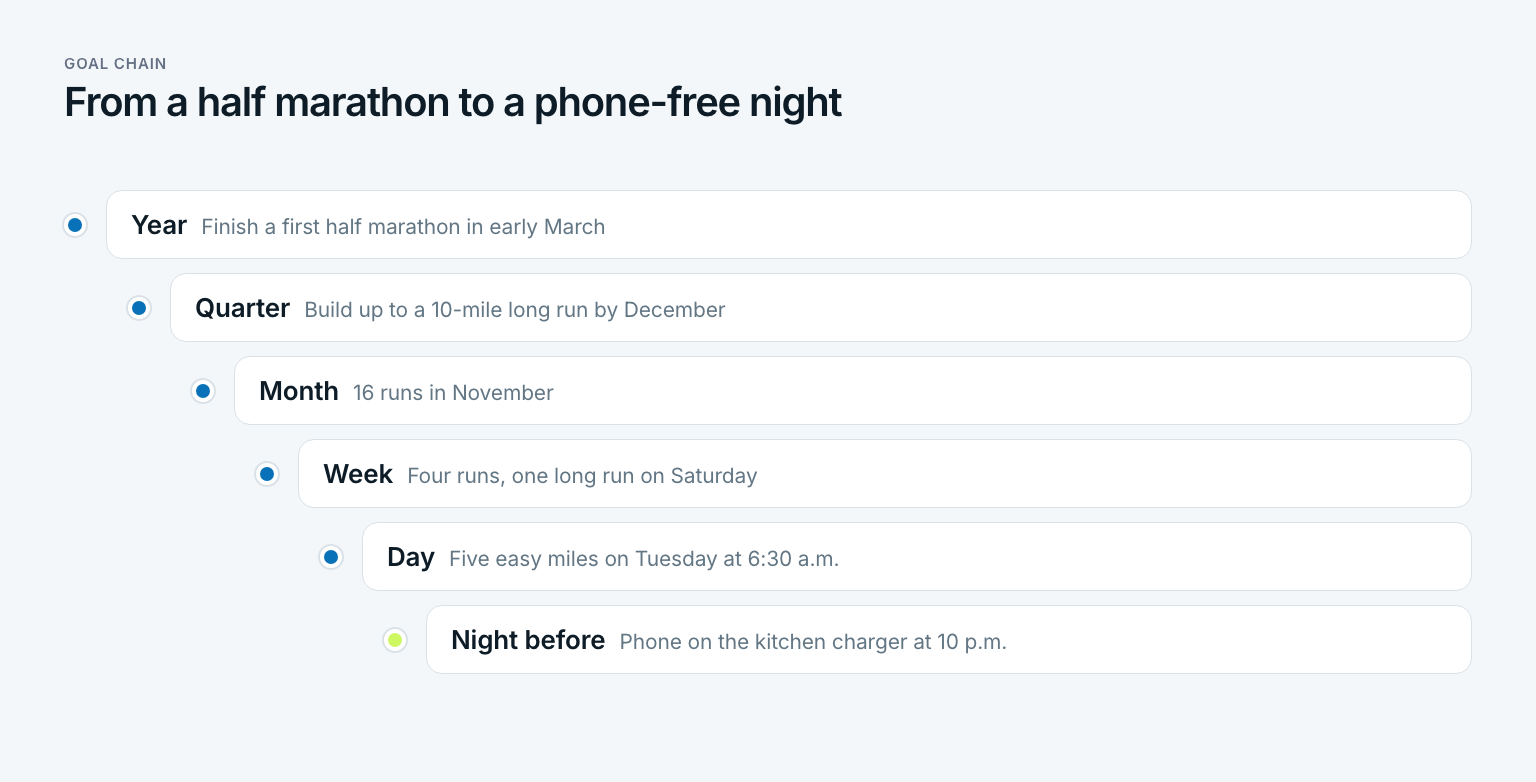
For Maya it looks like this. Year: finish her first half marathon in early March. Quarter: build up to a 10-mile long run by the end of December. Month: 16 runs in November. Week: four runs, including one long run on Saturday. Day: five easy miles on Tuesday at 6:30 a.m. The phone on the kitchen charger at 10 p.m. the night before is no longer a sacrifice. It is the smallest part of a plan that ends at a finish line.
In Gaapp, every daily goal hangs on a weekly goal, and every weekly goal on a monthly goal. Progress for any period is the share of goals you completed. For Maya, that means on Friday she sees not only whether her screen time went down, but whether the hours she won back actually turned into runs. If you are not sure how to break a yearly goal into steps like these, read Turn Yearly Goals Into Daily Steps.
Four weeks later, Maya's screen time sits at 2 hours and 35 minutes a day. She hits four runs in three of those four weeks. She did not give up her phone to get there. She just took the late evenings away from it and handed them to a goal.
Three questions for your screen time
Before you delete apps or book a weekend offline, answer three questions:
- How many minutes of your daily screen time would you have planned that morning?
- In which two situations do you reach for the phone most often without a plan, and what will you do there instead?
- Which goal gets the time that opens up, and on which days does that block sit?
Whoever answers the first question with a number knows how big the lever is. Whoever answers the second already has a replacement. Anyone who cannot answer the third should start there, because without a goal the old habits come back. In short: a digital detox is not about giving up technology. It is a decision about who gets your time.
Digital detox FAQ
Can 3 days without a phone reset your brain?
Reset is not a scientific term, and there is no good evidence that three days rewire anything for good. Short breaks in studies change mood, stress and habits modestly, and the benefits fade if old patterns return. A smaller cut you keep, such as an hour less a day, held up better over four months in one large study.
How do you do a 7-day digital detox?
Change one thing per day. Measure first, then turn off notifications, clean up your home screen, set phone-free zones, set phone-free times, pick a replacement for each cue, and review on day seven. Keep the three or four rules that helped most.
Do digital detoxes actually work?
Partly. Studies find modest gains in well-being, lower stress and about an hour of extra free time a day, depending on the type. A 2022 review of 21 studies found mixed results, so it helps to choose a form that fits your life.
How long should a digital detox last?
Studies range from one to four weeks. One week is enough to start if you change one thing each day. After that, length matters less than which rules you keep for good.
What is a digital detox?
A digital detox is a deliberate break from, or limit on, your phone, social media and other screens. It can be a full break, cutting specific apps, phone-free zones, or phone-free times. The goal is to get time, attention and sleep back.
Does a digital detox help you sleep better?
Keeping screens out of the last hour before bed can help. In a 2015 study by Anne-Marie Chang and colleagues, reading on a light-emitting screen before bed delayed sleep and suppressed melatonin compared with a printed book. Charging the phone outside the bedroom makes that rule easier to keep.
Last updated: 22 October 2026
Read next
 Habits
75 Hard: Rules, Risks and a Version You Can Finish
75 Hard is not a fitness program. The full rules, four health risks, 75 Soft compared and a custom version built around a real goal.
15 min read
 Habits
Delayed Gratification: Meaning, Examples, How to Build It
Delayed gratification isn't self-denial, it's a trade: what the marshmallow test really showed, everyday examples, five proven strategies and a plan.
15 min read
 Habits
Willpower: What It Is and How It Really Works
Willpower is not a tank that runs dry. The definition, the honest state of ego depletion research, and six steps that work before temptation hits.
16 min read