How to Focus: A Four-Part Setup for Attention
How to focus without willpower: find your leak, clear the field, set a block you can hold, park every pull. Six steps, a measured week, your goal chain.

Contents
- 01What it means to focus, and what quietly breaks it
- 02Why am I really struggling to focus? The four leaks
- 03What really happens in your study hour: time at the desk is not focus
- 04How to focus in six steps: the setup that replaces willpower
- 05How to improve focus over weeks: attention is trained, not found
- 06How to stay focused when the pull arrives
- 07Focus techniques compared: which block fits which work
- 08Focus in your goal chain: year, quarter, month, week, day
- 09ADHD, study sessions, and 100 percent focus: what changes and what does not
- 10The three mistakes nobody notices
- 11Frequently asked questions about how to focus
How to focus is not a willpower question. Focus is the ability to keep your attention on one task until it is done, and it comes from four things you set up before the task starts: one clear finish line, a field with nothing else in it, a block of time you can actually hold, and a way to park every thought that tries to pull you away. Willpower is what you use when those four are missing. It runs out by minute twelve.
That is good news, because a setup can be measured and a setup can be changed. This article walks through a four-week experiment by Elena, 29, a data analyst who is studying for a graduate school entrance exam next to a full-time job. She has ten hours a week. In week one, 225 of those minutes were actually focused. In week four, 476 were. Same desk, same ten hours, same brain. What changed was the system, and you can copy it in six steps.
What it means to focus, and what quietly breaks it
To focus means to hold one task in attention long enough to finish a meaningful piece of it. Three words in that sentence carry the weight: one, hold, and finish. One task, not a project. Hold, which means returning every time your attention drifts, not never drifting. Finish, which means the session has an end you can recognize. A session with no end has no finish line, and attention without a finish line looks for one somewhere else, usually in your phone.
Attention is not broken by big things. It is broken by small switches, and the switches add up. Gloria Mark, a professor of informatics who has measured screen attention for two decades, reports in her book Attention Span from 2023 that the average time people spend on one screen before switching has fallen to about 47 seconds. Nobody decides to switch every 47 seconds. It happens between decisions, which is why willpower cannot fix it.
Attention residue
When you switch from one task to another, part of your attention stays with the first task. Sophie Leroy, who coined the term in a 2009 paper, showed that people perform worse on a second task when the first one was left unfinished. That means: every quick check of your inbox costs you twice. Once for the minute you spend there, and once more for the minutes afterward when half your mind is still reading the email. Fewer switches beat shorter switches.
Why am I really struggling to focus? The four leaks
Most people who cannot focus do not have an attention problem. They have a leak problem, and the leak is almost always one of four. Before you try a technique, find your leak. A technique aimed at the wrong leak feels like effort and produces nothing.
- The device leak. Your phone is in reach, notifications are on, or a second screen shows a chat window. This is the loudest leak and the easiest to fix, which is why most focus advice stops here. For Elena it was 29 of her 63 switches in week one. Loud, but not even half.
- The open loop leak. Unfinished business from somewhere else keeps surfacing: the email you have not answered, the bill you meant to pay, the thing your manager said at 4 p.m. Your mind returns to open loops on its own, a pattern David Allen built Getting Things Done around in 2001. Elena logged 18 switches that started as a stray thought, not a notification.
- The fuzzy task leak. You sat down to study, or to work on the report, or to make progress on the thesis. None of those is a task. A task has a next physical action and a finish line. Without one, your attention has to decide what to do every few minutes, and every decision is an exit. Ten of Elena's switches came right after she finished a question and did not know which came next.
- The environment leak. The kitchen table, the roommate, the TV in the next room, the chair that hurts after 40 minutes. This leak is quiet and gets blamed on you. Six switches for Elena, all on the two evenings her roommate cooked.
Why does the leak matter so much? Because the fixes are different. Anyone who puts the phone in another room but still sits down to study has fixed one leak out of four. The session feels cleaner and still produces 40 focused minutes out of 90, and that is the moment most people conclude they cannot focus. They can.
What really happens in your study hour: time at the desk is not focus
Ninety minutes at the desk feels like 90 minutes of work. It almost never is. Elena found out by doing the one thing most focus articles skip: she measured. For one week she kept a stopwatch running while she studied and paused it every time she left the task, whether for the phone, a thought, or the kitchen. Next to it, a tally mark for every switch. No technique yet, just the count.
| Session, week one | Planned | Switches | Focused minutes |
|---|---|---|---|
| Monday evening | 90 min | 14 | 35 |
| Tuesday evening | 90 min | 11 | 40 |
| Wednesday evening | 90 min | skipped, late at work | 0 |
| Thursday evening | 90 min | 9 | 45 |
| Friday evening | 90 min | 17 | 25 |
| Saturday morning | 150 min | 12 | 80 |
| Total | 600 min | 63 | 225 |
Of 600 planned minutes, 225 were focused. That is 37 percent. Of the 510 minutes she actually sat down, it is 44 percent. The Friday session is the telling one: 90 minutes at the desk, 17 switches, 25 focused minutes. She remembered it as a decent evening of studying. The stopwatch remembered it differently.
Elena did not feel distracted during that week. She felt busy. Being busy at a desk and being focused at a desk feel identical from the inside, and only one of them moves the exam score. That means: before you change anything, run the stopwatch for a week. Anyone who has never measured focused minutes is improving a number they cannot see.
How to focus in six steps: the setup that replaces willpower
The method takes four minutes before each session and two minutes after. It does not ask you to concentrate harder. It removes the reasons your attention had to leave. Elena ran it from week two on.
Name one task with a finish line, one minute
Write a sentence you could check at the end: “Problem set 7, questions 1 to 20, every wrong answer logged with the reason.” Not “study quant.” If the sentence has no number or no deliverable, it is not a task yet. Elena wrote hers on an index card and put it on top of the book.
Clear the field, two minutes
Phone in another room, not face down, another room. One tab or one book. Notifications off on the laptop. A blank sheet and a pen within reach: this is your parking lot for stray thoughts. The field is clear when nothing in sight can start a different task.
Set a block you can actually hold
Your block is your measured focused stretch plus about ten minutes, not the 90 minutes you wish you had. Elena's longest unbroken stretch in week one was 22 minutes, so her first blocks were 30 minutes with a five-minute break. The block grows later. Starting too long teaches you that you fail.
Start with the smallest physical action
Open the book to the page. Type the heading. Read question one aloud. The first 90 seconds decide whether the session starts or whether you check one more thing. A tiny physical action gets you past them without a decision.
Park every pull, then return
When a thought arrives that is not the task, write it on the parking lot sheet in five words and go back. When the urge to check the phone arrives, make a tally mark and go back. Do not argue with the urge and do not obey it. Write, mark, return. The urge passes in under a minute when it is not fed.
Close with a two-line log, two minutes
Focused minutes, number of switches, and the next task in one sentence. Then take a real break away from the desk. The log is what turns one session into training, because tomorrow you will set the block from today's number, not from hope.
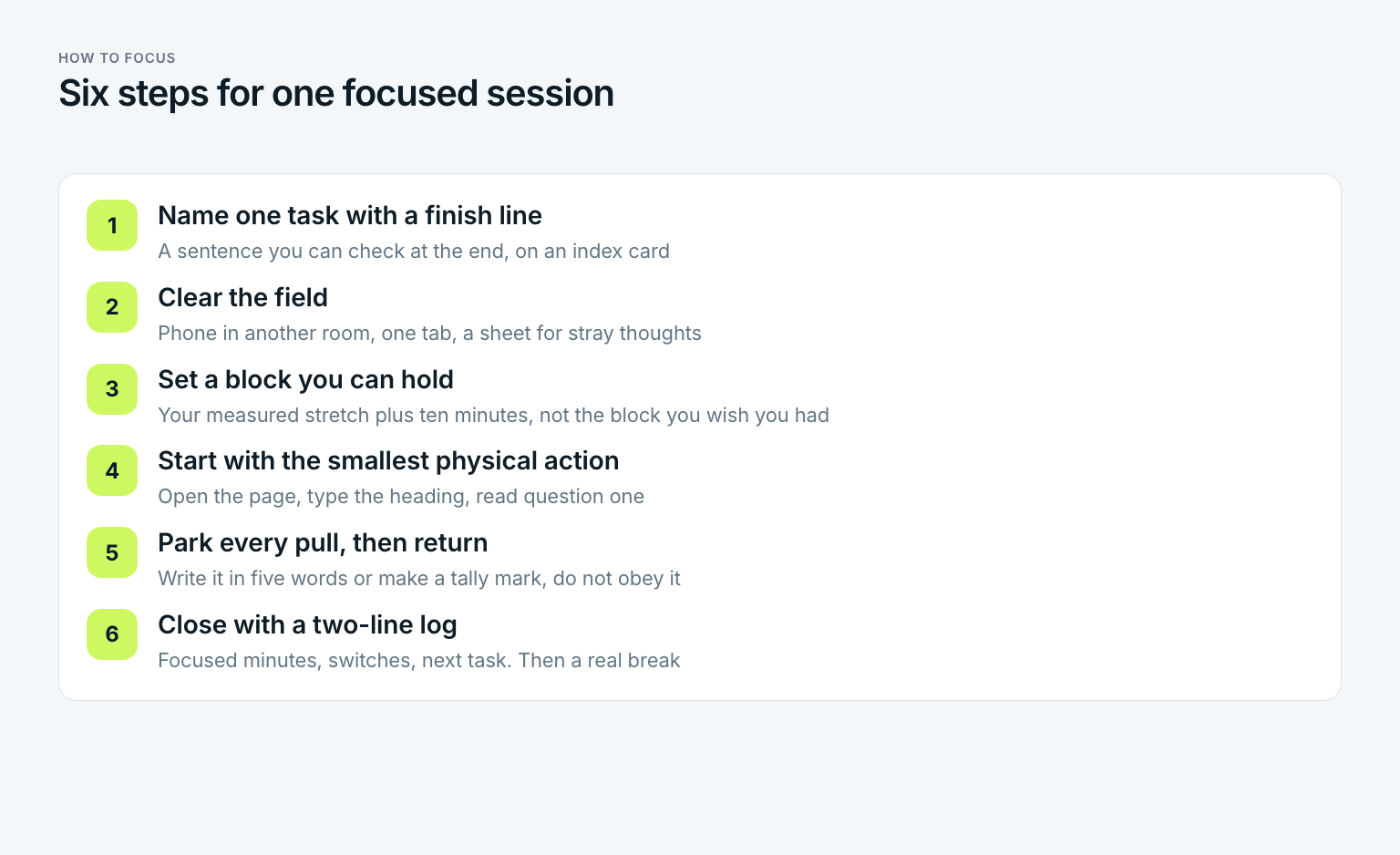
Six steps sound like a lot for a study evening. In practice it is an index card, a sheet of paper, a timer, and a phone in the hallway. Elena's week two: 600 planned minutes, 31 switches, 340 focused minutes. Week three brought 410 minutes, week four 476 minutes and 20 switches, which is 79 percent of her planned time, up from 37. Her hours, her job, her roommate, and her phone did not change. In short: she did not learn to concentrate harder. She stopped giving her attention reasons to leave.
How to improve focus over weeks: attention is trained, not found
The six steps fix a session. Improving focus is what happens across sessions when you treat the block like a muscle. Sleep, movement, and food matter here, and most articles on how to improve concentration stop at that list. They are right and they are incomplete. Sleep is the floor your attention stands on. It is not the training.
Grow the block by ten percent, not by resolve
Each week, add ten percent to your block length if last week's log shows you held it in at least four of five sessions. Elena went from 30 minutes in week two to 35 in week three to 40 in week four. By her exam in February she plans to sit 75-minute blocks, which is the length of each exam section. The goal is not the longest block. It is a block that matches the work you need to do.
Practice boredom in low-stakes moments
Cal Newport makes the case in Deep Work from 2016 that attention trained to seek stimulation at every idle moment cannot suddenly hold still at the desk. The training ground is the line at the grocery store, the elevator, the three minutes before a meeting starts. Leave the phone in your pocket. It feels pointless and it is the cheapest focus training there is. Anyone who checks a screen every time there is nothing to do is practicing the exact habit that breaks a study session.
Close loops before the session, not during
Open loops surface during focused work because that is when your mind finally has room. Give them a different room. Ten minutes before a session, write down everything that is nagging you, with a next step for each. Elena does this on Sunday for the week and in two minutes before each evening block. Her open loop switches fell from 18 in week one to four in week four. The loops were parked in advance, not resolved during study time.
How to stay focused when the pull arrives
Starting focused is a setup problem. Staying focused is an interruption problem, and interruptions come from two directions: outside, which the cleared field handles, and inside, which it does not. Nir Eyal calls the inside ones internal triggers in Indistractable from 2019: boredom, uncertainty, mild anxiety, the itch to see whether someone replied. You cannot clear them from the field. You can change what happens when they arrive.
- The ten-minute rule. When the urge to switch arrives, tell yourself you can switch in ten minutes. Set no timer, just note the time. Most urges dissolve before the ten minutes are up because they were never about the phone. They were about the hard sentence in front of you. By week four, two of every three of Elena's urges never turned into a switch.
- The parking lot. Every stray thought goes on the sheet in five words. Not acted on, not evaluated, written down. The thought was asking for a promise that it would not be forgotten. The sheet is that promise. Review it in the break, and most items will take 30 seconds or turn out to be nothing.
- The if-then plan. Decide in advance what you will do when a specific pull arrives: “If I want to check the news, then I write the headline I am imagining on the sheet and read one more question.” Peter Gollwitzer showed in 1999 that these implementation intentions make a planned response far more likely than a general resolve. The decision is made before the moment, when it is cheap.
- The re-entry ritual. When you do switch, and you will, come back the same way every time: look at the index card, read the task sentence, find the exact line you left. Thirty seconds. It cuts the attention residue short and stops one switch from becoming a drift.
Which of the four do you need? Sort one session's switches. Urges go to the ten-minute rule, thoughts to the parking lot, predictable pulls to an if-then plan, and every switch that happens anyway gets the re-entry ritual. In short: staying focused is not resisting. It is having a script for the moment resistance would fail.
Focus techniques compared: which block fits which work
Pomodoro, time blocking, deep work, monotasking. Each is a good technique, and each is built for a different problem. The question is not which is best. It is which leak it fixes and which block length it assumes.
| Technique | Block | Fixes which leak | Where it falls short |
|---|---|---|---|
| Pomodoro | 25 minutes work, 5 minutes break, long break after four | Fuzzy task and the urge to switch, through a visible timer and a hard stop | Breaks interrupt tasks that need 60 minutes to warm up, such as writing or debugging |
| Time blocking | Calendar blocks of 60 to 120 minutes, each with one task | Open loops and the fuzzy task, because every hour has a name in advance | Says nothing about what happens inside the block when the pull arrives |
| Deep work | 90 minutes to 4 hours, no interruptions, scheduled in advance | Device and environment, through a strict ritual and location | Needs a block length most people cannot hold yet, so it fails on the first day for beginners |
| Monotasking | Any length, one tab, one document, one input | Device leak, especially the second screen | Does not help with internal triggers or with knowing what the one task is |
| Body doubling | A session alongside another person who is also working, in person or on a call | Environment and starting, through gentle social accountability | Depends on another person's schedule and does not train solo focus |
Elena uses two of them. Her weekday evenings are Pomodoro-shaped, because the exam sections are short and the hard stop keeps her from drifting after a wrong answer. Her Saturday morning is a single 90-minute deep work block for the problem sets that need warm-up. Long blocks like that are also where a flow state becomes likely, once the warm-up is over and the task holds her attention on its own. She picked by leak and by block length. Anyone who adopts a technique because it sounds serious, and not because it fixes a measured leak, usually drops it within two weeks and blames themselves.
Focus in your goal chain: year, quarter, month, week, day
A focused session only matters if it moves something larger, and the fastest way to lose focus for good is to study hard for a month and not know whether it worked. Focus needs a chain above it. Elena's looks like this.
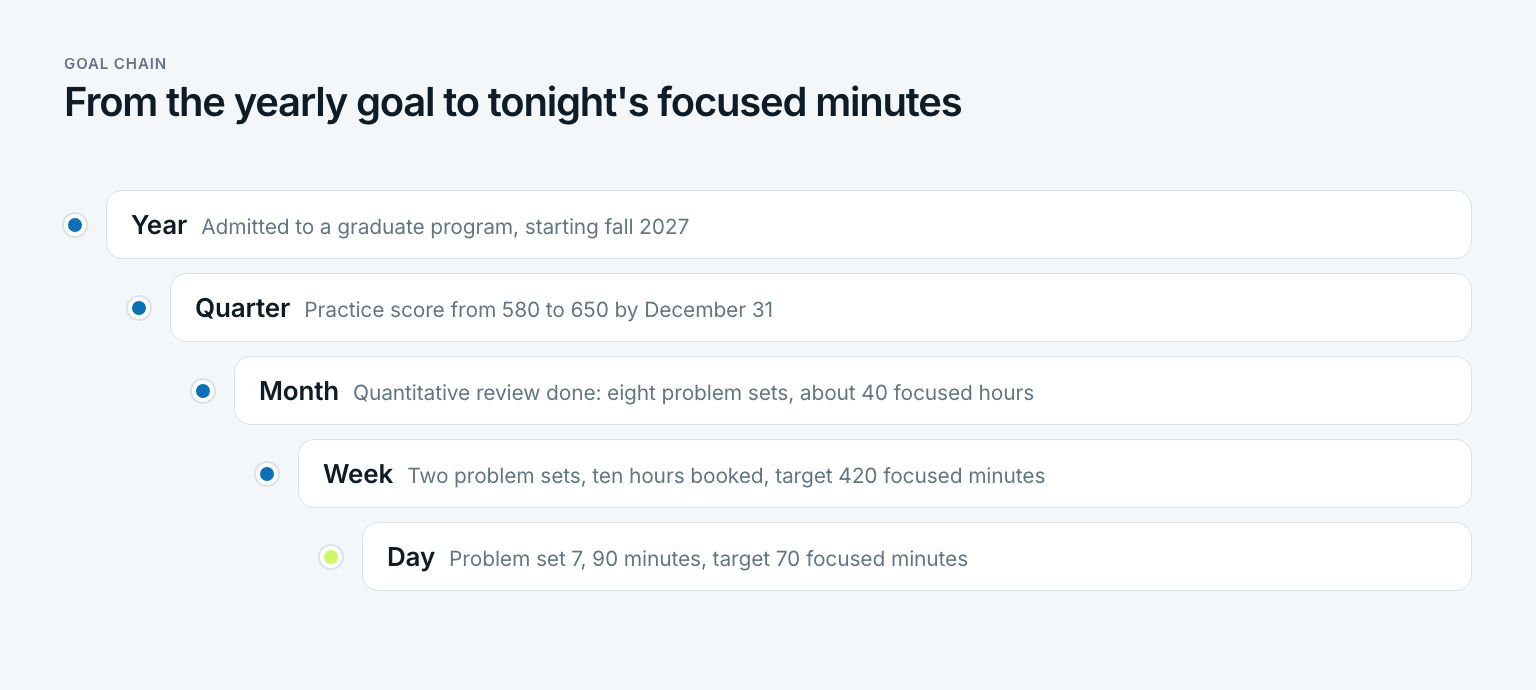
- Year. Admitted to a graduate program, starting fall 2027. That requires an exam score by February.
- Quarter. Practice score from 580 to 650 by December 31. Three monthly goals get her there.
- Month, October. Quantitative review finished: eight problem sets, every error logged, about 40 focused hours.
- Week. Two problem sets done. Ten hours booked, target seven focused hours, which is 420 minutes on the log.
- Day. Problem set 7, 90 minutes booked, target 70 focused minutes, 30-minute blocks.
Look at where the focused minutes live: on the week and the day. The month is measured in problem sets, the quarter in a practice score, the year in an admission letter. Focus is the daily and weekly currency that buys the monthly result. That means: on Friday, Elena does not ask whether she studied enough. She reads two numbers, focused minutes against 420 and problem sets against two, and knows by 6 p.m. whether the week paid into the month.
The chain also decides what the one task is each evening, which closes the fuzzy task leak at the source. Whoever has a weekly goal of two problem sets does not sit down to study quant. They sit down to do problem set 7. If your days feel unfocused before they start, the issue is often one level up: there is no weekly goal the day could serve. The guide on how to achieve goals walks through building that chain from the year down, and the piece on daily goals shows how small a daily goal has to be before you can check it off in one evening.
In Gaapp, this chain is the structure: five levels from year to day, each goal attached to a larger one, and progress on every level shown next to the time already used. Elena's week shows seven of ten focused hours next to five of seven days gone. The ten-minute weekly review is where she reads those two numbers side by side and sets next week's block length.
ADHD, study sessions, and 100 percent focus: what changes and what does not
Can ADHD make it difficult to focus? Yes, and it is worth being plain about that. ADHD is a difference in how the brain regulates attention, effort, and motivation, and the gap between what someone with ADHD knows they should do and what they can start is not a character flaw. The six steps still help. They are not a treatment, and anyone who suspects ADHD should talk to a clinician rather than to a productivity article.
What changes in practice? Externalize more. A visible timer instead of a mental one, the task sentence on a card instead of in your head, the parking lot sheet always in reach. Shorter blocks, often 15 to 20 minutes, with movement in the breaks. Body doubling works unusually well, and so does novelty: a different seat, a different pen, a different order. The log matters even more, because ADHD makes it harder to feel how a session went.
And the student question: how can I focus 100 percent on study? You cannot, and the target is the problem. Nobody holds 100 percent of a block, not Elena in week four at 79 percent and not a professional chess player. Set the target at 75 to 80 percent of the block, measure it, and treat every session above that as a win. A student who aims for 100 and lands at 70 feels like a failure and quits. A student who aims for 75 and lands at 70 adjusts the block length and keeps going. Three habits hold the block together: active recall instead of rereading, one problem set per block instead of one subject, and the last five minutes for the error log, so the session does not follow you into tomorrow.
The three mistakes nobody notices
Most attempts to focus better do not fail at the technique. They fail quietly at one of three mistakes, and none of them feels like a mistake while you are making it.
The most common mistake: you count time at the desk
Ninety minutes at the desk goes into the planner as 90 minutes of studying, and the plan looks on track right up to the practice test. Time at the desk is the input. Focused minutes are the output, and only the output moves the score. Fix: run a stopwatch you pause at every switch for one week, no technique, just the count. Your real number is the baseline, and everything after it is measured against that number, not against hours.
- Starting with the longest block you can imagine. Two hours of deep work on day one, because that is what the book described. The block breaks at minute 25, and the lesson you learn is that you cannot focus. The lesson you should have learned is that your block is 30 minutes right now and 40 next month. Start from your measured stretch plus ten.
- Fighting the urge instead of parking it. Gritting your teeth through the pull to check the phone uses the exact willpower that runs out. Writing the pull down and returning uses none. The urge is not the enemy. Acting on it is, and a sheet of paper stands between the two.
Three questions before you close this tab
Take your last work or study session and answer honestly:
- Could you have said the task's finish line out loud before you sat down?
- Do you know how many focused minutes the session contained, as a number and not a feeling?
- When the pull to switch arrived, did you have a script, or did you negotiate?
Anyone who answers no to one of these does not have an attention problem. They have a setup problem, and setups can be fixed on Monday. Whoever answers no to all three is in good company: that was Elena in week one, at 37 percent, before the stopwatch, the index card, and the sheet of paper.
In short: focus is not something you have or lack. It is something you set up, measure, and train, one session at a time, until the block fits the work.
Frequently asked questions about how to focus
How do I improve my focusing?
Measure first: run a stopwatch for one week and pause it at every switch, so you know your real focused minutes. Then fix the leak the count reveals, which is usually the phone, open loops, a fuzzy task, or your environment. Grow your block by ten percent a week once you hold it in four of five sessions. Improvement shows up in the log before it shows up in how a session feels.
How can I focus 100% on study?
You cannot, and aiming for it is what makes students quit. Set a target of 75 to 80 percent of your block as focused minutes and measure it with a stopwatch. Use one problem set per block as the finish line, practice active recall instead of rereading, and end each block with a short error log. A session at 75 percent that repeats five times a week beats a session at 100 percent that never happens again.
Can ADHD make it difficult to focus?
Yes. ADHD affects how the brain regulates attention, effort, and starting, so the gap between knowing what to do and doing it is wider and not a matter of discipline. The six steps still help, especially externalizing everything: a visible timer, the task on a card, shorter blocks of 15 to 20 minutes with movement, and body doubling. They support treatment, they do not replace it, so talk to a clinician if you suspect ADHD.
Why am I really struggling to focus?
Almost always because of a leak, not a lack of ability. Four leaks explain most sessions: the device in reach, open loops from other parts of your life, a task without a finish line, and an environment that pulls at you. Count your switches for one session and note what caused each one. The leak with the most marks is where your effort goes first, and fixing one leak alone typically removes a third of the switches.
How long can a person stay focused at a time?
Longer than they think and shorter than they plan. Most people who measure find an unbroken stretch of 15 to 25 minutes at the start, which is why 25-minute Pomodoro blocks feel right to beginners. With training, 60 to 90 minutes is realistic for a single demanding task, and a few hours is possible for work that has warmed up. Your own number comes from your log, not from an average.
Does music help you focus?
It depends on the task and the music. Instrumental music or steady background sound can mask a noisy environment and fix the environment leak. Music with lyrics competes with reading and writing, because language processing is the same channel the task is using. The test is simple: run two sessions, one with and one without, and compare focused minutes on the log. Keep whichever number is higher.
Last updated: 19 October 2026
Read next
 Productivity
Feynman Technique: Four Steps to Real Understanding
The Feynman technique is not a memorization trick: four steps, a worked example from a stats class, a one-page template, and what research says.
16 min read
 Productivity
Zettelkasten: How to Turn Notes Into Your Own Ideas
A Zettelkasten is not an archive: Luhmann's method, the three note types, a five-step setup and an Obsidian template, with a worked example.
15 min read
 Productivity
Second Brain: How to Build One You Actually Use
A second brain is not a note archive: Tiago Forte's CODE steps, the PARA method with an example, a five-step setup and the mistakes that sink it.
15 min read