Feynman Technique: Four Steps to Real Understanding
The Feynman technique is not a memorization trick: four steps, a worked example from a stats class, a one-page template, and what research says.

Contents
- 01The Feynman technique in four steps
- 02Where the Feynman method comes from
- 03Why explaining beats rereading
- 04A Feynman technique example: Sofia explains the p-value
- 05The Feynman technique for studying versus other methods
- 06Three mistakes that make the method useless
- 07Where the Feynman learning technique falls short
- 08The Feynman technique in your goal chain: from semester goal to tonight's concept
- 09Three questions before you open the next chapter
- 10Frequently asked questions about the Feynman technique
The Feynman technique is not a memorization trick but a test of whether you really understand something: you explain a topic in plain words, as if you were teaching it to a twelve-year-old. Wherever your explanation stalls or hides behind jargon, you have found a gap. You close that gap with the textbook, then explain the topic again, shorter and clearer. The method is named after the physicist Richard Feynman, who was famous for making hard ideas sound simple.
Everything on this page is worked through with one student. Sofia, 20, is a sophomore psychology major at a public university in Ohio. She needs at least a B in her statistics course to apply for a research assistant spot in a lab next fall. The midterm is in five weeks. She has read the chapter on hypothesis testing twice and highlighted most of it, and she still freezes on practice questions. If you want to set up the grade goal itself, see SMART goals for students. This page is about turning reading time into understanding.
The Feynman technique in four steps
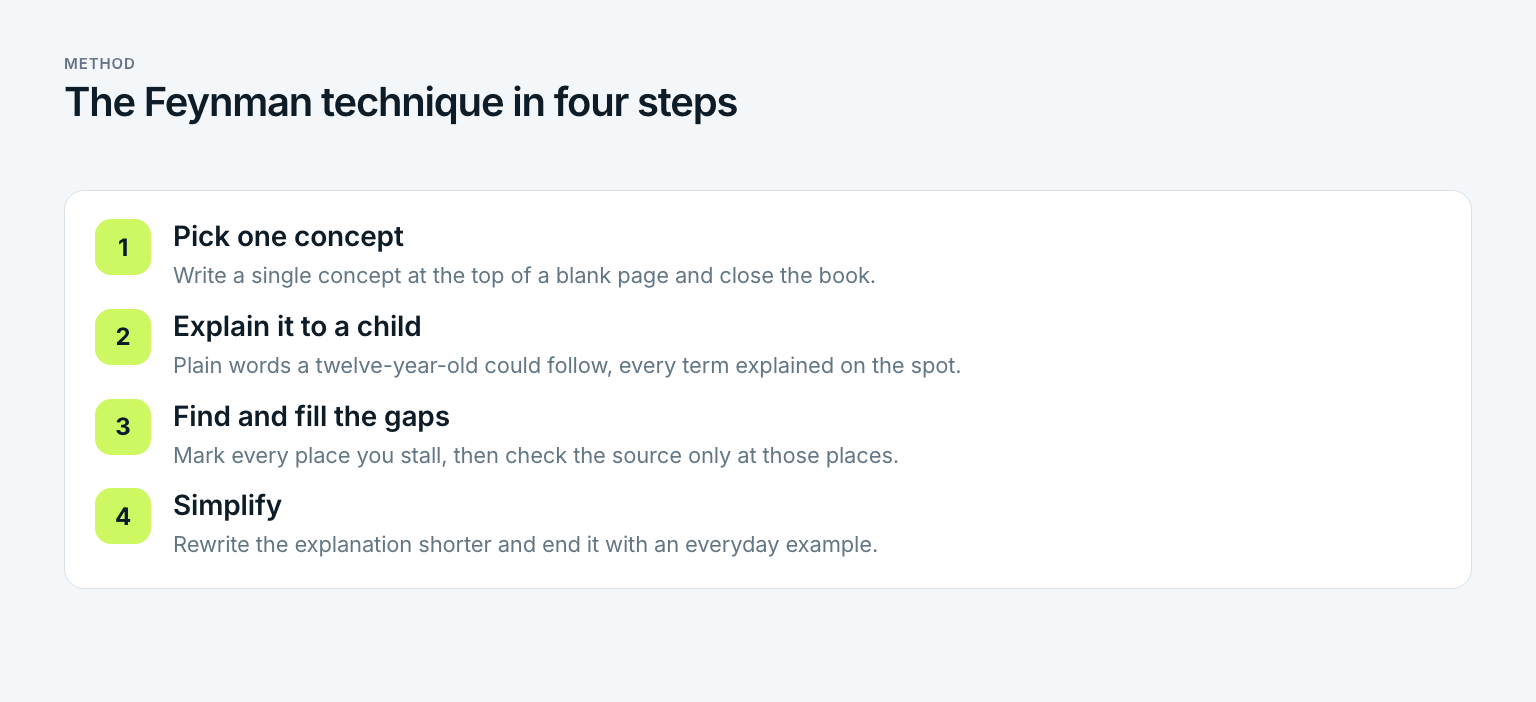
The method has four steps, and each one has its own job. The first decides what you are learning. The second shows what you already know. The third reveals what is missing, and the fourth compresses the result. Whoever skips a step ends up with a nice summary but no proof of understanding.
Pick one concept and write it at the top of a blank page
Take a single concept, not a whole chapter. "P-value" is a good topic. "Inferential statistics" is far too big. Write the concept as a heading on an empty page and close the book.
Explain it as if to a twelve-year-old
Write or say an explanation a sixth grader could follow. Short sentences, everyday words, an example from a kid's life. Every technical term you use has to be explained in the very next sentence.
Mark the gaps and go back to the source
Underline every spot where you hesitate, wave your hands, or leave a term unexplained. Only now do you open the book, and only at those spots. Write down what you had wrong or did not know at all.
Simplify and finish with an example
Rewrite the explanation so it is shorter than the first draft, and end it with an analogy or an example. If the new version works without the book and a kid could follow it, the concept is done.
The child is not your audience but your yardstick. A twelve-year-old knows no jargon but understands cause and effect. That means: you cannot use a single word to hide behind. Some guides say to explain it to a grandparent or to someone outside your field. The principle stays the same.
Whether you write or speak matters less than you might think. Writing is slower but leaves every gap visible on the page. Talking is faster, and anyone who stumbles while talking hears the gap at once. Sofia writes her first draft and says the second one out loud to her roommate Kayla, an art major who has never taken a statistics class.
A one-page template for every concept
So that she does not reinvent the method every evening, Sofia uses the same page each time. It fits on one sheet and has five fields:
- Concept: one word or one question, such as "What does a p-value tell you?"
- First explanation: from memory, no book, no more than ten sentences.
- Gaps: every spot where you stalled, each on its own line.
- Correction: what the source says, in your own words, with the page number.
- Final version: three to five sentences plus one example a kid would get.
The fields force an order. Write first, look it up second. Whoever has the book open while filling in the first field is copying and calling it understanding. Sofia keeps the pages in a binder, sorted by lecture. Before the midterm she will not reread the textbook. She will reread her final versions.
Where the Feynman method comes from
Richard Feynman lived from 1918 to 1988 and is one of the best known physicists of the 20th century. In 1965 he shared the Nobel Prize in Physics with Julian Schwinger and Shin'ichirō Tomonaga for work on quantum electrodynamics. He became famous outside physics, too: as a teacher at Caltech, as the author of funny memoirs, and in 1986 as a member of the commission that investigated the Challenger space shuttle disaster.
Feynman never wrote down a four-step method. The name and the steps appeared long after his death and have spread through study blogs and videos since around 2010. They do, however, sum up habits of his that are well documented:
- The notebook of things he did not know. His biographer James Gleick describes in Genius, published in 1992, how Feynman as a graduate student at Princeton started a notebook listing the subjects he did not understand. He then worked through each one from the ground up.
- The freshman test. The physicist David Goodstein recounts in Feynman's Lost Lecture, published in 1996, that Feynman once set out to prepare a freshman lecture on a hard point of quantum statistics. He came back and admitted he could not reduce it to the freshman level, which, he said, meant nobody really understood it yet.
- The case against memorizing. In his memoir Surely You're Joking, Mr. Feynman!, published in 1985, he describes students in Brazil who could recite definitions word for word but could not apply them to an example right in front of them.
- The line on the blackboard. When he died in 1988, his Caltech blackboard carried the sentence "What I cannot create, I do not understand."
In short: the four steps are a simplification, but an honest one. Feynman tested his understanding by trying to explain something simply and from first principles. Where that failed, he treated the topic as not yet understood. That attitude is the core of the method. The steps are just the packaging.
The Feynman Lectures and the Feynman learning technique are not the same
The Feynman Lectures on Physics are something else entirely. They are the printed version of the introductory physics course Feynman taught at Caltech in the early 1960s, published in three volumes between 1963 and 1965. They show his teaching style at its best, but they are a physics textbook, not a study method. When people search for the Feynman method, the Feynman learning technique, or the Feynman technique for studying, they mean the four steps above.
Why explaining beats rereading
Rereading feels productive. The text grows more familiar the second time, and familiarity feels like knowledge. That is exactly the problem. Anyone who recognizes a text can still be miles away from explaining it.
The psychologists Leonid Rozenblit and Frank Keil tested this in 2002. They asked people to rate how well they understood everyday things like a zipper or a flush toilet. Then the people had to explain the mechanism step by step. Afterward they rated their understanding clearly lower than before. The researchers called this the illusion of explanatory depth.
The illusion of explanatory depth
It is the tendency to overrate your own understanding as long as nobody asks you to explain. The overconfidence is strongest for mechanisms and processes. Only the attempt to explain shows where your knowledge ends. The Feynman technique uses exactly that moment: it forces the explanation before the exam does.
Other findings back up the individual steps of the method:
- Explaining to yourself builds understanding. Michelene Chi and colleagues showed in 1994 that eighth graders who explained a biology text to themselves while reading understood more afterward than a comparison group that read it twice.
- Retrieval beats rereading. Henry Roediger and Jeffrey Karpicke found in 2006 that students remembered a text better a week later when they had recalled it from memory after reading instead of reading it again.
- Expecting to teach changes how you learn. John Nestojko and colleagues showed in 2014 that people recalled more, and in a more organized way, when they expected to teach the material to someone else later.
- Rereading and highlighting do little. A large review by John Dunlosky and colleagues rated ten common study techniques in 2013. Practice testing and spaced practice came out on top. Rereading and highlighting came out at the bottom.
That means: the Feynman technique is not a learning theory of its own. It bundles three well-supported principles, retrieval, self-explanation and teaching, into one exercise that fits on a single page. We know of no study that tests these exact four steps under this name. The building blocks, however, are well researched, which is more than most study tips online can claim.
A Feynman technique example: Sofia explains the p-value
Here is what that looks like on Sofia's first evening. She has copied 30 concepts from the midterm study guide onto a list, and the p-value is near the top. She has read the section twice and feels fine about it. Then she closes the book and takes a blank page.
First draft, from memory
"The p-value is the chance that your result happened by luck. If it is below 0.05, the result is real and your hypothesis is proven. A really small p-value means a really big effect. That is why researchers want small p-values."
Four sentences, and they flow. But reading them back, Sofia finds three places where Kayla could not follow. Chance of what, exactly? Who decided on 0.05, and what does proven mean here? And is a small p-value really the same as a big effect?
Three gaps, three corrections
Only now does she open the textbook, and only at those three spots. Here is what she finds:
- It is not the chance that the result is luck. The p-value assumes there is no real effect and then asks how often you would see data at least this extreme anyway. A statement from the American Statistical Association, written by Ronald Wasserstein and Nicole Lazar in 2016, says it plainly: a p-value does not measure the probability that the studied hypothesis is true. Sofia's first sentence was not just vague. It was wrong.
- 0.05 is a convention, not a law of nature. Below it, a result is usually called statistically significant. Nothing is proven. A small p-value says the data would be surprising if there were no effect, and that is all it says.
- Small p-value does not mean big effect. The same ASA statement notes that a p-value does not measure the size of an effect or the importance of a result. With a large enough sample, even a tiny effect can produce a tiny p-value. Effect size is a separate number.
Second draft, for Kayla
"Say a friend swears her coin is fair, and you think it is rigged. You flip it 20 times and get 16 heads. The p-value answers one question: if the coin really were fair, how often would you get 16 or more heads out of 20 just by luck? The answer is about 0.6 percent of the time. That is rare enough to make you doubt the coin. But it does not tell you the chance that the coin is rigged, and it does not tell you how rigged it is."
Kayla asks one question, and that question is the real test: so if you got only 12 heads and the p-value came out big, does that prove the coin is fair? Sofia has to look it up again. The answer is no. A large p-value only means the data are not surprising enough to rule out a fair coin. With just 20 flips, a slightly rigged coin would often look fair. Sofia would never have caught this fourth gap by rereading, because she would never have asked the question.
The whole round takes 35 minutes. That is longer than a third pass through the chapter. But after a third pass, Sofia would still believe a p-value tells you the chance your result is a fluke.
Sofia's first four weeks in numbers
Sofia plans three Feynman sessions a week of 40 minutes each, on Monday, Wednesday and Thursday after dinner. On Sunday she explains two concepts from that week to Kayla. On Friday she quizzes herself: she pulls up to five concepts she has already covered and explains them without her pages.
| Week | Concepts covered | Gaps found | Friday quiz without notes | What she changed |
|---|---|---|---|---|
| 1 | 4 | 13 | 2 of 4 solid | Topics were too big, so she split hypothesis testing into five concepts |
| 2 | 6 | 12 | 3 of 5 solid | First drafts in writing only, never with the book open |
| 3 | 7 | 10 | 4 of 5 solid | Missed one session, explained three concepts to Kayla on Sunday instead |
| 4 | 6 | 7 | 5 of 5 solid | Mixed older concepts from week 1 into the quiz |
| Total | 23 of 30 | 42 | 14 of 19 | Quiz rate 74 percent |
Three things stand out. The number of gaps per concept falls, not because the concepts get easier, but because Sofia reads differently now. She asks herself at every paragraph how she would explain it to Kayla. Second, the first week was the weakest because the topics were too big. Third, the progress on the Friday quiz comes from recalling without notes, not from writing alone.
Is that fast? No. With 23 concepts in four weeks, the last seven fill most of week five. But every one of them is learned well enough to explain, and that is exactly what a question asking you to interpret a result, rather than define a term, requires.
The Feynman technique for studying versus other methods
The Feynman technique does not replace other study methods. It tests something the others do not. Flashcards check whether you can recall an answer. The Feynman technique checks whether you can justify it. Anyone who confuses the two picks the wrong tool for every topic.
| Method | What you do | What it tests | Best for |
|---|---|---|---|
| Rereading | Read the text a second time | Recognition only | A first overview of a new chapter |
| Highlighting | Mark key passages | Almost nothing, the choice goes unchecked | Finding passages again later |
| Flashcards | Read a prompt, recall the answer | Whether you can retrieve a fact | Terms, formulas, dates, definitions |
| Feynman technique | Explain simply, fill the gaps | Whether you understand how things connect | Concepts, mechanisms, cause and effect |
| Study group | Explain topics to each other | Understanding plus other people's questions | Exam prep with fixed meeting times |
Sofia combines two of them. She uses the Feynman technique for concepts like the p-value, confidence intervals or the difference between correlation and causation. For formulas, symbols and definitions she uses flashcards, because there is nothing to explain there, only something to remember. In short: explain for the why, quiz for the what.
A fixed time frame helps with the sessions themselves. If you prefer 25-minute blocks, the Pomodoro technique walks you through them. Sofia uses 40 minutes with her phone in another room, which is closer to a short block of deep work. The length matters less than one rule: nobody interrupts the first draft.
Three mistakes that make the method useless
The method is simple, and that is exactly why it is so often done in a way that tests nothing. Three mistakes are especially common, and all three feel good while you make them.
The most common mistake: keeping the book open for the first explanation
Whoever writes the first draft with the book open is paraphrasing the source and calling it understanding. The explanation sounds good because it is borrowed. The test is gone before it starts. Close the book, put the phone away, and write what you know right now, even if it is only three sentences. The gaps are the result, not the failure.
Second: simplifying until it is wrong. Simple does not mean sloppy. Sofia's first draft was simple, but "the chance it happened by luck" was flat out wrong. A good example leaves out details, but it never claims something false. So test every analogy against the source: where does it break, and does it break at a point the exam will ask about?
Third: not writing the gaps down. Anyone who stalls, peeks at the book and moves on throws away the most valuable output of the whole exercise. The list of gaps shows where your knowledge is thin. It is what you quiz on Friday and explain again next week. Without that list, all that remains of the session is a good feeling.
Where the Feynman learning technique falls short
The Feynman learning technique is a strong tool for understanding. For some other kinds of learning it simply was not built. Know these three limits before you rebuild your whole study plan around it:
- Pure facts. A date, a formula or a vocabulary word cannot be explained more simply. Flashcards and review at growing intervals work better here. Nicholas Cepeda and colleagues confirmed in 2006, in an analysis of many studies, that spaced practice beats cramming.
- Skills. Anyone learning piano, a programming language or how to run a statistical test in software has to practice. Explaining helps you understand the rules but does not replace repetition. That is why Sofia also works one old exam problem under time pressure every Sunday.
- Time. A good session costs 30 to 45 minutes per concept. In a course with hundreds of terms, you cannot do that for all of them. Pick the concepts that other topics depend on, and the ones you skimmed fastest while reading.
There is one more point that many guides skip. Anyone who explains alone misses some gaps because they do not even see them as gaps. A real listener who asks questions is worth more than an imagined child. Kayla's question about the big p-value taught Sofia more than her own review did. If you do not have a Kayla, a study group or a classmate does the same job.
The Feynman technique in your goal chain: from semester goal to tonight's concept
A study method alone does not tell you how much to study, or when. For that you need a chain from the big goal down to a single evening. Sofia's chain runs from a goal for next year down to tonight's page:
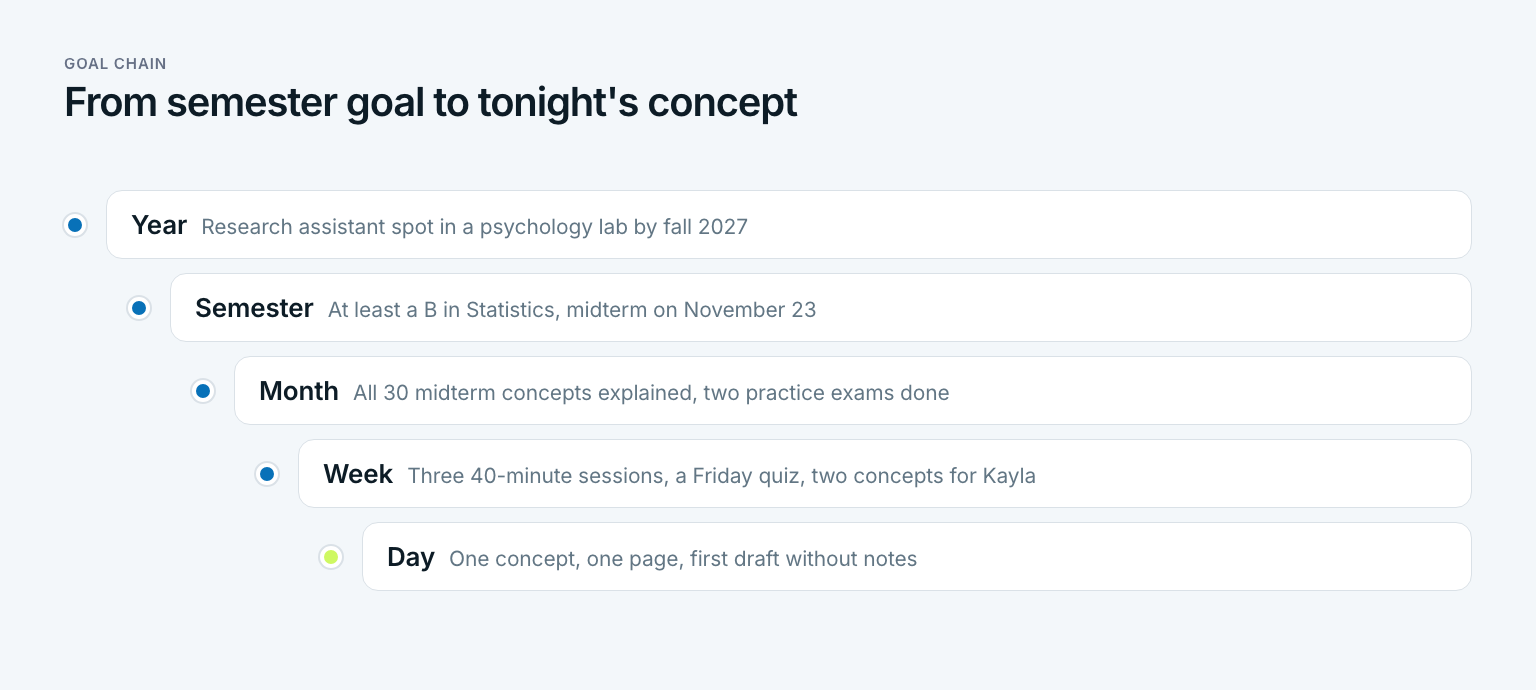
- Year: a research assistant spot in a psychology lab by fall 2027.
- Semester: at least a B in Statistics, with the midterm on November 23.
- Month: all 30 midterm concepts explained, plus two full practice exams.
- Week: three 40-minute sessions, a Friday quiz on five concepts, two concepts for Kayla on Sunday.
- Day: one concept, one page, first draft without notes.
The Feynman technique sits at the bottom level. Every level above it checks whether the evenings add up. If Sofia covers only four concepts in a week instead of seven, she notices it that Friday, not the night before the midterm. Then she moves concepts or adds a fourth evening. The weekly goal is the key link, because that is where a monthly plan turns into a promise about specific evenings. How to set those up is covered in weekly goals.
In Gaapp you set the lab spot as a yearly goal, break it down through the semester and the month to the week, and check off each concept you explained as a daily goal. On Friday you see not only what you studied but whether it is enough for the goal above it.
Three questions before you open the next chapter
Knowing a method changes nothing by itself. Three questions show whether you will actually use it tomorrow:
- Which concept from my course could I not explain to a twelve-year-old today, even though I have read the chapter?
- On which evening, and for how long, will I write my first draft, with no book and no phone?
- Who will ask me follow-up questions, a roommate, a classmate or a study group, and when is the first session?
Whoever can answer all three needs no more instructions. In short: the Feynman technique does not measure how much you have read. It measures how much you can explain.
Frequently asked questions about the Feynman technique
What is the Feynman technique for teaching?
Teachers use it in two ways. They run the four steps on a topic before class to find the spots they cannot yet explain simply, and they have students explain a concept to a partner in plain words. Logan Fiorella and Richard Mayer found in 2013 that students who actually taught material on video after studying it did better on a delayed test than students who only studied it.
What did Einstein think of Feynman?
There is no reliable record of Einstein giving an opinion of Feynman. What is documented is a meeting: as a Princeton graduate student in the early 1940s, Feynman gave his first seminar talk, and Einstein sat in the audience along with Wolfgang Pauli and John von Neumann. Feynman tells the story, including his nerves beforehand, in Surely You're Joking, Mr. Feynman!
Are Feynman lectures good for JEE?
The Feynman Lectures on Physics are excellent for understanding the ideas behind physics, but they were written for an introductory university course at Caltech, not for a competitive entrance exam. They contain few drill problems of the kind the JEE asks. Use them when a concept keeps tripping you up, and use exam-style problem books for practice.
What was Feynman's IQ?
According to his biographer James Gleick, Feynman scored 125 on a school IQ test, a good but not extraordinary result. The number is quoted often because it contrasts so sharply with a Nobel Prize in Physics. Mostly it shows how little a single test says about what someone can learn.
How long should a Feynman technique session take?
For a single concept, 30 to 45 minutes is usually enough: about ten minutes for the first draft, 15 minutes to close the gaps and ten minutes for the final version. Break bigger topics into single concepts first. Several short sessions spread across the week beat one long one, because spaced practice is one of the best-supported study techniques.
Can you use the Feynman technique without a listener?
Yes. You can write the explanation down or say it out loud and record yourself. A real listener, though, finds gaps you miss on your own, because they ask questions you do not expect. If you study alone, ask a classmate or a study group for one fixed session a week.
Last updated: 22 October 2026
Read next
 Productivity
Zettelkasten: How to Turn Notes Into Your Own Ideas
A Zettelkasten is not an archive: Luhmann's method, the three note types, a five-step setup and an Obsidian template, with a worked example.
15 min read
 Productivity
Second Brain: How to Build One You Actually Use
A second brain is not a note archive: Tiago Forte's CODE steps, the PARA method with an example, a five-step setup and the mistakes that sink it.
15 min read
 Productivity
Kaizen Method: How Small Changes Add Up
The kaizen method explained: meaning, origins, principles, six steps and a worked example from a bookkeeping practice, plus personal kaizen for your goals.
15 min read