Flow State: What It Is and How to Get Into It
A flow state is not luck. It shows up when your goal, your feedback and your challenge fit. Meaning, examples, six steps and a session log.
Contents
- 01Flow state meaning: what it is like to be in the zone
- 02Flow state and Csíkszentmihályi: where the idea comes from
- 03How to trigger flow state: three conditions that come first
- 04Why you feel bored or anxious instead: the flow channel
- 05How to get into flow state in six steps
- 06Flow state examples at work, at home, and in sport
- 07ADHD, hyperfocus, and flow: what overlaps and what does not
- 08When flow works against you
- 09Flow in your goal chain: from a yearly goal to tonight's session
- 10Frequently asked questions about flow state
A flow state is not a lucky mood but a state of complete absorption in what you are doing: action and awareness merge, time bends, and the inner critic goes quiet. Psychologist Mihály Csíkszentmihályi first described it in 1975 and explored it in depth in his 1990 book Flow. He found that it shows up under three conditions: a clear goal, immediate feedback, and a challenge that matches your skill. You cannot force flow. You can make it far more likely.
The worked example is Marcus, 31, who answers support tickets at a software company in Columbus, Ohio, and learns to code at night. His goal is a junior developer job by October 2027, with three small apps in his portfolio. Tutorials bore him. His own app scares him. He rarely gets into flow, and that gap shows exactly what is missing. Along the way you get the flow channel as a chart, six steps, a session log to copy, and a way to tie it all to your goal chain.
Flow state meaning: what it is like to be in the zone
Flow is the state in which doing and knowing that you are doing become one thing. You stop thinking about the task and simply do it. Each move follows from the last, and the question of what time it is never comes up. Afterward you feel tired and satisfied at once.
The name came from the people Csíkszentmihályi interviewed. Artists, rock climbers, chess players, dancers, and surgeons kept reaching for a similar image: it felt like being carried by a current. That image became the word flow. Athletes call it being in the zone. The experience underneath is the same.
So what does flow state mean in plain words? You are doing something that stretches you without breaking you. You know exactly what you are trying to do. You can tell right away whether it is working. Take away any one of those and the state collapses. Too easy turns into boredom, too hard turns into stress, and no goal turns into drifting. That means: flow is not a feeling you have. It is a fit you build.
Six signs you are in a flow state
The conditions come before flow. The signs describe it from the inside. Not every sign is equally strong every time, but together they draw a clear picture:
- Total concentration on the task. Attention stays put without effort.
- Action and awareness merge. You are not watching yourself work. You are working.
- A sense of control. You feel on top of the situation without worrying about it.
- Self-consciousness fades. The voice that comments and judges goes quiet.
- Time changes shape. Hours pass like minutes, and sometimes seconds stretch.
- The activity is its own reward. You keep going because doing it feels good, not because of the payoff.
Most people notice the time shift first, and only afterward. One Thursday Marcus looked at the clock at 7:05 pm and then not again until 9:20. In between he had built and tested a form that had beaten him twice the week before. Anyone who writes moments like that down finds a personal pattern within a few weeks: time of day, kind of task, length of session.
Flow state and Csíkszentmihályi: where the idea comes from
Mihály Csíkszentmihályi was a Hungarian American psychologist who spent much of his career at the University of Chicago. He started with a simple puzzle. Why do people pour hours into things that pay them nothing? Painters who barely looked at a canvas once it was done. Climbers who spent a whole day on a wall just to walk back down. The answer, he concluded, was not in the result. It was in the experience of doing it.
He described the concept first in Beyond Boredom and Anxiety in 1975. In 1990 he published Flow: The Psychology of Optimal Experience, the book that carried the idea far beyond psychology departments. Fifteen years of research sit between the two, and in that time an observation about artists turned into a model for ordinary days.
To study flow outside the lab, Csíkszentmihályi and his colleagues developed the Experience Sampling Method. Participants carried a pager that beeped at random times during the day. At each beep they wrote down what they were doing, how challenged they felt, and how skilled they felt. The result was a picture of normal Tuesdays rather than rare moments on a mountain or a stage.
One finding still surprises people. Flow showed up more often at work than in leisure time. Yet at work, people more often wished they were somewhere else. Work supplied the conditions for flow, but it was not remembered that way. Anyone who thinks of their job as the place where nothing good happens may be overlooking the hours when they are most fully themselves.
Autotelic: when the activity rewards itself
Csíkszentmihályi called an activity autotelic when its purpose lies in itself, from the Greek auto for self and telos for goal. A flow experience is autotelic: you keep going because the doing feels good, not because of a reward at the end. For your goals, that matters. Whoever finds flow in the work toward a goal needs far less outside motivation to take the next step.
How to trigger flow state: three conditions that come first
Quiet alone does not produce flow. Csíkszentmihályi describes three conditions that come before the experience. When they are in place, the signs of flow often follow on their own. When one is missing, even the quietest room will not help.
A clear goal for this session
A clear goal is not “work on the app.” It is “the save button writes one expense to the database, and the test passes.” The goal has to be concrete enough that you always know the next move. Whoever has to stop between two lines and wonder what they are actually trying to do leaves flow before reaching it. A yearly goal is far too big for this. It needs to be broken down all the way to a single session.
Immediate feedback while you work
Feedback here does not mean a code review two weeks later. It means you can see, while you work, whether you are on track. A climber feels whether the hold takes weight. A pianist hears whether the note is right. Knowledge work often lacks that signal, so you have to build it in: a test that turns green, a word count, a page that renders, a paragraph you read out loud.
For Marcus, feedback was the bottleneck. He would write code for an hour and only then run it, and by then he had no idea which of thirty changes had broken things. Doubt ran alongside him the whole time. Once he started running the app after every small change and writing one test before each feature, a session gave him twenty small signals instead of one big verdict.
A challenge just above your skill
The third condition matters most and gets ignored most. Flow appears when the challenge is high, your skill is high, and the two roughly match. The sweet spot is a task that pulls you a little past what you can comfortably do. Much easier and you get bored. Much harder and you get anxious. In short: the task alone does not decide whether you reach flow. The ratio between task and skill does.
Why you feel bored or anxious instead: the flow channel
The best known picture from Csíkszentmihályi's work is the flow channel. One axis is challenge, the other is skill. When both are high and in balance, you are in flow. When challenge runs well ahead of skill, you feel anxiety. When skill runs well ahead of challenge, you feel boredom. When both are low, you land in apathy, the state of a Sunday night on the couch with nothing in particular on the screen.
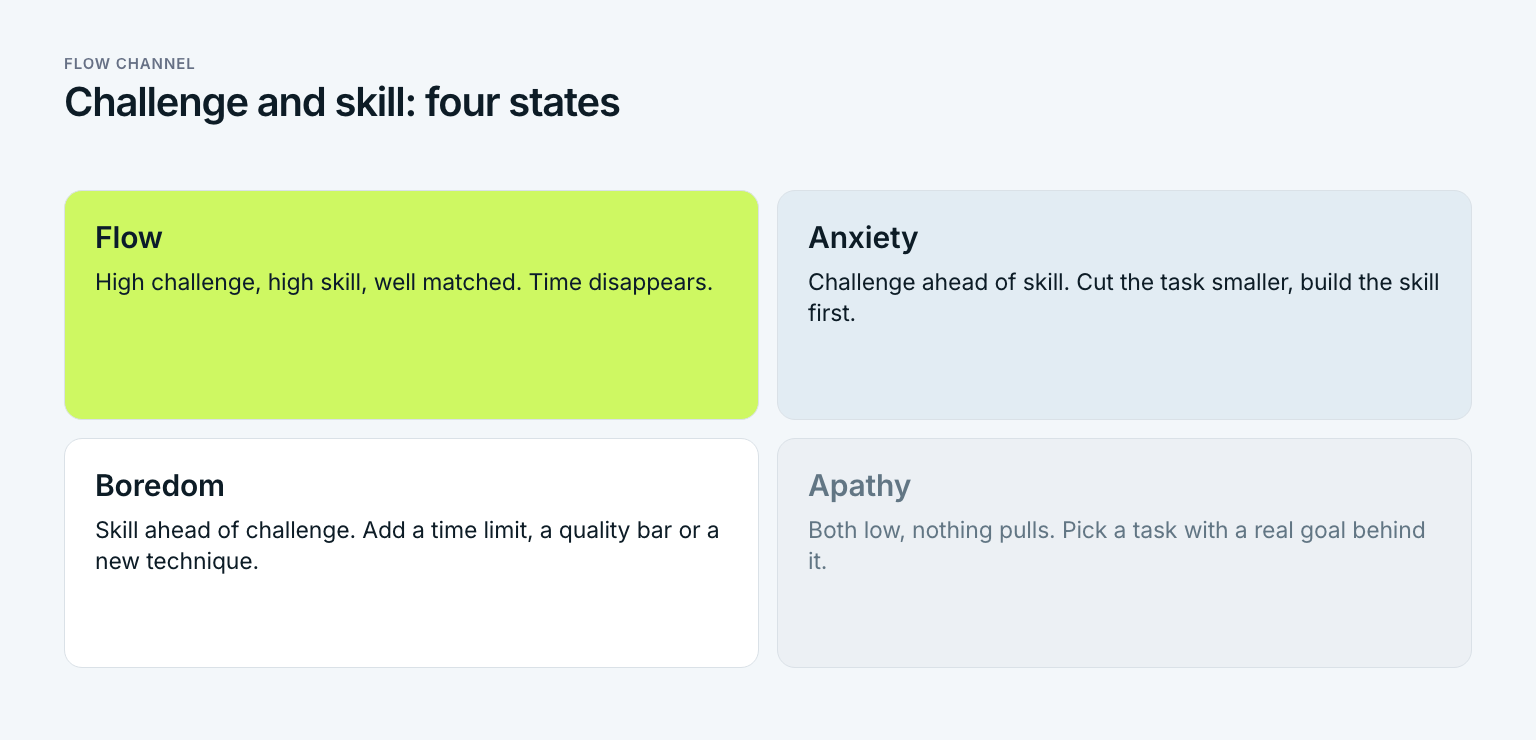
The value of the model is diagnosis. Anyone who is not in flow can ask one question: am I bored, or am I in over my head? Both states feel alike from the inside, because both send you to your phone, the fridge, or your inbox. But they call for opposite fixes. Boredom needs a harder task. Anxiety needs an easier one, or more skill built up before you start.
| State | Challenge | Skill | How it feels | What to change |
|---|---|---|---|---|
| Flow | high | high and matched | time disappears, the next step is obvious | nothing, just protect it |
| Anxiety | high | clearly lower | restless, constant searching, putting it off | cut the task smaller, build the missing skill first |
| Boredom | low | high | reaching for the phone, mind wandering | add a time limit, a quality bar, or a new technique |
| Apathy | low | low | listless, nothing pulls | pick a task with a real goal behind it |
For two weeks Marcus rated every session on two numbers from 1 to 10: how hard the task was, and how well he could handle it. The pattern was obvious. Video tutorials scored challenge 3 and skill 7, plain boredom. Building his own budgeting app scored challenge 9 and skill 4, because he had never connected a form to a database. In the first week he had nine sessions and felt something like flow in two. Both were small bug fixes he had found himself.
What does that say about your own week? Probably that your bad sessions are not all bad for the same reason. Some are too easy, some are too hard. Whoever treats them all the same, with more discipline for instance, fixes neither.
How to get into flow state in six steps
A quiet room is necessary, but it is not enough. Put a task that is too easy in that room and you get boredom. Put one that is too hard there and you get procrastination. So these steps start with the task, not the setting. For the setting itself, the guide on how to focus covers phones, tabs, and notifications in detail.
Write the session goal in one sentence, two minutes
Write down what will be done when the session ends, phrased so you can answer it with yes or no. For Marcus: the expense form saves one entry to the database, and one test covers it. Whoever cannot fit the goal into one sentence starts the session by planning, and then planning is the real task.
Rate the challenge and tune it, three minutes
Give the task two numbers from 1 to 10, one for challenge and one for skill. If challenge sits more than two points below skill, make it harder: a time limit, a quality bar, a technique you have not used yet. If it sits more than two points above, make it easier: a smaller slice, prep work the day before, a solved example open next to you.
Build in feedback before you start
Decide how you will know, mid-session, that it is working: a test, a page that renders, a word count, a paragraph read aloud. Without a signal you are working blind, and blind work tips into doubt. Marcus writes the test first, so red turns green in front of him.
Clear the runway, five minutes
Close every tab you will not need, put the phone in another room, and tell the people around you when you will be back. Keep this short. Its job is only to remove the easiest escape, not to build the perfect setting.
Start the same way and give it fifteen minutes
Flow rarely arrives at once. In Peopleware, published in 1987, Tom DeMarco and Timothy Lister estimated that it takes about fifteen minutes to sink into demanding work. Start every session the same way, for example by rereading the last line you wrote, and do not check whether it is flowing yet during those first 15 minutes.
Log two numbers and one sentence afterward
Write down whether you hit the goal, where the session landed on challenge and skill, and whether you felt flow. Add one sentence on what to change next time. After two weeks the log tells you when, and on which tasks, flow shows up for you.
The most common mistake: fixing the room and forgetting the task
Anyone who wants flow usually starts by clearing the desk, muting the phone, and putting on headphones. That helps, but it is only half the job. A task with a fuzzy goal or the wrong difficulty stays sticky in the quietest room on earth. Before you tune the setting, check the task: is the goal one sentence, can you see progress as you go, and does the difficulty sit just above your skill?
Marcus's third week
After week one Marcus changed two things. He dropped passive tutorials and instead rebuilt each tutorial project from memory with one feature the video did not cover. That raised the challenge. For his own app he cut each feature into slices of one session each, and he looked up the one concept he lacked the day before, in 20 minutes. That lowered the challenge. The easy work got harder and the hard work got easier.
| Session | Task | Challenge | Skill | Flow | Result |
|---|---|---|---|---|---|
| Mon 7:00 pm | Rebuild tutorial to-do app from memory, add due dates | 6 | 7 | partly | done in 80 minutes |
| Tue 7:00 pm | Expense form saves one entry, test first | 7 | 6 | yes | test green, one extra field added |
| Wed 7:00 pm | Read docs on database queries | 5 | 6 | no | notes on two query types |
| Thu 7:00 pm | Monthly view lists all expenses for one month | 8 | 6 | yes | view works, two tests |
| Sat 9:00 am | Edit and delete an expense | 7 | 7 | yes | both work, three tests |
By the end of week three he had five flow sessions out of eight instead of two out of nine, and the number of finished features per week went from one to four. Those are his numbers, not research results. But they show where the leverage was: not in more willpower, but in tasks that fit. The documentation session on Wednesday had no flow at all, and that is fine. Not all work has to flow.
Flow state examples at work, at home, and in sport
Flow is not reserved for artists and elite athletes. It can show up in almost any activity that has a goal, feedback, and the right level of difficulty. Whether an activity produces flow depends less on the activity than on how you set it up. A few examples:
| Area | Example | Goal | Feedback |
|---|---|---|---|
| Work | A developer builds a feature | feature works, test passes | test fails or passes |
| Work | A teacher runs a class discussion | every student speaks once | faces, answers, silence |
| Work | A surgeon operates | procedure without complications | tissue, monitors, team |
| Sport | A runner holds a pace | a 10K in 55 minutes | watch and breathing |
| Sport | A climber works a route | reach the top | every hold takes weight or not |
| Home | Someone cooks a new recipe for friends | dinner on the table at 7 pm | taste, texture, clock |
| Home | A parent and child build a bookshelf | shelf stands level | spirit level |
| Hobby | A guitarist learns a solo just above their level | play it clean at full tempo | the sound itself |
Notice what is missing from the list: watching TV, scrolling, waiting. These have no goal of their own and ask for almost no skill. They feel relaxing, but they rarely produce flow. In Csíkszentmihályi's data, hours in front of the television tended to come with passivity and low concentration. Whoever wants more out of an evening is more likely to find it in a demanding hobby than in another episode.
It also means flow at work is more common than most people think. Work often supplies what leisure lacks: a goal, feedback, and a real demand on your skill. What it usually lacks is long stretches without interruption. How to defend those stretches on your calendar is covered in the guide to deep work. This article is about the question that comes before: what the task inside that stretch has to look like for flow to have a chance.
ADHD, hyperfocus, and flow: what overlaps and what does not
Can people with ADHD enter flow state? Many do, and many describe something they call hyperfocus: long stretches of intense absorption in a task that grabs them, sometimes at the cost of meals, sleep, or everything else on the list. Researchers still debate how closely hyperfocus and flow are related. What is clear is that they overlap in some ways and differ in others.
They overlap in absorption and in the way time disappears. They tend to differ in control and direction. Flow comes with a sense of being in charge, and it usually happens inside a task you chose for a reason. Hyperfocus can lock onto whatever is most stimulating in the moment, and it can be hard to leave even when something more important is waiting. That means: the experience can feel similar while the result is very different.
The three conditions still apply, and for many people with ADHD they matter even more. A clear goal for a short session gives attention a target. Fast, visible feedback, like a test that turns green, supplies the stimulation a vague task lacks. A firm end time protects against the other side of hyperfocus, the evening that disappears. If ADHD seriously affects your work or study, a clinician who knows the condition is the right person to plan with.
When flow works against you
Flow feels good, so it is tempting to assume it is always good. Csíkszentmihályi warned against exactly that. Flow says nothing about whether an activity is worthwhile. A gambler can be in flow. So can someone playing one more round of a video game at 3 am. The state is neutral. The goal decides where it takes you. And it is not available for every hour: taxes, invoices, and email will rarely flow, and that is fine.
The second risk is exhaustion. Whoever finds flow in their work tends to work longer than is good for them. Time disappears, and with it breaks, meals, and the end of the day. A day of flow followed by two drained days is not a win. That is why every session needs an end time set in advance, and a break that is not up for negotiation.
The third risk is in the numbers people quote. You will often read that people in flow are 500 percent more productive. That figure comes from executives rating their own peak days, not from measuring what they produced. Treat it as a hint about how flow feels, not as proof of what it delivers. Your own log is a sturdier source: features, pages, miles, before and after you changed something.
Flow in your goal chain: from a yearly goal to tonight's session
The first condition, a clear goal, is where flow fails most often. A big goal motivates, but it does not tell you what to do at 7 pm on a Tuesday. Only when the yearly goal is broken down through the quarter, the month, the week, and the day into a single session do you get the one sentence you can write down before you start.
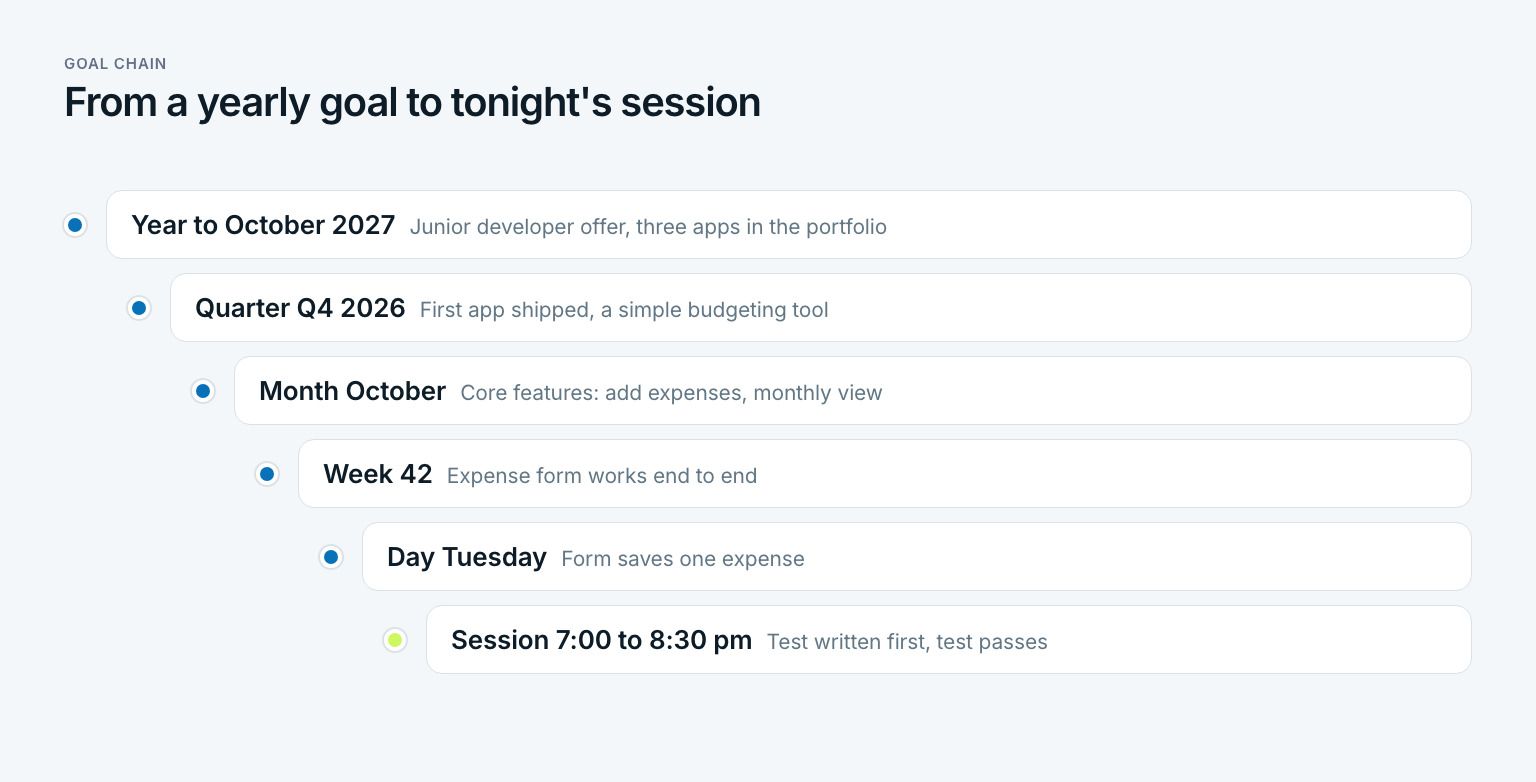
For Marcus the chain looks like this. The yearly goal is a junior developer offer by October 2027, backed by three apps. In the fourth quarter of 2026 the first app ships, a simple budgeting tool. In October the core features get built: add expenses, see a month at a glance. In week 42 the expense form works end to end. On Tuesday it saves one entry. And the session from 7 to 8:30 pm has a goal that fits in a sentence. Each level is small enough for the next one. The session is small enough for flow.
The chain also supplies the second condition, feedback, at a larger scale. Whoever can see that this week's form feeds this month's app knows after every session whether they are on track. In Gaapp you set up that chain once and see each day what a session added to the weekly goal. For the weekly level, see weekly goals. For the full path from a goal to a result, see how to achieve goals.
Template: a one-week flow log
| Field | Question | Example: Marcus, week 42 |
|---|---|---|
| Weekly goal | What is done by Friday? | Expense form works end to end |
| Session goal | What is done when this session ends, in one sentence? | Save one expense, test passes |
| Challenge, 1 to 10 | How hard is this task for you today? | 7 |
| Skill, 1 to 10 | How well can you do what it asks? | 6 |
| Feedback | How will you know mid-session that it is working? | Test written first, run after each change |
| Flow | Yes, partly, or no? | Yes, 7:00 to 8:30 pm |
| Change | What will you do differently next time? | Read the docs on queries the night before |
Three questions before your next session
- Can I say in one sentence what will be done when the session ends?
- How will I see, while I work, whether it is working?
- Does the task sit just above my skill, or does it bore me or swamp me?
Whoever can answer yes to all three has done everything that can be done in advance. The rest is starting and giving it fifteen minutes. In short: flow is not a talent. It is a well-sized task.
Frequently asked questions about flow state
What does it mean to have a flow state?
It means being completely absorbed in an activity, so that action and awareness merge, self-consciousness fades, and time seems to change speed. Psychologist Mihály Csíkszentmihályi named and described the state, first in 1975. It tends to appear when you have a clear goal, immediate feedback, and a challenge that matches your skill.
Can people with ADHD enter flow state?
Yes. Many people with ADHD report intense absorption, often called hyperfocus, which overlaps with flow but can be harder to steer toward the task that matters. Short sessions with one clear goal, fast visible feedback, and a firm end time tend to help. For serious difficulties at work or school, a clinician who knows ADHD is the right partner.
How do you trigger flow state?
You cannot switch it on, but you can set up its three conditions. Define one goal for the session that you can answer with yes or no, build in feedback you can see while you work, and tune the task so it sits just above your current skill. Then remove the easiest distractions and give it about fifteen minutes.
How do you get into your flow state?
Start by finding out when it already happens. Log each session with two numbers, challenge and skill from 1 to 10, plus whether you felt flow. After two weeks you will see which tasks and times work for you, and which sessions fail because they are too easy or too hard.
Is flow state the same as hyperfocus?
Not quite. Both involve deep absorption and lost track of time. Flow usually comes with a sense of control and happens inside a task you chose on purpose, while hyperfocus can latch onto whatever is most stimulating and be hard to break away from.
How long does a flow state last?
It varies widely, from a few minutes to several hours. How long it holds depends on whether the conditions stay stable and whether someone interrupts you. For planning, a session of 60 to 90 minutes with a fixed end leaves enough room to get in and still stop before you are drained.
Last updated: 6 October 2026
Read next
 Productivity
Feynman Technique: Four Steps to Real Understanding
The Feynman technique is not a memorization trick: four steps, a worked example from a stats class, a one-page template, and what research says.
16 min read
 Productivity
Zettelkasten: How to Turn Notes Into Your Own Ideas
A Zettelkasten is not an archive: Luhmann's method, the three note types, a five-step setup and an Obsidian template, with a worked example.
15 min read
 Productivity
Second Brain: How to Build One You Actually Use
A second brain is not a note archive: Tiago Forte's CODE steps, the PARA method with an example, a five-step setup and the mistakes that sink it.
15 min read