How to Give Feedback to Employees: Steps and Examples
Feedback to employees is not a verdict: four steps, a prep template, twelve constructive and eight positive feedback examples, and what not to say.

Contents
- 01What feedback to employees is, and what it is not
- 02Why most feedback misses: opinion is not feedback
- 03How to give feedback to employees in four steps
- 04How to prepare in ten minutes: a one-page template
- 05Constructive feedback examples: twelve situations, said well
- 06Employee feedback examples: positive feedback that names what to repeat
- 07What not to say when giving feedback
- 08The three mistakes nobody notices
- 09From feedback to goals: year, quarter, month, week, day
- 10Frequently asked questions about giving feedback to employees
Feedback to employees is not a verdict on a person. It is a short, planned conversation in which you describe one specific behavior, name its impact, and agree on what changes and by when. Knowing how to give feedback to employees comes down to that order: observation first, judgment never, agreement last. A performance review grades a year. Feedback steers next week.
Three things make the difference: an observation with a number, a question you do not know the answer to, and an agreement with a date. This guide walks through all three with Dana, a sales manager who leads six inside sales reps at a software reseller, and Luis, her top rep, who books more demos than anyone and loses almost half of them. You also get four steps for the conversation, a one-page prep template, twelve constructive feedback examples, eight positive ones, and a list of what not to say.
What feedback to employees is, and what it is not
Feedback has a trigger, a topic, and a result. The trigger is something you observed that affects a goal. The topic is one behavior, not the whole person and not the whole quarter. The result is an agreement both of you can repeat in one sentence. Drop any of the three and the conversation turns into something else: without a trigger it is small talk, without a topic it is a lecture, without a result it is venting.
Feedback is not only criticism, either. Anyone who schedules a feedback conversation only when something breaks teaches the team to dread every calendar invite. Positive feedback follows the same rules. It is specific, it names the impact, and it tells the person what to keep doing.
The SBI model in one paragraph
The Center for Creative Leadership teaches feedback as Situation, Behavior, Impact, or SBI. Situation is when and where. Behavior is what the person did, described so plainly that a camera could have recorded it. Impact is what that behavior caused for a customer, a colleague, or a goal. SBI works because it removes the one thing people argue with, which is your interpretation. Everything in this guide builds on it and adds the two pieces SBI leaves out: a real question and an agreement.
Four kinds of conversation tend to blur together. None of them is wrong, and each one is built for something else. The only question is: which one fits what you saw?
| Conversation | Trigger | How often | Length | Result |
|---|---|---|---|---|
| Feedback conversation | one specific behavior, good or bad | when it happens, within a week | 15 to 30 minutes | one agreed change and a follow-up date |
| One-on-one | the report's topics and weekly progress | weekly or every two weeks | 30 minutes | next steps and small course corrections |
| Performance review | six or twelve months of work | once or twice a year | 60 to 90 minutes | a rating and goals for the next period |
| Coaching conversation | a skill the person wants to build | as agreed, often monthly | 45 minutes | a practice plan the person owns |
The feedback conversation is the smallest and fastest of the four. It needs no form from HR and no two weeks of notice. It only needs a trigger that is still fresh. Whoever saves feedback for the annual review delivers a bank statement in December about things nobody remembers clearly. That means: the review summarizes, feedback steers. How feedback, goals and the review fit into one yearly cycle is the subject of performance management.
Giving feedback to employees: how often and where
There is no magic number, but there is a rule of thumb. Give constructive feedback within a week of what happened and positive feedback the same day. On top of that, run a rhythm. For Dana's team of six, every rep gets at least one piece of goal-linked feedback a month, usually inside the weekly one-on-one. A separate meeting is only worth it when the topic needs more than five minutes or when it might sting.
Where? Criticism happens in private, always, in a room with a closed door or on a video call with nobody else in it. Never in a hallway, never in a team chat thread. Praise can be public if the person is comfortable with that. And how long? 15 to 30 minutes for one topic. Anyone who regularly needs longer has brought more than one topic or is circling the point.
Why most feedback misses: opinion is not feedback
Most feedback does not fail because of tone. It fails because an opinion is dressed up as feedback. “You need to slow down” is an opinion. The employee can agree or disagree, but there is nothing to do with it. An observation with a number gives them something to work with.
Here is what that looked like for Dana. Luis, 27, has been on her team for 14 months and tops the leaderboard for demos booked. Every demo he books goes to one of two account executives, who block 45 minutes for it. In late September Dana pulled the numbers from the CRM:
| September | Luis | Team average |
|---|---|---|
| Demos booked | 26 | 17 |
| Demos held | 15 | 14 |
| Show rate | 58 percent | 81 percent |
| Average days between booking and demo | 16 | 6 |
| Demos confirmed the day before | 4 of 26 | 14 of 17 |
The table tells two stories. The first is good: Luis still holds more demos than the average rep. The second is expensive: eleven demos did not happen, and each one blocked 45 minutes of an account executive's calendar. That is more than eight hours of selling time in one month, gone. Dana then opened all eleven no-shows. Nine had no confirmation of any kind in the 24 hours before. Eight had been booked more than two weeks out.
Now Dana has a finding instead of a feeling. “You need to slow down” would have been wrong, because speed is not the problem. The problem is a behavior: Luis books far out and does not confirm. Whoever skips the counting before a feedback conversation criticizes the wrong thing and often praises the wrong thing too.
There is something else in the numbers. In August Luis ran a subject line test on cold emails, and the whole team now uses his winning version. Reply rates went from 4 to 7 percent. That deserves feedback as well, its own feedback, at its own time. When did Luis last hear a thank-you that was more specific than “great job”?
How to give feedback to employees in four steps
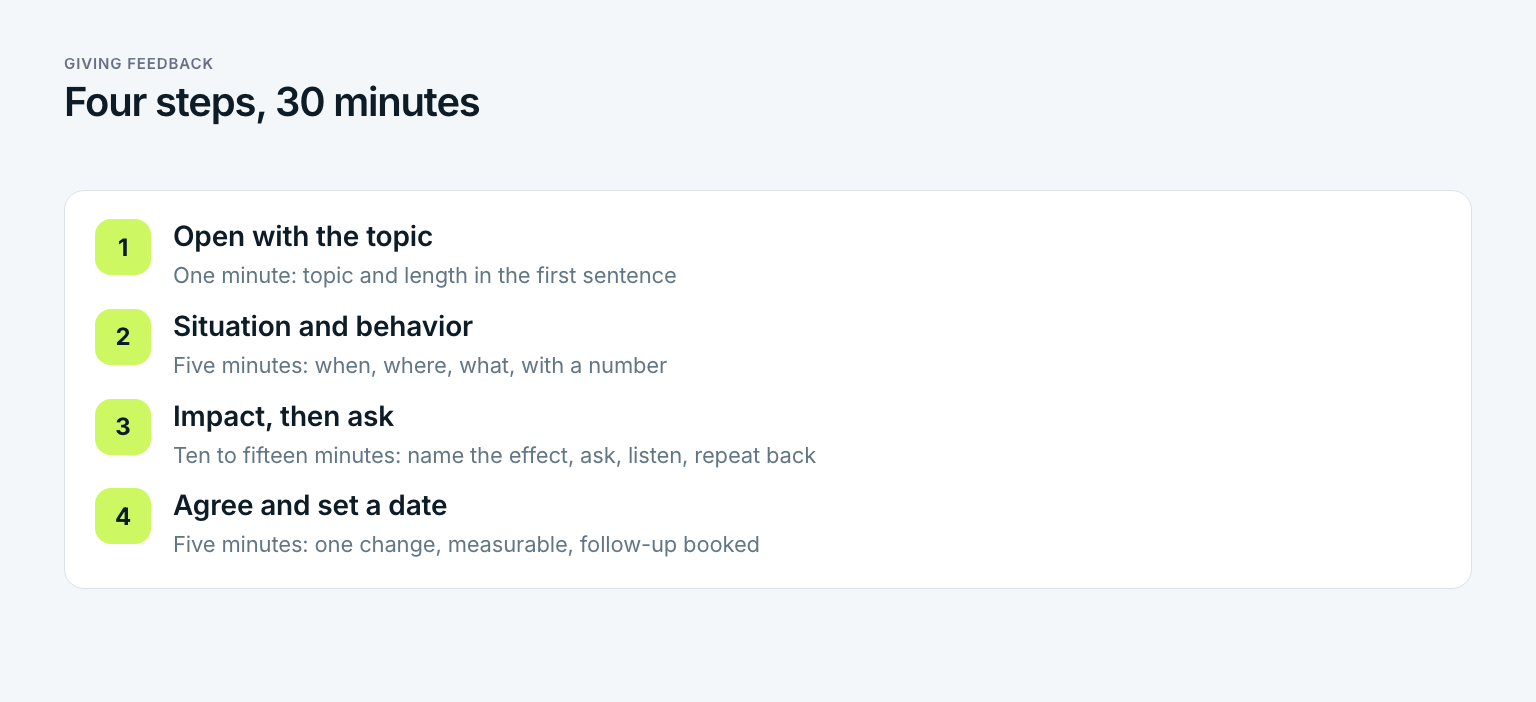
How do you give feedback to employees so that something actually changes? With a fixed order that you keep for every topic. The order protects both sides. It keeps you from judging too early, and it keeps the employee from defending against something you have not said yet. One topic takes 20 to 30 minutes.
Open with the topic, one minute
Say what this is about and how long it will take in your first sentence. No small talk as padding, no compliment as a warm-up. Anyone who circles the topic for ten minutes builds the exact tension they wanted to avoid.
Describe the situation and the behavior, five minutes
When and where, then what the person did, with a number if you have one. Use I-statements: “I looked at all eleven no-shows from September.” No adjectives about the person, no guesses about motives.
Name the impact, then ask, ten to fifteen minutes
Say what the behavior caused for a customer, a colleague, or a goal. Then ask one open question and listen to the full answer without jumping in. Repeat back what you heard before you respond. This is where you learn whether the problem sits with the person or with the system.
Agree on one change and a date, five minutes
Agree on exactly one change you can both measure, and put the follow-up on the calendar before you leave the room. Ask the employee to say the agreement in their own words. Whatever they cannot repeat was not agreed.
The example: Dana and Luis on a Tuesday at 10 a.m.
Dana opens without a detour: “I want to talk about demo no-shows. I have 30 minutes, and at the end I want us to agree on one thing.” Then the behavior: 26 demos booked in September, 15 held, a show rate of 58 percent against a team average of 81. Nine of the eleven no-shows had no confirmation, and eight were booked more than two weeks out. Then the impact: more than eight hours of account executive time lost, and the team's fourth-quarter goal, an 80 percent show rate, is out of reach if one of six reps sits at 58.
Then she asks: “What does a good week look like to you?” Luis does not hesitate. “Booked demos. That's what the leaderboard shows, and that's what the $25 bonus pays for.” That is the moment the conversation turns, and it turns the right way. The bonus pays for booked demos, not held ones. Dana set it up that way in January. Luis optimized exactly what she paid him to optimize.
The agreement is easy after that, and it has two sides. Luis books demos no more than seven days out and confirms each one the day before, by email with the invite and by text message. Dana switches the bonus to held demos starting October 1, for all six reps. The October goal for Luis: a show rate above 70 percent. The follow-up is in four weeks and takes 15 minutes. And the praise for the subject line test? Dana gave it on Monday in the team meeting, with the numbers. It does not belong in this conversation, where it would read as padding.
Length: 24 minutes. Result: one behavior, one number, one date. And one finding Dana did not expect, which was her own part in it. Whoever really listens in a feedback conversation almost always gets feedback back.

How to prepare in ten minutes: a one-page template
Preparing for feedback does not mean writing a script. It means answering a handful of questions in writing before you send the invite. Ten minutes is enough when the numbers are already in front of you. Without numbers you do not need more time. You need a different trigger.
| Field | Question | Dana's notes before talking to Luis |
|---|---|---|
| Situation | When and where did it happen? | September, all demos booked by Luis, CRM data |
| Behavior | What exactly did the person do, with a number? | Books demos 16 days out on average, confirmed 4 of 26 |
| Impact | Who does it affect, and which goal? | Eleven no-shows, over eight hours of account executive time, Q4 goal of an 80 percent show rate |
| Request | What should happen instead, in one sentence? | Book within seven days and confirm every demo the day before |
| Open question | What do I not know, and how will I ask? | Why does he book so far out? Ask: What does a good week look like to you? |
| Positive | What is going well and deserves its own moment? | Subject line test, reply rate from 4 to 7 percent, praise on Monday in the team meeting |
| Setting | When, where, how long? | Tuesday 10 a.m., small conference room, 30 minutes, one on one |
| Follow-up | When will we look at the result? | Tuesday in four weeks, 15 minutes, October numbers |
The open question row matters most and gets skipped most. Whoever walks in with a finished explanation only listens for agreement. Whoever walks in with a real question finds out why the behavior made sense to the other person. And it almost always made sense, otherwise they would not have done it.
Keep the invite short and name the topic. “I'd like 30 minutes on Tuesday to talk about demo no-shows” is fair. “Can we talk?” is not, because it leaves the employee alone with the worst case for two days. In short: the topic goes in the invite, the observation goes in the conversation, and the agreement goes in writing.
Constructive feedback examples: twelve situations, said well
What are good examples of constructive feedback? They all share one shape: a situation, a behavior, an impact, and a request or a question. The table shows twelve common situations, the sentence most managers reach for first, and a version that gives the employee something to act on. Swap in your own numbers.
| Situation | Instead of | Say |
|---|---|---|
| Missed deadline | “You're always late with this.” | “The report was due Monday and came Wednesday, so the client call ran without numbers. If a deadline is at risk, flag it two days before.” |
| Talking over others | “You talk over people.” | “In Tuesday's standup you finished Maya's sentence twice, and she stopped sharing after that. Let her finish and ask one question instead.” |
| Repeated errors | “Your work is careless.” | “Three of the last five invoices had the wrong PO number, and accounting sent all three back. Before you send, check the PO against the order.” |
| Long emails | “Your emails are way too long.” | “Your update yesterday ran 900 words, and the decision was in the last paragraph. Put the ask in the first line next time.” |
| Not speaking up | “You need to be more confident.” | “In the planning meeting you had the right numbers and shared them afterward. Bring them in the first ten minutes, and I'll ask you directly.” |
| Missing handoffs | “You don't communicate.” | “Twice this month the night shift started without your handoff notes and spent 30 minutes rebuilding orders. Send the notes before you clock out.” |
| Tone with a client | “You were rude.” | “On the Carter call you said that's not my job, and the client escalated to their VP. Next time, say who will handle it and by when.” |
| Overcommitting | “You take on too much.” | “You said yes to four projects this quarter, and two are behind. Before you accept the next one, let's look at the list together.” |
| Micromanaging, for a team lead | “You micromanage.” | “You reviewed all 46 pull requests this month yourself, and merges slowed by two days. Pick two people who can approve without you.” |
| Late to meetings | “You're never on time.” | “You joined the last three client calls five minutes late, and the client mentioned it Thursday. Can you block ten minutes before each call?” |
| Wrong priorities | “You're not focused.” | “You spent most of last week on the dashboard redesign, which is not a goal this quarter. The onboarding fix is. What pulled you toward the dashboard?” |
| Negativity in meetings | “Your attitude is a problem.” | “In the last two retros you said this won't work to three ideas, with no alternative. When you disagree, bring one other option.” |
Notice what the right column never contains: adjectives about the person. “Careless,” “rude,” and “unfocused” are verdicts. A verdict invites a defense. A number invites a fix. Anyone who catches themselves reaching for an adjective has not finished preparing yet.
Employee feedback examples: positive feedback that names what to repeat
Praise fails at the same spot as criticism: it is too vague to act on. “Great job” feels good for a minute, but it does not say what to keep doing. Positive feedback follows the same shape, and the request becomes: more of exactly this. Here are eight employee feedback examples you can adapt.
- “Your subject line test lifted our reply rate from 4 to 7 percent, and the whole team uses it now. Run one more test in October.”
- “You walked the new hire through the CRM without being asked. She logged her first demo in week two. That is exactly how I want onboarding to look.”
- “In Thursday's pricing call you raised the budget question before the client did. Do that again in next week's renewal.”
- “Your summary after the outage was out within an hour, with three next steps. Nobody had to ask twice.”
- “You pushed back on the launch date with data, not with a complaint. We moved it by a week and shipped clean.”
- “You closed the loop with the customer who complained in May. She renewed for two years.”
- “Your weekly notes are short and start with the decision. I read them first every Monday.”
- “You said no to the side project and kept the onboarding fix on track. That was the right call, and I noticed.”
Two rules keep praise useful. Give it the same day, while the person still remembers what they did. And keep it separate from criticism, so it does not become the opening act for a “but.” That means: praise that arrives on its own is believed, and praise that arrives right before bad news is discounted.
What not to say when giving feedback
Some sentences sound harmless and still wreck the conversation. Each line below has a reason it backfires and a better option to use instead.
| Don't say | Why it backfires | Say instead |
|---|---|---|
| “You always …” or “You never …” | Invites a single counterexample, and the talk turns into a debate | “Three times in the last two weeks …” |
| “Everyone on the team thinks …” | Anonymous witnesses feel like an ambush | “I noticed …” |
| “Great job, but …” | The “but” erases the first half | Give praise and criticism separately |
| “Why would you do that?” | Sounds like an interrogation | “What was important to you there?” |
| “Don't take this personally.” | Announces that it is personal | Describe the behavior and skip the disclaimer |
| “You're just like Sam.” | Comparison shames and changes nothing | Talk about this person's behavior only |
| “This is a small thing, but …” | Shrinks the topic, so nothing changes | Name the impact, then decide if it is worth a talk |
| “We need to talk.” | Leaves the person guessing for days | Name the topic and the length in the invite |
The common thread is easy to spot. Every bad line either judges, generalizes, or hides the point. Every good line describes something both of you can check. Is there a line in the left column you used last month?
The three mistakes nobody notices
Most feedback does not fail because of bad intent. It fails because of well-meant habits, and none of these three feels like a mistake in the moment. Which one is yours? The most common one gets its own box, the other two follow below.
The most common mistake: the feedback sandwich
The sandwich puts criticism between two slices of praise. The intent is kind, because nobody wants to hurt anyone. The problem shows up by the third conversation: the employee hears the first compliment and waits for the “but.” The praise loses its value, and the criticism still lands, only blurrier. Kim Scott calls this pattern ruinous empathy in Radical Candor, published in 2017. Separate the two: praise when it is due, criticism in its own conversation.
- Saving it up. Collecting observations for the annual review feels thorough. To the employee it feels like an ambush, because they never had a chance to change anything. Any observation older than four weeks has missed its feedback conversation.
- No follow-up date. The talk went well, both of you leave relieved, and four weeks later nobody remembers exactly what was agreed. An agreement without a date is a wish. The follow-up takes 15 minutes and goes on the calendar before you leave the room.
One more pattern deserves a name, even though it is not a mistake in the conversation itself. Some behavior is not a character trait. It is a reasonable answer to what gets measured and paid. Luis did not book far out because he was careless. He did it because the bonus paid for bookings. Anyone who fixes only the person and not the incentive will have the same conversation in three months with the next rep.
From feedback to goals: year, quarter, month, week, day
A feedback conversation ends with an agreement. Whether it holds is decided in the four weeks that follow, not in the room. For that, the agreement has to land where the work happens, in the week and the day. And it has to hang from something bigger than the conversation.
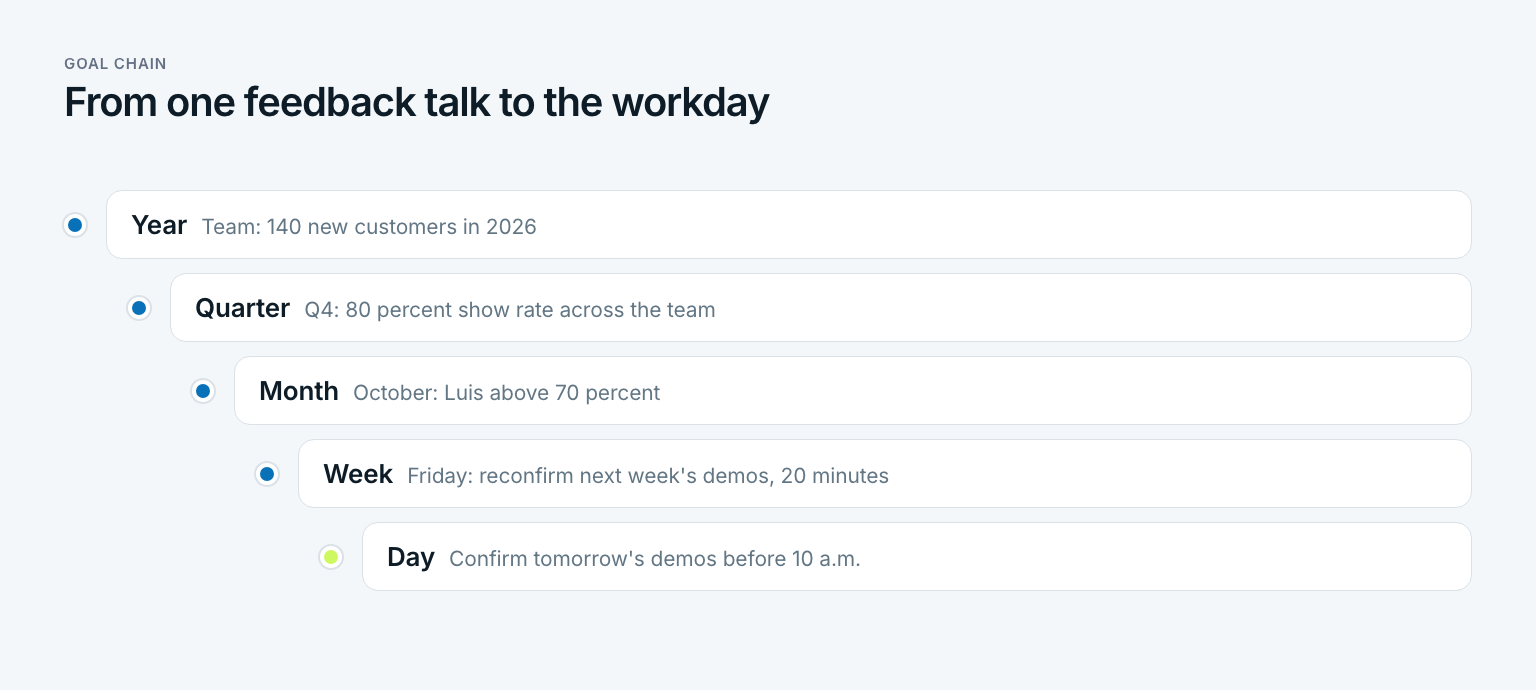
For Dana and Luis the chain looks like this. The team's goal for 2026: 140 new customers. The fourth-quarter goal: an 80 percent show rate across the team. Luis's October goal: a show rate above 70 percent. His weekly goal: every Friday, check next week's demos and reconfirm any booked more than seven days ago, 20 minutes. His daily goal: send confirmations for tomorrow's demos before 10 a.m.
Did it work? At the follow-up in late October, Luis had booked 22 demos and held 16, a 73 percent show rate, just above his monthly goal. In November he held 18 of 22, or 82 percent. He books fewer demos than before and holds more of them, and the account executives got back more than five of the eight lost hours. That means: the feedback did not slow Luis down. It pointed his speed at the number that pays.
Without the chain it would have gone differently. The agreement would have lived in a note, and nobody reads notes between meetings. With the chain, the daily step sits where Luis looks every morning. For how to phrase a step so it can be checked off at night, see the guide to daily goals. For how to turn a monthly goal into a number with a date, the SMART goals examples show the pattern.
In Gaapp those five levels are the core: every goal hangs from a bigger one, and progress per period is the share of goals done. Dana and Luis share a space where both see the same status, as described in shared goals in a space. The follow-up then starts with a number instead of “so, how's it going?” If you want the method behind the chain from the ground up, read how to achieve goals.
Three questions about your last feedback conversation:
- Could you back up the observation with a number or a date?
- Did you ask a question you did not already know the answer to?
- Is the follow-up on the calendar, and do you know which number you will look at?
Anyone who answers no to one of them was not too harsh or too soft, just too vague. In short: feedback to employees is not a verdict on what happened. It is an agreement about what happens next.
Frequently asked questions about giving feedback to employees
What are the five R's of feedback?
There is no single source for the five R's, and trainers list them differently. A version that fits the steps in this guide: right time, right place, relevant behavior, result named, request made. The first two are preparation, the middle two are the observation and its impact, and the last one is the agreement.
What are some examples of positive feedback for an employee?
Good positive feedback names a specific action and its result, for example: “Your subject line test lifted our reply rate from 4 to 7 percent, and the whole team uses it now.” Or: “You walked the new hire through the CRM without being asked, and she logged her first demo in week two.” Both tell the person exactly what to repeat.
What not to say when giving feedback?
Avoid always and never, anonymous claims like everyone thinks, the word but right after praise, and why would you do that. Also skip don't take this personally, which signals that it is personal. Describe the behavior, name the impact, and ask a question instead.
What are good examples of constructive feedback?
Constructive feedback describes a situation, a behavior, and its impact, then makes a request. For example: “Three of the last five invoices had the wrong PO number, and accounting sent all three back. Before you send, check the PO against the order.” It contains a number and a next step, never an adjective about the person.
How often should you give feedback to employees?
Give constructive feedback within a week of the event and positive feedback the same day. As a baseline, every employee should get at least one piece of goal-linked feedback a month, usually inside a weekly one-on-one. Book a separate conversation when a topic needs more than five minutes.
Should feedback be given in person or in writing?
Give constructive feedback in person or on a video call, so you can hear the other side and agree on a change together. Then send a short written note with the agreement and the follow-up date. Positive feedback works in writing too, as long as it is specific.
Last updated: 19 October 2026
Read next
 Leadership & Teams
Leadership Styles: Which One Fits Which Situation
Leadership styles are not personality types: 11 types compared, Lewin, Goleman, situational leadership and five steps to find the style that fits you.
14 min read
 Leadership & Teams
Retrospective: How Teams Learn From Every Sprint
A retrospective is not a blame session: what the word means, five phases, seven retrospective examples and action items that stick, shown on one team.
16 min read
 Leadership & Teams
How to Delegate Tasks: Hand Off Work, Keep Results
Delegation is not dumping work: five levels of delegation, seven steps, a handoff script and what to keep, shown on one marketing team.
15 min read