Performance Management: What It Is and How to Run It
Performance management is not an annual review form. It is a cycle: five stages, a monthly rhythm, a one-page plan, worked through at a 54-person company.

Contents
- 01What is performance management, and what is it not
- 02Performance management vs. performance appraisal: what each is built for
- 03What actually happens in most small businesses: the December ritual
- 04The performance management process in five stages
- 05A performance management system on one page
- 06When performance falls short: diagnose before you act
- 07Three mistakes nobody notices
- 08Performance management in the goal chain: from year to day
- 09Frequently asked questions about performance management
Performance management is not a form you fill out once a year but the ongoing process by which a manager sets goals with each employee, follows progress through the year, rates results against evidence, and turns that rating into development and decisions. The annual form records what happened. Performance management steers what happens next, and it lives in the weeks when the work gets done, not in the last two weeks of December.
For a small business, that can sound like something built for corporations with an HR department and a software budget. It does not have to be. This guide follows Dana, 41, general manager of a family-owned heating and air conditioning company in Columbus, Ohio, with 54 employees and four team leads. Until last year, her performance management system was one meeting in December and a form with ten rated competencies. Today it is three goals per team, a rhythm of monthly, quarterly, and annual conversations, and one page per employee. Along the way you get the five stages of the performance management process, a one-page template, a way to handle underperformance, and the three mistakes nobody notices.
What is performance management, and what is it not
Performance management has four fixed parts: goals that come from the goals of the business, conversations on a fixed rhythm, a rating based on evidence, and decisions that follow from the rating. Take away any one of the four and the whole thing tips over. Without goals, the rating becomes a gut feeling. Without a rhythm, the goal becomes a memory of last January. Without decisions, everyone figures out by year two that the effort changes nothing.
The annual review is not useless. It creates a record, it forces a conversation that might otherwise never happen, and it gives you a basis for raises and promotions. It is just built for something else: for documenting, not for steering. Anyone who looks at performance once a year sees it too late to change it. If the form asks for a self rating, employee self evaluation comments with numbers and dates give the review its first piece of evidence.
How much time pure documenting can eat was made public by Deloitte in 2015. Marcus Buckingham and Ashley Goodall wrote in Harvard Business Review that the firm's annual review process consumed close to two million hours a year, mostly on forms, rating meetings, and ratings. Deloitte replaced much of it with shorter, more frequent check-ins. A company of 54 people works on a different scale. The ratio is often the same, though: lots of time on the score, very little on what happens after it.
Performance management vs. performance appraisal: what each is built for
What does performance even mean here? Performance has two sides: the result, meaning what someone achieves, and the behavior, meaning how they achieve it. A technician who closes five calls a day and leaves every third customer annoyed has a strong result and weak behavior. Good performance management sees both. That is why every goal in it has a number and one sentence about how the number should come about.
Several terms sit close to performance management and get mixed up all the time. None of them is wrong. Each one is built for a different job:
| Term | What it is | How often | Who runs it | Built for |
|---|---|---|---|---|
| Performance appraisal or performance review | A rating of one employee's work over a period, usually with a form and a scale | Once or twice a year | The manager, often with HR | Documenting, a basis for pay and promotion |
| Performance management | The whole cycle of goals, follow-up, rating, and development | Ongoing, with fixed dates each month, quarter, and year | Every manager for their own team | Steering while there is still time to change the outcome |
| Performance management system | The tools and rules that carry the cycle: templates, calendar, software, rating rules | Set up once, reviewed yearly | The owner or HR, with the team leads | Making the cycle repeatable across teams |
| One-on-one meeting | A short, private conversation between a manager and one report | Weekly or every two weeks | The report sets the agenda | Trust, coaching, early warning |
The appraisal is one part of performance management, not a replacement for it. The performance management system is the scaffolding that keeps the cycle running when things get busy. And the one-on-one is the smallest unit of the whole thing, the place where problems show up first. That means: if your company has an appraisal form but no rhythm around it, you have a record, not a system. If you are building the form, start with a performance review template that names criteria, a rating scale and a reason for every rating.
What actually happens in most small businesses: the December ritual
At Dana's company, it worked the way it works in a lot of small businesses. In November, she sent out a form with ten competencies, from technical skill to reliability to teamwork, each rated from one to five. In December, she and her four team leads held 53 reviews of 45 minutes each. With an hour of preparation per review, that came to 93 hours, more than two full work weeks of management time.
The result looked tidy. The average rating across the company was 3.8. Out of 53 employees, 44 landed between 3.5 and 4.5. Only when Dana put the forms next to the numbers from the business did the picture change:
| What the forms showed | What the business showed |
|---|---|
| Service technicians averaged 4.0, with 4.2 for quality of work | Callback rate of 9 percent, meaning nearly one in ten customers needed a second visit for the same problem within 30 days |
| Dispatch and customer care averaged 4.1 | During the July heat wave, a nonemergency service call waited 2.6 days on average |
| One senior technician rated 4.6, the highest score in the company | He left for a competitor in March. In his exit interview he said nobody had ever told him what his next step could be |
| Goals for next year written on 49 of 53 forms | By February, none of the four team leads could name their team's goals from memory |
No part of this process was done badly. The forms were filled in, the meetings happened, the goals were on paper. What was missing was the link between the score and the business. How does a team rated 4.2 for quality of work send a technician back to the same house nearly one time in ten? Simple: nobody measured the score against callbacks. They measured it against an impression from December.
That means: the problem is neither the scale nor the form. It is that performance was rated once a year and never steered in between. Whoever looks only in December is rating a year they can no longer change.
The performance management process in five stages
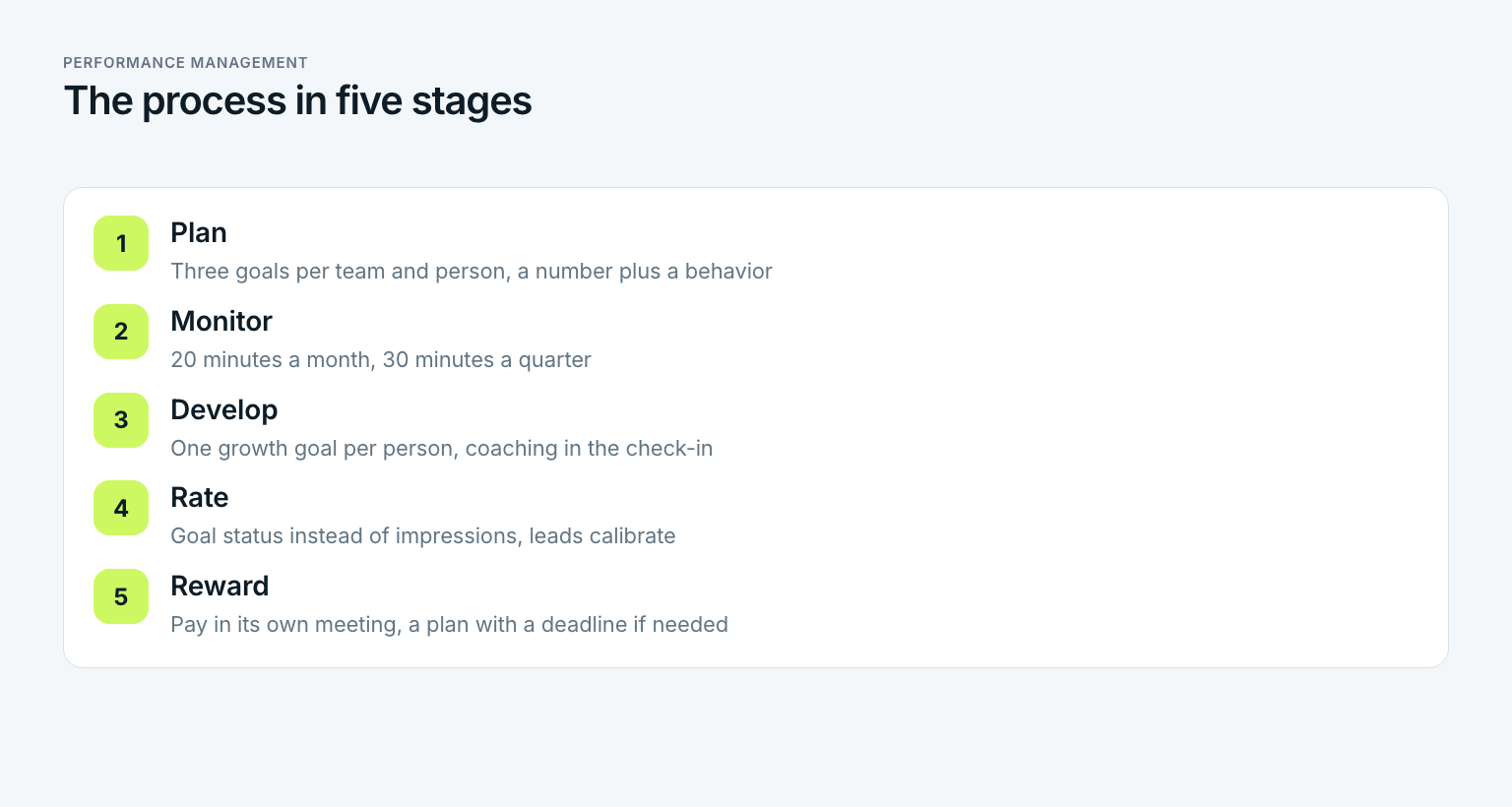
A performance management process for a small business does not need a handbook or an HR department. It needs five stages that run the same way every year, and a rhythm to hold them. The US Office of Personnel Management describes the cycle as planning, monitoring, developing, rating, and rewarding, and that sequence works just as well for 54 people as for a federal agency. Here is how Dana set it up in January:
Plan
The owner sets three annual goals for the business, each with a number. Each team lead turns them into no more than three team goals, and each employee gets no more than three of their own. Every goal has a number for the result and one sentence for the behavior. Anyone who hands out more than three goals is really handing out tasks.
Monitor
Twenty minutes per employee every month, 30 minutes every quarter. The question is always the same: Where is the goal, and what is holding it back? The team lead listens, clears obstacles, and writes down the status in one sentence.
Develop
Every employee gets one development goal next to their performance goals: a certification, a new responsibility, a skill. Coaching happens in the monthly check-in, not in a separate program. Whoever only sets performance goals ends up with a team that delivers this year and leaves next year.
Rate
At year end, you rate the status of the goals quarter by quarter, not the impression. Before the reviews, the team leads compare their ratings side by side so that a four on the install crew means the same as a four in service. This is called calibration, and at Dana's company it takes two hours a year.
Reward
Decisions follow from the rating: a raise discussed in its own meeting, recognition, a promotion path, and for sustained underperformance a clear plan with a deadline. Anyone who rates and then decides nothing teaches the team that the rating does not matter.
The rhythm that fits a small business
The most common objection to this process is time. It is a fair objection, so do the math. Here is what the rhythm costs per employee per year:
| Format | How often | Length | The one question | Time per employee per year |
|---|---|---|---|---|
| Monthly check-in | Eight times, in the months without another meeting | 20 minutes | Where is your goal, and what is holding it back? | 160 minutes |
| Quarterly review | Three times, in April, July, and October | 30 minutes | Do the goals still hold, or do we adjust them? | 90 minutes |
| Annual review | Once, in January | 60 minutes | What did we achieve, and what matters next year? | 60 minutes |
| Pay conversation | Once, in May, separate from the rating | 30 minutes | What does the year mean for pay and role? | 30 minutes |
Together that is just under six hours per employee per year, a little more than three times what the December ritual took. For Marcus, 35, who leads Dana's 14 service technicians, it adds up to about 79 hours a year, or well under two hours per work week. Is that a lot? Andrew Grove, who ran Intel, wrote in High Output Management in 1983 that a manager's output is the output of their team. Measured that way, two hours a week for 14 people is not overhead. It is the job.
Example: Marcus and the first quarter
Dana's goal for the service side was simple: more completed calls per technician per day, from 3.6 to 4.2, so customers would stop waiting three days in peak season. Marcus made it his team goal in January and broke it down with each technician. Six weeks later, the team was at 4.4 calls per day. It looked like a clean win.
In the monthly check-in at the end of February, Marcus noticed a second number. The callback rate, the share of customers who needed a second visit for the same problem within 30 days, had climbed from 9 to 13 percent. The technicians were closing calls faster, but more of them were leaving before the system had run through a full cycle. Customers were no longer waiting for the first visit. They were waiting for the second.
Grove recommended paired indicators for exactly this case: for every measure of quantity or speed, a measure of quality, so that one cannot rise at the expense of the other. Marcus rewrote the goal in March: 4.2 calls per technician per day with a callback rate under 6 percent. By the end of June, the team stood at 4.1 calls and 7 percent, on track for the year. Without the monthly check-in, Dana would have seen the 13 percent in December, as an average in a year-end report, and nobody would have remembered where it came from.

A performance management system on one page
What the ten-competency form was missing fits on one page. The plan has seven fields, and it belongs to both the employee and the manager. The third column shows the entries of Priya, 29, in her third year as a service technician on Marcus's team, so you can see how short an entry can be.
| Field | Question | Example: Priya |
|---|---|---|
| Company goal | Which goal of the business does my work feed? | Service customers get a working system on the first visit, within one day in peak season |
| Result goal | Which number do I want to reach by year end? | 4.0 completed calls per day on average |
| Paired measure | Which number must not get worse while I do it? | Callback rate under 6 percent |
| Behavior | How should the result come about? | Every visit ends with a full test cycle and a two-minute explanation for the customer |
| Team contribution | What do I build that helps others too? | A truck stock list for the 30 parts that cause the most second trips, done by the end of May |
| Development goal | What do I want to learn or take on this year? | NATE certification in heat pumps by September, then the go-to technician for heat pump calls |
| Status per quarter | Where am I, in one sentence? | Q1: 3.8 calls, 10 percent, list covers twelve parts. Q2: 4.1 calls, 6 percent, list done |
The plan is written in the annual review and opened in every monthly check-in, not just in December. Priya fills in the last row herself before each quarterly review. Whoever writes down their own status walks into the meeting with a number, not a feeling. And a manager who has the same page in front of them talks about causes instead of impressions.
Where the goals come from decides how good the page is. A result goal without a number is a wish, and a number without a date is a hope. The SMART goals examples show how to write both cleanly. If your company prefers objectives and key results, the OKR framework gives you the structure, because a result goal with a paired measure is, at its core, an objective with two key results. When a role has no obvious number, the employee goals examples show how to write a goal that still holds up in December.
Performance goals and development goals
A performance goal describes a result for the business: calls per day, callback rate, revenue. A development goal describes a skill or role for the person: a certification, a new responsibility, a position. A performance management system needs both, or it tips over. Only performance goals turn the plan into a quota sheet. Only development goals turn it into a wish list. Priya's certification is what makes her two numbers feel like a path and not a demand.
When performance falls short: diagnose before you act
Every performance management process eventually meets someone who keeps missing their goals. The reflex is understandable: more pressure, a formal warning, and if that fails, a parting of ways. In a company of 54 people, that is expensive, and it often hits the wrong person. Weak performance has three possible causes, and only one of them sits with the employee alone:
- Can. The employee does not know how to do it, or never really learned. The answer is training, a ride-along with a senior colleague, or a clearer checklist, not a warning.
- Context. The tool is missing, the process jams, or two goals contradict each other. Anyone who is told to finish more calls and also to run every system through a full test cycle will miss one of the two, unless someone says which one wins.
- Will. The employee can do it, has everything they need, and still does not. Only here is it a management problem in the narrow sense, and only here do clear expectations with a deadline belong on the table.
At Dana's company, one install crew had been running a full day behind schedule on almost every job for months. The crew lead blamed effort. In the monthly check-in, it turned out that since the supplier had changed, the crew's ductwork arrived the morning of the job instead of the day before, so they spent the first three hours waiting and fitting. Not will, but context. After one phone call to the supplier, the crew was back on schedule within a month. How many of your so-called low performers are really the victims of a process nobody looked at?
If it really is will, you need a plan with three parts: a written expectation with a number, a deadline of usually 30 to 90 days, and fixed dates on which you check the status together. Many US companies call this a performance improvement plan. Write down a short summary of every meeting. Before any step toward termination, bring in an HR advisor or an employment attorney, because a documented, fair process protects the employee and the company. In short: diagnose first, then decide, never the other way around.
Three mistakes nobody notices
Most performance management mistakes feel like thoroughness in the moment. They only show up when a year has passed and nothing has changed. Which one is hiding in your process?
- The December effect. Whoever rates once a year is really rating the last eight weeks. What went well in March is forgotten by December, and what went wrong in November is on the form. Psychologists call this the recency effect. The fix is not a better memory but one sentence of notes per monthly check-in, which you simply lay side by side at the annual review.
- Pay in the same meeting. The moment money is on the table, nobody listens to the development part. The employee defends the score because it means money, and the manager justifies it for the same reason. Keep the two conversations at least four weeks apart. Daniel Pink collected the research in Drive in 2009 on why “if you do this, you get that” rewards work for routine tasks and often backfire on work that requires thinking.
- The scale as the goal. Ten competencies rated one to five look like measurement. They measure impressions, and in the end 44 of 53 people land between 3.5 and 4.5. A scale on which almost everyone crowds the middle tells you nothing. Three goals with numbers tell you more than ten competencies with scores.
The most common mistake: measuring what is easy to count
The economist Charles Goodhart observed in 1975 that a measure loses its value as a signal once it becomes a target. Marcus's team lived through it in February: calls per day went up because visits got shorter, not better. This happens to every team that chases a single number, because people optimize for whatever is being watched. The fix is the paired measure: for every number about speed or volume, one number about quality. Anyone who measures only one number gets exactly that number and nothing else.
Performance management in the goal chain: from year to day
An annual goal from your performance management process is far away in January and forgotten by June unless it finds its way into the week. Edwin Locke and Gary Latham showed in their goal-setting theory in 1990 that specific, challenging goals lead to higher performance than being told to do your best. But a goal only becomes specific at the level where the work happens. The broader method is laid out in how to achieve goals. For a business, it means a chain: year, quarter, month, week, day. Here is the chain for Marcus's team goal:
| Level | Goal | When it gets checked |
|---|---|---|
| Year | 4.2 completed calls per technician per day with a callback rate under 6 percent | Annual review in January |
| Quarter | Q1: 4.2 calls. Q2: callbacks under 8 percent. Q3: under 7 percent through the summer peak. Q4: under 6 percent | Quarterly review, 30 minutes |
| Month | July: every truck carries the new stock list, so no call ends with a parts run | Monthly check-in, 20 minutes |
| Week | Restock all 14 trucks against the list on Friday afternoon | The team's weekly review on Friday, ten minutes |
| Day | Each technician runs a full test cycle before leaving every job | A quick look at the day's callback flags at 5 p.m. |
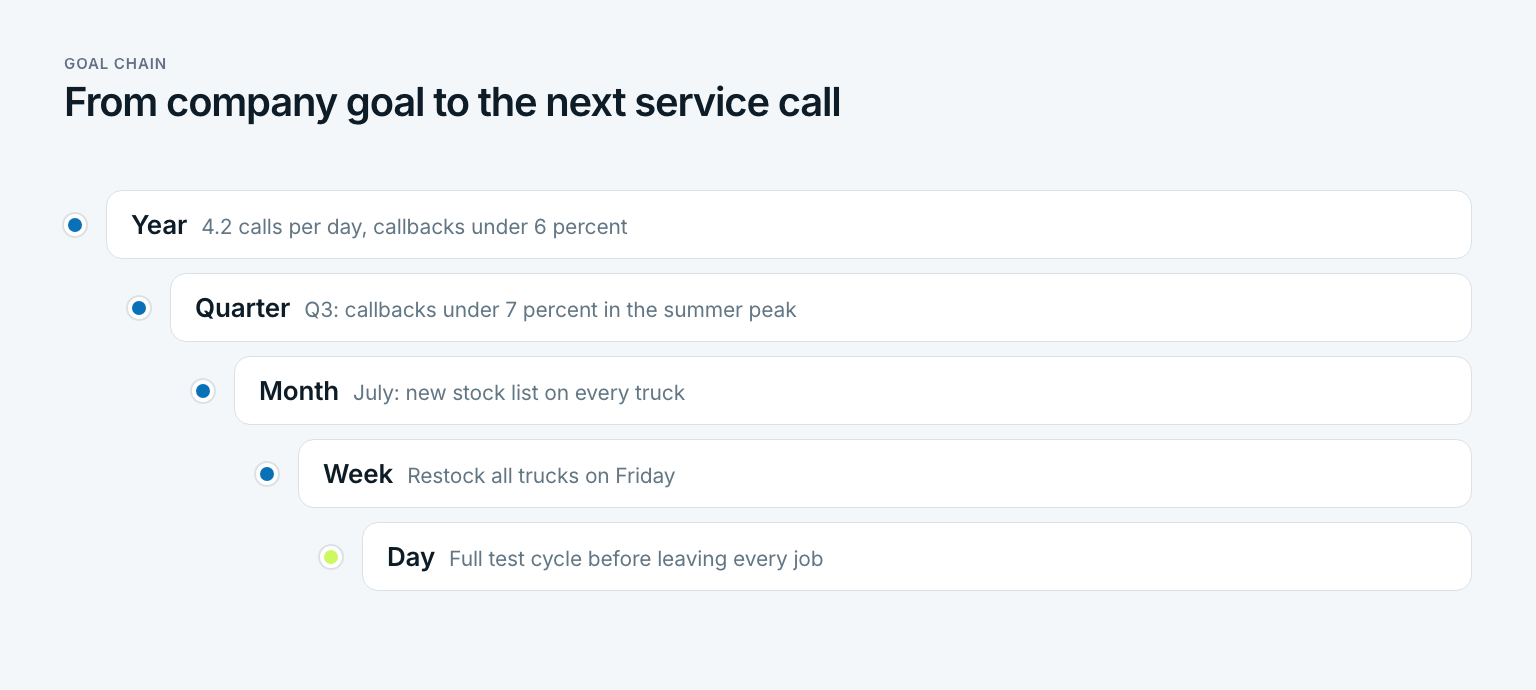
The chain splits the responsibility. The year and the quarter belong to Dana and Marcus together, the month is the conversation between Marcus and his team, and the week and the day belong to the technicians. Whoever manages down at the daily level as a team lead has not agreed on goals but handed out tasks. Whoever never sees the week finds out at the quarterly review, far too late, that the trucks have been missing parts since June. How a team uses Friday for this is shown in the ten-minute weekly review.
For the chain not to fall apart into five spreadsheets, it needs one place that everyone can see. In Gaapp, this chain is the core: five levels from year to day, progress per level is the share of goals completed, and a team shares its goals in a common space. What that looks like for a whole team is described in shared goals in a space. And if the company goals themselves are not set yet, start with annual planning, because a team goal with no company goal above it has nothing to feed.
Three questions to finish, about your own performance management:
- Can everyone on your team name their three goals from memory, with a number?
- Do you know where each goal stands today, and not just where it stood last December?
- Does every number you track have a second number watching that it does not rise at the expense of quality?
If you answer no to any of the three, you do not need a better form. You need less distance between the goal and the conversation. Dana did not improve her ten-competency form. She replaced it with one page and a rhythm. In short: performance management is not a score at the end of the year but the conversation that turns December into a formality.
Frequently asked questions about performance management
What are the 5 elements of performance management?
Most frameworks agree on five building blocks: clear goals tied to the business, measures for both results and behavior, regular feedback through check-ins, development for each employee, and consequences such as raises, promotions, or an improvement plan. If one of the five is missing, the process turns into either paperwork or pressure. Small businesses can run all five with a one-page plan and a monthly check-in.
What are the 5 C's of performance management?
There is no single official list of five C's, and different HR writers use different versions. Most of them come down to the same ideas: clarity about expectations, regular communication, coaching, consistency in how people are rated, and consequences that follow from the rating. If your process covers all five, the label matters less than the rhythm.
What does performance management mean?
Performance management means steering how well people do their work throughout the year, not just rating it at the end. It covers setting goals, following progress, giving feedback, rating results against evidence, and making decisions about development and pay. The term describes the whole cycle, while a performance review is only one meeting inside it.
What are the 5 stages of performance management?
The US Office of Personnel Management describes five stages: planning, monitoring, developing, rating, and rewarding. Planning sets goals and expectations, monitoring follows progress, developing builds skills, rating summarizes the year against evidence, and rewarding turns the rating into decisions. The stages repeat every year, and the rhythm between them is what makes the cycle work.
What is a performance management system?
A performance management system is the set of tools and rules that keeps the cycle running: a goal template, fixed meeting dates, rating rules, and often software that shows everyone the same status. In a small business it can start as one page per employee and recurring calendar entries. Software becomes worth it once goals connect across several teams.
How do you handle an underperforming employee?
Find the cause before you act: is it a skill gap, the context, or the will? Many cases are solved with training or a fixed process. If it is the will, agree on a written expectation with a number, a deadline of 30 to 90 days, and fixed check-in dates, and involve HR or an employment attorney before any step toward termination.
Last updated: 19 October 2026
Read next
 Leadership & Teams
Leadership Styles: Which One Fits Which Situation
Leadership styles are not personality types: 11 types compared, Lewin, Goleman, situational leadership and five steps to find the style that fits you.
14 min read
 Leadership & Teams
Retrospective: How Teams Learn From Every Sprint
A retrospective is not a blame session: what the word means, five phases, seven retrospective examples and action items that stick, shown on one team.
16 min read
 Leadership & Teams
How to Delegate Tasks: Hand Off Work, Keep Results
Delegation is not dumping work: five levels of delegation, seven steps, a handoff script and what to keep, shown on one marketing team.
15 min read