How to Stop Procrastinating: Start Smaller
How to stop procrastinating: procrastination is mood repair, not laziness. Four reasons, six steps, a worked week, and the goal chain that makes it stick.

Contents
- 01What procrastination is, and what it is not
- 02What really happens to your week: Jordan’s log
- 03Why people procrastinate: the four reasons behind the delay
- 04How to stop procrastinating in six steps
- 05Jordan’s second week: the same task, a smaller first step
- 06Procrastination, ADHD and anxiety: how to tell what you are dealing with
- 07Why your procrastination is getting worse
- 08How to avoid procrastination before it starts: the goal chain from year to day
- 09The three mistakes nobody notices
- 10Three questions before you close this tab
- 11Frequently asked questions about procrastination
Procrastination is not a time management problem. It is a feeling problem with a time management symptom, and that is why most advice on how to stop procrastinating fails: it hands you a better calendar when the thing you avoid is a feeling. Procrastination means putting off a task you intended to do, knowing you will be worse off for the delay, and doing it anyway. The way out is not more willpower. It is a next step so small that the feeling never gets a vote.
Three things you need for that: an honest picture of where the time goes, a first step that takes less than ten minutes, and a chain that connects that step to something you actually want. The picture comes from one logged week. The step comes from a rule you will read below. The chain runs from a yearly goal down to a single morning. All of it is worked through on Jordan, 31, a freelance illustrator in Denver who has put off building his portfolio website for five months, plus the three mistakes that keep capable people stuck and six answers to the questions people ask most.
What procrastination is, and what it is not
Procrastination is the voluntary delay of an intended action despite expecting to be worse off for the delay. That is the definition Piers Steel used in his 2007 meta-analysis in Psychological Bulletin, and every word in it is doing work. Voluntary: nobody is stopping you. Intended: you planned to do it. Expecting to be worse off: you know the cost. Whoever meets all three conditions is procrastinating. Whoever is simply too busy, or has decided the task does not matter, is not.
Laziness is a different thing. A lazy person does not want to do the task and feels fine about not doing it. A procrastinator wants to have done it, feels worse every hour it stays undone, and still does not start. That gap between wanting the result and avoiding the work is the whole problem. Tim Pychyl, who ran the Procrastination Research Group at Carleton University for two decades, calls procrastination a mood repair strategy: you are not managing your time, you are managing a feeling, and the fastest way to feel better right now is to not look at the task. It works for about an hour. Then the task is still there and the feeling is bigger.
Delay is not always procrastination either. Waiting for a client to answer before you write the proposal is sequencing. Moving your taxes from Tuesday to Saturday because Saturday is free is scheduling. Procrastination begins at the moment you have the time, the task and the intention, and you open something else instead. That means: the question is never why you are so lazy. The question is which feeling you are avoiding, and how to make the first step smaller than that feeling.
What really happens to your week: Jordan’s log
Jordan is 31, a freelance illustrator in Denver, and his portfolio site has been “next month” since May. The site matters. Right now he gets work through Instagram messages and takes $250 rush jobs because that is what shows up. A portfolio with written case studies would let him pitch $3,000 editorial projects. He knows this. He has known it for five months. Before changing anything, he did the one step that cannot be skipped: for a week he wrote down every time he touched the project, and what he did instead.
| Day | Opened the project | Minutes of real work | What happened instead |
|---|---|---|---|
| Monday | 2 times | 0 | Reorganized the fonts folder for 40 minutes |
| Tuesday | 1 time | 15 | Wrote one headline, rewrote it four times, closed the file |
| Wednesday | 0 times | 0 | Client revision took the afternoon, felt justified |
| Thursday | 3 times | 20 | Browsed other illustrators’ portfolios for 90 minutes |
| Friday | 2 times | 0 | Compared website builders, opened six tabs, closed six tabs |
| Saturday | 1 time | 0 | Decided to start fresh on Monday |
| Sunday | 0 times | 0 | Did not open it, felt bad about it at 11 pm |
Nine times opened, 35 minutes of work. Around four hours went into fonts, other people’s portfolios and website builders. Every one of those hours felt related to the project, and not one of them moved it. That is the signature of procrastination: activity that stays near the task without touching it. Without the log, Jordan would have told you he worked on the site this week. With the log, he can see that the week was an expensive way to avoid writing three case studies.
Why the case studies? Because that is where the log points. Every real minute, all 35 of them, went into the headline and the text. Every avoidance hour went into something visual or technical, the parts he is good at. The feeling he is avoiding is not that websites are boring. It is that writing about his own work makes him feel like a fraud. Whoever logs one week finds their own version of that sentence. It is almost never the one they expected.
Why people procrastinate: the four reasons behind the delay
People procrastinate for four reasons, and each one calls for a different fix. Steel’s 2007 analysis found two of the strongest predictors to be task aversiveness, how unpleasant the task feels, and delay of reward, how far away the payoff sits. Add two more that show up in almost every log: a fuzzy next step and a fear about the result. Most stuck tasks carry two of the four. Jordan’s carried three.
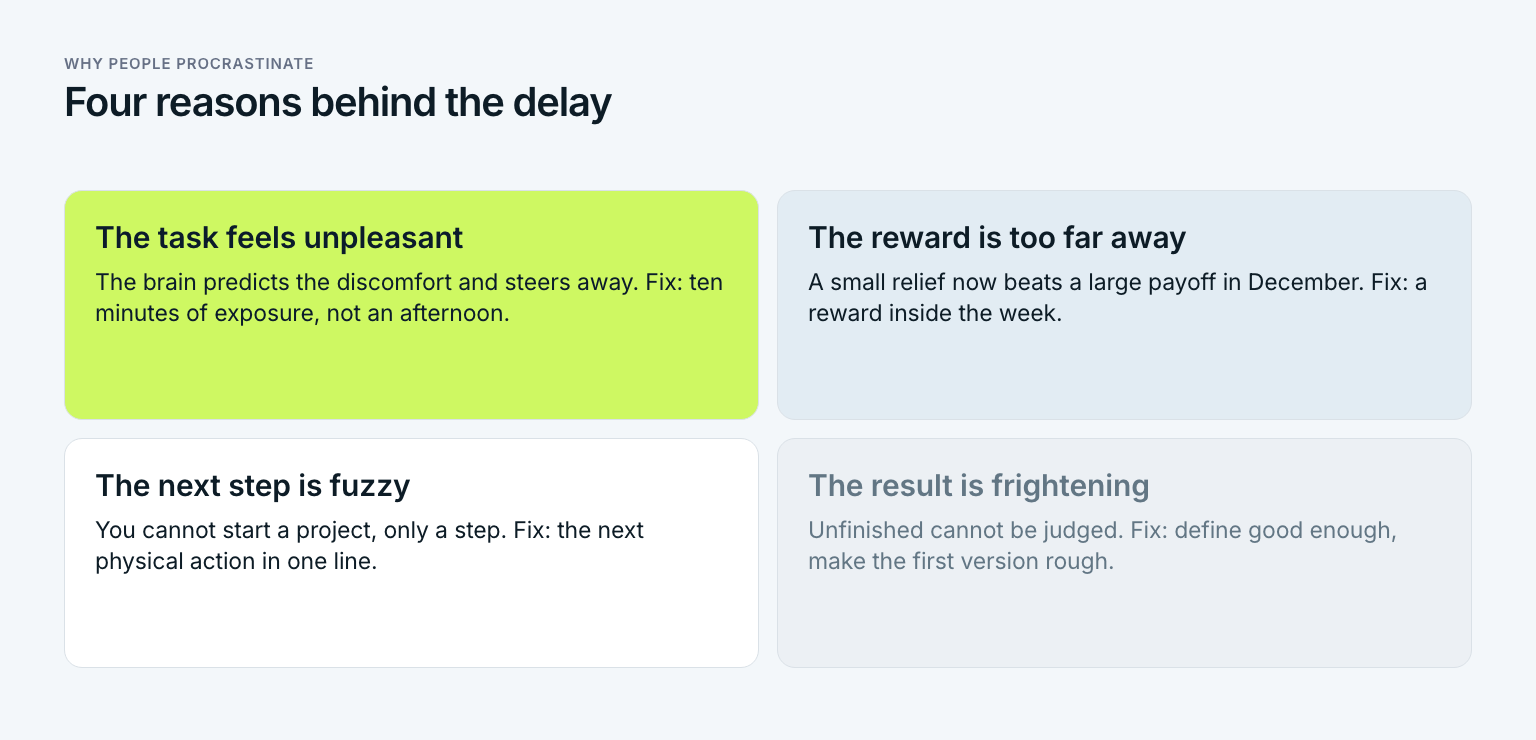
- The task feels unpleasant. Boring, tedious or emotionally uncomfortable. The brain predicts the feeling and steers away before you have consciously decided anything. Fix: shrink the exposure. Ten minutes of an unpleasant task is survivable. An afternoon is not.
- The reward is too far away. Jordan’s $3,000 projects are months out. The relief of closing the file is immediate. Steel’s temporal motivation theory describes exactly this: the value of a reward shrinks with distance, and a small reward now beats a large one later. Fix: put a reward inside the week, not at the end of the project.
- The next step is fuzzy. “Build the website” is not a step. It is a project with forty steps inside it. The mind cannot start a project, it can only start a step, and when the step is undefined it picks the nearest defined thing. That is why Jordan reorganized fonts. Fix: write the next physical action in one line.
- The result frightens you. A finished portfolio can be judged. An unfinished one cannot. For perfectionists this is the main engine: as long as it is not done, it is not yet a failure. Fix: define good enough in advance and make the first version deliberately rough.
That means: before you fight procrastination, name which of the four you are looking at. Whoever treats a fear problem with a timer gets a very precise record of not starting. Whoever treats a fuzzy-step problem with motivation videos has a clear head and still no first line.
How to stop procrastinating in six steps
The method has six steps and takes about 20 minutes to set up. It does not need an app, though it works better with one, and it does not require you to feel ready. Feeling ready is the one thing procrastinators wait for and the one thing that never shows up on its own. Action comes first. The feeling follows it, not the other way around.
Log one week, honestly
Every time you open the task, and every time you do something near it instead. No judgment, just the record. Jordan’s log took two minutes a day and produced the table above. You cannot fix a pattern you cannot see.
Name the feeling in one sentence
Look at what you did instead and ask what the real work would have made you feel. Jordan’s sentence: writing about my work makes me feel like a fraud. The sentence does not have to be flattering. It has to be true, because the fix is aimed at it.
Write the next physical action, under ten minutes
Not “write case study one”. Instead: open a blank document and type the client, the brief and the deadline for the Hartman book cover. If the step takes more than ten minutes, cut it in half. Then cut it again. The step is small enough when the thought of doing it produces no resistance at all.
Give it a slot before noon, with nothing ahead of it
Procrastination lives in the gap between “sometime today” and now. Close the gap: Tuesday, 9:00, first thing, 25 minutes, phone in another room. The slot does not need to be long. It needs to be first, because every task you put ahead of the hard one is another chance to never get to it.
Stop at the timer, mid-sentence if you have to
Set 25 minutes, work, stop when it rings, even if it is going well. Especially then. A task you left in the middle pulls you back the next day. Bluma Zeigarnik described that pull in 1927, and it is the cheapest motivation you will ever get. Whoever works until exhausted on day one teaches the brain that starting is expensive.
Count on Friday: how many slots did you show up for?
Not how much you finished. How many of the five first-slots did you actually sit down for? Three of five is a working system. Zero of five means the step is still too big or the slot is wrong. Adjust one thing, never both, and run the next week.
Six steps, none of them about willpower. The log makes the pattern visible, the sentence names the feeling, the tiny step gets underneath it, the slot removes the daily decision, the timer makes stopping safe, and the Friday count keeps score on the one thing that matters: starting. Finishing takes care of itself once starting is routine.
| Willpower approach | Design approach | |
|---|---|---|
| Starting | Wait until you feel ready | Start at the slot, ready or not |
| Step size | The whole task | Under ten minutes, written as a physical action |
| Stopping | Work until exhausted | Stop at the timer, mid-sentence |
| What you measure | How much got done | How many slots you showed up for |
| When it fails | You lack discipline | The step was too big, shrink it |
The two-minute rule, the five-second rule, and why they are the same rule
You will meet several versions of this advice. David Allen’s two-minute rule in Getting Things Done says: if it takes less than two minutes, do it now. Mel Robbins’ five-second rule says: count down from five and move before the brain objects. The Pomodoro Technique says: commit to 25 minutes and nothing more. All of them are good. All of them do the same thing: they shrink the commitment until it is smaller than the resistance. Pick one and stop shopping. Whoever is still comparing techniques on Friday has found a very respectable way to procrastinate.
Jordan’s second week: the same task, a smaller first step
Jordan kept the project. He changed the step, the slot and the stopping rule. His next physical action for Monday was one line: open a blank document and type the facts of the Hartman cover, client, brief, deadline, and what changed between the first draft and the final. Slot: 9:00, before email. Timer: 25 minutes.
| Day | First slot at 9:00 | Minutes worked | Result |
|---|---|---|---|
| Monday | Showed up | 25 | Facts for case study one, 180 words, stopped mid-sentence |
| Tuesday | Showed up | 25 | Finished the first draft, started the facts for case study two |
| Wednesday | Missed, client call moved to 9:00 | 10 | Did ten minutes at 4 pm instead, kept the chain |
| Thursday | Showed up | 40 | Second draft done, timer rang, kept going 15 minutes, noted it |
| Friday | Showed up | 25 | Third draft, rough. Friday count: four of five slots |
Four of five slots, 125 minutes of real writing, three rough case studies. The week before had 35 minutes and none. Nothing about Jordan changed between the two weeks. He did not become disciplined. He did not find motivation. He made the first step smaller than the fraud feeling and put it in a slot where nothing could get ahead of it. The feeling was still there on Monday at 8:58. It had nothing to grab onto, because typing a client’s name is not frightening.
Note Wednesday. The slot was taken by a client, and the old Jordan would have called the week ruined by lunch. Instead he did ten minutes at 4 pm. Ten minutes is not nothing. It is a kept promise, and the chain of five days stayed intact. That means: the rule is not 25 minutes every morning. The rule is never miss twice. One miss is life. Two in a row is the old pattern coming back, and that is the moment to shrink the step again.
Note Thursday as well. Jordan ran past the timer because it was going well. He wrote that down, and that is the right response. Going over is fine now and then. It becomes a problem when it turns 25 minutes into a two-hour expectation, because then Friday’s slot feels like a mountain again. The timer is not there to limit good days. It is there to make bad days survivable.
Procrastination, ADHD and anxiety: how to tell what you are dealing with
Procrastination is a behavior, not a diagnosis, and it shows up in people with ADHD, in people with anxiety, and in people with neither. Is procrastination ADHD or anxiety? Sometimes one, sometimes the other, most often neither. Joseph Ferrari’s research puts chronic procrastination at roughly 20 percent of adults, a far larger group than adults with ADHD. The overlap is real. The behavior alone does not tell you which one you have.
There are clues. Anxiety-driven procrastination is specific. It clusters around tasks where you can be judged, the thesis chapter, the portfolio, the difficult email, and it comes with a worry you can name. Can anxiety cause procrastination? Yes, directly: the task triggers the worry, avoidance relieves it, and the relief trains the avoidance. ADHD-related procrastination is broader. It touches boring tasks and interesting ones alike, comes with difficulty starting almost anything that is not urgent, and often pairs with losing track of time, skipping steps, and a history that goes back to school. Whoever recognizes the second pattern across most areas of life, over years, should talk to a clinician, because the tools in this article help but they do not replace treatment.
For both, the six steps still apply, with one adjustment each. Anxiety needs the fear named and the first version declared rough on purpose, so there is nothing to judge yet. ADHD needs the slot and the external timer more than anything, because the problem is less the feeling about the task than the gap between intention and action, and external structure bridges that gap in a way intention cannot. In short: the first step gets smaller for anxiety and more external for ADHD, and the Friday count works for both.
Why your procrastination is getting worse
Procrastination gets worse because avoidance is a skill, and you are practicing it. Every time the task triggers discomfort and you open something else, the relief arrives within seconds. Fuschia Sirois and Tim Pychyl described this in 2013 as the priority of short-term mood repair: the brain learns that avoiding works, because it does, for a minute. Meanwhile the task grows. It picks up guilt, a tighter deadline, and the memory of every day you did not do it. Next time it triggers more discomfort, and the relief of avoiding is bigger. The loop tightens.
To be fair, some of what feels like worsening procrastination is a change in load. More responsibility means more tasks that are large, unpleasant and far from their reward, which is exactly the profile that gets delayed. A 24-year-old with one job rarely procrastinates on retirement planning. A 38-year-old with a mortgage does. The behavior did not change. The number of tasks that invite it did.
Still, the loop is the main story, and the loop has a weak point: it needs the task to stay large. Whoever shrinks the next step to ten minutes removes the discomfort that starts the loop, and without discomfort there is no relief to learn from. Jordan’s five months were five months of practicing avoidance. His second week was five days of practicing starting. The loop does not care about intentions. It responds to repetition, in both directions.
How to avoid procrastination before it starts: the goal chain from year to day
The most reliable way to avoid procrastination is to never hold a task that is both large and disconnected. Large tasks get delayed because the step is fuzzy. Disconnected tasks get delayed because the reward is nowhere in sight. A goal chain fixes both at once: the yearly goal supplies the reason, and the breakdown through quarter, month and week supplies a step small enough to start on Tuesday at 9:00.
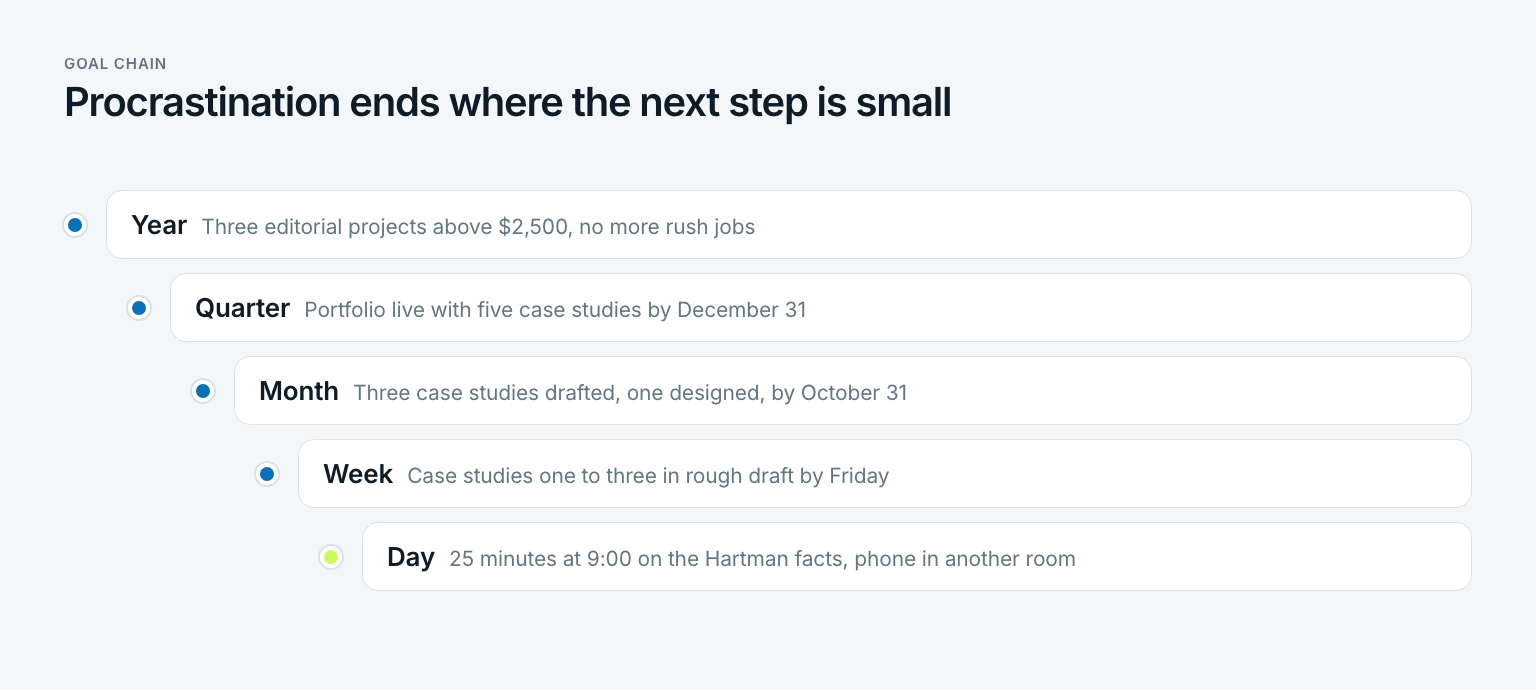
Jordan’s chain looks like this. Year: a client base that lets him turn down rush work, meaning three editorial projects above $2,500 by December. Quarter: portfolio live with five case studies by December 31. Month, October: three case studies drafted and one designed. Week: case studies one to three in rough draft by Friday. Day: 25 minutes at 9:00 on the Hartman facts. Read it from the bottom up and every small step has a reason attached. Read it from the top down and the big goal has a Tuesday morning attached. Neither one is abstract anymore.
This is the part most advice on procrastination skips. It treats the stuck task as an island and hands you tricks for the island. The task is not an island. It is unfinished because it is not connected to anything you check regularly, and a task nobody checks on is a task that can wait. In the goal chain, the week is where the checking happens. A ten-minute weekly review on Friday asks three questions, and one of them is how many first-slots you showed up for. That question, asked every week, does more against procrastination than any single technique, because it makes the avoidance visible before it has five months to grow.
Whoever plans a year this way needs fewer goals than they think. Three at the top is plenty, and the case for three goals is the case against procrastination in disguise: every goal beyond the third is one more large, disconnected task waiting to be avoided. A daily goal that takes 25 minutes and belongs to a weekly goal is the smallest unit of the chain, and it is the one that actually gets done. In Gaapp the five levels hang on each other, so the Tuesday slot is never a loose task. It is the current end of a chain that starts in December. How the whole chain is built from the top is laid out in the guide on how to achieve goals.
How to overcome procrastination when the task has no deadline
Deadlines are the external structure most people rely on, and tasks without one are where procrastination does its worst work. Nobody will ever ask Jordan about his portfolio. The fix is to manufacture the deadline at the week level, not the project level. Portfolio live by December is a wish. Three drafts by Friday, counted in the weekly review, is a deadline five days away, which is close enough for the brain to feel. Whoever has a project with no deadline needs a weekly goal with one. That is the whole trick.
The three mistakes nobody notices
Most attempts to stop procrastinating fail quietly, at one of three points, and none of them feels like a mistake while it is happening. Which one is yours?
- Preparing instead of starting. Reading about procrastination is a good habit. It explains the mechanism, and it is how you got here. It only becomes a problem when the reading replaces the first slot, and it does that very easily, because reading about the task feels like working on it. Jordan’s 90 minutes of other illustrators’ portfolios were research. They were also Thursday.
- Making the first step a real step. “Write case study one” sounds small. It is a full afternoon with a blank page in it. The first step should feel almost embarrassingly tiny, because its job is not to produce output. Its job is to get you into the chair with the file open. Output comes from the second step, and the second step is easy once you are sitting there.
- Measuring output instead of starts. A week with three slots and one rough draft feels like failure if you count drafts. It is a strong week if you count slots. Early on, starts are the only metric that matters, because the pattern you are breaking is the not-starting. Whoever counts output in week one quits in week two.
The most common mistake: waiting to feel ready
Procrastinators wait for motivation to arrive before they start. It arrives after, not before. Motivation is a result of progress, not a precondition for it, and 25 minutes spent feeling unready at the desk produce more of it than a day of waiting on the couch. The fix is mechanical: a slot, a timer, a step under ten minutes. Jordan did not feel ready on Monday at 9:00. He typed the client’s name anyway, and by 9:10 the feeling had changed its mind.
Three questions before you close this tab
Three questions about the task you have been putting off, whichever one came to mind when you opened this article:
- Can you write its next physical action in one line, and would that action take less than ten minutes?
- Does it have a slot tomorrow that nothing else can get ahead of?
- Do you know how many times you showed up for it last week, as a number and not as a feeling?
Whoever answers no to one of these does not have a discipline problem. They have a step that is too big, a slot that does not exist, or a count nobody is keeping. All three are fixable this afternoon. In short: you do not stop procrastinating by becoming a different person. You stop by making the next step smaller than the feeling, and then showing up for it once.
Frequently asked questions about procrastination
Is procrastination ADHD or anxiety?
Neither by default. Procrastination is a behavior that appears in people with ADHD, people with anxiety, and people with neither, and roughly one in five adults procrastinates chronically. Anxiety-driven procrastination clusters around tasks where you can be judged. ADHD-related procrastination is broader, affects most areas of life, and usually goes back to childhood. If the second pattern fits over years, a clinician can tell you more than an article can.
What are the main reasons why people procrastinate?
Four reasons cover most cases: the task feels unpleasant, the reward is too far away, the next step is fuzzy, or the result is frightening. Piers Steel’s 2007 meta-analysis found task aversiveness and delay of reward among the strongest predictors. Most stuck tasks combine two of the four, and each has a different fix, so naming the reason comes before choosing a technique.
Why is my procrastination getting worse?
Because avoidance is rewarded every time you do it. The task triggers discomfort, you switch to something else, and the relief arrives within seconds, which trains the avoidance. Meanwhile the task grows and picks up guilt and a tighter deadline, so it triggers more discomfort next time. The loop breaks when the first step becomes small enough that there is no discomfort to escape from.
Can anxiety cause procrastination?
Yes, directly. A task that could be judged triggers worry, avoiding the task relieves the worry, and the relief teaches you to avoid again. The fix is to name the fear in one sentence, declare the first version deliberately rough so there is nothing to judge yet, and make the first step under ten minutes. If the anxiety is broad and persistent, treat the anxiety itself, not only the delay.
How do I stop procrastinating right now, today?
Write the next physical action for the task in one line, something under ten minutes. Set a timer for 25 minutes, put the phone in another room, and do that one action. Stop when the timer rings, even mid-sentence. Then write down that you showed up. That is one start, and one start is the whole method in miniature. Tomorrow, repeat it at the same time.
Is it better to do the hardest task first?
For most people, yes. Brian Tracy’s Eat That Frog argues for doing the most important and most unpleasant task first thing, before the day fills up. The reasoning holds: every task you put ahead of the hard one is another chance to never get to it. If the hard task is too large to face first thing, do its first ten minutes first, which is the same rule at a smaller scale.
Last updated: 19 October 2026
Read next
 Productivity
Feynman Technique: Four Steps to Real Understanding
The Feynman technique is not a memorization trick: four steps, a worked example from a stats class, a one-page template, and what research says.
16 min read
 Productivity
Zettelkasten: How to Turn Notes Into Your Own Ideas
A Zettelkasten is not an archive: Luhmann's method, the three note types, a five-step setup and an Obsidian template, with a worked example.
15 min read
 Productivity
Second Brain: How to Build One You Actually Use
A second brain is not a note archive: Tiago Forte's CODE steps, the PARA method with an example, a five-step setup and the mistakes that sink it.
15 min read