Self-Reflection: How to Do It, With 21 Questions
Self-reflection is examining your thoughts and actions with a question in hand. Definition, 5 steps, 21 questions, 3 examples, and a plan from year to day.

Contents
- 01What self-reflection means, and what it is not
- 02Self-reflection vs. introspection vs. rumination
- 03Why self-reflection matters: what eight Sundays showed Dana
- 04How to self-reflect in five steps
- 05Self-reflection questions: seven that do most of the work, and 21 more
- 06Self-reflection examples: three situations, one method
- 07The three mistakes that turn self-reflection into rumination
- 08Self-reflection in the goal chain: from year to day
- 09Three questions to audit your own reflection habit
- 10Frequently asked questions about self-reflection
Self-reflection is not overthinking. It is the deliberate act of examining your own thoughts, feelings, and actions with a specific question in hand, so that you learn something you can use next week. Overthinking circles. Self-reflection measures. The difference is not how long you think about yourself but whether you leave with an answer.
Three things make it work: a question, a reference point, and a consequence. The question is fixed and comes back every week. The reference point is a goal or a value you compare your week against. The consequence is one thing you do differently. This guide walks through all three with Dana, a 34-year-old pediatric nurse in Denver who has changed hospitals three times in four years and is holding a fourth offer. Along the way you get a definition you can use, five steps, 21 self-reflection questions, three worked examples, and the three mistakes that turn reflection into rumination.
What self-reflection means, and what it is not
Self-reflection means turning your attention back on yourself to understand why you did what you did and what you want to do next. The word is built from the Latin reflectere, to bend back. You bend your attention back on your own experience. That sounds simple. Most people do it only when something has gone wrong, and then they do it without a question, which is why it hurts and teaches nothing.
Donald Schön drew a useful line in 1983 in The Reflective Practitioner. Reflection-in-action happens while you work: the nurse who notices a child is not responding to the usual approach and changes it on the spot. Reflection-on-action happens afterward, when you sit down and ask what happened and why. This article is about the second kind. It is the kind you can schedule, and the kind that compounds.
Dana has done plenty of the first kind. She is good at her job. What she has never done is sit down on a Sunday and ask the same three questions eight weeks in a row. She has quit three jobs on a feeling. Each time the feeling was accurate and the conclusion was wrong. That is what unreflected experience does: it gives you real data and lets you draw the wrong line through it.
What reflection is not: three neighbors that get confused with it
Journaling is writing down what happened and how it felt. It is a good habit, and it is the raw material for reflection, not the reflection itself. Introspection is looking inward at your thoughts and feelings in the present moment, without necessarily asking what to do about them. Rumination is replaying the same event and the same feeling without a question and without an exit. Self-reflection borrows from all three and adds what they lack: a question, a comparison, and a next step.
Self-reflection vs. introspection vs. rumination
Introspection is a valuable skill, and the psychologists who studied it for a century were not wasting their time. It observes what is in your mind right now. Self-reflection goes one step further and asks what that observation means for what you do next. Rumination is what happens when introspection loses its question. The three look identical from outside. Someone is sitting quietly and thinking about themselves. The table shows what is actually happening.
| Introspection | Self-reflection | Rumination | |
|---|---|---|---|
| Looks at | Thoughts and feelings right now | Actions, outcomes, and what they say about you | One event or one feeling, over and over |
| Question | What am I feeling? | What happened, why, and what do I change? | Why does this keep happening to me? |
| Reference point | None needed | A goal, a value, or a standard | None, which is why it never ends |
| Ends with | Awareness | One decision | The same feeling, slightly worse |
| Time | Minutes, in the moment | 15 minutes, scheduled | Hours, uninvited |
Research draws the same line. Susan Nolen-Hoeksema spent two decades at Yale studying rumination and found that people who replay negative events without a problem-solving question stay low longer and solve less. In short: the problem was never thinking about yourself. The problem is thinking about yourself without a question that can be answered.
Dana's version of rumination was lying awake after a bad shift and asking why she always ends up in units like this. That question has no answer, so it ran every night for a year. Her version of self-reflection, once she started it, was asking on Sunday which shifts this week she would gladly do again and which she would not, and why. That question has an answer every single week.
Why self-reflection matters: what eight Sundays showed Dana
Self-reflection matters because experience alone does not teach. In 2014 Giada Di Stefano, Francesca Gino, Gary Pisano, and Bradley Staats published a field study with a call center in Bangalore. Trainees who spent the last 15 minutes of each day writing down what they had learned performed about 23 percent better on the final assessment than trainees who used the same 15 minutes for more practice. Fifteen minutes of thinking beat fifteen minutes of doing. The reflecting group also reported more confidence in their ability to do the job.
Dana ran her own small version of that study. From early September to late October 2026 she kept a Sunday appointment at 7 p.m., 15 minutes, same three questions. Which shifts would I do again? Which ones drained me, and what exactly was draining about them? What is one thing I change this week? She rated each week from 1 to 10. Here is what the numbers said after eight weeks.
| Week | Night shifts | Shifts with teaching | Rating 1 to 10 | What she wrote |
|---|---|---|---|---|
| 1 | 3 | 0 | 3 | Exhausted. Thought about the Aurora offer twice. |
| 2 | 1 | 2 | 7 | Precepted a new grad. Best day in months. |
| 3 | 3 | 0 | 4 | Called in sick Thursday. Not sick. |
| 4 | 2 | 1 | 5 | Taught a family to use a feeding pump. Left late and did not mind. |
| 5 | 0 | 2 | 8 | Day shifts only, two teaching moments. Did not think about Aurora. |
| 6 | 3 | 0 | 3 | Same as week 1. Pattern? |
| 7 | 1 | 1 | 6 | Asked the unit educator how she got her role. |
| 8 | 2 | 2 | 7 | Two teaching shifts carried two night shifts. |
Eight rows, and the pattern is hard to miss once it is on paper. Every week with three night shifts scored 3 or 4. Every week with two or more teaching moments scored 7 or higher, even with night shifts in it. Of the 14 shifts she marked as ones she would gladly repeat, 11 involved teaching someone. The hospital never appears as a variable. Nights and teaching do.
That means: Dana's problem was never the employer. Three times she solved the wrong problem by changing it. The Aurora offer pays $4 more per hour and comes with the same rotating nights and no educator track. Without the log she would have taken it, because the feeling of wanting out was real. With the log she can see that the feeling points somewhere else. Whoever reflects with a question and a number for eight weeks ends up with a decision. Whoever reflects on a bad night ends up with a resignation letter.
How to self-reflect in five steps
How to self-reflect is less a matter of depth than of repetition. One profound session changes nothing. Eight shallow ones at the same time every week change the decision you make in week nine. The method below takes 15 minutes. Anyone who needs an hour is journaling, which is fine, but it is a different activity. Five minutes of daily journaling does feed it, though: the entries become the material your weekly session looks at.
Pick a fixed time and a fixed length, once
Sunday at 7 p.m., or Friday at 4 p.m., 15 minutes, as a recurring event in your calendar. Dana chose Sunday because her schedule for the coming week is posted by then. The time matters less than the fact that it does not move. Reflection that happens when you feel like it happens after bad weeks only, and that skews everything you learn.
Choose a reference point, once
You cannot reflect against nothing. Pick one goal or one value for the next eight weeks and write it at the top of every entry. Dana's was a sentence: I want to look forward to most of my shifts. A goal from your yearly plan works just as well. Without a reference point the question becomes how was my week, and the answer is always fine.
Ask the same three questions, ten minutes
What went well, and what exactly made it go well? What drained me, and what exactly was draining? What is one thing I will do differently this week? Write one to three sentences per question. The word exactly is doing the work. Not the night shift but being alone with twelve patients at 3 a.m. Not the good day but the 20 minutes spent teaching a new nurse to place an IV.
Add one number, one minute
Rate the week from 1 to 10 against your reference point. The number is not the insight. The number is what lets you see a pattern in week six that you cannot feel in week one. Dana's 3, 7, 4, 5, 8, 3, 6, 7 told her more than any single entry did.
Decide one thing and schedule it, three minutes
The answer to question three becomes a task on a specific day. Not try to teach more, but ask the unit educator for a coffee on Tuesday. Reflection without a scheduled consequence is a diary with better questions. Next week you check whether it happened before you write anything else.
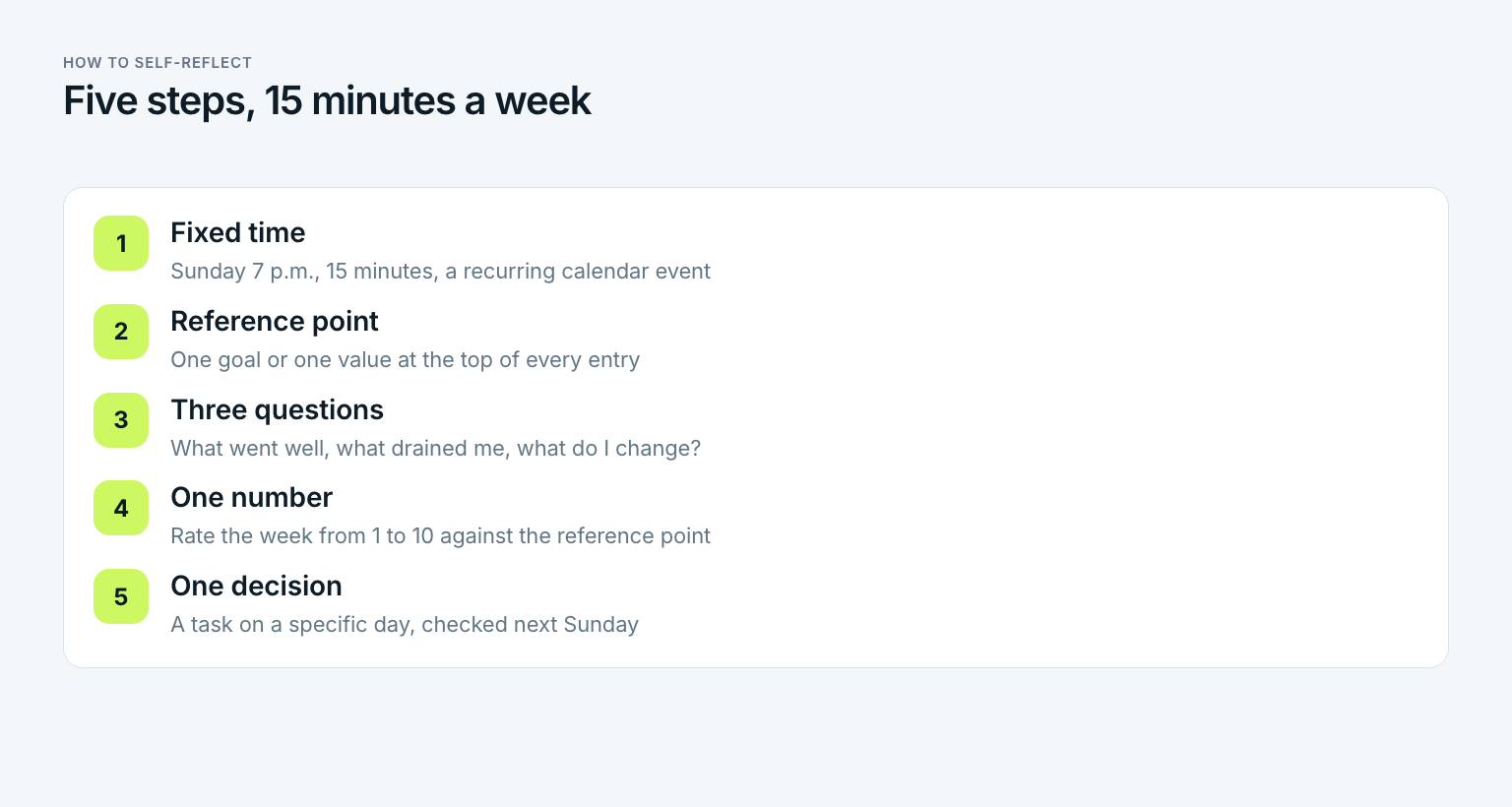
Anyone who does these five steps for eight weeks has a log of 24 answers and eight numbers. That is a dataset about your own life that no amount of thinking in the shower produces. Does it feel too mechanical? That is the point. The structure carries you through the weeks when you do not feel like looking.
Self-reflection questions: seven that do most of the work, and 21 more
Self-reflection questions work when they are specific, answerable, and repeated. The seven below are the ones Dana and most people actually need. They cover the week, the pattern, and the next step. Use them as they are for the first month. After that, pick one group from the 21 below when a week needs a different angle.
The seven core questions
- What did I do this week that I would gladly do again, and what exactly made it good?
- What drained me, and what exactly was draining about it?
- Where did I act against what I said I wanted?
- What did I avoid, and what was I afraid would happen?
- Which decision did I make on a feeling, and would I make it again with a clear head?
- What did I learn about myself this week that I did not know last Sunday?
- What is the one thing I will do differently this week, and on which day?
Seven questions, 15 minutes, one to three sentences each. Question seven is the only one with a deadline. Whoever skips it has done introspection, not reflection.
Work and career
- Which task this week felt like me, and which felt like someone else's job?
- If I had to describe my job to a stranger using only this week, what would I say?
- What would need to be true for me to stay in this role for five more years?
Relationships
- Who got my full attention this week, and who got the leftovers?
- Which conversation am I still replaying, and what did I want to say in it?
- Who helped me, and do they know?
Health and energy
- On which day did I have the most energy, and what was different about that day?
- What did I do to recover this week that actually worked?
- Where did I trade sleep for something that was not worth it?
Habits and routines
- Which habit held this week without effort, and which one needed a fight?
- What did I do out of habit that I would not choose again?
- What small routine made the rest of the day easier?
Values and direction
- What did I spend money or time on that I am proud of?
- When did I say yes this week and mean no?
- If this week repeated 50 times, would I be where I want to be?
Learning
- What mistake did I make for the second time?
- What did I read, hear, or watch that changed how I see something?
- What question did I not ask because I was afraid of the answer?
Letting go
- What have I been carrying for more than a month without acting on it?
- What would happen if I simply stopped doing it?
- Which worry from this week will still be here next week if I do nothing?
Twenty-one questions, seven groups. Do not answer them all in one sitting. Pick the group that matches the week. Dana added the career group in week seven, after the pattern had shown up. The third question in that group, what would need to be true to stay for five years, produced the sentence that changed her plan: I would need to teach.

Self-reflection examples: three situations, one method
A self-reflection example is only useful if it shows the question, the answer, and the change. Here are three. One is Dana's. The other two use the same five steps on a relationship and on a team, because the method does not care what you point it at.
Example 1: Dana and the fourth offer
Reference point: I want to look forward to most of my shifts. Eight weeks of the three questions. Finding: nights and the absence of teaching predict bad weeks, the hospital does not. Decision: decline the Aurora offer, ask the unit educator about the path into her role, and enroll in the precepting course her hospital runs twice a year. Her week-nine entry reads: First Sunday in a year I did not think about quitting. That is not because the job changed. It is because the question did.
Example 2: Ben and the Sunday argument
Ben, 39, noticed that he and his partner argued almost every Sunday evening. His reference point: I want Sunday to be the day we like each other most. His three questions for four weeks: What did we argue about, exactly? What was I feeling an hour before? What is one thing I change next Sunday? Finding after four weeks: three of the four arguments started within 30 minutes of him opening his work laptop to check Monday's calendar. The argument was never about the dishes. The change: he checks the calendar on Saturday morning instead. Not every problem is that simple. This one was, and nobody saw it until it had been written down four times.
Example 3: Priya and the team that stopped speaking up
Priya leads a team of seven and noticed that meetings had gone quiet. Her reference point: I want every person to say at least one thing I did not expect each week. Her questions: Who spoke, and who did not? What did I do in the first five minutes? What do I change next meeting? Finding after three weeks: she had opened every meeting by presenting her own plan. People were not quiet. They were agreeing, because the decision looked made. The change: she now asks the question before she shows the slide. In short: reflection on a team works exactly like reflection on yourself, only the reference point is shared.
Three examples, one shape. A reference point, repeated questions, a pattern that shows up around week three or four, one change. Anyone who wants to see the goal side of this worked through will find it in the guide to how to achieve goals, where the same logic runs from a yearly goal down to a Tuesday.
The three mistakes that turn self-reflection into rumination
Most self-reflection does not fail because people are shallow. It fails quietly on one of three mistakes, and none of them feels like a mistake while you are making it. Which one is yours?
The most common mistake: reflecting without a reference point
The question how was my week has no answer, because there is nothing to measure it against. Fine is the only honest reply. Rumination lives here: the mind keeps searching for a verdict that cannot exist without a standard. Whoever writes a reference point at the top of the page, a goal, a value, a single sentence about what they want, has turned an open question into a measurable one. Dana's sentence was ten words long, and it did more than three resignations.
- Reflecting only after bad weeks. A bad week produces a strong urge to understand. A good week produces none. If you reflect only when it hurts, your log is a list of failures and your conclusion will be that you fail a lot. Dana's week five, rated 8, taught her more than week one, rated 3, because it showed what good looked like. Fixed time, every week, no exceptions for the good ones.
- Judging instead of describing. I was lazy is a verdict. I skipped the gym three times, each time after a night shift, is a description. Carol Dweck's work on mindset, published in 2006, shows why this matters: a verdict about who you are closes the question, a description of what you did opens it. Write what happened. Let the pattern deliver the judgment, if there is one.
- No scheduled consequence. The insight arrives and feels like progress. Then nothing is written into Tuesday. Reflection that does not end in a calendar entry is a very good diary. The change can be tiny. Dana's first one was a single question to a colleague. It took four minutes and it changed the next eight months.
Self-reflection in the goal chain: from year to day
Reflection answers the question what. Goals answer the question so what. The two need each other, and the place they meet is the goal chain from year to quarter to month to week to day. Dana's eight Sundays produced one sentence: I would need to teach. On its own that sentence is a nice insight. Hung into a chain, it becomes a plan she can check every week.

Her yearly goal for 2027: hold a clinical educator or dedicated preceptor role by December. Her first quarter: complete the precepting course and shadow the unit educator for two full shifts. Her month, January: submit the course registration and have one conversation with the educator about openings. Her week: one Sunday reflection and one task from the plan. Her day: Tuesday at 8 p.m., 15 minutes, the three questions and the number.
Notice what happened to the reflection itself. It did not stop when the insight arrived. It moved one level down and became the weekly check on the plan. Each Sunday Dana now asks the same three questions with a new reference point: the monthly goal. Did this week move it? What got in the way? What is the one thing for next week? This is the same ritual described in the ten-minute weekly review, and it is the reason the plan survives February.
In Gaapp this chain is the structure: five levels from year to day, each goal attached to a bigger one, and the progress of each period shown next to the time that has passed. Reflection is the Sunday habit that feeds it. Anyone who sets a yearly goal in annual planning and never looks back at it has a wish. Anyone who checks it against the week has a plan. The daily goals at the bottom of the chain are small enough that the Tuesday entry can be a yes or a no.
That means: self-reflection is not a separate activity from pursuing your goals. It is the part of pursuing them where you find out whether the goals are still yours.
Three questions to audit your own reflection habit
Before the FAQ, three questions about your last month. Answer them honestly, in one word each.
- Can you name the reference point your last reflection was measured against, without looking?
- Do you have at least four written entries from the last four weeks, each with a number?
- Did your last reflection end with something that appeared on a specific day in your calendar?
Whoever answers no to one of these has not been reflecting too little. They have been reflecting without a question, without a record, or without a consequence, and the fix is the missing piece, not more time. In short: self-reflection is not thinking about yourself. It is asking yourself a question you can answer, and then answering it.
Frequently asked questions about self-reflection
What does self-reflection mean?
Self-reflection means examining your own thoughts, feelings, and actions on purpose, with a question in hand, in order to learn something you can use. The word comes from the Latin reflectere, to bend back: you bend your attention back on your own experience. It differs from simply thinking about yourself in two ways. It has a reference point you measure against, and it ends with a decision.
What are 7 questions you can use as self-reflection?
What did I do this week that I would gladly do again, and what made it good? What drained me, and what exactly was draining? Where did I act against what I said I wanted? What did I avoid, and what was I afraid of? Which decision did I make on a feeling? What did I learn about myself that I did not know last week? What is the one thing I will do differently, and on which day? Answer each in one to three sentences, once a week.
What is a self-reflection example?
Dana, a pediatric nurse, spent eight Sundays asking which shifts she would gladly repeat and which drained her, and rated each week from 1 to 10. The log showed that weeks with three night shifts scored 3 or 4 and weeks with teaching moments scored 7 or higher, regardless of the hospital. She declined a job offer that would have changed the employer but not the pattern, and started on a path toward a nurse educator role. That is self-reflection: a question, a record, a pattern, a decision.
What is the difference between self-reflection and introspection?
Introspection is observing your own thoughts and feelings as they are right now. Self-reflection takes that observation and asks what it means for what you do next, measured against a goal or a value. Introspection ends with awareness. Self-reflection ends with a decision. Rumination is what both become when the question disappears and the same feeling replays without an exit.
How often should you self-reflect?
Once a week, at a fixed time, for about 15 minutes, is enough for most people and more than most people do. Daily reflection works if it stays under five minutes and asks one question. Monthly reflection is too rare to catch a pattern before it has cost you something. Dana's pattern appeared in week three and was undeniable by week six. Weekly is the rhythm at which that happens.
How do you self-reflect without being too hard on yourself?
Describe instead of judge. Write what happened and what you did, not what it says about you. I skipped the gym three times after night shifts is a description you can act on. I have no discipline is a verdict you cannot. Keep a reference point so the question has an answer, reflect on good weeks as well as bad ones, and end every session with one small change on a specific day. Reflection that ends in a task has no room left to end in shame.
Last updated: 19 October 2026
Read next
 Personal Growth
Maslow's Hierarchy of Needs: The 5 Levels Explained
Maslow's hierarchy of needs sorts motivation into five levels. What each level means, what research says today and a needs audit you can run yourself.
14 min read
 Personal Growth
Mindfulness Exercises: 12 for Everyday Life
Mindfulness exercises are not about emptying your mind. 12 techniques for stress and focus, what research shows, and a four-week plan to practice daily.
16 min read
 Personal Growth
Positive Affirmations: 50 Examples You Can Believe
Positive affirmations are not magic words. What research shows, 50 daily affirmations you can believe, and a five-step method with a worked example.
16 min read