Positive Affirmations: 50 Examples You Can Believe
Positive affirmations are not magic words. What research shows, 50 daily affirmations you can believe, and a five-step method with a worked example.

Contents
- 01What affirmations are, and what they are not
- 02Do positive affirmations work? What the research shows
- 03Three myths about affirmations
- 04Affirmations you can believe: four types
- 05Daily affirmations: 50 examples by situation
- 06How to write your own affirmations in five steps
- 07The three mistakes that make affirmations fail
- 08Why action makes the sentence believable
- 09Positive affirmations in your goal chain: year, quarter, month, week, day
- 10Three questions before you write your first affirmation
- 11Frequently asked questions about affirmations
Positive affirmations are not magic words that pull good things into your life. A positive affirmation is a short, positively worded statement about yourself that you repeat, say out loud, or write down, such as “I can learn hard things.” Used well, affirmations can soften stress and nudge behavior. They only work when you believe the sentence and when it points to something you can actually do.
That is exactly where most lists of daily affirmations fall apart. They promise “I am successful” and “I attract abundance,” and anyone who says that to the mirror on a bad morning mostly feels the gap. This guide follows one case from start to finish: Tasha, 32, an accountant in Denver who was promoted to team lead in the spring and tenses up before every Monday meeting. Her private line about herself has been the same since college: “I’m not a leader.” Along the way you get 50 affirmations sorted by situation, a five-step method, and what the research actually shows.
What affirmations are, and what they are not
An affirmation is a sentence that confirms something about you: a trait, a value, or an ability. Three features define it. It talks about you, it is phrased positively, and you repeat it. That means: a one-off pep talk in the car is not an affirmation. The same sentence written every morning is.
The idea is older than any self-help shelf. In the early 1920s, the French pharmacist Émile Coué had his patients repeat a single sentence: Every day, in every way, I am getting better and better. He called it autosuggestion. Coué claimed a lot and proved little. Still, his formula shapes how affirmations sound to this day.
Three related terms often get mixed up with affirmations. None of them is wrong. Each one is built for something different:
- Limiting belief. A conviction you already hold, often unspoken and often negative, like Tasha’s “I’m not a leader.” An affirmation is the deliberate answer to it.
- Mantra. A word or phrase that steadies your attention, often with no claim about you. “Breathe slowly” is a mantra, not an affirmation.
- Self-affirmation in research. When psychologists say self-affirmation, they usually do not mean an I am statement. They mean a short writing exercise about your core values. That distinction is the most important one in this article.
Whoever searches for affirmations is usually looking for the same thing: a sentence that turns down the volume on the inner critic. The real question is which kind of sentence actually does that, and for whom.
Do positive affirmations work? What the research shows
Yes, under certain conditions. Research draws a sharper line than most affirmation lists do. On one side are values affirmations, which are well studied. On the other side are I am statements, where the evidence is thinner and more mixed.
The foundation comes from the social psychologist Claude Steele, who proposed self-affirmation theory in 1988. His argument: people want to see themselves as broadly good and capable. When that self-image is threatened in one area, by criticism or failure, it helps to affirm it in another. Anyone who remembers what they care about can take in criticism instead of fighting it off.
Most studies test this with a plain exercise. Participants pick the value that matters most to them from a list, such as family, humor, or honesty, and write for a few minutes about why. In a 2005 study in Psychological Science, David Creswell and colleagues had people do this exercise before a stressful speech and math task. The values affirmation group released less cortisol afterward than the comparison group.
In a school study published in Science in 2006, Geoffrey Cohen and colleagues had seventh graders write for about 15 minutes about their values at the start of the school year. Students who faced a negative stereotype earned better grades afterward. Larger replication studies later found smaller and less consistent effects. A 2015 meta-analysis by Tracy Epton and colleagues in Health Psychology paints a similar picture for health behavior: self-affirmation makes people more open to uncomfortable health messages and shifts behavior, but only by a small amount.
Christopher Cascio and colleagues looked inside the brain in 2016. People who reflected on their own values activated regions linked to self-related thinking and reward. The effect was strongest when the affirmation pointed to the future, to something the person planned to do. That is a hint, not proof. It does fit everything this guide says later about the next step.
What about classic I am statements? In 2009, Joanne Wood, Elaine Perunovic, and John Lee published a study in Psychological Science in which students repeated “I am a lovable person” during a short writing task. Students with high self-esteem felt slightly better afterward. Students with low self-esteem felt worse than those who did not repeat the sentence. The authors’ explanation: a statement far from your self-image triggers counterarguments. You say “I am lovable,” and your mind answers with three reasons why not.
In short: values affirmations have solid support with small to moderate effects. I am statements mostly help people who already half believe them. Anyone who doubts themselves needs a different format.
Affirmations are not treatment
Affirmations are an everyday exercise, not therapy. They do not cure depression, anxiety disorders, or physical illness. If you have felt low for weeks, barely sleep, or no longer enjoy anything, talk to a doctor or a licensed therapist. In a crisis in the US, you can call or text 988 to reach the Suicide and Crisis Lifeline at any hour.
Three myths about affirmations
A lot of wishful thinking has grown up around affirmations. Some of it is harmless. Some of it points you in the wrong direction. Three claims are especially stubborn.
Myth one: the universe is listening
The so-called law of attraction says thoughts attract events. Think “I am wealthy” often enough, the story goes, and money will flow to you. There is no scientific evidence for such a mechanism. If anything, the evidence points the other way. The psychologist Gabriele Oettingen has shown in several studies that dreamy, positive fantasies about the future go along with less effort and worse results. In a 2002 study with Doris Mayer, graduates who fantasized most positively about landing a job later received fewer offers. In a 2011 study with Heather Kappes, people who pictured an ideal future even showed lower blood pressure, a sign of less energy to act. The mind treats the goal as if it were already reached.
Oettingen’s remedy is mental contrasting: think about the wish and the obstacle together. The guide on how to visualize goals shows how that works with the WOOP method. For affirmations, it means this: a sentence that only celebrates the outcome can hold you back. A sentence that points to the next step helps.
Myth two: affirmations heal illness
In the 1980s, the author Louise Hay linked affirmations to the promise of healing physical disease. There is no evidence for that. What the evidence does support is more modest. Values affirmations can soften the stress response and make people more open to health information. Whoever sells that as healing is promising more than the research delivers.
Myth three: more repetitions, better results
Many lists tell you to repeat a sentence 50 or 100 times a day. The study by Wood and colleagues suggests repetition does not make an unbelievable sentence more believable. It can make the inner pushback louder. That means: one sentence you believe, said once with attention, beats ten sentences you rattle off.
Affirmations you can believe: four types
Not every affirmation has to be an I am statement. Research points to four types, each built for a different situation. None of them is wrong. The question is which one fits you and the moment you are in.
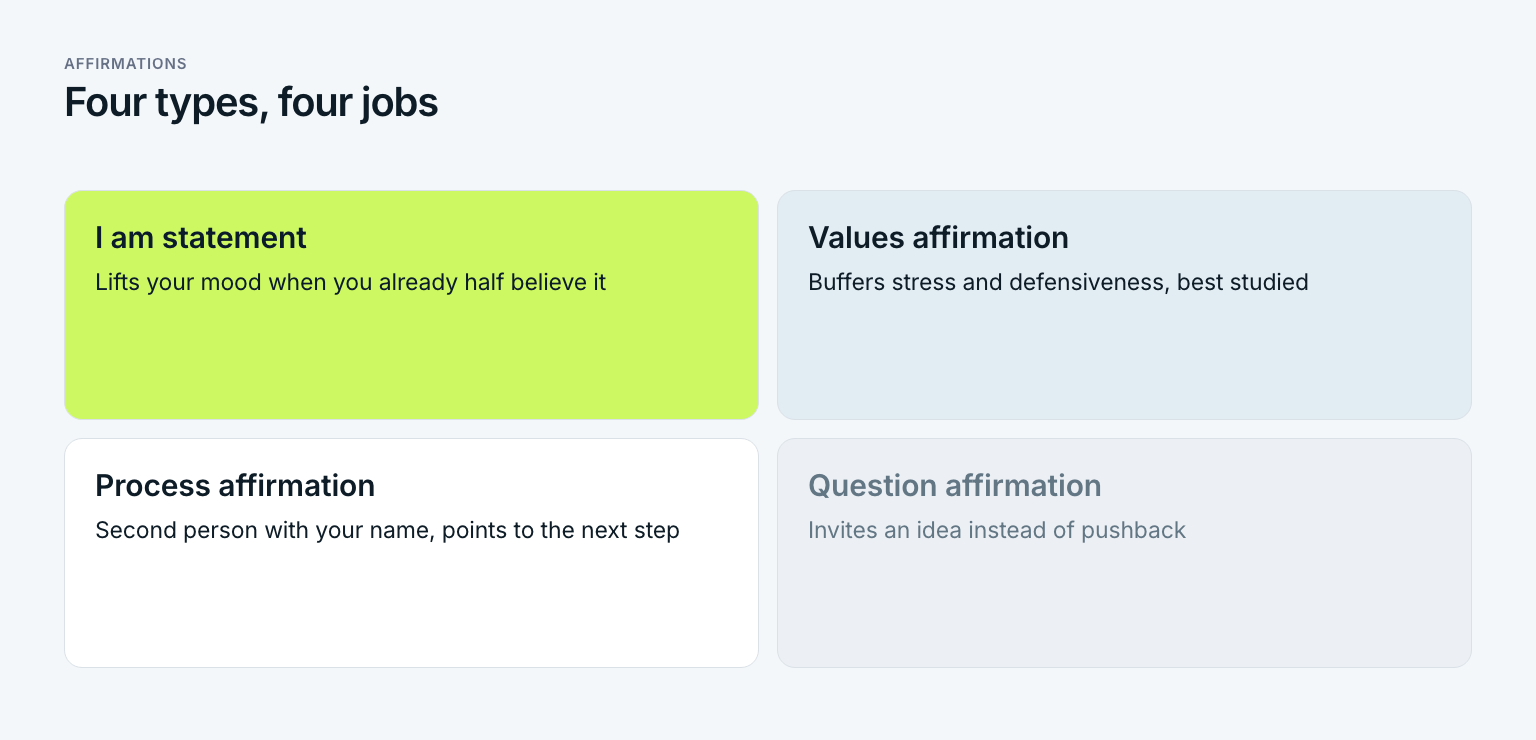
| Type | Example | Built for | Evidence |
|---|---|---|---|
| I am statement | I am calm and focused. | Lifting your mood when you already half believe it | Mixed, can backfire with low self-esteem |
| Values affirmation | I care about building a team where people speak up. | Before stress, criticism, or hard conversations | Well studied, small to moderate effects |
| Process affirmation | Tasha, you open the meeting with the numbers. | Starting the next step | Supported by research on self-talk |
| Question affirmation | What can I get done in the next 45 minutes? | Motivation without inner pushback | Single studies, not always replicated |
Two findings support the process affirmation in the second person. In 2014, Ethan Kross and colleagues reported in the Journal of Personality and Social Psychology that people who talked to themselves using “you” or their own name before giving a speech felt less anxious and performed better than those who used “I.” Sanda Dolcos and Dolores Albarracín found something similar in 2014 for you statements on tasks. The distance seems to help you encourage yourself the way you would encourage a friend.
The question affirmation rests on one well-known experiment. In 2010, Ibrahim Senay, Dolores Albarracín, and Kenji Noguchi had participants write either “I will” or “Will I?” before a set of word puzzles. The question group solved more of them. Later attempts did not always replicate the effect. Still, the question is a useful tool because it does not invite an argument. Ask your mind a question, and it answers with an idea, not a rebuttal.
For Tasha, this changes everything. “I am a confident, powerful leader” is an I am statement she does not believe. “Tasha, you open the meeting with the numbers” is a sentence she can believe, because by 9:15 on Monday she either did it or she did not. Anyone who does not argue with their sentence can work with it.
Daily affirmations: 50 examples by situation
The examples below are written so you can believe them on an ordinary day. Many use the second person. Some are questions. Pick one sentence, not five, and edit it until it sounds like you.
Morning affirmations
- You do not have to do everything today, just the most important thing first.
- What is the one step today that moves my goal forward?
- I can start slowly and still get there.
- A good start is enough for this morning.
- You have finished harder days than this one.
Affirmations for work
- I prepared, so I have something to add.
- You can ask questions. It shows interest, not weakness.
- The work I do today makes tomorrow a little easier.
- Mistakes show me where to adjust.
- Which task moves things forward the most today?
Affirmations for learning something new
- I can’t do this yet, and I am learning it right now.
- You are learning one chapter today, not the whole book.
- Every practice problem makes the test a little smaller.
- I have been new at things before, and I learned them.
- What do I understand today that I did not understand yesterday?
Affirmations for confidence and self-worth
- I am more than my worst day.
- Honesty matters to me, and I act on it today.
- You are allowed to be proud of what you have already done.
- I do not have to be perfect to be worth something.
- The people who matter to me do not like me for my output.
Affirmations for hard days
- This is a hard day, not a hard life.
- You only need to see the next step today.
- I am allowed to ask for help.
- Feelings come and go, and so will this one.
- What would help me in the next hour?
Positive affirmations for men
- Strength includes asking for help.
- You can be steady and still say how you feel.
- I keep my word to the people who count on me.
- My worth is not my paycheck.
- What kind of man do I want my kids to remember?
Affirmations for body and health
- I move today because I feel better afterward.
- Ten minutes still counts.
- My body carries me through the day, so I give it sleep and breaks.
- You train for yourself, not for the mirror.
- What kind of movement fits into my day today?
Affirmations for relationships
- Today I will really listen once.
- You can say no and still be kind.
- Closeness matters to me, so I make time for it.
- I am allowed to say what I need.
- Whose day could I make a little easier?
Evening affirmations
- I did what I could today.
- What went well today, even if it was small?
- You can close the day now.
- Tomorrow starts with a plan, not with worry.
- Open tasks belong on my list, not in my head.
Affirmations as questions
- What would a calm version of me do next?
- What is one thing I handled well this week?
- Where did I grow this month?
- What can I control in the next ten minutes?
- Who could I ask for help with this?
Which of these are the most powerful? The ones you believe and the ones that point to something you can do. No single list of the best affirmations works for everyone, because a sentence works in your head, not on paper. Anyone who uses morning affirmations does best by tying them to a fixed action, such as the first cup of coffee. You can see how to build that kind of sequence in the guide to a morning routine.

How to write your own affirmations in five steps
Writing your own affirmation takes about 20 minutes the first time. After that, it takes one minute a day. Here is how:
Find the old sentence
Write down what you tell yourself when things get hard. For Tasha, it is “I’m not a leader.” Without that sentence, you do not know what your affirmation is up against.
Name the value behind it
Ask yourself why this area matters to you at all. Write about it for ten minutes without worrying about style. This values exercise is the best-studied form of affirmation.
Make the sentence believable
Phrase it so you do not argue back inside. The word “yet,” the second person with your own name, or a question all help. Test it: would you say this to a friend without lying?
Tie it to an action
The affirmation points to a step you can take today. It gets a fixed moment, such as right after you brush your teeth or right before you open your laptop.
Check it after four weeks
Ask: Do I still say the sentence? Do I do what it points to? Do I believe it more than I did at the start? If not, rewrite it instead of repeating it more often.
Step three is the one most lists skip. It decides whether the sentence holds. Whoever is honest at this point saves weeks of sentences that feel like ad copy.
The example: Tasha’s twelve weeks
Tasha needed two tries. In April, she found a list of positive affirmations online and stuck “I am a confident, powerful leader” on her monitor. She took the note down after eleven days. Every Monday it had felt like a dare she was losing. In early June she started over, this time with the five steps.
She wrote her values exercise on a Sunday afternoon. Ten minutes on why she took the team lead role at all. Two reasons came out. She wants a team where junior staff speak up earlier than she did at their age, and she wants to be considered for the controller role within three years. Those reasons became three sentences for three moments:
| Moment | Old sentence | New affirmation | Type |
|---|---|---|---|
| Sunday, weekly planning | I’m not a leader. | I care about building a team where people speak up. | Values affirmation |
| Monday, before the meeting | They will see I don’t know what I’m doing. | Tasha, you open the meeting with the numbers. | Process affirmation |
| Monday evening | That was a disaster again. | What did I handle better this week than last week? | Question affirmation |
Her plan was simple: a 15-minute prep block every Monday at 8:30 and opening the 9:00 team meeting herself. Over twelve weeks she led ten of the twelve meetings. Before each one she rated her nervousness from 1 to 10. In June it was an 8. By the end of August it was a 5. That is not proof the sentences did the work. She also prepared more, and that was the point. The affirmations did not run the meeting for her. They got her to open her laptop at 8:30.
The three mistakes that make affirmations fail
Most affirmations do not fail for lack of repetition. They fail quietly, on a morning when the sticky note no longer does anything. Which of these three is yours?
Mistake one, the most common: a sentence you do not believe
“I am rich,” “I am confident,” and “I love my body” sound strong. If you do not believe them, they trigger exactly the inner pushback Wood and colleagues described in 2009. The sentence turns into daily proof that it is not true. The fix is not a louder sentence but a smaller one: add “yet,” switch to the second person or a question, and tie it to a step you can complete today.
- Mistake two: outcome instead of path. “I ace every presentation” celebrates the goal before you have taken a step. Oettingen’s research shows that fantasies like this cost energy. A sentence about the next step keeps your eyes on what you can do.
- Mistake three: no fixed moment. A sentence you say whenever you remember it is a sentence you soon forget. Anyone who ties it to a fixed action no longer has to remember it. The guide to habit stacking explains how that linking works.
All three mistakes have one thing in common: they feel right in the moment. A big sentence feels bolder, an outcome feels more motivating, a loose rhythm feels more relaxed. In short: affirmations rarely fail because of willpower. They almost always fail because of wording.
Why action makes the sentence believable
The psychologist Albert Bandura called the belief that you can handle a task through your own effort self-efficacy. Its strongest source is your own experience of success. Encouragement from others, or from yourself, helps too, but less and for a shorter time. The guide to self-efficacy goes deeper on the four sources.
For affirmations, this is the key bridge. A sentence on its own is persuasion. A sentence followed by a finished action becomes evidence. After four weeks, Tasha could believe “you open the meeting with the numbers,” because she had done it three Mondays out of four. That means: the best affirmation is one you can check off tonight.
Whoever works this way can bring I am statements back later. After twelve weeks, Tasha said “I can lead this team” for the first time and meant it. Not because she had said it often, but because ten Mondays stood behind it. Isn’t that the more honest order?
Positive affirmations in your goal chain: year, quarter, month, week, day
An affirmation is not a goal. It measures nothing and plans nothing. In a goal chain, though, it gets a fixed place. It sits at the bottom, on the day, and connects your yearly goal to the one step you take today.
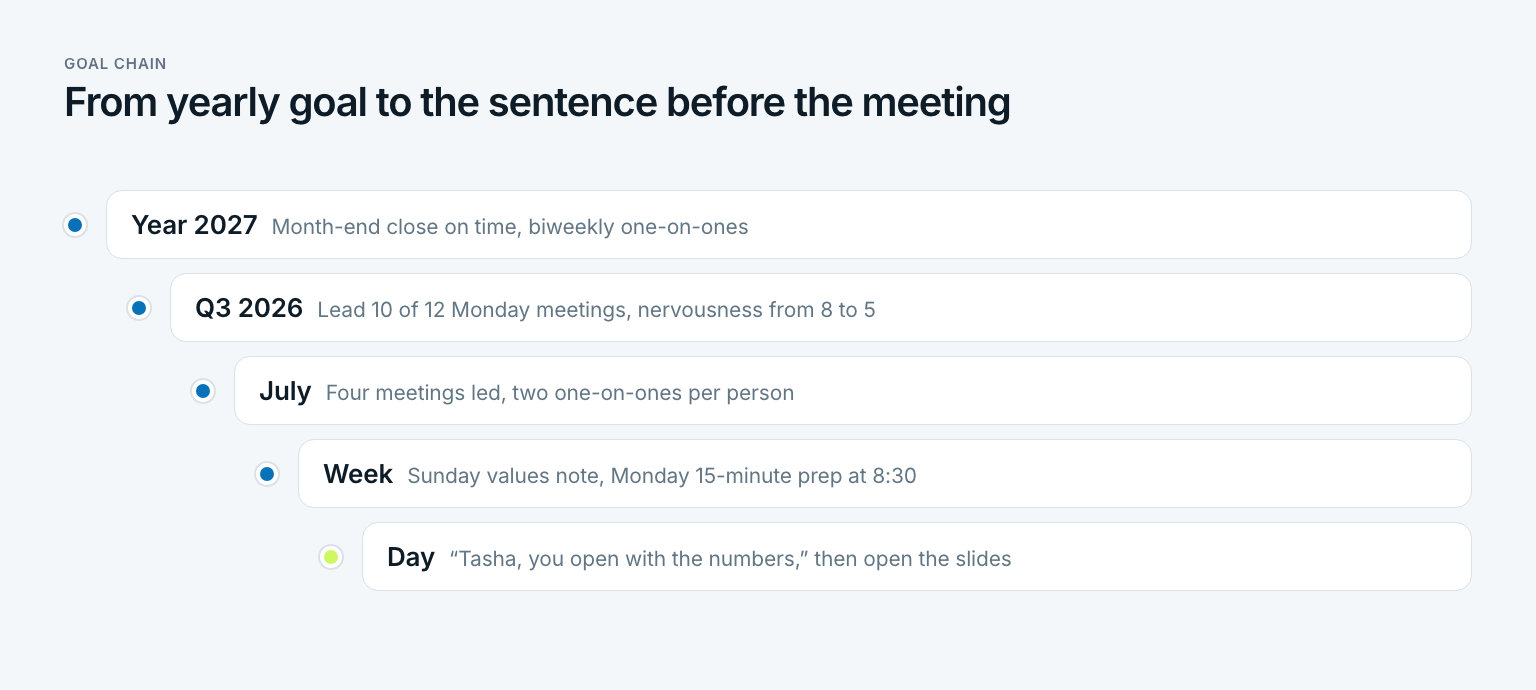
Tasha’s chain looks like this. Her yearly goal for 2027: every month-end close on time and a one-on-one with each of her five reports every two weeks. The third quarter of 2026 had a milestone: lead ten of twelve Monday meetings and bring her nervousness from 8 down to 5. July had four meetings and two one-on-ones per person. The week had a values note on Sunday and a 15-minute prep block on Monday. The day had one sentence and one action: “Tasha, you open the meeting with the numbers,” then open the slides.
That is how a sticky note becomes part of a plan. The affirmation points up to the reason and down to the step. If you want to see how to break a yearly goal down that far, the guide on how to turn yearly goals into daily steps walks through it. In Gaapp, you set the yearly goal, hang the quarter, month, and week underneath, and check off the steps as weekly goals. On Friday, you see whether Monday’s sentence came true.
Three questions before you write your first affirmation
Before you stick a note on the mirror, answer three questions:
- What do you tell yourself today when things get hard?
- What value sits behind the thing you want to achieve?
- What step tonight would make your affirmation true?
Whoever cannot answer the third question does not have an affirmation yet. They have a wish. That is not failure, just an earlier point in the process. In short: a good affirmation is not a promise to the universe. It is an appointment with yourself.
Frequently asked questions about affirmations
What are some positive affirmations for men?
Good options for men are sentences that leave room for strength and for asking for help, such as “Strength includes asking for help,” “My worth is not my paycheck,” or “I keep my word to the people who count on me.” They work best when they point to something you can do today. The list above includes five more examples for men and 45 for other situations.
What are 21 positive things I can say about myself?
Start with facts, not superlatives: skills you have learned, promises you kept, people who rely on you, and hard things you got through. Write seven in each of three groups: what you can do, what you value, and what you have survived. Sentences like “I learned to drive at 30” or “I show up for my sister” are easier to believe than “I am amazing.”
What is one positive affirmation?
A strong single affirmation is “I can’t do this yet, and I am learning it right now.” It admits where you are, so your mind does not push back, and it points to action. If you want one sentence for the morning, try “What is the one step today that moves my goal forward?”
What are 7 affirmations?
Seven you can believe: “I am more than my worst day,” “You only need to see the next step today,” “I am allowed to ask for help,” “Ten minutes still counts,” “I did what I could today,” “Mistakes show me where to adjust,” and “What went well today, even if it was small?” Pick one for each day of the week or keep the one that fits best.
How often should you repeat affirmations?
There is no proven ideal number. One sentence said once a day with attention and tied to an action makes more sense than a hundred mechanical repetitions. After four weeks, check whether you believe it more than at the start, and rewrite it if you do not.
Can affirmations backfire?
Yes, in one case: Wood, Perunovic, and Lee showed in 2009 that people with low self-esteem felt worse after repeating “I am a lovable person.” If you doubt yourself, values affirmations, questions, or small process sentences work better. If low mood persists, professional support helps more than any sentence.
Last updated: 22 October 2026
Read next
 Personal Growth
Maslow's Hierarchy of Needs: The 5 Levels Explained
Maslow's hierarchy of needs sorts motivation into five levels. What each level means, what research says today and a needs audit you can run yourself.
14 min read
 Personal Growth
Mindfulness Exercises: 12 for Everyday Life
Mindfulness exercises are not about emptying your mind. 12 techniques for stress and focus, what research shows, and a four-week plan to practice daily.
16 min read
 Personal Growth
How to Manifest: What Science Says Actually Works
Manifesting is not magic. Learn how to manifest something with a method that holds up: what research says, 369 and 777, and a template on paper.
15 min read