Maslow's Hierarchy of Needs: The 5 Levels Explained
Maslow's hierarchy of needs sorts motivation into five levels. What each level means, what research says today and a needs audit you can run yourself.

Contents
- 01Maslow's hierarchy of needs explained: five levels, one principle
- 02What each level of Maslow's pyramid of needs means in real life
- 03Where the pyramid came from, and who actually drew it
- 04Maslow's theory is not a checklist
- 05Criticism of the hierarchy of needs theory: what the research says
- 06Other theories that explain motivation
- 07Maslow at work: what the hierarchy says about motivation on the job
- 08The needs audit: score your own pyramid in five steps
- 09From pyramid to plan: Dana's goal chain from year to day
- 10Frequently asked questions about Maslow's hierarchy of needs
Maslow's hierarchy of needs is a theory of motivation by psychologist Abraham Maslow that sorts human needs into five levels, and it is not a staircase you have to climb one step at a time. At the bottom sit physiological needs like sleep, food and warmth. Above them come safety, love and belonging, and esteem. At the top sits self-actualization. Maslow laid out the order in 1943 in a paper called “A Theory of Human Motivation.”
The pyramid you know from school is not his. That sounds like trivia. It is not. The drawing decides whether you read the theory as a rigid law or as a useful map of what drives you right now, and Maslow meant the map.
Dana shows why the difference matters. She is 29, a junior accountant who moved from Ohio to Denver eight months ago for a job at a mid-size firm. She signed up for the CPA exam in spring and has restarted her study plan four times since. Discipline is not her problem. Dana set a goal at the top of the pyramid and never looked at the levels underneath it.
Maslow's hierarchy of needs explained: five levels, one principle
Maslow's hierarchy of needs explains motivation with one principle: what is missing drives you. Anyone who is starving thinks about food, not about recognition. Anyone who is about to lose their apartment is not planning a sabbatical. Only when a need is reasonably met does the next one move to the front.
Maslow called this prepotency. An unmet need dominates attention, thinking and behavior. A met need barely motivates at all, because whoever has just eaten is no longer driven by food. That means: the hierarchy does not describe what you value in general. It describes what is pushing you today.
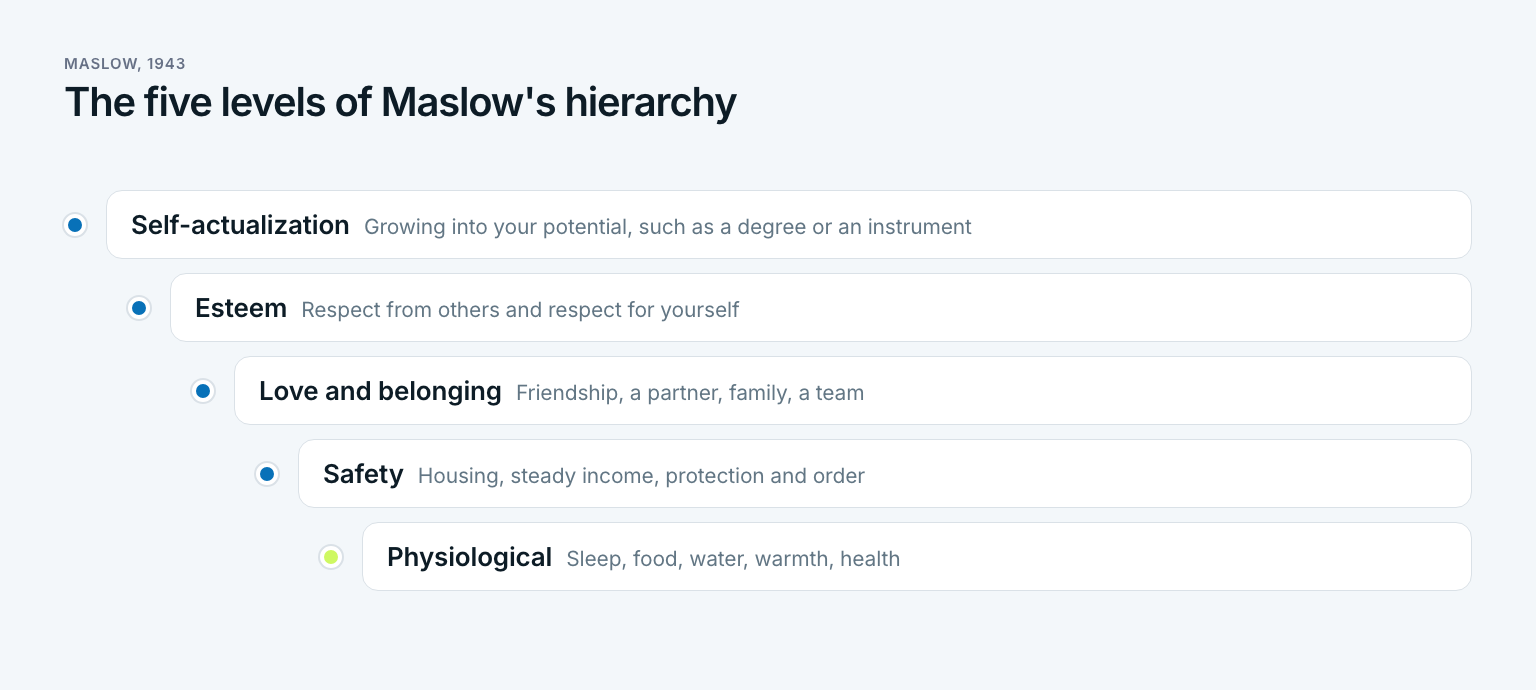
The five levels, one sentence each:
- Physiological needs: sleep, food, water, warmth and basic health. The body speaks first and loudest.
- Safety needs: a roof over your head, steady income, order and protection from violence or illness.
- Love and belonging: friendship, a partner, family and a group where you are welcome.
- Esteem needs: respect from others and respect for yourself, plus the sense that you are good at something.
- Self-actualization: becoming what you are capable of and doing the work you feel made for.
The first four levels share a trait. They speak up when something is missing and go quiet once it is there. The fifth works differently, and that difference changes how you set goals.
What each level of Maslow's pyramid of needs means in real life
Each level shows up at home and at work. The table gives one personal and one workplace example per level, plus the warning sign that tells you a need is running low. The last column is the one you will use most.
| Level | What it covers | Personal example | Work example | Warning sign |
|---|---|---|---|---|
| Physiological | What your body needs to function | Sleep, meals, water, a warm home | Real breaks, sane shift patterns | Irritability, foggy focus, constant fatigue |
| Safety | Stability and protection from threat | Housing, savings, health insurance | Steady contract, predictable pay | Money worries, dread of any change |
| Love and belonging | Connection and closeness | Friends, partner, family | A team where questions are welcome | Withdrawal, feeling like an outsider |
| Esteem | Respect from others and from yourself | Being taken seriously at home, finished projects | Specific feedback, real responsibility | Constant comparing, over-explaining, touchiness |
| Self-actualization | Growing into your potential | Learning an instrument, volunteering | Work that stretches you | Emptiness despite success |
Notice the warning signs. Almost none of them is a thought about the need itself. Whoever sleeps too little rarely thinks about unmet physiological needs. They snap at people, forget things and put off studying. That is why the signs are more useful than the labels.
Deficiency needs and growth needs
In his 1962 book “Toward a Psychology of Being,” Maslow split needs into two kinds. Deficiency needs come from a lack and fade once the lack is fixed. Growth needs do not come from a lack. They also do not fade when you follow them. A painter does not want to paint less after the tenth canvas. She wants to paint better.
Deficiency or growth: why the difference matters for goals
A deficiency need has a point where it is satisfied. A growth need does not. For your goals, that means: goals on the lower levels need a threshold where enough is enough, such as seven hours of sleep on five nights out of seven. Goals on the top level need a direction and a next step instead, because there is no finish line up there.
Where the pyramid came from, and who actually drew it
The theory is older than the picture. Abraham Maslow, born in 1908 in New York and died in 1970, published it in the journal Psychological Review in 1943. Eleven years later he expanded it in the book “Motivation and Personality.” Neither text contains a pyramid.
So who drew it? Todd Bridgman, Stephen Cummings and John Ballard traced the question in 2019 in the journal Academy of Management Learning and Education. Their answer: the first pyramid appeared in 1960 in an article by consultant Charles McDermid in Business Horizons. Management textbooks did the rest and turned it into the most famous image in motivation psychology.
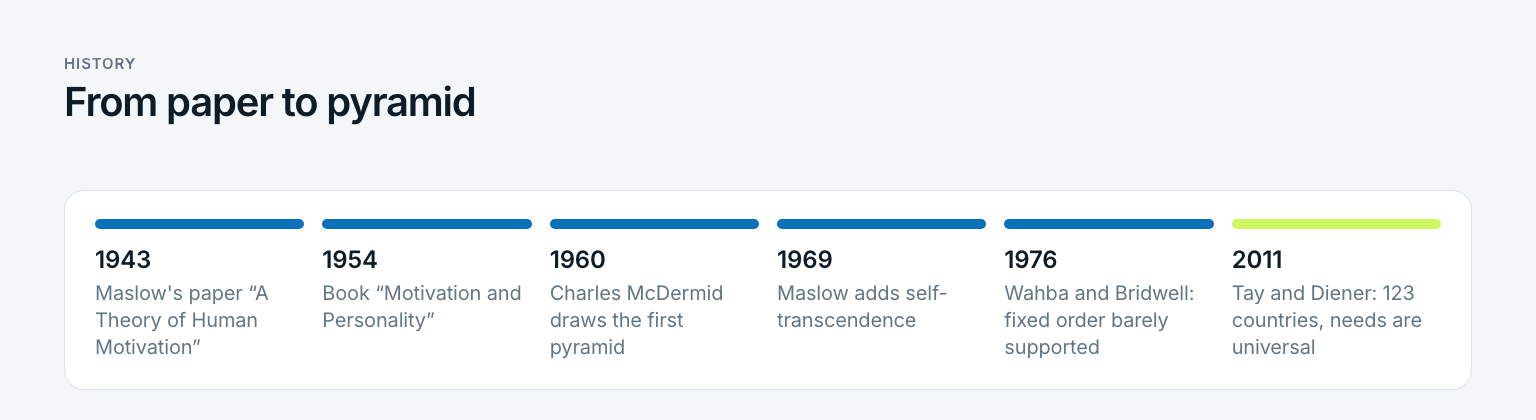
The shape has consequences. A pyramid suggests a foundation that must be finished before the next layer can hold. It is easy to remember and fits on any slide. Maslow himself described something looser.
Who Abraham Maslow was and what he contributed
Maslow grew up in Brooklyn as the son of Jewish immigrants from the Russian Empire. He earned his PhD at the University of Wisconsin in 1934 under Harry Harlow, studying dominance behavior in monkeys. He later taught at Brooklyn College and, from 1951, at Brandeis University. In 1968 he served as president of the American Psychological Association.
His key contribution was a change of question. Psychology in the 1940s mostly asked what makes people ill or how behavior can be conditioned. Maslow asked what drives healthy people. He studied the lives of people he considered unusually fulfilled, among them Abraham Lincoln, Albert Einstein and Eleanor Roosevelt, and wrote about peak experiences. That made him a founder of humanistic psychology, which saw itself as a third force next to behaviorism and psychoanalysis.
Was that method rigorous? Not by today's standards, because Maslow picked his role models himself and described them himself. His questions stuck anyway. Anyone who researches strengths, meaning or well-being today works in a field Maslow helped open.
Maslow's theory is not a checklist
Maslow's theory describes weights, not a list to tick off in order. In the 1943 paper he wrote that a need does not have to be met 100 percent before the next one appears. As an illustration he described an average citizen who might be satisfied 85 percent in physiological needs, 70 percent in safety, 50 percent in love, 40 percent in esteem and 10 percent in self-actualization.
That is a fuel gauge, not a staircase. All five needs are active at once, just at different volumes. Maslow also named exceptions in the same paper: people for whom esteem matters more than love, and people who accept hunger and danger for an ideal. In short: the order is a tendency, not a law.
The most common mistake: treating the pyramid as a waiting room
Whoever reads the pyramid as a staircase postpones everything at the top until the bottom is perfect. First fix the finances, then build a social life, then finally go after the big goal. The model becomes a reason never to start. Dana kept telling herself she would study properly once busy season was over. Busy season ended and her evenings still went nowhere. The better reading: find the need that is so loud it drowns out everything else, and raise it to good enough. Good enough is not perfect.
For Dana, that means she does not need a perfect life in Denver before she studies. She needs the loudest gap closed far enough that it stops sabotaging her evenings. That is a goal with a threshold. Thresholds can be planned, measured and reached.

Criticism of the hierarchy of needs theory: what the research says
Criticism of the hierarchy of needs theory is almost as old as the pyramid. Maslow built the theory mostly from clinical observation and biographies, not from experiments. That was common for psychology in the 1940s. It also makes the theory hard to test.
Three objections hold up well:
- The fixed order has little support. Mahmoud Wahba and Lawrence Bridwell reviewed the available studies in 1976. They found little evidence that needs operate in exactly this sequence. The categories showed up in part, the strict ladder hardly at all.
- The top is culturally colored. Geert Hofstede argued in 1984 that self-actualization at the peak reflects an individualist, American ideal. In more collectivist cultures, belonging to the group can matter more than the growth of the individual.
- The pyramid is incomplete from an evolutionary view. Douglas Kenrick and colleagues proposed a renovation in 2010 in Perspectives on Psychological Science. Their version puts finding a mate, keeping a mate and parenting at the top and drops self-actualization as a separate level.
The largest test so far comes from Louis Tay and Ed Diener. In 2011 they analyzed Gallup World Poll data from more than 60,000 people in 123 countries. The result supports Maslow and contradicts him at the same time. The needs are broadly universal, and meeting them is linked to well-being. But social needs and respect add to well-being even when basic needs are still unmet. The order is looser than the pyramid claims.
Do psychologists still use Maslow's hierarchy of needs?
As a map, yes. As a law, no. The five categories are still a practical grid for spotting what is missing in a life or a team, and the model is still taught in business, nursing and education programs. Few motivation researchers defend the strict sequence today. Whoever uses the model now uses it as a checklist and a conversation starter, not as a prediction.
There is also a level most textbooks leave out. In 1969 Maslow described self-transcendence in a paper titled “The Farther Reaches of Human Nature”: commitment to something beyond yourself, such as a cause, a community or a faith. Mark Koltko-Rivera showed in 2006 in the Review of General Psychology that this later version had been largely forgotten. Some textbooks also show an eight-level version with cognitive and aesthetic needs. Maslow touched on both themes, but he never drew an eight-level pyramid.
Anyone who asks why a big goal matters often ends up on that sixth level. If that question is open for you, the guide to finding purpose walks through it.
Other theories that explain motivation
Maslow was not the last word on motivation. Several later theories picked up his idea and fixed it where the criticism landed. Five of them show up most often in textbooks and management training.
| Theory | Author and year | Core idea | How it differs from Maslow |
|---|---|---|---|
| Two-factor theory | Frederick Herzberg, 1959 | Hygiene factors prevent dissatisfaction, motivators create satisfaction | Two separate scales instead of one ladder |
| Expectancy theory | Victor Vroom, 1964 | Effort depends on expected success and the value of the reward | Focuses on choices, not on needs |
| ERG theory | Clayton Alderfer, 1969 | Existence, relatedness and growth | Three levels, several active at once, frustration can send you back down |
| Self-determination theory | Edward Deci and Richard Ryan, 1985 | Autonomy, competence and relatedness | No hierarchy, all three count equally |
| Goal-setting theory | Edwin Locke and Gary Latham, 1990 | Specific, hard goals raise performance | Explains how to direct motivation, not where it comes from |
What survives of Maslow next to his successors? The core idea that motivation grows out of needs, and that not all of them are equally loud at the same time. Alderfer removed the rigidity, Deci and Ryan removed the hierarchy. Locke and Latham, whose work is covered in the article on goal setting theory, explain the step after that: how a need turns into a goal that gets done.
Maslow at work: what the hierarchy says about motivation on the job
At work, Maslow's pyramid is most useful as a diagnostic list. Talk about motivation in a team and you quickly land on snacks and offsites. The pyramid asks a less comfortable question: which level is shaky for this person right now?
- Physiological: breaks that actually happen, shift schedules with enough rest, a workspace without constant noise.
- Safety: reliable contracts, transparent pay rules, clear ownership.
- Love and belonging: a team where asking is safe, onboarding with a named buddy.
- Esteem: specific feedback on real work, visible responsibility.
- Self-actualization: projects someone can grow into, training tied to a goal.
Praise does not make up for a shaky contract. That means: whoever wants to motivate a team closes the loudest gap first and works on the upper levels after that. Herzberg described exactly this with his hygiene factors. What it looks like in day-to-day management is covered in how to motivate employees.
The needs audit: score your own pyramid in five steps
The hierarchy becomes useful the moment you put numbers on it. The audit takes about 30 minutes and follows Maslow's fuel gauge idea. You are not checking whether a level is done. You are checking how loud it is.
Score each level from 0 to 10
For each level ask: how well was this need met over the last four weeks? Go with your gut, but write one piece of evidence next to every number. Dana gave belonging a 2 and wrote: no one to call in Denver outside work, family calls on Sundays only.
Find the loudest gap
The loudest gap is not always the lowest number. It is the level whose shortage drags the others down. For Dana, loneliness turned every evening into scrolling, which killed her study hours and her sleep.
Set a threshold for enough
A deficiency need needs a number where it is satisfied. Dana set two social plans a week, in person. More would be nice. Two is enough to stop the evenings from collapsing.
Keep one growth goal alive in parallel
Do not wait for the threshold. Keep a smaller version of your top-level goal running. Dana's review course suggested about 15 study hours a week. She committed to eight.
Re-score after four weeks
Run the audit once a month. When the loudest gap reaches its threshold, the next one moves forward. That keeps the pyramid a measuring tool instead of a poster.
| Level | September | Evidence | December |
|---|---|---|---|
| Physiological | 6 | Sleeps about six and a half hours, lots of takeout | 6 |
| Safety | 7 | Stable salary, student loan payments on autopay | 7 |
| Love and belonging | 2 | No friends in Denver yet, family calls on Sundays | 6 |
| Esteem | 5 | New on the team, little feedback so far | 6 |
| Self-actualization | 4 | CPA study plan restarted four times | 6 |
What did Dana actually change? She joined a CPA study group that meets at a public library on Tuesday and Thursday evenings. She signed up for a climbing gym and went every Sunday. The study group did double duty: it raised her belonging score and her study hours in the same two evenings. Her pyramid did not need to be fixed in order. It needed one move that served two levels.
Look at physiological needs. Dana never worked on sleep, and her score stayed at 6. It did not need to move, because it was not the loudest gap. Anyone who prefers to score life areas rather than needs can use the wheel of life. The two grids work well together: the wheel shows where something is missing, the pyramid shows why it presses. One note: if any level sits at 0 to 2 for weeks, especially loneliness or a sense of worthlessness, that is not a planning problem, so talk to your doctor or a licensed therapist, and in a crisis call or text 988 to reach the Suicide and Crisis Lifeline any time.
From pyramid to plan: Dana's goal chain from year to day
A need is not yet a goal. It becomes one when it gets a number, a date and a next step. Dana translated both of her goals, the threshold at the bottom and the growth goal at the top, into one chain:
- Year 2027: Pass two of the four CPA exam sections by December, with at least two in-person social plans every week.
- Quarter, October to December: Study group twice a week, eight study hours a week, first exam section booked for January.
- Month, November: 32 study hours, two full practice tests, eight study group sessions.
- Week: Tuesday and Thursday from 6 to 8 pm at the library, a four-hour block on Saturday morning, climbing on Sunday.
- Day: Tuesday at 6 pm, 40 practice questions on lease accounting.
The chain links two levels of the pyramid in one plan. The bottom goal has a threshold, the top goal has a direction. Both have a place on every level, and neither waits for the other. In Gaapp you set the yearly goal and hang quarterly, monthly, weekly and daily goals under it. The progress of each level is the share of goals completed beneath it.
After twelve weeks Dana had logged 88 of 96 planned study hours and booked her first section for January. More important than the number: for the first time, her plan survived a full quarter. Anyone who wants the full method for carrying a goal through a year will find it in the guide on how to achieve goals.
Three questions to ask your own pyramid
Before you start a big goal, answer three questions:
- Which level is so loud right now that it drowns out the rest?
- At what number would that level be good enough, not perfect?
- Which small growth goal will you keep alive in parallel so you are not sitting in the waiting room?
Whoever can answer all three has turned a textbook picture into a tool. Maslow's hierarchy of needs is not a ladder you must finish climbing. It is a fuel gauge you read once a month.
Frequently asked questions about Maslow's hierarchy of needs
What does each level of Maslow's hierarchy of needs mean?
Physiological needs cover the body, such as sleep, food and warmth. Safety covers stability, like housing and income. Love and belonging covers relationships, esteem covers respect from others and yourself, and self-actualization means growing into your potential.
What are the main theories that explain motivation?
Besides Maslow, the best-known are Herzberg's two-factor theory, Vroom's expectancy theory, Alderfer's ERG theory, Deci and Ryan's self-determination theory and Locke and Latham's goal-setting theory. Need theories explain where motivation comes from. Expectancy and goal-setting theories explain how it is directed into effort.
What were Abraham Maslow's key contributions to psychology?
Maslow proposed the hierarchy of needs in 1943 and helped found humanistic psychology, which studied healthy, thriving people instead of only illness or conditioning. He introduced the ideas of self-actualization, peak experiences and, late in life, self-transcendence. He served as president of the American Psychological Association in 1968.
Do psychologists still use Maslow's hierarchy of needs?
Yes, as a framework for thinking about needs, and it is still widely taught. Research does not support a strict order, though. A 2011 study by Tay and Diener across 123 countries found the needs are broadly universal, and that social needs and respect add to well-being even when basic needs are not fully met.
Who created the Maslow pyramid?
Abraham Maslow created the theory, but not the pyramid. The first pyramid drawing appeared in 1960 in an article by consultant Charles McDermid and spread through management textbooks. Maslow's own texts describe the levels in words only.
What is the sixth level of Maslow's hierarchy of needs?
In 1969 Maslow added self-transcendence, meaning commitment to something beyond yourself, such as a cause, a community or a faith. Most diagrams leave it out. It explains why people sometimes set their own needs aside for something they believe in.
Last updated: 22 October 2026
Read next
 Personal Growth
Mindfulness Exercises: 12 for Everyday Life
Mindfulness exercises are not about emptying your mind. 12 techniques for stress and focus, what research shows, and a four-week plan to practice daily.
16 min read
 Personal Growth
Positive Affirmations: 50 Examples You Can Believe
Positive affirmations are not magic words. What research shows, 50 daily affirmations you can believe, and a five-step method with a worked example.
16 min read
 Personal Growth
How to Manifest: What Science Says Actually Works
Manifesting is not magic. Learn how to manifest something with a method that holds up: what research says, 369 and 777, and a template on paper.
15 min read