Journaling: How to Start and Actually Keep Going
Journaling is not a diary. Three types, a 30-day plan for beginners, the 3/2/1 method, 50 journaling prompts, and the mistakes that end most journals.

Contents
- 01What journaling is, and what it is not
- 02Does journaling help? What the research actually says
- 03The three types of journaling, and six formats to choose from
- 04How to start journaling: a 30-day plan in five steps
- 05How to journal: structure, length, timing, and rereading
- 06Journaling prompts: 50 ideas sorted by format
- 07The three mistakes that end a journal in week two
- 08Journaling in the goal chain: year, quarter, month, week, day
- 09Three questions to audit your own journal
- 10Frequently asked questions about journaling
Journaling is not keeping a diary of what happened today. Journaling is writing with a purpose: on set days you sit down for 5 to 15 minutes and write about what is on your mind in a format you chose, free, from a prompt, or as a list. A diary records. A journal sorts.
To start, you need three things: a reason, a format, and a minimum small enough for your worst day. The example running through this guide is Marcus, 38, a high school chemistry teacher in Columbus, Ohio, who also coaches the robotics team and spends Sunday nights replaying the week in his head. Along the way you get the three types of journaling, a 30-day plan for beginners, the 3/2/1 method, 50 journaling prompts, and the three mistakes that end most journals in week two.
What journaling is, and what it is not
Journaling is the habit of writing regularly to think, not just to remember. The word covers many formats, from free writing to a bullet list, but they share one feature. You write with an intention, and the intention decides what goes on the page. A diary asks what happened. A journal asks what is on your mind and what you will do with it. In short: the difference is not the notebook but the purpose.
A diary is a good habit. It keeps memories, and anyone who reads an old one ten years later meets a younger version of themselves. It is simply built for something else. Whoever writes down what they ate and whom they met is archiving. Whoever writes down the conversation they cannot let go of, then answers one question about it, is processing. Both have their place. Only the second one changes how you think about the thing.
| Aspect | Diary | Journal | Self-reflection |
|---|---|---|---|
| Core question | What happened? | What is on my mind, and what do I do with it? | What did I do, and what follows from it? |
| Format | free, in order of events | chosen: free, prompted, list, or letter | fixed questions on a fixed day |
| Rhythm | whenever something happens | daily or almost daily, short | weekly, about 20 minutes |
| Result | a memory | a clearer head and material for decisions | one change for next week |
Journaling and self-reflection overlap, but they are not the same. Journaling is the tool, and self-reflection is one way to use it. If you want a method for checking your own actions against a set of questions, the guide to self-reflection covers it. This guide is about the writing itself: which format, how long, at what time of day, and with which prompt.
Does journaling help? What the research actually says
The best-known evidence comes from psychologist James W. Pennebaker. In 1986, he and Sandra Beall asked college students to write for 15 minutes on four consecutive days. Some wrote about a stressful or traumatic experience, a control group wrote about everyday topics. Students who wrote about both the facts of the experience and their feelings about it visited the campus health center less often in the months that followed. Right after writing, though, they felt worse than the control group.
In 1997, Pennebaker summarized the research on this kind of expressive writing in the journal Psychological Science. The effect had shown up in many follow-up studies, with different groups of people and different outcome measures. His reading was that writing turns a messy experience into a story you can understand and then put down. Later reviews of the research confirm an effect but describe it as small on average and not the same for everyone.
That means: journaling is a well-supported tool for sorting through something difficult. It is not a cure, and it is not a substitute for treatment. Anyone who has slept badly for weeks, keeps ruminating, or feels persistently low should take that to a doctor or a therapist, not only to a notebook. And if one topic leaves you more stirred up every time you write about it, you are allowed to switch topics.
Expressive writing
Expressive writing is the format from Pennebaker's studies: on three or four days in a row, write for 15 to 20 minutes without stopping about something that weighs on you, facts and feelings both, without worrying about spelling. It works like a short course, not a daily habit. For everyday journaling you need a lighter format, which is why the next section lays out six.
The three types of journaling, and six formats to choose from
There is no official list, but most journaling formats fall into three types. Expressive journaling processes feelings. Reflective journaling thinks something through, usually from a prompt or a question. Practical journaling logs tasks, progress, and plans. Each type has its own formats, and each format is built for a different job. Which job do you actually need done?
| Format | Type | How it works | Time | Built for |
|---|---|---|---|---|
| Expressive writing | expressive | Write without stopping about something hard, facts and feelings | 15 to 20 minutes on three or four days | processing one experience |
| Morning pages | expressive | Three longhand pages right after waking, whatever comes | 20 to 30 minutes daily | clearing your head, getting unstuck |
| Prompt journaling | reflective | One prompt, three to ten sentences in response | 5 to 10 minutes | beginners, clarity on one topic |
| Gratitude journal | reflective | Three things you are grateful for today | 2 to 5 minutes | shifting attention to what went right |
| Bullet journal | practical | Short entries marked as task, event, or note, reviewed monthly | 5 to 10 minutes daily | tasks and thoughts in one place |
| Goal journal | practical | One line on progress, one on the obstacle, one on the next step | 5 minutes | keeping a goal alive in daily life |
Morning pages come from Julia Cameron, who described them in her 1992 book The Artist's Way: three handwritten pages every morning, not to be reread or shown to anyone. The bullet journal was developed by designer Ryder Carroll, who published The Bullet Journal Method in 2018. Both are proven systems with large followings. Both are often too big for a first month. Three pages take half an hour, and a bullet journal needs setting up before the first thought goes in. A gratitude journal is the shortest format and follows its own logic, because it steers attention instead of sorting thoughts.
Marcus rules out two formats right away. Morning pages do not fit a morning that starts at 5:45 a.m. with a 7:10 first bell. A bullet journal feels like one more project. What he wants is to stop carrying the week around on Sunday night, and he has ten quiet minutes with his coffee before anyone else is up. So he picks prompt journaling in the morning, using one short structure, the 3/2/1 method. That means: the purpose chose the format, not the nicest notebook in the store.
How to start journaling: a 30-day plan in five steps
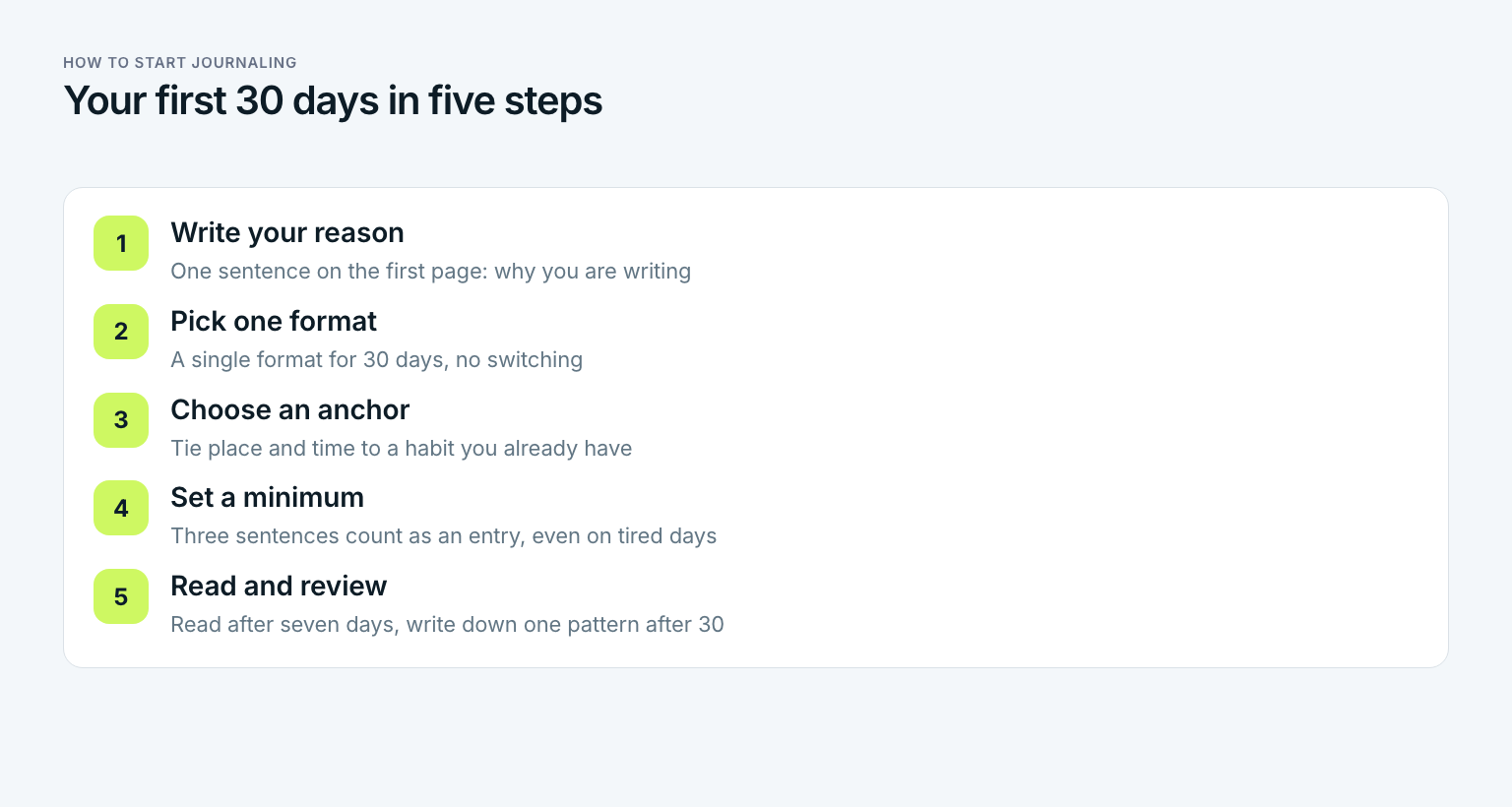
Most journals do not fail at the writing. They fail at a start that is too big. A new notebook, a promise to write every day, a full page every night. By day ten you miss one night, then three, and the notebook turns into a small source of guilt. These five steps keep the start small:
Write down your reason in one sentence, once
On the first page, write why you are journaling, for example “I write so the week stops following me into Sunday night” or “I write to figure out whether to take the department head job.” The reason decides the format. Without one, you will be writing down what happened within a few weeks.
Pick one format for 30 days
Choose a single format from the table above and stay with it for a month. For most beginners, prompt journaling is the easiest way in, because the prompt answers the question of how to start. You can switch after 30 days, not after three.
Choose a place, a time, and an anchor
Attach journaling to something you already do every day: the first coffee, brushing your teeth, the moment the kids are asleep. The guide to [habit stacking](/en/blog/habit-stacking) explains how to link a new habit to an existing one. Keep the notebook exactly where the anchor happens.
Set a minimum you can always hit
Three sentences count as an entry. Anyone who aims for ten minutes skips the tired days entirely. Anyone who aims for three sentences writes three sentences on tired days and a full page on good ones.
Read after seven days, review after 30
On day seven, read every entry in five minutes and underline one sentence that surprises you. On day 30, count your entries and write down one pattern in a single sentence. Rereading is what turns entries into insight.
Example: Marcus's first month
Marcus's reason: “I write so the week stops following me into Sunday night.” His format: the 3/2/1 method from a prompt card. His anchor: the first coffee at 5:50 a.m., notebook next to the coffee maker. His minimum: one line per part, so three lines in total. As a simple measure, every Sunday at 9 p.m. he rates how heavy the evening feels on a scale from 1 to 10.
| Week | Entries | Average minutes | Sunday night rating | Note |
|---|---|---|---|---|
| 1 | 5 of 7 | 5 | 8 | Mostly lists of grading he had not done yet |
| 2 | 6 of 7 | 6 | 7 | Started adding one sentence on why each item mattered |
| 3 | 3 of 7 | 3 | 8 | Parent-teacher conferences, four mornings skipped |
| 4 | 6 of 7 | 8 | 5 | First full page, about the robotics competition schedule |
| Total | 20 of 28 | about 6 | from 8 to 5 | One pattern written down on day 30 |
Twenty entries in 28 days, about six minutes each, roughly two hours over the whole month. His Sunday night rating dropped from 8 to 5. Does that prove journaling works? No. It is one month and one person, and week four was also the week the competition schedule was finally published. It is a signal, not a study.
What he does know is in his day 30 sentence: “12 of my 20 entries are about the robotics team, not my classes.” He would never have written that without rereading, because every single morning felt different. In short: the month did not promise him a better mood. It handed him a clear topic.
How to journal: structure, length, timing, and rereading
There is no rulebook for journaling, but five settings decide whether you are still writing in three months: the structure, the length, the time of day, the medium, and the rereading. The same rule applies to all five. Pick the setting you can manage on your worst day, not your best.
What is the 3/2/1 method of journaling?
The 3/2/1 method is a short structure for a daily entry: three of one thing, two of another, one of a third. There is no single official version. A common one is three things on your mind, two things that went well, and one thing you will do first today. Marcus uses exactly that. The three lines empty his head, the two lines stop the entry from becoming a complaint, and the one line gives the morning a starting point. Anyone who struggles with a blank page will find it easier to fill six short slots than one empty sheet.
Other short structures work the same way. One line a day is a single sentence, every day, often in a notebook that holds five years on each page. A brain dump is two minutes of listing everything on your mind without sorting. Write, then read is the habit of rereading yesterday's entry before writing today's, which builds the review into every session. Pick one and keep it for a month.
How long: 5 to 15 minutes is enough
For everyday journaling, 5 to 15 minutes is enough. Writing longer does no harm, it just makes starting harder. Pennebaker's participants wrote for 15 to 20 minutes, but only for a few days. Whoever wants to write daily needs a smaller dose. Marcus averaged about six minutes and once wrote for 25. That means: the topic sets the length, not the plan.
When: mornings to sort, evenings to set down
Writing in the morning sorts the day before it starts. Writing at night sets down what the day left behind. Whoever has no quiet ten minutes in the morning should write at night, and the other way round. If you already have a fixed start to the day, the guide to building a morning routine shows where a short entry fits. The exact hour matters less than keeping it roughly the same every day.
Paper or app
Some people swear by paper because the hand is slower than the mind and that slows the thinking down. Others write on their phone because it is always with them and easy to search. No clear winner has been shown for journaling. Use whatever is already sitting at your anchor. If the notebook is in your bag, you will write less often.
Rereading: the step almost everyone skips
Writing brings relief right away. Insight comes from reading, and rarely from reading one entry. Whoever reads all seven entries at the end of a week sees which thought came up three times. Whoever never turns back the pages is only collecting. When did you last read what you wrote a month ago? Plan two reading slots from the start: five minutes at the end of each week and half an hour at the end of each month.

Journaling prompts: 50 ideas sorted by format
A prompt is the beginning, not the assignment. It gets you to the first sentence, then you write whatever comes. These 50 journaling prompts are sorted by format rather than topic, because the format changes what you write. A sentence starter draws out feelings, a list sorts, a letter makes you honest. Use one prompt a day and stay with one format for a week. If one stops working, switch formats before you switch topics.
Sentence starters
- Today I was surprised that …
- What I did not say today was …
- My head is full of …
- The thing that drained me most today was …
- I notice I avoid things when …
- If I am honest, what I actually want is …
- The best moment of the day was …
- Tomorrow will be a good day if …
- I keep coming back to …
- Right now I am afraid that …
Lists that sort
- Five things I do not want to forget tomorrow
- Everything I am putting off right now, without judging it
- Three things that were easier today than I expected
- Seven people I would like to spend more time with
- What I learned this month, in bullet points
- Ten things that give me energy and ten that take it
- Decisions that are still open
- Sentences I have been saying a lot lately
- Things I would stop doing if no one noticed
- Small wins from this week that nobody saw
Letters you never send
- To yourself five years ago
- To yourself one year from now, with everything you want to have happened by then
- To someone you could not say something to
- To your job, as if it were a person
- To the worry that is loudest right now
- To your child or a younger relative on their 18th birthday
- To someone who helped you without knowing it
- To the version of you who makes the hard decision next week
- To your body, about the last month
- To the person you were on your first day at work
Questions that clarify
- What is on my mind most right now, and which part of it can I influence?
- What am I genuinely looking forward to this week?
- What would I do if nobody ever found out?
- Which thought came up more than once today?
- What do I already know but do not want to admit?
- What did I say yes to this week when I meant no?
- What do I need right now that I can give myself?
- Which conversation am I putting off, and what is its first sentence?
- What would make this week feel finished on Friday?
- Where did my time go today, and where did I want it to go?
Change the angle
- Describe your day the way a friend would tell it
- Write today's conversation from the other person's point of view
- How will you see today's problem ten years from now?
- What would you tell a colleague in exactly your situation?
- Write today's frustration as a plain incident report
- List three explanations for the behavior that annoyed you
- Tell the day in six sentences without a single feeling word
- What would your body say about today if it could write?
- Write the headline your day would get in a local paper
- Describe the room you are sitting in, then what it says about your week
These journaling ideas also work as a rotation. Marcus kept the 3/2/1 frame but drew his three lines from a different group each week. Lists made his entries tidy, letters made them long, and the question about where his time went is the one that surfaced the robotics pattern. Whoever notices their entries all sound the same should change the format, not the topic.
The three mistakes that end a journal in week two
Journals rarely end with a decision. They just fade. Behind almost every faded notebook is one of three mistakes, and none of them has anything to do with a lack of discipline.
The most common mistake: starting too big
A page a day, every day, starting now. That is how most people begin, and that is how most journals end two weeks later. The first missed night becomes a gap, and the second gap becomes proof that it does not work. Whoever starts with a three-sentence minimum still has an entry on bad days, and no gap to keep them from the next one.
Mistake two: writing without a reason. Without a reason, every journal slides into a log of events. You write down what happened because that is the easiest thing to write, and after a month the notebook reads like a calendar. Nothing about that is wrong. It has just become a diary, and that was not the plan. The reason on the first page keeps you on track.
Mistake three: never rereading. Many people write for months and never look back, because old entries feel embarrassing or there is no time. Then all journaling gives them is the relief of the moment. That relief is worth a lot, but it is only half the value. Without a reading slot, nobody sees the pattern sitting in 20 entries.
What do the three mistakes have in common? They all look sensible on day one. A full page sounds ambitious, no reason sounds open-minded, no reading slot sounds relaxed. That means: the risk is not in sticking with it. It is in the setup.
Journaling in the goal chain: year, quarter, month, week, day
Journaling is not a goal. It is a tool that produces material for goals. It shows you what you keep writing about, and that is often the topic a goal should be built around. For that to happen, journaling needs its own job at each level of the goal chain. You write daily, read weekly, pull out one pattern monthly, and once a quarter one pattern becomes a goal.
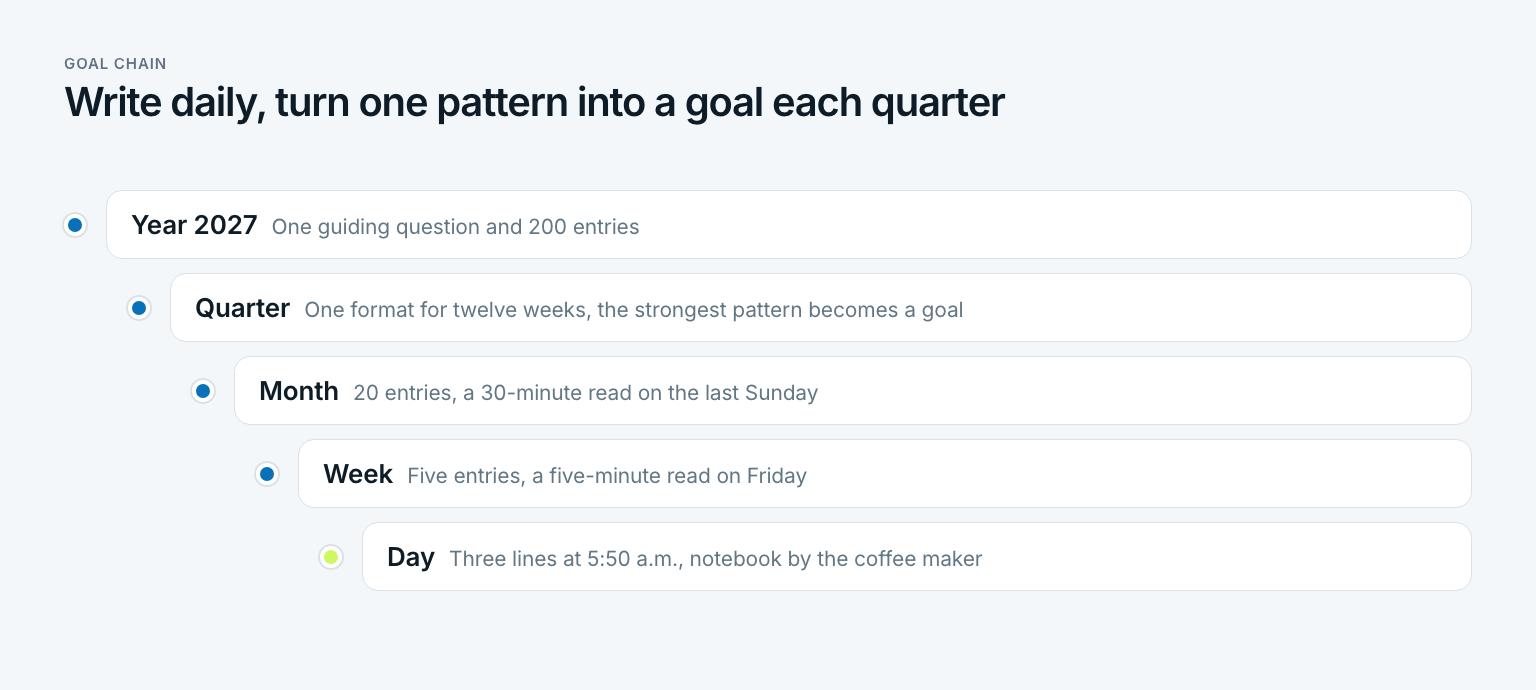
For Marcus, 2027 looks like this. His guiding question for the year: “What in my job gives me energy, and what drains it?” He aims for 200 entries, just under four a week. In the first quarter he keeps the 3/2/1 method, and at the end of the quarter the strongest pattern becomes a goal, for example: “By the end of June, robotics prep is limited to two fixed afternoons a week.” Each month holds 20 entries and a 30-minute read on the last Sunday. Each week holds five entries and a five-minute read on Friday. Each day holds three lines at 5:50 a.m.
The weekly read fits neatly into a short review like the one in the ten-minute weekly review. There you measure the week against your goals, and the journal supplies the why. If you break your goals down from year to day in Gaapp, you can set the daily entry as a recurring daily goal and turn the quarterly pattern straight into a new goal. Whoever keeps journal and goals apart ends up with a full notebook and a goal list that know nothing about each other.
Three questions to audit your own journal
Before you buy a new notebook or try a new format, answer three questions about the journal you keep or want to keep:
- Do you know why you are writing? If you cannot say it in one sentence, write it on the first page today.
- Can you hit your minimum on your worst day? If not, cut it in half until the answer is yes.
- When did you last reread? If it was more than a month ago, read your last ten entries tonight and write down one pattern in a single sentence.
In short: a journal is not an archive of your days but a tool that only starts working when you read it back.
Frequently asked questions about journaling
What is journaling and how do I do it?
Journaling is writing regularly with a purpose, to sort your thoughts rather than just record events. Pick a reason, one format such as a daily prompt, and a fixed time tied to something you already do. Write for 5 to 15 minutes, with a minimum of three sentences, and reread your entries once a week.
What is the 3/2/1 method of journaling?
It is a short daily structure with three parts of decreasing size. There is no single official version, but a common one is three things on your mind, two things that went well, and one thing you will do first. It works well for beginners because six short slots are easier to fill than a blank page.
What are the three types of journaling?
There is no official classification, but most formats fit into three types. Expressive journaling processes feelings, reflective journaling thinks something through from a prompt or question, and practical journaling logs tasks, progress, and plans. Morning pages, gratitude journals, and bullet journals each sit inside one of these types.
How do I begin journaling as a beginner?
Write your reason on the first page, pick one format for 30 days, and attach journaling to an existing habit such as your first coffee. Set a minimum of three sentences so tired days still count. After seven days, read everything once and underline one sentence that surprises you.
Is journaling good for mental health?
Research on expressive writing, starting with James W. Pennebaker's studies in 1986, suggests it can help people process stressful experiences. Later reviews describe the effect as small on average and not the same for everyone. Journaling is not a substitute for treatment, so persistent distress belongs with a doctor or therapist.
How often should you journal?
Four to seven short entries a week is a good rhythm for everyday journaling. More important than any single day is a minimum you can hit on bad days, such as three sentences. Add a fixed reading slot, for example five minutes every Friday.
Last updated: 19 October 2026
Read next
 Personal Growth
Maslow's Hierarchy of Needs: The 5 Levels Explained
Maslow's hierarchy of needs sorts motivation into five levels. What each level means, what research says today and a needs audit you can run yourself.
14 min read
 Personal Growth
Mindfulness Exercises: 12 for Everyday Life
Mindfulness exercises are not about emptying your mind. 12 techniques for stress and focus, what research shows, and a four-week plan to practice daily.
16 min read
 Personal Growth
Positive Affirmations: 50 Examples You Can Believe
Positive affirmations are not magic words. What research shows, 50 daily affirmations you can believe, and a five-step method with a worked example.
16 min read