Mindfulness Exercises: 12 for Everyday Life
Mindfulness exercises are not about emptying your mind. 12 techniques for stress and focus, what research shows, and a four-week plan to practice daily.

Contents
- 01What mindfulness is, and what it is not
- 02The five facets of mindfulness researchers measure
- 03What the research shows, and where it gets overstated
- 0412 mindfulness exercises, sorted by the time you have
- 05How to practice mindfulness every day: a four-week plan
- 06How to create your own guided meditation
- 07Mindfulness in your goal chain: from a yearly goal to Tuesday morning
- 08Three mistakes that quietly end a mindfulness practice
- 09When mindfulness exercises are not the right tool
- 10Frequently asked questions about mindfulness exercises
Mindfulness exercises are not a way to empty your mind. They are short, repeatable practices that train you to notice where your attention is right now, on your breath, your body, a sound or the task in front of you, and to bring it back without scolding yourself for drifting. Whoever notices they have wandered off has not failed the exercise. They have just completed one repetition of it. That small return is the whole workout.
Most modern mindfulness techniques trace back to Jon Kabat-Zinn, who built the eight-week Mindfulness-Based Stress Reduction program, known as MBSR, at the University of Massachusetts Medical School in 1979. To keep things concrete, this guide follows Priya, 34, a product manager in Denver with a two-year-old daughter and a 40-minute commute. Priya has noticed that she drafts Slack replies in her head during bath time and rehearses tomorrow's standup while reading bedtime stories. You get 12 exercises sorted by how much time you have, the five skills researchers actually measure, a four-week plan, a short guide to recording your own guided meditation, three common mistakes, and a clear line on when mindfulness is not the right tool.
What mindfulness is, and what it is not
Mindfulness is a way of paying attention. In his 1994 book Wherever You Go, There You Are, Kabat-Zinn describes it as attention that is deliberate, anchored in the present moment, and free of judgment. In 2004, a group of researchers led by psychologist Scott Bishop broke that down into two parts that can be studied. The first is steering your attention on purpose. The second is meeting whatever shows up with curiosity and openness instead of resistance.
That means: mindfulness is not a mood. It is a skill. Moods come and go on their own schedule. Skills get better with repetition, the way a muscle does. Anyone who practices for a few minutes a day is training the exact thing that goes missing in a busy week, the ability to catch where your attention went before it has been gone for an hour.
Three ideas often get lumped in with mindfulness. None of them is wrong. Each one is built for something else:
- Relaxation. A state you deliberately produce with methods like progressive muscle relaxation. Mindfulness can be relaxing, but it does not have to be. Whoever feels restless during an exercise is still doing it right.
- Meditation. The formal version of practice, a set time when you sit or lie down and train. Mindfulness is the quality you train there and then carry into the rest of the day. Kabat-Zinn calls these formal and informal practice.
- Positive thinking. Mindfulness does not ask you to feel good or to reframe a thought into something nicer. It only asks you to notice what is there. An irritated thought is allowed to stay irritated.
For Priya, this changes the goal. She does not need to feel calm to be mindful. She needs to notice, halfway through her daughter's bath, that she is writing a message to her engineering lead, and then come back to the water and the rubber duck. In short: mindfulness is noticing and returning, as many times as it takes.
The five facets of mindfulness researchers measure
If you have seen the question about the five basics of mindfulness, the most solid answer comes from research. In 2006, psychologist Ruth Baer and colleagues combined several existing questionnaires and found five distinct skills that together make up mindfulness. Their Five Facet Mindfulness Questionnaire is still one of the most widely used measures in the field. Each facet is something you can practice on purpose.
| Facet | What it means | What it looks like for Priya |
|---|---|---|
| Observing | Noticing sensations, sounds, sights and feelings | She feels the warm mug in her hands before the first sip |
| Describing | Putting what you notice into words | She labels a tight chest as “nervous about the roadmap review” |
| Acting with awareness | Paying attention to what you are doing right now | She drives the commute without replaying yesterday's meeting |
| Nonjudging | Not grading your thoughts and feelings as good or bad | She notes “mind wandered a lot” instead of “I am terrible at this” |
| Nonreactivity | Letting thoughts and feelings come and go without acting on them | An urge to check Slack passes without her picking up the phone |
Notice that only one of the five facets is about focusing hard. The other four are about seeing clearly and not reacting right away. Whoever wants to practice mindfulness well needs all five, which is why the 12 exercises below cover different ground.
What the research shows, and where it gets overstated
The research on mindfulness is large but uneven. In 2014, Madhav Goyal and colleagues reviewed 47 randomized trials of meditation programs in JAMA Internal Medicine. Mindfulness programs produced small to moderate improvements in anxiety, depression and pain compared with control groups. The evidence for reducing stress and improving quality of life was weaker.
A second study explains why practice is worth the effort at all. In 2010, Matthew Killingsworth and Daniel Gilbert used a smartphone app to ask about 2,250 adults, at random moments, what they were doing and what they were thinking about. In roughly 47 percent of those moments, people were thinking about something other than what they were doing. And in those moments they reported being less happy on average. Does that sound like your Tuesday afternoon? Anyone who recognizes the pattern knows where mindfulness exercises come in.
Mindfulness is not a cure
In 2018, a group of researchers led by Nicholas Van Dam published a paper in Perspectives on Psychological Science with a blunt warning about hype. Many studies are small, good control groups are often missing, and the word mindfulness gets used for very different things. That does not mean the exercises do nothing. It means they are attention training, not a replacement for treatment. Whoever keeps that in mind will expect the right thing: more noticing, not fewer problems.
12 mindfulness exercises, sorted by the time you have
The easiest way to choose mindfulness exercises is by the time you actually have. Some take one minute and fit between two calls. Others take ten to 30 minutes and a quiet spot. The table shows all 12 at a glance, followed by instructions in four groups.
| Exercise | Time | Type | Use it when |
|---|---|---|---|
| Three mindful breaths | 1 minute | informal | you switch between two tasks |
| STOP | 1 to 2 minutes | informal | you are about to snap at someone |
| 5-4-3-2-1 grounding | 2 to 3 minutes | informal | your thoughts are racing |
| Breath meditation | 5 to 20 minutes | formal | you want one fixed daily practice |
| Body scan | 10 to 45 minutes | formal | you want to notice tension in your body |
| Noting thoughts | 5 to 10 minutes | formal | one worry keeps pulling you back |
| Mindful eating | 3 to 5 minutes | informal | you eat in front of a screen |
| Mindful walking | 5 to 15 minutes | both | sitting still feels impossible |
| Mindful listening | one conversation | informal | you plan your reply while others talk |
| RAIN | 3 to 5 minutes | informal | a strong emotion takes over |
| Self-compassion break | 2 to 3 minutes | informal | you are being hard on yourself |
| Three moments at night | 5 minutes | informal | you want to close the day on purpose |
One-minute mindfulness techniques
Three mindful breaths. Breathe in and out three times and follow each breath from start to finish. Notice where you feel it most clearly: at the nostrils, in the chest or in the belly. Priya does this every time a video call ends and before the next one starts. On a typical day that is eight to ten chances to practice without adding a single minute to her calendar.
STOP. This acronym comes from MBSR teachers and gives you four quick steps. Stop what you are doing. Take one deliberate breath. Observe what is happening in your body, your feelings and your thoughts. Proceed with whatever you were about to do. Whoever runs through STOP before replying to a sharp message buys one breath of space between the trigger and the reaction.
5-4-3-2-1 grounding. Silently name five things you can see, four you can hear, three you can feel, two you can smell and one you can taste. The technique is widely used in therapy and self-help, though its exact origin is unclear. It pulls your attention out of your head and back into the room through the senses. That makes it useful when your thoughts are spinning and a breathing exercise would turn you even further inward.
Ten-minute practices: breath meditation and the body scan
Breath meditation. Sit upright with your feet on the floor and your eyes closed or resting on a spot on the floor. Bring your attention to the breath without trying to change it. When you notice you have drifted, briefly name where you went, such as “planning” or “remembering,” and come back to the breath. In ten minutes this can happen dozens of times. Every return counts as one repetition, like a single squat at the gym.
Body scan. A body scan meditation is a practice in which you lie down and move your attention slowly through the body, usually from the toes to the top of the head. You notice each area without trying to change anything: warmth, tingling, pressure, or nothing at all. In the MBSR course the body scan lasts about 45 minutes. Ten minutes is plenty to start. Whoever falls asleep every time probably needs more sleep, so try it sitting up or at a more alert time of day.
Noting thoughts. Picture your thoughts as clouds crossing the sky or leaves floating down a stream. You watch them pass without climbing aboard. When the same thought keeps returning, give it a short label like “the roadmap worry.” The label creates distance. The thought is still there, but you are no longer standing in the middle of it.
Mindfulness in everyday activities
Mindful eating. In the first session of an MBSR course, participants eat a single raisin very slowly: they look at it, smell it, feel it and finally taste it. The exercise shows how much we usually miss. In daily life, the first three bites of a meal without a phone or a screen are enough. Priya does this at lunch, which used to happen in front of her inbox.
Mindful walking. Walk a little slower than usual and pay attention to how your feet roll from heel to toe, how your weight shifts, how the air feels on your skin. You can do this in a hallway, on the way to the parking garage or around the block. Anyone who gets restless sitting still will find a formal practice here that moves.
Mindful listening. In your next conversation, just listen. Do not draft your reply while the other person is still talking. Pay attention to the words, the tone and the pauses. When you catch yourself planning, come back to the voice. For Priya, this is the exercise that matters most, because her whole job runs on meetings.
Mindfulness exercises for stress
RAIN. The acronym was first used by meditation teacher Michele McDonald and later popularized by Tara Brach. Recognize what you are feeling. Allow it to be there for a moment. Investigate where it shows up in your body. Nurture yourself with a kind word or a hand on your chest. RAIN is one of the more useful mindfulness exercises for stress, because it gives a strong emotion a structure instead of a fight.
Self-compassion break. Psychologist Kristin Neff describes self-compassion as three parts: mindfulness, a sense that struggle is part of being human, and kindness toward yourself. The break turns that into three short sentences. This is hard right now. Other people feel this way too. What would I say to a friend in my place? Priya uses it after meetings that went badly.
Three moments at night. Before you go to sleep, walk back through the day and find three moments you actually noticed, pleasant or not. Write one sentence about each. This is not a gratitude list. It is a review of your attention. Whoever already keeps a journal can simply add these three lines to the end of the entry.

How to practice mindfulness every day: a four-week plan
The best way to practice mindfulness as a beginner is small and anchored. Whoever starts with 30 minutes a day often quits in the second week. Whoever starts with five minutes has usually found a place for it in the day by week four. Priya followed these five steps:
Pick one formal and one short exercise
Choose one practice with a fixed time, such as breath meditation, and one for the gaps in your day, such as three mindful breaths. Nothing more. Priya picks breath meditation in the morning and three breaths between calls.
Attach it to an anchor
Link the formal practice to something you already do every day. Priya sits down right after she starts the coffee maker at 6:15 a.m., before her daughter wakes up. The article on [habit stacking](/en/blog/habit-stacking) explains how this kind of link works.
Start with five minutes
Set a timer for five minutes. Only add time once you have practiced on five of seven days. Priya moves to eight minutes in week two and ten in week three.
Write one line a day
After each session, write one line: date, minutes, one observation. Something like “8 minutes, kept drifting to the sprint plan.” The line does not measure how well you did. It only records that you showed up.
Review after four weeks
Count your practice days and read your lines. Priya lands at 22 of 28 days and an average of nine minutes. Her notes show that she catches herself drifting in meetings more often than she used to. Then decide whether to add time, switch exercises or stay where you are.
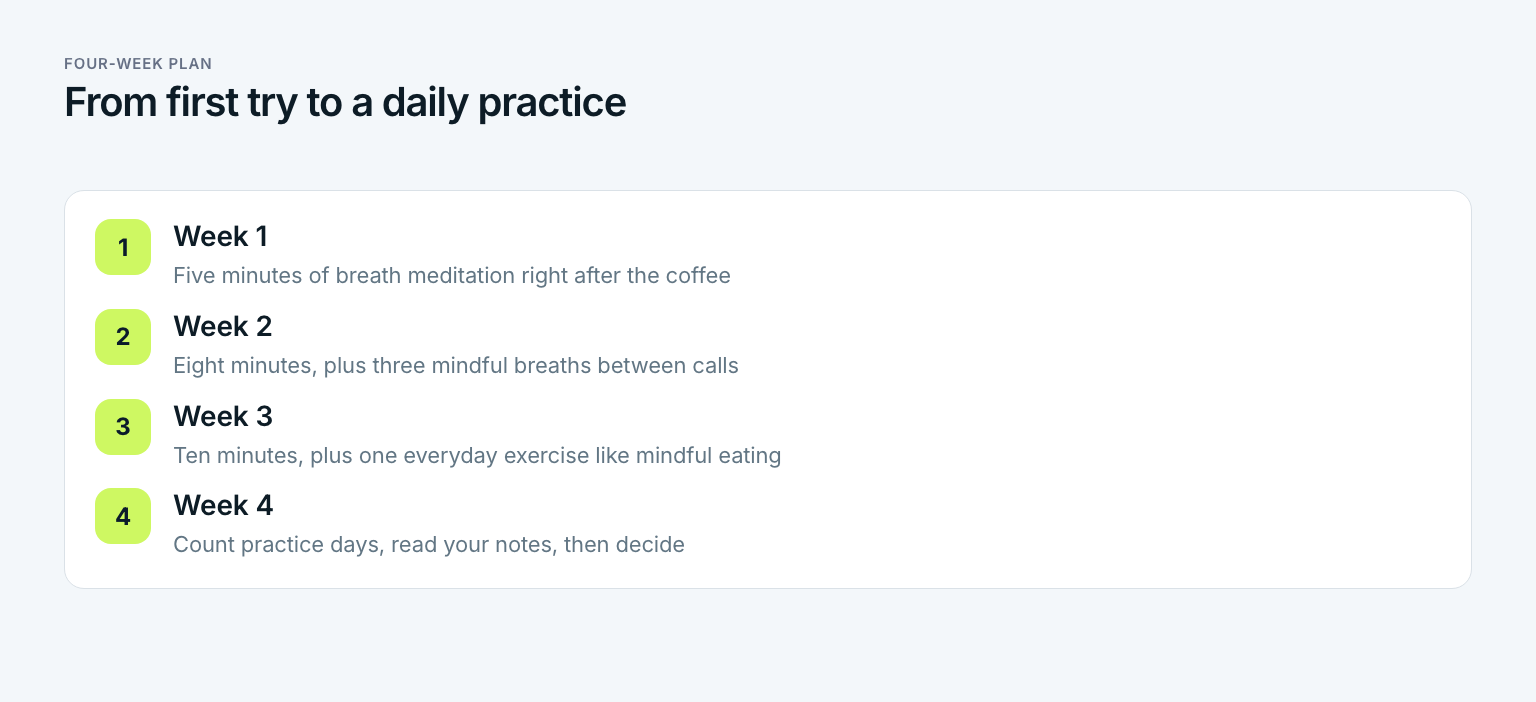
What step five leaves out matters as much as what it includes: there is no grade for how calm your mind was. That swings from day to day, even for people who have practiced for years. What counts is the number of days you sat down. Everything else is weather.
How long until it sticks? In a 2010 study, psychologist Phillippa Lally and her team followed people as they built a new habit. On average it took 66 days for the behavior to feel automatic, with a wide range between individuals. The article on how long it takes to form a habit covers the details. For mindfulness, that means planning for two to three months, not two weeks.
How to create your own guided meditation
Recorded meditations from apps work well for many people. Some prefer their own voice, their own pace or a script that fits their day. Writing your own guided meditation takes about 20 minutes and a phone. A simple script has five parts:
- Arrive. One or two sentences to settle in: sitting position, feet on the floor, eyes closed or lowered.
- Choose an anchor. Name one place to rest attention, usually the breath at the belly or the nostrils.
- Expect wandering. Add a sentence that gives permission to drift, such as “When you notice your mind has wandered, gently come back to the breath.”
- Widen. Toward the end, open attention to the whole body and the sounds in the room.
- Close. Count down from three, open your eyes, and name one thing you will do next.
Read the script slowly and leave long pauses, often 20 to 30 seconds between instructions. Silence is where the practice happens. Priya recorded a seven-minute version for her commute days, using the parking garage elevator as her cue to start. Whoever records their own track usually notices something useful: the pauses feel longer than they are, which is exactly the point.
Mindfulness in your goal chain: from a yearly goal to Tuesday morning
Isn't mindfulness the opposite of goal setting? It is a fair objection. Non-striving is one of the attitudes Kabat-Zinn describes, and anyone who chases a result inside the practice misses it. The way out is to be precise about what the goal covers. It covers practice time, not the experience during practice. “Practice ten minutes a day” is a goal you control. “Be calmer” is not.
Priya translated her intention into a goal chain like this:
- Year 2027: Mindfulness as a steady practice on at least 250 days, plus an eight-week MBSR course in the spring.
- Quarter Q1: Finish the four-week plan, then ten minutes daily on 60 of 90 days.
- Month January: Breath meditation at 6:15 a.m. on 20 days, STOP before every one-on-one.
- Week 3: Five practice days, MBSR course registration sent.
- Tuesday: Ten minutes of breath at 6:15 a.m., mindful listening in the 2 p.m. sprint review, three moments at night.
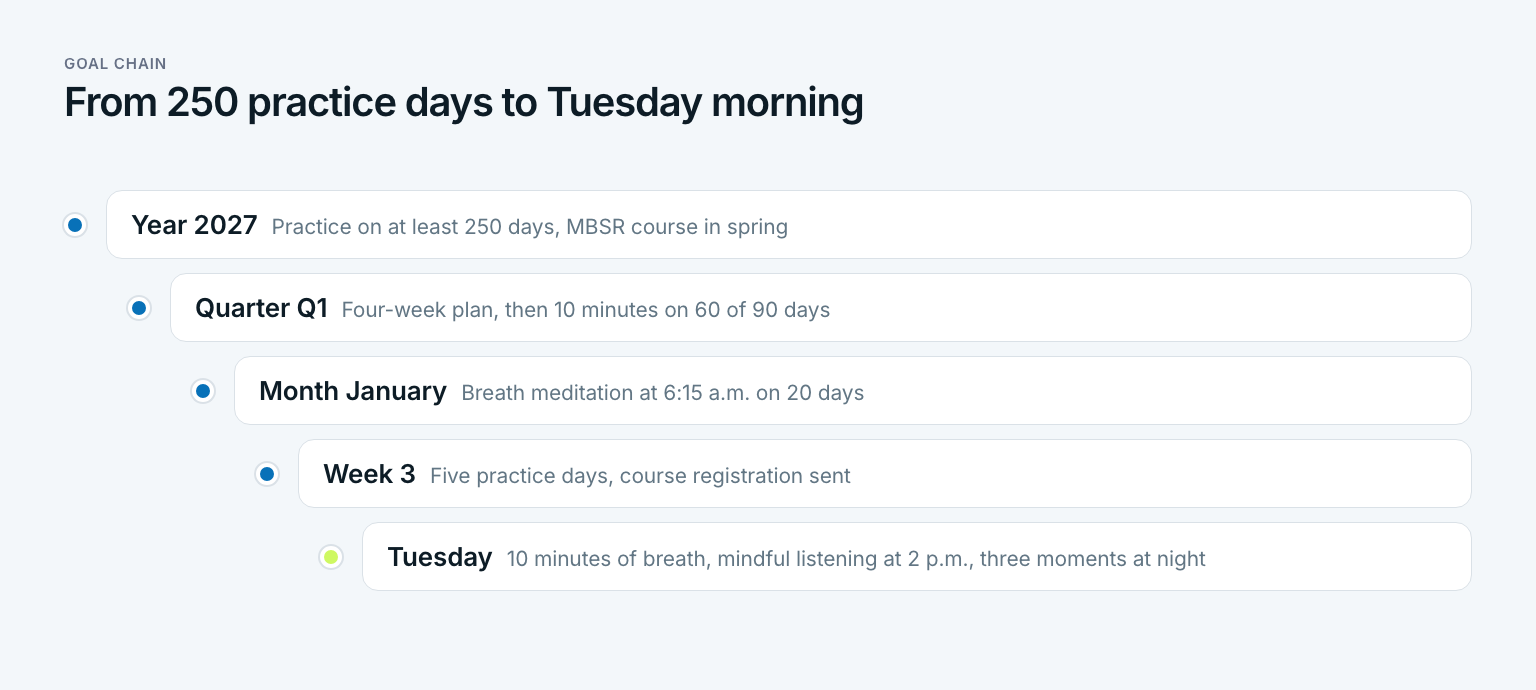
The benefit of this chain: every level has a number Priya controls. Whether her mind was quiet on Tuesday is not something she tracks. Whether she practiced is. In Gaapp she sets the yearly goal once and sees each Friday whether the week held. That means: the goal takes care of consistency, and the practice itself stays free of performance pressure. For the bigger picture of handling a heavy workload, the guide to stress management adds the other two pillars.
Three mistakes that quietly end a mindfulness practice
Most people do not quit because the exercises are wrong for them. They quit because they started with the wrong expectations. Three mistakes come up again and again:
- Treating wandering as failure. Whoever thinks after five minutes that they cannot do this because they only thought about work has misunderstood the exercise. Noticing is the exercise. Wandering off ten times means coming back ten times.
- Starting too big. Thirty minutes on day one feels ambitious and rarely lasts past a week. Five minutes on 25 days adds up to more practice than 30 minutes on three days, and it builds a habit on top.
- Only practicing in a crisis. Anyone who pulls out mindfulness only when stress is already high is practicing under the hardest possible conditions. An exercise you know from calm days is available on hard ones.
The most common mistake: mindfulness as a performance
Many people grade every session. Today was good, yesterday was bad. That is understandable, because we grade almost everything. But grading turns practice into a test, and tests create pressure. So write down only whether you practiced and what you noticed, never how well it went. That is the nonjudging facet, applied to yourself.
Three questions before you start
- Which one exercise will I do starting tomorrow, and at what time?
- What daily activity will I attach it to, so I do not have to remember?
- What will I count after four weeks, without grading how calm I felt?
Whoever can answer all three in one sentence each has a plan. Whoever still hesitates can start with three mindful breaths before the next meeting. The first day does not need more than that. For longer stretches of focused work, the guide on how to focus picks up where this leaves off.
When mindfulness exercises are not the right tool
Mindfulness exercises are designed for the everyday life of healthy adults. They do not replace a diagnosis or treatment. And they are not pleasant for everyone at every point in life. A 2020 systematic review by Miguel Farias and colleagues found that about 8 percent of participants across the included studies reported unwanted effects, most often anxiety and depressive symptoms. That is not a reason to worry, but it is a reason to pay attention to how you respond.
If strong restlessness, panic or distressing memories come up during an exercise, stop and open your eyes. Switch to an outward-facing practice like 5-4-3-2-1 grounding or mindful walking. Anyone who has or has had PTSD, psychosis or severe depression should talk to a doctor or therapist before starting a meditation practice. The same goes for sleep problems, exhaustion or low mood that last for weeks.
If you are in crisis, call or text 988 in the United States, or in Germany call the TelefonSeelsorge at 0800 111 0 111, free and around the clock. In short: mindfulness is not a remedy for hard days. It is a practice that helps you live your days with more attention.
Frequently asked questions about mindfulness exercises
What is a body scan meditation?
A body scan meditation is a practice in which you move your attention slowly through the body, usually from the toes to the head, and notice each area without changing anything. It is a core exercise in MBSR, where it lasts about 45 minutes. Beginners can start with ten minutes, lying down or sitting.
What are the 5 basics of mindfulness?
The best-supported answer comes from the Five Facet Mindfulness Questionnaire by Ruth Baer and colleagues, 2006. It names five skills: observing, describing, acting with awareness, nonjudging of inner experience and nonreactivity to inner experience. Each can be trained with specific exercises.
How to create my own guided meditation?
Write a short script with five parts: arriving, choosing an anchor like the breath, permission to wander and return, widening attention, and closing. Record it on your phone in a slow voice with pauses of 20 to 30 seconds between instructions. Five to ten minutes is a good length to start.
What are the three C's of mindfulness?
The three C's are not a fixed term from research, and different teachers use different trios, often built around curiosity and compassion. If you want a research-based core, Bishop and colleagues described two components in 2004: directing attention on purpose and meeting what you notice with curiosity and openness.
How do I practice mindfulness as a beginner?
Start with one formal exercise of five minutes a day, such as breath meditation, and one short exercise for the gaps in your day, such as three mindful breaths. Attach the formal practice to something you already do every morning. Add time only after you have practiced on five of seven days.
How long should you practice mindfulness each day?
Five to ten minutes a day is enough to start. The MBSR program asks for about 45 minutes of daily home practice over eight weeks, which is a lot for most working parents at the beginning. Practicing on most days matters more than practicing for long.
Last updated: 22 October 2026
Read next
 Personal Growth
Maslow's Hierarchy of Needs: The 5 Levels Explained
Maslow's hierarchy of needs sorts motivation into five levels. What each level means, what research says today and a needs audit you can run yourself.
14 min read
 Personal Growth
Positive Affirmations: 50 Examples You Can Believe
Positive affirmations are not magic words. What research shows, 50 daily affirmations you can believe, and a five-step method with a worked example.
16 min read
 Personal Growth
How to Manifest: What Science Says Actually Works
Manifesting is not magic. Learn how to manifest something with a method that holds up: what research says, 369 and 777, and a template on paper.
15 min read