Coaching Goals: How to Set Them With Your Clients
Coaching goals are not wishes: how to clarify them in the first session, five steps, 15 examples and a way to track progress between sessions.

Contents
- 01What coaching goals are and what they are not
- 02Types of coaching goals, with examples
- 03Coaching is not therapy: where the line is
- 04Goal setting in coaching: the first session in three questions
- 05How to set coaching goals in five steps
- 06Coaching goals examples: 15 before-and-after rewrites
- 07Tracking progress between coaching sessions
- 08Three coaching goal mistakes nobody notices
- 09Coaching goals in a goal chain: from engagement to today
- 10Frequently asked questions about coaching goals
Coaching goals are not wishes that a coach writes down more neatly. A coaching goal describes what the client will do differently or will have achieved by the end of the engagement, in their own words, with a criterion you can observe and a date. The wish is “I want to be more confident.” The goal is “By June 30, I present our numbers in the monthly leadership meeting myself and make one recommendation each time.” The first session exists to get from one to the other.
If you coach, you need three things for that: a first session that separates the issue from the goal, a goal the client actually owns, and a way to see progress between sessions. All of it is worked through with Maya, a leadership coach in Denver, and her client Marcus, a newly promoted operations manager. You also get four types of coaching goals, 15 coaching goals examples as before-and-after rewrites, the three mistakes that quietly sink them, and a clear line between coaching and therapy.
What coaching goals are and what they are not
A coaching goal is the agreed end state that coach and client use to judge whether the engagement worked. It has three fixed parts. It belongs to the client, it names a behavior or result rather than a feeling alone, and it has a date. That sounds obvious. Yet many engagements still start with a topic instead of a goal. Anyone who starts with a topic has good conversations. Anyone who starts with a goal can tell at the end whether those conversations were enough.
The International Coaching Federation describes coaching as a partnership in a thought-provoking, creative process that helps clients reach their personal and professional potential. The word partnership carries the weight. The coach does not hand over a solution and does not set the goal. The coach asks the questions that let the client find the goal and phrase it so it can be checked.
Coaching objectives, goals and actions: three levels
Three words get used interchangeably in coaching agreements. They work better as three levels:
- Coaching objective. The overall purpose of the engagement, often agreed with the sponsor in company-paid coaching: “Marcus leads his new team with confidence.” It gives direction, but it cannot be measured on its own.
- Coaching goal. The specific, dated end state the client commits to: what will be different, by when, and how you will both know.
- Action. The step the client takes before the next session. Actions change every two weeks. The goal stays put.
In short: the objective says why, the goal says what, the action says what next. Anyone who writes down only the objective ends up coaching toward a direction without a finish line.
Types of coaching goals, with examples
Coaching goals can be sorted by what has changed at the end. Four types cover almost every one-on-one engagement. Knowing which one you are dealing with tells you what to measure, often in the first twenty minutes.
| Type | What changes | Example | How you measure it |
|---|---|---|---|
| Outcome goal | Something in the world | “By May 31, I have an offer for a product manager role.” | Offer signed, yes or no |
| Behavior goal | What the client does regularly | “I hold a 30-minute one-on-one with each direct report every two weeks.” | One-on-ones held per month |
| Decision goal | An open question gets settled | “By April 15, I decide whether to take the regional role.” | Decision made, reasons written down |
| Capability goal | What the client can do | “I run the quarterly business review without notes.” | Self-rating on a 0 to 10 scale plus feedback from two peers |
Most strong coaching goals mix two types. Marcus wants an outcome, being taken seriously by the leadership team, and he needs a behavior to get there: speaking up with a prepared recommendation. That means: the outcome sets the direction, the behavior is the lever. Anyone who writes down only the outcome will know at the end whether it worked, but not why.
The three key goals of coaching in general
Ask what coaching is for in general, not for one client, and the classic answer comes from John Whitmore. In “Coaching for Performance,” first published in 1992, he names two aims: raising the client’s awareness and building their responsibility. A third follows from those two in practice: action the client takes on their own. Awareness without action is insight. Action without responsibility is compliance. A good coaching goal asks for all three.
Coaching is not therapy: where the line is
Coaching is for people who are broadly well and able to act, and who want to reach a goal or settle a question. Therapy treats conditions that need clinical care. This line is not a technicality. Diagnosing and treating mental health conditions is the job of licensed professionals such as psychiatrists, psychologists and licensed therapists or counselors. A coach who tries to coach someone out of depression has stepped outside the role and can do harm.
For goal work, that has three consequences. A coaching goal never promises healing or freedom from symptoms. It describes behavior, decisions or results in the client’s everyday life. And part of the first session is asking, briefly and calmly, about warning signs before any goal is agreed.
Signs a concern does not belong in coaching
Weeks of persistent low mood, ongoing sleep problems, panic attacks, substance misuse or thoughts of self-harm are not coaching topics. Anyone who describes them needs an assessment from a doctor or a licensed mental health professional first. Coaching may make sense afterward or alongside treatment if the treating professional agrees. In the US, anyone in crisis can call or text 988 at any hour. Name this boundary openly in the first session, so it never comes as a surprise later.
Maya asks those questions when Marcus mentions that leadership meetings make him nervous. How are you sleeping? How long has this been going on? Is it only in that meeting, or everywhere? Marcus sleeps fine, feels the nerves only before leadership meetings, and is relaxed with his own team. His topic is a new role and visibility, not a clinical picture. Had he described panic attacks or weeks of dread, Maya would have suggested he see a professional first and paused the goal work.
Goal setting in coaching: the first session in three questions
Goal setting in coaching is the path from the client’s issue to a goal. It needs no twenty-page intake form. Three questions carry most of the weight, as long as you give each one time and resist sorting the answers too early.
Question one: What exactly should be different?
The first question pulls the issue into everyday life. Marcus says “more confidence.” Maya asks: Where in a normal week do you notice it is missing? The answer gets specific. He was promoted four months ago and manages 14 people. In the monthly leadership meeting, his boss presents the operations numbers for him. Marcus has ideas, but he brings them up afterward in hallway conversations, when the decisions are already made. Anyone who translates the issue into situations finds the first measures right there.
Question two: How will you know you got there?
The second question aims at the criterion. It makes the client picture the end, not only the path. One variant from solution-focused practice is the miracle question: Suppose the problem were solved overnight. What is the first thing you would notice the next morning? Marcus thinks for a while. “I’d walk into the leadership meeting with my own slides, and I wouldn’t rehearse my first sentence twenty times.” That is a criterion you can observe.
Question three: Why does this matter to you?
The third question tests whether the goal belongs to the client. For Marcus the answer is clear. He wants the regional director role in two years, and he knows nobody gets that role from the hallway. A goal with its own why carries the client through hard weeks. A goal set by a boss or a spouse lasts until the first excuse. Do you notice the client speaking for someone else? Then that belongs on the table before you go on.
The GROW model as scaffolding
John Whitmore made the GROW model widely known through “Coaching for Performance.” The letters stand for Goal, Reality, Options and Will. Notice the order. The goal comes first, before the analysis of the current situation. Anyone who lays out all the problems first tends to phrase the goal as the opposite of the problem, which makes it smaller and more defensive than it needs to be.

How to set coaching goals in five steps
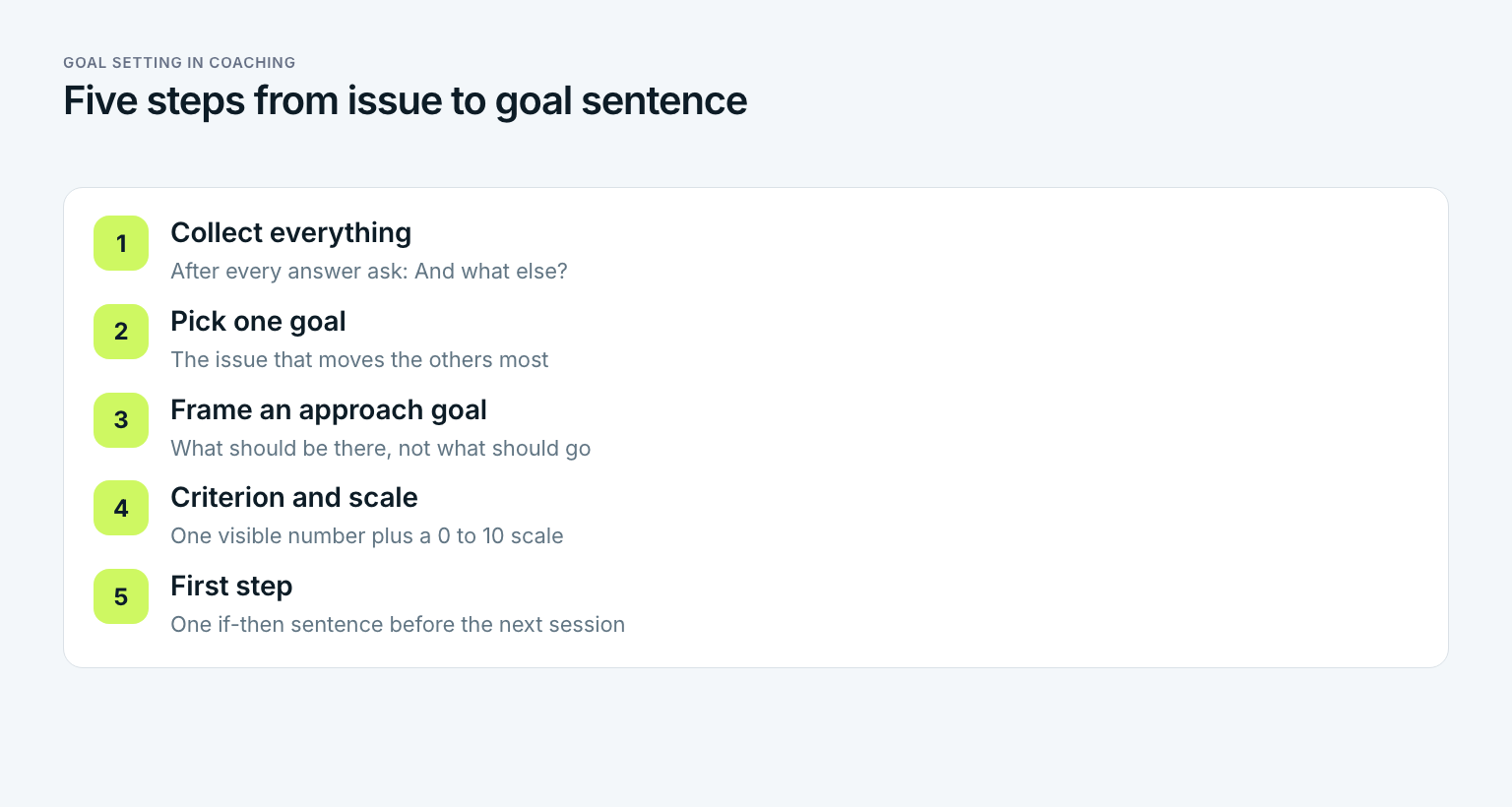
Issue, criterion and why now become one sentence. These five steps take you and your client there in the first or second session, in about 40 minutes. For the sentence mechanics of goals in general, see how to write SMART goals. This section covers what coaching adds: ownership, approach framing and the step until the next session.
Collect everything, judge nothing
Let the client list everything that should change, and after each answer ask: And what else? Michael Bungay Stanier calls this the best coaching question in the world in “The Coaching Habit,” because the first answer is rarely the real one. Marcus lists five things. The fourth is the one that matters: “I wait until I’m sure, and by then the meeting is over.”
Pick one goal
Ask which item would move the others most. An engagement with five goals is an engagement without one. One main goal, two at most, is plenty for four months. Marcus picks speaking up in the leadership meeting, because his visibility, his confidence and his path to promotion all hang on it.
Frame it as an approach goal
Phrase what should be there instead of what should go away. “Stop staying quiet in meetings” describes a hole. “Make one recommendation in every leadership meeting” describes a state you can move toward. Approach goals are easier to plan, because they already point to a next step.
Set a criterion and a scale
Agree on an observable criterion and add a 0 to 10 scale for what is hard to count. Marcus rates his confidence walking into the leadership meeting at 3 today. His target is 7. Two hard measures go with it: he presents the operations numbers himself, and he makes at least one recommendation in each of the four monthly meetings before June 30.
Agree on the first step
Close every goal setting conversation with one step the client takes before the next session, written as an if-then sentence. Psychologist Peter Gollwitzer showed in 1999 that these implementation intentions make follow-through considerably more likely than a goal alone. Marcus: “When the agenda for the March meeting goes out, I email my boss and ask for ten minutes for the operations update.”
Worked example: Maya and Marcus
Marcus is 38 and was promoted to operations manager at a regional logistics company four months ago. His company pays for eight sessions of 60 minutes over four months, one every two weeks. In the first session with Maya, “more confidence” turns into this sentence in about an hour:
“By June 30, I present our operations numbers myself in each monthly leadership meeting and make at least one recommendation every time. I rate my confidence going in at 7 out of 10 or higher.”
Three things stand out. It is in the first person, and Marcus dictated it himself. It names one specific meeting rather than “meetings.” And it combines a behavior, presenting and recommending, with a scale for the feeling he came in with. Because the company pays, there is a three-way relationship. Maya puts it in writing that HR learns the goal and the completion, not what is said in sessions. Anyone who leaves confidentiality unsettled before the first session loses it at the first sensitive question.
| Leadership meeting | Who presented the ops numbers | Recommendations made | Confidence going in |
|---|---|---|---|
| February, before coaching | His boss | 0 | 3 |
| March | Marcus, 5 minutes | 0 | 4 |
| April | Marcus, 10 minutes | 1, accepted | 5 |
| May | Marcus, 10 minutes | 0 | 3 |
| June | Marcus, 15 minutes | 2, one accepted | 7 |
May is the most useful row in the table. Marcus presents but makes no recommendation, and his confidence drops back to 3. Without a goal, the next session could have been: it isn’t working. With a goal, the question is sharper: what exactly was missing that week? The answer is precise. A board member joined the meeting unannounced, and Marcus had prepared his recommendation for his boss, not for the board. That means: setbacks in coaching are not interruptions. They are the material the goal gets sharpened on.
Coaching goals examples: 15 before-and-after rewrites
These coaching goals examples come from typical one-on-one issues. The left column shows how clients describe the issue in the first session. The right column shows a coaching goal it can turn into. The numbers are placeholders. In a real engagement, the client sets them.
| Area | What the client says | Coaching goal after goal setting |
|---|---|---|
| Leadership | “I need to delegate more.” | By June 30, two team members each run one project end to end, and I only join the monthly review. |
| Leadership | “I avoid hard conversations.” | Through May, I raise every missed commitment in a one-on-one within 48 hours. |
| Leadership | “My team doesn’t know what I expect.” | By the end of the quarter, every direct report has three written priorities we agreed on together. |
| Communication | “I’m too quiet in meetings.” | In every department meeting until the summer break, I bring at least one proposal of my own. |
| Communication | “Presenting isn’t my thing.” | By September, I give two talks to groups of 20 or more and rate my confidence afterward at 6 out of 10 or higher. |
| Career | “I don’t know whether to stay.” | By April 30, I decide against three written criteria whether to apply internally or externally. |
| Career | “I want to change careers.” | By July 31, I hold six informational interviews with people in product roles and apply to two positions. |
| Career | “I want a promotion.” | Before the November review cycle, I lead one cross-team project and ask my manager for written promotion criteria. |
| Business | “I undercharge.” | From my next proposal on, I quote my new day rate of $1,200 without offering a discount in my first reply. |
| Business | “I’m spread too thin.” | Until the end of the quarter, I spend three fixed mornings a week on my main offer, with email closed. |
| Time | “I never have time to think.” | Every Friday from 9 to 11 a.m., I block strategy time and keep it in eight out of ten weeks. |
| Transition | “I’m new in the role and don’t know where to start.” | In my first 90 days, I hold a getting-to-know-you meeting with all 14 direct reports and then set three priorities. |
| Conflict | “It’s not working with my co-founder.” | By the end of May, we hold one structured conversation and agree on two rules for how we make decisions. |
| Balance | “I want more time with my family.” | Starting in January, I am offline after 7 p.m. on four evenings a week and keep my work phone off on Sundays. |
| Habits | “I want to take better care of myself.” | For the next eight weeks, I take a 30-minute walk at lunch on four weekdays and log it every Friday. |
Notice what the right column lacks: none of the goals promises a feeling as its only result. “Be more confident” or “feel calmer” are legitimate wishes. They become coaching goals once a behavior or a scale sits next to them, so the client can tell for themselves whether anything is moving. Many coaches open the first session with a wheel of life to find out which area of life the goal should come from.
Tracking progress between coaching sessions
Progress in coaching does not happen in the session. It happens between sessions. Run the numbers for Marcus. Eight sessions of 60 minutes add up to eight hours. Over four months he has roughly 1,800 waking hours. The coaching itself is less than half a percent of his time. So what happens in the other 99.5 percent?
For many clients, the honest answer is: not much, until two days before the next session. Then they remember they are supposed to report something. That is not a character flaw. Everyday life is loud, the goal is quiet, and without a fixed moment to look at it, everyday life wins. Anyone who asks about the goal only in session sees only the week the client still remembers.
Maya and Marcus agree on a five-minute check-in every Friday. Same three questions every time:
- What moved the goal forward this week?
- Where am I on the 0 to 10 scale, and why not one point lower?
- What is my one step before next Friday?
The second question comes from solution-focused practice. It points attention at what already works rather than at the gap. For the general routine, see the ten-minute weekly review. Coaching adds one rule: Marcus writes the check-in for himself, not for Maya. She reads it before each session but does not comment in between. The goal stays his, and the session starts not from zero but from the question the past two weeks left open.
For your sessions, that means the first ten minutes no longer belong to the report. They belong to the pattern. Maya does not ask “How did it go?” She asks: “In three of four meetings you were at 4 or higher. In May you were at 3. What was different in the good ones?” Anyone who asks this way lets the client find their own answers instead of handing them over.
Three coaching goal mistakes nobody notices
Most coaching goals do not fail because the client lacks motivation. They fail because of three patterns that slip in during goal setting and only show up around session four.
First: the borrowed goal. The client phrases what a manager, HR or a partner expects. The goal sounds sensible but has no why of its own. You can spot it in sentences like “I’m supposed to …” or “My boss thinks I should …”. Without its own why, it lasts exactly as long as someone is watching.
Second: the feeling goal without an anchor. “Be calmer” is an honest wish. Without a behavior or a scale, though, nobody knows after four months whether it came true. The engagement ends with a pleasant feeling and no result, and no one can say whether the investment paid off.
Third: the goal that only exists in session. It lives in the coach’s notes, not in the client’s calendar. Between sessions nobody thinks about it, so every session turns into a recap. How many of your sessions have opened with the question of what happened since last time?
The most common mistake: the coach writes the goal
Coaches are good with words. So it is tempting to take the client’s halting sentences, pour them into a clean phrase and read it back. The sentence gets better. It just no longer belongs to the client. You can offer options, sharpen and point out missing numbers. But anyone who writes the goal for the client also takes on the responsibility for reaching it. Let the client say the final sentence and write it down word for word.
Coaching goals in a goal chain: from engagement to today
A four-month coaching goal is too big for one week and too small for a career. To reach everyday life, it needs a chain: a bigger goal above it and smaller ones below. The goal chain of year, quarter, month, week and day turns the goal from the session into the calendar. The principle behind it is laid out in how to achieve goals. For Marcus, the chain looks like this:
- Year: Be ready for the regional director role, known in the leadership team for clear numbers and useful recommendations.
- Quarter, the core of the engagement: By June 30, present the operations numbers in every leadership meeting with at least one recommendation, confidence at 7.
- Month: In April, prepare a recommendation on weekend shift staffing with data from all three warehouses.
- Week: Draft three slides on Tuesday and test them with one peer on Thursday.
- Day: Wednesday, 8 a.m.: 45 minutes pulling the overtime data for the three warehouses.
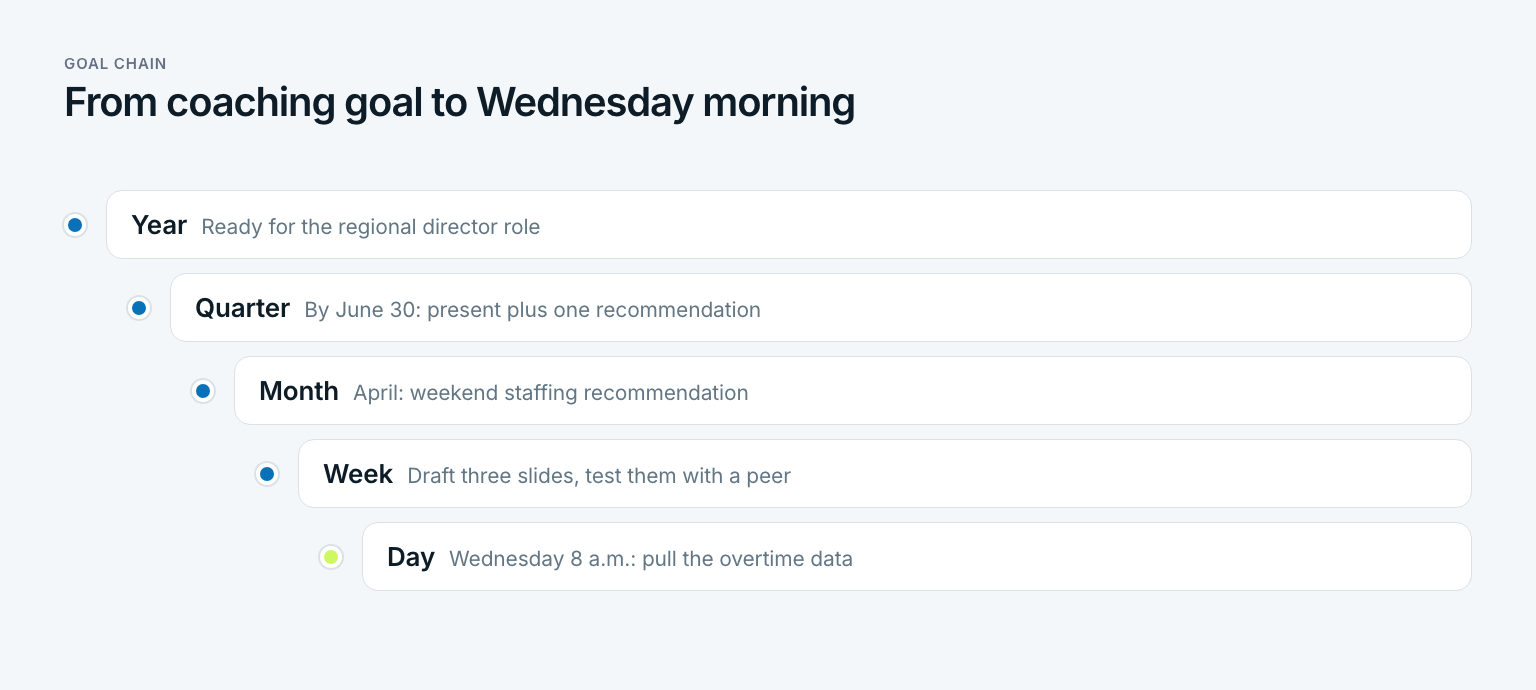
The chain has a second benefit in coaching: coach and client look at the same thing. In Gaapp, the client creates the goal in a shared space and invites the coach. He keeps the weekly goals and Friday check-ins current, she reads along and arrives at each session prepared. How shared goals work in practice is covered in shared goals in a space.
Two rules come with it. The client decides what to share and can end the coach’s access at any time. And confidential content from sessions stays where it belongs, in the coach’s own notes, not in the shared goal space. Anyone who keeps the two apart protects the trust every engagement rests on.
Five questions before the next session
Before your next session, check your client’s goal with five questions:
- Did the client phrase the goal sentence, and could they repeat it without notes?
- Does the goal name a behavior or a number, not only a feeling?
- Is there a scale, and do you both know the starting value?
- Does the client know what they will do before Friday?
- Have you made sure the concern belongs in coaching and not in treatment?
Anyone who can answer all five with yes no longer has a topic in front of them, but a goal. In short: a coaching goal is good when the client can pursue it on a Tuesday without the coach.
Frequently asked questions about coaching goals
What are some examples of coaching goals?
Typical coaching goals include handing one project fully to a team member by a set date, making one recommendation in every leadership meeting, deciding by a deadline whether to change jobs, or blocking two hours of strategy time every Friday. Good examples combine a behavior with a result and a date. The client should phrase the final version in their own words.
What are the five C's of coaching?
There is no single official list. A widely cited set comes from youth development research by Richard Lerner and colleagues: competence, confidence, connection, character and caring, which sports coaching later adopted as outcomes for athletes. In business coaching, people use their own variations, and for goal setting, competence and confidence translate most directly into measurable goals.
What are 10 important coaching skills?
Commonly named skills are active listening, asking open questions, building trust, clarifying goals, giving direct feedback, summarizing, spotting patterns, holding the client accountable, managing time in session and knowing the limits of coaching. The International Coaching Federation publishes its own model with eight core competencies. For goal work, clarifying goals and accountability between sessions matter most.
What are the three key goals of coaching?
John Whitmore named awareness and responsibility as the core aims of coaching. In practice a third follows: action the client takes on their own between sessions. A good coaching goal asks for all three, so the client understands the situation, owns the goal and acts on it.
How many goals should a coaching client have?
One main goal, two at most. More goals spread attention across too many fronts, and none of them gets enough steps between sessions. Other issues can be noted and tackled once the first goal is reached.
What is the difference between coaching and therapy?
Coaching works with people who are broadly well and want to reach a goal or settle a question. Therapy diagnoses and treats mental health conditions and is provided by licensed professionals. If a client describes persistent low mood, panic attacks or thoughts of self-harm, a coach refers them to a doctor or licensed therapist before continuing any goal work.
Last updated: 6 October 2026
Read next
 Leadership & Teams
Leadership Styles: Which One Fits Which Situation
Leadership styles are not personality types: 11 types compared, Lewin, Goleman, situational leadership and five steps to find the style that fits you.
14 min read
 Leadership & Teams
Retrospective: How Teams Learn From Every Sprint
A retrospective is not a blame session: what the word means, five phases, seven retrospective examples and action items that stick, shown on one team.
16 min read
 Leadership & Teams
How to Delegate Tasks: Hand Off Work, Keep Results
Delegation is not dumping work: five levels of delegation, seven steps, a handoff script and what to keep, shown on one marketing team.
15 min read