How to Write SMART Goals, With Before and After
How to write SMART goals sentence by sentence: five editing passes, a four-part measurement line, six before and after rewrites and three tests.

Contents
- 01A SMART goal is one sentence, not five boxes
- 02The sentence Marcus started with, and why it was reasonable
- 03How to write SMART goals in five passes
- 04Measurable goals examples: the four parts of a measurement line
- 05How to make goals measurable when there is nothing to count
- 06Before and after: six goals rewritten in one line each
- 07Three tests before you commit
- 08Can ChatGPT write SMART goals?
- 09Writing SMART goals from year to day: one sentence, five sizes
- 10Frequently asked questions about writing SMART goals
Knowing how to write SMART goals is not a matter of filling five boxes under an acronym. It is a matter of editing one sentence, in five passes, until someone who does not know you could read it on the due date and say done or not done. The letters Specific, Measurable, Attainable, Relevant and Time-bound are the questions you ask of that sentence. The sentence is the goal.
Three things make the sentence work: a result instead of an activity, a measurement line with a number, a source and a date, and a because that survives a bad week. This guide runs all three through one real draft. Marcus, 34, leads a five-person customer support team and wrote his quarterly goal in September the way most people do: one line, three wishes, no numbers. By the end of the morning the sentence looked very different. You will see every pass in between, six more before and after rewrites, the four parts of a measurement line, and the three tests to run before you commit.
A SMART goal is one sentence, not five boxes
A SMART goal is a sentence that answers five questions at once: what exactly will be true, how you will know, whether it fits your hours, why it matters, and by when. The acronym is a checklist for reading that sentence, not a form for producing it. Most templates get this backwards. They hand you five empty boxes, you fill each box with a phrase, and the result is five fragments that nobody can read aloud. A goal you cannot say in one breath is a goal you will not repeat to yourself on a Tuesday in November.
Templates are not useless. They remind you what a finished goal contains, and a first-time writer needs that reminder. They just stop one step too early. The step they skip is the edit: taking a sentence you actually mean and pushing it through the five questions until each one has a concrete answer inside the sentence itself. That means: the method is an editing method, and editing is a skill you can practice. Among the goal setting frameworks, SMART is the one built for wording, not for choosing. If you want the five criteria explained one by one, with the history and a template, the guide to SMART goals does that. This article starts where that one ends, at the blank line.
Why a sentence and not a table? Because the sentence is what travels. It goes into your planner, into the Friday review, into the one-on-one with your manager, into your own head at 7 am. A table stays in the document where you wrote it. Anyone who has ever found a forgotten goal spreadsheet in March knows the difference. Edwin Locke and Gary Latham, whose decades of goal research are summarized in A Theory of Goal Setting and Task Performance from 1990, found that specific and challenging goals produced higher performance than vague “do your best” goals across hundreds of studies. Specific is not decoration. It is the part that pulls.
The sentence Marcus started with, and why it was reasonable
Marcus, 34, leads a customer support team of five at a software company. Every September he writes his goals for the next quarter, and in September 2026 he wrote this: “Improve our customer response times and reduce the backlog, and grow as a leader.” Read it once and it sounds fine. His manager signed it off in under a minute. It names a real problem, it points in a direction, and it contains an honest ambition about his own development. There is nothing stupid in that line.
There is also nothing checkable in it. Improve by how much, from what? Reduce the backlog to what number, by when? Grow as a leader as shown by what? On December 18, the last Friday before the holidays, Marcus could look at this sentence and argue either way. That is the real test of a goal draft. Not whether it sounds good in September, but whether it can lose in December. A goal that cannot lose cannot be won either.
The draft has three faults, and they are the same three faults in nearly every first draft: activity verbs where results should be, no numbers, and more than one goal per sentence. Whoever fixes those three has done most of the work before touching a single letter of the acronym. Here is how the sentence changed over five passes on one Monday morning.
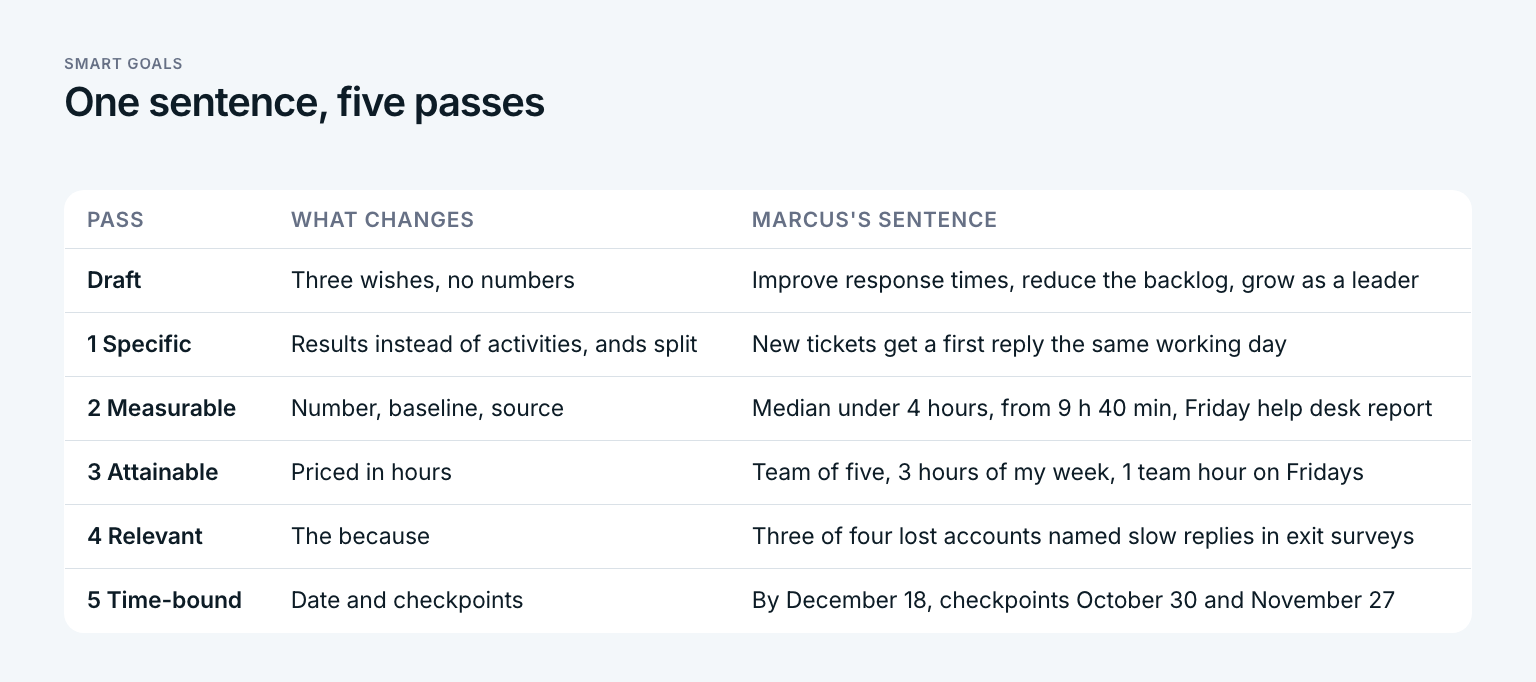
How to write SMART goals in five passes
Each pass handles one letter, and each pass changes the sentence rather than adding a note beside it. Work with pen or keyboard, read the sentence aloud after each pass, and do not move on until the new version is something you would say to a colleague. Marcus took 35 minutes for all five on Monday, September 28. His first draft is above. The passes:
Pass one, Specific: swap activities for results and split the ands
Underline every verb. Improve, reduce and grow are activities. They describe effort, not a state of the world. Ask of each: What is true when this has worked? Then count the ands. Marcus had two, and each and hides a second goal with its own measure and its own date, so it gets its own sentence. After pass one: “New tickets get their first reply within the same working day, and the open backlog is cleared down to tickets from the current week.” The leadership wish became a separate line, edited later the same way.
Pass two, Measurable: add the number, the baseline and the source
A result needs a number you can read and a place to read it. Marcus pulled four weeks of help desk reports: 1,520 tickets, a median first response of 9 hours 40 minutes, 212 open tickets on Monday morning, the oldest 23 days old. Now a target had something to stand next to. After pass two: “Median first response time is under 4 hours, down from 9 hours 40 minutes, and open tickets are under 60, down from 212, as shown in the Friday help desk report.” Without the baseline, under 4 hours is a hope. With it, it is a 59 percent cut that anyone can track.
Pass three, Attainable: price the goal in hours and check the math
Attainable is not a feeling, it is arithmetic. To get from 212 to 60 open tickets in twelve weeks, the team must close 152 more than arrive, about 13 extra a week, or 2.5 per person. Marcus budgeted three hours of his own week for a macro library and a triage rota, and one team hour on Friday afternoons. Those hours exist in his calendar, he checked. After pass three the sentence carried its price: “… with the current team of five, three hours of my week and one team hour on Fridays.” If the hours do not exist, change the number or the date, not the hours.
Pass four, Relevant: write the because
Every goal needs a reason that outlasts the first bad week. Marcus read the exit surveys of the four accounts the company lost last quarter. Three named slow replies. Renewals start in January. After pass four: “… because three of the four accounts we lost last quarter named slow replies in their exit survey, and renewals start in January.” The because is also the test for the yearly goal above it. If you cannot connect the sentence to something you want this year, it is a task, not a goal.
Pass five, Time-bound: a date and two checkpoints
By when is a calendar date, not a season. Marcus chose Friday, December 18, 2026, twelve weeks out, and two checkpoints: October 30 and November 27, the last Fridays of each month. A checkpoint is a date with an expected number attached, under 7 hours by the end of October, under 5 by the end of November. After pass five the sentence was finished. It is long. That is fine. A long sentence that can be checked beats a short one that cannot.
Marcus's goal after five passes
“By Friday, December 18, 2026, our median first response time is under 4 hours, down from 9 hours 40 minutes, and open tickets are under 60, down from 212, as shown in the Friday help desk report, with the current team of five, three hours of my week and one team hour on Fridays, because three of the four accounts we lost last quarter named slow replies in their exit survey. Checkpoints: under 7 hours by October 30, under 5 hours by November 27.” Long, yes. Also the first version of this goal that can lose.
Pass one and pass two carry most of the weight. Whoever gets the verb and the number right has a goal that is already better than the draft. Passes three to five protect it against the things that kill goals later: a calendar that was never consulted, a reason nobody remembers, and a due date that keeps moving because it was never written down.
Measurable goals examples: the four parts of a measurement line
A measurable goal has a measurement line, and a measurement line has four parts: a number, a unit, a source and a reading rhythm. The number is the target next to the baseline. The unit says what is counted. The source says where the number is read. The rhythm says how often. Marcus's line reads: under 4 hours median first response, from 9 hours 40 minutes, help desk report, every Friday at 4 pm. Four parts, one line. Leave one out and the goal gets softer in a specific way.
| Part | Question it answers | Marcus's line | What goes wrong without it |
|---|---|---|---|
| Number | How much, from where? | Under 4 hours, from 9 hours 40 minutes | Improve means anything, including nothing |
| Unit | What exactly is counted? | Median first response time per ticket | Average instead of median hides the 23-day ticket |
| Source | Where is the number read? | The weekly help desk report | Two people, two numbers, one argument in December |
| Rhythm | How often is it read? | Every Friday at 4 pm | The number is read once, on the due date, too late to steer |
The source is the part most drafts skip, and it is the one that makes the goal checkable by someone else. A number without a source is a claim. A number with a source is a fact anyone on the team can look up. That is also why the Friday rhythm matters: a goal read once, on the due date, can only be judged. A goal read every Friday can be steered. Twelve readings beat one.
Three kinds of measures cover almost every goal. Counts: tickets closed, runs completed, dollars moved, issues sent. Rates and ratios: median hours, percent of renewals, pages per week. Binary milestones: contract signed, draft delivered, exam passed. Pick the kind first, then the number. Marcus's response time is a rate, his backlog is a count, and his October checkpoint, triage rota live, is a binary milestone. Mixing kinds in one goal is fine. Having none is not.
The most common mistake: the word and
Most first drafts hold two or three goals in one sentence, joined by and. Marcus's draft had three. Each goal needs its own number, its own source and its own date, and an and gives all three to the first goal and none to the rest. The backlog and the response time survived in one sentence only because they share a source and a date. The leadership goal did not, so it got its own sentence. Whoever finds an and in a goal draft should ask: Does the second half have its own number? If not, cut it or move it.
How to make goals measurable when there is nothing to count
Some goals have no obvious number. Grow as a leader. Be more present at home. Get better at writing. The usual move is to leave them vague and feel good about the sentiment. The better move is to find the behavior that produces the outcome, count that, and set a date to check whether the outcome moved. You are not measuring leadership. You are measuring the twelve conversations that leadership, in your case, is made of.
Marcus's second sentence went through the same five passes. Grow as a leader became: “Between September 28 and December 18, I hold a 30-minute one-on-one with each of my five team members every other week, twelve conversations in total, logged in my calendar, and in the December team survey the question 'My manager knows what I am working on' scores at least 4 of 5, up from 3.1 in June.” A behavior count, twelve meetings, plus an outcome check, one survey question with a baseline. Neither alone is enough. The count without the survey rewards attendance. The survey without the count gives him nothing to do on Monday.
Four ways to put a number on a soft goal:
- Count the behavior. One-on-ones held, pages written, evenings without a laptop. The behavior is in your control and the outcome is not, so the behavior is the weekly measure.
- Name the artifact. A finished thing that either exists or does not: a draft sent to an editor, a rota published, a will signed. Binary, dated, checkable.
- Anchor a scale. A 1 to 5 rating is a measure only if each step is defined. A 4 on Marcus's survey question means team members agree, a 3 means neutral. Write the anchors down before you rate.
- Borrow a judge. A tutor confirms you held a 15-minute conversation. A colleague confirms the document is usable. Outside judgment is the oldest measurement there is.
In short: if you cannot count the outcome, count the behavior that produces it and check the outcome on a date. That one rule turns most of the goals people call unmeasurable into measurable goals in a single pass.
Before and after: six goals rewritten in one line each
Here are six first drafts and their rewrites, one line each. The left column is how most people write goals when nobody is watching. The right column is the same wish after five passes. Read them aloud and notice that every rewrite could lose on its due date.
| Area | Before | After |
|---|---|---|
| Work | Improve our response times | Median first reply under 4 hours by December 18, from 9 hours 40 minutes, read in the Friday help desk report |
| Health | Get in shape | Walk 8,000 steps on at least five days a week for ten of the next twelve weeks, counted by my phone |
| Money | Save more | Move $400 to the house fund on the first of every month, $4,800 by next September 30, balance checked on the first |
| Learning | Learn Spanish | Hold a 15-minute conversation with my tutor without switching to English by March 31, 24 lessons logged |
| Family | Spend more time with the kids | One screen-free Saturday morning outing a week, ten of twelve weekends by December 20, marked on the fridge calendar |
| Side project | Launch my newsletter | Send twelve weekly issues to at least 100 subscribers by December 18, first issue October 2, counted in the newsletter tool |
Every after version has a verb that describes a state, a number next to a baseline or a count, a source and a date. None of them says improve, more or better. Two of the six are behavior counts rather than outcomes, the walking and the Saturday mornings, because the outcome there is a feeling and the behavior is what you can book. More rewritten goals for work, health, money and family are collected in the SMART goals examples, each with the before version shown. Work goals that a manager has to score are sorted by role and industry in SMART goals for work.
Three tests before you commit
Before the sentence goes into your planner, run three tests. Each takes a minute, and each catches a different way goals go wrong. Marcus ran all three on September 28 and changed the goal once: the first version of his backlog target was 40, and the calendar test sent it back to 60.
The stranger test. Hand the sentence to someone who does not know you or your work. Could they, on the due date and with access to your source, say done or not done without asking you a question? If they would have to ask what you meant, the sentence is not finished. This is the test George T. Doran had in mind in 1981 when he wrote the original SMART article in Management Review for managers whose objectives had to be checked by other people. His third letter was Assignable, not Attainable. A goal somebody else can check was the whole point from the start.
The Friday test. Can you read one number this Friday that tells you whether you are on track? Not on the due date. This Friday. If the only reading comes at the end, the goal is a verdict, not a plan. Marcus's Friday report answers this. A goal like “pass the exam in May” fails it until you add a weekly measure, pages covered or practice questions scored. How to build that weekly measure for a goal that ends in an exam, planning backward from the test date, is shown in SMART goals for students.
The calendar test. Open next week. Are the hours this goal needs actually in it, as blocks, not as intentions? Marcus's three hours were Tuesday and Thursday mornings before stand-up. The team hour was Friday at 3 pm. The first backlog target of 40 would have needed four hours he did not have, so the number moved to 60. The calendar, not the ambition, sets the number. Anyone who skips this test writes the goal twice: once in September and once in November, smaller.
Can ChatGPT write SMART goals?
Yes, and it does the grammar well. Paste “improve response times” into any current language model, ask for a SMART version, and you get a well-formed sentence in seconds with a number, a date and a because. The structure is fine. The problem is the content. The model does not know your baseline, your hours or the reason this goal matters to you, so it invents all three. The 20 percent it suggests is a plausible number, not your number. Marcus tried it. The suggested target was a response time under 2 hours, which for a team of five handling 380 tickets a week would have been a goal that loses on day one.
Use it as an editor, not as an author. Three requests work well: mark every verb that describes an activity instead of a result, list every number, source and date that is missing from this sentence, and find every and that joins two goals. Those are the questions a good colleague asks. The answers, the baseline, the hours and the reason, stay yours. Whoever lets a model fill in the numbers has written a goal for a person who does not exist.
Writing SMART goals from year to day: one sentence, five sizes
A SMART goal for a quarter is one sentence. The same goal for the year above it and for the month, week and day below it are four more sentences, each written with the same five passes and each shorter than the last. That is the goal ladder, and it is how a twelve-week sentence turns into something you do on a Tuesday. Marcus's ladder:
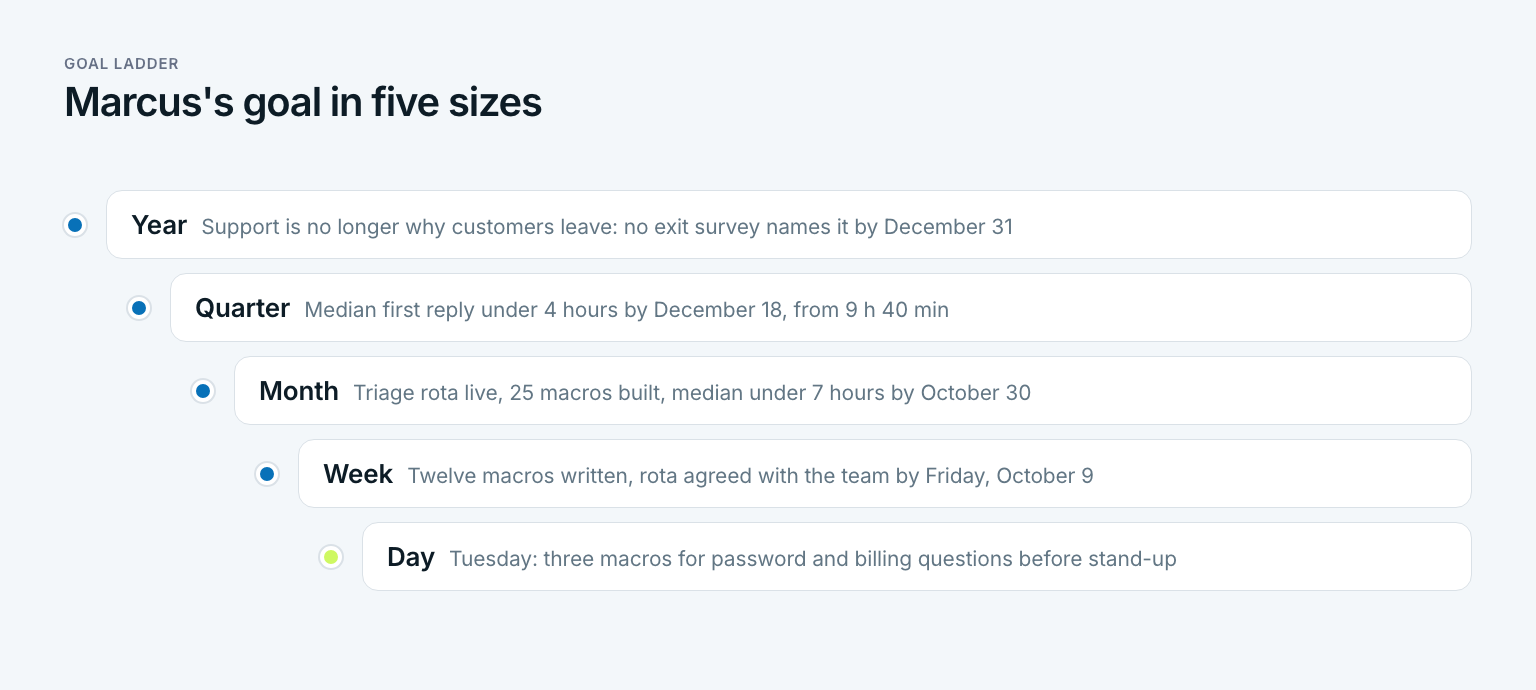
Every rung keeps the measurement line: a number, a source, a date. The year says support is no longer why customers leave, measured in exit surveys through December 31. The quarter says under 4 hours by December 18. The month says the rota is live and the median is under 7 hours by October 30. The week says twelve macros written and the rota agreed by Friday, October 9. The day says three macros before stand-up on Tuesday. Each rung answers one question about the rung above: What has to be true this month for the quarter to hold? What has to be true this week for the month to hold?
This is where the sentence earns its length. On Tuesday, October 6, Marcus does not need the full quarter goal. He needs the Tuesday line, and he needs to know it hangs on something bigger. In Gaapp the five rungs sit under each other, year to day, and each one shows what is done next to how much of the period has passed. The quarter goal is read on Fridays, the daily goal is checked in the evening, and the ladder between them keeps the because visible on the days when the Friday number is bad. How to walk the rungs down is covered in turning yearly goals into daily steps, and the shape of a good Tuesday line in the guide to daily goals.
Three questions before you write yours
Three questions, then write:
- Which verb in my draft describes effort rather than a state, and what is true when the effort has worked?
- Where will I read the number on Friday, and what does it say today?
- Which hours next week belong to this goal, and what did I move to make room?
Whoever can answer all three has already written the goal. The sentence is just the answers in order. In short: writing SMART goals is not filling in an acronym, it is editing one honest sentence until it can lose, and then reading it every Friday until it wins.
Frequently asked questions about writing SMART goals
What are 5 SMART goals examples?
Median first reply under 4 hours by December 18, from 9 hours 40 minutes, read in the Friday help desk report. Walk 8,000 steps on five days a week for ten of the next twelve weeks, counted by your phone. Move $400 to the house fund on the first of every month, $4,800 by next September 30. Hold a 15-minute Spanish conversation without switching to English by March 31, with 24 lessons logged. Send twelve weekly newsletter issues to at least 100 subscribers by December 18. Each one has a result, a number, a source and a date.
How to write a simple SMART goal?
Use one sentence in the form: By DATE, RESULT is true, as shown by NUMBER in SOURCE, from BASELINE. Fill the result with a state rather than an activity, and the number with something you can read every week. “By March 31, I run 5K without stopping, as shown by one logged run in my watch app, from a current best of 2K” is simple and complete. Add the because and the weekly hours when the goal is bigger than a month.
Can ChatGPT write SMART goals?
It writes the sentence structure well and fast, but it has to invent your baseline, your available hours and your reason, so the numbers it suggests are plausible rather than true. Use it as an editor: ask it to mark activity verbs, to list the missing numbers, sources and dates, and to find every and that joins two goals. Then supply the real numbers yourself.
What are the 5 steps of a SMART goal?
One editing pass per letter. Specific: swap activity verbs for a result and split any sentence joined by and. Measurable: add the target, the baseline and the source where the number is read. Attainable: price the goal in weekly hours and check next week's calendar. Relevant: write the because and connect it to a yearly goal. Time-bound: set a calendar date and two checkpoints with expected numbers.
How do you make a goal measurable when there is nothing to count?
Count the behavior that produces the outcome and set a date to check whether the outcome moved. Grow as a leader becomes twelve one-on-ones held by December 18 plus one survey question scored against a baseline. Other options are naming an artifact that either exists or does not, anchoring a 1 to 5 scale with written definitions, or borrowing a judge such as a tutor or a colleague.
How many SMART goals should I write at once?
Three per quarter is a practical ceiling for one person, and one is enough if it is the right one. Every goal needs its own Friday reading and its own hours in the calendar, and a fourth goal usually takes those from the first three. Marcus wrote two, response time and one-on-ones, and parked the rest for January.
Last updated: 19 October 2026
Read next
 Goal Setting
Intrinsic Motivation: What Drives You From the Inside
Intrinsic motivation is not a personality trait. Meaning, 12 examples, the three needs behind it and five steps to build it, with a worked example.
17 min read
 Goal Setting
Financial Goals: How to Turn Wishes Into a Plan
Financial goals are not wishes with a dollar sign. Short and long term examples, SMART savings goals and a five step plan, worked through one year.
17 min read
 Goal Setting
WOOP Method: Four Steps From Wish to If-Then Plan
The WOOP method is not positive thinking. What WOOP stands for, the research, if-then plans, eight goal examples and a five-minute guide.
18 min read