Wheel of Life: Score 8 Areas, Set One Yearly Goal
The wheel of life scores eight areas of life from 1 to 10 and shows where your year is off balance. Six steps, a template, 24 questions, a worked example.

Contents
- 01What the wheel of life is, and what it actually measures
- 02The eight areas of life, and why the number of segments is not the point
- 03How to complete the wheel of life assessment in six steps
- 04Priya's wheel, read in three patterns
- 05From one low score to a yearly goal: the goal chain
- 06A wheel of life template you can fill in on paper
- 07The three mistakes that turn the wheel of life into a mood chart
- 08The wheel of life for couples, families, teams and coaches
- 09Three questions before you draw your wheel of life
- 10Frequently asked questions about the wheel of life
The wheel of life is not a quiz. It is a circle cut into eight areas of life, each scored from 1 to 10 for how satisfied you are right now, so that the shape of the circle shows you where your year is out of balance. A quiz tells you what type you are. The wheel of life tells you which area needs a goal next.
Three things make the wheel useful instead of decorative: a fixed set of areas, an honest score for each one, and a decision about the single lowest spoke. The areas are eight. The score is a number, not a mood. The decision becomes a yearly goal with a chain down to this week. All of it is worked through on the wheel of Priya, a 38-year-old engineering team lead in Austin who came out of a release year with a career score of 8 and a health score of 4, along with six steps, a template you can copy into a notebook, 24 questions, and the three mistakes that turn the wheel into a mood chart by March.
Prefer the screen? Fill in the wheel of life online: eight sliders, the wheel draws itself live, free and without sign-up.
What the wheel of life is, and what it actually measures
The wheel of life is a self-assessment tool from coaching. You draw a circle, divide it into segments, one per area of life, and rate your current satisfaction in each segment from 1 at the center to 10 at the rim. Then you connect the points. The result is a shape. A round shape close to the rim means a life that feels full in every direction. A jagged shape with one deep dent means one area is dragging on the rest.
The tool is usually credited to Paul J. Meyer, who founded the Success Motivation Institute in 1960 and used a wheel to teach what he called the total person. His version had six segments: financial and career, physical and health, mental and educational, family and home, spiritual and ethical, social and cultural. Coaches later split and renamed the segments, which is why you find versions with eight, ten, or twelve areas today. The mechanics never changed. Segments, a score per segment, a shape.
Here is the part most templates leave out. The wheel measures satisfaction, not performance. A 4 in finances does not mean your bank balance is low. It means you are unhappy with where your money stands, whatever the balance says. Anyone who scores performance ends up with a wheel that praises overwork. Anyone who scores satisfaction ends up with a wheel that tells the truth about the overwork. That means: the wheel is not a report card. It is a weather map of your own contentment, drawn on one day, and it is only as useful as the day you draw it next.
Satisfaction score
A number from 1 to 10 for how content you are with one area of life right now, not how well you perform in it. A 10 means nothing needs to change. A 1 means almost everything does. The wheel of life is eight of these numbers side by side, which is what makes the gaps visible.
The Buddhist wheel of life has the same name and a different job
If you search the term you will also find a painted wheel from Tibetan Buddhism, the bhavachakra, which translates roughly as wheel of becoming. It shows the cycle of rebirth, six realms, and the twelve links of dependent origination, all held by a figure that stands for impermanence. It is a teaching image about suffering and the way out of it. The coaching wheel borrowed nothing from it except the circle. Anyone who worries that the exercise is religious can stop worrying. It is a pie chart with feelings in it.
The eight areas of life, and why the number of segments is not the point
Most coaching wheels today use eight areas of life. The list below is the one this article uses for Priya, and each area comes with the question you answer before you write a score. The question matters more than the label. A label like relationships can be read ten ways. A question like do I have someone I could call at 2 a.m. can only be read one way.
| Area | The question you score | Priya, October 2026 |
|---|---|---|
| Career | Does my work use what I am good at, and does it lead somewhere I want to go? | 8 |
| Finances | Could I cover a 3,000 dollar surprise without borrowing, and am I saving toward something I have named? | 7 |
| Health | Do I have the energy at 8 p.m. that I had at 8 a.m., and do I move my body most days? | 4 |
| Family | Do the people I live with get my attention, not just my presence? | 6 |
| Love | Is my partnership a source of energy right now, or another task on the list? | 6 |
| Friends | Have I seen a friend on purpose in the last two weeks? | 3 |
| Fun | When did I last do something for no reason except that I enjoy it? | 3 |
| Growth | Am I learning something that is not for work? | 5 |
Eight scores, an average of 5.25, and a shape that looks like a wheel with two flat spots on the same side: friends and fun, both at 3, with health at 4 right next to them. Career sits at 8 across the circle. That is the pattern of a release year. Anyone who has shipped something big knows it. The work spoke grows, and it grows by eating the spokes next to it.
Six, eight, ten or twelve areas: how to choose
There is no official list. Meyer used six. Most templates use eight. Some coaches go to twelve by splitting family from friends and adding spirituality, contribution, creativity, and physical environment. More segments give you finer detail and a longer exercise. Fewer segments give you a wheel you will actually redraw in three months. Pick the smallest number that still separates the areas you suspect are different. If you already know your friends score and your family score would sit three points apart, split them. If you are not sure, keep them together and split later.
- Six areas, Meyer's original: financial and career, physical and health, mental and educational, family and home, spiritual and ethical, social and cultural. Good for a first wheel in 15 minutes.
- Eight areas, the coaching standard and the list in this article: career, finances, health, family, love, friends, fun, growth. Good for most adults with a job and a household.
- Twelve areas: the eight plus physical environment, spirituality, contribution, creativity. Good for a yearly deep dive, too fine for a quarterly check.
How to complete the wheel of life assessment in six steps
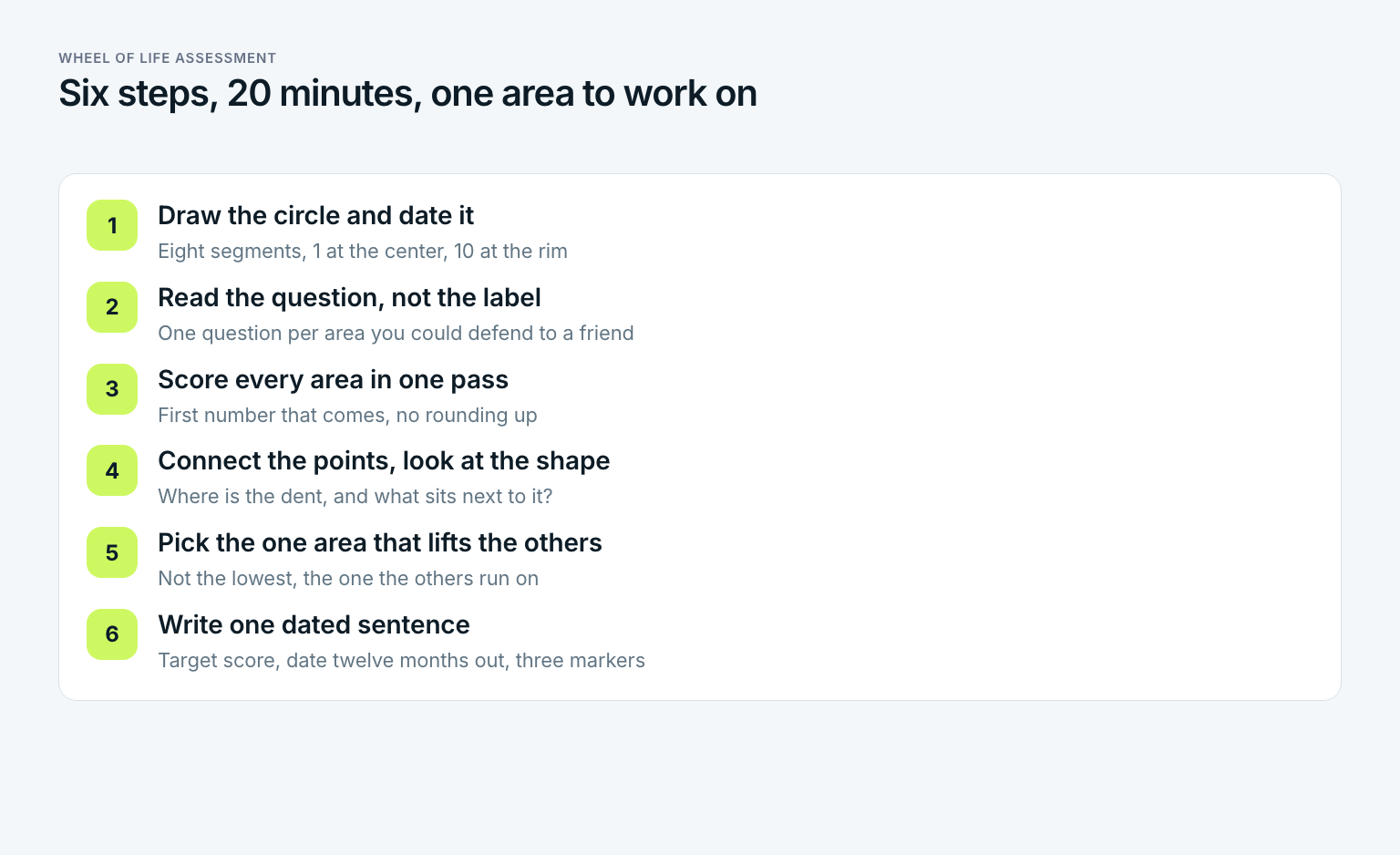
The exercise takes 20 minutes the first time and ten minutes every time after. Paper works better than an app for the first round, because drawing the line yourself makes the dent visible in a way a bar chart does not. You need a sheet, a pen, and a date.
Draw the circle and the segments, two minutes
A circle, eight lines from the center, a label per segment. Mark the center as 1 and the rim as 10. Write today's date in the corner. Without the date the wheel becomes a poster. With it, it becomes the first point in a series.
Read the question for each area, not the label, three minutes
Use the questions from the table above or write your own. One question per area, answerable with a feeling you could defend to a friend. Priya's health question was: do I have the energy at 8 p.m. that I had at 8 a.m.? She did not, four days out of five.
Score every area in one pass, five minutes
Write the first number that comes, then move on. Do not compare areas yet and do not round up. A 4 that you want to call a 5 is a 4. Anyone who negotiates with the score is scoring the wheel they want to see. Score the one you have.
Connect the points and look at the shape, one minute
Draw a line from score to score around the circle. Now look before you think. Where is the deepest dent? Where do two low scores sit next to each other? Priya saw her two 3s side by side, friends and fun, and understood that they were one problem with two names.
Pick the one area that would lift the others, five minutes
Not the lowest score automatically. The one whose rise would pull two or three other spokes up with it. For Priya that was health, a 4, because energy at 8 p.m. is what friends, fun, and love all run on. Friends and fun at 3 would follow if the energy came back.
Write one sentence for that area, dated twelve months out, four minutes
The sentence is a goal, not a wish. What score do you want in that area on this date next year, and what would be true in your life for you to give it honestly? Priya's: on October 1, 2027, health is a 7, I run three mornings a week and I sleep seven hours on weeknights.
Priya's wheel, read in three patterns
A finished wheel gives you eight numbers and a shape. Most people read the numbers, sort them, and start working on the lowest. That is the quickest way to pick the wrong area. Read the shape first. Three patterns come up on almost every wheel, and each one points to a different move.
The flat tire: one score far below the rest
Seven scores between 6 and 8 and one score at 2 or 3. The wheel rolls, but it thumps. This is the easiest pattern to act on, because the area is obvious and everything else is stable enough to carry a focused year. The move is one goal, one year, one area. Anyone who adds a second goal here is diluting the only thing that needed attention.
The dented side: two or three low scores next to each other
Priya's wheel. Friends 3, fun 3, health 4, all on one side, with career at 8 across from them. Low scores that sit together usually share a cause, and the cause is often the high score opposite. The move is not three goals. It is to find the one area among the low ones that feeds the others, and to let the high score pay for it. In Priya's case that meant career would be allowed to drift from 8 to 7 for a year, on purpose, and health would get the hours. How to turn that drift into a weekly time budget is the subject of the guide to work-life balance.
The small wheel: every score between 4 and 6
Nothing is terrible and nothing is good. This is the hardest pattern, because there is no obvious dent and the temptation is to call it balanced. It is balanced the way a parked car is balanced. The move is to ask a different question: which area, if it went to 9, would make the other seven feel acceptable? Usually that is growth or fun, the areas people cut first and miss least, right up until the whole wheel has shrunk. Pick that one and make it the goal of the year. If growth is the area you pick, the personal development plan guide splits it into five areas and a six-step plan.
That means: the average score is nearly useless. Priya's 5.25 sounds like a middling year. The shape says something sharper. One area is being paid for by three others, and the bill is coming due in energy. Anyone who only reads the average will plan a slightly better year. Anyone who reads the shape will plan a different one. Read across ten years instead of one, the same eight scores become the snapshot step of a life plan.

From one low score to a yearly goal: the goal chain
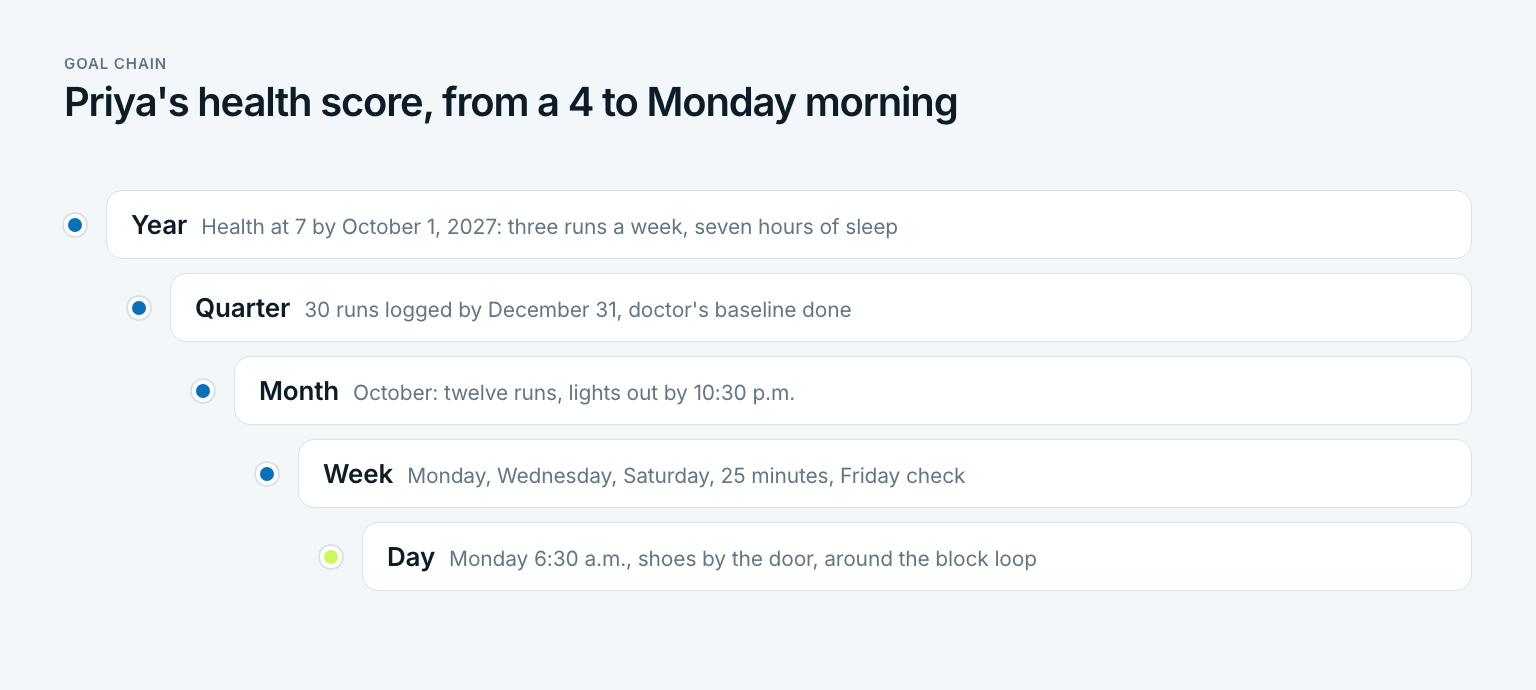
A score of 4 is a diagnosis. It is not a goal. The gap between the two is where most wheels die, because the wheel is drawn in January, the feeling is real, and nothing in the exercise says what to do on Tuesday. The fix is to translate the one chosen area into a chain: year, quarter, month, week, day. Each level answers one question, and each level is small enough to check.
- Year. The sentence from step six: on October 1, 2027, health is a 7. I run three mornings a week, I sleep seven hours on weeknights, and I can climb the four floors to the office without stopping. Three concrete markers, because a 7 on its own is a feeling and a feeling cannot be scheduled.
- Quarter. What has to be true by December 31 for the year to be on track? Priya: 30 runs logged in twelve weeks, a baseline from a doctor's visit, and a bedtime that holds on four of five weeknights. Thirty runs in twelve weeks is two and a half per week, which leaves room for one bad week.
- Month. October: twelve runs, the doctor's appointment booked and kept, lights out by 10:30 p.m. on weeknights. Twelve is the number she checks on October 31. Not how she feels about running. How many runs.
- Week. Three runs, Monday, Wednesday, Saturday, 25 minutes each, and one weekly review on Friday that asks a single question: did the three runs happen? If two happened, the week counts as two, not as almost three.
- Day. Monday, 6:30 a.m., shoes by the door the night before, 25 minutes of walk and run around the block loop, back by 7. One task, one checkbox. Everything above it in the chain exists so that this box is easy to tick.
The chain is also where the other low scores get their turn. Friends at 3 did not get a goal this year. It got a rule attached to the health goal: the Saturday run is with a friend, a different one each month. Fun at 3 got nothing, deliberately. One area, one year. Priya redraws the wheel on the first Saturday of every quarter and expects fun to move on its own once the evenings have energy in them again. If it does not, fun becomes the goal of 2028. How to achieve goals lays out the full logic of the chain, and annual planning shows how the yearly sentence gets written when more than one area is in play.
A wheel of life template you can fill in on paper
You do not need a printable circle. A table does the same job and survives being folded into a notebook. The template below is Priya's, with the fields that make one wheel comparable to the next: a date, a question per area, a score, and one line on why. The why is what you will be grateful for in three months, when the score has moved and you cannot remember what a 4 felt like.
| Field | What goes in it | Priya, October 2026 |
|---|---|---|
| Date | The day you score. Same weekday each quarter if you can. | Saturday, October 3, 2026 |
| Area and question | Eight areas, each with its one question | Health: do I have the energy at 8 p.m. that I had at 8 a.m.? |
| Score | 1 to 10, satisfaction, the first number that comes | 4 |
| Why | One line of evidence, not a story | Asleep on the couch by 9 p.m. four nights this week |
| Change since last wheel | Up, down, or same, with the previous number | First wheel, no previous score |
| Chosen area | The one spoke that lifts the others | Health |
| Yearly sentence | Target score, date, three concrete markers | October 1, 2027: health at 7, three runs a week, seven hours of sleep, four floors without stopping |
| Next wheel | A date in the calendar, not an intention | Saturday, January 9, 2027 |
24 questions, three for each area of life
If one question per area does not land you on a number, use three. Score each from 1 to 10 and take the lowest of the three, not the average. The lowest is the one you are actually feeling.
- Career. Does my work use what I am good at? Does it lead somewhere I want to be in three years? Would I do this job if the pay were the same elsewhere? The Western ikigai diagram asks the same questions with four circles: what you love, what you are good at, what the world needs and what you can be paid for.
- Finances. Could I cover a 3,000 dollar surprise without borrowing? Am I saving toward something I have named? Do I know what I spent last month within 10 percent?
- Health. Do I have energy at 8 p.m.? Do I move my body on most days? Did I sleep seven hours on more nights than not this week?
- Family. Do the people I live with get my attention, not just my presence? Have I had a conversation this week that was not logistics? Do I know what each of them is worried about right now?
- Love. Is my partnership a source of energy or another task? When did we last do something new together? Do I say the thing I am thinking, or wait?
- Friends. Have I seen a friend on purpose in the last two weeks? Is there someone I could call at 2 a.m.? When did I last make a new friend?
- Fun. When did I last do something for no reason except that I enjoy it? Do I have a hobby that is not also a side income? Did I laugh out loud this week?
- Growth. Am I learning something that is not for work? Have I finished a book this month? Is there a skill I started this year and kept?
The three mistakes that turn the wheel of life into a mood chart
The wheel is easy to draw and easy to waste. Three mistakes account for nearly every wasted one, and all three happen after the drawing, not during it.
Mistake one: fixing every low score at once. Priya's first instinct was three goals, one for health, one for friends, one for fun. Three goals on a wheel with a career at 8 means three new demands on the calendar that produced the dents in the first place. By February two of the three are gone and the wheel has proven that nothing works. One area. The others get a rule or they wait. Why three goals are enough makes the same case for the whole year, and the wheel is where you find out which one of the three is not optional.
The most common mistake: scoring the wheel you want
Nearly everyone rounds up on the first pass. A 4 becomes a 5 because 4 sounds like a problem, and a 7 becomes an 8 because the week was good. A rounded wheel looks healthier and tells you nothing. Score the first number that comes, write one line of evidence next to it, and let the evidence overrule the number if they disagree. The wheel is a measurement. A measurement you adjust to feel better is a mood chart.
Mistake two: drawing it once. A single wheel is a snapshot. It cannot show direction, and direction is the only thing that tells you whether the yearly goal is working. Anyone who draws the wheel in January and never again has a nice memory of January. Anyone who draws it four times a year has a line. Priya's calendar holds four Saturdays, one per quarter, 20 minutes each, and the previous wheel sits next to the new one while she scores.
Mistake three: comparing your wheel to someone else's. Satisfaction scores are personal by design. Your 6 in finances and your neighbor's 6 share a digit and nothing else. The only wheel yours can be compared with is your own from three months ago. In short: the wheel is a tool for noticing change in one life, yours, and every comparison outside that life is noise.
The wheel of life for couples, families, teams and coaches
The wheel scales, as long as each person scores alone first. A couple who scores together scores a negotiation. A couple who scores separately and then puts the two wheels side by side has a conversation worth having, usually about the one area where the scores differ by three or more. Priya and her partner found a two-point gap in love, hers a 6, his an 8, and a five-point gap in fun. The gap, not the scores, became the dinner conversation, and the Saturday run with a friend was his suggestion.
Families with teenagers can run the same exercise with simpler areas: school, friends, body, home, fun, screen time. Each person scores in private, then the wheels go on the fridge for a week. Nobody has to explain a score. The shape does the explaining. Anyone who has tried to ask a fifteen-year-old how things are going will recognize the difference between that question and a wheel on the fridge.
Teams use the same mechanic with different segments: clarity of goals, workload, learning, recognition, tools, trust in the team, trust in leadership, meaning. Each person scores in private, the team lead sees the spread and the average per area, and the one area with the widest spread is the first topic of the next retrospective. Coaches use the wheel as the first session's map and the last session's proof. Two wheels, six months apart, show a client what changed more clearly than any notes. If you track goals with other people, shared goals in a space describes how one chosen area becomes a goal both of you can see.
Three questions before you draw your wheel of life
Before the pen touches the paper, three questions decide whether this wheel will be worth redrawing in three months.
- Which area am I already tempted to round up, and why? Name it before you score it. The temptation is the information.
- If I could change only one area in the next twelve months, which one would make the other seven easier to live with? That is your candidate, whatever the scores turn out to say.
- When is the next wheel? A date, written down, before the first one is finished. A wheel without a successor is a drawing.
Priya's answers were health, health, and the first Saturday in January. Her wheel from October 2026 shows career at 8 and three dents on the opposite side. The chain under it says Monday, 6:30 a.m., 25 minutes. The wheel in January will say whether it worked. In short: the wheel of life is not a picture of balance. It is the measurement that tells you which goal to set, and the next wheel is how you find out whether you set the right one. A ten-minute weekly review keeps the chain honest between wheels, and daily goals is where Monday morning actually lives.
Frequently asked questions about the wheel of life
What are the 12 areas of the Wheel of Life?
The twelve-area version takes the eight standard areas and adds four. The usual list: career, finances, health, family, love, friends, fun, personal growth, physical environment, spirituality, contribution, and creativity. There is no official list, so coaches vary the names. Use twelve for a yearly deep dive and eight for the quarterly check.
What is the Wheel of Life concept?
The wheel of life is a coaching self-assessment. You divide a circle into areas of life, score your satisfaction in each from 1 to 10, and connect the scores to see the shape. The idea is credited to Paul J. Meyer of the Success Motivation Institute in the 1960s. The shape shows which area is dragging on the rest, and that area becomes the next goal.
How do you complete the Wheel of Life assessment?
Draw a circle with eight segments and date it. Read one question per area and write the first score from 1 to 10 that comes to mind. Connect the points, look at the shape, and pick the one area that would lift the others if it rose. Then write a dated sentence for that area twelve months out. The whole exercise takes about 20 minutes the first time.
What religion is the Wheel of Life?
The painted wheel of life, or bhavachakra, belongs to Tibetan Buddhism. It shows the cycle of rebirth, six realms, and the twelve links of dependent origination, as a teaching image about suffering and release from it. The coaching wheel shares only the name and the circular shape. It has no religious content and works for anyone.
How often should you do the wheel of life?
Every quarter. One wheel is a snapshot and cannot show direction. Four wheels a year give you a line for each area and show whether the goal you set is working. Put the next date in the calendar before you finish the first wheel, and keep the previous wheel next to you while you score.
Is there a free wheel of life template?
You do not need a printed circle. A table with eight rows, one question per area, a score, one line of evidence, and the date does the same job and fits in a notebook. The template section above shows the fields with Priya's example. Redraw it on the same table each quarter so the columns line up and the change is visible.
Last updated: 19 October 2026
Read next
 Personal Growth
Maslow's Hierarchy of Needs: The 5 Levels Explained
Maslow's hierarchy of needs sorts motivation into five levels. What each level means, what research says today and a needs audit you can run yourself.
14 min read
 Personal Growth
Mindfulness Exercises: 12 for Everyday Life
Mindfulness exercises are not about emptying your mind. 12 techniques for stress and focus, what research shows, and a four-week plan to practice daily.
16 min read
 Personal Growth
Positive Affirmations: 50 Examples You Can Believe
Positive affirmations are not magic words. What research shows, 50 daily affirmations you can believe, and a five-step method with a worked example.
16 min read