Deep Work: How to Schedule Focused Hours That Last
Deep work is scheduled, uninterrupted concentration on one hard task. Four rules, four schedules, a six-step plan and a worked month with real hours.

Contents
- 01What deep work is and what it is not
- 02Why your calendar is full and your week is empty
- 03The four rules of deep work, translated to a Tuesday
- 04Four ways to schedule deep work, and which one fits your week
- 05How to build a deep work schedule in six steps
- 06How many hours of deep work per day are realistic
- 07Deep work in the goal chain: from a yearly goal to a 90-minute block
- 08The three mistakes that make deep work exhausting
- 09Three questions before you block tomorrow morning
- 10Frequently asked questions about deep work
Deep work is not a focus hack. It is a scheduled block of uninterrupted concentration on one hard task that moves a goal, a term Cal Newport introduced in his 2016 book of the same name for cognitively demanding work done without distraction, work that creates new value and is hard to replicate. A focus hack buys you twenty quiet minutes. Deep work is a weekly budget of hours, with a target attached to every one of them.
Three things make that budget hold: a measured week, a deliverable for every block, and a schedule the rest of your calendar has to respect. Worked through here on one month of Priya, a senior engineer who has to get a billing migration design approved while she is on-call, in meetings and on Slack. Along the way: the four rules, the four scheduling philosophies, a six-step deep work schedule and the three mistakes that make deep work exhausting without making it pay.
What deep work is and what it is not
Deep work is a practice, not a mood. Newport sets it against shallow work: logistical tasks, often done while distracted, that create little new value and that almost anyone could do. Answering Slack is shallow. Writing the data model section of a design document is deep. Both are work. Only one of them changes what you are capable of.
The distinction is not about effort or urgency. A shallow task can be urgent and still shallow, and a deep task can stay quiet for weeks and still be the one that decides your quarter. The test is simple: Could a smart new hire with no context do this in a week? If yes, it is shallow. If it needs your skill, your context and your full attention for a stretch, it is deep.
Deep work, flow and attention residue
The flow state, described by Mihaly Csikszentmihalyi in 1990, is being fully absorbed in a task. Deep work is the schedule that makes flow likely. Attention residue, a term from Sophie Leroy's 2009 research, is what happens in between: when you switch from one task to another, part of your attention stays with the first one, and the second task gets what is left. That means: A quick look at your inbox inside a block does not cost you the minute it takes. It costs you the quality of the next twenty.
What deep work is not: It is not a retreat, a morning routine or a noise-cancelling headset. Those can help. None of them is the thing. The thing is a block in your calendar with a deliverable attached, repeated often enough that your brain stops negotiating about it. Anyone who has a block like that four mornings a week is doing deep work, headset or not.
Why your calendar is full and your week is empty
Full weeks feel like productive weeks. That is the trap. Priya, 31, is a senior engineer at a software company with about 200 people. Her yearly goal is to switch off the legacy billing system by December 18. In October she needs the design document for the new billing service approved by the architecture review on October 29. Six sections, roughly 5,000 words, and only she can write sections three and four. She feels busy from the first standup to the last message. So she logged one week in 30-minute slots and marked each slot deep or shallow.
| Where Priya's 40 hours went in week one | Hours | Deep or shallow |
|---|---|---|
| Meetings: standups, planning, two syncs, one all-hands | 13 h | Shallow |
| Slack and email, answering questions from two teams | 9 h | Shallow |
| Code review and pull request comments | 6 h | Mostly shallow |
| On-call: one incident, two false alarms | 4 h | Shallow |
| Admin: timesheet, expense report, ticket grooming | 3 h | Shallow |
| Design document, written in fragments | 3.5 h | Deep |
| Switching, waiting, restarting | 1.5 h | Lost |
| Total | 40 h | 3.5 h deep, 36.5 h shallow or lost |
Three and a half hours of deep work in a 40-hour week, less than 9 percent. Her longest uninterrupted stretch was 35 minutes. In those fragments she produced about 400 words she kept, which puts the design document at twelve weeks of work. She has four. Nobody in that week did anything wrong. Every meeting had a reason. Every Slack answer unblocked someone. The week was full, and the goal did not move.
Anyone who has not measured a week like this will overestimate their deep hours. Fragments feel like focus while you are inside them. Gloria Mark's research at the University of California, Irvine, published in 2008, found that after an interruption people needed around 23 minutes to return fully to the original task. Anyone who wants to learn how to focus starts by counting these interruptions. In short: Thirty-five minutes minus the restart is not a block. It is a warm-up that never gets to the game.
This is also the honest answer to the question whether deep work is tiring. Yes. It is effortful the way training is effortful, and the week in the table is tiring too. The difference is that one kind of tired comes with 400 words and the other with a finished section.
The four rules of deep work, translated to a Tuesday
Newport's book is built on four rules. They read like principles. In practice they are four decisions you make before 8:30 on a Tuesday morning, and each one removes a negotiation you would otherwise have with yourself.
Rule one: work deeply, which means schedule it
The first rule is the engine. Willpower runs out, so the rule removes the decision: a fixed time, a fixed place, a fixed deliverable, and a ritual that opens and closes the block. Priya's version: Tuesday to Friday, 8:30 to 10:00, at the desk by the window, laptop open on the design document only, phone in her bag in another room, one bottle of water. Her rule for being stuck: write the question down and keep going on the next paragraph. Her rule for the end: note where she stopped and what the first sentence tomorrow will be.
Rule two: embrace boredom
Concentration is a skill you train outside the block. Anyone who reaches for a phone in every queue is training the opposite. Newport's suggestion is not to take breaks from distraction but to take breaks from focus: distraction stays the default, and you schedule the windows in which you allow it. Priya's version: Slack and email open in two windows, 10:15 to 10:45 and 15:30 to 16:15. Outside those windows the apps are closed, not minimized. The first week felt strange. By the third week the two windows were enough, because people had learned when answers came.
Rule three: quit social media, or at least audit it
This rule is the most quoted and the least followed. Newport's actual argument is narrower than the headline: stop judging a tool by whether it offers any benefit at all, and judge it by whether it substantially supports a goal you care about. That is a craftsman's test, not a moral one. Priya did not quit anything. She removed two apps from her phone for the month and kept one on the laptop, inside the afternoon window. The result was not more virtue. It was fewer reasons to pick up the phone during the block.
Rule four: drain the shallows
Shallow work does not disappear. It gets a budget. Newport recommends planning every minute of the day in blocks and revising as the day breaks the plan, so that shallow work is contained instead of expanding into every gap. Priya's version: she asked her manager what share of her week should be shallow and got a number, about 60 percent. That number made two things possible. She could decline a recurring sync with one sentence, and she could point to the deep hours as agreed work, not as a personal preference.
Is the book Deep Work by Cal Newport worth reading
Yes, with a plan for how to read it. The first half makes the case that deep work is valuable, rare and meaningful. If you are already convinced, skim it. The second half holds the four rules and the practical material: the scheduling philosophies, the shutdown ritual, the shallow work budget. Read that half slowly, with your calendar open. Anyone who finishes the book without changing a single recurring event has read it as entertainment.
Four ways to schedule deep work, and which one fits your week
Newport describes four scheduling philosophies. None is better than the others. Each fits a different kind of calendar, and picking the wrong one is the usual reason a deep work schedule dies in week two.
| Philosophy | How it works | Fits you if | Priya's verdict |
|---|---|---|---|
| Monastic | Shallow work is almost eliminated, deep work fills the day | Your output is one thing and nobody needs you daily, like a novelist | No. She is on-call and leads code reviews. |
| Bimodal | Stretches of pure deep work, a day or a week, alternate with normal weeks | You can disappear for a day or more at a time, like a researcher or a founder in a build phase | Partly. One deep day a month is possible. |
| Rhythmic | The same block every day, usually early, until it is a habit | You have a normal full calendar and need deep work to survive your meetings | Yes. Four mornings of 90 minutes. |
| Journalistic | Deep work slotted into any free gap, switched on at will | You are trained, your week is unpredictable and you can start cold | Not yet. This is the advanced mode. |
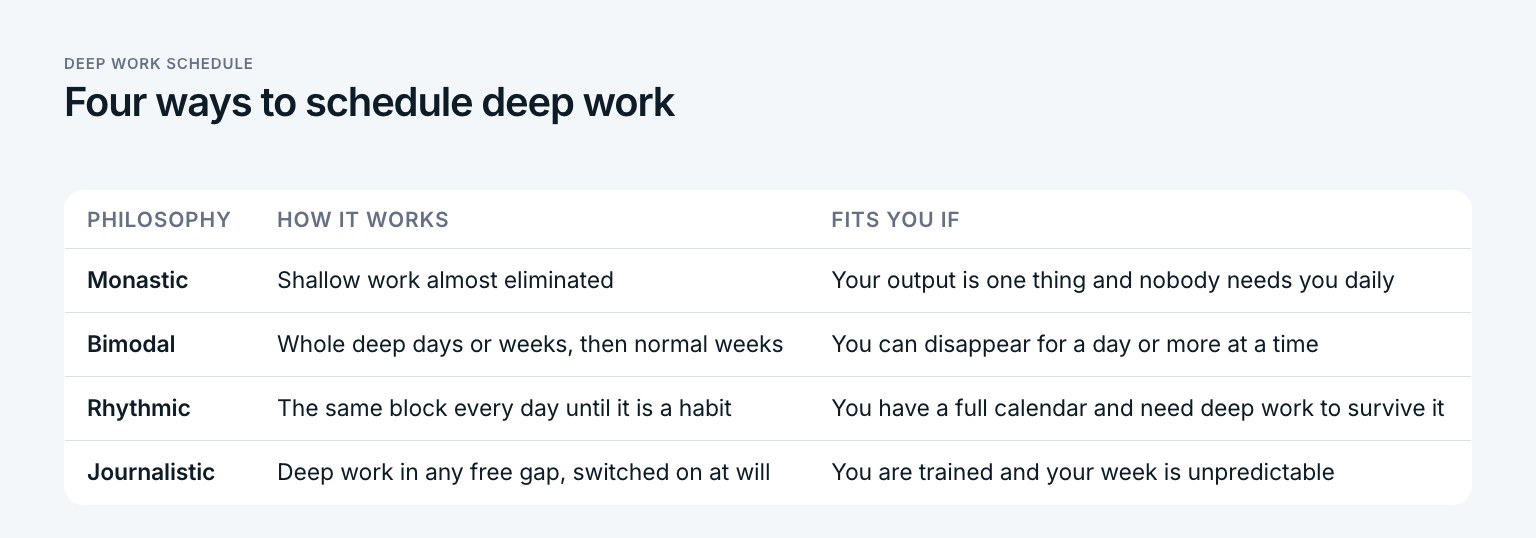
The rhythmic philosophy wins for most people with a job, and it wins for a boring reason: It removes the daily decision about when. Anyone who has to decide each morning whether today is a deep day will lose that decision to the first urgent message. That means: Pick a time, make it recurring, and let the rest of the week adapt. Priya's blocks moved the daily standup from 9:30 to 10:15 for the whole team. Nobody objected. Nobody had ever asked.
How to build a deep work schedule in six steps
A deep work schedule is a budget, not an intention. Six steps, about an hour to set up, then ten minutes a week to keep it running. The steps follow the order in which they fail: measurement first, because everything after it is built on that number.
Measure one honest week
Log your week in 30-minute slots and mark each slot deep, shallow or lost. Change nothing yet. The number you get is the baseline, and it is almost always below five hours. Priya's was 3.5.
Give every block a deliverable
A block labeled deep work is an invitation to think about what to do. A block labeled section three, data model, two of four tables is a task. Take the deliverable from your weekly goal, and the weekly goal from your monthly goal. If you cannot name a deliverable, you do not need a block. You need a plan.
Choose a philosophy and set recurring blocks
Rhythmic for most calendars: the same 90 minutes, four days a week, as a recurring event marked busy. Bimodal if you can take a whole day. Start with 90 minutes, not three hours. A block you complete beats a block you abandon.
Write the rules of the block
Newport's four questions: Where will you work, for how long, how will you work, and what support do you need? Answer each in one line and keep the lines where you can see them. Where: the desk by the window. How long: 90 minutes, timer on. How: the document only, questions go on a list, no browser. Support: water, headphones, phone in another room.
Protect the block and batch the shallows
Set the calendar to busy, set a status message that names when you will answer, close the chat app instead of muting it. Then give shallow work two windows a day and tell the people who depend on you. Most interruptions are not urgent. They are convenient for the person interrupting.
Keep score and shut down
Tally completed deep hours on paper where you can see the week. End every day with a shutdown ritual: look at every open task, decide where it goes, plan tomorrow's first block, say a closing phrase. Review the tally on Friday and adjust the schedule, not the ambition.
The tally matters more than it looks. Newport kept a count of deep hours on a sheet of paper and circled the days on which a milestone was reached. Priya kept hers on a sticky note on the monitor: four boxes a week, a line through each completed block. The note did one thing a calendar never did. It made a lost block visible on Friday instead of forgotten by Monday. For the Friday check itself, the ten-minute weekly review supplies the three questions, and the deep work tally is the first number you look at.
How many hours of deep work per day are realistic
About one hour a day when you start, up to four hours a day once trained, and almost never more. Newport takes the ceiling from research on deliberate practice by Anders Ericsson and colleagues, published in 1993, in which elite performers rarely sustained more than about four hours of intense practice a day. Deep work draws on the same resource. Anyone who schedules six deep hours on day one is planning the week in which they quit.
The ramp is where most schedules fail, because the first scheduled week looks like a defeat. Priya's four weeks in October:
| Week | Scheduled | Completed | Longest block | What happened |
|---|---|---|---|---|
| Week one | Nothing | 3.5 h in fragments | 35 min | Baseline. Design document at 400 words. |
| Week two | 6 h, four blocks of 90 min | 4.5 h | 90 min | One block lost to an incident, one cut short by a standup that had not moved yet. |
| Week three | 6 h | 6 h | 90 min | Standup moved to 10:15. Section three finished. |
| Week four | 9.5 h, blocks extended to 120 min plus one Monday block | 8.5 h | 120 min | One block cut by a review. Section four drafted and sent to two reviewers. |
Eight and a half hours in week four is less than half of Newport's theoretical ceiling of twenty hours a week. It is also more than double her baseline, and it produced two finished sections in two weeks after a baseline that had projected twelve weeks for the whole document. That is the realistic shape: not four hours a day, but eight to twelve hours a week, held for months. In short: The question is not how many hours of deep work you can do per day. It is how many you can repeat next week.
Time of day matters as much as the count. Most people get their best block in the first two hours after they start, before the day has added residue. Priya's 8:30 block worked. Her one attempt at a 14:00 block produced half the output in the same 90 minutes. Anyone who can only block afternoons should block them anyway, and expect a longer warm-up. A worse block that happens beats a perfect block that does not.
Deep work in the goal chain: from a yearly goal to a 90-minute block
Deep work without a goal is quiet time. The block needs to know what it is for, and the fastest way to give it that is a chain from the year down to the morning. Priya's chain in October looks like this:
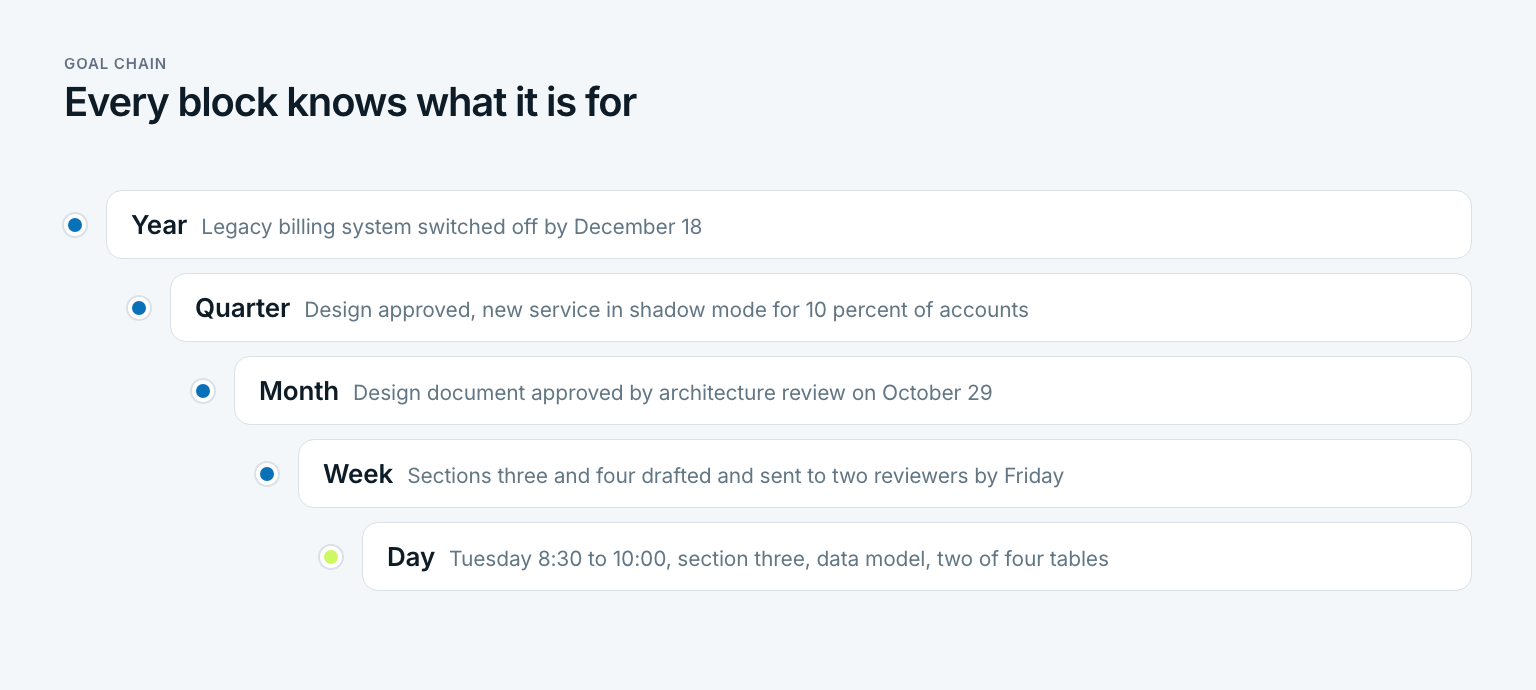
Every level answers one question for the level below. The year says why the design document matters at all. The quarter says what has to be true by December. The month sets the deadline. The week names the two sections. The day names the tables she will have drafted at 10:00. That means: When Priya sits down on Tuesday, there is no decision left to make except the first sentence.
The chain also works upward. If section three takes two blocks instead of one, the week slips by a day, and she knows it on Wednesday, not on October 28. If the architecture review moves, the month changes and the weekly deliverables change with it. In Gaapp this chain is the structure: five levels from year to day, each goal attached to a larger one, and the week's progress is the share of weekly goals done. The deep work block is the smallest link. It is where the chain either moves or does not.
The daily goal is the block's deliverable, phrased so that at 10:00 you can answer yes or no. Two of four tables drafted is a daily goal. Work on the data model is not. How to phrase one so it survives contact with the morning is in the guide to daily goals.
Whoever plans in twelve-week cycles has a natural fit here, because the 12 week year treats each week as a scored unit and a deep work tally is a score. Whoever works with OKRs attaches blocks to key results instead of weekly goals. And whoever has no yearly goal yet starts there, with the chain described in how to achieve goals, before blocking a single morning. A block is a tool. The goal is the reason.
The three mistakes that make deep work exhausting
Deep work is tiring by design. Three mistakes make it tiring in a way that does not pay, and all three feel like diligence while you make them. Which one is yours?
The most common mistake: a block with no deliverable
Blocking two hours labeled deep work and sitting down to decide what to work on. The first twenty minutes go to choosing, the next twenty to opening files, and the block ends with the feeling of having worked and nothing to show for it. Fix: Name the deliverable in the calendar event itself, taken from your weekly goal. If the event says deep work, delete it and write what you will have finished when it ends.
- Too long, too soon. Ambition is good, and a three-hour block is a real thing for a trained practitioner. For a beginner it is a 90-minute block followed by 90 minutes of guilt. Start at 60 or 90 minutes and extend by 30 once you have completed four blocks in a row.
- No shutdown. Anyone who ends the day mid-thought carries the thought into dinner, and the next morning starts with residue instead of a plan. Newport's shutdown ritual takes about ten minutes: every open item reviewed, tomorrow's first block planned, a closing phrase said out loud. It sounds silly. It is the step that makes the block repeatable.
- Blocks that vanish. A block that is cancelled whenever something comes up is not a schedule. It is a preference, and preferences lose to calendars. Move a threatened block to the same day or the next. Cancel it only if the week itself is cancelled.
Open offices, on-call rotations and leadership roles are real constraints, and anyone who calls them excuses has never carried a pager. The answer is not to wait for a quieter job. It is to shrink the block to what the job allows, 60 minutes if that is all, and to defend that one. Priya kept her blocks through two incidents by moving them, not cancelling them. A moved block is a schedule. A cancelled block is a wish.
Three questions before you block tomorrow morning
Three questions about the week you just had, to be answered in numbers rather than feelings:
- Can you say, in hours, how much deep work you did last week, without guessing?
- Does the next block in your calendar name what you will have finished when it ends?
- Do you know the time of day when your best 90 minutes happen, and is that time blocked for the rest of the month?
Anyone who answers no to one of these does not lack focus. They lack a schedule. Deep work is a practice you can start tomorrow at 8:30 with one deliverable and a timer, and it compounds in a way shallow work never does: Each block makes the next one easier to start and the output harder to replicate. In short: Deep work is not the hack that makes a busy week bearable. It is the budget that makes a busy week count.
Frequently asked questions about deep work
What is the concept of deep work?
Deep work is Cal Newport's term, from his 2016 book of the same name, for professional work done in a state of distraction-free concentration that pushes your abilities to their limit. It creates new value, improves your skill and is hard to replicate. Its opposite is shallow work: logistical tasks that can be done while distracted and that almost anyone could do. The concept is less about intensity than about protection, because deep work only happens in scheduled, uninterrupted time.
What are the four rules of deep work?
Work deeply, embrace boredom, quit social media and drain the shallows. The first rule is about schedules and rituals so that focus does not depend on willpower. The second trains concentration by resisting distraction outside of work. The third asks you to judge tools by whether they substantially support your goals rather than by whether they offer any benefit at all. The fourth caps shallow work with a budget and a plan for every hour of the day.
Is the book Deep Work worth reading?
Yes, especially the second half, which contains the four rules, the scheduling philosophies, the shutdown ritual and the shallow work budget. The first half argues why deep work is valuable and rare, and you can skim it if you are already convinced. Read it with your calendar open and change at least one recurring event before you finish.
How many hours of deep work can you do per day?
About one hour a day when you start and up to four hours a day once trained, according to Newport, who draws on Anders Ericsson's 1993 research on deliberate practice. Most people with a normal job land between eight and twelve hours a week. Start with one block of 90 minutes and extend it only after you have completed four blocks in a row.
What is the difference between deep work and flow?
Flow is a mental state described by Mihaly Csikszentmihalyi in 1990: full absorption in a task, where time seems to disappear. Deep work is a practice and a schedule that makes flow more likely. You can do deep work without reaching flow, especially in the first twenty minutes of a block, and you can experience flow in activities that are not work. Schedule the practice, and the state shows up more often.
How do you do deep work when you are on-call or in an open office?
Shrink the block to what the role allows and defend that block, rather than waiting for a quieter job. Sixty minutes with the chat app closed and a status message beats three aspirational hours you never get. Move blocks when an incident hits instead of cancelling them, and batch your shallow work into two fixed windows so colleagues learn when to expect answers.
Last updated: 14 October 2026
Read next
 Productivity
Feynman Technique: Four Steps to Real Understanding
The Feynman technique is not a memorization trick: four steps, a worked example from a stats class, a one-page template, and what research says.
16 min read
 Productivity
Zettelkasten: How to Turn Notes Into Your Own Ideas
A Zettelkasten is not an archive: Luhmann's method, the three note types, a five-step setup and an Obsidian template, with a worked example.
15 min read
 Productivity
Second Brain: How to Build One You Actually Use
A second brain is not a note archive: Tiago Forte's CODE steps, the PARA method with an example, a five-step setup and the mistakes that sink it.
15 min read