Getting Things Done: The GTD Method in Five Steps
Getting things done moves every commitment out of your head into a system you trust: five steps, the two minute rule, a weekly review, a worked first week.

Contents
- 01What getting things done means in simple terms
- 02GTD, a to-do list, and time blocking: what each is built for
- 03What really happens in your head: an open loop is not a plan
- 04The getting things done method in five steps
- 05The two minute rule, the 3-3-3 rule, and the next action
- 06The weekly review: where GTD lives or dies
- 07Getting things done in your goal chain: year, quarter, month, week, day
- 08The three mistakes nobody notices
- 09Three questions before you start
- 10Frequently asked questions about getting things done
Getting things done is not a to-do list. It is a method, written down by David Allen in 2001, for moving every commitment out of your head and into a system you trust, so that your attention is free for the one thing in front of you. A to-do list stores tasks. Getting Things Done, GTD for short, decides what each task actually is, where it belongs, and when you will look at it again. The list is a side effect. The decision is the method.
Five steps carry the method: capture, clarify, organize, reflect, engage. Each is simple on its own. Together they explain why some people run GTD for 20 years and others quit after three weeks. This article walks through all five with Dana, a support team lead in Denver who tried GTD because her head was full and her goals were not moving. You will see her 212 captured items, where each one went, how long the first week took, and how the method connects to a goal chain from year to day. At the end you get the two rules everyone asks about, the weekly review, and the three mistakes that end most GTD attempts quietly.
What getting things done means in simple terms
Getting things done means that nothing you have committed to lives only in your memory. Every email you need to answer, every call you promised, every idea for the kitchen renovation sits in a place outside your head, written as a concrete next step, and you review that place often enough to trust it. Allen's image for the result is a mind like water: it reacts to what arrives in proportion, then returns to calm. The method does not make you faster. It makes you stop carrying.
Why does carrying matter? Because an unfinished task does not wait politely. Bluma Zeigarnik described in 1927 how uncompleted tasks stay active in memory and interrupt whatever you are doing now. E. J. Masicampo and Roy Baumeister showed in 2011 that the interruption stops once you write a concrete plan for the task, even before you do it. That is the whole mechanism of GTD in one sentence. The plan does the work the worrying was trying to do.
Dana, 38, leads a team of 14 support agents at a software company in Denver and is halfway through a part-time MBA. In September she counted how often she checked her inbox during a one hour planning block: eleven times. She was not looking for new mail. She was looking for things she was afraid she had forgotten. That is the symptom GTD is built for, and it is more common than the word productivity suggests.
GTD, a to-do list, and time blocking: what each is built for
A to-do list is a good tool. It is fast, it is visible, and crossing something off feels like progress because it is progress. It just does not tell you what to do when the list has 80 items and three of them are projects with 20 steps each. Time blocking is a good tool too. It gives work an appointment. It just assumes you already know which work deserves one. GTD sits underneath both. It is the step where you decide what the work is.
| Tool | What it answers | Its unit | Where it breaks |
|---|---|---|---|
| To-do list | What do I want to do? | A task, often vague | Items pile up with no decision attached, and projects hide as single lines |
| Time blocking | When will I do it? | An hour in the calendar | You block time for the wrong things because the list underneath was never clarified |
| GTD | What is this, what is the next physical step, where does it belong? | A next action with a context | Without a weekly review the lists go stale within two weeks |
| Goal chain | Why does this matter, and which goal does it serve? | One goal per time horizon | Goals stay abstract if no next action hangs under them |
That means: the four are not rivals. Dana kept her calendar blocks and her habit of a short daily list. GTD changed what went into both. Anyone who argues about GTD versus time blocking is comparing a sorting method with a scheduling method. You need the sorting first, because a calendar full of unclarified work is just a to-do list with times on it.
What really happens in your head: an open loop is not a plan
Allen calls every unfinished commitment an open loop. Most people carry dozens of them, often more than a hundred, and almost nobody has counted. The loops feel like awareness. In fact they are the opposite: a loop you have not written down is a loop you have to keep re-noticing, and each re-noticing costs attention that was meant for something else. Here is the concession. Keeping things in your head works fine when you have twelve of them. Dana had more than 200.
Open loop
An open loop is anything that has your attention and is not where it belongs, in Allen's definition. The unanswered text from your sister is a loop. So is the vague sense that the quarterly report needs a new chart. The loop closes when the item is captured, clarified into a next action, and parked where you will see it again. Not when it is done. When it is decided.
Dana's mind sweep took 90 minutes on a Saturday morning with a pot of coffee and a blank document. She wrote everything: 212 items. Work and home mixed, because the head does not keep them apart either. Forty of the 212 were about the help center project she had been meaning to start since June. Twenty-six were about her MBA. Nine were about her car. The point of the exercise was not the number. It was that on Saturday at 10:30 the number existed, and on Friday it had not.
What did she notice first? Relief, then alarm. The alarm is normal. Two hundred items on one page look like failure. They are not. They are the inventory you were already carrying, now visible. Nobody added anything. Writing it down only moved the weight from your working memory to a page, where it costs nothing to store.
The getting things done method in five steps
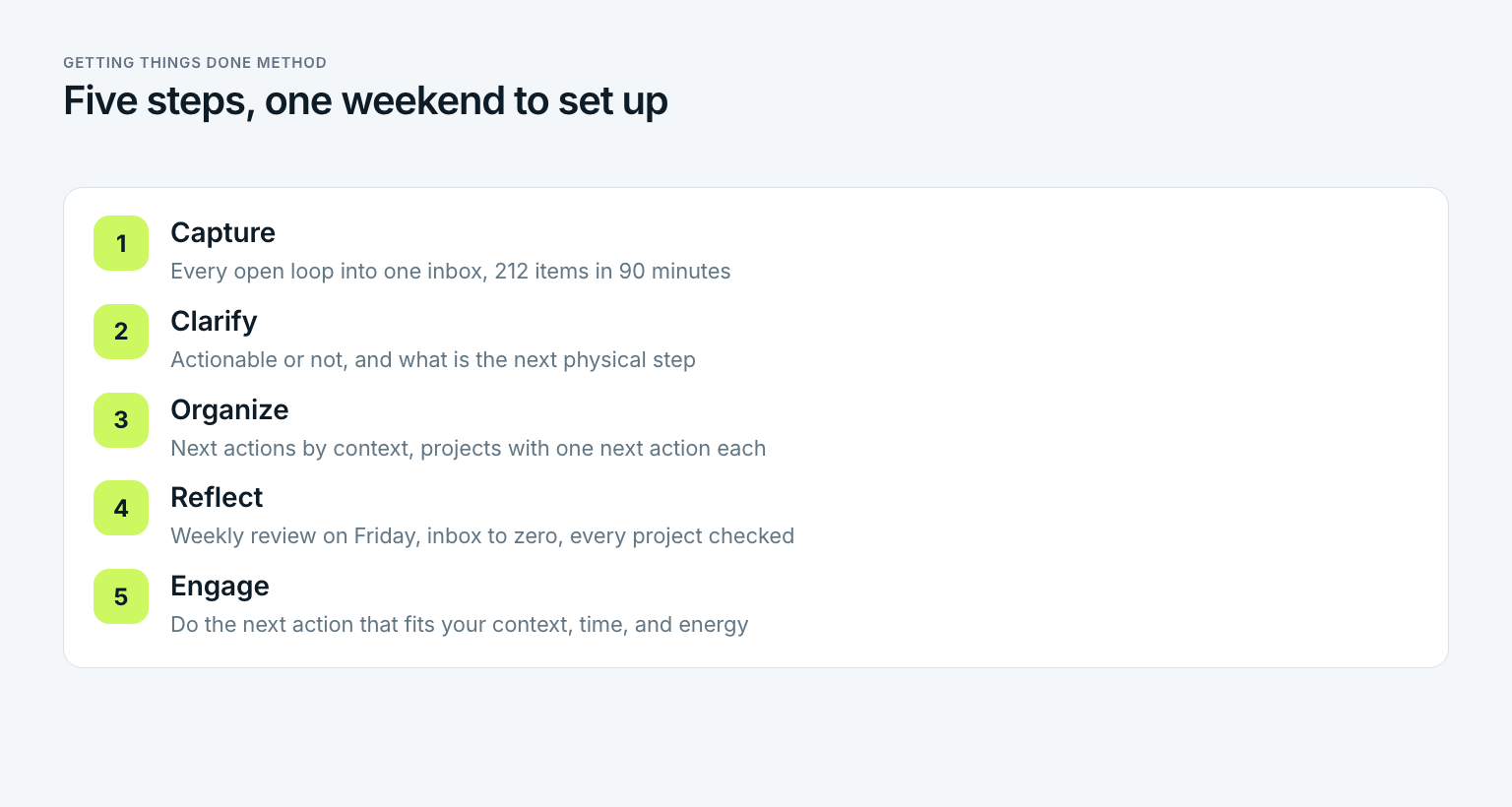
The five steps of GTD are capture, clarify, organize, reflect, and engage. Allen's 2001 edition named them collect, process, organize, review, and do. The 2015 revision renamed them, the content is the same. Each step answers one question, and the method breaks when a step gets skipped or two steps get merged. Here is the sequence, with Dana's numbers from her first week.
Capture everything, 90 minutes once, then two minutes a day
Write down every open loop in one place: a notebook, a notes app, a physical tray. Do not sort while you write. Dana filled a document with 212 lines on Saturday. After the first sweep, capture becomes a reflex: anything that lands on you goes into the inbox in the moment, and the inbox gets emptied once a day.
Clarify each item: what is it, is it actionable, what is the next action
Take items one at a time, top to bottom, no skipping. For each one ask: is this actionable? If no, it is trash, reference, or someday/maybe. If yes, what is the very next physical step? If that step takes under two minutes, do it now. Dana clarified her 212 items in two hours and 40 minutes on Sunday.
Organize by what the item is, not by how important it feels
Next actions go on lists sorted by context: calls, computer, errands, at the office. Anything with more than one step becomes a project with exactly one next action attached. A date goes in the calendar only if the item dies without that date. Things you are waiting on from others get their own list. Dana ended Sunday with 23 projects, 70 next actions on four lists, and 24 someday/maybe entries.
Reflect weekly, and look at the right list daily
Each day, glance at the calendar and the context list that fits where you are. Each week, in one sitting, empty the inbox, go through every project, confirm every project has a next action, and clean the lists. Dana's first weekly review took 45 minutes on Friday at 15:30. By week four it took 25.
Engage: do the next action in front of you, without re-deciding
Pick from the list that fits your context, your available time, and your energy. The deciding happened in step two, which is the point. Dana's Monday 9:00 block had three next actions from the help center project waiting on her computer list. She started on the first one at 9:02.
Dana's 212 items: where each one went
This is the table most GTD guides skip, and it is the one that makes the method real. Every item from the mind sweep landed in exactly one of six places. The numbers add up to 212 because clarify does not allow leftovers. An item you cannot place is an item you have not clarified.
| Where it went | Count | What that means | Example from Dana's sweep |
|---|---|---|---|
| Trash | 71 | No action, no future value | Look into a standing desk, written in 2024, she has one now |
| Reference | 38 | No action, might be needed later | Parking garage rate sheet, MBA syllabus |
| Someday/maybe | 24 | Possible later, not now | Learn Spanish before the Mexico trip in 2028 |
| Done in two minutes | 9 | Actionable, under two minutes | Approve two vacation requests, say yes to a dinner invite |
| Next action, single step | 47 | Actionable, one step, no project behind it | Call the dentist to move the cleaning |
| Next action of a project | 23 | One per project, 23 projects | Draft the outline for the help center structure |
| Total | 212 |
Seventy-one items went straight to trash. One in three. Those were loops she had been carrying for months, and they required nothing. Thirty-eight were reference, filed in two folders in eleven minutes. That left 103 items that still had her attention. Twenty-four of those went to someday/maybe, nine were finished before Sunday lunch, and 70 became next actions, 23 of them the first step of a project. In short: 212 things in her head became 70 decided next steps on four lists plus one list she reads once a month. The weight did not disappear. It got a shelf.
Contexts: the four lists Dana actually uses
Allen sorts next actions by context, meaning the tool, place, or person the action needs. The reason is practical. When you have twelve minutes before a meeting and your phone in hand, you want to see the calls, not the errands. Dana's 70 next actions split into four lists: 31 at the computer, 18 calls and messages, 12 at the office with the team, and nine errands. The MBA items and the help center items sit on the same computer list. Context beats topic, because at 21:00 on a Tuesday you are at the computer either way, and the question is only which action fits the 40 minutes you have.
Two more lists complete the set. Projects holds the 23 outcomes that need more than one step, each with its one next action visible. Waiting for holds the eleven things Dana has handed to someone else: a budget approval from her director, a transcript from the registrar, a quote from the garage. Whoever skips the waiting-for list keeps those eleven items in memory instead, and memory is the one place GTD is trying to empty. Whoever prefers to see these lists as a board can lay them out as columns and cap the cards in progress, which is the idea behind personal kanban.
The two minute rule, the 3-3-3 rule, and the next action
Three rules come up in almost every question about getting things done, and only one of them is Allen's. Here is what each does, and what it does not.
The two minute rule
If a next action takes less than two minutes, do it the moment you clarify it. Not because it is important, but because filing it, tracking it, and finding it again would cost more than two minutes. Dana finished nine items this way on Sunday. The rule belongs to the clarify step. Anyone who applies it all day long is using it as a polite way to avoid the big work.
The 3-3-3 rule is not part of GTD. It comes from Oliver Burkeman, who describes it in Meditations for Mortals in 2024: three hours on your most important project, three shorter urgent tasks, and three maintenance tasks that keep life running. It is a shape for a day, not a sorting system. The 1-3-5 rule is a cousin: one big task, three medium, five small per day. Both work well on top of GTD, because they assume you already have a clarified list to pick from. Without that list they are a wish with numbers on it.
The next action is the rule that carries the whole method. A next action is the next physical, visible thing you would do if you had nothing else to do. Not help center but open a blank document and list the ten most asked questions from last month's tickets. Not taxes but find the W-2 in the mail stack. Dana's first list had MBA paper on it. Her clarified version read: email Professor Hale to confirm the topic is approved. The first version sat for two weeks. The second took four minutes. The difference is not motivation. It is the verb.
The weekly review: where GTD lives or dies
The weekly review is the step most people skip, and Allen calls it the critical success factor of the method. He is right, and here is why in numbers. In her first week Dana added 41 new items to her inbox. Thirty-eight were processed the same day, three were not. Four projects had their next action completed by Wednesday and no new one attached. Without a review, by the following Friday she would have had three unprocessed items, four stalled projects, and a growing sense that the system was lying to her. The system was not lying. It was waiting for its Friday.
The review has a fixed shape: get the inbox to zero, look at the calendar for the past week and the coming one, read every project and confirm it has a next action, scan the waiting-for list and chase what is late, and read someday/maybe once to see whether anything has become now. Dana does it Friday 15:30 to 16:00 with the door closed. The first one took 45 minutes. The fourth took 25. The number of projects stayed at 23. The number of stalled projects went from four to zero, and that one number is the difference between a system you trust and a system you check on.
That means: the weekly review is not maintenance. It is the method. Capture, clarify, and organize set the system up once. Reflect is what keeps it true. If you have ten minutes instead of 30, the shortest useful version is in our guide to the ten-minute weekly review: three questions, one measure, one decision for next week. Whoever cannot find 30 minutes on Friday can find ten, and ten beats none by more than the arithmetic suggests.
Getting things done in your goal chain: year, quarter, month, week, day
GTD is strongest at ground level and quietest at the top. Allen knows this. He describes six horizons of focus, from current actions through projects and areas of responsibility up to goals, vision, and purpose, and he admits that most practitioners live on the bottom two. The result is familiar: an immaculate list of next actions that serve no goal in particular. The lists are clean. The year still ends where it started.
The fix is to hang every project on a goal, and every goal on a time horizon. A goal chain does that in five levels: year, quarter, month, week, day. Dana's chain for the help center project looks like this.
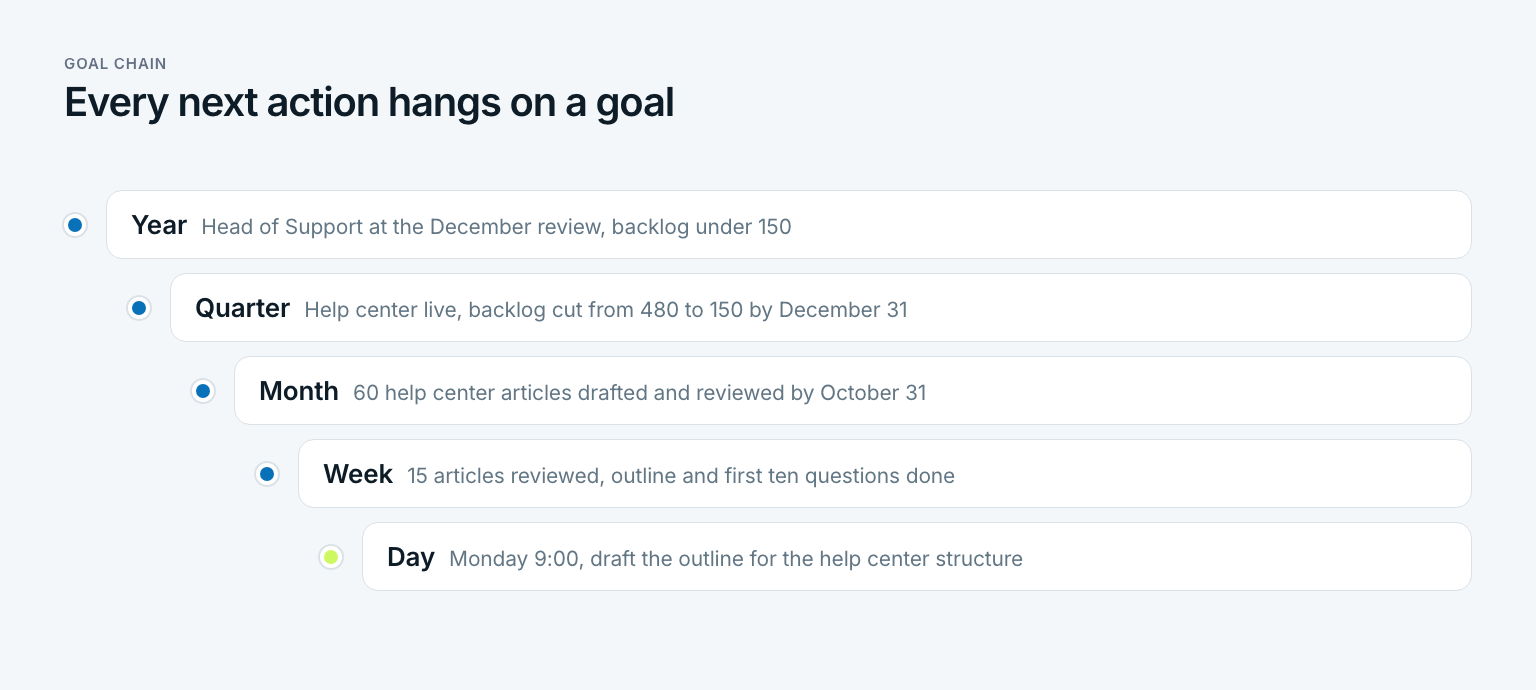
| Allen's horizon | Goal chain level | Dana's example |
|---|---|---|
| Purpose and vision | The reason the chain exists | Lead a support team people want to join |
| Goals, one to two years | Year | Head of Support at the December review, team backlog under 150 tickets |
| Areas of focus | Quarter | Help center live and backlog cut from 480 to 150 by December 31 |
| Projects | Month | 60 help center articles drafted and reviewed by October 31 |
| Next actions | Week and day | 15 articles this week, three per day, the first one Monday at 9:00 |
Read the table from the bottom. Draft the outline for the help center structure is a next action. It belongs to the project help center live, which is a quarterly outcome. The quarter serves the yearly goal, and the yearly goal is what Dana will be measured on in December. Now her 23 projects fall into two groups: 14 that hang on one of her three yearly goals, and nine that hang on nothing. Those nine did not disappear. Four moved to someday/maybe. Five stayed, because life has projects that serve no yearly goal, like the car. But she knows which five, and that knowledge is new.
In Gaapp the chain is the structure itself: a yearly goal, quarterly goals under it, monthly goals under those, then weekly and daily goals. Progress at each level is the share of goals ticked off, with a thin line showing how much of the period has passed. A GTD project becomes a monthly or quarterly goal. Its next action becomes the daily goal. Anyone who runs GTD without an upper chain gets busy. Anyone who runs a goal chain without next actions gets stuck. The two were built for each other. Allen's horizons say so, they just never got a shelf for the week.
How a yearly goal gets broken into quarters and months is in the guide to annual planning. How the one next action for today is written so that you can tick it off tonight is in the piece on daily goals. The long version of the whole chain, from the first yearly goal to the Friday check, is the pillar on how to achieve goals.
The three mistakes nobody notices
GTD rarely fails loudly. It fades. Three weeks in, the lists are slightly stale, the inbox has 60 items, and the person decides the method was too complicated. The method was fine. One of three things happened, and none of them felt like a mistake at the time. Which one is yours?
- Capturing without clarifying. Writing everything down feels like progress, and it is the first step. But an inbox with 200 unprocessed items is just a to-do list with a new name. Dana nearly stalled here: the Saturday sweep felt so good that Sunday's clarify session looked optional. It is the opposite. Capture without clarify is a longer list of open loops.
- Too many projects, none of them connected. Allen's own estimate is that most people have 30 to 100 projects. That is fine as long as each one has a next action and most of them hang on a goal. Twenty-three projects with no yearly goal above them is a busy life, not a directed one. The piece on why three goals are enough makes the case for a ceiling at the top of the chain.
- Making the system beautiful. Tags, nested folders, color codes, a new app every quarter. Every hour spent tuning the system is an hour not spent on a next action. Dana uses a notes app with six lists and a calendar. That is the whole stack. Anyone who has spent more time on the setup than on the weekly review has already left the method, even if the app still opens every morning.
The most common mistake: a system with no weekly review
The lists are set up, the inbox is empty, the first week goes well. Then Friday arrives with a meeting at 15:30, and the review slides to Monday, then to never. Within two weeks the lists stop matching reality. Because you can feel that, you stop trusting them, and because you stop trusting them, the loops move back into your head. Fix: book the review as a recurring appointment before you capture a single item. Thirty minutes, same slot, door closed. The review is not the upkeep of the system. It is the system.
Three questions before you start
Before you clear a Saturday morning for a mind sweep, answer three questions about last week:
- How many times did you check your inbox or your phone to see whether you had forgotten something, rather than to find something new?
- Can you name the next physical action for your most important project right now, without opening anything?
- When did you last read your whole list of projects, start to finish, in one sitting?
Anyone who answered more than five, no, and I do not remember is not disorganized. They are carrying the system in a place that was never built to hold it. Dana's answers in September were eleven, no, and never. In October they were two, yes, and Friday. Nothing about her job changed in between. In short: getting things done is not a list of things to do. It is a way of deciding, once, what each thing is, so that you never have to decide it again.
Frequently asked questions about getting things done
What are the 5 steps of GTD?
Capture, clarify, organize, reflect, engage. You collect every open loop in an inbox, decide for each one whether it is actionable and what the next physical step is, file it on the right list or in the calendar, review all lists once a week, and then do the next action that fits your context. Allen's first edition in 2001 called the same steps collect, process, organize, review, and do.
What is the 3-3-3 rule for Getting Things Done?
The 3-3-3 rule is not from David Allen. Oliver Burkeman describes it in Meditations for Mortals in 2024: spend three hours on your most important project, then handle three shorter urgent tasks and three maintenance tasks. It shapes a single day. GTD supplies the clarified list the rule picks from, so the two combine well.
What does "getting things done" mean?
As a method, getting things done means moving every commitment out of your memory and into a trusted system of lists and a calendar, written as concrete next actions, and reviewing that system weekly. The goal is not to do more. It is to stop carrying open loops in your head so that you can give full attention to the one thing in front of you.
What is the two minute rule in GTD?
When you clarify an item and its next action takes less than two minutes, you do it right then instead of filing it. Tracking a two minute task costs more than the task. The rule applies during processing, not all day. Dana finished nine of her 212 captured items this way on her first Sunday.
How long does it take to set up GTD?
Plan one weekend. Dana's mind sweep took 90 minutes, clarifying and organizing 212 items took two hours and 40 minutes, and the first weekly review took 45 minutes. After that the method costs about two minutes a day for capture and 25 to 30 minutes on Friday for the review. The first weekend is the only large investment.
Do I need a special app for GTD?
No. You need an inbox, a calendar, and six lists: next actions by context, projects, waiting for, and someday/maybe. A paper notebook works, a plain notes app works. The method lives in the weekly review, not in the software. If you want the projects to hang on yearly and quarterly goals, a goal tracker with a year to day structure adds that layer.
Last updated: 14 October 2026
Read next
 Productivity
Feynman Technique: Four Steps to Real Understanding
The Feynman technique is not a memorization trick: four steps, a worked example from a stats class, a one-page template, and what research says.
16 min read
 Productivity
Zettelkasten: How to Turn Notes Into Your Own Ideas
A Zettelkasten is not an archive: Luhmann's method, the three note types, a five-step setup and an Obsidian template, with a worked example.
15 min read
 Productivity
Second Brain: How to Build One You Actually Use
A second brain is not a note archive: Tiago Forte's CODE steps, the PARA method with an example, a five-step setup and the mistakes that sink it.
15 min read