Goal Oriented: What It Means and How to Build It
Being goal oriented is not a personality type. The meaning, three goal orientations, synonyms, resume lines and five steps to build the habit.

Contents
- 01What goal oriented means: the everyday sense and the research
- 02Busy or goal oriented: how to tell the difference
- 03The three goal orientations: learning, proving, avoiding
- 04Is goal oriented a skill? Yes, and it has five parts
- 05How to be goal oriented: five steps for next week
- 06Three mistakes that turn goal oriented into rigid
- 07Goal oriented synonyms and what to call a goal oriented person
- 08Goal oriented on a resume: show it, don't claim it
- 09The goal chain: being goal oriented from year to day
- 10Goal oriented: frequently asked questions
Being goal oriented is not a personality type. It is the habit of aiming your actions at a clearly defined result and sorting every task by whether it moves that result closer. Whoever is goal oriented can tell you, on any random Tuesday, what they are working toward. Whoever is merely busy can tell you what they are working on. The difference sounds small. It decides whether anything has changed by the end of the year or whether a lot simply got done.
Psychology adds a second, sharper meaning: goal orientation describes why you pursue a goal, to learn something or to prove something. Both meanings belong together, and both can be trained. They are worked through here on Maya, 26, a marketing coordinator at a software company in Denver, who hears one sentence in her mid-year review that she cannot shake: “You're the most reliable person on this team. I just can't tell what you're building toward.” Below you'll find the three goal orientations, what to call a goal oriented person, five steps to become one, the mistakes that turn focus into rigidity, and resume lines that show it instead of claiming it.
What goal oriented means: the everyday sense and the research
In everyday language and in job postings, goal oriented means you have a result in mind and plan your time around it. A goal oriented person meets a new task by first asking which result it serves, and only then how to finish it quickly. The opposite is not laziness. The opposite is being task oriented: you work through whatever arrives, in the order it arrives. Anyone who works that way can end a day exhausted and still not know what the day moved.
In psychology, the term goal orientation means something finer. Carol Dweck described in 1986, in the journal American Psychologist, that children working on the same hard problem do it for two different reasons. Some want to master the problem. Others want to show they are smart, or hide that they aren't. John Nicholls had drawn a similar line in 1984. Both groups are aimed at a goal. Yet they react very differently once something goes wrong. The first group tries harder. The second gives up sooner, because every mistake feels like a verdict on who they are.
This second meaning explains why well-meant advice often misses. “Just set a clear goal” helps someone who wants to learn. For someone who needs to prove themselves, a clear goal can make things worse, because now it is even clearer where they might fail. That means: being goal oriented is not only a matter of direction. It is also a matter of drive.
Two meanings, one phrase
Goal oriented in the everyday sense: I have a goal and arrange my time around it. Goal orientation in the research sense: I pursue my goal to learn, or to prove myself. The first describes direction, the second describes drive. You need both, because a clear direction with the wrong drive leads exactly where Maya stood in June: lots of work, little movement.
Busy or goal oriented: how to tell the difference
Hard work is a good trait. It just doesn't measure anything. Maya handles every launch email, every social post and every last-minute request from sales. Her calendar shows nine recurring meetings a week, and her time tracker averaged 45 hours across the first half of the year. Nobody would call her lazy. Her manager is still right, because when she asked Maya what she wanted to achieve by the end of the year, Maya had no answer with a number in it. She said: “Grow, I guess. Maybe get closer to paid search.”
Here is her week broken down by hours: 14 hours of chat and email, 10 hours of meetings, 15 hours of production work and 6 hours of reporting. Not a single block serves the move into paid search, even though it is the only wish she named herself. So Maya is not short on drive. She simply doesn't have a goal yet that she could orient toward. The table shows how to spot the difference in yourself:
| Signal | Busy | Goal oriented |
|---|---|---|
| First question in the morning | What's urgent today? | What moves my goal today? |
| A new request | Do it right away | Check it against the goal, then decide |
| How the day is measured | Number of tasks done | Progress on the result |
| After a setback | More of the same | Find the cause, adjust the path |
| Answer to “What are you working on?” | A list | One sentence with a number and a date |
The right column doesn't ask for more hours. It asks for one sentence that the hours line up behind. Whoever lacks that sentence can work as hard as they like and still end the year wherever other people's requests pushed them. How would you measure last Tuesday?
The three goal orientations: learning, proving, avoiding
Research has refined Dweck's distinction since. Andrew Elliot and Judith Harackiewicz split performance goals in two in 1996: you can want to show that you are good, or want to avoid looking bad. Don VandeWalle built a questionnaire for the workplace in 1997 that measures exactly these three forms. Almost everyone carries all three, just in different strengths:
- Learning goal orientation. You want to build a skill. Mistakes are signals that show where you are still stuck. The question it asks: what will I be able to do that I can't do today?
- Prove goal orientation. You want to show that you are good, better than others or better than the target. The question it asks: how do I look by comparison?
- Avoid goal orientation. You want to keep from looking bad. The question it asks: how do I keep anyone from seeing a weakness?
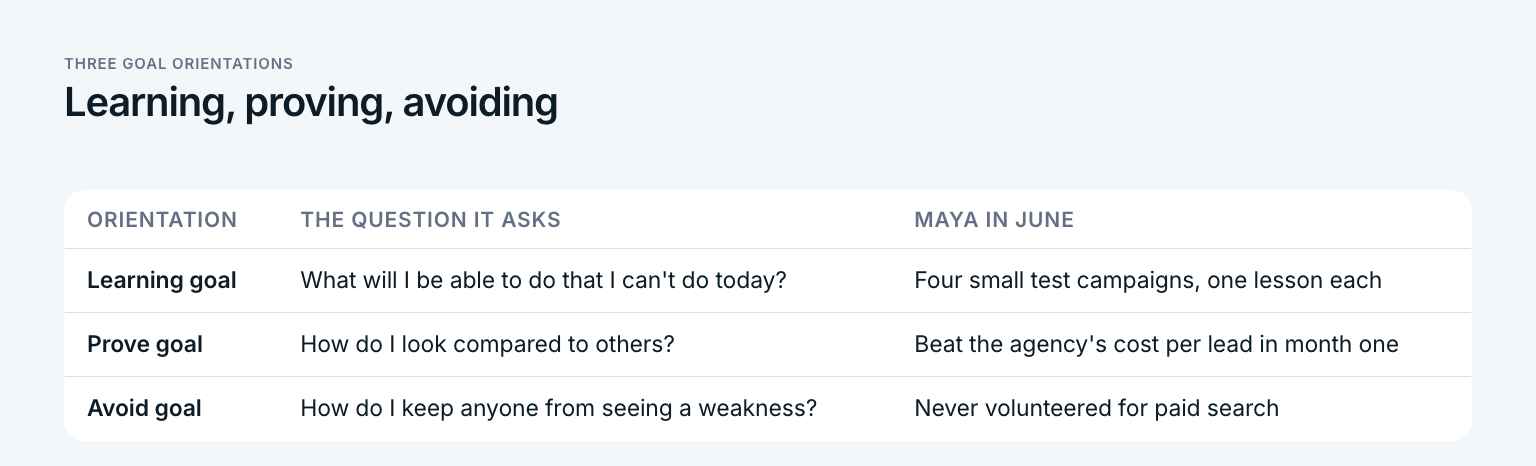
Which one dominates makes a measurable difference. Stephen Payne, Satoris Youngcourt and Matthew Beaubien published a meta-analysis across many studies in the Journal of Applied Psychology in 2007. Learning goal orientation was positively related to job performance. Avoid goal orientation was negatively related. The prove form sat in between and showed little relationship of its own. In short: whether you have a goal is only half the story. Why you have it is the other half.
For Maya, the third form is the strongest, and she only notices when she counts honestly. The paid search role she wants requires running campaigns. She has never volunteered for one, officially because she's too busy. Actually, because a bad cost per lead would show up on the weekly dashboard that the whole team sees. Anyone who postpones a goal out of fear of other people's judgment is not aimless. They are avoidance oriented. That is a different problem, and it needs a different fix than a new schedule.
Performance goals are not the villain here. For tasks you already know how to do, they are exactly right, because there the result is what counts and a hard number pulls you forward. For new, complex tasks the opposite holds. Dan Winters and Gary Latham showed in 1996 that people facing a new, difficult task did better when their goal was to discover a specific number of strategies than when their goal was a high score. That means: a learning goal first, while you are still learning the task. A performance goal once you know it.
Is goal oriented a skill? Yes, and it has five parts
Being goal oriented is partly temperament and largely habit and environment. Dweck's work tied goal orientation closely to how people see their own abilities. Whoever believes abilities are fixed leans toward performance goals, because every task becomes a test. Whoever believes abilities can grow leans toward learning goals, because every task becomes practice. Those beliefs can shift. Slowly, through experience, but they shift.
The setting shapes it too. A team that discusses mistakes in public and punishes them trains people to avoid. A team that treats mistakes as material for next week trains people to learn. Maya's team, with its weekly dashboard, leans toward the first. She can't change that alone. She can change how she frames her own goal, and that is the lever the five steps below pull.
A second lever is the experience of having done something by your own effort. Albert Bandura called the belief that grows from it self-efficacy and named such mastery experiences its strongest source. Anyone who collects small, safe wins dares the next bigger goal. How to build that experience on purpose is covered in the article on self-efficacy. For being goal oriented, it means this: the trait does not grow through resolutions. It grows through small goals you visibly reach.
So yes, goal oriented is a skill. Taken apart, it is five smaller skills, and each one can be practiced on its own:
- Defining a result: turning a wish into a state with a number and a date.
- Prioritizing: ranking tasks by whether they move the result, and leaving the rest alone on purpose.
- Saying no: declining or deferring requests that don't serve the goal, without damaging relationships.
- Measuring progress: checking at short intervals whether the current path is enough.
- Learning from setbacks: reading a mistake as information, not as a verdict.
Maya is weak on the first and has never practiced the fourth and fifth. That is a more useful diagnosis than “not goal oriented enough,” because it tells her where to start. Which of the five is weakest for you?
How to be goal oriented: five steps for next week
Becoming goal oriented doesn't mean planning more. It means deciding once, cleanly, and then building the week around that decision. The first pass takes about an hour, and after that 15 minutes a week. Maya went through the steps on a Sunday in late June:
Name one result with a number and a date
A goal without a number gives you nothing to orient toward. Ask yourself: what will be different on the deadline, and how would someone else see it? Maya writes: by January 31, I am promoted to marketing specialist and own the paid search budget. How to phrase a goal like this so it holds up is covered in depth in [goal setting](/en/blog/goal-setting).
Put a learning goal underneath
Outcome goals pull, but they don't tell you what to do today, and under pressure they wake up the urge to avoid. So every result gets a learning goal that describes which skill you are building. Maya's learning goal: by September 30, run four small test campaigns at $500 each and write down one lesson per campaign. That turns the feared dashboard into a series of experiments where a bad number is useful, because it shows what to fix.
Measure last week against the goal
Take your last week and sort every hour into one of three groups: serves the goal, has to happen, could go. Maya finds zero hours in the first group, 39 in the second and 6 in the third, mostly status meetings where she only listens. She turns two of them into written updates and batches chat into three fixed windows a day. That frees three hours a week for the goal without a minute of overtime.
Block fixed time on the calendar
What isn't on the calendar loses to everything that is. Maya blocks Tuesday and Thursday from 8 to 9 a.m. for campaign work, with chat closed, and books one hour every other Friday with the agency's account manager to review her numbers. She adds an if-then plan for the day something is on fire: if sales pings me at 8:15, I answer at 9.
Count progress and lessons on Friday
Being goal oriented runs on feedback. 15 minutes on Friday is enough: how many blocks happened, what did the latest campaign show, what changes next week? The questions for that are in the [ten-minute weekly review](/en/blog/ten-minute-weekly-review). Whoever only measures at the end finds out in January that the path wasn't enough. Whoever measures every Friday finds out in August.
Twelve weeks later, Maya's week looks different without being longer. Most blocks stayed the same. Four hours moved, and those four hours are the whole difference:
| Block | June | September |
|---|---|---|
| Chat and email | 14 hours | 12 hours |
| Meetings | 10 hours | 8 hours |
| Production work | 15 hours | 15 hours |
| Reporting | 6 hours | 6 hours |
| Campaign work toward the goal | 0 hours | 3 hours |
| Total | 45 hours | 44 hours |
And the test campaigns? Cost per lead came in at $61 on the first, $52 on the second, $44 on the third and $38 on the fourth. Her lesson notes moved from targeting mistakes to landing page mistakes, and that is exactly where her blocks go now. In September she asked her manager for a live budget, without waiting for the right moment. That means: the learning goal didn't talk the fear away. It replaced the fear with numbers.
Three mistakes that turn goal oriented into rigid
Being goal oriented has a shadow side, and goal oriented people are the last to notice it. Lisa Ordóñez and colleagues described in 2009, in a paper titled “Goals Gone Wild,” how narrow goals lead people to overlook everything else, up to and including unethical behavior. That is not an argument against goals. It is an argument for holding them well. Which of these three is yours?
- Tunnel vision. Whoever only sees the number misses what breaks next to it: client relationships, health, the team. Maya could have taken her three hours out of production work for sales. She might have hit her campaign numbers and lost the trust of the people who depend on her. So every goal needs a boundary: what will not be sacrificed for it.
- Holding on to the method instead of the goal. Goal oriented means holding on to the result, not to the route. Anyone who notices after three weeks that evening work doesn't stick changes the time, not the goal. It turns rigid only when the two get confused.
- Only performance goals. A goal made up only of a number that others judge wakes up avoidance at every setback. Without a learning goal underneath, the first bad test campaign becomes a reason to stop asking for a real one.
The most common mistake: confusing goal oriented with constant tension
Plenty of people think they are highly goal oriented because they think about their goals all the time and feel every deviation as failure. It feels like ambition. Usually it is avoidance in a new outfit, because the drive is fear of missing the goal, not the wish to reach it. Without question, that stance burns exactly the energy the path needs. That means: goal oriented is the person who knows the goal and checks it calmly on Friday, not the person who carries it around the clock.
The test is simple. Picture the next campaign, the next quarterly number or the next race going badly. Do you first ask what you'll learn from it, or who saw it? Whoever asks about the audience first has a performance goal with no learning goal underneath.
Goal oriented synonyms and what to call a goal oriented person
A goal oriented person is most often called driven, focused or results oriented. As a noun, the common words are achiever, go-getter and self-starter. None of them is a perfect match, and the differences matter when you pick one for a resume, a review or a reference letter. The table shows the closest options and what each one quietly adds:
| Word | What it stresses | Best used for |
|---|---|---|
| Goal-driven | The goal as the main motivator | Resumes and cover letters, closest synonym |
| Results oriented | Outcomes over effort | Sales, operations, management roles |
| Purpose-driven | Meaning behind the goal | Mission-led organizations, nonprofits |
| Focused | Attention on few things | Describing work style in a review |
| Driven | Energy and persistence | References, but it can sound restless |
| Self-starter | Starting without being told | Roles with little supervision |
One caution applies to all of them. The word itself proves nothing, and people who read resumes for a living skip over it. What convinces is a sentence that shows the trait at work.
Goal oriented on a resume: show it, don't claim it
Goal oriented appears in countless job postings, and nearly as many applicants copy it back into their resume. There it says nothing, because nobody describes themselves as aimless. What works is a line with a goal, an action and a result. Anyone who wants to prove they are goal oriented describes a goal they set for themselves, what they did, and where they landed.
Three resume lines that replace the phrase:
- “Set a goal to bring cost per lead on paid search below $40 within one quarter. Ran four $500 test campaigns, documented one lesson each, and cut cost per lead from $61 to $38.”
- “Aimed to pass the CPA exam on the first attempt while working full time. Studied two fixed hours every weekday morning for 40 weeks and passed all four sections.”
- “Our support team wanted first-response time down from three days to one. Sorted tickets by topic, wrote templates for the five most common requests, and reached 1.2 days within eight weeks.”
In interviews the question usually arrives as “Tell me about a goal you set and how you reached it.” The strongest answer has the same shape plus a setback, because a goal without a setback sounds like luck. Mention what didn't work and what you changed. That shows not just that you are goal oriented but that you are learning oriented, and that is the form research ties to job performance.
The goal chain: being goal oriented from year to day
Being goal oriented needs a link between the goal and today. Without that link, the goal lives on a sticky note and the day belongs to other people's requests. The goal chain builds the link across five levels: year, quarter, month, week, day. The result sits at the top, learning and performance goals in the middle, and actions you can check off at the bottom. Here is Maya's chain in October:
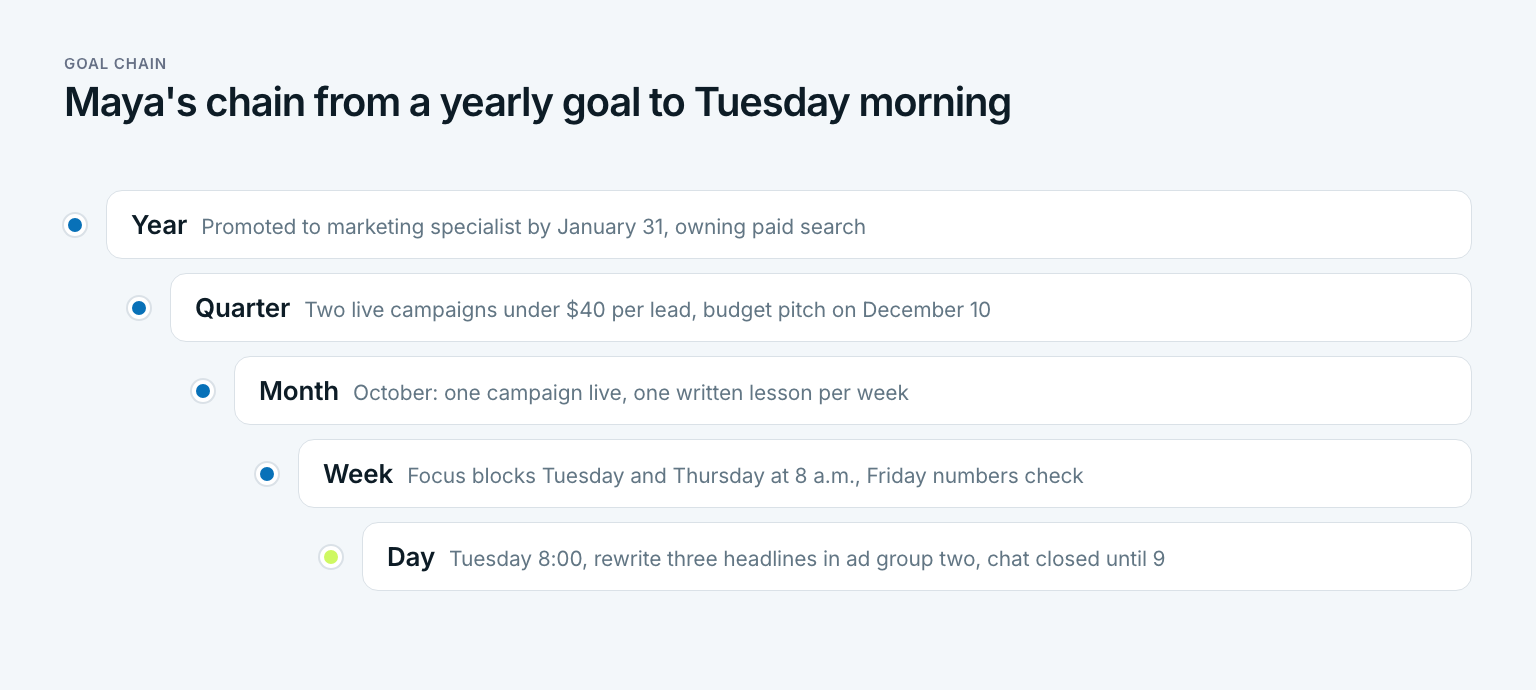
Each level checks the one above it. If Maya misses her October campaign, she knows in early November that the quarter is at risk, not in January that the promotion is. Anyone who chains goals this way doesn't need fresh motivation every morning, because the decision has already been made. How to break a yearly plan down into weeks and stay on track is in the guide on how to achieve goals. How to read progress against time elapsed is covered in achieving goals.
In Gaapp, this chain is the backbone: every goal hangs on a bigger one, and for each period you see the share of goals done next to the share of time gone. For someone learning to be goal oriented, that is a very practical number, because it answers the question of whether you are on track every Friday without you having to ask it.
Three questions to close, aimed at your last week:
- Can you say your most important goal in one sentence, with a number and a date, without thinking?
- How many hours last week went directly toward it?
- Have you ever postponed a goal because you were afraid of the result?
Whoever answers the first with no needs a goal before any technique. Whoever gets zero on the second needs fixed blocks. Whoever answers the third with yes needs a learning goal that breaks the fear into experiments. In short: being goal oriented is not a trait you have or lack. It is a week you build around your goal.
Goal oriented: frequently asked questions
What does it mean to be goal-oriented?
Being goal-oriented means aiming your actions at a clearly defined result and ranking tasks by whether they move that result closer. In psychology, goal orientation also describes the drive behind a goal: wanting to learn or wanting to prove yourself. The most effective form combines a clear result with a learning goal underneath.
What is a synonym for goal-oriented?
The closest synonyms are goal-driven, results oriented, purpose-driven and focused. Goal-driven is the most direct swap on a resume. Results oriented puts more weight on outcomes, and purpose-driven puts more weight on meaning.
What do you call someone who is goal-oriented?
Common words are achiever, go-getter and self-starter, or the adjectives driven and focused. In a reference or review, a concrete example says more than any of these labels. Something like “set and hit a target of 20 percent fewer support tickets” shows the trait directly.
Is goal-oriented a skill?
Yes. It is a learnable skill made of five parts: defining a result, prioritizing, saying no, measuring progress and learning from setbacks. Each part can be practiced on its own, and small goals reached visibly build the confidence for bigger ones.
How do I become more goal oriented?
Start with one result that has a number and a date, add a learning goal underneath, and block two or three fixed hours a week for it. Check progress for 15 minutes every Friday. You don't need more hours, just hours that point the same way.
What is the difference between goal oriented and task oriented?
A task oriented person works through what arrives in the order it arrives and measures the day by tasks completed. A goal oriented person checks each task against a result and measures the day by progress toward it. Both can be equally hardworking, but only the second can say what changed by year end.
Last updated: 6 October 2026
Read next
 Goal Setting
Intrinsic Motivation: What Drives You From the Inside
Intrinsic motivation is not a personality trait. Meaning, 12 examples, the three needs behind it and five steps to build it, with a worked example.
17 min read
 Goal Setting
Financial Goals: How to Turn Wishes Into a Plan
Financial goals are not wishes with a dollar sign. Short and long term examples, SMART savings goals and a five step plan, worked through one year.
17 min read
 Goal Setting
WOOP Method: Four Steps From Wish to If-Then Plan
The WOOP method is not positive thinking. What WOOP stands for, the research, if-then plans, eight goal examples and a five-minute guide.
18 min read