Financial Goals: How to Turn Wishes Into a Plan
Financial goals are not wishes with a dollar sign. Short and long term examples, SMART savings goals and a five step plan, worked through one year.

Contents
- 01What financial goals are, and what makes one real
- 02Short term, medium term and long term financial goals
- 03What is really happening in your account: Marcus's month
- 04How to set SMART financial goals in five steps
- 05Savings goals: the rate matters more than the total
- 06Which financial goal comes first
- 07Financial goals in the goal chain: from year to receipt
- 08Financial goals examples: 20 goals you can copy
- 09The three mistakes that sink savings goals
- 10Five questions for your financial check-in
- 11Financial goals FAQ
Financial goals are not wishes with a dollar sign. A financial goal is an amount with a deadline and a purpose that breaks down into a monthly number: $1,000 in a starter emergency fund by December 31, which means $500 a month for two months. “Save more” is a wish. “$500 moved to savings the day after payday” is a plan.
Most guides list types of goals and stop where it gets hard: the question of where the monthly money comes from. This one works through a full year. Marcus, 29, is a dental hygienist in Columbus, Ohio. He takes home $4,100 a month, carries $5,200 on a credit card at 24 percent APR and has no savings. By the end you will see his short term and long term financial goals, the payoff math, 20 examples you can copy and the three mistakes that end most savings plans by February.
What financial goals are, and what makes one real
A financial goal has four parts: an amount, a deadline, a purpose and a monthly rate. Amount and deadline make it measurable. The purpose decides whether you still care in March, when the money could go somewhere more fun. The rate turns the goal into this month's action, and without it the goal stays a number on a page.
Drop any of the four and you are back to a wish. “A cushion for emergencies” has no amount. “$10,000 in savings” has no deadline. “$10,000 by 2028” has no rate, so it has no first step. Anyone who knows only the amount wakes up on payday with nothing to do. Anyone who knows the rate has exactly one job that day: let the transfer run.
| Wish | Financial goal | Monthly rate |
|---|---|---|
| I want to get out of debt. | Pay off a $5,200 credit card balance by August 2027 | $250 for two months, then $700 |
| I need a safety net. | $1,000 starter emergency fund by December 31, 2026 | $500 in November and December |
| I want real savings. | Three months of expenses, $10,000, by October 2028 | $700, later $660, once the card is gone |
| I never have money for gifts. | $500 holiday gift fund by October 31, 2027 | $50 |
| I should save for retirement. | Raise 401(k) contributions from 3 to 10 percent of pay, one point each January from 2028 | about $40 of take-home pay per step |
Short term, medium term and long term financial goals
Financial goals sort by time horizon. Short term financial goals take up to a year, medium term goals one to five years, long term financial goals anything beyond that. The lines are a convention, not a law. What matters more is that each goal carries a number and a date. How short and long term goals carry each other in general is covered in the guide to short-term and long-term goals. Here the focus is money.
| Horizon | Financial goal | Measured as |
|---|---|---|
| Short term | Track every expense for 90 days | all spending sorted into ten categories or fewer |
| Short term | Starter emergency fund | $1,000 in a separate account by a set date |
| Short term | Cancel unused subscriptions | a list of all recurring charges, two canceled by the 30th |
| Short term | Pay the credit card in full | statement balance paid six months in a row |
| Short term | Holiday gift fund | $500 by October 31, $50 a month |
| Short term | Raise your savings rate | from 5 to 10 percent of take-home pay by March |
| Medium term | Pay off a credit card | balance at zero by a set month |
| Medium term | Full emergency fund | three to six months of expenses |
| Medium term | Car fund | $8,000 in cash for a used car by a set year |
| Medium term | Down payment | amount from your target price, date from your rate |
| Long term | Retirement savings | a fixed share of pay every month, reviewed each year |
| Long term | College fund for a child | a monthly amount from birth to age 18 |
Notice how many short term goals have no savings amount at all. Tracking spending, canceling subscriptions, paying the card in full: these goals free up money before anything can be saved. Whoever starts with a big savings target without knowing where today's money goes is planning with a rate that does not exist. That means: the first financial goal is almost always an honest look at the last three months.
What is really happening in your account: Marcus's month
Marcus had a rough picture of his money: rent, car, groceries, eating out a few times a week, the card payment. Some months the card balance went down, some months it went up. He had no savings account at all. His question was not how much to save. It was why $4,100 a month never seemed to leave anything behind.
In October 2026 he went through three months of bank and card statements and sorted every charge. It took two evenings. This was his average month before, and after five changes:
| Category | Before | After | What changed |
|---|---|---|---|
| Rent and utilities | $1,480 | $1,480 | nothing |
| Car payment, insurance, gas | $610 | $610 | nothing |
| Phone and internet | $145 | $110 | switched to a cheaper phone plan |
| Groceries | $420 | $420 | nothing |
| Restaurants and takeout | $520 | $300 | takeout on weekends only |
| Subscriptions and apps | $95 | $40 | canceled four of seven |
| Gym | $60 | $60 | nothing |
| Shopping and fun | $340 | $270 | monthly cap instead of open card |
| Unsorted small purchases | $160 | $60 | weekly budget |
| Total spending | $3,830 | $3,350 | $480 less |
| Left over from $4,100 | $270 | $750 | savings rate from about 7 to 18 percent |
The biggest line was no surprise: rent. The most expensive insight was takeout, $520 a month, most of it on weeknights after long shifts. Marcus did not ban it. He moved it to the weekend and kept $300 for it. The unsorted small purchases, none of them over $30, got a weekly budget instead of an open card.
More important than the $480 is what happens to it. Marcus had a surplus before, too. It went to the card, and new charges filled the gap the next month, which is why the balance sat near $5,200 for a year. Without a goal, a surplus is just a balance waiting to be spent. So Marcus did not start by cutting. He started by deciding what the $750 was for, and only then looked for where it would come from.
How to set SMART financial goals in five steps
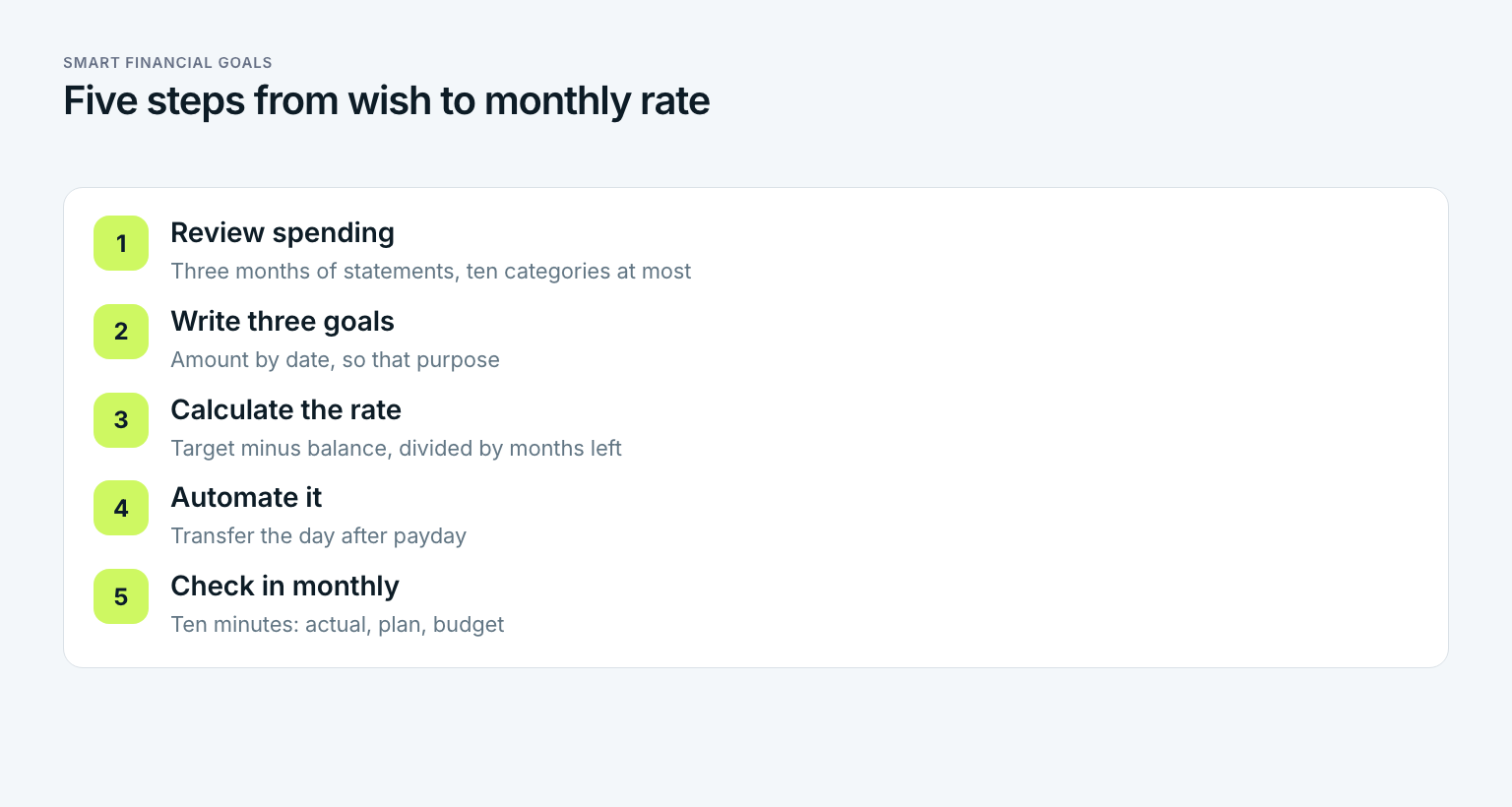
SMART goes back to George T. Doran, who proposed it in 1981 in Management Review as a way to write objectives that are specific, measurable, assignable, realistic and time related. Today most people read the A as achievable. For money, SMART financial goals come down to the four parts above plus one test: does the rate fit the surplus? The full method is in the guide to SMART goals. These five steps apply it to money, and the order is not random.
Review three months of spending
Pull your last three months of bank and card statements and sort every charge into no more than ten categories. Three months smooth out the odd ones, a single month misleads. The output is one number: what is left over on average? For Marcus it was $270.
Write no more than three goals with amount, date and purpose
Use one sentence per goal: amount by date, so that purpose. Marcus's first one reads: “$1,000 by December 31, so that a flat tire does not go on the credit card.” More than three goals at once split the rate so thin that none of them visibly moves.
Calculate the rate and check it against the surplus
For each goal, subtract what you already have from the target and divide by the months left. Add up the rates. If the total is higher than your surplus, move a deadline or trim a spending category first, not the purpose. Marcus needed $750 and had $270. He closed the gap with five changes, not by giving up everything.
Automate the transfer for the day after payday
Open a separate savings account for each savings goal, name it after the goal and set an automatic transfer for the day after your paycheck lands. Debt payments get their own autopay date. The goal gets paid first and daily life runs on the rest. You can change the transfer any time. You just do not have to decide again every month.
Check in for ten minutes each month
At month end, compare three numbers: the goal balance, where the plan says it should be, and spending against budget. If a goal falls behind, adjust the rate or the date before the gap grows. The routine is the same one described in the guide to [monthly goals](/en/blog/monthly-goals).
Marcus's three goals
| Goal | Amount and date | Rate | Purpose |
|---|---|---|---|
| Starter emergency fund | $1,000 by December 31, 2026 | $500 in November and December | A car repair does not land on the card. |
| Credit card payoff | $5,200 at 24 percent APR, paid off by August 2027 | $250 in November and December, then $700 | Stop paying about $100 a month in interest. |
| Full emergency fund | $10,000 by October 2028 | $700 from September 2027, $660 from January 2028 | Three months of expenses, so a job change is not a crisis. |
The full emergency fund matches three months of spending after his review: three times $3,350, rounded down to a clean $10,000. The rate drops to $660 in January 2028 because that is when Marcus starts raising his 401(k) contribution by one percentage point, which costs him about $40 of take-home pay. The remaining $50 a month stays in checking as a buffer the whole time.
Savings goals: the rate matters more than the total
A savings goal is a financial goal where you set money aside instead of spending it or paying down debt. Its key number is not the target but the monthly rate. $10,000 sounds like a year of sacrifice. $700 a month sounds like a question you can answer: where does the $700 come from?
The savings goal formula
Monthly rate equals target amount minus current balance, divided by the months until the deadline. For Marcus's full emergency fund: $10,000 minus $1,000, divided by 13 months, comes to about $700. If the rate is higher than what is free each month, you have two levers: the date and the spending. The amount itself is rarely the right lever, because it follows from the purpose.
Two findings from behavioral economics help the rate actually flow. The first comes from Richard Thaler, who summed up in 1999 under the name mental accounting how people sort money into mental buckets and treat labeled money differently from unlabeled money. For savings goals that means: a separate account named “Emergency fund” gets raided less often than the same amount sitting in checking. Dilip Soman and Amar Cheema showed in a 2011 field experiment with laborer households in India that money split into separate envelopes was more likely to stay saved.
The second finding is about timing. Richard Thaler and Shlomo Benartzi evaluated a program called Save More Tomorrow in 2004. Employees committed in advance to raise their retirement savings rate with each future pay raise. The average savings rate of participants rose from 3.5 to 13.6 percent over 40 months. Whoever moves the rate automatically right after payday, instead of saving whatever is left at month end, uses the same mechanism. The decision gets made once, not every month.
In short: a savings goal needs a rate, its own named account and an automatic transfer right after payday. Everything else is willpower, and willpower runs low around the 28th.
Which financial goal comes first
Three goals at once can work. Five goals with equal priority cannot. Many consumer finance guides describe a similar order:
- A small starter fund. A first amount that covers a repair, so not every surprise lands on a credit card.
- High-interest debt. Credit card rates are usually far above anything savings earn. Every dollar of balance paid off saves that rate.
- A full emergency fund. A common rule of thumb is three to six months of essential expenses in an account you can reach quickly.
- Planned expenses and medium term goals. Car, gifts, a move: anything you can see coming gets its own rate instead of becoming a surprise.
- Long term goals. Retirement and building wealth, with a fixed share of pay.
Why debt before the full fund? Marcus's card charged 24 percent APR. Every dollar he paid off saved him that rate, and no savings account came close. The numbers make the order obvious:
| Monthly payment on $5,200 at 24 percent APR | Months to payoff | Total interest |
|---|---|---|
| $150 every month | about 60 | about $3,750 |
| $250 for two months, then $700 | 10 | about $640 |
Same debt, same rate. The difference is roughly $3,100 in interest and four years. The $1,000 starter fund still comes first, because without it the next car repair goes right back on the card and the payoff plan starts over.
Planning goals, not investment advice
This article helps you set and plan financial goals. It is not investment advice and does not recommend products. How to invest money for long term goals depends on your situation, time horizon and risk tolerance. For that, talk to an independent, fee-only fiduciary financial planner who is not paid on commission. If debt feels out of control, nonprofit credit counseling agencies, for example members of the National Foundation for Credit Counseling, offer free or low-cost help.
The 50/30/20 and 70/20/10 rules as starting points
Elizabeth Warren and Amelia Warren Tyagi proposed the 50/30/20 split in 2005 in “All Your Worth”: 50 percent of after-tax income for needs, 30 percent for wants, 20 percent for savings and debt payments. The 70/20/10 rule is a simpler variant without one clear origin: 70 percent for living expenses, 20 percent for savings, 10 percent for paying down debt or giving. Both are useful starting points. Neither is a test you fail. Marcus spends about 82 percent of his take-home pay on living costs and still puts 18 percent toward his goals. That means: the rule shows where you stand. Your goals show where you are going.
Financial goals in the goal chain: from year to receipt
A yearly money goal feels far away until it is broken down to the day. The rate turns the year into a month. The weekly budget turns the month into a week. And one small rule turns the week into a day. This is Marcus's chain for 2027:
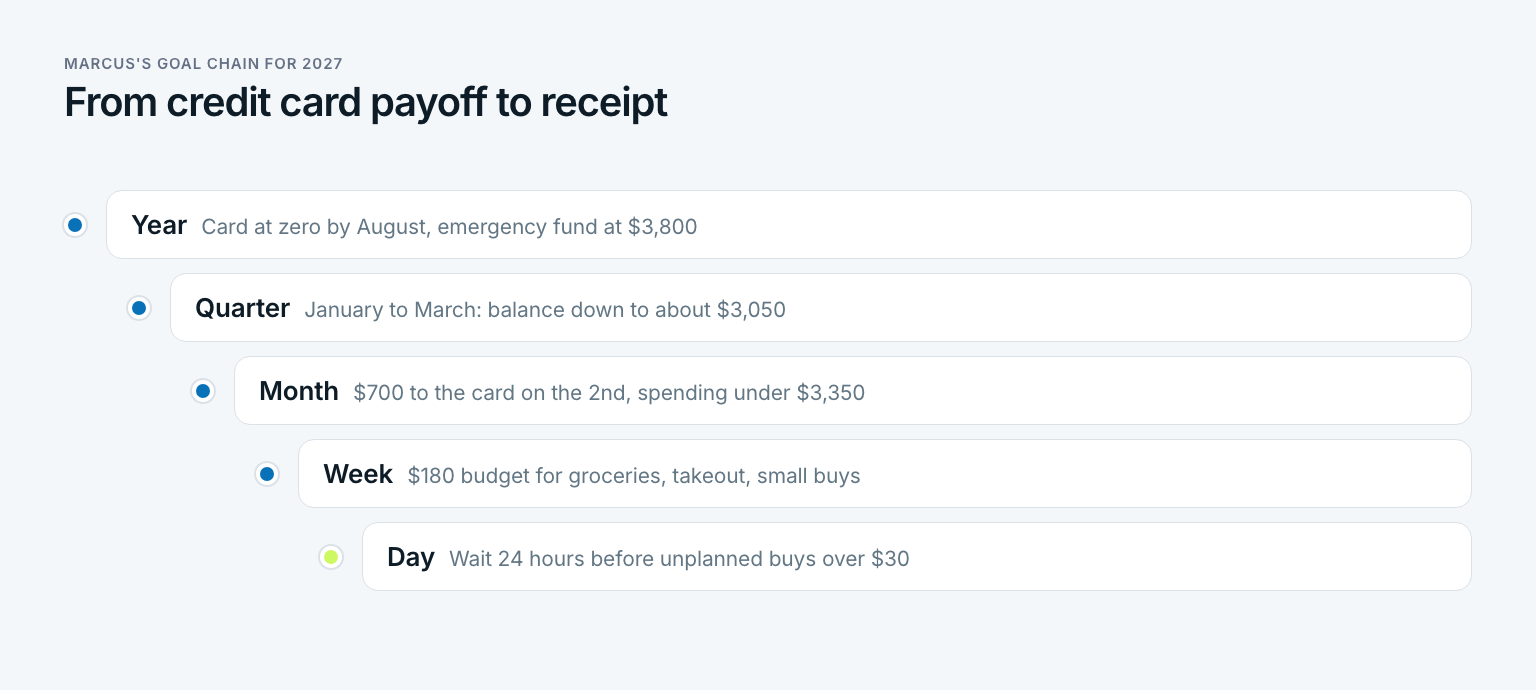
- Year 2027: credit card at zero by August, emergency fund from $1,000 to $3,800 by December.
- Quarter, January to March: card balance from about $4,900 to about $3,050.
- Month, January: $700 to the card on the 2nd, spending under $3,350.
- Week: $180 budget for groceries, takeout and small purchases, checked on Friday in five minutes.
- Day: wait 24 hours before any unplanned purchase over $30. That turns delayed gratification into a rule instead of a test of will.
Each level has its own job. The yearly goal carries the purpose. The quarter is long enough to show whether the plan was realistic, and short enough that you have not lost half a year finding out. The month is where the rate lives, the week is where the budget lives, the day is where the habit lives. Whoever only knows the yearly goal tries to catch up in December. Whoever knows the week notices on Friday that money is tight and still has the weekend to adjust.
Marcus checks his weekly budget on Fridays and his goals at month end. In a goal app like Gaapp the weekly goal hangs from the monthly goal and the monthly goal from the yearly one, so progress on the card rolls up to the year. How to build that chain for any goal is laid out in the guide on how to achieve goals.
Financial goals examples: 20 goals you can copy
Each of these has an amount or a measure and a date. Swap in your own numbers, then pick no more than three to work on at the same time.
Short term financial goals examples
- Track every purchase for 90 days and sort it into ten categories.
- Build a $1,000 starter emergency fund by the end of the quarter.
- Cancel two unused subscriptions by the end of this month.
- Pay the full credit card statement balance six months in a row.
- Cut takeout from $400 to $200 a month for the next three months.
- Save $1,200 for a summer trip by June, $150 a month.
- Raise your savings rate from 5 to 10 percent of take-home pay by March.
- Check your credit reports once this year and dispute any errors within 30 days.
Medium term financial goals examples
- Pay off a $5,200 credit card balance within 12 months.
- Grow the emergency fund to three months of expenses within two years.
- Save $8,000 for a used car by the end of 2028.
- Pay off a $12,000 car loan two years early with an extra $150 a month.
- Save a down payment amount based on a target home price within five years.
- Build a $3,000 fund for professional training by next fall.
Long term financial goals examples
- Raise retirement contributions by one percentage point every January until you reach a set target.
- Save a fixed monthly amount for a child's college fund from birth to age 18.
- Pay off the mortgage before a chosen age.
- Grow the emergency fund to six months of expenses by the time you have children.
- Reach a net worth number you define, reviewed once a year.
- Set aside a fixed share of pay for a sabbatical in ten years.
Some of these touch investing. The goal, the amount and the date are yours to set. How to invest the money is the question for an independent, fee-only advisor, not for a list of examples.
The three mistakes that sink savings goals
Savings goals rarely fail because of income. They fail because of three patterns that feel like ambition in January and like failure in March. Do you recognize one of them from last year?
The most common mistake: saving what is left at month end
Whoever saves at month end saves the leftovers, and the leftovers on the 28th are almost always smaller than planned. That is not a lack of discipline. Money in checking feels available, so it gets spent. Flip the order: the rate moves the day after payday, daily life runs on the rest. Marcus had a surplus almost every month and still kept the same balance on his card for a year.
The second mistake is a goal without a purpose. “$10,000 by 2028” is measurable, but it says nothing about why you should skip takeout on a Tuesday in February. Edwin Locke and Gary Latham summed up 35 years of research in 2002: specific, challenging goals lead to better performance than being told to do your best. One condition is commitment to the goal. The purpose supplies exactly that, and one sentence is enough: what is the money for?
The third mistake is a plan with no slack. A budget that assigns every dollar breaks at the first birthday that was not on the calendar. That is why Marcus kept $270 for shopping and fun and set his small purchases budget to $60, not zero. Anyone who allows themselves nothing lasts three months. Anyone who plans a little fun on purpose lasts the year.
If-then plans for tight months
No year goes to plan. The transmission fails, a friend gets married in Denver, the dentist finds something. A money plan built only for normal months breaks in the first abnormal one. The answer is not a bigger reserve for everything. It is a decision made in advance.
Peter Gollwitzer calls these advance decisions implementation intentions, or if-then plans. In a 2006 meta-analysis of 94 studies, Gollwitzer and Paschal Sheeran found that people with such plans reached their goals clearly more often than people who only had a goal, with a medium to large effect. For money that means: you decide what happens before it happens. Marcus's four plans:
- If a bill over $300 shows up, then I pay it from the emergency fund and pause the extra card payment until the fund is back.
- If the weekly budget is gone by Wednesday, then I cook from what is in the kitchen until Sunday and order nothing.
- If I get a raise, then half of it goes to the current goal before I get used to the bigger paycheck.
- If I fall behind the plan two months in a row, then I move the deadline by two months instead of dropping the goal.
The last plan matters most. A moved deadline is not a failure. Whoever drops the goal at the first gap loses far more than two months. A finding by Hengchen Dai, Katherine Milkman and Jason Riis from 2014 fits here: people are more likely to start fresh at temporal landmarks like the first of the month, a birthday or a new year. Whoever fell off the plan in March does not need to wait for January. The next first of the month is enough.
Five questions for your financial check-in
Before you set your goals, answer these five questions in writing. Each answer is a number or a sentence, not a feeling.
- How much was left at month end on average over the last three months, and where did it go?
- Which expense would you not miss if it disappeared tomorrow?
- How many months of expenses could you cover today if your income stopped?
- Which of your goals has an amount, a date, a purpose and a rate, and which one is missing something?
- What happens to your plan if a $500 bill shows up in March?
Anyone who can answer all five already has more of a financial plan than most New Year's resolutions. In the end, financial goals are not a question of income but of order: know first, decide second, automate third.
Financial goals FAQ
What should be financial goals?
Good financial goals cover three horizons: a short term goal like a starter emergency fund or paying off a card, a medium term goal like a full emergency fund or a car fund, and a long term goal like retirement savings. Each needs an amount, a date, a purpose and a monthly rate. Start with the goals that protect you, then the ones that build wealth.
What is the 70/20/10 rule money?
The 70/20/10 rule is a budgeting rule of thumb: 70 percent of take-home pay for living expenses, 20 percent for savings and 10 percent for paying off debt or giving. It has no single authoritative source and works best as a starting point. If your rent alone takes half your pay, set the split from your actual goals instead.
What are the 7 pillars of financial success?
There is no single official list. Versions that circulate usually include earning, budgeting, saving, managing debt, protecting yourself with insurance, investing and planning for retirement or your estate. Treat any such list as a checklist of areas, then set one measurable goal in the area that is weakest for you right now.
What are 5 good goals?
Five solid financial goals for most people: track spending for 90 days, build a $1,000 starter emergency fund, pay off high-interest credit card debt, grow the emergency fund to three to six months of expenses, and save a fixed share of pay for retirement. Give each one a date and a monthly rate before you start.
What is the difference between short term and long term financial goals?
Short term financial goals are reached within about a year, like a starter emergency fund or a vacation fund. Long term financial goals take five years or more, like retirement or a child's college fund. Short term goals protect the plan from surprises, long term goals give it direction.
How much should be in an emergency fund?
A common rule of thumb is three to six months of essential expenses, not income. People with stable jobs and no dependents can lean toward three months. Freelancers, single earners and families often aim for six, and anyone far from either can start with a $1,000 starter fund.
Last updated: 22 October 2026
Read next
 Goal Setting
Intrinsic Motivation: What Drives You From the Inside
Intrinsic motivation is not a personality trait. Meaning, 12 examples, the three needs behind it and five steps to build it, with a worked example.
17 min read
 Goal Setting
WOOP Method: Four Steps From Wish to If-Then Plan
The WOOP method is not positive thinking. What WOOP stands for, the research, if-then plans, eight goal examples and a five-minute guide.
18 min read
 Goal Setting
Medium-Term Goals: 40 Examples for Work and Life
Medium-term goals are not small life goals. How long mid-term is, 40 examples for work, career, money, health, five steps, and six-month checkpoints.
17 min read