WOOP Method: Four Steps From Wish to If-Then Plan
The WOOP method is not positive thinking. What WOOP stands for, the research, if-then plans, eight goal examples and a five-minute guide.

Contents
- 01What the WOOP Method Is and What WOOP Stands For
- 02Mental Contrasting and What the Research Shows
- 03The Four Steps of the WOOP Technique, One by One
- 04Implementation Intentions: How to Write the If-Then Plan
- 05How to WOOP in Five Minutes
- 06WOOP Goal Examples for Work, School, Health and Home
- 07When WOOP Is the Wrong Tool
- 08WOOP in Your Goal Chain: Year, Quarter, Month, Week, Day
- 09Three WOOP Mistakes Nobody Notices
- 10Three Questions Before Your Next WOOP
- 11Frequently Asked Questions About the WOOP Method
The WOOP method is not a positive thinking exercise. It is a four-step technique that tests a wish against reality and protects it with an if-then plan: Wish, Outcome, Obstacle, Plan. Psychologist Gabriele Oettingen built it from her research on mental contrasting and combined it with the implementation intentions studied by her colleague Peter Gollwitzer. One round takes five to ten minutes, and you can do it on a single sheet of paper.
Everything below is worked through with one person. Marcus, 41, runs operations for a regional delivery company in Columbus, Ohio. He wants to finish the first draft of a 60,000-word mystery novel by June 30, 2027. In two years he has written 9,000 words. His example runs through every section: what WOOP stands for, what the research shows, how to write each step, how to phrase the if-then plan, eight more WOOP goal examples, and how to carry the method from the year down to a single evening.
A note on scope. How mental contrasting fits into picturing your goals is covered in Visualize Goals. How WOOP compares with SMART, OKRs and other approaches is covered in Goal Setting Frameworks. This guide is about the method itself. Every step, every sentence, every common mistake.
What the WOOP Method Is and What WOOP Stands For
WOOP is an acronym. Each letter names one step, and the order of the steps is part of the method:
- Wish: something you want that challenges you and that you believe you can reach, in three to six words.
- Outcome: the single best result if the wish comes true, imagined as vividly as you can.
- Obstacle: the main thing inside you that holds you back. A habit, an emotion, a belief, an excuse.
- Plan: one sentence in the form: if the obstacle shows up, then I will do this.
In research papers the technique is called mental contrasting with implementation intentions, or MCII. The first three steps are the mental contrasting. The fourth step is the implementation intention, better known as an if-then plan. Oettingen gave it the name WOOP so people could remember it outside the lab. She made it widely known in her 2014 book Rethinking Positive Thinking.
So what is the point of WOOP goal setting? It does two jobs. For a wish you can reach, it raises your commitment and hands you a sentence for the moment you would normally quit. For a wish you cannot reach, it helps you let go and put your energy somewhere else. Both outcomes save you months.
Mental Contrasting and What the Research Shows
Mental contrasting is the habit of pairing a desired future with the obstacle that stands in its way. Oettingen arrived at it through an uncomfortable finding. Across several studies, people who daydreamed most positively about their future tended to reach their goals less often. The mind enjoys the result in advance, and the energy to act drops. The details of those studies are in the article on visualizing goals. For WOOP, the conclusion is what counts: positive images alone are not enough. They need a counterweight. That is also where most advice on how to manifest falls short, because it stops at the pretty picture.
That counterweight is the obstacle. Whoever pictures the outcome and then, right after, the thing inside them that blocks it, connects the future to the present. A pleasant picture becomes a task. That means: WOOP does not take your dream away. It puts the dream on the floor you will stand on tomorrow morning.
WOOP is one of the few self-help techniques that has been tested in controlled experiments. That is a point in its favor. It is not a guarantee, because the effects are measurable, not magical. Here are the key findings:
| Study | Who | Finding |
|---|---|---|
| Oettingen, Pak and Schnetter, 2001 | College students with personal concerns | Only those who considered the outcome first and the obstacle second committed more strongly to goals they could reach. The reverse order did not work. |
| Gollwitzer and Sheeran, 2006 | Meta-analysis of 94 tests of if-then plans | Medium to large effect on goal attainment, d = 0.65 |
| Stadler, Oettingen and Gollwitzer, 2009 | Women who wanted to exercise more | With mental contrasting plus if-then plans, about one hour more physical activity per week over four months than with information alone |
| Adriaanse and colleagues, 2010 | Adults with ingrained snacking habits | Fewer unhealthy snacks in the days after the exercise than in the comparison groups |
| Duckworth and colleagues, 2011 | High school students preparing for the PSAT | About 60 percent more practice questions completed than the control group |
Three things stand out. First, the combination works better than either part alone. Mental contrasting creates commitment, and the if-then plan triggers action at the right moment. Second, everything depends on expectation. In the 2001 study, contrasting increased effort only for goals people believed were doable. Third, the effects are measured across groups. For you, that means WOOP raises your odds. It does not replace the practice, the training or the work itself.
What does this mean for Marcus? He believes a first draft by June is within reach. He has an outline, he writes well in short bursts, and he has eight months. His wish meets the condition under which mental contrasting increases effort. Had he set out to publish the finished book by June, the honest look at the obstacle would probably have said: too far. In that case WOOP would have helped him shrink the goal before he spent a year running into a wall.
The Four Steps of the WOOP Technique, One by One
Each step has a job and a typical trap. Anyone who knows the traps can do a solid round in under ten minutes. Anyone who does not fills in four lines and wonders why nothing changes.
Wish: challenging and within reach
Keep the wish short. Three to six words are enough, such as “finish my draft by June 30.” It should challenge you, because a wish that needs no effort needs no method. And it should feel reachable, or the effect fades. To start, pick a time frame you can see the end of: a day, a week, a month. Long-term wishes work too. They get easier when you hang shorter rounds underneath them later.
Marcus wrote “become a real writer” on his first try. That is not a WOOP wish. It is a longing. His second try had a word count and a date. Only then could he honestly ask what stood in the way.
Outcome: the best result, pictured in detail
In the second step you ask: what would be the best thing about fulfilling this wish? Name one outcome, then close your eyes and imagine it for about a minute. Place, people, sounds, feelings. Here, daydreaming is the assignment. Without the pull of the outcome, the contrast has only one side.
The outcome has to be yours. Not what sounds impressive, not what someone else expects. Marcus first wrote “prove I can do it” and felt nothing. Then he pictured handing the printed stack to his sister, who has read every mystery he ever lent her, and watching her turn the first page at his kitchen table. That image landed. That was his outcome.
Obstacle: the thing inside you
The third step decides whether WOOP works. You ask: what in me keeps me from fulfilling this wish? You are looking for an inner obstacle. A habit, an emotion, an assumption, an excuse. Outside conditions like a busy job or a noisy house are real. They are rarely the point where you can act on your own.
Ask twice. Marcus's first answer was “no time.” When he looked at what actually happens at 9 p.m., the honest answer appeared: “I open the file, reread yesterday's pages, decide they are bad, and switch to email.” Underneath was a feeling. Every new paragraph felt like a test he might fail. That is the obstacle. You picture this moment for a minute too, as clearly as the outcome.
Plan: one sentence for the hard moment
The plan is a single if-then sentence. The if is the obstacle from step three, phrased as a situation you will recognize. The then is an action you can take right away. Marcus's plan: “If I catch myself rereading yesterday's pages, then I scroll to the blank line and write one bad paragraph.” It is short enough to remember. And it starts exactly where his evening used to fall apart.
Why the obstacle has to be inside you
An outside obstacle like “too many meetings” needs an agreement with other people. An inside obstacle like “after meetings I just want to switch off” needs a decision from you, and that decision can be made in advance. That is what the if-then plan does. Outside obstacles have their own tools: calendars, buffers, conversations. WOOP works one level deeper, where you are the only one deciding.
Implementation Intentions: How to Write the If-Then Plan
Implementation intentions are plans that link a specific situation to a specific response. Peter Gollwitzer described them in the 1990s and summarized the evidence in a widely cited 1999 review. The idea is simple. A goal says what you want. An implementation intention says when, where and how you will act. You make the decision once, ahead of time, while you are calm.
That sounds like a small change. Across the 94 tests in the Gollwitzer and Sheeran meta-analysis, it made a clear difference. The reason is a division of labor in your head. Whoever is tired at night makes poor decisions. Whoever already decided on Sunday only has to react on Tuesday. The situation itself becomes the trigger.
A strong if-then plan meets three conditions:
- The if is recognizable. A time, a place, a feeling or a thought you can notice in the moment. “If I feel tired” is too vague. “If I catch myself rereading yesterday's pages” is recognizable.
- The then is immediate. An action that starts within 30 seconds and needs no further decision. “Then I write more” is a goal. “Then I scroll to the blank line and type one sentence” is an action.
- The sentence targets the obstacle. Not the goal in general. A plan that steps around the real obstacle is a calendar entry, not a WOOP plan.
Here is what weak and strong versions look like side by side:
| Weak | Strong | What changes |
|---|---|---|
| If I have time, I will write. | If the dishwasher is running at 9 p.m., then I open the draft at the kitchen table. | A recognizable moment instead of hoping for free time |
| If I do not feel like it, I will push through. | If I think tonight is not worth it, then I write for ten minutes and am allowed to stop. | A small action instead of a pep talk |
| If a scene gets hard, I will keep going. | If I get stuck on a scene, then I type a note in brackets and jump to the next scene. | A ready-made move for the moment of doubt |
| If I get distracted, I will refocus. | If I reach for the email tab, then I close the browser and set a 25-minute timer. | The trigger comes before the problem, not in the middle of it |
If-then plans also work without WOOP. They sit inside many habit methods, for example habit stacking, where a new habit is attached to an existing one. The difference is the if. In habit stacking, the if is a routine that already happens. In WOOP, the if is your personal obstacle. That makes WOOP the better choice when you already sense where things break down but do not yet know what to do in that moment.
How to WOOP in Five Minutes
One round needs quiet, a pen and five to ten minutes. Nothing more. Do it on paper the first few times, because writing sharpens the images and lets you reread your plan later. Here is how:
Find five quiet minutes
Choose a place where nobody will interrupt you. Phone face down, door closed. Write the letters W, O, O and P down the left side of a page, with room for one sentence each.
Write the wish
Write a wish for a time frame you can see the end of, in three to six words. Ask two quick questions: does it challenge you, and do you believe you can do it? If either answer is no, adjust the wish before you go on.
Picture the outcome
Write the best outcome in a few words. Then close your eyes and imagine it for about a minute. Where are you, who is there, what do you feel? Marcus saw his sister at his kitchen table, turning page one.
Find and picture the obstacle
Ask what inside you blocks the wish most. Ask a second time until you land on a habit, a feeling or a thought. Write it down and imagine that moment for a minute too, as clearly as the outcome.
Write the if-then sentence
Write one sentence: if the obstacle shows up, then I will do this. Read it aloud twice. Put the page where the hard moment happens. Marcus taped his to the lid of his laptop.
How often should you WOOP? For a big wish, once in depth and then briefly whenever something changes. Many people run a quick round each morning for the day ahead. Oettingen's team recommends practicing it regularly, because it gets faster and sharper with use. Marcus does one on Sunday night for the week and a short one before any session he is dreading.
Is there a WOOP app? Oettingen's team offers its own app through woopmylife.org that walks you through the four steps, and it is listed there as free as of October 2026. App, notebook or index card makes no difference to the method. What matters is that you do not skip the two imagery phases, and that is easier to do when tapping quickly on a phone than when writing by hand.
WOOP Goal Examples for Work, School, Health and Home
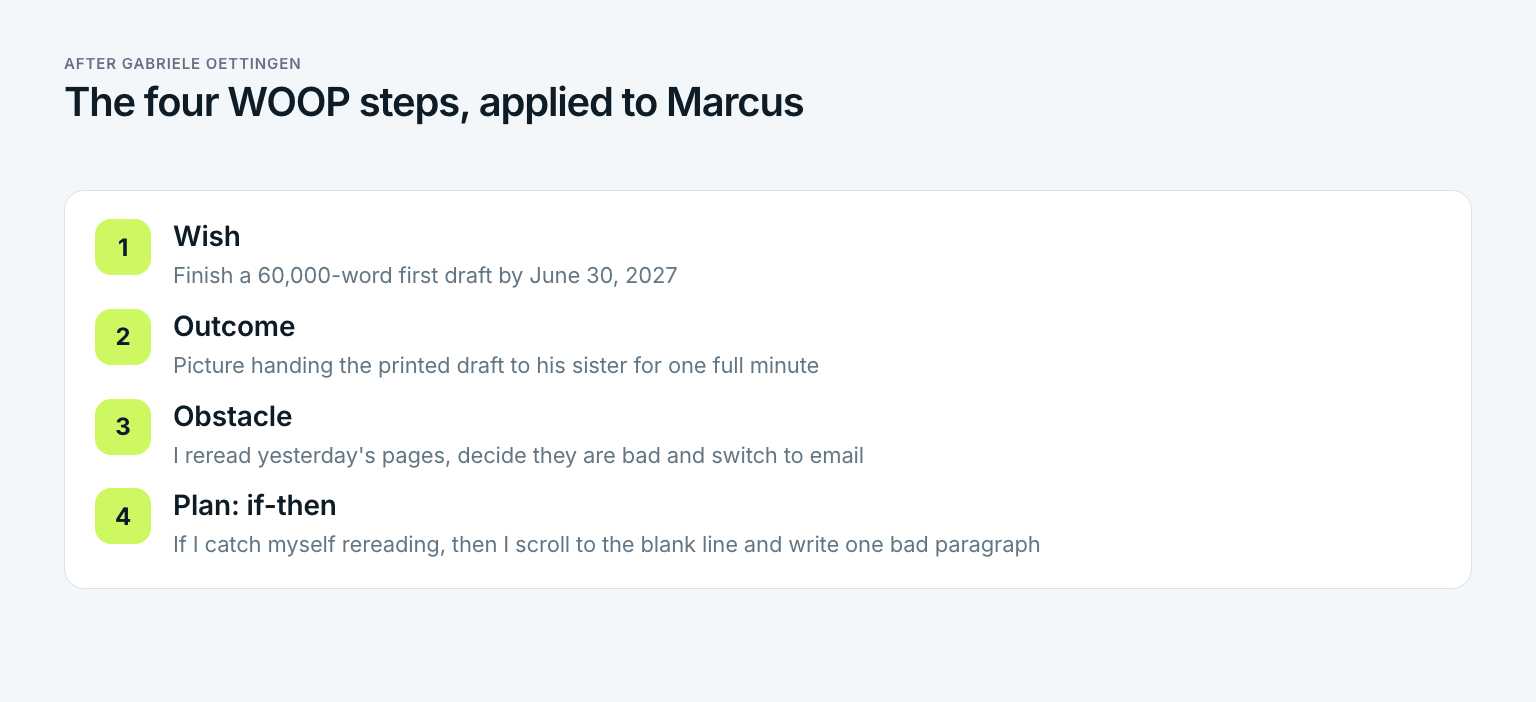
Marcus's complete WOOP fits on an index card:
- Wish: finish a 60,000-word first draft by June 30, 2027.
- Outcome: handing the printed draft to his sister at his kitchen table.
- Obstacle: I reread yesterday's pages, decide they are bad and switch to email.
- Plan: if I catch myself rereading, then I scroll to the blank line and write one bad paragraph.
The examples below show how different obstacles look, even when the wishes sound alike. Each obstacle sits inside the person, and each plan aims right at it:
| Area | Wish | Obstacle | If-then plan |
|---|---|---|---|
| Work | Lead the quarterly review without notes | I put off rehearsing because speaking out loud feels silly | If the slides are done, then I record the first three out loud on my phone right away |
| College | Submit the term paper by March 15 | I keep reading one more source instead of writing | If I feel the urge to research more, then I write 200 words first |
| Fitness | Get to the gym three times a week | After work I tell myself I am too tired | If I think I am too tired, then I drive there anyway and do ten minutes |
| Eating | No sweets on weeknights | I reach for candy out of boredom while watching TV | If I sit down on the couch at night, then I make a pot of tea first |
| Money | Save $200 every month | I shop online when I am stressed | If I add something to my cart, then I wait 48 hours before buying |
| Relationship | Two phone-free evenings a week with my partner | I answer work email after dinner | If my work phone buzzes after 8 p.m., then I put it in the hallway |
| Parenting | Calmer school mornings | I raise my voice when we are running late | If I hear my voice getting louder, then I breathe out once and say only the next step |
| Middle school | Raise my math grade from a C to a B | I give up on hard problems after a minute | If I get stuck on a problem, then I circle it and ask the teacher the next day |
Notice how rarely the obstacle has anything to do with the topic. In fitness it is a thought, with money a feeling, in parenting a reaction under time pressure. That is why a WOOP cannot be copied. You can borrow someone else's wish. You have to find the obstacle yourself.
WOOP is also used in classrooms. Teachers use it to help students set their own learning goals, and several schools and universities publish worksheets for it. With younger kids, simpler words help: my wish, the best part, what slows me down, what I will do then. The logic stays the same.
Couples and families can WOOP together, for example over Sunday breakfast. Each person names a wish for the week and their own obstacle, and each writes their own plan. One rule matters here. Anyone who names someone else's obstacle has left the method and started a critique. Everyone finds the obstacle only in themselves.
When WOOP Is the Wrong Tool
WOOP is not a tool for everything. It is built for one situation: you have a wish and still do not act. Other situations call for other tools, and it helps to know which:
- You do not know what you want. Then there is no wish to contrast. Start with questions about your values and the areas of your life.
- The goal needs numbers and milestones. WOOP tells you how to get past the obstacle, not how much by when. SMART criteria and key results are built for that. The overview of goal setting frameworks shows which fits when.
- The obstacle really is outside you. A road closure on the way to the gym or a project dumped on your desk is solved with planning and conversations, not with an inner sentence.
- There are several obstacles at once. One WOOP handles one obstacle. Pick the biggest and run separate rounds for the others later.
Sometimes the result of WOOP is letting a wish go. If the obstacle feels overwhelming and the outcome leaves you cold, that is information, not failure. Oettingen describes this release as the method's second function. A wish you drop makes room for one that actually pulls you, because it comes from intrinsic motivation.
WOOP is a self-help technique for everyday goals, not treatment. If you have felt low for weeks or are in crisis, call or text 988 in the US to reach someone right away.
WOOP in Your Goal Chain: Year, Quarter, Month, Week, Day
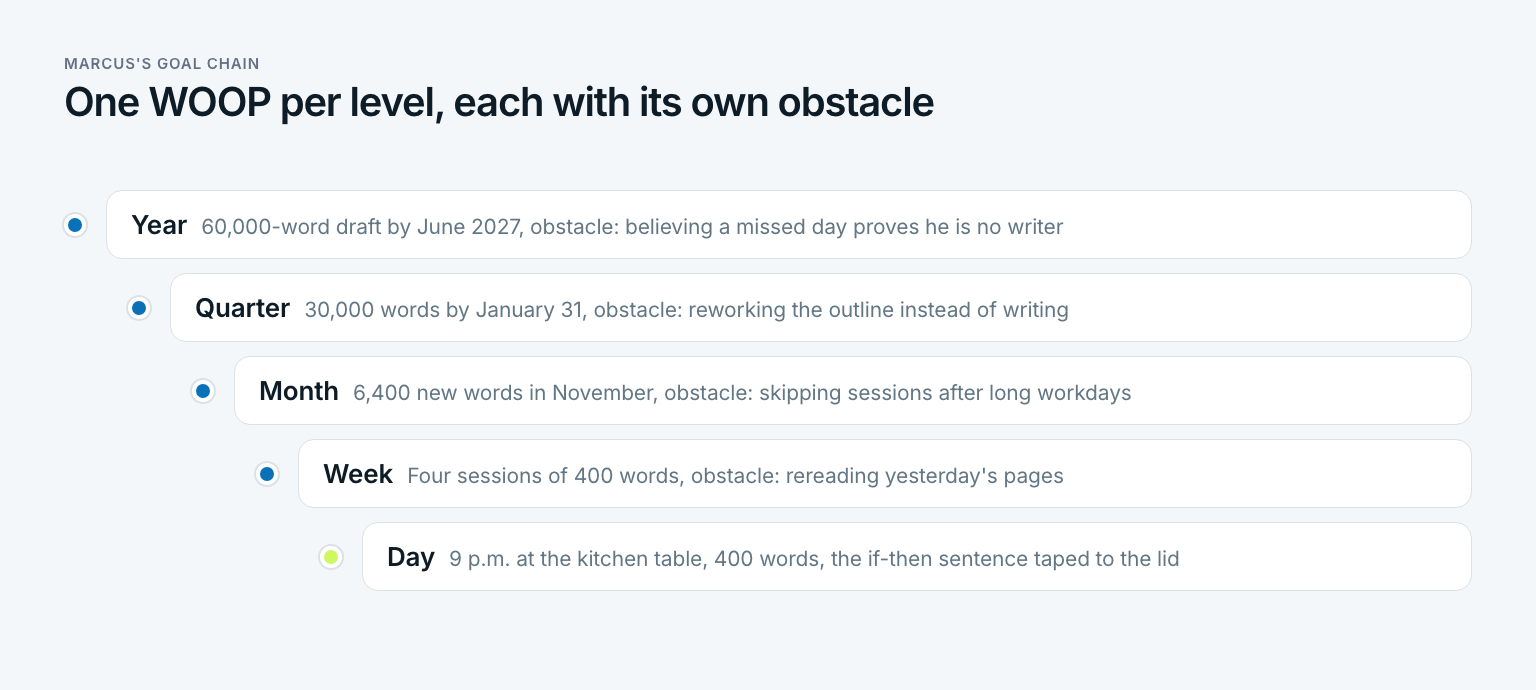
WOOP works best with time frames you can see the end of. A big yearly wish makes sense, but obstacles show up in daily life. So it pays to spread the method across your goal chain: one WOOP for the year and shorter ones for the quarter, month and week. Each level has its own obstacle. Here is Marcus's chain:
- Year: a 60,000-word first draft by June 30, 2027. Obstacle: the belief that real writers write every day, so a missed day feels like proof he is not one. Plan: if I miss a day, then I add one session on Saturday morning, no more.
- Quarter: reach 30,000 words by January 31. Obstacle: he wants to rework the outline before writing further.
- Month: 6,400 new words in November. Obstacle: he skips sessions when the week at work runs long.
- Week: four sessions of 400 words, Monday, Tuesday, Thursday and Sunday. Obstacle: rereading yesterday's pages.
- Day: 9 p.m. at the kitchen table, 400 words, laptop opened at the blank line. The if-then sentence is taped to the lid.
The interplay is the real gain. The yearly WOOP holds the direction. The weekly WOOP handles whatever obstacle is live right now. Whoever spends five minutes on the week on Sunday does not have to negotiate with themselves on Wednesday night. For the general method of breaking yearly goals down to the day, see the guide on how to achieve goals. In Gaapp you can write the if-then sentence right next to the weekly goal, so it meets you exactly where you plan the week.
One detail from Marcus's chain: obstacles move. At the year level it is a belief, in the month it is long workdays, in the week it is rereading. Anyone who writes a single WOOP for the whole year ends up fighting an obstacle in February that disappeared in November.
Three WOOP Mistakes Nobody Notices
Most mistakes do not happen in understanding WOOP but in filling it out. They are easy to miss, because the page still looks complete:
- The obstacle is an outside excuse. “No time” and “too much work” appear on a lot of WOOP cards. They sound honest but give you nothing to act on. Keep asking until the obstacle is something you do or feel.
- The imagery gets skipped. Whoever fills in the four boxes in one minute has completed a form, not a WOOP. The effect comes from the two phases where you actually picture the outcome and the obstacle.
- The plan is a second goal. “Then I will write more” is not a plan but a repeat of the wish. A plan is an action that begins within 30 seconds.
The most common mistake: obstacle before outcome
Many people write down what could go wrong first, or jump back and forth between outcome and obstacle. The order is not a detail. In the experiments by Oettingen, Pak and Schnetter, only the sequence outcome first, obstacle second strengthened commitment. Anyone who reverses it ends up dwelling on problems with no goal pulling behind them. Marcus follows a simple rule: one minute of his sister at the table, then one minute of the email tab.
Then there is an expectation that leads to disappointment: doing WOOP once and forgetting it. A plan you never reread loses its grip as soon as life gets loud. In short: WOOP works like training, not like a switch.
Three Questions Before Your Next WOOP
Before your next round, check your last WOOP with three questions:
- Would you recognize the obstacle if it showed up tonight at 9 p.m.?
- Can you start the then part of your plan within 30 seconds, without thinking?
- Does the outcome still move you, or are you just copying it down?
Anyone who answers yes to all three has a WOOP that holds. A single no is reason for a new round. After three weeks Marcus noticed his obstacle had moved. He no longer rereads. Now he stalls whenever a chapter needs a plot twist he has not worked out. New obstacle, new plan: if I reach a scene I have not figured out, then I write what the characters say to each other and leave the twist for Sunday.
In the end the method fits into one sentence. WOOP is not a tool for beautiful dreams but for the one moment when you would otherwise quit.
Frequently Asked Questions About the WOOP Method
What are the four steps of the WOOP technique?
The four steps are Wish, Outcome, Obstacle and Plan, done in that order. You name a wish, imagine the best outcome, imagine the main obstacle inside you, and then write an if-then plan for that obstacle. One round takes five to ten minutes.
What is the woop method?
The WOOP method is a goal-setting technique developed by psychologist Gabriele Oettingen. It combines mental contrasting, which pairs a desired future with the obstacle in the way, with implementation intentions, which are if-then plans. Studies show it helps people follow through on goals they believe they can reach.
What is a woop goal example?
A writer's WOOP could read: wish, finish a 60,000-word draft by June 30. Outcome, handing it to his sister. Obstacle, rereading old pages and switching to email. Plan, if I catch myself rereading, then I scroll to the blank line and write one bad paragraph.
What do woop goals stand for?
WOOP stands for Wish, Outcome, Obstacle, Plan. The acronym describes the four steps of the method in their fixed order. In research the technique is called mental contrasting with implementation intentions, or MCII.
Is the WOOP app free?
The app from Gabriele Oettingen's team is listed as free on woopmylife.org as of October 2026. It guides you through the four steps. A sheet of paper and five quiet minutes work just as well.
What is the difference between mental contrasting and implementation intentions?
Mental contrasting is the first part of WOOP: you imagine the outcome, then the obstacle, which builds commitment to reachable goals. Implementation intentions are the second part: if-then plans that tie a specific situation to a specific action. Together they work better than either one alone.
Last updated: 22 October 2026
Read next
 Goal Setting
Intrinsic Motivation: What Drives You From the Inside
Intrinsic motivation is not a personality trait. Meaning, 12 examples, the three needs behind it and five steps to build it, with a worked example.
17 min read
 Goal Setting
Financial Goals: How to Turn Wishes Into a Plan
Financial goals are not wishes with a dollar sign. Short and long term examples, SMART savings goals and a five step plan, worked through one year.
17 min read
 Goal Setting
Medium-Term Goals: 40 Examples for Work and Life
Medium-term goals are not small life goals. How long mid-term is, 40 examples for work, career, money, health, five steps, and six-month checkpoints.
17 min read