Intrinsic Motivation: What Drives You From the Inside
Intrinsic motivation is not a personality trait. Meaning, 12 examples, the three needs behind it and five steps to build it, with a worked example.

Contents
- 01Intrinsic motivation meaning: what it is, and what it is not
- 02Extrinsic vs. intrinsic motivation: the difference
- 03Twelve examples of intrinsic motivation in everyday life
- 04The three intrinsic motivations: autonomy, competence, relatedness
- 05What really happens: how rewards crowd out the fun
- 06How to build intrinsic motivation in five steps
- 07Intrinsic motivation in your goal chain: from year to day
- 08The three mistakes nobody notices
- 09Three questions before you plan your next goal
- 10Frequently asked questions about intrinsic motivation
Intrinsic motivation is not a personality trait. It is the drive to do something for its own sake, because the activity itself interests you, challenges you or feels good, not because of a reward that comes afterward. Whoever is intrinsically motivated needs no reason outside the activity. Doing it is the payoff. And because that drive depends on conditions, you can strengthen it, or switch it off without noticing.
That is exactly what happened to Maya. Maya is 29, a UX designer in Denver, and for years she filled a sketchbook every few weeks because drawing the people on the light rail was the most relaxing part of her day. In early 2026 she started posting a sketch a day on Instagram. In April she opened paid commissions at $40 a portrait. By June she drew three times a week instead of almost every day, and every page felt like a deadline. Her case shows how intrinsic motivation works, how it gets lost and how to win it back without giving up the goal.
Intrinsic motivation meaning: what it is, and what it is not
The most cited definition comes from Richard Ryan and Edward Deci. In a 2000 paper in Contemporary Educational Psychology they describe intrinsic motivation as doing an activity for its inherent satisfactions rather than for some separable consequence. The key word is separable. A paycheck, a trophy or a like can be taken away from the activity. The curiosity you feel while solving a puzzle cannot.
The word itself comes from the Latin intrinsecus, meaning on the inside. Intrinsic means coming from the thing itself. Its opposite, extrinsic, comes from extrinsecus, from the outside. Neither word says whether a reason is good or bad. They only say where the reason sits.
People often treat intrinsic motivation as another word for fun. That is only half right. Fun is one form of it, but not the only one. The interest that keeps you reading a hard book is intrinsic too, and so is the pull to get better at a skill while practice feels like a grind. Anyone who has practiced the same eight bars of piano for the twentieth time knows the feeling. It is rarely fun. You still want to know whether it will work this time. That means: being intrinsically motivated does not mean the work is easy. It means the reason lives inside the work.
Intrinsic, extrinsic, autonomous
In Deci and Ryan's research, a second pair sits next to intrinsic and extrinsic: autonomous and controlled. Autonomous covers everything you do with your own full agreement. That includes intrinsic motivation, but also extrinsic motivation whose reason you have made your own, like flossing because you care about your teeth. Controlled covers everything you do out of pressure or guilt. For your goals, the second pair often matters more than the first, because an outside reason can carry you a long way once you truly agree with it.
Where the idea comes from: monkeys, puzzles, and magic markers
The idea is older than its name. In 1950, Harry Harlow and his colleagues watched rhesus monkeys solve mechanical puzzles made of hooks and hinges again and again, with no food reward at all. That did not fit the theory of the day, which said behavior was driven only by hunger, thirst or reward. In 1959, Robert White pulled the thread together in a paper in Psychological Review: living beings want to have an effect on their surroundings and get better at it. He called it competence motivation.
In 1971, Edward Deci showed that money can weaken that drive. College students who were paid for each puzzle they solved later spent less of their free time on the puzzles than an unpaid group. Two years later, Mark Lepper, David Greene and Richard Nisbett found the same pattern in preschoolers who loved drawing with markers. Children who had been promised a Good Player award for drawing later drew less during free play than children who got no award or a surprise award. Researchers call this the overjustification effect. The promised reward had turned play into a job.
Extrinsic vs. intrinsic motivation: the difference
Extrinsic motivation is the drive to do something for an outcome that sits outside the activity: money, praise, a grade, or staying out of trouble. That is the short answer to what extrinsic motivation is, and it is not an insult. Without outside reasons, almost nobody would file a tax return. The difference from intrinsic motivation is not strength. It is how the drive behaves when circumstances change.
| Feature | Intrinsic | Extrinsic |
|---|---|---|
| Source | The activity itself | An outcome of the activity |
| Typical triggers | Curiosity, interest, mastery, meaning | Money, grades, praise, pressure, penalties |
| When the reward stops | Keeps going | Fades or stops |
| Strength in research | Quality and persistence | Quantity on clearly measurable tasks |
| Typical risk | Does not cover the boring parts | Can crowd out the interest you already had |
| Maya's example | Catching a stranger's posture in six lines | The $40 fee and the likes on each post |
The row on strength comes from a 2014 meta-analysis by Christopher Cerasoli, Jessica Nicklin and Michael Ford in Psychological Bulletin, which pooled 40 years of research. Intrinsic motivation was the better predictor of the quality of performance. Incentives were the better predictor of quantity, especially on simple tasks tied directly to the incentive. Both worked at the same time, not against each other. That means: the question is not intrinsic or extrinsic. It is which kind does which part of your goal.
Between the two poles lies a spectrum. Deci and Ryan sort extrinsic motivation by how fully you have taken on its reason, from pure pressure to guilt to a reason that has become part of who you are. If you lead people, the article on how to motivate employees shows what that spectrum looks like on a team. For your own goals, one test question usually does the job: would you still do it if nobody ever found out?
Twelve examples of intrinsic motivation in everyday life
What is an example of intrinsic motivation? The clearest examples come in pairs, because the same activity can have two very different reasons. The activity tells you nothing. The reason tells you everything. The table shows twelve examples, each with an intrinsic and an extrinsic reason for exactly the same action.
| Activity | Intrinsic reason | Extrinsic reason |
|---|---|---|
| Sketching | The quiet focus of getting a face right | Commission fees and likes |
| Learning Spanish | You want to follow your neighbors' jokes | A certificate for a job application |
| Coding | Cracking a bug that will not leave you alone | The bonus for shipping the feature |
| Reading | Curiosity about the story or the subject | Having something to say at book club |
| Cooking | Testing how two spices work together | Compliments from your guests |
| Gardening | Watching something grow | The best front yard on the block |
| Playing guitar | Hearing the riff finally come out clean | Passing the next lesson level |
| Volunteering | Seeing your help change something | A line on your resume |
| Studying | Wanting to understand how something works | The grade and the degree |
| Cleaning up | The calm of a tidy room | Avoiding a fight with your roommate |
| Building a slide deck | Making a messy idea clear | Your manager's approval |
| A child doing math homework | Solving a puzzle that is fun | A sticker or extra screen time |
Most activities carry both reasons at once. That is normal, and not a problem. Trouble starts when the outside reason grows louder than the inside one, until you can no longer hear the inside one at all. For Maya, that was the first row of the table. Anyone who turns a hobby into a side hustle can swap the reason they started with, and never notice the swap.
Work has intrinsic motivation too. It is just harder to spot, because a paycheck always sits next to it. One clue is what you keep thinking about after hours when nobody asks you to. A second clue is which tasks you do better than required, by choice. Whoever can answer both questions knows where their inner drive lives at work and where only the salary is doing the work.
The three intrinsic motivations: autonomy, competence, relatedness
What are three intrinsic motivations? In Deci and Ryan's self-determination theory, intrinsic motivation grows from three basic psychological needs: autonomy, competence and relatedness. When they are met, intrinsic motivation grows. When they are blocked, it shrinks. Unlike Maslow's hierarchy of needs, the theory has no ranking. All three apply at the same time. Daniel Pink translated the idea for a wide audience in his 2009 book Drive as autonomy, mastery and purpose. Both versions mean nearly the same thing.
- Autonomy. You experience yourself as the author of what you do. That does not mean you decide everything alone. It means you agree with the reason. Maya's sketch subjects now came from clients. She was no longer drawing. She was filling orders.
- Competence. You experience that you can do something and that you are getting better. The task sits just above your current skill, not far above it. Commissions asked for a polished style Maya had not built yet. Every page reminded her of the gap.
- Relatedness. You feel connected to people who matter to you. Posting looked like connection. In practice it was an audience. The Thursday sketch meetup she used to attend had slipped off her calendar in March.
All three needs tipped at the same time for Maya, and none of them had anything to do with willpower. If you want to see how the three needs work together with the four kinds of motivation over a long goal, read goals and motivation. The question here is narrower: how do you keep the joy in the activity itself once a goal joins it?
What really happens: how rewards crowd out the fun
Rewards are not harmful by default. That is the first half of the truth, and it often gets skipped. In a 1994 review, Judy Cameron and David Pierce concluded that rewards, overall, do little damage to intrinsic motivation. In 1999, Edward Deci, Richard Koestner and Richard Ryan analyzed 128 experiments and drew a sharper picture. Whether a reward hurts depends on how it is given.
Expected, tangible rewards tied to doing or finishing a task reduced how much people chose to keep doing a task they had found interesting. Unexpected rewards did not. Positive feedback even increased intrinsic motivation. Deci and Ryan explain this with their cognitive evaluation theory: every reward has a controlling side and an informing side. What feels like control weakens the drive. What shows you that you are capable strengthens it.
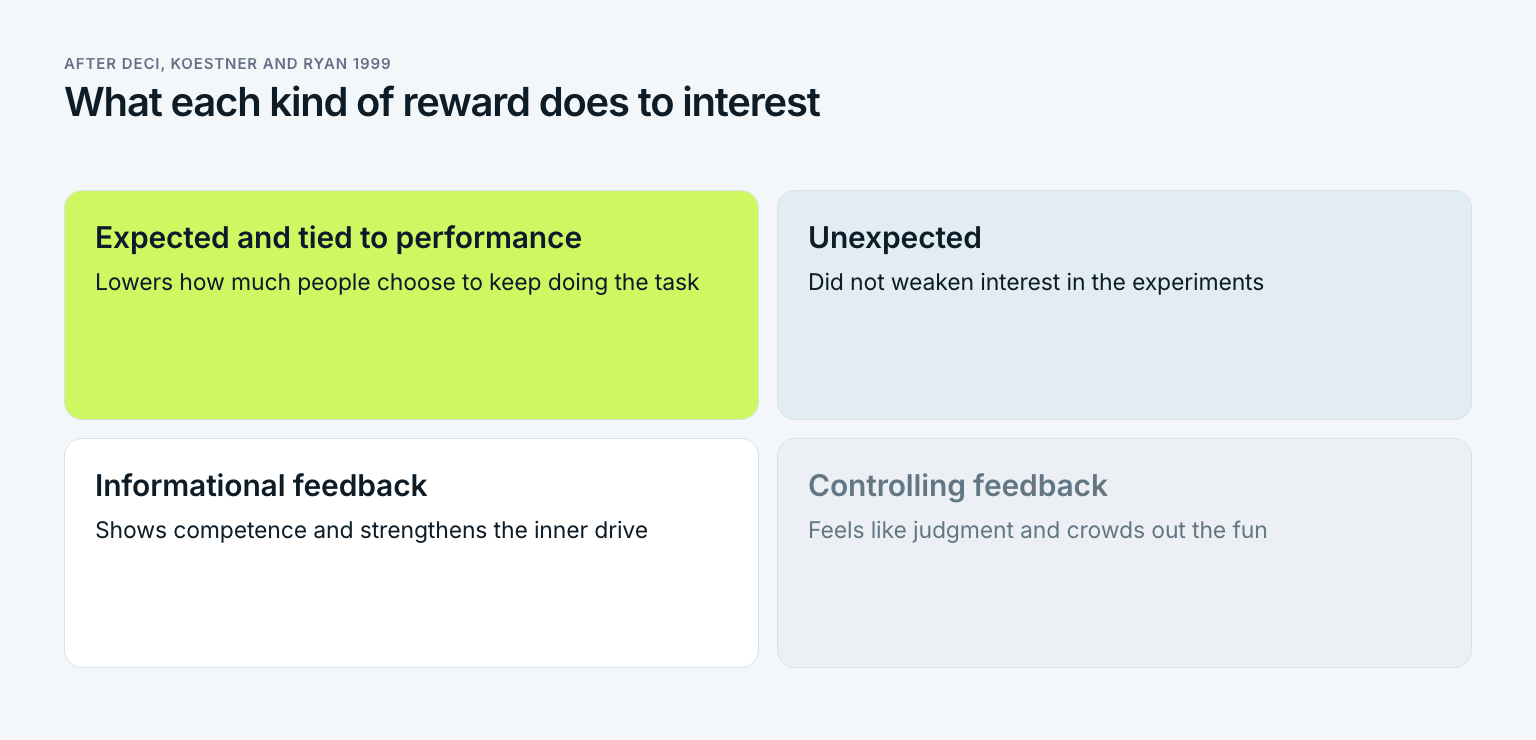
Maya's commissions were both at once. They told her that people valued her work, and they judged every page against a client's expectations. Which side won shows up in her months:
| Period | Sketches per week | What decided each page |
|---|---|---|
| 2025 | 9 | Whatever caught her eye on the train, no plan, no audience |
| February 2026 | 9 | A daily post on Instagram, likes checked each evening |
| April 2026 | 7 | Commissions open at $40, two client portraits a week |
| June 2026 | 3 | Only client work, personal pages skipped |
| August 2026 | 5 | Restart: two free pages a week, commissions capped |
| October 2026 | 8 | Free pages back on the train, posting once a week |
Between February and June, neither Maya's skill nor her love of drawing changed. The reason she opened the sketchbook did. Before, she drew because drawing felt good. After, she drew to deliver a page and be judged on it. And a page you might get wrong is a poor reason to pick up a pen on a tired Tuesday. In short: the commissions did not destroy Maya's motivation. They gave it a new owner.
The most common mistake: rewarding what already feels good
Whoever rewards an activity they already enjoy tells themselves they do it for the reward. That holds for money, for gold stars and for likes. It shows most clearly in children and most quietly in adults. Save rewards for the things that are hard and have no pull of their own, and leave alone what already draws you in. For Maya that meant: the habit app no longer tracks sketches. It tracks invoicing, which she cannot stand.
How to build intrinsic motivation in five steps
How do you build intrinsic motivation in yourself? Not by ordering yourself to enjoy something. You change the conditions the activity happens under, and enjoyment follows the conditions. The five steps take about 45 minutes the first time. Maya worked through them with a pen and one blank page on a Sunday in August.
Write down your original reason
In one sentence, write why you started before there was any goal. Not what you want to achieve, but what pulled you in. Maya's sentence: “When I draw strangers on the train, my head goes quiet and I notice things I would have missed.” That sentence is the yardstick for every step that follows.
Swap control for information
Go through every tool attached to your goal: app, tracker, client list, reward. Ask of each one: does it show me something, or does it judge me? Keep what informs. Switch off or postpone what judges. Maya stopped checking likes and moved posting to one batch on Sundays. She still sees the numbers, just not while she draws.
Build in a real choice
Autonomy comes from choice, even small choice. Decide what is fixed and what you choose fresh every week. For Maya, five pages a week are fixed. Two of them are free pages, where she picks the subject, the pen and the place on the day itself. Only the commissions follow a brief.
Set the difficulty just above your skill
You feel competence when a task stretches you without breaking you. Too easy bores, too hard discourages. Maya had promised clients a polished style she was still learning. She now offers a loose ink portrait she can draw well, and she practices the polished style on free pages with no deadline. The offer is smaller, and she delivers it with pride.
Look for connection, not an audience
Share the activity with a few people you actually do it with, rather than many who watch. One person you draw, read or play with once a week outweighs a hundred reactions. Maya is back at the Thursday sketch meetup, where nobody posts anything and everybody draws.
The pattern works far beyond art. Anyone learning a language can hide the streak counter and instead pick one podcast a week that genuinely interests them. Anyone who has lost interest in a project at work can ask their manager which part they get to shape themselves. The logic stays the same: more choice, the right level of challenge, less judgment, real connection.
Parents can use the same logic, with extra care. Whoever promises a child a point for every book read risks exactly what Lepper and his colleagues saw in 1973: the child reads for the points and stops when the points stop. It tends to work better to give the child a real choice of books and to ask about the story afterward, not about the count. Praise is fine, as long as it describes what went well instead of grading the child.
Intrinsic motivation and ADHD
Do people with ADHD have intrinsic motivation? Yes. ADHD is not a lack of motivation, and many people with ADHD describe long, intense focus on tasks they find interesting. What differs is how the brain handles rewards, especially rewards that are far away. Psychologist Edmund Sonuga-Barke described a strong preference for sooner rewards, which he called delay aversion, in his dual pathway model of 2002. Nora Volkow and colleagues reported in 2009 that adults with ADHD showed differences in the brain's dopamine reward pathway. In practice, interest tends to carry further than duty, and distant rewards carry less far. Choice and the right level of challenge from the steps above can help here too, but they are not a treatment. Anyone who suspects ADHD should talk to a doctor or a licensed clinician for an assessment. How interest-driven focus relates to hyperfocus is covered in the article on flow state.
Intrinsic motivation in your goal chain: from year to day
A goal does not have to destroy intrinsic motivation. Chosen for the right reason, it can protect it. In 1999, Kennon Sheldon and Andrew Elliot followed college students through a semester. Students who pursued goals out of interest or full personal agreement kept up their effort longer, reached more of their goals and ended the semester more satisfied than students who pursued goals under pressure. Sheldon and Elliot call such goals self-concordant: they fit what you actually care about.
A goal chain helps you keep that fit for a whole year. The yearly goal carries the reason. The lower levels carry daily life. The danger starts when the lower levels hold nothing but numbers that bury the reason. That is why Maya decided, at every level, what gets measured and what stays free.
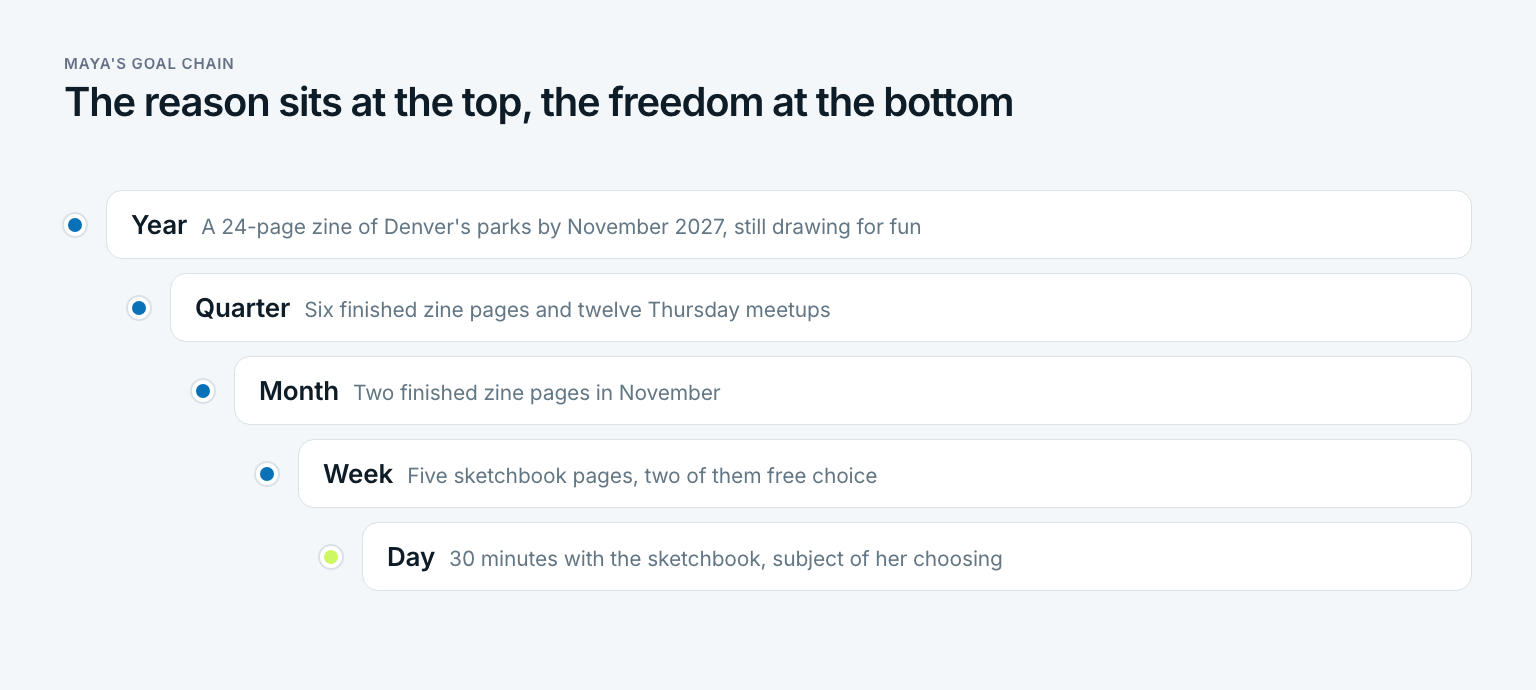
Here is Maya's chain. The yearly goal: finish a 24-page illustrated zine of Denver's parks by November 2027, and still draw for fun every week. The quarterly goal through December: six finished zine pages and twelve Thursday meetups. The monthly goal for November: two finished zine pages. The weekly goal: five sketchbook pages, two of them free choice. The daily goal: 30 minutes with the sketchbook, subject of her choosing.
The second half of the yearly goal is not decoration. It protects the reason Maya started from the number she wants to hit. The daily goal names no subject and no style on purpose. Whoever measures only whether an action happened at the lowest level leaves room for the activity itself. In Gaapp, every daily goal hangs on a weekly, monthly and yearly goal, so on Friday you can see whether the week fits the year without grading every single page. For the full method of breaking a yearly goal down to the day, read turn yearly goals into daily steps.
Each level answers a different question. The year asks: what is this for? The quarter asks: what will be different in twelve weeks? The month asks: am I on track? The week asks: where do I get to choose this week? The day only asks: do I open the sketchbook? Anyone who answers the upper questions with numbers and the lower ones with freedom connects a measurable goal with an activity that still feels like their own.
The three mistakes nobody notices
Intrinsic motivation rarely leaves with a bang. It fades quietly, usually through decisions that feel sensible at the time. Which of these three is hiding in your plan?
- Measuring everything you enjoy. Measuring helps when it shows you something you would otherwise miss. Whoever counts every page, every step and every minute turns a pleasure into bookkeeping. Measure the things that would not happen without measuring, and leave the rest alone.
- Turning the hobby into proof. Once an activity has to prove that you are disciplined, fast or talented, your self-worth is on the line. Every weak day becomes a defeat. Maya kept the zine, but dropped the question of whether it would finally make her a real illustrator.
- Waiting for enjoyment where there is none. Not every task has a pull of its own. Invoices, stretching, paperwork: here, intrinsic motivation is the wrong expectation. Anyone who waits for an inner spark before doing taxes will wait forever. Outside reasons, small rewards and fixed slots on the calendar exist for exactly these tasks, and that is perfectly fine.
All three mistakes mix up the two kinds of motivation. They use outside tools where inside reasons already carry the load, and expect inside reasons where only outside ones help. That means: good planning starts by sorting which parts of your goal pull on their own and which do not. Only then do you decide what to measure and what to reward.
Three questions before you plan your next goal
Before you build a goal around something you love doing, answer three questions:
- Can you say in one sentence what draws you to the activity, regardless of the outcome?
- Which tool in your plan judges you instead of informing you, and what happens if you switch it off for one week?
- Who do you do this with, and not only in front of?
Whoever can answer all three has a goal that protects their motivation. Whoever gets stuck on the first should check whether the goal is really theirs. If a lack of drive lasts for weeks and touches almost everything you used to enjoy, it is no longer a motivation question, so talk to your doctor or a mental health professional, and if you are in crisis in the US, call or text 988. For an ordinary slump, the article on how to stay motivated walks you through the next steps.
In short: intrinsic motivation is not a talent you lack. It is a drive that the conditions of your plan either feed or crowd out.
Frequently asked questions about intrinsic motivation
What's the difference between intrinsic and extrinsic motivation?
Intrinsic motivation comes from the activity itself, such as curiosity, interest or the pull to get better. Extrinsic motivation comes from an outcome outside the activity, such as money, grades or praise. Intrinsic motivation tends to keep going when rewards stop, while extrinsic motivation tends to fade with them.
Do people with ADHD have intrinsic motivation?
Yes. Many people with ADHD show strong, lasting focus on tasks they find interesting, while distant rewards and dull tasks are harder to act on. Research by Sonuga-Barke and by Volkow and colleagues points to differences in how the brain processes rewards, not to an absence of motivation. If you suspect ADHD, a doctor or licensed clinician can assess it.
What is extrinsic motivation?
Extrinsic motivation is the drive to do something for an outcome outside the activity, such as pay, praise, grades or avoiding a penalty. It is not bad, and for many necessary tasks it is exactly the right tool. It is most stable when you agree with the reason instead of just complying with it.
What are three intrinsic motivations?
Self-determination theory by Edward Deci and Richard Ryan names three basic needs that feed intrinsic motivation: autonomy, competence and relatedness. Daniel Pink's book Drive uses a related trio: autonomy, mastery and purpose. When all three are met, intrinsic motivation tends to grow.
What is an example of intrinsic motivation?
Reading a book because the subject fascinates you is intrinsic motivation. Reading the same book to talk about it at book club is extrinsic. Other examples are practicing guitar to hear a riff come out clean, gardening to watch things grow, or coding to crack a problem that will not let you go.
Can rewards kill intrinsic motivation?
They can, depending on how they are given. A 1999 meta-analysis of 128 experiments by Deci, Koestner and Ryan found that expected, tangible rewards tied to a task reduced interest in it, while unexpected rewards did not and positive feedback increased it. Rewards work best on tasks that have no pull of their own.
Last updated: 22 October 2026
Read next
 Goal Setting
Financial Goals: How to Turn Wishes Into a Plan
Financial goals are not wishes with a dollar sign. Short and long term examples, SMART savings goals and a five step plan, worked through one year.
17 min read
 Goal Setting
WOOP Method: Four Steps From Wish to If-Then Plan
The WOOP method is not positive thinking. What WOOP stands for, the research, if-then plans, eight goal examples and a five-minute guide.
18 min read
 Goal Setting
Medium-Term Goals: 40 Examples for Work and Life
Medium-term goals are not small life goals. How long mid-term is, 40 examples for work, career, money, health, five steps, and six-month checkpoints.
17 min read