Self-Efficacy: Four Sources and How to Build It
Self-efficacy is your belief that you can do a specific task. Bandura's definition, four sources, six steps to build it, examples, a plan from year to day.

Contents
- 01What self-efficacy means in psychology
- 02Self-efficacy vs. self-esteem vs. confidence
- 03Bandura's self-efficacy theory: where it comes from
- 04The four sources of self-efficacy, and which one does most of the work
- 05Self-efficacy examples from everyday life
- 06What happens when self-efficacy is low
- 07How to build self-efficacy in six steps
- 08Self-efficacy in the goal chain: from year to day
- 09Three questions that tell you where your self-efficacy stands
Self-efficacy is your belief that you can carry out the specific actions a specific task requires. The psychologist Albert Bandura introduced the term in 1977, and it has been one of the most studied ideas in psychology since. Self-efficacy is not confidence. Confidence is a mood about yourself in general. Self-efficacy is a judgment about one task: Can I give this presentation, run this distance, make this call? That judgment decides whether you start, how long you stay with it, and how you read the first setback.
Three things make the concept useful rather than another word for positive thinking: it is specific to a domain, it comes from four identifiable sources, and it can be built on purpose. Everything below is worked through on one person. Elena, 42, runs operations for a freight company in Denver. In the fall of 2025 a new vice president decided that every manager would present quarterly results to the full department of 45 people. Elena had spent eleven years avoiding exactly that. In September 2025 she rated her belief that she could do it at 3 out of 10. The article follows her from that number to the podium in March 2026, with the four sources, six steps, examples from other areas of life, and a plan from year to day.
What self-efficacy means in psychology
In psychology, self-efficacy is the expectation that you can produce a result through your own actions. Bandura defined it in his 1977 paper in Psychological Review, “Self-Efficacy: Toward a Unifying Theory of Behavioral Change,” and separated it from a second expectation that people confuse with it. An outcome expectation is the belief that a certain behavior leads to a certain result. An efficacy expectation is the belief that you can perform that behavior. Elena knew that a well-rehearsed presentation gets a good reception. That is an outcome expectation, and hers was high. What she doubted was whether she could stand there and deliver it. That is self-efficacy, and hers was low.
The distinction matters because advice usually targets the wrong expectation. Anyone who tells Elena that presenting well will advance her career is addressing a belief she already holds. Anyone who helps her get through 90 seconds in front of six people is addressing the one she lacks. That means: self-efficacy is not about whether the goal is worth it. It is about whether you believe you can execute the steps.
Self-efficacy is also specific. You can have high self-efficacy for spreadsheets and low self-efficacy for small talk, and the two barely touch. Bandura argued against treating it as a single personality trait, and researchers who wanted a general measure had to build one separately. Ralf Schwarzer and Matthias Jerusalem published the ten-item General Self-Efficacy Scale in 1995 for that purpose. Even so, the original concept lives at the level of tasks. Which is good news. A task-level belief can be changed with task-level evidence.
What “efficacy” means, and the words people use instead
Efficacy comes from the Latin efficere, to bring about. It is the power to produce an intended effect. A drug has efficacy if it does what the label says. Self-efficacy is the belief that you have that power for a given task. Close synonyms are perceived capability, mastery belief, agency, and the plain phrase can-do belief. None of them is a synonym for confidence or self-esteem, and the next section shows why.
Self-efficacy vs. self-esteem vs. confidence
Self-esteem is a judgment of your worth. Self-efficacy is a judgment of your capability for a task. Confidence is the everyday word that covers both and therefore explains neither. Bandura drew the first line himself in his 1997 book: capability and worth are different judgments, and a person can hold one high and the other low. Elena likes herself fine. Her self-esteem, measured with Morris Rosenberg's ten-item scale from 1965, would come out average. Her self-efficacy for public speaking came out near the floor.
The confusion is understandable. All three feel like the same thing from the inside, a sense of being up to it or not. They part ways in what they predict. Self-esteem predicts how you feel after a failure. Self-efficacy predicts whether you attempt the task at all and how long you persist when it gets hard. Confidence predicts very little, because it is not tied to anything. Whoever wants to change a behavior needs the belief that is tied to that behavior. That is also why the belief, not the mood, decides how to stay motivated once a task gets hard.
| Question | Self-efficacy | Self-esteem | Confidence |
|---|---|---|---|
| What it judges | Can I do this specific task? | Am I a worthwhile person? | Do I feel good about myself right now? |
| Scope | One domain, one task | The whole self | Vague, shifts with mood |
| Where it comes from | Four sources, mostly your own past performance | Upbringing, relationships, comparison | Recent events, sleep, company |
| What it predicts | Whether you start and how long you persist | How you feel after success or failure | Little, on its own |
| How you change it | Graded mastery experiences | Slowly, often with help | For an afternoon, with a pep talk |
| Origin of the concept | Albert Bandura, 1977 | William James, 1890, measured by Rosenberg, 1965 | Everyday language, no single author |
One more neighbor deserves a line. Locus of control, described by Julian Rotter in 1966, is the belief that outcomes depend on your actions rather than on luck or other people. It is close to Bandura's outcome expectation, not to self-efficacy. You can believe that effort pays off in general and still doubt that you, specifically, can produce the effort this task needs. In short: self-esteem is about worth, locus of control is about whether actions matter, and self-efficacy is about whether you can perform the action.
Bandura's self-efficacy theory: where it comes from
Albert Bandura was born in 1925 in Mundare, a small town in Alberta, Canada, and taught at Stanford University from 1953 until his death in 2021. He became famous first for the Bobo doll experiments of 1961, in which children who watched an adult hit an inflatable doll went on to hit it themselves. The finding was that people learn by watching, without reward or punishment of their own. That idea, observational learning, became the second of the four sources of self-efficacy sixteen years later.
The 1977 paper grew out of therapy research. Bandura, with Nancy Adams and Janice Beyer, worked with adults who had a severe fear of snakes. The treatment that worked best was participant modeling: a therapist handled the snake first, then guided the person through the same steps, one at a time, until they could hold it. What interested Bandura was what predicted success. It was not how afraid people said they were. It was how strongly they believed, before each step, that they could perform it. Change the belief, and the behavior followed. He called the belief self-efficacy.
In 1986 he placed the concept inside a larger framework, social cognitive theory, in the book Social Foundations of Thought and Action. In 1997 he devoted an entire book to it, Self-Efficacy: The Exercise of Control, which is still the reference work. The book also extends the idea to groups under the name collective efficacy, the shared belief of a team or a family that it can pull off what it has set out to do. That means: the theory has had five decades of testing. A 1998 meta-analysis by Alexander Stajkovic and Fred Luthans pooled 114 studies and found a correlation of .38 between self-efficacy and work performance, which is a sizable effect for a single belief.
Why does an idea from snake phobia therapy matter for Elena's presentation? Because the mechanism is the same. Her fear is not the problem. Her belief that she cannot perform the steps is the problem, and that belief responds to the same four inputs that moved Bandura's participants from the doorway to the snake.
The four sources of self-efficacy, and which one does most of the work
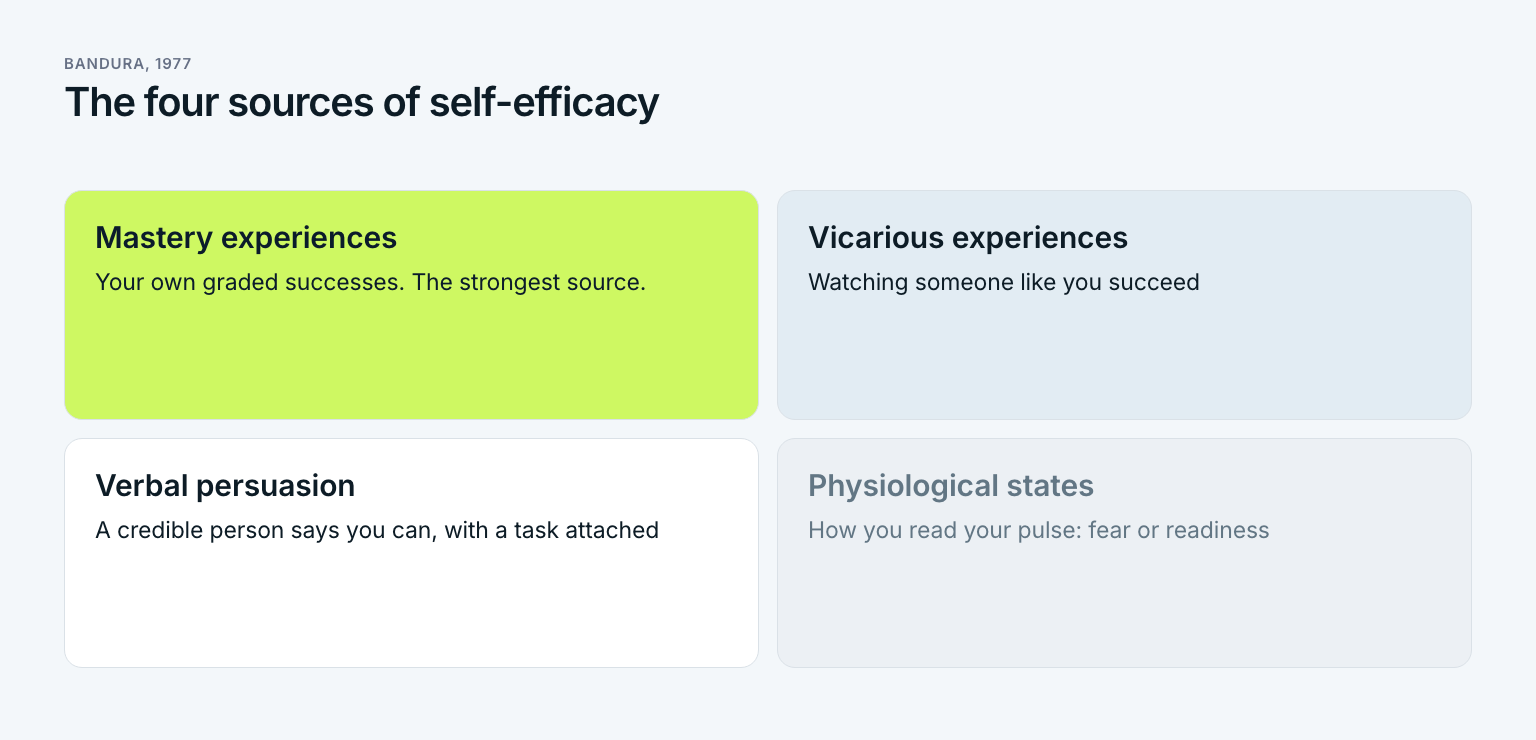
Bandura named four sources in 1977 and kept them in 1997 with slightly different labels: mastery experiences, vicarious experiences, verbal persuasion, and physiological and emotional states. They are not equal. Mastery experiences carry the most weight, and the other three mostly work by changing how you approach the next mastery experience.
Mastery experiences
Mastery experiences are successes you produced yourself, at a task that was hard enough to count. Nothing else convinces you that you can do something as reliably as having done it. The catch is in the word graded. A success that came too easily teaches you little, and a failure early in the process teaches you the wrong thing. Elena's first mastery experience was a 90-second update at the Monday huddle. Six people, no slides, one number. She did it on October 6, 2025. Nobody noticed, and that is the point. She did.
Vicarious experiences
Vicarious experiences are other people's performances, observed closely enough to learn from. The effect is strongest when the model resembles you. Watching a polished keynote speaker did little for Elena, because she could not see herself in him. Watching Priya, a peer in procurement who stammered through her first department update in 2024 and gave a steady one in 2025, did a great deal. Elena asked Priya how she prepared. The answer, three run-throughs out loud with a timer, became part of Elena's plan.
Verbal persuasion
Verbal persuasion is being told by someone credible that you can do it. It is the weakest source on its own and the one people lean on most. A pep talk raises self-efficacy for about as long as the conversation lasts, unless it is followed by an attempt. It works best as a nudge into a mastery experience you were about to avoid. Elena's manager said one useful sentence: “Take the Monday update for the next eight weeks.” That was persuasion with a task attached.
Physiological and emotional states
Your body reports on the task before your mind does. A racing heart, a dry mouth, and shaky hands get read as evidence: I am not able to do this. The source works through interpretation. The same pulse can be read as fear or as readiness, and the reading changes the belief. Elena learned to say, quietly, before each update: “That is my body getting ready.” It sounds small. It stopped her from counting nerves as a verdict.
Why the order of the four sources matters
Bandura ranked mastery first because it is the only source that produces direct evidence. The other three produce reasons to try. Anyone who builds a plan on persuasion and role models without a graded first task is collecting reasons and never collecting evidence. The working sequence is: watch someone like you, let a credible person push you, reframe the nerves, then do the smallest version of the task. Repeat.

Self-efficacy examples from everyday life
Self-efficacy examples are easiest to spot in the moment just before someone starts or quits. High self-efficacy shows up as starting without a perfect plan, treating a setback as information, and staying with a hard task past the first ugly attempt. Low self-efficacy shows up as avoidance that looks like scheduling, effort that stops early, and setbacks read as proof. Here are six domains, each with a high and a low version. Elena is the first.
| Domain | High self-efficacy looks like | Low self-efficacy looks like |
|---|---|---|
| Public speaking | Elena takes the Monday update, times it, and asks for one piece of feedback | Elena volunteers for the written report so that someone else presents |
| Health | A new runner plans three 20-minute run-walks a week and adjusts after a sore knee | A new runner buys shoes, skips the first cold morning, and concludes that running is not for them |
| Learning | An adult learning Spanish books a 15-minute tutoring call and accepts making errors | An adult learning Spanish collects apps and never says a sentence to a person |
| Work | A new team lead runs the first one-on-one with three prepared questions | A new team lead postpones one-on-ones for a month to avoid the awkwardness |
| Money | Someone paying off debt sets up one automatic transfer and checks the balance monthly | Someone paying off debt avoids opening statements because the number feels fixed |
| Parenting | A parent tries one new bedtime routine for two weeks before judging it | A parent drops the routine after one bad night and returns to the old pattern |
Notice what the high column has in common. Every example is small, specific, and repeated. None of them is a leap. That is self-efficacy in practice: not the courage to attempt something enormous, but the belief that the next small step is within reach, which makes the step happen, which makes the belief stronger. Whoever is looking for a dramatic example has misunderstood the concept. The dramatic version is this loop, run a few hundred times.
What happens when self-efficacy is low
Low self-efficacy does not feel like a belief. It feels like a fact about the world. The task looks harder than it is, the first attempt looks more final than it is, and avoidance looks like reasonable planning. Bandura described three consequences: people choose tasks they already know they can do, they put in less effort when the task gets hard, and they recover more slowly from setbacks. All three were visible in Elena's history.
For eleven years she arranged her career around not presenting. She chose roles with reports instead of meetings. When a presentation could not be avoided, she over-prepared the slides and under-prepared the delivery, then read the slides aloud, then took the flat reaction as confirmation. Each cycle lowered the number. By 2025 she was at 3 out of 10, and the reorganization took the choice away. Does that story sound familiar in some other area of your life?
The cost is not only the missed task. Low self-efficacy raises stress, because a task you believe you cannot handle is a threat, while the same task with a higher belief is a challenge. It also narrows goals. Anyone who has quietly decided that a whole category of tasks is “not me” has removed those goals from consideration before weighing them. In short: low self-efficacy shrinks the future one avoided task at a time, and it does so without announcing itself. That threat-or-challenge reading is the first appraisal in the transactional model of stress.
How to build self-efficacy in six steps
How to build self-efficacy comes down to engineering mastery experiences and arranging the other three sources around them. The method takes about an hour to set up and ten minutes a week to run. Elena's numbers are in every step. Her goal: present the quarterly results to 45 people on March 19, 2026, for 15 minutes, without reading from the slides.
Name the task and rate your belief, ten minutes
Write the task as one sentence someone else could watch you do. Then rate, from 0 to 10, how sure you are that you can do it today. Elena wrote: “Present the Q1 results to the department for 15 minutes without reading from slides.” Her rating was 3. The number is your baseline. Without it you will not know in March whether anything changed.
Build a ladder of five to eight rungs, fifteen minutes
List versions of the task from the one you can do today to the real thing. Each rung should feel about one notch harder than the last. Elena's ladder: a 90-second update to six people, a five-minute update with one slide, a ten-minute update to 15 people, a 15-minute run-through for two colleagues, a 15-minute presentation to 20 people in another department, the real thing. Six rungs, five months.
Find one model who resembles you, this week
Pick someone who was recently where you are, not someone who was never there. Ask one question: What did you do between the first bad attempt and the first good one? Elena asked Priya and got a method she could copy. Anyone who picks a natural as their model gets inspiration and no instructions.
Do the first rung within seven days, and log it
The first rung has to happen before the belief has time to argue. Put it in the calendar with a date. Afterwards write three lines: what you did, what went wrong, what you will change. Elena's log for October 6: “Gave the number. Spoke too fast. Next week, pause after the number.” That is a mastery experience, recorded.
Reframe the nerves before each rung, two minutes
Before each attempt, name what your body is doing and label it as preparation. Pulse up, hands cold, that is the body getting ready. Then one slow exhale, and start. Elena uses the same sentence every time. The body does not calm down much. The interpretation changes, and the interpretation is the source.
Re-rate your belief every four weeks and adjust the ladder
Same question, same 0 to 10 scale, every fourth Friday. If the number moved, add a rung or shorten the ladder. If it did not, the current rung is too big, so split it. Elena's ratings: 3 in October, 4 in November, 6 in December after the 15-person update, 7 in February. The number tracks evidence, not mood.
The most common mistake: a first rung that is too big
Most attempts to build self-efficacy fail at step two. The ladder starts with the real thing minus one slide, the first attempt goes badly, and the failure confirms the old belief with fresh evidence. Bandura's snake study moved people from standing in the doorway to touching the glass before anyone handled a snake. Whoever starts at the podium has skipped the method. The first rung should be so small that skipping it would feel silly. Elena's was 90 seconds and one number.
Six steps look like a lot of structure for a belief. They are not six beliefs. They are one loop, attempt, record, re-rate, with the other three sources wired in at steps three and five. Anyone who runs the loop for twelve weeks has twelve pieces of evidence. Evidence is what the belief is made of.
Self-efficacy in the goal chain: from year to day
A ladder of rungs is a goal chain with a different name. The yearly goal is the top rung. Each quarter, month, week, and day holds a smaller version of the same task, and every completed level is a mastery experience that feeds the next. This is where self-efficacy stops being a concept and becomes a calendar. Elena's chain for the presentation goal looked like this.
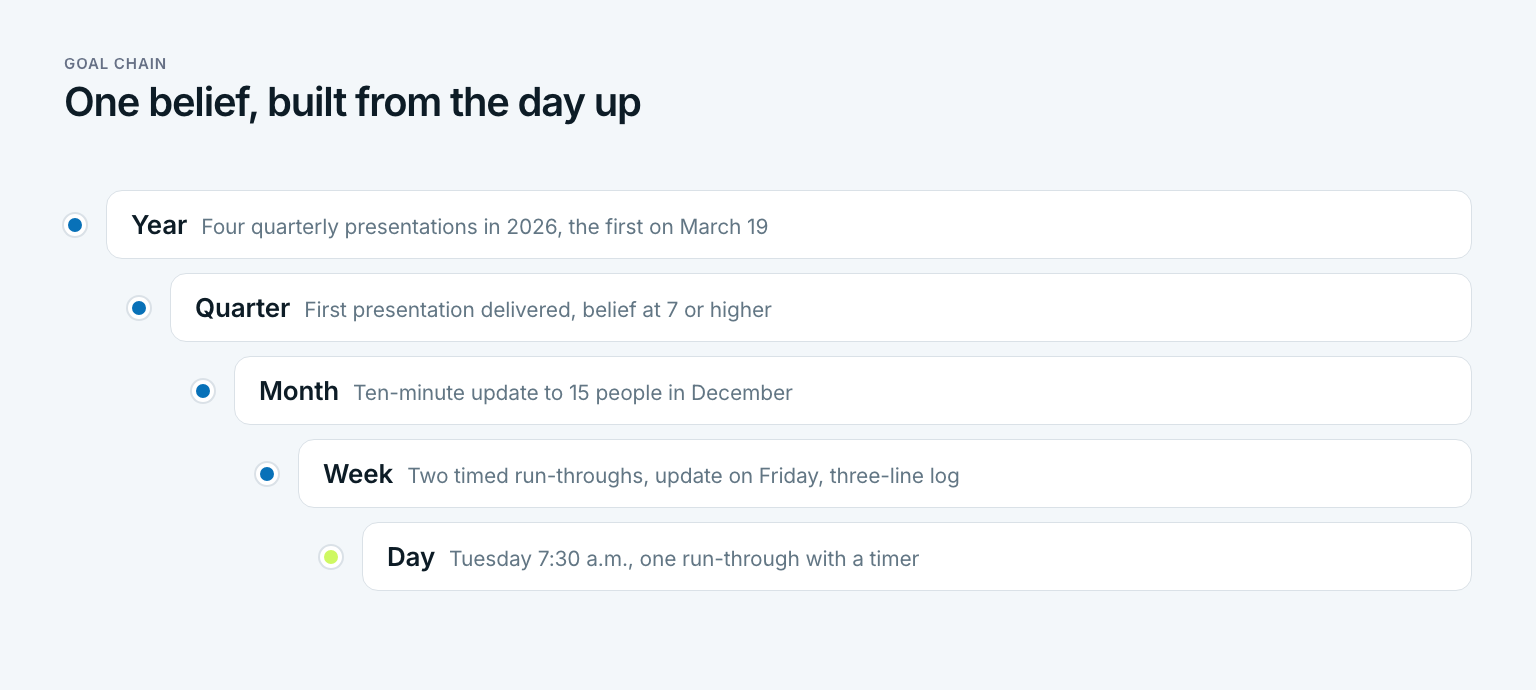
Year: present quarterly results to the department four times in 2026, the first on March 19, without reading from slides. Quarter one: the first presentation delivered, belief rated 7 or higher. Month, December 2025: a ten-minute update to 15 people in the operations meeting. Week, December 8 to 12: two timed run-throughs out loud on Tuesday and Thursday, the update on Friday, the three-line log the same afternoon. Day, Tuesday, December 9: one run-through with a timer at 7:30 a.m., 20 minutes, then a note on where she rushed.
Each level answers the question the level above cannot. The year says what counts. The quarter says when the first proof is due. The month says which rung is current. The week says which attempts happen. The day says what to do at 7:30 a.m. That means: self-efficacy is built on the day level and measured on the quarter level, and the levels between keep the two from drifting apart. The weekly review is where you check whether the week's rung happened and re-rate the belief. Turning a yearly goal into daily steps is the general method. This article applies it to one belief.
The chain also protects the first source from the fourth. Whoever has to decide each morning whether today is the day for a run-through will decide with the body's report, and the body votes no. Whoever has the run-through in the calendar on Tuesday decides nothing. It is Tuesday. Daily goals that were decided a week earlier are how a low belief gets around itself.
Three questions that tell you where your self-efficacy stands
Before you set the next goal, ask three questions about the task behind it. First: Have I done a smaller version of this in the last 30 days? If not, there is no fresh mastery experience, and the belief is running on old data. Second: Who do I know who was recently where I am? If nobody, the second source is empty, and you are learning from strangers on a stage. Third: What did I conclude from my last setback at this task? If the answer is a verdict about yourself rather than a note about the attempt, the fourth source is working against you.
Elena's answers in September 2025 were no, nobody, and “I am not a presenter.” Her answers in February 2026 were yes, Priya, and “I rushed the second slide.” Same person, same task, different belief, because the three sources behind the belief had changed. On March 19 she spoke for 14 minutes, read nothing, lost her place once on the second slide, and recovered. Her rating that evening was 8. Eleven logged attempts stood behind it.
In short: self-efficacy is not something you have. It is something you have evidence for, and the evidence is yours to produce. How to achieve goals covers the full method from yearly goal to daily step. SMART goals examples show how to write a rung so that it can be checked. The same evidence-first approach runs through personal development, where what you practice and count is what changes. Start with a task you have been avoiding, rate it, and build the first rung so small that it feels silly.
What is self-efficacy in psychology?
Self-efficacy is a person's belief that they can perform the actions a specific task requires. Albert Bandura introduced the term in 1977 and distinguished it from the belief that the actions will lead to a good outcome. It is task-specific, so a person can have high self-efficacy for one activity and low self-efficacy for another, and it predicts whether someone starts a task and how long they persist.
Can you give an example of self-esteem versus self-efficacy?
Self-esteem is a judgment of worth: “I am a good person.” Self-efficacy is a judgment of capability: “I can give this 15-minute presentation.” A manager can like herself and still believe she cannot speak in front of a room, which is high self-esteem and low self-efficacy. The reverse exists too, a person who is sure they can do the task and still feels worthless. The two beliefs are built and changed in different ways.
What's another word for self-efficacy?
Perceived capability, mastery belief, and agency are the closest terms. In everyday language people say can-do belief or self-belief. Confidence is often used as a synonym but is broader and not tied to a task. Self-esteem is not a synonym at all, because it describes worth rather than ability.
What does “efficacy” mean?
Efficacy is the power to produce an intended effect. The word comes from the Latin efficere, to bring about or accomplish. In medicine, a treatment has efficacy if it does what it is supposed to do. Self-efficacy borrows the term: it is the belief that your own actions have that power for a particular task.
What are the four sources of self-efficacy according to Bandura?
Mastery experiences, vicarious experiences, verbal persuasion, and physiological and emotional states. Mastery experiences, your own graded successes, are the strongest source. Vicarious experiences are other people's successes, strongest when the person resembles you. Verbal persuasion is credible encouragement, and physiological states are how you interpret your body's signals before and during the task.
How long does it take to build self-efficacy?
It depends on how many graded attempts you can fit in. A belief tends to move after a handful of logged mastery experiences, which for a weekly task means one to three months. In the example in this article, a rating of 3 out of 10 became 8 in about six months with eleven attempts. A single pep talk changes the number for an afternoon. Repeated small successes change it for good.
Last updated: 19 October 2026
Read next
 Personal Growth
Maslow's Hierarchy of Needs: The 5 Levels Explained
Maslow's hierarchy of needs sorts motivation into five levels. What each level means, what research says today and a needs audit you can run yourself.
14 min read
 Personal Growth
Mindfulness Exercises: 12 for Everyday Life
Mindfulness exercises are not about emptying your mind. 12 techniques for stress and focus, what research shows, and a four-week plan to practice daily.
16 min read
 Personal Growth
Positive Affirmations: 50 Examples You Can Believe
Positive affirmations are not magic words. What research shows, 50 daily affirmations you can believe, and a five-step method with a worked example.
16 min read