Achieving Goals: How to Measure Progress and Keep Going
Achieving goals is not a burst of willpower in December. Measure goal attainment from a baseline, check it against time, and get through the middle.

Contents
- 01What achieving goals actually means
- 02Goal achievement starts with a baseline: the progress formula
- 03Progress against time: a traffic light for every goal
- 04The 5 steps for achieving your goals
- 05Goal attainment, measured five ways
- 06What happens in the middle, and how to keep going
- 07Achieving goals in a goal chain: year, quarter, month, week, day
- 08The top 10 goals in life, and how to measure each one
- 09Three questions before your next check-in
- 10Frequently asked questions about achieving goals
Achieving goals is not a single moment on December 31 when you check a box. It is a number you can read every week: the share of the distance from your starting point to your target that you have already covered, set next to the share of the time that has already passed. How to write a goal with a number and a date is covered in goal setting. Which method fits your goal and how a year breaks down into weeks is in the guide on how to achieve goals. This article covers the stretch in between: how to measure goal achievement while it is happening, and how to keep going when the number stalls in the middle.
Three tools do the work: a progress formula that knows where you started, a comparison with the calendar, and a rule for the day the light turns red. All three are worked through on Marcus, 41, an operations manager at a freight company in Charlotte, North Carolina, with two kids and a commute that eats an hour a day. He has two goals for 2026. He wants to go from 218 to 188 pounds by December 31. He also wants a $12,000 emergency fund, up from the $2,000 he had on January 1. By the end of June, both goals look fine. Both are behind.
What achieving goals actually means
Achieving goals means two different things, and most advice blurs them. One is the result: on the deadline, the goal is reached or it is not. The other is the state along the way, a number between 0 and 100 percent that researchers call goal attainment and that most people never calculate. Whoever only knows the result finds out on December 31 what should have changed in July. Whoever reads the number every month can still change July.
Achieving goals is also not a feeling. A packed quarter feels like progress and a quiet one feels like failure, and both feelings can be wrong. A goal with a number needs a measurement with a number. Anyone who measures by feel is measuring their mood. That means: achieving a goal does not start on the deadline. It starts on the first day, when you write down where you are.
Result, attainment, and time elapsed
The result is the answer on the deadline: reached or not. Goal attainment is the share of the distance covered so far, from 0 to 100 percent. Time elapsed is the share of the period that is already gone. Attainment and time elapsed together tell you whether the result is still likely, and that pair is what the rest of this article is built on.
Goal achievement starts with a baseline: the progress formula
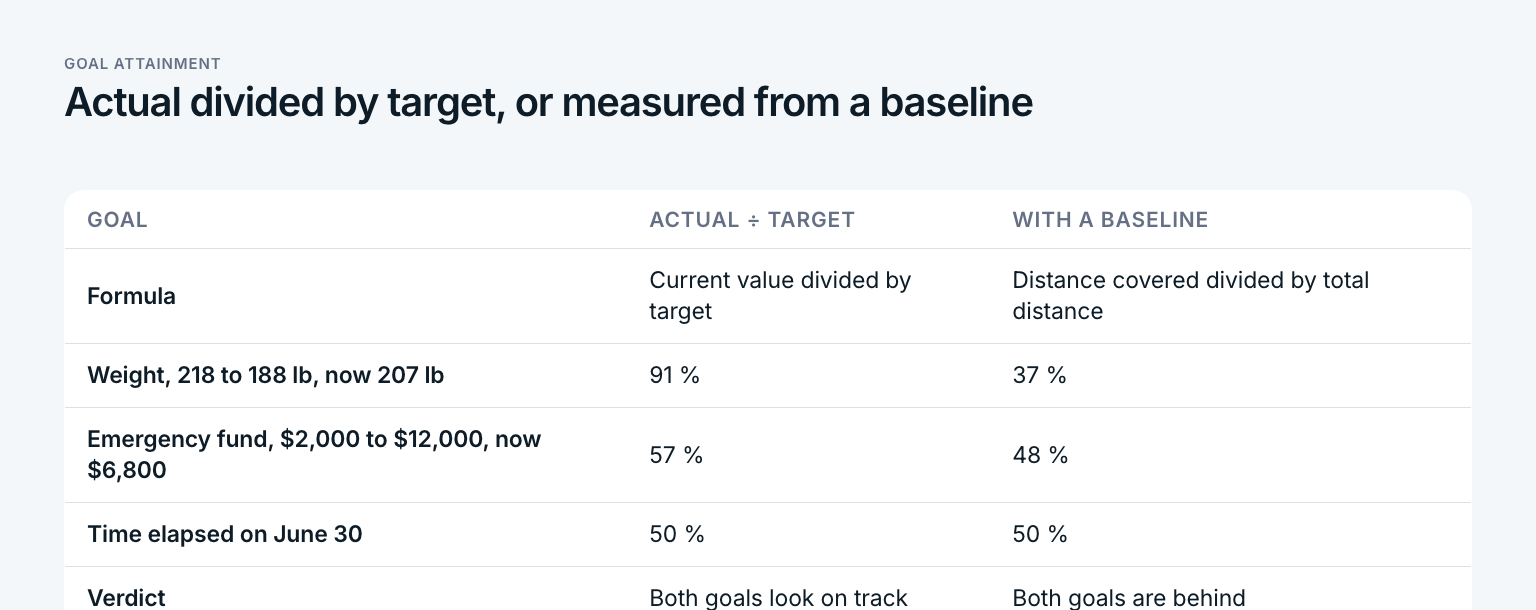
The formula most people reach for is actual divided by target. It is simple, and for some goals it works. If you start at zero and want to read 24 books, 12 books is 50 percent, and that is true. It breaks for every goal that does not start at zero. Most goals do not.
Marcus found this out in July. He weighed 218 pounds on January 1 and 207 pounds on June 30. For a goal that goes down, people flip the formula to target divided by actual: 188 divided by 207 is 91 percent. That reads like a goal that is almost done. In fact he has lost 11 of 30 pounds, which is 37 percent. His emergency fund tells the same story from the other direction. $6,800 divided by $12,000 is 57 percent, ahead of schedule. But he started at $2,000, so he has saved $4,800 of the $10,000 he set out to save. That is 48 percent.
The goal attainment formula
Goal attainment = distance from start to now ÷ distance from start to target × 100. It works for goals that go up and for goals that go down, because it only counts distances. Marcus's weight: 11 of 30 pounds, 37 percent. His fund: $4,800 of $10,000, 48 percent. Without a baseline there is no distance, and without a distance every percentage is a guess.
The most common mistake: measuring without a baseline
Anyone who skips the starting number ends up measuring against the target alone. That flatters every goal that does not start at zero. Marcus would have seen 91 and 57 percent in June instead of 37 and 48. The bigger numbers feel better, no question. They also push the moment you notice something is wrong back by months. In short: the baseline is the most important number you write down on day one, more important even than the target.
Progress against time: a traffic light for every goal
Thirty-seven percent is neither good nor bad on its own. On March 31 it would be excellent. On November 30 it would be an alarm. Only the comparison with time elapsed turns the number into a verdict. On June 30, half the year is gone. On September 30, three quarters are.
Put the two numbers side by side and read the light. The ten-point threshold is a rule of thumb, not a law of nature. It keeps one bad week from setting off an alarm and still trips early enough to act. For weekly goals, where a single week moves a lot, a tighter threshold is fine.
| Light | Condition | What you do |
|---|---|---|
| Green | Attainment at or above time elapsed | Change nothing and keep the plan exactly as it is |
| Yellow | Attainment up to 10 points below time elapsed | Calculate the catch-up rate and put it into next week's plan |
| Red | Attainment more than 10 points below time elapsed | Find the cause and decide: more effort, a different approach, or an adjusted goal |
On June 30, Marcus's fund is at 48 against 50, which is yellow. In April his car needed a new transmission, and $1,400 went to the shop instead of the savings account. His weight is at 37 against 50, which is red. Two goals, two colors, two very different conversations with himself. What does each one need? The yellow goal needs arithmetic. The red goal needs a decision.
The catch-up rate: what each month needs now
The catch-up rate is the remaining distance divided by the remaining time. For the fund, that is $5,200 over six months, about $867 a month instead of the planned $833. Thirty-four dollars a month is one canceled subscription and one fewer takeout night. For his weight, it is 19 pounds over six months, a little over three pounds a month instead of two and a half. Anyone who skips this calculation is hoping for a good December. Anyone who does it changes July.
The catch-up rate has a second use. It tells you whether the goal is still realistic. Had Marcus waited until October, the same 19 pounds would have meant more than six pounds a month, a pace his doctor would not sign off on. At that point the question is no longer discipline. It is an honest decision about the goal. An uncomfortable number in July beats an impossible one in October.
The 5 steps for achieving your goals
What are the five steps for achieving your goals? Most lists start with dreaming big and end with celebrating. The five below start after the goal is written, because that is where most goals are lost. Setting up the system takes about 30 minutes. Running it takes ten minutes a week.
Write down the baseline on day one
Record the number, the date, and the source. For Marcus, that is 218 pounds on the bathroom scale on January 1 and $2,000 in savings on the December statement. A number without a source gets renegotiated in June.
Fix the target, the deadline, and the formula
188 pounds and $12,000 by December 31, measured as distance covered divided by total distance. Decide the formula now, not when the first number comes in. Otherwise you will pick whichever one looks better.
Set two rhythms: weekly for actions, monthly for results
Results swing too much from week to week, and actions react too late from month to month. Marcus checks every Sunday whether his three workouts and his food log happened. On the first of each month he reads his average weight and his account balance.
Put attainment next to time elapsed
Two numbers, one light: green, yellow, or red. Write the color next to the date. After three months you have a row of colors, and a row says more than any single reading.
At yellow, calculate. At red, decide
Yellow means working out the catch-up rate and writing it into next week. Red means finding the cause and choosing one of three responses: more effort, a different approach, or an adjusted goal. Write the decision down with the date so you can check it at the next reading.
After that, the system mostly runs itself. Whoever has a fixed weekly slot for it needs no extra discipline, only those ten minutes. What that slot can look like is described in the ten-minute weekly review. The monthly check is even shorter: read the number, calculate attainment, write down the color.
Goal attainment, measured five ways
Not every goal can be measured with the same number. The baseline formula fits goals with a number. Other goals need other measures, and each one is built for something different. None of them is wrong, as long as you know what it does not show.
| Measure | What it shows | Fits | What it does not show |
|---|---|---|---|
| Yes or no on the deadline | Whether the goal was reached | Goals with a clear end state, such as passing an exam | Where you stand along the way |
| Attainment with a baseline | Share of the distance covered | Goals with a number: weight, debt, savings, revenue | Whether you are on schedule |
| Attainment against time elapsed | Whether you are ahead or behind | Every level from the year down to the week | Why you are behind |
| Execution rate | Share of planned actions that happened | Process goals and weekly plans | Whether the actions work |
| OKR score from 0 to 1 | Degree of attainment per key result | Ambitious goals with several measures | A simple yes or no |
The execution rate comes from The 12 Week Year by Brian P. Moran and Michael Lennington. Every week you count the share of planned actions that actually happened, and the authors treat 85 percent as the threshold. Whoever holds that line usually lands the result as well, in their experience. The OKR score is described by John Doerr in Measure What Matters, his 2018 book on objectives and key results. At Google, each key result is graded from 0 to 1, and for ambitious goals 0.7 already counts as success. Anyone who sets goals deliberately high needs that scale. Without it, every good year looks like a failure.
Outcome, performance, and process goals
Goals come in three kinds, and each is measured differently. An outcome goal describes an end state, such as 188 pounds on December 31. A performance goal describes your own number getting better, such as a faster 5K time. A process goal describes a behavior, such as three workouts a week. You measure the outcome goal with yes or no on the deadline and with attainment along the way. You measure the performance goal with attainment against your own baseline. You measure the process goal with the execution rate.
The real power is in combining them. Marcus's weight goal is an outcome goal with two process goals underneath: three workouts a week and a food log every day. If attainment stalls while execution is at 100 percent, the plan is wrong. If attainment stalls while execution is at 50 percent, the plan is fine and simply is not happening. That means: two numbers tell you not only that something is stuck, but where.
What happens in the middle, and how to keep going
Beginnings are easy, and so are endings. At the start, novelty carries you. Near the finish, the finish line does. In between is a long stretch where neither works. For a yearly goal, that stretch is summer.
Researchers have described this pattern. Andrea Bonezzi, C. Miguel Brendl, and Matteo De Angelis showed in a 2011 paper in Psychological Science, titled Stuck in the Middle, that effort toward a goal often follows a U shape: high at the start, high near the end, low in the middle. Early on you compare yourself with the starting point, and every step looks big. Near the end you compare yourself with the target, and every step looks big again. In the middle both are far away, and every step looks small.
Marcus knows this middle. By the end of June, eleven pounds are gone and nineteen are left. The scale has shown the same number three Saturdays in a row, there is a cookout every weekend, and a week at the beach is coming in August. Is this a character flaw? No. It is the middle, and it is predictable. Anyone who knows it is coming can plan for it instead of being surprised by it. Why motivation follows progress rather than the other way around is covered in goals and motivation.
Look at the smaller number
Minjung Koo and Ayelet Fishbach described a simple counter in a 2012 paper in the Journal of Consumer Research: pay attention to whichever number is smaller. As long as the distance covered is smaller than the distance left, count what you have done. Once the remainder is smaller, count what is left. The smaller number moves visibly with every step. The larger one barely seems to move at all.
For Marcus that means counting pounds lost until he passes 15, the halfway mark. Through June that was 11 pounds lost against 19 to go. At the end of July he crosses 15 and switches. From then on he counts down: 15 to go, then 13 at the end of August, then 10 at the end of September. The same Saturday weigh-in suddenly feels like progress. In short: you do not change the plan, you change the number you look at. Which display shows the smaller number best, a bar, a box poster, or a calendar chain, depends on the goal, and the guide on how to visualize goals compares the formats.
Make the middle shorter
The second counter is structural. A twelve-month stretch has one long middle. Four quarters have four short middles, and each quarter has its own beginning and its own end. Whoever breaks a yearly goal into quarterly goals gets the push of a fresh start four times a year and the pull of a finish line four times. That is exactly what a goal chain is built for.
The third counter is about writing things down. Benjamin Harkin and colleagues pulled together the experiments on progress monitoring in a 2016 review in Psychological Bulletin. Their finding: people who monitor their progress are more likely to reach their goals, and the effect is larger when progress is physically recorded or reported to someone else. Marcus texts his brother his monthly average on the first of every month. It takes a minute and turns a private number into a shared one. The guide to writing down goals separates what holds up in this research from the famous Harvard study that nobody has ever found.
When the light turns red: effort, approach, or the goal itself
Red is not a verdict on you. It is a question for the plan. There are three possible answers, and they come in a fixed order:
- More effort. The approach is right, it just is not happening often enough. You can tell by an execution rate below 85 percent. The fix is an extra fixed time slot, not more willpower.
- A different approach. The effort is there, it just is not working. You can tell by a high execution rate with stalled attainment. The fix is a different action, not more of the same one.
- An adjusted goal. Something outside has changed, such as an injury, a new job, or a new baby. Only after two red readings in a row, and only with a written reason. An adjusted goal is a new goal with a new baseline, not a deleted one.
In June, Marcus is at 37 against 50 on his weight. His workouts are fine: 70 of 78 planned sessions happened, about 90 percent. His food log is not. He filled it in on 73 of 181 days, about 40 percent. So it is effort, and specifically effort on the food side. He adds two fixed slots. On Sunday at 4:00 p.m. he preps five lunches. At 12:45 p.m. a phone reminder asks him to log lunch before he eats it. By September 30 he weighs 198 pounds. That is 20 of 30, or 67 percent attainment against 75 percent time elapsed. Yellow instead of red.
Whoever lowers the goal at the first red reading never learns whether effort or approach would have been enough. Whoever never lowers it holds on to a goal whose basis no longer exists. The fixed order protects you from both.
Achieving goals in a goal chain: year, quarter, month, week, day
A goal chain translates a yearly goal into a quarter, a month, a week, and a day. For measurement, that means each level has its own attainment and its own time elapsed, and each one measures something different. At the top you measure the result. At the bottom you measure what you did. In between you see where the chain breaks.
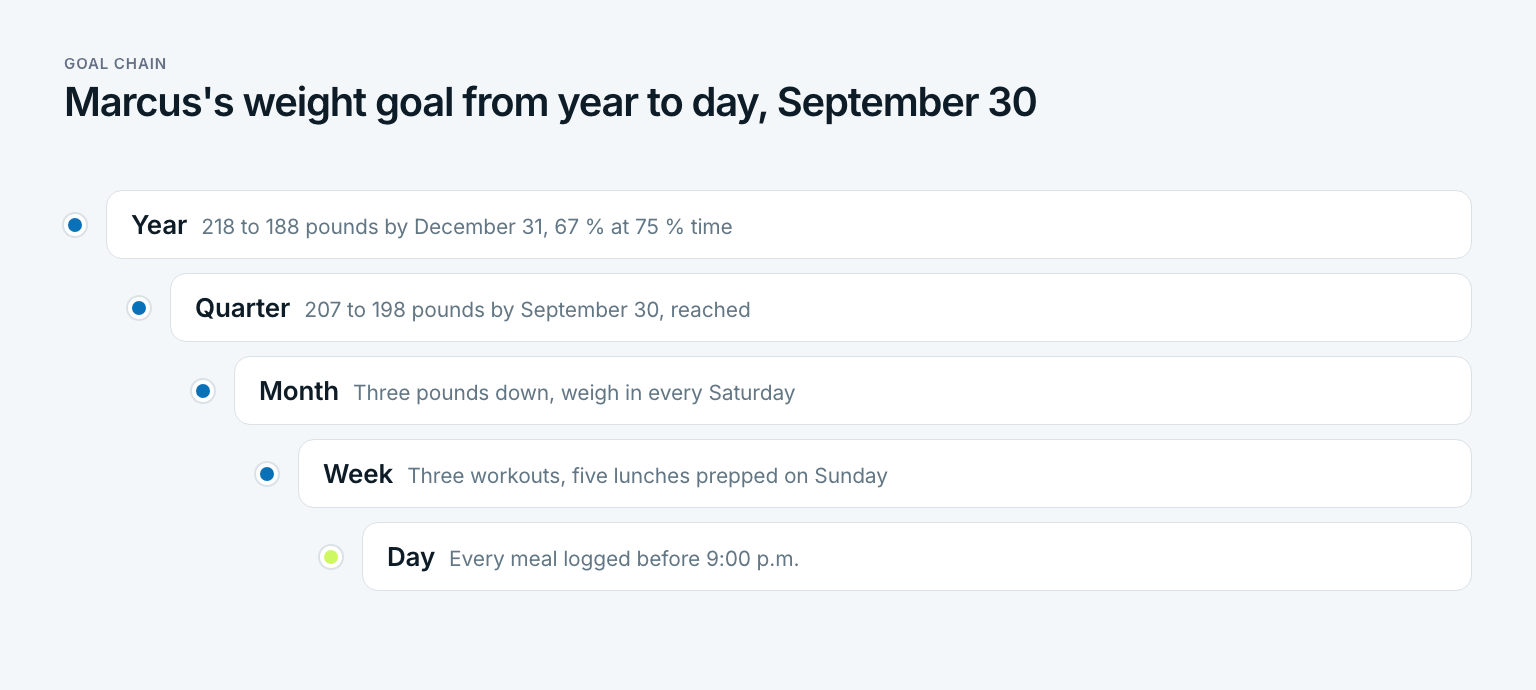
This is Marcus's chain for the third quarter, after he built the catch-up rate in:
| Level | Goal | Measure | Status on September 30 |
|---|---|---|---|
| Year | 218 to 188 pounds by December 31 | Attainment against time elapsed, monthly | 67 % at 75 % time, yellow |
| Quarter | 207 to 198 pounds by September 30 | Attainment, monthly | 198 pounds, 100 %, green |
| Month | Three pounds down, weigh in every Saturday | Yes or no on the first of the month | July yes, August one pound short, September yes |
| Week | Three workouts and five lunches prepped on Sunday | Execution rate, every Sunday | 12 of 13 weeks, 92 % |
| Day | Every meal logged before 9:00 p.m. | Check mark | 79 of 92 days, 86 % |
The chain shows what no single number can. The quarter is green, and the year is still yellow, because the first half left a gap that one good quarter cannot fully close. Execution sits at 92 percent for the weeks and 86 percent for the days, so the plan is actually happening. The new catch-up rate for the last quarter is ten pounds in three months, a little over three a month. Marcus plans Thanksgiving and the holidays into it now instead of discovering them in December. His emergency fund, which only needed arithmetic, stands at $9,600: 76 percent against 75, green.
In Gaapp, every goal hangs from a bigger one, and next to each goal's progress you see how much of its time has passed, so the light needs no arithmetic. Paper works too: one line per level, two numbers per line, once a week. What matters is not the tool. What matters is that the baseline and time elapsed sit next to the current number.
The top 10 goals in life, and how to measure each one
What are the top 10 goals in life? Resolution lists and goal guides keep returning to the same ten: health, money, relationships, work, and learning in different combinations. The list itself is less interesting than the question of how to tell, in July, whether you are getting there. Here are ten common life goals, each with a measure and a baseline:
| Goal | Measure | Baseline to write down | Type of measure |
|---|---|---|---|
| Lose weight | Pounds, weekly average | Weigh-in on day one | Attainment with a baseline |
| Get fit | Workouts per week and a 5K time | Current workouts per week and current time | Execution rate plus attainment |
| Pay off debt | Balance owed | Balance on the first statement | Attainment with a baseline |
| Build an emergency fund | Account balance | Balance on day one | Attainment with a baseline |
| Read more | Pages or books per week | Books read last year | Execution rate |
| Learn a language | Lessons per week and one conversation test | Current level or lesson count | Execution rate plus yes or no |
| Advance your career | New role or promotion by a date | Current role and the skills still missing | Yes or no plus milestones |
| More time with family | Phone-free evenings per week | Phone-free evenings last month | Execution rate |
| Sleep better | Nights in bed by 10:30 p.m. | Nights in bed by 10:30 p.m. last month | Execution rate |
| Start a side business | First paying customer and monthly revenue | Revenue today, often zero | Yes or no plus attainment |
Two patterns stand out. Every goal that sounds vague, like more time with family, becomes measurable once you name a behavior and count it. And every goal with a number needs a baseline, even when that baseline is zero. Whoever writes down the baseline for all ten in January has done more for December than whoever writes ten resolutions. Which of the ten matters most to you right now? Pick three at most, and run the rest as habits until their turn comes.
Three questions before your next check-in
Before you read the next number, check the system itself. Three questions are enough:
- Do I know my baseline, with a date and a source? If not, today is day one. A late baseline beats none.
- Do I know how much time has passed, and is my attainment above or below it? If you have to guess, you are missing a fixed check-in.
- What will I do at red, and is that already decided? Whoever decides only when the light turns red decides under pressure.
In short: achieving goals is not a matter of willpower on the deadline. It is a number you can read every week, once you know where you started. Marcus does not know on September 30 whether he will weigh 188 pounds on New Year's Eve. He does know that he needs a little over three pounds a month, and that is more than most people know about their yearly goal in October.
Frequently asked questions about achieving goals
What do you mean by achieving goals?
Achieving goals means reaching a result you decided on by a set date, and it also covers the progress toward that result along the way. That progress is measured as goal attainment: the share of the distance from your starting point to your target that you have covered. Compared with the share of time that has passed, it tells you whether you are on track.
What are the 5 steps for achieving your goals?
Write down your baseline on day one, fix the target, the deadline, and the formula, and set a weekly rhythm for actions and a monthly one for results. After each reading, compare attainment with time elapsed. At yellow, calculate the catch-up rate. At red, decide between more effort, a different approach, or an adjusted goal.
What are the top 10 goals in life?
The goals that come up most often are losing weight, getting fit, paying off debt, building savings, reading more, learning a language, advancing a career, spending more time with family, sleeping better, and starting a business. None of them is a goal until it has a number and a date. Each one becomes measurable once you write down a baseline and decide how you will count progress.
What are 5 good goals?
Good goals have a number, a date, and a weekly action you control. Five examples: lose 20 pounds by December 31, save $5,000 by June 30, read 20 pages five nights a week, keep two phone-free evenings a week with your kids, and finish one online course by the end of the quarter. Write the baseline next to each one before you start.
What is the difference between goal achievement and goal attainment?
In everyday use they mean the same thing. When people do separate them, goal achievement usually means the final result, and goal attainment means the degree to which a goal has been reached, often as a percentage. Measuring attainment along the way is what makes the final achievement more likely.
What should I do if I am behind on a goal?
Calculate the catch-up rate first: remaining distance divided by remaining time. If that rate is realistic, put it into next week's plan. If attainment stays red, check your execution rate. Below 85 percent, the fix is more effort, above it, a different approach, and you adjust the goal only after two red readings in a row.
Last updated: 14 October 2026
Read next
 Goal Setting
Intrinsic Motivation: What Drives You From the Inside
Intrinsic motivation is not a personality trait. Meaning, 12 examples, the three needs behind it and five steps to build it, with a worked example.
17 min read
 Goal Setting
Financial Goals: How to Turn Wishes Into a Plan
Financial goals are not wishes with a dollar sign. Short and long term examples, SMART savings goals and a five step plan, worked through one year.
17 min read
 Goal Setting
WOOP Method: Four Steps From Wish to If-Then Plan
The WOOP method is not positive thinking. What WOOP stands for, the research, if-then plans, eight goal examples and a five-minute guide.
18 min read