Goals and Motivation: The Four Kinds That Last
Goals and motivation in the right order: motivation follows progress, not the other way. Four kinds, five P's, ten example goals, a plan from year to day.

Contents
- 01Goals and motivation: what the pair actually is, and what it is not
- 02The four kinds of motivation, and which one carries a goal
- 03What really happens in week three: why motivation leaves before the goal does
- 04The five P's of motivation, tested against a real goal
- 05How to stay motivated to reach goals in five steps
- 06Goals and motivation in the goal chain: from a yearly goal to Tuesday at 6:00 a.m.
- 07Ten examples of goals that carry their own motivation
- 08The three mistakes nobody notices
- 09Three questions to ask your goal before Friday
- 10Frequently asked questions about goals and motivation
Goals and motivation work in the opposite order from the one most people assume. Motivation is not the fuel you need before you can start on a goal. It is the result of seeing progress toward a goal that matters to you, and it shows up after the first visible step, not before it. That means: the useful question is not how to feel more motivated. It is how to set a goal up so that progress becomes visible every week, because that is where motivation gets made.
Three things are needed for that: a motive written as an outcome, a chain from the yearly goal down to a single day, and a Friday that counts what happened. All three are worked through on Dana, a 36-year-old dental hygienist in Columbus, Ohio, with two kids, who wants to run a half marathon on May 1, 2027, in under 2 hours and 20 minutes. She has started training twice before. Both times she stopped in week four.
Goals and motivation: what the pair actually is, and what it is not
A goal is a result you have decided to reach by a date. Motivation is the force that gets you to act on it today. Edwin Locke and Gary Latham define a goal as the object or aim of an action, and their 1990 book shows across hundreds of studies: specific, difficult goals produce more effort than vague goals or the instruction to do your best. Richard Ryan and Edward Deci define the second half just as plainly in their 2000 paper on self-determination theory: to be motivated means to be moved to do something. One is a destination. The other is movement.
Most people treat motivation as the thing they must have before they can start. They wait for the feeling, start when it arrives, and stop when it leaves. The research points the other way. Teresa Amabile and Steven Kramer collected nearly 12,000 diary entries from 238 professionals and published the result in 2011 as The Progress Principle: of everything that happened during a workday, the single strongest lift to motivation was making progress on meaningful work, even small progress. Progress came first. The feeling followed.
Dana knows the wrong order from experience. Twice she printed a plan and ran hard for two weeks on the feeling of a fresh start. In week three the feeling was gone, and she concluded that she was not a motivated person. She was looking for a feeling at the one point where it cannot exist yet, because nothing was visible. Anyone who can see the second week sitting next to the first has something to be motivated by. Anyone who cannot is running on memory.
Expectancy, instrumentality, valence: the three parts of a motive
Victor Vroom broke motivation into three questions in his 1964 book Work and Motivation. Expectancy: if I try, will it work? Instrumentality: if it works, will I get the result? Valence: do I actually want that result? Multiply the three. A zero in any one of them produces zero motivation. Dana's valence was always high. Her expectancy collapsed in week three, because she had no evidence that trying was working.
The four kinds of motivation, and which one carries a goal
Four kinds come from two distinctions laid on top of each other. The first is Deci and Ryan's: intrinsic motivation comes from the activity itself, extrinsic motivation comes from a consequence of the activity. The second is Andrew Elliot's, from his 1999 work on achievement goals: approach motivation moves toward something you want, avoidance motivation moves away from something you fear. Cross the two and you get four fields. Every goal you have ever held sits in at least one of them.
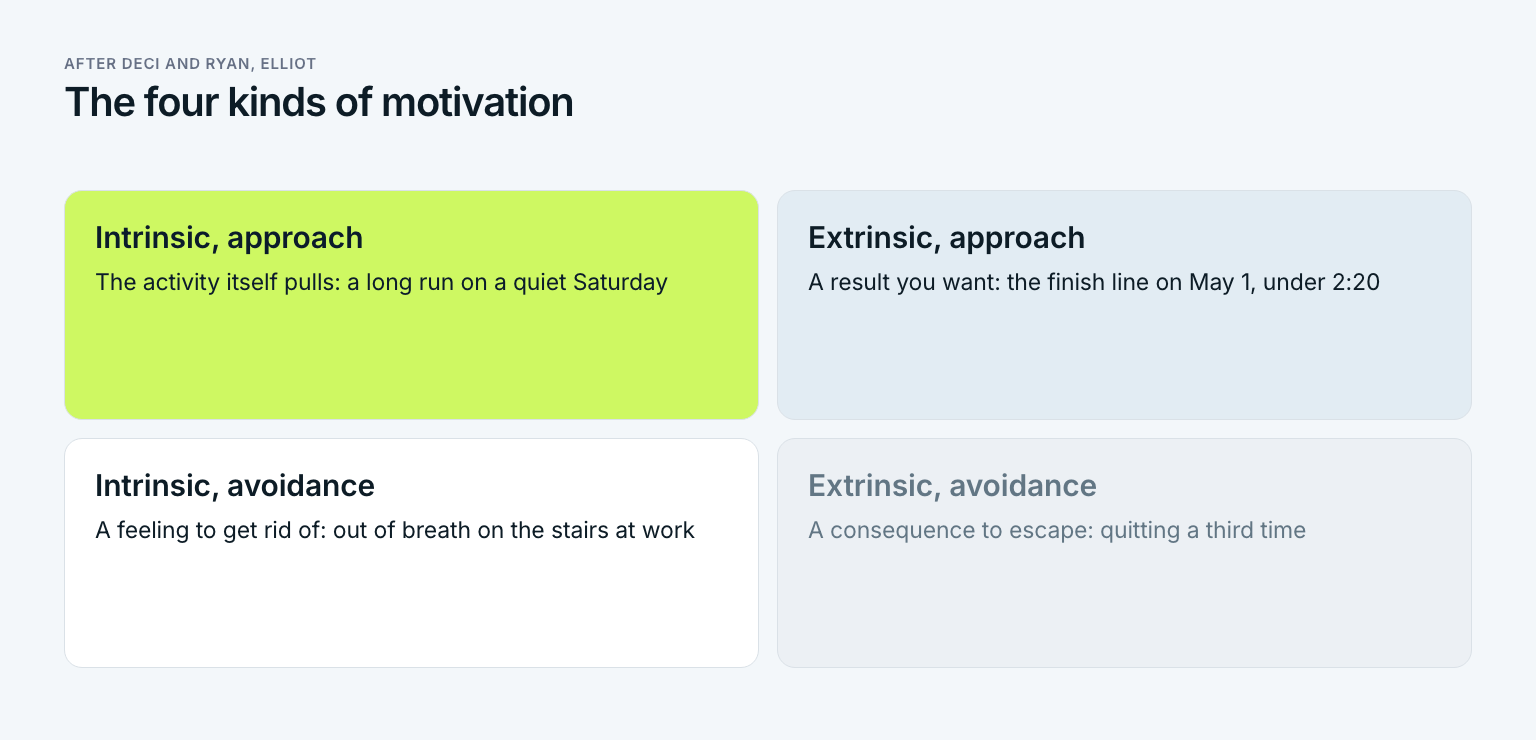
The fields are not equal. Intrinsic approach is the strongest while it lasts, and it rarely lasts through a hard month, because the activity stops being pleasant at mile eight. Extrinsic approach is steadier: a concrete result you want, with a date, that you can picture. Avoidance motivation, in both forms, gets you started fast and wears you out faster. Ryan and Deci's research is consistent: people who act from avoidance report more anxiety and give up sooner. A similar split shows up in research on being goal oriented: people who chase goals to learn tend to perform better at work than people who mainly want to avoid looking bad. That means: the field you want your goal to live in is the top row.
Goal motivation examples: the four-field test
Write your goal four times, once per field, as a sentence that starts with I want or I do not want. Then read the four aloud and notice which one you believe. Dana's four:
| Kind | Dana's sentence | How long it carries |
|---|---|---|
| Intrinsic, approach | I want the feeling of a long run on a quiet Saturday morning | A few weeks, until the long runs stop being pleasant |
| Extrinsic, approach | I want to cross the finish line on May 1 with my kids at the fence and a time under 2:20 | The full 30 weeks, if the progress toward it stays visible |
| Intrinsic, avoidance | I do not want to feel out of breath climbing the stairs at work | Until the stairs get easier, which happens in month two |
| Extrinsic, avoidance | I do not want to be the one who quit a third time | Strongly in week one, then it turns into dread |
Her believable sentence was the second one. It had a date, a place, a number, and two faces at the fence. That sentence became her yearly goal, word for word. The test is not about finding the noblest motive. It is about finding the one you will still believe in February.
The three needs behind every kind: autonomy, competence, relatedness
Deci and Ryan name three psychological needs that decide whether any of the four kinds holds: autonomy, the sense that you chose this, competence, the sense that you are getting better at it, and relatedness, the sense that someone else is in it with you. Dana checked hers. Autonomy: she picked the race and the date herself. Competence: this is where both earlier attempts broke, because she never measured anything she could see improving. Relatedness: this time she told her sister, who agreed to a Sunday walk after every long run. Whoever covers all three needs on paper before week one has done more for their motivation than any quote on a mirror ever will.
What really happens in week three: why motivation leaves before the goal does
Motivation does not leave because the goal got harder. It leaves because the goal stopped being visible. Here is Dana's second attempt, reconstructed from her running app, next to the printed plan.
| Week | Planned | Run | What she could see |
|---|---|---|---|
| 1 | 3 runs, 7 miles | 4 runs, 8.5 miles | New shoes, a plan on the fridge, a race on the calendar |
| 2 | 3 runs, 8 miles | 3 runs, 8 miles | The plan, same as last week, no mark on it |
| 3 | 3 runs, 9 miles | 3 runs, 9 miles | Sore calves, a Tuesday run that felt harder than week one |
| 4 | 3 runs, 10 miles | 1 run, 3 miles | A sick kid, a missed Thursday, the plan still unmarked |
| 5 | 3 runs, 11 miles | 0 runs | Nothing, and the race bib arrived in the mail |
Read the third column alone and the story is fine. Twenty-five miles in three weeks, on plan. Read the fourth column and the problem is obvious. For three weeks, Dana did the work and saw nothing change. The plan on the fridge looked the same on day 21 as on day one. Then one bad week arrived, and there was no record of the three good ones to set against it. She did not quit for lack of discipline. She quit because the only visible evidence she had was the bad week.
Compare that with a tracked attempt. Same three good weeks, same sick kid in week four. The difference is a sheet with 25 miles already on it, a Tuesday pace that dropped from 12:40 to 12:05 per mile, and a long run that went from 2 miles to 4. Week four still goes badly. But it goes badly against a background of visible progress, and the Friday question changes from should I keep going to how do I get back to three runs. Is that really all it takes? Not all. But it is the part that was missing both times. Which display fits which goal, from a progress bar to a chain of check marks, is laid out in the guide on how to visualize goals.
The most common mistake: treating motivation as a precondition
Whoever waits to feel motivated before starting is waiting for an effect before setting its cause. First comes a small action, then a small visible result, then the feeling we call motivation, which makes the next action a little easier. Anyone who gets the order right does not need more motivation than they have today. They need a way to see tomorrow that today happened. A mark on a sheet is enough.
The five P's of motivation, tested against a real goal
The five P's are not one fixed model. Different coaches use different lists, and none comes from a single study. The version you will meet most often is purpose, plan, passion, persistence, and progress. It is a useful checklist if you know which of the five you can control. Three you can. Two you cannot order, and that is the point most lists miss.
- Purpose. The motive in one sentence, from the four-field test. Dana's: cross the line on May 1, under 2:20, with the kids at the fence. It belongs at the top of every weekly review.
- Plan. The chain from the yearly goal down to this Tuesday, with a number on each level. It is the subject of the next two sections.
- Passion. The intrinsic pull of the activity itself. You cannot order it, and most people have less of it than the quotes suggest. Dana does not love running. She loves having run. Plan for that.
- Persistence. Continuing after a bad week. You cannot decide to be persistent in the abstract. You can decide what Friday looks like after a bad week, and that is what persistence is made of.
- Progress. The one P that produces the other four. Visible progress restores purpose, justifies the plan, occasionally produces a flicker of passion, and is the only reliable source of persistence. Move it first.
In short: purpose and plan you write once, progress you record every day, and passion and persistence are the names you give the result. Any list that asks for passion before progress has the order backwards.
How to stay motivated to reach goals in five steps
Five steps, three once at the start and two as a weekly loop. Dana did the first three on a Sunday afternoon in 50 minutes.
Write the motive as an outcome with a date, 15 minutes
Take the sentence you believed in the four-field test and write it as a finished result: On May 1, 2027, I cross the finish line of the Columbus half marathon in under 2 hours and 20 minutes. Pin it where the weekly review happens, not on the fridge, because the fridge is where plans go to be ignored.
Build the chain down to one day, 20 minutes
Year, quarter, month, week, day, each with one number. Dana's: race under 2:20 in May, 20 miles a week by the end of December, twelve runs in October with the long run reaching 4 miles, three runs and 9 miles this week, 2.5 miles on Tuesday at 6:00 a.m. The day is the only level you act on. The other four exist so that Tuesday means something. The method is laid out in [Turn yearly goals into daily steps](/en/blog/turn-yearly-goals-into-daily-steps).
Write an if-then plan for the one obstacle you know is coming, 10 minutes
Peter Gollwitzer's 1999 research on implementation intentions is clear: people who write down when, where, and what they will do when an obstacle hits follow through at far higher rates than people who only set the goal. Dana's obstacle is a sick kid or a 6:00 a.m. that does not happen. Her if-then: if I miss the morning, then I run 20 minutes after bedtime. Gabriele Oettingen's mental contrasting adds the step before: picture the finish, then name the obstacle honestly. Wishing without the obstacle lowers effort. Wishing with it raises it.
Make one mark every day, 2 minutes
A sheet, an app, a calendar square: anything where today's run becomes visible next to yesterday's. Record what you planned and what you did. Dana logs miles and the pace of her Tuesday run. By week three, the Tuesday pace is her evidence that trying is working, and evidence is what expectancy runs on. Whoever skips this step is back to the unmarked plan on the fridge.
Hold a ten-minute Friday that asks three questions, weekly
What did this week add to the monthly goal? What is open, and does it come back or get dropped? What is the one thing that counts next week? Written, not thought, because in your head question two always answers itself with it was important. The template is in [the ten-minute weekly review](/en/blog/ten-minute-weekly-review). After a bad week, this is where persistence is made, not in the moment of the missed run.
Goals and motivation in the goal chain: from a yearly goal to Tuesday at 6:00 a.m.
Motivation is made between the levels of a goal, not at the top of it. A yearly goal is too far away to pull on a Tuesday. A single run is too small to matter. The chain connects the two, so that the run is visibly a piece of the race. Here is Dana's.
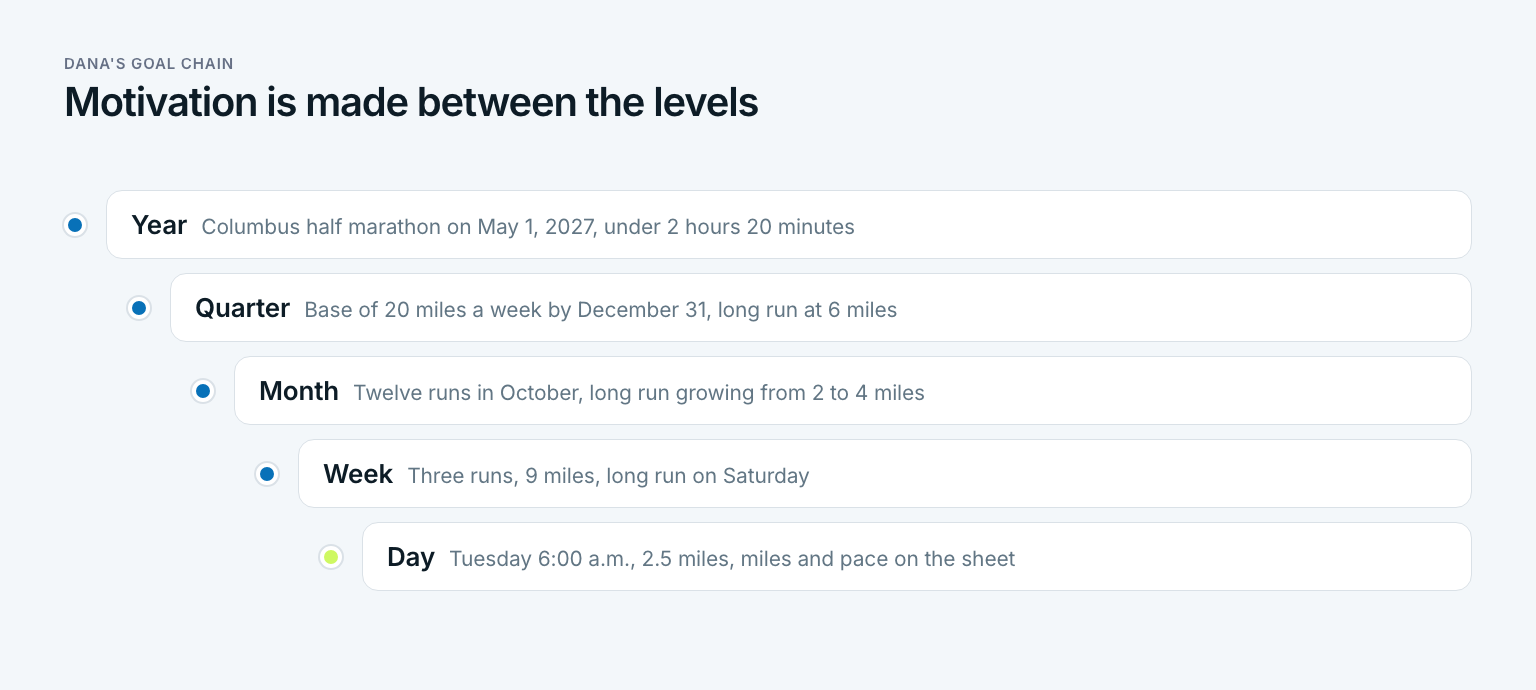
Each level answers one question. The year says what done looks like. The quarter says what has to be true by December for May to be realistic, and for a half marathon that is a base of 20 miles a week. The month breaks the quarter into twelve runs and a long run that grows by half a mile a week. The week is the unit of review: three runs, 9 miles, one long run on Saturday. The day is the only level with a clock on it. Whoever has all five levels can answer why am I running at 6:00 a.m. in October in one sentence, and that sentence is the motivation. The structure is the same for any yearly goal, as the guide to achieving goals lays out.
The day is where motivation gets made
The levels above the day are planning. The day is the only place where anything happens, and so the only place where progress can be seen. That makes the daily goal the most important design decision in the chain. Three rules for it. It has a clock: 6:00 a.m. Tuesday, not sometime this week. It is small enough for a bad day: 2.5 miles, and the if-then plan shrinks it to 20 minutes if the morning fails. It leaves a mark: miles and pace on the sheet before the shower. A daily goal built this way produces visible progress every time it is done, which is the only reliable way to manufacture motivation. More on that level in Daily goals.
Ten examples of goals that carry their own motivation
A good goal does not need motivation added to it. It is written so that progress becomes visible every week on its own. The test: can you say on Friday, with a number, whether the week moved it? Ten goals across the areas of a life, each written the usual way and then so that it passes the Friday test.
| Area | The usual version | Written so progress is visible | Weekly mark |
|---|---|---|---|
| Health | Get in shape | Run the Columbus half marathon on May 1 under 2:20 | Miles run against miles planned |
| Money | Save more | Emergency fund of $9,000 by June 30, $500 a month | Transfer made, yes or no |
| Career | Get promoted | Lead the Q2 onboarding project and present results to the director by June 15 | Project milestone reached this week |
| Learning | Learn Spanish | Hold a 15-minute conversation with my neighbor in Spanish by Thanksgiving | Five 20-minute sessions done |
| Relationship | Spend more time together | One phone-free evening a week, 40 of them by December 31 | Evening held, yes or no |
| Family | Be more present | Read with each kid 15 minutes a night, five nights a week | Nights read out of five |
| Home | Declutter | Garage cleared and car parked inside by March 31, one shelf a week | Shelf done |
| Mind | Stress less | Ten minutes of breathing before work on 20 days a month | Days done out of 20 |
| Community | Give back | Volunteer 50 hours at the food bank this year, one Saturday a month | Hours logged |
| Work | Fewer meetings | Two meeting-free mornings a week, protected on the calendar for twelve weeks | Mornings protected out of two |
The second column describes a wish. The third and fourth describe a result, a date, and a number you can mark on Friday, and they need less motivation, not more, because each week produces evidence. More patterns are in the SMART goals examples.
Which five are good goals to start with? The five you can mark weekly with the least effort: one for health, one for money, one for the people closest to you, one for your work, and one for your learning. Pick one as the goal you actively work on this quarter and let the other four run on habits. The top ten goals in life are not a list anyone can hand you, only the ten areas above filled in with your own numbers.
The three mistakes nobody notices
Three mistakes end more goals than any lack of motivation, and all three look like motivation problems from the inside.
- Measuring the feeling instead of the progress. Dana's first two attempts had one metric: how motivated she felt. The feeling dipped in week three, and she read the dip as a verdict. Whoever measures the feeling will always quit in week three, because that is when the feeling dips and nothing else is being measured. Measure the miles, and week three becomes a 25-mile wall of evidence.
- Setting the goal at only one level. A yearly goal written as train for a race has no Tuesday in it. A daily goal written as run a half marathon has no path. Most people set one level and expect it to do the work of five. The year without a day is a wish. The day without a year is a chore. The motivation lives in the connection, and the connection has to be written down.
- Restarting from zero after a bad week. The sick kid in week four is not a failure of the plan. It is the obstacle the plan was supposed to expect. Anyone who treats a bad week as a reason to start over throws away three good weeks of evidence and begins again at the point where the feeling has not yet arrived. Katy Milkman's research on fresh starts shows that new beginnings help people start. They do nothing for people already underway. Do not restart. Resume.
Three questions to ask your goal before Friday
Before the first weekly review, put three questions to the goal itself. If any has no answer, the goal is not yet set up to produce motivation, and no amount of wanting it will change that.
- Which of the four fields does it live in, and do I believe the sentence? If the honest answer is extrinsic avoidance, rewrite it until it points toward something.
- What is the number I can mark this week, and where will I mark it? If the answer is I will know it when I feel it, there is no number yet.
- What is the obstacle I already know is coming, and what is my if-then? If the answer is nothing will come up, the plan has not met a real week yet.
Dana's answers, written on that Sunday: extrinsic approach, the finish line with the kids. Miles and Tuesday pace, on the sheet by the coffee maker. A sick kid, then 20 minutes after bedtime. Thirty weeks later those three answers had carried her through eleven bad days, two missed Saturdays, and a January with eight inches of snow. Her time was 2 hours and 17 minutes. She was not more motivated than the two times before. She could see further.
In short: goals and motivation are not two things you need to have before you begin. A goal, set up so that progress shows every week, is the machine that makes the motivation. Build the machine. The feeling is its product.
Frequently asked questions about goals and motivation
What are 5 good goals?
Good goals are the ones you can mark every week with the least effort, one each for health, money, the people closest to you, your work, and your own learning. Write them as outcomes with a date and a number: a half marathon on May 1 under 2:20, a $9,000 emergency fund by June 30, one phone-free evening a week, one project presented by June 15, a 15-minute conversation in Spanish by Thanksgiving. Pick one of the five as the goal you actively work on this quarter. The other four run on habits until their turn comes.
What are the 5 P's of motivation?
There is no single official list, but the version you will meet most often is purpose, plan, passion, persistence, and progress. Purpose and plan you can write down once. Progress you can record every day. Passion and persistence are not things you can decide to have, they are what shows up once the first three are in place, which is why progress belongs first on the list rather than last.
What are the 10 examples of goals?
Ten goals across the areas of a life, each written so progress is visible weekly: run a half marathon under 2:20 by May 1, build a $9,000 emergency fund by June 30, lead one project and present it by June 15, hold a 15-minute Spanish conversation by Thanksgiving, keep one phone-free evening a week, read with each kid five nights a week, clear the garage one shelf a week by March 31, breathe for ten minutes on 20 days a month, volunteer 50 hours this year, and protect two meeting-free mornings a week for twelve weeks. The pattern is the same every time: an outcome, a date, and a number you can mark on Friday.
What are the top 10 goals in life?
Nobody can hand you a ranked list, because the ranking depends on the life. What the research on well-being does support is balance across areas: health, money, close relationships, family, work, learning, home, mind, community, and contribution. Treat those ten as areas, not as goals. Fill each with one outcome and a number, then choose the one or two that get your active attention this quarter. A goal in every area at once is ten chores and no progress.
How are goals and motivation connected?
In the opposite order from the one most people assume. A goal does not need motivation to exist, and motivation does not arrive before the goal is underway. Progress toward a goal is what produces motivation, as Amabile and Kramer's diary study of 238 professionals showed in 2011, and the goal is what makes progress measurable in the first place. Set the goal, make the progress visible, and the motivation follows.
How do I stay motivated to reach goals when progress is slow?
Make the progress visible at a smaller scale. If the monthly number barely moves, record the daily one: miles today, pages today, dollars transferred this week. Hold a ten-minute review every Friday that asks what the week added, what is open, and what counts next week. And write an if-then plan for the obstacle you already know is coming, so that a bad week becomes something you resume from rather than restart after.
Last updated: 14 October 2026
Read next
 Goal Setting
Intrinsic Motivation: What Drives You From the Inside
Intrinsic motivation is not a personality trait. Meaning, 12 examples, the three needs behind it and five steps to build it, with a worked example.
17 min read
 Goal Setting
Financial Goals: How to Turn Wishes Into a Plan
Financial goals are not wishes with a dollar sign. Short and long term examples, SMART savings goals and a five step plan, worked through one year.
17 min read
 Goal Setting
WOOP Method: Four Steps From Wish to If-Then Plan
The WOOP method is not positive thinking. What WOOP stands for, the research, if-then plans, eight goal examples and a five-minute guide.
18 min read