Individual Development Plan: Examples and a Template
An individual development plan is not a training wish list: five components, five steps, a one-page IDP template and four examples to copy.

Contents
- 01What an individual development plan is, and what it is not
- 02IDP, performance review, improvement plan: what each is built for
- 03Why most development plans die in a drawer
- 04The five components of an individual development plan
- 05How to write your individual development plan in five steps
- 06IDP template: one page, eight fields
- 07Individual development plan examples for four situations
- 08The three mistakes nobody notices
- 09From IDP to Tuesday morning: year, quarter, month, week, day
- 10Individual development plan FAQ
An individual development plan is not a training wish list. It is a one-page written plan, owned by the employee and agreed with the manager, that states one development goal for the next one to two years, the gap between today and that goal, and the specific actions, support, and check-in dates that close it. A wish list says what you would like to learn. An IDP says what you will be able to do, by when, and how anyone will know.
Three things decide whether an IDP changes anything: a goal with a date instead of a wish, actions that happen mostly in your actual work, and check-ins where someone asks how it is going. All three are worked through on the plan of Jordan, a staff accountant at a construction company in Columbus, Ohio, who wants to move into financial planning and analysis. You also get the five components, a five-step process, a one-page IDP template, four individual development plan examples, and the three mistakes that quietly kill most plans by spring.
What an individual development plan is, and what it is not
An individual development plan, usually shortened to IDP, connects where someone is in their career with where they want to be, and turns the distance into actions. The employee writes it. The manager shapes it, supports it, and checks in on it. It is not a performance review, which rates the past year, and it is not a job description, which lists what the company needs today. Anyone who mixes it with either one ends up with a plan that is really about something else.
The term shows up in very different places. Federal agencies have used IDPs for decades, and the Office of Personnel Management publishes guidance on them. In 2013 the National Institutes of Health began encouraging the institutions it funds to use IDPs for graduate students and postdocs, which is why so many university pages rank for the term. In private companies the same document is often called an employee development plan or a career development plan. The structure is the same everywhere: where you are, where you are going, what is missing, and what you will do about it.
Who needs one? Anyone expected to stay longer than a year. Development is not only for high potentials on their way up. It matters just as much for the senior expert who wants more depth and for the new hire who is still learning how things work. That means: the plan looks different for each person, but the five components stay the same.
IDP, performance review, improvement plan: what each is built for
Four documents get confused all the time, and in many companies they land in the same meeting. None of them is wrong. Each is built for something else. The only question is: which one plans the future?
| Document | Looks at | Result | Typical rhythm |
|---|---|---|---|
| Performance review | the past year | A rating, often tied to pay or bonus | once a year |
| Goals or OKRs | the next quarter or year | Business results the person contributes to | quarterly or yearly |
| Individual development plan | the next one to two years | One development goal with actions, support, and check-ins | written once a year, reviewed monthly |
| Performance improvement plan | a specific shortfall | Required changes within a deadline, often 30 to 90 days | only when needed |
Performance reviews are useful. They create a record, and they make pay decisions less arbitrary. They just measure the past, and a development plan needs the future. Whoever writes the IDP in the last ten minutes of a review meeting gets a plan from someone who is still thinking about their rating. Give it its own meeting, a few weeks after the review.
An IDP is not a performance improvement plan
A performance improvement plan, or PIP, is a formal document for an employee who is not meeting expectations. It sets required changes and a deadline, and it often ends in a decision about the job. An IDP is the opposite in spirit: voluntary, owned by the employee, and built around growth. Calling a PIP a development plan erodes trust in both. Keep the words separate, and people stop flinching when you suggest an IDP.
Why most development plans die in a drawer
Most development conversations end with a sentence that sounds good. I want to grow. Great, look into some training. Both people leave the room satisfied, and a year later they are back in the same room saying the same thing. Did either of them do something wrong? Not really. They just skipped the step that turns a wish into a goal.
That is exactly what happened to Jordan. Jordan is 31 and has spent four years as a staff accountant at a commercial construction company in Columbus with about 400 employees. He closes the books, reconciles job costs, and is the person project managers call when a number looks strange. In last year's review he said he wanted to move toward financial planning and analysis, FP&A for short. His manager Rachel, 44, the controller, wrote one line on the form: Interested in growth, will look into training. Jordan bought an online financial modeling course, finished two of nine modules, and stopped. By December he was answering recruiter messages.
The wish was real, and Rachel wanted to help. What was missing was anything you could measure progress against: which role, by when, through which work, and who signs him up. Edwin Locke and Gary Latham summarized decades of research in 1990 in “A Theory of Goal Setting and Task Performance”: specific, challenging goals lead to better performance than being told to do your best. Development works the same way. In short: an IDP without a goal is a friendly conversation about wishes, written down.
Neither side is to blame. Employees rarely name a concrete goal because it sounds like a demand. Managers avoid concrete commitments because they do not know next year's budget. So both settle on something vague. Anyone who recognizes this quiet compromise can name it in the meeting instead of following it.
The five components of an individual development plan
A good IDP has five components, and each one answers a single question. If one is missing, you notice at the first check-in. These five belong in every plan:
- Strengths. What can you do today, and how does anyone know? List three examples from the last six months, each with a month attached. Jordan rebuilt the job-cost reconciliation in April so it takes two days instead of four, and two project managers now ask him to review their estimates before bids go out.
- Development goal. Where do you want to be in one to two years, stated so that someone else could check it on a given date? It can be a role, a responsibility, or a deeper level of expertise. Jordan's goal: by December 15, he owns the quarterly forecast for the commercial division and has presented it to the leadership team twice.
- Gap. What is missing between today and the goal? Skills, experience, proof, and sometimes only visibility. Jordan can model a single project but not a whole division, and he has never presented numbers to people outside finance.
- Actions. What will you do to close the gap, and by when? This is where most plans go wrong, because they list courses and forget work. Strong professional development goals name the work that builds the skill, not only the course.
- Support and check-ins. Who helps with what, and when do you look at progress together? Budget, time, a mentor, and dates on the calendar. Without this component the plan stays a statement of intent.
The 70-20-10 model
The model goes back to Michael Lombardo and Robert Eichinger, who described it in 1996 in “The Career Architect Development Planner.” It says that leaders get roughly 70 percent of their development from challenging assignments, 20 percent from other people such as mentors and managers, and 10 percent from formal courses. The numbers are a rule of thumb from surveys, not a precise measurement. For an IDP the direction is enough: whoever plans only a course has planned a tenth of the work and is hoping for the rest.
For Jordan the split looks like this. The modeling course is the 10 percent. The 20 percent comes from Dev, the company's only FP&A analyst, whom Jordan shadows in forecast meetings. The 70 percent is work Rachel hands him now: the monthly job-cost forecast for two project managers and the variance commentary for the commercial division at every month-end close. That means: Jordan develops from week one, not from the day the course finally clicks.
How to write your individual development plan in five steps
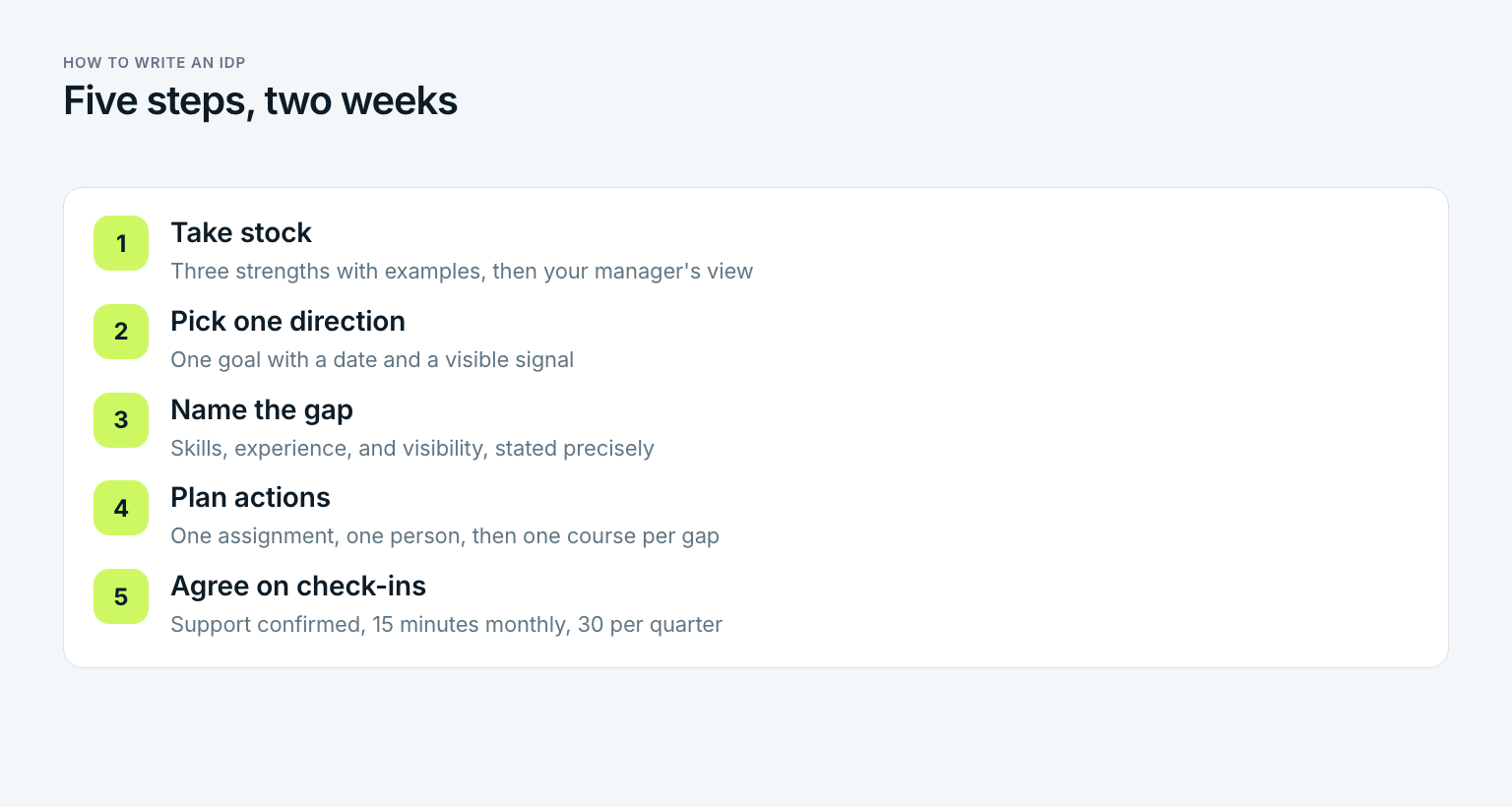
You can write an IDP in about two hours, spread over two weeks. The order matters more than the minutes: first where you stand, then where you are going, then how you get there. Whoever starts with actions ends up browsing course catalogs before knowing what for.
Take stock, 30 minutes
Write down three strengths with examples and two things you enjoy at work, then ask your manager for their view before you meet. Compare both lists. Where you agree, move on. Where you disagree, ask the question Michael Bungay Stanier calls the best coaching question in “The Coaching Habit”: And what else? The second answer is often the useful one.
Pick one direction, 20 minutes
Choose a role, a responsibility, or a deeper specialty for the next one to two years. Then turn it into a goal with a date and a visible signal. Jordan's wish to move toward FP&A becomes: owns the commercial forecast by December 15, presented twice. One goal is enough. Two is the limit.
Name the gap, 20 minutes
List what is missing in three columns: skills, experience, and visibility. Better at Excel is not a gap. Cannot build a forecast model for a whole division is.
Plan actions with 70-20-10, 30 minutes
For each gap, add one assignment, one person, and only then one course. Every action gets a date and an owner. Jordan starts the job-cost forecast in March, shadows Dev twice a month, and finishes the modeling course by June.
Agree on support and check-ins, 20 minutes
Walk your manager through the draft and agree on what the company provides. Put the check-ins on the calendar before you leave the room: 15 minutes at the end of a regular 1:1 every month, plus 30 minutes per quarter. Then send the final version within a week. Anyone who writes their own plan actually rereads it.
If you are the manager: the employee development plan conversation
The employee writes the IDP, but the manager decides whether it survives. Your part of the employee development plan conversation fits into three questions, which you answer before the meeting:
- Which strength have I seen, and when? Rachel writes: the reconciliation rebuild in April, and the bid reviews the project managers now ask Jordan for.
- What will the team need in the next two years? The CFO wants a quarterly forecast by division starting next year, and Dev cannot build all four alone.
- What can I offer, and what can I not? Rachel can pay for the course, protect two hours a week, and introduce Jordan to the CFO. She cannot promise an FP&A title next year, so she says so.
The third question is the uncomfortable one. It prevents the most common misunderstanding: the employee hears a promise, the manager meant a possibility. Whoever clears up what they cannot offer before the meeting does not have to explain it six months later.

IDP template: one page, eight fields
An IDP template does not need ten pages of competency grids. One page with eight fields covers everything above. Here is Jordan's plan, which you can copy field by field:
| Field | Guiding question | Jordan's entry |
|---|---|---|
| Strengths | What can I do already, with proof? | Rebuilt job-cost reconciliation from four days to two, project managers ask me to review bids |
| Development goal | Where will I be on the deadline? | By December 15, I own the quarterly commercial forecast and have presented it twice |
| Gap | What is still missing? | Division-level modeling, presenting to leaders outside finance, how project managers estimate |
| Assignments, 70 percent | Which work will teach me? | Monthly job-cost forecast for two project managers from March, variance commentary at every close |
| People, 20 percent | Who will I learn from? | Shadow Dev in two forecast meetings per month, ten-minute debrief after each |
| Courses, 10 percent | Which training, and when? | Finish the nine-module modeling course by June, one presentation workshop in Q3 |
| Support | What does my manager provide? | Course fee, Friday 2 to 4 pm protected, introduction to the CFO in May |
| Check-ins | When do we look at progress? | Monthly 15 minutes at the end of our 1:1, quarterly 30 minutes, final review in January |
The field most templates leave out is the gap. Without it, the actions look random. With it, every action has a reason. If you want help phrasing the goal so it can be checked on a date, the SMART goals examples show the pattern.
Individual development plan examples for four situations
No two plans look alike, but most fall into a handful of situations. Each needs a different opening question and ends with a different kind of goal. Here are four individual development plan examples, each with its goal and its 70-20-10 actions:
Example 1: The first-time manager
Tasha was promoted in January to lead six customer support reps. Her gap is not product knowledge. It is everything around people. The opening question: Which part of the new job do you avoid? She answers: hard conversations. Her goal: by the end of Q3, she holds a weekly 1:1 with all six reps and has handed the escalation queue to her most senior rep. Assignment: she runs the next hire herself. Person: a monthly hour with a manager from another department. Course: a new-manager program in the spring.
Example 2: The senior expert who wants depth, not a title
Greg, 52, has been a senior software engineer at the same company for 15 years and does not want to manage anyone. Development for him means going deeper, not up. The opening question: What do younger engineers come to you for when they are stuck? His answer: anything that touches billing. His goal: by October, he leads the design of the new billing service and has given two internal talks on it. Whoever overlooks experienced people because they do not want a promotion loses exactly the knowledge nobody has written down.
Example 3: The new hire after 90 days
Priya joined the marketing team three months ago. It is too early for a two-year plan and exactly the right time for a first IDP. The opening question: What surprised you here, good or bad? From her answer comes a six-month goal: she builds the monthly campaign report on her own and presents it once at the team meeting. That means: the first IDP sets a rhythm, not a career path.
Example 4: The postdoc deciding between academia and industry
Ana is a second-year postdoc in molecular biology and unsure whether to stay in academia. Her IDP starts with exploration, not with a job title. Her goal: by June, she has held five informational interviews with scientists in biotech and decided which track to prepare for. Assignment: she leads her lab's collaboration with an industry partner. Person: a quarterly conversation with her principal investigator about the plan. Course: a project management workshop at her university.
| Situation | Development goal | Biggest lever |
|---|---|---|
| First-time manager | Weekly 1:1s with six reps by the end of Q3 | Running the next hire herself |
| Senior expert | Leads the billing service design by October | Two internal talks |
| New hire after 90 days | Builds the monthly report alone within six months | Presenting it once to the team |
| Postdoc | Five informational interviews and a decision by June | Leading an industry collaboration |
What do the four have in common? None ends with a rating. All end with a goal that has a date and a visible signal. Tasha either holds the 1:1s or she does not. Ana either decides by June or she does not. That is what keeps the check-ins short.
The three mistakes nobody notices
Almost no IDP fails in the meeting. It fails in the weeks after, without anyone noticing. Three mistakes come up again and again:
- The course is the plan. A course is easy to book and easy to document. It is a good action, but it is only a tenth of development. Without an assignment that uses the skill, what you learned fades before you need it.
- The goal has no date. Improve communication, gain leadership experience, grow into a bigger role: these are directions, not goals. Without a date and a visible signal, nobody can say next year whether it happened.
- The manager writes the plan. Then it is the manager's plan. The employee nods, files it, and waits for someone to ask. Whoever writes their own plan feels responsible for it.
The most common mistake: the plan lives in a folder
The meeting went well, the IDP is signed, and then it sits in the HR system until next year. The following January someone opens it for the first time and finds that the course enrollment was never sent. The fix is not a second big meeting. It is a short rhythm: 15 minutes once a month and a single question. What has happened since last time? Whoever looks at the plan twelve times a year does not have to search for it in January.
For Jordan and Rachel, this rhythm is the real difference from last year. The planning meeting itself was barely longer. What changed is that the plan now lives in the week where the work happens. If you want a simple format for that short look back, the ten-minute weekly review works for development goals as well as for projects.
From IDP to Tuesday morning: year, quarter, month, week, day
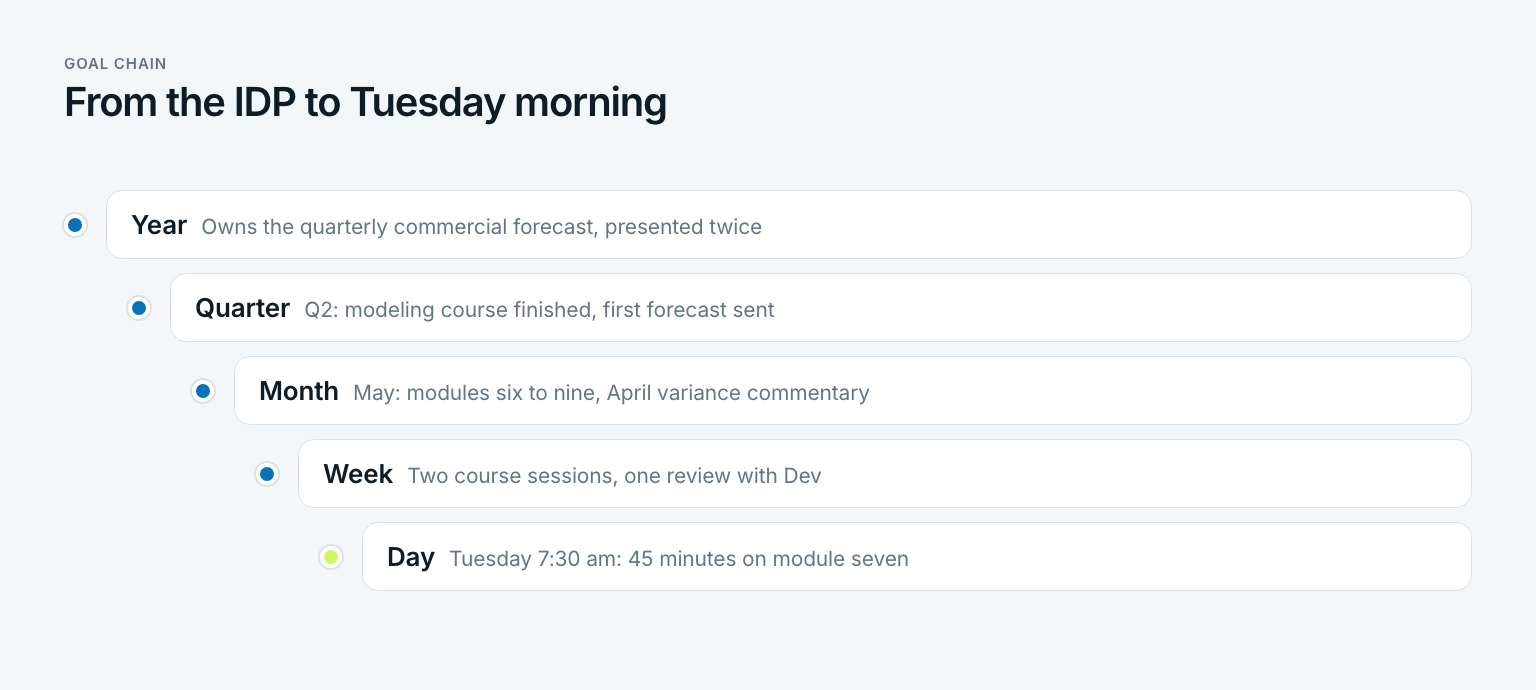
A development goal is a yearly goal. And like every yearly goal, it only moves when it is broken into smaller goals until a step is left that you can take on an ordinary Tuesday. The goal chain translates Jordan's plan into five levels:
| Level | Jordan's goal | How he knows |
|---|---|---|
| Year | Owns the quarterly commercial forecast, presented twice | Two presentations delivered to the leadership team |
| Quarter | Q2: modeling course finished, first forecast for two project managers | Course certificate, forecast sent by June 30 |
| Month | May: modules six to nine, variance commentary for the April close | Commentary in the close package, four modules marked done |
| Week | Two course sessions and one review with Dev | Three check marks on Friday |
| Day | Tuesday 7:30 am, 45 minutes on module seven | Module seven complete |
Each level has its own job. The year sets the direction, the quarter makes it checkable, and the month fits it around the month-end close. The week and the day are where development actually happens, and they are exactly what almost every IDP leaves out. For the full method of breaking a yearly goal down, see how to turn yearly goals into daily steps.
For the manager, the goal chain has a second benefit. When Jordan and Rachel look at the same chain, the monthly check-in gets short: which level is stuck, and why? In Gaapp you can set up the development goal as a shared goal in a space, so both of you see the same progress without anyone maintaining a spreadsheet. For the bigger picture of how goals turn into results, read the guide on how to achieve goals.
Self-audit: three questions before your next IDP
Before you schedule the next development conversation, as a manager or as an employee, answer three questions honestly:
- Does your current plan contain a goal with a date, or only a direction?
- How many of your actions happen in your actual work, and how many in a classroom?
- When did someone last ask what happened to the plan?
Anyone who cannot answer one of the three knows where the next conversation starts. Jordan sent his first forecast to the two project managers in March. In April he stopped answering the recruiters. In short: an individual development plan is not a document you write once a year, it is a plan with a step in every week.
Individual development plan FAQ
What are some examples of individual development plans?
Typical examples are a specialist moving into a new function, a first-time manager learning to lead, a senior expert going deeper instead of up, a new hire after 90 days, and a postdoc deciding between academia and industry. Each has one development goal with a date, such as owning the quarterly forecast by December 15. The actions follow the 70-20-10 split: mostly assignments, some mentoring, and a little coursework.
How do I write my individual development plan?
Start with three strengths and examples, then choose one direction for the next one to two years and turn it into a goal with a date. Name the gap in skills, experience, and visibility, and plan actions for each gap: an assignment, a person, and then a course. Finish by agreeing with your manager on support and monthly check-ins.
What are the 5 components of a personal development plan?
Strengths, a development goal, the gap between the two, actions that close the gap, and support with check-in dates. Some templates use other names, such as current state or resources, but the logic is the same. If one component is missing, the plan usually stalls at the first check-in.
What is an example of a development plan?
A staff accountant who wants to move into financial planning sets the goal of owning the quarterly forecast for one division by December 15. His actions are building a monthly job-cost forecast from March, shadowing the FP&A analyst twice a month, and finishing a modeling course by June. His manager pays for the course, protects two hours a week, and checks in for 15 minutes every month.
What is the difference between an IDP and a performance improvement plan?
An IDP is voluntary, owned by the employee, and focused on growth over one to two years. A performance improvement plan is a formal document for someone who is not meeting expectations, with required changes and a short deadline. Mixing the two makes employees suspicious of any development plan, so keep them clearly separate.
How often should an individual development plan be reviewed?
Write or rewrite it once a year, review it briefly every month, and take a longer look every quarter. A monthly check-in of 15 minutes is enough when the plan has a goal with a date. Plans that are only reviewed once a year are usually forgotten by spring.
Last updated: 19 October 2026
Read next
 Leadership & Teams
Leadership Styles: Which One Fits Which Situation
Leadership styles are not personality types: 11 types compared, Lewin, Goleman, situational leadership and five steps to find the style that fits you.
14 min read
 Leadership & Teams
Retrospective: How Teams Learn From Every Sprint
A retrospective is not a blame session: what the word means, five phases, seven retrospective examples and action items that stick, shown on one team.
16 min read
 Leadership & Teams
How to Delegate Tasks: Hand Off Work, Keep Results
Delegation is not dumping work: five levels of delegation, seven steps, a handoff script and what to keep, shown on one marketing team.
15 min read