Professional Development Goals: Skills You Can Prove
A professional development goal is not a course but a skill with a date and proof: four areas, 24 examples for work, five steps, a template.

Contents
- 01What professional development goals are, and what they are not
- 02Development goals for work vs. performance goals vs. career goals
- 03Why a certification is not a professional development goal
- 04The four development areas, and how to find your top three
- 05Professional development goals examples: 24 goals for work
- 06How to set professional development goals in five steps
- 07From the yearly goal to Tuesday: development goals in a goal chain
- 08How managers can support development goals for work
- 09The three mistakes that quietly stall development goals
- 10Frequently asked questions about professional development goals
Professional development goals are not a list of courses. A professional development goal names a skill you will show at work by a set date, in a way someone else can see. The course is the road, not the destination. Anyone who plans only trainings collects certificates. Whoever plans development goals collects proof.
Three things turn a good intention into a goal for professional development: a trigger, a proof, and a learning path. The trigger is a task coming up that asks for something you cannot do reliably yet. The proof is what another person will observe. The learning path roughly follows the 70-20-10 rule of thumb: most of it on the job, some of it through feedback, the smallest part in classes. You will follow Marcus, a project engineer in construction, through 24 professional development goals examples, five steps, a one-page template, and the three mistakes that stall development plans until the next review.
What professional development goals are, and what they are not
A development goal is about you, not about a business result. It asks one question: What will I be able to do in twelve months that I cannot do today? A revenue goal measures what comes out at the end. A development goal measures what you do differently afterward. Both belong in a review, but they are different goals.
Every useful development goal has three features. It describes behavior someone can observe, it has a date, and it names a proof that someone else can confirm. "Improve my communication" has none of them. "By June 30, I run the weekly client meeting on my own, in 30 minutes, with every open question answered or dated" has all three. That means: A development goal is finished only when you can answer yes or no on the due date.
So what is the goal of professional development? To close the gap between the work ahead of you and what you can reliably deliver, before the work arrives. Many companies call the document an individual development plan, or IDP.
Development goals for work vs. performance goals vs. career goals
Meet Marcus, 31, a project engineer at a mid-sized general contractor in Columbus, Ohio. In his November review, his manager Dave asks for his development goals for 2027. Marcus pulls up last year's list: get PMP certified, improve communication, take on more leadership. He passed the PMP exam in April. Since then he has run one client meeting, in August, while Dave was on vacation. The owner's rep pushed back on a $38,000 change order. Marcus said he would have to check with Dave. By Friday, the owner had called Dave's boss.
Was the certification goal achieved? On paper, yes. In practice, no. The problem is not Marcus. The problem is the list. It mixes three kinds of goals that answer three different questions.
| Goal type | Question it answers | Marcus's example | Who measures it |
|---|---|---|---|
| Career goal | Where do I want to go? | Project manager within two years | You, against your direction |
| Development goal | What do I need to be able to do? | Run the weekly client meeting alone from July | Someone who watches it happen |
| Performance goal | What result should come out? | Close out the Riverside job within budget | The numbers, often tied to a bonus |
The career goal sets the direction. If you have not written yours yet, start with career goals. The performance goal usually drives the bonus. The development goal sits between them and translates the direction into skills. Whoever wants to become a project manager has to hold their ground in front of an owner. Marcus's third item, more leadership, was not a development goal at all. It was a career goal without an address.
Research backs this split. Edwin Locke and Gary Latham summarized the evidence in 1990 in "A Theory of Goal Setting and Task Performance": specific, hard goals lead to better performance than being told to do your best. Gerard Seijts and Gary Latham added an important exception in 2005, in "Learning versus Performance Goals: When Should Each Be Used?" For new, complex tasks, a learning goal works better than a performance goal. Anyone who cannot do something yet gets little from a target number.
Learning goal or performance goal
A performance goal names a result: close the job within budget. A learning goal names what you want to figure out or be able to do: find three ways to answer a cost pushback without leaving the room. For familiar work, use the performance goal. For new work, use the learning goal. Professional development goals almost always start as learning goals and only turn into performance at the end.
Why a certification is not a professional development goal
Formal learning matters. Courses and certifications give you vocabulary, models, and sometimes the nerve to try something new. They rarely give you the skill itself. That shows up when you do the thing, get feedback, and do it again.
A popular rule of thumb for this is the 70-20-10 model. Michael Lombardo and Robert Eichinger described it in 1996 in "The Career Architect Development Planner", based on interviews with successful executives at the Center for Creative Leadership. About 70 percent of their learning came from challenging assignments, 20 percent from other people, and 10 percent from courses and reading. The numbers are not a precise measurement. The direction is still useful for every goal you set.
| Share | Where learning comes from | Marcus's learning path |
|---|---|---|
| 70 percent | Assignments that need the skill | Lead four internal meetings, then run the change order part of real client meetings |
| 20 percent | Feedback, role models, conversations | Three points from Dave after each meeting, shadowing one tough negotiation |
| 10 percent | Courses, books, videos | PMP is done, one book on effectiveness in a leadership role |
Marcus's mistake last year was not the PMP. It was that nothing came after it. The 10 percent was on the plan, the 70 percent was not. In short: A certification without a stage is an investment without a return.
The most common mistake: the course as the goal
"Get PMP certified" is an action, not a development goal. At the end you have a checkmark, but your work has not changed. Write down what you will do after the course, in which situation, and put that situation on the calendar.
The four development areas, and how to find your top three
Most development goals fall into four areas: technical skills, communication, leadership and collaboration, and self-management. The lines blur, but the split helps with a question most reviews skip. Where is your gap really?
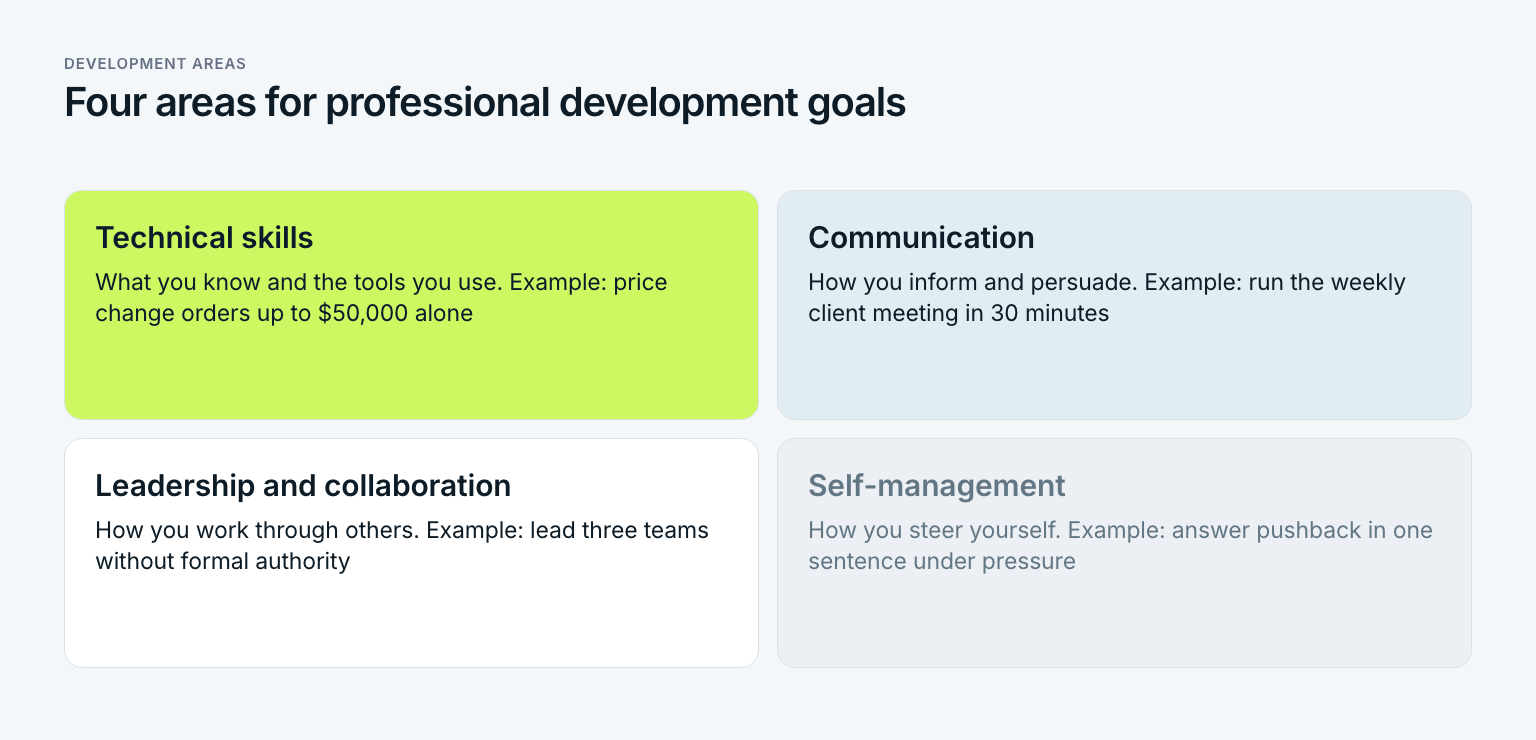
Marcus thought his gap was technical. He knew the numbers, and the PMP had taught him the process. What failed in August was something else. Under pressure, he reached for his manager instead of a sentence. That is self-management and communication, not technical skill. A second certification would not have changed the outcome.
That means: Name the area only after you have watched the gap show up at work once. Anyone who picks the area by gut feeling signs up for the wrong course. Whoever has no observation yet should ask for feedback first.
How to answer "What are your top 3 development areas?"
The question comes up in interviews and in most annual reviews. A strong answer names three areas, each with what you observed, what you are doing about it, and how you will know. Marcus answered like this:
- Self-management under pressure. "In August I deferred a cost question to Dave instead of answering. By June I want to answer pushback in one sentence and offer a time for details."
- Running client meetings. "I have led one client meeting. I want to run the weekly meeting alone from July, starting with the change order part in Q1."
- Delegating. "I still redo field reports myself. By September two recurring tasks are handed over."
Professional development goals examples: 24 goals for work
Each example below can be checked on its due date. Swap in your own dates and numbers. Pick no more than three, not six. Whoever chases six development goals at once ends up chasing none of them. The reasoning behind that limit is in why three goals are enough.
Technical skills
- By March 31, build my own pivot tables in Excel, so the weekly cost report no longer waits on accounting.
- By the end of Q2, pass the PMP exam and run the schedule for one project phase, with my manager signing off on the baseline.
- By June 30, price change orders up to $50,000 on my own, with no more than one round of review.
- By September, learn our new scheduling software well enough to train two coworkers.
- By December, answer customer questions about the new pricing model without looping in finance.
- By year end, demo the product to a new customer in 30 minutes without a sales engineer on the call.
Communication
- By June 30, run the weekly client meeting on my own, in 30 minutes, with every open question answered or dated.
- By September, put the recommendation in the first sentence of every email to leadership.
- By the end of Q3, give a ten-minute update at the all-hands meeting without notes.
- Starting in March, send a written summary within two hours of every client call.
- By May, tell a client about a delay within one business day of knowing it, with a recovery plan attached.
- By year end, write decision memos of two pages or less that get approved three times in a row.
Leadership and collaboration
- Starting in February, hold a 30-minute one-on-one every two weeks with each of my three direct reports, and cancel none of them.
- By June, hold three hard feedback conversations using situation, behavior, and impact.
- By September, lead a project across three teams without formal authority, and get all three to deliver on time.
- By the end of Q3, hand off two recurring tasks for good, with no review from me.
- By year end, coach a junior coworker until she runs the monthly close on her own.
- By August, mentor one intern through a full project, from kickoff to the final presentation.
Self-management
Self-management goals sound personal, yet at work they often matter most. They cover how you steer yourself: focus, workload, pressure, and criticism.
- Starting in February, protect two 90-minute focus blocks a week, and by June the blocks break no more than twice a month.
- By March, push back on requests that have no purpose or deadline, and cut overtime from 12 to 5 hours a month.
- By June, answer pushback in meetings in one sentence and offer a time for details, instead of searching my laptop live.
- By June 30, ask for one piece of feedback after each of twelve major meetings and log it in one line.
- By September, share drafts at 80 percent and collect comments in the first round.
- By year end, learn one new topic each quarter well enough to explain it to my team in 20 minutes.
See what all 24 examples have in common? None of them is a course. Each one names a situation at work where the skill becomes visible. They are written much like SMART goals, with one difference: the yardstick is observable behavior, not a business result.

How to set professional development goals in five steps
Plan a little over an hour per goal, split into two sessions. Have ready your career direction, last year's feedback, and your calendar for the next three months. Then work through these steps:
Start with a trigger, not a wish, 20 minutes
Do not ask what you would like to learn. Ask which task in the next twelve months will demand something you cannot do reliably today. Look at your career goal, at changes on your team, and at the moments last year when you were out of your depth. Marcus's trigger: Dave moves to a larger project in July, and Marcus takes over the Riverside job.
Write the gap as today and target, 15 minutes
Write two sentences. What happens today in that situation, and what should happen instead? Both describe behavior, not feelings. Marcus's today: when an owner pushes back on cost, he defers to Dave, and the issue escalates. His target: he answers in one sentence and commits to a time for the details.
Pick the proof and the date, ten minutes
Decide how a third person will know on the due date that you can do it. Marcus's proof: from July he runs every weekly client meeting alone, and nothing gets escalated past him for lack of an answer. Dave confirms it after three meetings in a row.
Plan the learning path with 70-20-10, ten minutes
Plan the practice first, then the feedback, then the input. Marcus plans four internal meetings he leads, three points of feedback from Dave after each one, and one book. The PMP is done, so it does not go on the list again.
Break it down and put it on the calendar, 15 minutes
Break the goal into a quarterly goal, a monthly goal, and the first week. Book one fixed practice slot a week and a monthly check-in with your manager. Skip this, and the goal waits until next year's review.
Whoever starts with what they would like to learn ends up with a course catalog. Whoever starts with the task that is coming ends up with a stage.
Template: your development plan on one page
The template has ten fields and fits on one page or into any review form. The third column shows Marcus's entries, so you can see how short each field can be.
| Field | Question | Example: Marcus, 2027 |
|---|---|---|
| Direction | Where do I want to be in two or three years? | Project manager |
| Trigger | Which task will soon ask for something new? | Riverside job without Dave from July |
| Development area | Where is the gap really? | Self-management and communication under pressure |
| Today | What happens now? | Defers cost questions to Dave, issue escalates |
| Target | What happens instead? | Answers in one sentence, commits to a time for details |
| Proof and date | How will someone else know, and by when? | From July, every client meeting alone, no escalation, three in a row |
| Practice, 70 | Where do I practice at work? | Four internal meetings, change order part of three client meetings |
| Feedback, 20 | Who gives me feedback? | Dave, three points after each meeting |
| Learning, 10 | What do I read or study? | One book, PMP already done |
| Check-in | When do we review progress? | Last Thursday of each month, 15 minutes with Dave |
The goal sentence itself follows a simple pattern: by when, what exactly, and how someone will see it. Marcus's version: "From July, I run the weekly client meeting on the Riverside job on my own, and nothing gets escalated past me for lack of an answer." If you cannot complete the sentence, you are usually missing the proof. Go back to step three.
The 5 P's of professional development, as a checklist
You will find the 5 P's of professional development in many trainings, but there is no single source, and different coaches fill the five letters with different words. A version that works as a final check for any development goal: purpose, plan, practice, people, and proof.
- Purpose. Why this skill, and why now? Marcus: the Riverside job.
- Plan. Is there a date, a quarterly goal, and a first week?
- Practice. Where at work will you do it? Marcus: internal meetings first.
- People. Who watches and gives feedback?
- Proof. What will someone else see on the due date? Marcus: three client meetings in a row with no escalation.
From the yearly goal to Tuesday: development goals in a goal chain
A development goal for a year is too big for a week. That is why so many fail: agreed in November, forgotten by December. A goal chain pulls the goal into the week. Year, quarter, month, week, and day hang together, and each level feeds the one above it. The full method for breaking a year down is in how to achieve goals.
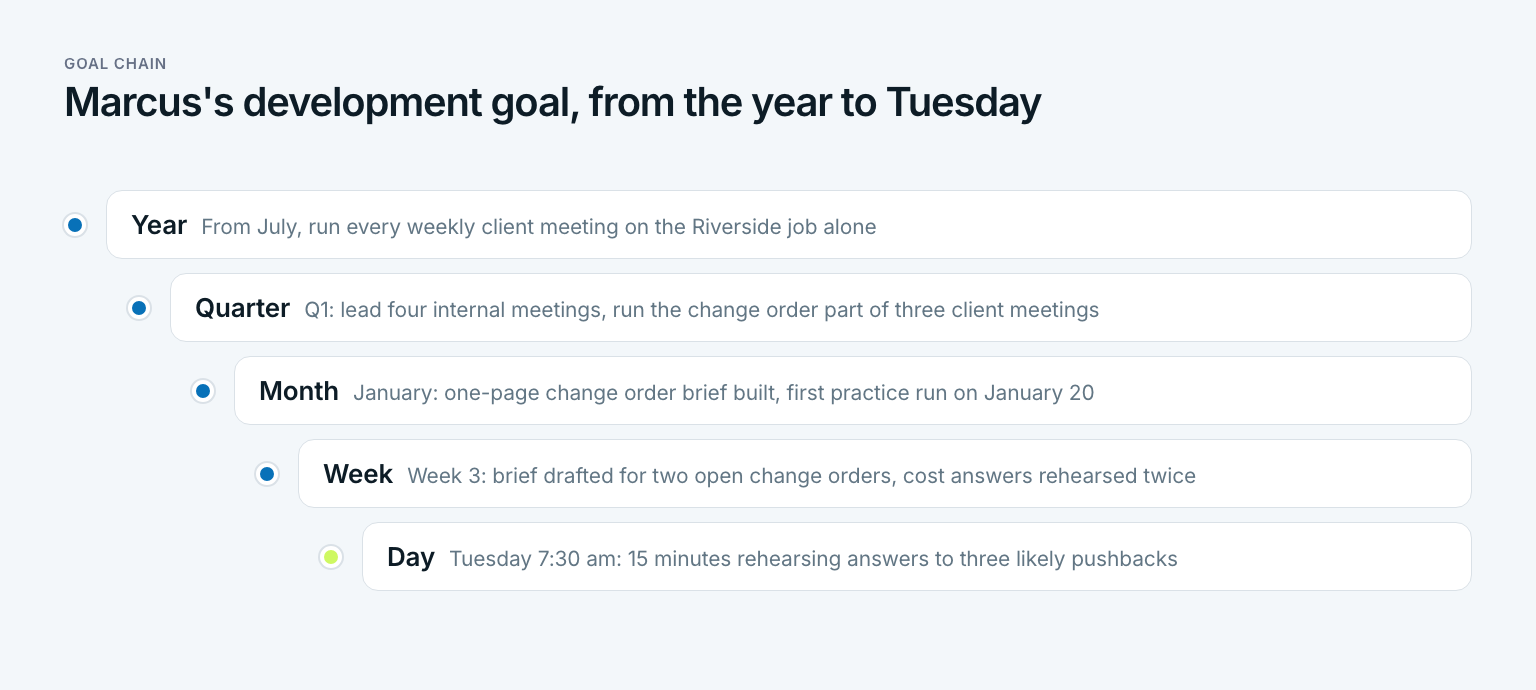
Here is Marcus's chain for the first quarter of 2027. The yearly goal is his development goal: from July he runs every weekly client meeting on the Riverside job alone. The quarterly goal for Q1: lead four internal meetings and run the change order part of three client meetings. The monthly goal for January: a one-page change order brief and a first practice run with Dave on Wednesday, January 20. The weekly goal for Week 3: two briefs drafted, cost answers rehearsed twice. The daily goal for Tuesday: at 7:30 am, 15 minutes rehearsing answers to three likely pushbacks.
The daily goal looks small. It is the part of the 70 percent that Marcus controls. Dave decides when Marcus gets a client meeting. Nobody decides when he rehearses. Whoever breaks a development goal down to a single day stops waiting for opportunities and starts preparing for the next one.
In Gaapp, these five levels are linked. You set the development goal as a yearly goal, attach quarterly and monthly goals, and check off the weekly goals. Progress at each level sits next to the time that has passed. At the end of March, Marcus sees not only that a quarter of the year is gone, but whether all four internal meetings happened. On Fridays a short weekly review answers one question. Did this week practice, or did it just work?
How managers can support development goals for work
Development goals belong to the employee. Still, the manager controls most of the learning path, because the 70 percent needs assignments, and those are the manager's call. A manager who only asks for development goals and files them has held the meeting but agreed on nothing. Your own targets as a manager are a different subject, and goals for managers covers how to set them.
Three contributions make the difference:
- Promise a stage. Name a specific assignment with a date where the goal gets practiced. For Marcus, that is the change order part of client meetings in Q1 and the full meeting from July. Without that promise, his goal stays a wish.
- Give feedback on a rhythm. One monthly check-in, 15 minutes, two questions: What worked, and what are you practicing next? That is the part of the 20 percent only the manager can provide.
- Allow mistakes. A development goal is a learning goal. Tie it to the bonus and you get safe goals instead of honest ones. Keep development goals apart from the performance goals that decide pay.
Michael Bungay Stanier recommends in "The Coaching Habit", published in 2016, asking "What's the real challenge here for you?" It finds the real gap faster than any competency list. Dave asked it in November. Marcus did not say the numbers. He said the moment the owner's rep raises his voice. Coaches use the same kind of opening question when they turn a topic into coaching goals in the first session.
The three mistakes that quietly stall development goals
Most development plans do not fail in the review. They fail quietly in the weeks after. Which one is yours?
- Too many goals. Five development goals look ambitious in the review notes. In real life each gets an hour a month, which is not enough for any of them. Keep one to three per year, with one of them first.
- No stage on the calendar. A goal without a stage stays theory. If nothing in the next three months gives you a chance to practice, the goal is too early or the stage is missing. Sort that out in the review, not in December.
- No check-in. A goal that only comes back at next year's review was invisible for a year. A 15-minute monthly check-in keeps it visible.
Three questions to finish, about your own development goals:
- Can you name, for each goal, the situation in the next three months where you will show it?
- Would a coworker know on the due date, without your explanation, whether you made it?
- Is there a practice slot on your calendar this week?
Anyone who answers no to one of these does not have a bad goal, just an unfinished one. In short: A professional development goal is not a promise to get better. It is a date on which someone sees that you did.
Frequently asked questions about professional development goals
What are the goals of professional development?
The goal of professional development is to close the gap between the work coming at you and what you can reliably deliver, before the work arrives. Good professional development goals name a skill, a date, and a proof that someone else can confirm. Courses and certifications are part of the path, not the goal itself.
What are your top 3 development areas?
Pick three areas where you have seen a gap at work, and for each one say what you observed, what you are doing about it, and how you will know. Common areas are technical skills, communication, leadership and collaboration, and self-management. A specific answer like "answering cost pushback in one sentence" sounds more credible than a general one like "communication".
What are the 5 P's of professional development?
There is no single official list, and different trainers use different words for the five P's. A version that works as a checklist for any goal is purpose, plan, practice, people, and proof. If one of the five is missing, the goal is not ready yet.
Can you give me some examples of professional goals for 2026?
Good examples are specific and dated: run the weekly client meeting on your own by June 30, price change orders up to $50,000 without review by the end of Q2, or hand off two recurring tasks for good by September. With the fourth quarter of 2026 underway, set the date for the end of the year or roll the goal into 2027. The 24 examples above work for any year if you swap in your own dates.
How many professional development goals should I have?
One to three per year, with one clearly first. Every development goal needs a stage at work and a weekly practice slot, and both are scarce. Anyone with five goals ends up practicing none of them regularly.
What is the difference between a development goal and a performance goal?
A performance goal names a result, such as finishing a project within budget, and it is often tied to pay. A development goal names what you will be able to do afterward, and it works best as a learning goal. Because learning involves mistakes, keep development goals separate from the bonus, even if both come up in the same review.
Last updated: 14 October 2026
Read next
 Leadership & Teams
Leadership Styles: Which One Fits Which Situation
Leadership styles are not personality types: 11 types compared, Lewin, Goleman, situational leadership and five steps to find the style that fits you.
14 min read
 Leadership & Teams
Retrospective: How Teams Learn From Every Sprint
A retrospective is not a blame session: what the word means, five phases, seven retrospective examples and action items that stick, shown on one team.
16 min read
 Leadership & Teams
How to Delegate Tasks: Hand Off Work, Keep Results
Delegation is not dumping work: five levels of delegation, seven steps, a handoff script and what to keep, shown on one marketing team.
15 min read