OKR Examples: 20 Objectives for Work and Life
OKR examples are not templates to copy: 20 objectives with key results for marketing, sales, product, HR, teams and personal life, plus five steps.

Contents
- 01What a strong OKR example has that a weak one lacks
- 02Marketing OKR examples: three objectives with key results
- 03Sales OKR examples: conversion, expansion, a new market
- 04Product and engineering OKR examples
- 05HR OKR examples: hiring, onboarding, retention
- 06OKR examples for teams: from company OKR to team OKR
- 07Personal OKR examples: health, side projects, couples
- 08How to write an OKR from an example in five steps
- 09From quarterly OKR to daily goal: the goal chain
- 10Frequently asked questions about OKR examples
OKR examples are not templates to copy. A good OKR example shows one objective, a qualitative goal for a single quarter, and three key results that measure with a baseline and a target whether the objective is met. Anyone who copies an example word for word copies somebody else's numbers. Anyone who reads it as a pattern sees how a wish turns into a goal you can measure.
The 20 OKR examples below are sorted by function: marketing, sales, product and engineering, HR, teams and personal life. Each one has an objective, three key results with numbers and the situation it was written for. The thread running through all of them is Dana, 39, CEO of a 52-person software company in Denver that sells scheduling and billing software to veterinary clinics. In December she rolls out OKRs, and every team is asked to bring one objective for the first quarter of 2027. How the OKR cycle works, where the method comes from and how scoring works is covered in the guide to the OKR framework. This page is about the examples themselves and about what makes them strong or weak.
What a strong OKR example has that a weak one lacks
A strong OKR example has three features. The objective describes a state you want to reach, without a number. Every key result has a baseline, a target and a date. And together the key results answer one question: how will you know at the end of the quarter that the objective is true? If one of the three is missing, the OKR looks tidy and steers nothing.
Most example lists are not wrong. They are built for something else: for inspiration, not for the Monday after. They show goals without baselines, key results with no link to the objective, and objectives that would fit any company. That is exactly why they fit none. How do you spot that in an example you are reading right now?
| Weak OKR | What is missing | Stronger version |
|---|---|---|
| Objective: Grow revenue 20 percent | The number sits in the objective, the direction is missing | Objective: Existing customers stay and buy more. KR: Revenue per customer from $1,200 to $1,440 |
| KR: Publish eight blog posts | A task, not an outcome | KR: Demo requests from the blog from 12 to 30 per month |
| KR: Improve customer satisfaction | No baseline, no target | KR: Rating after each ticket from 3.9 to 4.4 out of 5 |
| One objective with nine key results | Focus, because nobody tracks nine numbers every week | Three key results. Everything else stays a KPI |
| Objective: Be better at support | A state you could actually recognize | Objective: Customers get help before they get frustrated |
| Team OKR with no link to the company | Alignment | The team OKR names the company key result it moves |
The most common mistake: key results that are tasks
“Publish eight blog posts” sounds measurable. It is a task, and tasks can be finished without anything changing. The test question is simple: would a customer, a colleague or your own body notice the difference once the key result is reached? If the answer is no, the sentence belongs to the initiatives, not under the objective.
Key results examples: four ways to measure an objective
Not every key result is a “from X to Y.” Four kinds show up again and again in the examples below, and each one is built for a different situation:
| Kind | Pattern | Example | Use it when |
|---|---|---|---|
| Change | Metric from X to Y | Trials that convert to paid from 20 to 32 percent | there is a baseline. This is the normal case |
| Guardrail | Metric stays above or below X | Downtime stays below 20 minutes per month | another key result could cause side effects |
| Milestone | The result exists or it does not | Pricing page with three plans is live | something new is being built that has no number yet |
| Measure first | Collect the baseline by week three, then set the target | Track first reply time for two weeks, set the target in week three | nobody knows where you stand today |
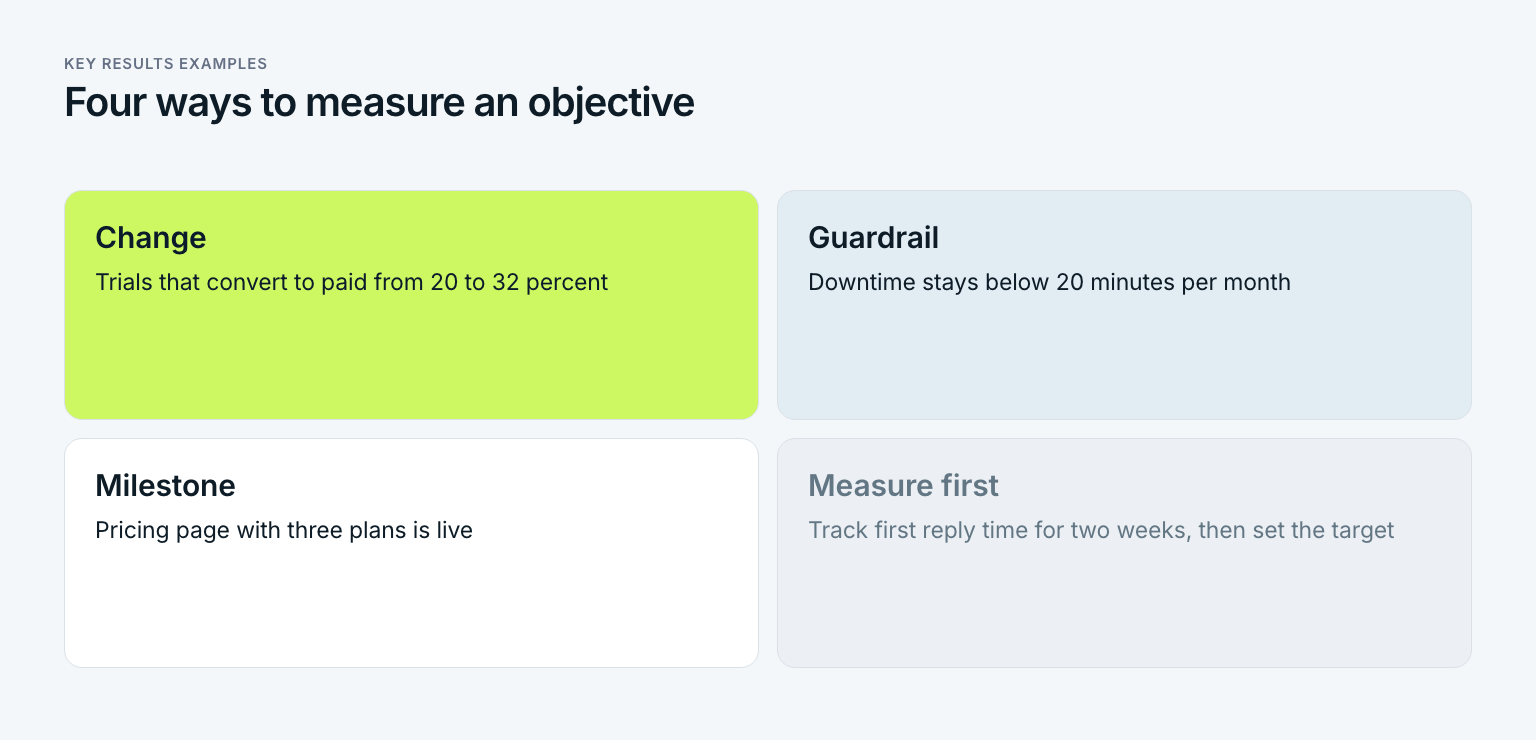
Change carries most OKRs. A guardrail protects them: whoever quintuples the number of releases without watching downtime gains speed and loses customers. A milestone is allowed, but at most one per objective, or the OKR turns into a project plan. Guardrails sit close to classic metrics, and where exactly the line runs is the subject of OKR vs KPI. In short: three key results, at least two of them real changes.
Marketing OKR examples: three objectives with key results
Marketing OKRs rarely fail for lack of numbers. They fail because there are too many. Clicks, followers, open rates, everything can be measured, and that is exactly why everything ends up in the OKR. The better marketing objective describes who does something at the end of the quarter that did not happen before.
| Situation | Objective | Key results |
|---|---|---|
| Dana's marketing team, software for vet clinics | The right clinics start a free trial. | Trials per month from 50 to 75. Share of trials from clinics with three or more vets from 40 to 60 percent. Cost per trial from $210 to $140. |
| Direct-to-consumer skincare brand | Customers who buy once come back. | Repeat purchases within 90 days from 21 to 30 percent. Share of revenue from email from 8 to 15 percent. Unsubscribes per send stay below 0.3 percent. |
| Accounting firm with ten people | Small business owners in town recommend us. | New clients from referrals from 4 to 10 per quarter. Google reviews from 26 to 60 at 4.7 stars or higher. Sign-ups for the tax season workshop from 0 to 50. |
Dana's head of marketing first wrote “More trials” as the objective. That is true, but it is a metric, not a state. The word “right” changes the quarter: a clinic with a single vet likes to test and rarely buys. That is why the second key result measures who starts a trial, not only how many do. The third protects the budget, so 75 trials are not bought at twice the cost. Anyone who measures only volume in marketing gets volume.
Sales OKR examples: conversion, expansion, a new market
Sales teams have more numbers than they need. Revenue, pipeline, win rate, every sales team already has them in the CRM. A sales OKR therefore needs no new metric. It needs a decision: which of these numbers should change this quarter, and which habit in the team will change it?
| Situation | Objective | Key results |
|---|---|---|
| Dana's sales team, five reps | Trials turn into contracts without us pushing. | Trials with a setup call in the first three days from 35 to 80 percent. Trial to paid conversion from 20 to 32 percent. Contracts paid annually up front from 18 to 35 percent. |
| Restaurant supply distributor | Existing accounts buy more than one product line from us. | Accounts with two or more product lines from 30 to 42 percent. Annualized revenue per account from $24,000 to $28,000. Meetings about new product lines from 3 to 8 per week. |
| Software company before entering Canada | We gain a foothold in Canada before our competitors do. | First calls with Canadian prospects from 0 to 40. Paying customers in Canada from 0 to 10. One case study with a Canadian customer is published. |
Dana's sales lead wanted to put only the conversion rate into the OKR. That would have been accurate and said nothing. The rate is the outcome, the setup call is the lever: in her own pipeline, clinics that are set up within three days buy about twice as often. Is that a key result or a task? Measured as a share of all trials, it becomes a key result, because it shows every week whether the team is living the new habit. That means: a leading indicator next to an outcome makes a sales OKR steerable in week three, not in week twelve.
Product and engineering OKR examples
Product OKRs have their own trap. They measure what gets built instead of what changes for users. “New booking screen is live” is a release, not an outcome. Whoever writes OKRs for a product team describes how users behave after the release.
| Situation | Objective | Key results |
|---|---|---|
| Dana's product team, an app for pet owners | Pet owners book appointments themselves, without calling the front desk. | Appointments booked in the app by pet owners from 30 to 55 percent. Reschedules handled by phone from 50 to 25 percent. App store rating from 3.7 to 4.4. |
| Platform engineering team | Customers never notice when we ship. | Deployments per week from 1 to 5. Deployments that have to be rolled back from 10 to 3 percent. Downtime stays below 20 minutes per month. |
| Ecommerce team that owns checkout | Shoppers who reach the cart finish the order. | Checkout abandonment from 70 to 58 percent. Mobile conversion from 1.5 to 2.1 percent. Time from cart to order from 4 to 2 minutes. |
Dana's product team arrived with a list of seven features for the quarter. None of them is in the OKR. They sit underneath it as initiatives, and every week the team decides which one moves the first key result most. The second key result is the reason clinics want this at all: every phone reschedule costs the front desk about five minutes. The third shows whether pet owners like the app or merely have to use it. In short: the feature is the tool, the OKR measures the effect.

HR OKR examples: hiring, onboarding, retention
HR OKRs are the hardest to write, because the important outcomes are slow. Whether a new hire stays shows after a year, not after a quarter. Good HR OKRs therefore measure what is visible today and will matter later.
| Situation | Objective | Key results |
|---|---|---|
| Dana's people team, one person for 52 | Strong engineers say yes to us faster. | Days from job post to accepted offer from 70 to 45. Offer acceptance rate from 50 to 80 percent. Candidates referred by the team from 2 to 10 per quarter. |
| Manufacturer with 250 employees | New hires are truly productive after four weeks. | New hires who finish a real task of their own within 30 days from 40 to 80 percent. Onboarding rating after 30 days from 3.2 to 4.3 out of 5. Laptop, access and a buddy ready on day one from 55 to 100 percent. |
| Home health agency with 70 nurses | Nurses stay because the schedule fits their lives. | Last-minute schedule changes from 30 to 12 per month. Time-off requests granted from 60 to 90 percent. Satisfaction with scheduling from 2.8 to 3.8 out of 5. |
Dana reviewed the hiring OKR herself, because it hangs on her most urgent problem. The product team needs two more engineers, or four of the seven features stay on the shelf. Seventy days to an accepted offer is too long, and good people sign somewhere else in that time. The first key result attacks the process, the second the offer, the third the source. Whoever writes HR OKRs needs no annual engagement survey as a key result, but a number that reacts faster than the survey does.
OKR examples for teams: from company OKR to team OKR
Team OKRs do not stand alone. They hang on a company OKR, and that makes them either stronger or pointless. Stronger, when every team knows which company key result it moves. Pointless, when every team writes its favorite topic into the quarter.
Dana's company OKR for the first quarter of 2027 reads: “Clinics that try us never want to go back.” It has three key results. Trials that convert to paid from 20 to 32 percent. Paying clinics from 410 to 470. Clinics that cancel in their first year from 14 to 8 percent. Marketing, sales, product and HR are covered above. This is what the other teams wrote:
| Team | Objective | Key results | Moves |
|---|---|---|---|
| Customer success, three people | New clinics never feel alone during the trial. | First reply to trial customers within two hours from 40 to 90 percent. Tickets solved on first contact from 50 to 70 percent. Rating after each ticket from 4.0 to 4.5 out of 5. | Trials that convert to paid |
| Finance, two people | Clinics pay on time without us chasing them. | Customers on autopay from 50 to 85 percent. Receivables older than 30 days from $26,000 to $9,000. Payment reminders per month from 45 to 10. | The annual goal, not a Q1 key result |
| Internal IT, one person | New colleagues are productive from their first hour. | Laptop, accounts and access ready on day one from 50 to 100 percent. Setup time per new workstation from 6 to 2 hours. IT requests solved the same day from 60 to 85 percent. | The HR hiring OKR |
| Cross-functional churn squad | We know why clinics cancel in their first year. | Interviews with clinics that cancelled from 0 to 15. Last year's cancellations with a recorded reason from 20 to 80 percent. One countermeasure per main reason is in the Q2 plan. | First-year cancellations |
Finance shows what often gets forgotten: not every team OKR has to hang on a key result of the quarter. Paying on time moves neither trials nor cancellations, but the annual goal needs cash in the bank. That is fine, as long as the team says so openly. Anyone who finds no company key result their OKR hangs on names the annual goal instead. Anyone who finds no link there either is writing down a favorite topic. Once three or four teams are involved, a shared spreadsheet gets crowded, and that is the point where OKR software earns its place.
Alignment is not a cascade
In a cascade, leadership writes a key result and the team turns it into its own objective. That looks orderly and produces teams that only pass numbers down the line. Alignment means the team chooses how it moves a company key result. Dana's customer success team picked first reply time, not the conversion rate, because reply time is the number it controls.
OKR objective examples for operations: the five performance objectives
Operations teams often have the clearest objectives of all, because their field already has a vocabulary for them. The operations management textbook by Nigel Slack and his co-authors names five performance objectives: quality, speed, dependability, flexibility and cost. Each one is a ready-made direction for an OKR objective. Here they are for a regional bakery that delivers to 80 cafes every morning:
| Performance objective | Objective example | One key result |
|---|---|---|
| Quality | Every tray that leaves the bakery is one we would sell over our own counter. | Orders returned or complained about from 3 to 1 percent |
| Speed | A cafe that orders late still gets fresh bread the next morning. | Order cutoff for next-morning delivery from 2 p.m. to 6 p.m. |
| Dependability | Cafes can set their clocks by our van. | Deliveries inside the promised 30-minute window from 82 to 97 percent |
| Flexibility | A cafe can change tomorrow's order this afternoon. | Order changes accepted until 3 p.m. the day before from 40 to 90 percent |
| Cost | We throw away less of what we bake. | Unsold product discarded from 9 to 5 percent of output |
No bakery should pick all five in one quarter. The model is useful as a menu: which of the five do the cafes complain about right now? That one becomes the objective, and the other four become guardrails that must not slip while the team works on it. A complete OKR would add two more key results to the one shown here.
Personal OKR examples: health, side projects, couples
Personal OKRs feel like overkill at first. Who measures their life in key results? Yet a quarter with a single personal objective is often the first quarter in which a resolution does not die in February. The difference from a resolution is the baseline. Anyone who knows it notices after three weeks whether anything is moving. Whether an OKR is the right tool for a personal goal at all is the question in goal setting frameworks, which sets OKR against eight other methods.
| Situation | Objective | Key results |
|---|---|---|
| Dana in her first OKR quarter | I am home in the evening, not just present. | Evenings per week with the laptop closed by 6:30 p.m. from 1 to 4. Sleep according to her watch from 6:05 to 7:00 hours as a weekly average. Family dinners from 2 to 5 per week. |
| Runner before her first half marathon in April | I run the whole half marathon without walking. | Longest continuous run from 6 to 11 miles. Runs per week from 1 to 3. Easy pace from 10:40 to 10:05 minutes per mile. |
| Couple planning a move in summer | We move into a bigger place in July without fighting about money. | Savings for deposit and moving costs from $4,000 to $10,000. Apartment viewings from 0 to 4 per month. The rental application packet is complete and ready to send. |
| Employee writing a book on the side | I write the book I have talked about for years. | Words in the manuscript from 0 to 30,000. Writing mornings per week from 0 to 4. Chapters with test readers from 0 to 3. |
Dana's personal OKR is not a counterweight to her work OKR. It is its precondition. The first OKR quarter costs time: conversations with every team, weekly check-ins, a scoring session in March. Without a boundary, that eats every evening. The first key result is a habit, which is fine in a personal OKR, as long as the second and third show whether the habit works. The couple shares one objective, and both see the same progress. That means: one personal objective per quarter is enough, because no everyday life next to a job and a family carries more.
How to write an OKR from an example in five steps
An example is a starting point, not a result. Dana's teams built each of their OKRs from somebody else's example, in five steps and roughly one hour per team:
Pick an example by situation, not by industry
Look for the example whose situation resembles yours. Dana's customer success team started from an online store, not from another software company, because the problem was the same: customers who feel alone in their first days.
Rewrite the objective in your own words
One sentence, no number, present tense, as if it were already true at the end of the quarter. Read it out loud. Would your team say it in Monday's meeting without laughing?
Measure the baselines
Every key result needs today's number. If it is missing, the key result becomes a measure first type, and the target follows by week three at the latest. Dana's customer success team did not know its first reply time and tracked it for two weeks.
Set targets at five out of ten
Christina Wodtke recommends in her book Radical Focus to set key results so that you feel only five out of ten confident at the start. Higher is wishful thinking, lower is routine. Mark as well whether the OKR is committed and must be hit in full, or aspirational, where a score of 0.7 is already a good quarter.
Set initiatives for the first two weeks
Under each key result go two or three actions for the first 14 days. After that, the weekly check-in decides which ones stay. An OKR without an initiative for Monday is a wish.
The blank OKR template has exactly these fields: objective, three key results with baseline and target, weekly initiatives, check-in and score. Whoever fills it in for the first time puts one of the examples above next to it and replaces every number with their own.
From quarterly OKR to daily goal: the goal chain
An OKR describes a quarter. It does not say what it means on a Tuesday. That is exactly where many OKR rollouts stall: the quarter is planned, the week is not. The goal chain closes that gap with five levels from year to day, and every goal hangs on a bigger one. This is what it looks like for Dana's customer success team, worked down to a Tuesday in January:
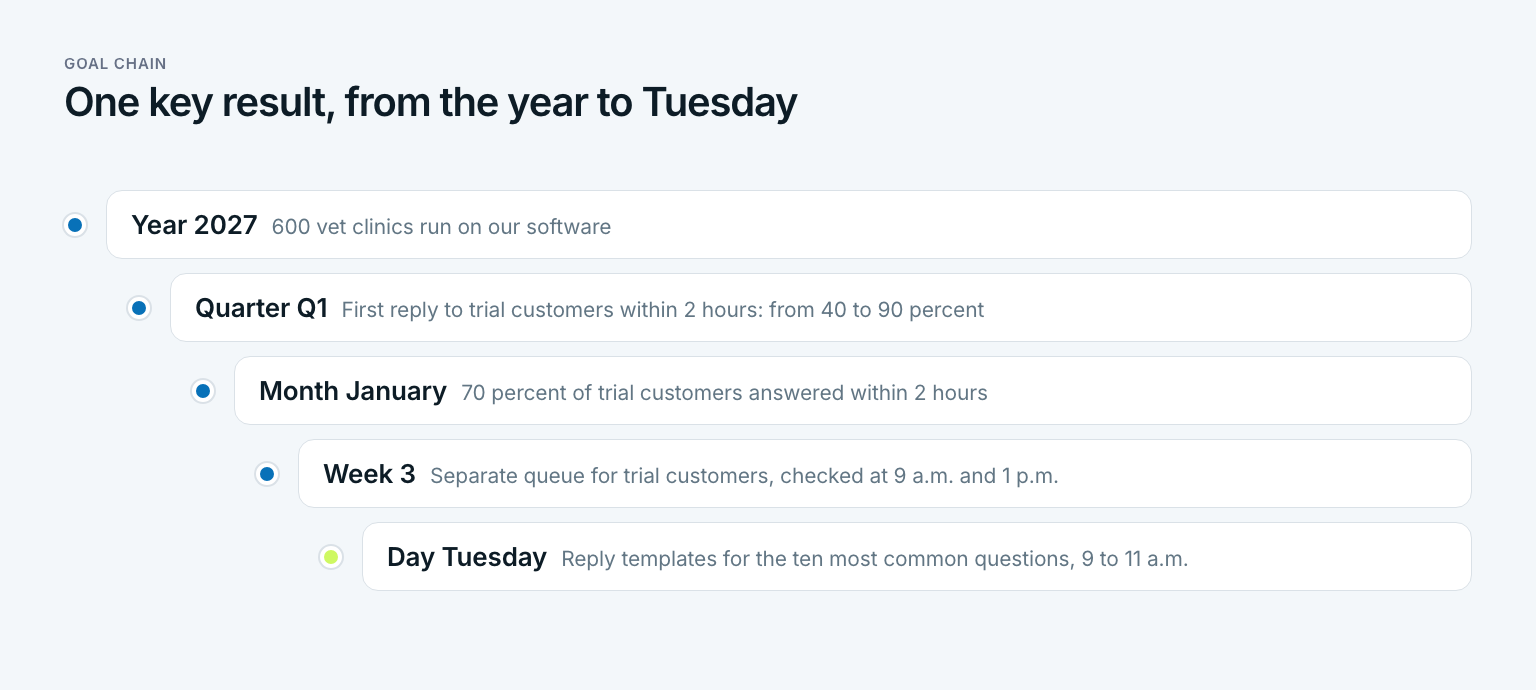
The yearly goal is the direction: 600 clinics by the end of 2027. The key result becomes the quarterly goal one to one. The monthly goal is the checkpoint the curve has to reach by the end of January for the quarter to stay realistic, 70 percent instead of 90. The weekly goal is the initiative meant to move that number. The daily goal is small enough to be done in one morning. Whoever plans only the quarter finds out in March that January was missing.
The payoff shows in the weekly check-in. Instead of asking how the OKR is going, Dana's customer success team asks: did last week's weekly goals move the monthly goal? That is a question with a number, not a mood. In Gaapp every goal hangs on a bigger one, and the progress at each level sits next to the time that has passed. How to derive the quarters from a yearly goal in the first place is covered in the guide to annual planning.
Three questions to ask your first OKR before you write it down:
- Can you name the baseline for every key result without guessing?
- Would a customer, a colleague or your own body notice that it has been reached?
- Do you know what you will do for it next Tuesday?
Anyone who answers no to one of the three has not picked a bad example. They have not translated it yet. In short: an OKR example is not a goal you adopt, it is a shape you fill with your own numbers.
Frequently asked questions about OKR examples
What are the 5 elements of OKR?
There is no official list, but most guides name the same five: an objective, key results, initiatives, a weekly check-in and a score at the end of the cycle. The first two define the goal, the last three make it move. The guide to the OKR framework explains the full cycle.
What is an OKR vs a KPI?
A KPI is a metric that tracks how something is doing on an ongoing basis. An OKR describes a change within a fixed period, with a baseline, a target and a date. A KPI becomes a key result the moment you decide it should change this quarter. The full comparison is in OKR vs KPI.
How do you write an OKR?
Start with an objective in one sentence without a number, describing what should be different at the end of the quarter. Add two to four key results, each with a baseline, a target and a date, and check that together they prove the objective. Then list the initiatives for the first two weeks and set a weekly check-in.
What are the 5 performance objectives examples?
In operations management, the five performance objectives are quality, speed, dependability, flexibility and cost, a model from the textbook by Nigel Slack and his co-authors. Each one can become an OKR objective once you attach a baseline and a target. The bakery examples in the teams section show one objective and one key result for each.
How many key results should an objective have?
Two to four, usually three. With one key result you measure only a slice, with five or more nobody follows every number in the weekly check-in. Three leave room for a change, a leading indicator and a guardrail that watches for side effects.
Can I copy an OKR example as it is?
Sometimes the objective, never the numbers. Baseline and target depend on your situation, and a borrowed target is either too easy or out of reach. Use the example as a shape, measure your own baselines and put everything into an OKR template.
Last updated: 14 October 2026
Read next
 Leadership & Teams
Leadership Styles: Which One Fits Which Situation
Leadership styles are not personality types: 11 types compared, Lewin, Goleman, situational leadership and five steps to find the style that fits you.
14 min read
 Leadership & Teams
Retrospective: How Teams Learn From Every Sprint
A retrospective is not a blame session: what the word means, five phases, seven retrospective examples and action items that stick, shown on one team.
16 min read
 Leadership & Teams
How to Delegate Tasks: Hand Off Work, Keep Results
Delegation is not dumping work: five levels of delegation, seven steps, a handoff script and what to keep, shown on one marketing team.
15 min read