Goal Setting Frameworks: Which One Fits Your Goal
Goal setting frameworks compared: SMART, HARD, WOOP, OKR, FAST, PACT, CLEAR, BHAG and the 12 Week Year, with a decision table and a worked example.

Contents
- 01Goal setting frameworks at a glance: nine questions, not nine answers
- 02Why we need different goal setting methods: the four gaps a goal can have
- 03The decision table: which framework fits which situation
- 04The nine frameworks up close: core, strength, limit
- 05How to choose a goal setting framework in five steps
- 06Combining frameworks: one goal, two tools
- 07The three mistakes nobody notices
- 08Goal setting frameworks in a goal chain: year, quarter, month, week, day
- 09Three questions before you commit
- 10Frequently asked questions about goal setting frameworks
A goal setting framework is not a belief system. Goal setting frameworks are short checklists, each built to fix one specific weakness in a goal, and the ones worth knowing are SMART, HARD, WOOP, OKR, FAST, PACT, CLEAR, BHAG and the 12 Week Year. SMART fixes a fuzzy goal. HARD fixes a goal you do not care about. WOOP fixes a goal you have already failed at twice. OKR and FAST fix a goal that a whole team has to carry. So the right framework is not the best one. It is the one that matches the problem your goal actually has.
This guide follows one person through all nine. Marcus is 36, runs a dispatch team of eight at an HVAC company in Columbus, Ohio, and has two kids with his wife Dana. His list for 2027 holds five goals that could hardly be more different: a certification, a team metric, a guitar habit he has quit twice, a cycling routine and a family road trip. You get a decision table, a five-step way to choose, three combinations that work and the three mistakes almost everyone makes when picking.
Goal setting frameworks at a glance: nine questions, not nine answers
Every framework on this list asks your goal one question. The letters are memory aids. The question is the tool. Here are the nine, each in a line:
- SMART asks: Is the sentence clear enough that someone else could judge on the due date whether you made it? Specific, measurable, achievable, relevant, time-bound.
- HARD goals ask: Do you actually want this, and can you feel it? Heartfelt, animated, required, difficult.
- WOOP asks: What will stop you, and what will you do when it shows up? Wish, outcome, obstacle, plan.
- OKR asks: Where is the team going, and which two to four numbers prove it got there?
- FAST goals ask: Is the goal talked about often, and can everyone see it? Frequently discussed, ambitious, specific, transparent.
- PACT goals ask: What will you do repeatedly, whatever the result? Purposeful, actionable, continuous, trackable.
- CLEAR goals ask: Who is in on this, and may the goal change along the way? Collaborative, limited, emotional, appreciable, refinable.
- BHAG asks: What is the bold goal for the next ten to 30 years?
- The 12 Week Year asks: What would you finish if the year were only twelve weeks long?
In short: these are not nine competing answers to one question. They are nine different questions. Anyone who sees that stops hunting for the best framework and starts picking the fitting one. If you want the basics of turning a wish into a goal first, the guide to goal setting covers that and compares six strategies briefly. This article goes one level deeper: which framework, for which situation, and why.
Why we need different goal setting methods: the four gaps a goal can have
A goal rarely fails at everything at once. Usually one thing is missing. Edwin Locke and Gary Latham showed in decades of research that specific, challenging goals beat a vague "do your best," and the guide to goal setting theory explains their five principles. For choosing a framework, a simpler question is enough: Which gap does your goal have?
- The clarity gap. The goal is a wish with no number and no date, like "get in shape" or "spend more time with the kids." SMART closes it, and OKR does the same job for teams.
- The drive gap. The goal is clear, but it has no pull. You write it down in January and forget it by February. HARD closes it, and for very long horizons, so does a BHAG.
- The follow-through gap. The goal is clear and wanted, but a known obstacle sits between the plan and your Tuesday evening. WOOP closes it, and the 12 Week Year adds the urgency.
- The alignment gap. Several people depend on the goal, and each one pictures something different. OKR, FAST and CLEAR close it.
There is one special case. Some goals are not really about an outcome at all. Whoever rides a bike to clear their head does not need a finish time. They need a rhythm. That is exactly what PACT goals are built for.
That means: before you pick a framework, you name the gap. Marcus does this for his five goals in about ten minutes. His results sit right below the decision table in the next section.
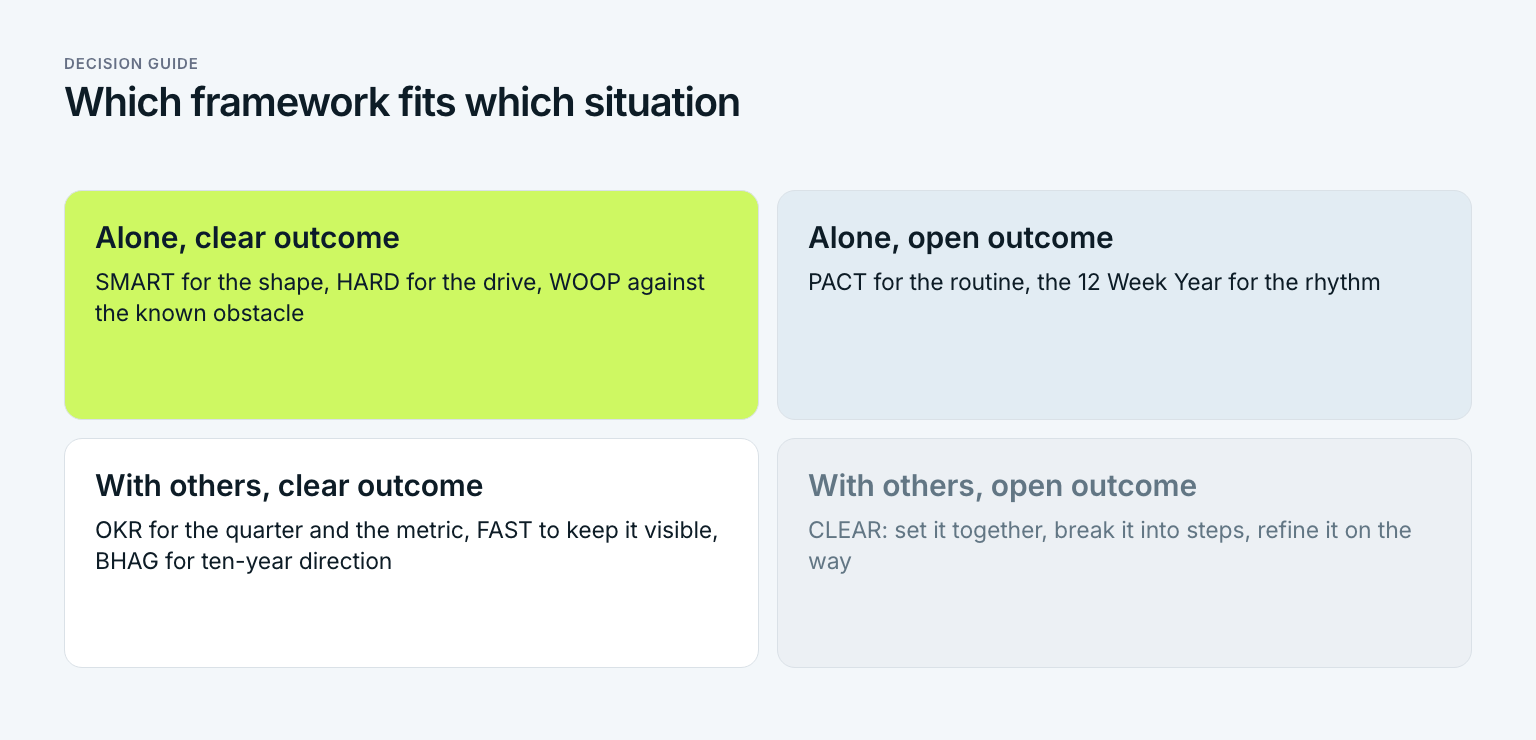
The decision table: which framework fits which situation
Read the table from left to right. First the situation, then the symptom that tells you you are in it, then the framework. The last column matters as much as the third. It tells you when to leave a framework alone.
| Situation | How you recognize it | Framework | Skip it when |
|---|---|---|---|
| The goal is fuzzy | No date, no number, everyone reads it differently | SMART | the goal is a learning path with an open result |
| The goal has no pull | On the list for weeks, nothing happens | HARD | the goal is imposed and means nothing to you |
| You failed before | Second or third attempt at the same goal | WOOP | you do not know the obstacle yet |
| A team needs one direction | Several people, one quarter, one metric that matters | OKR | it is one person with one goal |
| Goals fade by March | Set in January, forgotten in spring | FAST | nobody but you should see the goal |
| The outcome is not the point | Practice, habit or learning for its own sake | PACT | an outside deadline is fixed |
| Shared goal, moving target | Family, project, club, unclear path | CLEAR | the goal is already set and measurable |
| Very long horizon | Ten years or more, direction rather than plan | BHAG | you need a plan for this year |
| The year feels too long | Strong January, weak fall | 12 Week Year | you cannot free twelve weeks of focus right now |
Marcus runs his list through the table. The PMP certification is clear, but it has no pull. His team's on-time arrival rate needs alignment. Guitar is his third attempt. On the bike, he does not care about speed. And the road trip depends on four people. Five goals, five different gaps. Had he pushed all five into SMART form, three of them would look tidy on paper and be dead by spring.
The nine frameworks up close: core, strength, limit
Each framework gets the same treatment here: what it is, where it comes from, what it is good at, where it stops, and what Marcus's sentence looks like with it. Whoever is only after one framework can jump straight to it.
SMART goals: when the goal is fuzzy
SMART goes back to George T. Doran, who in 1981 described in Management Review how managers could write objectives that can be checked. Today the letters usually stand for specific, measurable, achievable, relevant and time-bound. SMART is a test for a sentence. It does not tell you which goal to pick, only whether your sentence holds up. Marcus's sentence: "By June 30, 2027, I hold the PMP certification, with the required 35 hours of training finished by January 31." The limit: for open-ended learning, SMART forces a number nobody can honestly estimate. The full letter-by-letter breakdown lives in the guide to SMART goals.
HARD goals: when the goal has no pull
HARD goals come from Mark Murphy and stand for heartfelt, animated, required and difficult. The goal matters to you personally, you can picture it vividly, it feels needed now rather than someday, and it is hard enough to stretch you. HARD is not a rival to SMART. It answers the question that comes before it: Why bother at all?
Marcus notices that the PMP is on his list because his boss mentioned it in his review. His own reason only shows up on the second pass. The company is opening a commercial division in 2028, the project lead role pays about $9,000 a year more, and he wants to stop being the person who only reacts to schedules. He writes that sentence directly under the SMART goal. The limit: a goal that is imposed on you and means nothing will not improve with feeling. Then the honest question is whether it has to be your goal.
WOOP: when you have failed before
WOOP comes from psychologist Gabriele Oettingen and stands for wish, outcome, obstacle, plan. At its core is mental contrasting: you picture the outcome, then right after, the inner obstacle in your way. Then you set an if-then plan. It works especially well on goals you have already failed at, because there you know the obstacle.
Marcus has started guitar twice and quit both times after about a month. His obstacle is not time. It is the evening, when he sits down with his phone after the kids are in bed and the guitar stays on its stand. His plan: "If I close the kids' bedroom door at 8:30 p.m., I pick up the guitar for 15 minutes before I touch my phone." The limit: anyone who does not yet know the obstacle, because the goal is brand new, is guessing. Better to start, watch for four weeks, and then write the plan.
OKR: when a team needs one direction
OKR stands for objectives and key results. It was developed at Intel under Andy Grove and made widely known by John Doerr. An objective describes the direction in words, and two to four key results make it measurable, usually for one quarter. OKR is built for teams, because it links goals across levels in a way everyone can see.
Marcus's team OKR for the first quarter of 2027 reads: "Customers get their technician when we said they would." The key results: on-time arrival rate from 81% to 90%, same-day reschedules from 14 to 6 a week, and dispatch phone rating from 4.2 to 4.5 stars. The limit: for a single personal goal, OKR is often more scaffolding than house. How to write objectives and key results in detail is covered in the guide to the OKR framework. If those key results sound like numbers your team already tracks, OKR vs KPI shows where the line between the two runs.
FAST goals: when goals fade by March
FAST goals come from Donald and Charles Sull and stand for frequently discussed, ambitious, specific and transparent. Their argument is simple and a little uncomfortable. Many organizations write good goals once a year and then stop talking about them, so the goals stop shaping decisions. FAST fixes that by making two habits part of the goal itself: the goal comes up in regular conversations, and everyone involved can see it.
That is why FAST is less a goal format than an operating rule for goals in a company. The A also pushes back on a common side effect of SMART. When achievable is read as safe, teams set goals they know they will hit. FAST asks for a goal that stretches, and it trusts the frequent discussion to catch problems early.
Marcus uses FAST as a layer on top of his OKR. The three key results sit on the screen in the dispatch room, and every Monday at 7:45 a.m. the team spends ten minutes on them before the first calls. The limit: whoever wants to keep a personal goal private has little use for transparency. For personal goals, a fixed weekly appointment with yourself often covers the F on its own.
PACT goals: when the outcome is not the point
PACT goals stand for purposeful, actionable, continuous and trackable. Instead of an outcome, a PACT goal describes a practice you repeat. That suits goals where you cannot control the result, or where the result simply is not why you are doing it.
Marcus rides his bike because he thinks more clearly afterward. A target time for a 20-mile loop would turn that into a race he does not want. His PACT goal: "I ride three times a week for at least 40 minutes, Tuesday, Thursday and Saturday, and log every ride." The limit: PACT has no end date. Anyone facing an exam or a deadline also needs an outcome goal. For a study goal that ends in an exam, SMART goals for students plans backward from the test date.
CLEAR goals framework: when several people share the goal
CLEAR stands for collaborative, limited, emotional, appreciable and refinable. The framework is built for settings that change fast and for goals that several people carry together. Appreciable means the big goal is broken into small steps you can actually notice. The R is the real difference from SMART. The goal may be sharpened along the way without counting as a failure.
Marcus's family goal: he, Dana and the kids, seven and ten years old, want a ten-day road trip to Yellowstone in the summer of 2027. Collaborative means every person adds one wish for the trip. Limited means ten days, $3,600, driving. Emotional means the kids pick the hikes. Appreciable means $400 a month from October through June and the lodging booked by the end of January. Refinable means that in March they check whether the budget still holds. The limit: for a goal that only concerns you and is already measurable, CLEAR adds little.
BHAG: when the horizon is ten years or more
BHAG stands for big hairy audacious goal. Jim Collins and Jerry Porras coined the term in 1994 in their book Built to Last. It means a bold goal for ten to 30 years that points a whole organization in one direction. A BHAG is not a plan, it is a lighthouse. It does not tell you what to do in March. It tells you where all of it leads.
Marcus writes one for his department: "By 2036, our service is the one people in central Ohio recommend first when a furnace dies in January." The idea carries over to personal life, but carefully. Anyone who only has a BHAG has a dream with a name. It needs a yearly goal underneath, or the lighthouse turns into decoration.
The 12 Week Year: when a year is too long
The 12 Week Year by Brian Moran and Michael Lennington is less a formula than a rhythm. Instead of planning a year, you plan twelve weeks, with weekly plans and a weekly score. The goal stays the same. Only the deadline gets more honest. Whoever starts strong in January and realizes in October that only two months are left knows the problem this method solves.
Marcus splits his PMP preparation into two blocks. Block one runs from November 2 to January 24 and covers the training hours and the people domain. Block two runs from February 1 to April 25 and covers process, business environment and three full practice exams. That leaves May and June for the exam itself and a buffer. The 12 Week Year page walks through the full cycle. The limit: twelve weeks of focus do not happen on the side. Whoever has three big projects running picks the rhythm for one and leaves the others on the yearly clock.
Other goal setting models exist, such as the GROW model from coaching, associated with John Whitmore, or the if-then plans of Peter Gollwitzer, which WOOP already contains. Most new acronyms recombine parts of these nine. Anyone who knows the nine questions can place a new acronym in about a minute.
How to choose a goal setting framework in five steps
Picking a framework is not a gut call. It is a short pass you make once per goal. Marcus needs about 40 minutes on a Sunday evening for all five.
Write every goal down as one sentence
Write each goal the way it sits in your head right now. One of Marcus's five still reads "guitar, for real this time." That is fine. The framework comes later.
Name the gap
For each sentence, ask: Is it missing clarity, drive, follow-through or alignment? Or is the outcome not the point at all? Write that word next to the sentence. Marcus's list now reads drive, alignment, follow-through, no outcome, alignment.
Pick the framework from the table
Take the framework that matches the gap, then check the last column of the decision table. If the skip condition applies, take the second best. Marcus picks HARD for the PMP, OKR plus FAST for the team, WOOP for guitar, PACT for cycling and CLEAR for the trip.
Run the SMART test where an outcome counts
Every goal with an outcome gets the SMART test at the end: Could someone else decide on the due date whether it was reached? For the PMP and the team metric, yes. For cycling, no, and that is on purpose.
Set a review rhythm
Decide how often you look at each goal. Marcus checks the team numbers on Monday with his dispatchers, the PMP, guitar and cycling alone on Friday, and the trip fund with Dana once a month. Without a rhythm, every framework is just a word after six weeks.
The whole pass takes less time than most people spend reading about one framework that then fails three of their goals. And it has a side effect. Whoever has named the gap for each goal also knows what to watch for in the first weeks.
Combining frameworks: one goal, two tools
The frameworks do not exclude each other. Most strong goals use two, one for the shape and one for the path. Three combinations hold up especially well:
- HARD plus SMART. HARD supplies the why, SMART the shape. Marcus writes both on one card: the PMP sentence with its date on top, the commercial division and the $9,000 underneath. Anyone with only the top line has a tidy goal with no engine.
- SMART plus WOOP. SMART says where you are going. WOOP says what will stop you. For guitar, Marcus's SMART line reads: "By May 31, 2027, I play three full songs from start to finish without stopping, recorded on my phone." The bedroom-door plan keeps the evenings from slipping.
- BHAG plus OKR. The BHAG sets the direction for ten years, and the OKR turns it into a quarter. Without OKRs, the BHAG is a sentence on the wall. Without the BHAG, the OKR becomes a metric with no purpose.
What does not work is three frameworks on one goal. Whoever runs their guitar goal through HARD, then SMART, then CLEAR spends more time writing than playing. Two tools per goal is the ceiling. Is this still goal setting or already a hobby of its own? That question helps once you reach the third acronym.
The three mistakes nobody notices
Mistakes with goal setting frameworks rarely sit in the framework itself. They sit in the choice. All three look like diligence from the outside, which is exactly why they show up so late.
Mistake one, and the most common: one framework for every goal
SMART is a good framework. Anyone who has learned it tends to push everything through it. The cycling goal gets a target speed, the road trip a rigid budget with no slack, and four weeks later both feel like chores. The framework was not wrong. It was built for something else. That means: the framework adapts to the goal, not the other way around. One word for the gap next to each goal prevents this mistake in five minutes.
Mistake two: picking a framework because it is in fashion. OKR sounds like Silicon Valley, BHAG like a bestselling business book. Neither is a reason. For a single personal goal, an OKR with three key results is often scaffolding without a house. And a family goal run as an OKR feels to the kids like a staff meeting.
Mistake three: switching frameworks at the first setback. Marcus's guitar habit ended twice after a month. The obvious move would be a new app or a new acronym. The WOOP plan aims somewhere else: the evening after bedtime, exactly where it broke twice. Anyone who swaps the framework at every stumble never learns what actually went wrong.
Goal setting frameworks in a goal chain: year, quarter, month, week, day
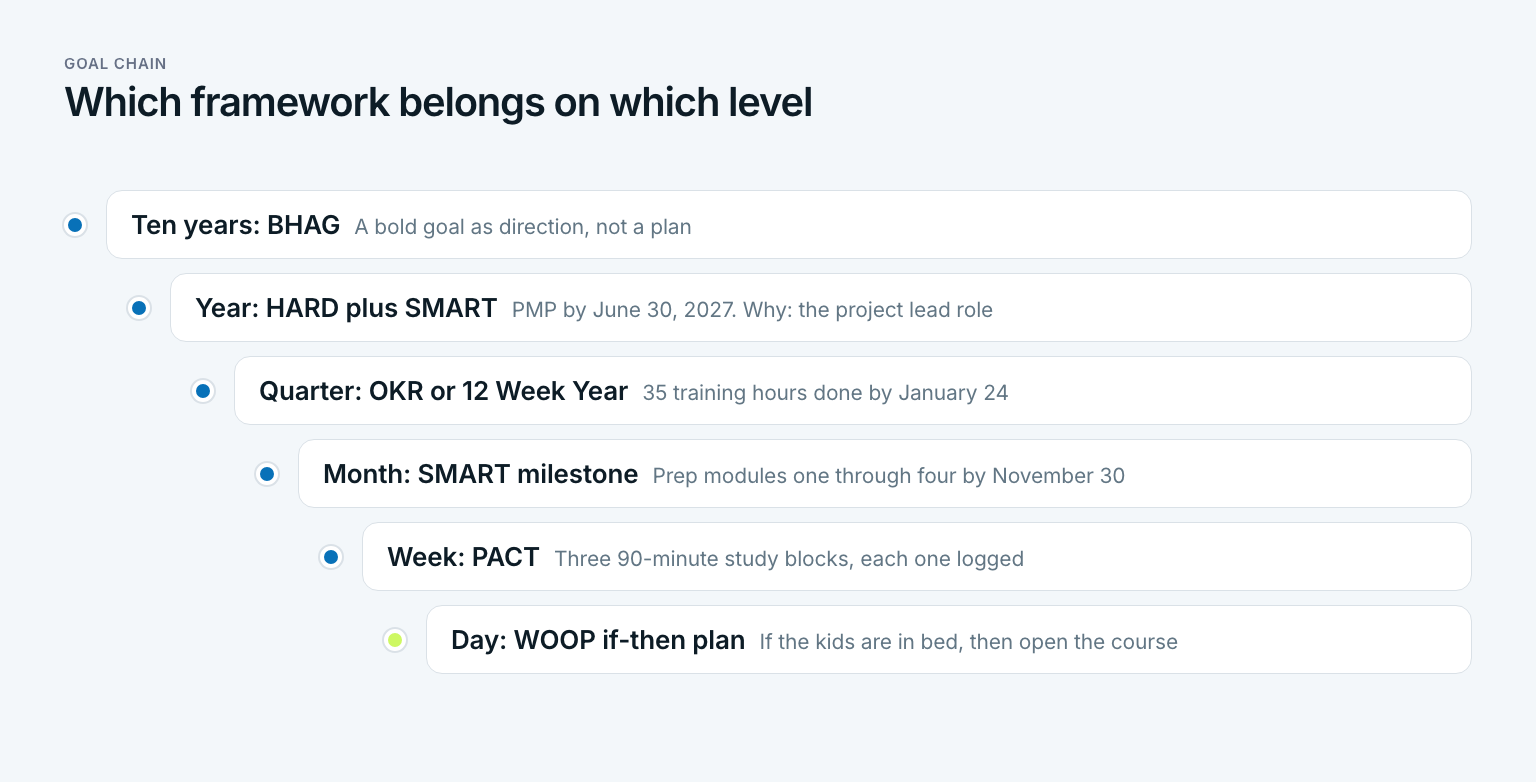
Frameworks match situations, and they also match levels. A BHAG is useless for Tuesday, and an if-then plan is useless for ten years. Whoever thinks of goals as a chain from year to day can give each level the tool that fits its time frame. Here is how that looks for Marcus's PMP goal:
| Level | Fitting framework | Marcus's sentence |
|---|---|---|
| Ten years | BHAG | By 2036, ours is the service central Ohio recommends first. |
| Year | HARD plus SMART | By June 30, 2027, I hold the PMP. Why: the project lead role in the commercial division. |
| Quarter | OKR or 12 Week Year | By January 24, the 35 training hours are done and the people domain practice test scores 75% or better. |
| Month | SMART as a milestone | By November 30, modules one through four of the prep course are finished. |
| Week | PACT | Three 90-minute study blocks, Monday, Wednesday and Saturday, each one logged. |
| Day | WOOP if-then plan | If the kids are in bed by 8:30 p.m. on Wednesday, I open the course before I open my phone. |
The logic is simple. The higher the level, the more direction. The lower the level, the more action. SMART sits in the middle, because it makes yearly and monthly goals checkable. PACT and WOOP sit at the bottom, because they shape everyday life. In Gaapp you build the chain exactly like this, with the yearly goal on top and quarter, month, week and day beneath it, and every level shows how far the one above has come.
Three questions before you commit
Before you pick a framework for your next goal, answer three questions in writing:
- Which gap does my goal really have: clarity, drive, follow-through or alignment?
- When will I look at this goal next, with a day and a time?
- How will I know in six weeks that the framework does not fit, and what will I do then?
Anyone who cannot answer the first question does not need a framework yet. They need ten minutes of thinking about the goal itself. Whoever leaves the second blank will not be saved by any framework, because no goal survives without a date on the calendar. And whoever answers the third already has more of a plan than most New Year's resolutions.
In short: a goal setting framework is not a creed but a tool, and you recognize the right one by the gap it closes.
Frequently asked questions about goal setting frameworks
What are the 7 types of goals?
There is no single official list, and authors sort goals differently. A common set covers career, financial, health, relationship, personal growth, education and leisure goals. Another useful split is by type: outcome, performance and process goals. The category matters less than the framework you use to write the actual goal.
What are the 5 SMART objectives?
Specific, measurable, achievable, relevant and time-bound. In George T. Doran's original 1981 article, the A and R stood for assignable and realistic. The five letters test one goal sentence, not whether it is the right goal to pursue.
Can you give me some examples of organizational goals?
Three from Marcus's team in this article: raise the on-time arrival rate from 81% to 90% by March 31, cut same-day reschedules from 14 to 6 a week, and lift the dispatch phone rating from 4.2 to 4.5 stars. Organizational goals work best as OKRs with a clear objective above the numbers and a weekly conversation about them.
What are the 5 F's of goal-setting?
There is no standard source for the five F's. The most common version lists five life areas: faith, family, finances, fitness and friends. Treat it as a checklist for where your goals come from, not as a framework for writing them. Once you pick an area, SMART, PACT or WOOP shapes the goal itself.
What is the difference between SMART goals and FAST goals?
SMART checks whether one goal sentence is clear and testable. FAST adds two habits around the goal: it is discussed often and it is visible to everyone involved, and it should stretch rather than play safe. Many teams use SMART to write the goal and FAST to keep it alive.
Which goal setting framework is best for personal goals?
It depends on the gap. For a fuzzy goal, use SMART. For a goal you keep abandoning, use WOOP. For a routine where the result is not the point, use PACT. For a goal that leaves you cold, add HARD to find the reason before you write the sentence.
Last updated: 14 October 2026
Read next
 Goal Setting
Intrinsic Motivation: What Drives You From the Inside
Intrinsic motivation is not a personality trait. Meaning, 12 examples, the three needs behind it and five steps to build it, with a worked example.
17 min read
 Goal Setting
Financial Goals: How to Turn Wishes Into a Plan
Financial goals are not wishes with a dollar sign. Short and long term examples, SMART savings goals and a five step plan, worked through one year.
17 min read
 Goal Setting
WOOP Method: Four Steps From Wish to If-Then Plan
The WOOP method is not positive thinking. What WOOP stands for, the research, if-then plans, eight goal examples and a five-minute guide.
18 min read