Personal Development: What It Is and a 12-Month Plan
Personal development is deliberate, measurable change in what you can do. Definition, five areas, seven skills, six-step plan, worked example, template.

Contents
- 01What personal development means, and what it is not
- 02Personal development, self-improvement, personal growth: what each is built for
- 03The five areas of personal development
- 04The seven skills of personal development that carry everything else
- 05Jordan's example: from I should be more confident to one measurable year
- 06How to write a personal development plan in six steps
- 07Personal development plan template: one page, ten fields
- 08The three mistakes that turn a year of effort into a year of consumption
- 09Personal development in the goal chain: year, quarter, month, week, day
- 10Frequently asked questions about personal development
Personal development is the deliberate work of changing what you can do, how you think, and how you live, measured against a goal you chose yourself. It is not a reading list. Reading about confidence is pleasant and costs nothing, and a year of it leaves you exactly as confident as before. Personal development starts where the reading stops: with a skill you cannot do yet, a date, and a way to check.
Three things make it work: a direction, a plan, and a check. The direction is one sentence about who you want to be able to be in a year. The plan breaks that sentence into areas, skills, and weekly practice. The check is a number you look at every Friday. All three run through the example of Jordan, 34, a project coordinator at a logistics company in Columbus, Ohio, who has been passed over for a team lead role twice. Along the way: the five areas of personal development, the seven skills that carry them, a six-step plan, a template, and the three mistakes that turn effort into consumption.
What personal development means, and what it is not
Personal development means closing the gap between what you can do today and what you want to be able to do, on purpose and with a way to tell the difference. Three parts of that sentence carry the weight. On purpose: it is chosen, not something that happens to you by getting older. The gap: it starts from an honest look at where you stand, not from where you wish you stood. Tell the difference: it produces evidence, not a mood. Whoever grows without noticing has matured. Whoever grows and can show it has developed.
Self-improvement content is good. Podcasts, books, and the right YouTube channel teach vocabulary, and vocabulary matters: you cannot work on emotional regulation if you have never heard the term. The problem is not the content. The problem is that consuming it feels like progress, and the feeling is the same whether anything changed or not. Carol Dweck made the distinction in Mindset, 2006: a growth mindset is a belief about ability, and the belief only matters when it changes what you practice. That means: the book is the start of the work, never the work itself.
Personal development, in one definition
Personal development is the deliberate, goal-directed change of skills, habits, and attitudes, checked against evidence over time. The four parts are not decoration. Remove deliberate and you have aging. Remove goal-directed and you have hobbies. Remove evidence and you have self-help. Remove time and you have a weekend workshop.
Personal development, self-improvement, personal growth: what each is built for
Three terms, used as if they meant the same thing. None is wrong. Each is built for something else, and the differences decide what you do on Monday morning.
| Term | What it asks | Typical form | What it measures |
|---|---|---|---|
| Self-improvement | How do I get better, generally? | Books, podcasts, courses, habits like cold showers or journaling | Usually nothing. The input is counted, the output is felt |
| Personal growth | Who am I becoming? | Reflection, therapy, big life changes, looking back over years | A change in perspective and values, visible in hindsight |
| Personal development | What can I do in a year that I cannot do today? | A plan with areas, skills, weekly practice, and a check | A skill or behavior you can demonstrate, on a date |
| Professional development | What does my employer need me to be able to do? | Trainings, certifications, performance reviews | Qualifications and ratings, set by someone else |
The table is not a ranking. Personal growth is the deeper thing, and most of it cannot be planned. Self-improvement is the entry point, and almost everyone starts there. Personal development is the middle layer the other two lack: deliberate, dated, and checkable. Whoever confuses the three usually does the first, hopes for the second, and never gets to the third. In short: growth is what happens to you, improvement is what you consume, development is what you build.
The five areas of personal development
The five areas most guides list are mental, physical, emotional, social, and spiritual. Call the last one purpose if the word spiritual does not sit well with you. For that area, the ikigai diagram is a common starting point, though it works better as a question than as a test. The list is a convention, not a law of nature, and its value lies in one thing: it forces you to look at the parts of your life you are not currently thinking about. Whoever only develops the mind becomes a well-read person who is tired, lonely, and unsure why any of it matters.
| Area | What it covers | Examples of personal development | How you can check it |
|---|---|---|---|
| Mental | Knowledge, thinking skills, learning how to learn | Learning to run a meeting, finishing a certification, reading with notes instead of just reading | A skill shown in front of others, a test passed, a decision made faster than last quarter |
| Physical | Energy, sleep, movement, food | Seven hours of sleep on weeknights, three workouts a week, a 5K finished | Nights over seven hours per week, workouts per month, a time on a date |
| Emotional | Self-awareness, regulation, how you handle setbacks | Noticing the trigger before the reaction, recovering from criticism in an hour instead of a weekend | A number from 1 to 10 each Sunday, the count of reactions you regret |
| Social | Communication, feedback, relationships, boundaries | Asking for feedback monthly, saying no once a week, one real conversation a week | Feedback conversations held, requests declined, conversations longer than ten minutes |
| Purpose | Values, direction, the reason behind the other four | Writing a one-sentence direction for the year, choosing a role because it fits rather than because it pays more | Whether you can say the sentence without looking, whether this year's goals fit it |
Jordan scored himself in all five before he did anything else, on a scale from 1 to 10, with one line of evidence per score. Mental: 7, he knows logistics inside out and nobody questions his numbers. Physical: 4, he sleeps six hours and has not exercised since March. Emotional: 5, he goes quiet in meetings when challenged and replays it for two days. Social: 4, he has never asked a manager for feedback. Purpose: 6, he wants to lead a team and does not yet know why. The scores are not a diagnosis. They are a starting line, and the two lowest tell him where the year goes.
The three stages every area goes through
Every area moves through the same three stages. Awareness: you notice the gap and can describe it in a sentence. Practice: you do the new behavior on purpose, awkwardly, with a count. Integration: the behavior happens without a reminder, and the count can stop. Most self-improvement lives in stage one and calls it progress. Most plans fail in stage two, because practice is boring and the count is low. That means: if you have been aware of the same gap for two years, you do not need another insight. You need a count.
The seven skills of personal development that carry everything else
Lists of personal development skills vary, and most of them are long. Seven are enough, because the other skills grow out of these. Which one of the seven is yours this year?
- Self-awareness. Knowing what you did, not just what you meant. Peter Drucker's feedback analysis from Managing Oneself, 1999, is the simplest tool: write down what you expect to happen before a decision and compare nine months later. A journaling habit gives you the written record to compare against.
- Communication. Saying the thing in one sentence, in the room, to the person it concerns. Half of what gets called confidence is this skill.
- Emotional regulation. The gap between the trigger and the response. Not feeling less, responding later.
- Time management. Not fitting more in. Choosing the one thing, protecting it, and letting the rest be late.
- Learning how to learn. Practice with feedback beats exposure. Anders Ericsson called it deliberate practice in Peak, 2016: a specific sub-skill, just beyond reach, with immediate correction.
- Decision making. Deciding with incomplete information and reviewing the result instead of the feeling.
- Persistence. Showing up in the weeks when nothing is visibly moving, which in any real development plan is most of them.
Jordan picked two: communication and emotional regulation. The other five are not ignored. They come along for free, because a plan to speak up in meetings trains self-awareness, decision making, and persistence whether you name them or not. Whoever picks all seven at once has written a wish list. Two is a plan.
Jordan's example: from I should be more confident to one measurable year
Here is what the two rejections actually said, once Jordan asked. Both managers used the same word: presence. He is reliable, his numbers are right, and in meetings he does not take up space. He does not push back, he does not propose, he does not run anything. That is not a verdict on his personality. It is a skill description, and skills can be built.
His direction for the year, one sentence: By September 30, I am the person my manager thinks of first when a team needs someone to run it. Not confident. Not better. A person others think of first, which can be observed from the outside. From there he worked backwards into two areas, two skills, and one supporting habit.
| Element | Jordan's entry | How it is checked |
|---|---|---|
| Direction for the year | By September 30, be the first name for the next team lead opening | Manager says so in the September review, or offers the role |
| Area 1: Social | Run the Monday stand-up for his team of eight, every week from January | Stand-ups run, target 1 per week |
| Area 2: Emotional | Push back or propose in every meeting with his manager | Tally in his notes app, counted on Fridays |
| Skill: Communication | One idea per meeting, in one sentence, before anyone else has spoken | Proposals per week, target 3 |
| Skill: Regulation | When challenged, say I want to think about that and come back within the hour | Recovery under an hour, rated 1 to 10 each Sunday |
| Supporting habit: Physical | In bed by 10:30 p.m., Sunday to Thursday | Early nights per week, target 4 of 5 |
Notice what is missing. No books on the list, though he read two. No course. No morning routine with eleven steps. Every line is something he does in a room with other people, or something that makes the room easier. That means: the plan tracks behavior, and each behavior is chosen because someone else can see it.
What the first eight weeks looked like
The first eight weeks were not impressive, and that is the point of writing them down. Here are his Friday counts:
| Week | Stand-ups run | Proposals | Recovery, 1 to 10 | Early nights of 5 |
|---|---|---|---|---|
| 1 | 1 | 1 | 3 | 2 |
| 2 | 1 | 2 | 3 | 3 |
| 3 | 0, travel | 1 | 4 | 2 |
| 4 | 1 | 3 | 4 | 4 |
| 5 | 1 | 2 | 5 | 3 |
| 6 | 1 | 4 | 5 | 4 |
| 7 | 1 | 3 | 6 | 4 |
| 8 | 1 | 3 | 6 | 4 |
| Total | 7 of 8 | 19 of 24 | 3 to 6 | 26 of 40 |
Seven stand-ups of eight. Nineteen proposals against a target of 24, which is 79 percent. Recovery doubled from a 3 to a 6. Sleep stayed the weakest line at 26 of 40 nights, and he knew it every Friday instead of discovering it in a review. Nothing in those eight weeks felt like a transformation. The counts say otherwise.
Six months in, the numbers: 21 stand-ups run out of 25, four missed for travel. 71 meetings with his manager, 58 of them with at least one proposal. Recovery self-rated at 7 in June, up from 3 in January. Sleep: 3.8 nights of 5 on average, still below target. At the six-month rescore, social had moved from 4 to 7, emotional from 5 to 7, physical from 4 to 5, mental and purpose up one each without a single hour aimed at them. In July his manager asked him to cover for the team lead during a two-week vacation. That was not the goal. It was the first time the goal became likely.

How to write a personal development plan in six steps
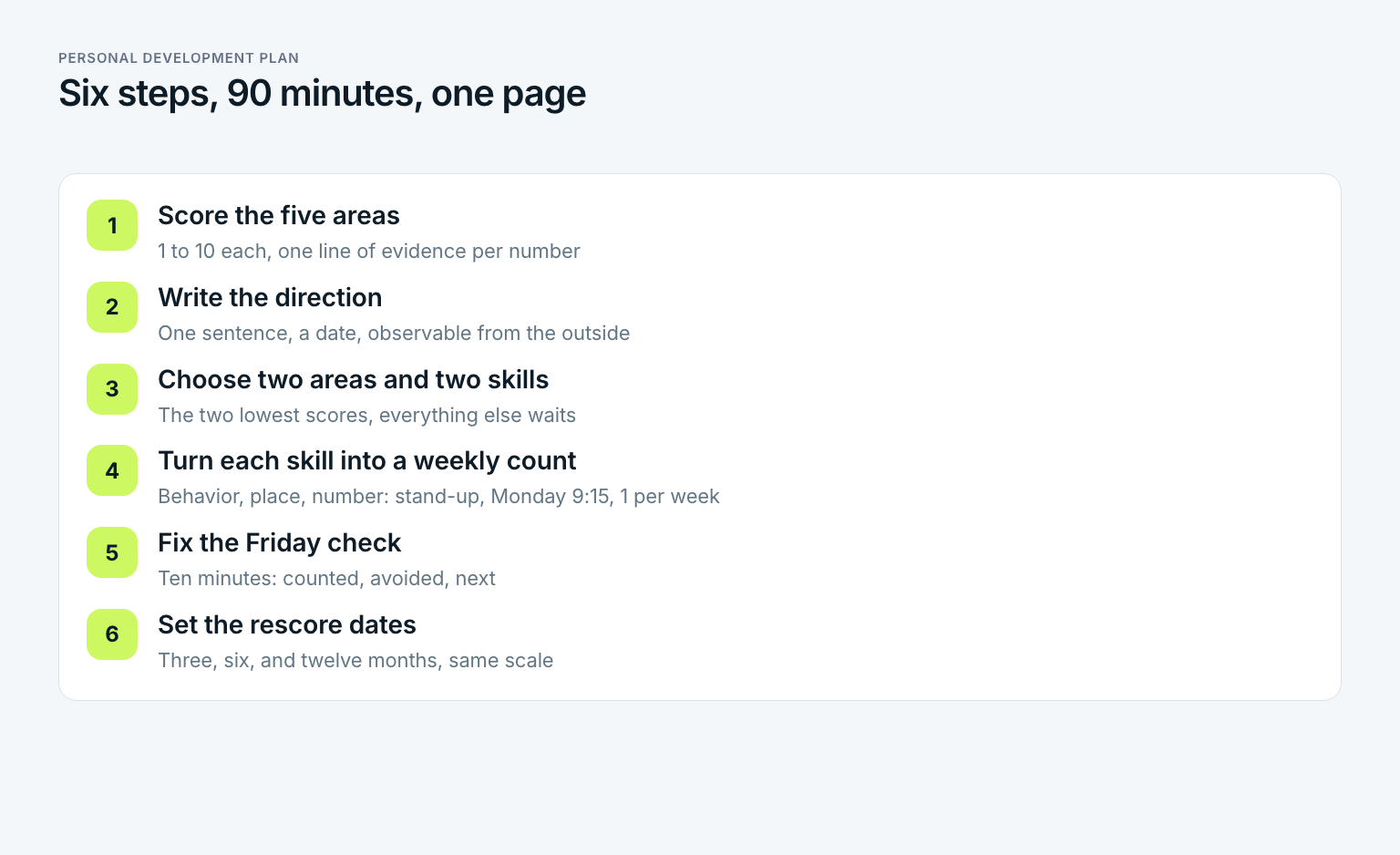
A personal development plan is one page. It takes about 90 minutes to write and ten minutes a week to run. Whoever spends a weekend on it has produced a document, not a plan. The six steps:
Score the five areas, 15 minutes
One number from 1 to 10 per area, one line of evidence per number. Not how you feel about the area, what you did in it last month. Jordan's physical score was a 4 because he had not exercised since March, not because he felt unfit. Evidence keeps the score honest and makes it repeatable in six months.
Write the direction in one sentence, 20 minutes
Who do you want to be able to be in twelve months? The sentence has a date and can be observed from the outside. If you cannot picture someone else noticing it, rewrite it. Weak: be more confident. Strong: be the first name when a team needs a lead, by September 30.
Choose two areas and two skills, ten minutes
Take the two lowest scores, or the two that block the sentence. Two, not five. Each area gets one skill from the list of seven. Everything else waits, and waits is a decision you write down so you stop relitigating it in March.
Turn each skill into a weekly behavior with a count, 20 minutes
A skill is not practiced in general. It is practiced on Monday at 9:15 a.m. in the stand-up. Write the behavior, the place, and the number per week. Run the stand-up: 1 per week. Propose in meetings: 3 per week. Peter Gollwitzer's research on implementation intentions, 1999, is the reason: a behavior tied to a situation gets done, a behavior tied to a wish gets postponed.
Fix the Friday check, five minutes
Ten minutes, same time every week. Three questions: What did I count this week? What did I avoid? What is the one behavior that counts next week? Whoever skips the check for three weeks has not lost discipline. They have lost the plan. Put it in the calendar before anything else.
Set the review dates, five minutes
Rescore the five areas at three, six, and twelve months, same scale, same evidence rule. Compare with the starting line. At six months, swap one skill if it has become routine. At twelve, write the next sentence.
Personal development plan template: one page, ten fields
The template fits on one page or in one note. The third column shows Jordan's entries from January, so you can see how short an answer is allowed to be. Copy the fields, not his answers.
| Field | Question | Example: Jordan, January |
|---|---|---|
| Date | When did I write this, when do I rescore? | January 6, rescore April 6, July 6, October 6 |
| Starting line | Five areas, 1 to 10, one line of evidence each | Mental 7, physical 4, emotional 5, social 4, purpose 6 |
| Direction | Who can I be in twelve months, observed from the outside? | First name for the next team lead opening by September 30 |
| Area 1 and skill | Which area, which skill? | Social: communication |
| Area 2 and skill | Which area, which skill? | Emotional: regulation |
| Weekly behavior 1 | What, where, how often? | Run the Monday stand-up, 9:15 a.m., 1 per week |
| Weekly behavior 2 | What, where, how often? | One proposal per manager meeting, 3 per week |
| Supporting habit | What makes the behaviors easier? | In bed by 10:30 p.m., 4 nights of 5 |
| Friday check | When, how long, which three questions? | Friday 4 p.m., 10 minutes: counted, avoided, next |
| Not this year | What am I deliberately leaving out? | Certification, side business, Spanish. Written down so they stop coming back |
Ready-made goal packages that break a yearly goal down to the day are in the templates hub. Rename or delete any goal inside them.
The three mistakes that turn a year of effort into a year of consumption
Most personal development does not fail at the plan. It fails quietly at one of three points, and none of them feels like a mistake while it is happening. Which one is yours?
The most common mistake: consuming instead of practicing
Reading a book about communication is not communication practice, in the same way that watching a marathon is not training. The brain does not make the distinction for you, because learning something new produces the same satisfaction as doing something new. Jordan read two books in January and could have told you the five steps to pushing back in a meeting. He had pushed back zero times. The fix is a ratio: for every hour of input, one hour of the behavior itself, with another person present. Whoever cannot find the practice hour has chosen a skill that cannot be practiced.
- Developing everything at once. The inventory shows five areas, and the temptation is to fix all five. Five new behaviors a week plus a job plus a life is twenty new decisions a day, and by February the plan is a reproach. Two areas, two skills. The scores of the other three usually rise anyway, because sleep improves when meetings stop being dreaded.
- Measuring the feeling instead of the count. I feel more confident is a mood report, and moods follow the last meeting, not the last six months. The count does not care how Tuesday went. Fifty-eight proposals in 71 meetings is a fact that survives a bad Tuesday. Whoever checks the feeling quits in the first bad week. Whoever checks the count sees the bad week as one data point among twenty.
Self-efficacy
Albert Bandura's term from 1977 for the belief that you can carry out a specific behavior. It is not confidence in general. It is confidence about this task, and it grows mainly from one source: doing the task and seeing it work. That is why Jordan's plan counts stand-ups run and not books read. Each stand-up is a deposit into the only account that pays out as presence.
Personal development in the goal chain: year, quarter, month, week, day
A personal development plan without a time structure is a list of intentions. The goal chain gives it one: the year holds the direction, the quarter one area, the month a countable milestone, the week the behaviors and their numbers, the day the single moment where the behavior happens. Progress at each level is the share of goals done, next to the share of time passed. Jordan's chain for the first quarter:
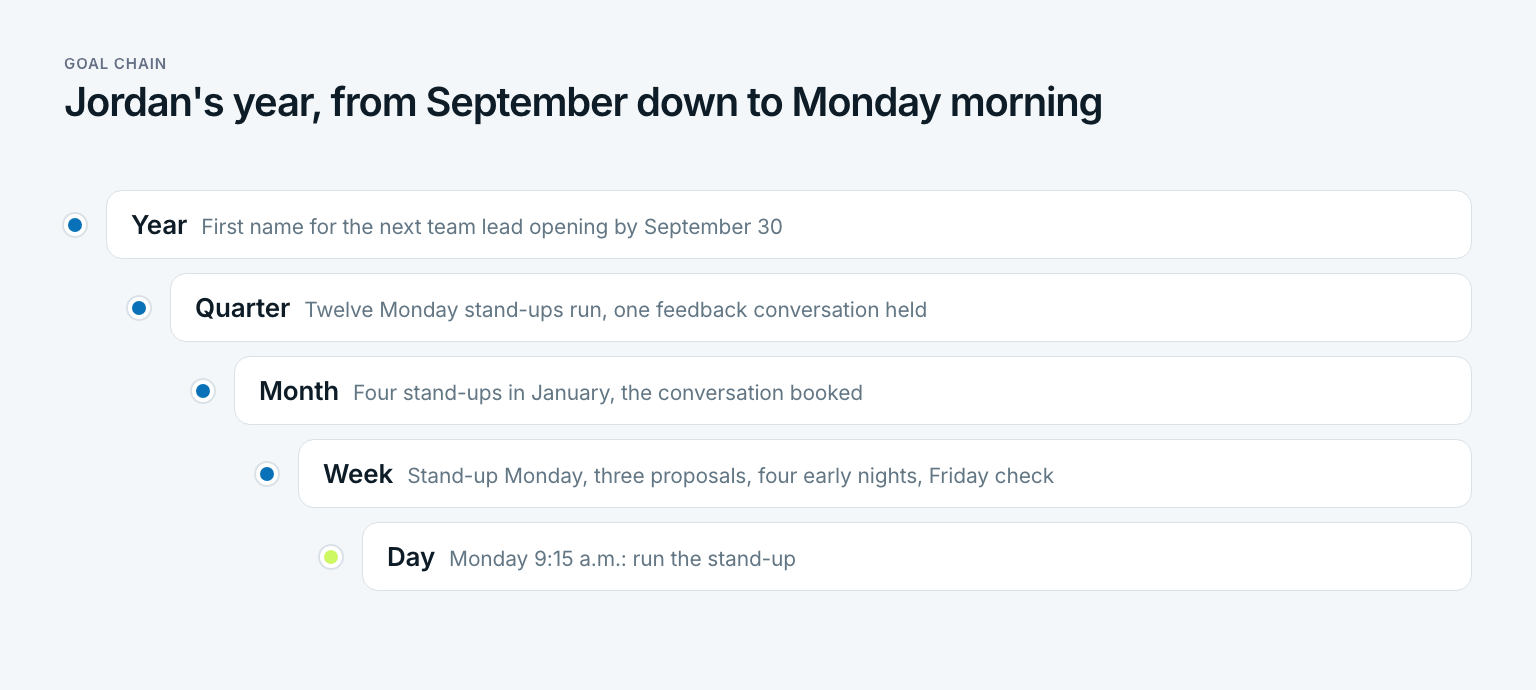
- Year. First name for the next team lead opening by September 30. Checked once, in the September review.
- Quarter, January to March. Social area: run twelve Monday stand-ups and hold one feedback conversation with his manager. Two goals, both countable.
- Month, January. Four stand-ups run, the feedback conversation booked. Progress on January 31: two of two.
- Week. Monday stand-up at 9:15 a.m., three proposals across the week's meetings, four early nights. Friday check at 4 p.m.
- Day. Monday: run the stand-up. Tuesday: one proposal in the planning meeting, written down the evening before in one sentence. The day holds one thing, not a routine.
The second quarter moved to the emotional area, the third added the supporting habit, the fourth was for the rescore and the next sentence. One area per quarter means twelve weeks of full attention, which is roughly how long a new behavior needs before it stops costing willpower. Phillippa Lally and colleagues measured a median of 66 days to automaticity in their 2010 study, with a wide range around it. A quarter covers it. Whoever runs all four areas in parallel gives each a quarter of the attention and gets a quarter of the result.
How the yearly sentence becomes quarterly and monthly goals is in the guide to annual planning. The Friday check is the ten-minute weekly review applied to one plan, and how to phrase the day's single behavior so you can check it off in the evening is in the article on daily goals. The method behind all of it is laid out in how to achieve goals. In Gaapp this chain is the structure itself: five levels, progress shown as goals done next to time passed, and nothing moving to next week on its own. You decide every Friday what comes back, and that decision is the development.
Three questions before you start
Three questions, about your last twelve months:
- Can you name one thing you can do today that you could not do a year ago, and show it to someone?
- Do you know, as a number and not a feeling, how often you practiced it last month?
- Is there a date in your calendar when you will score the five areas again?
Whoever answers no to one of the three has not read too little. They have practiced too little, or counted too little, or both. In short: personal development is not what you know about yourself. It is what you can now do that you could not do before, with a date on it.
Frequently asked questions about personal development
What are the 5 points of personal development?
The five areas most guides use are mental, physical, emotional, social, and spiritual, with purpose as a plainer word for the last one. Mental covers knowledge and thinking skills, physical covers energy and health, emotional covers self-awareness and regulation, social covers communication and relationships, and purpose covers values and direction. Score each from 1 to 10 with one line of evidence, then work on the two lowest.
What are the 7 skills of personal development?
Self-awareness, communication, emotional regulation, time management, learning how to learn, decision making, and persistence. Lists differ, but almost every other skill grows out of these seven. Pick two for a year and turn each into a weekly behavior with a count. The others improve as a side effect.
What are examples of personal development?
Running your team's weekly meeting for a year, asking your manager for feedback once a month, sleeping seven hours on weeknights, saying no to one request a week, finishing a certification with a date, or recovering from criticism within an hour instead of a weekend. Each example has a behavior, a place, and a number. Reading about any of them is preparation, not an example.
What do you mean by personal development?
Personal development is the deliberate, goal-directed change of skills, habits, and attitudes, checked against evidence over time. It differs from self-improvement by having a plan and a count, and from personal growth by being something you can schedule. The test is simple: can you name what you can do now that you could not do a year ago, and show it?
How do I write a personal development plan?
Score the five areas from 1 to 10 with evidence, write a one-sentence direction with a date that others could observe, choose two areas and two skills, turn each skill into a weekly behavior with a count, fix a ten-minute Friday check, and set rescore dates at three, six, and twelve months. The whole plan fits on one page. The template above has the ten fields.
What is the difference between personal development and self-improvement?
Self-improvement asks how to get better in general and usually measures input: books read, podcasts heard, habits attempted. Personal development asks what you will be able to do by a date and measures output: a behavior demonstrated, a count reached, a score moved. Self-improvement is where most people start. Personal development is what happens when you add a plan, a count, and a Friday.
Last updated: 19 October 2026
Read next
 Personal Growth
Maslow's Hierarchy of Needs: The 5 Levels Explained
Maslow's hierarchy of needs sorts motivation into five levels. What each level means, what research says today and a needs audit you can run yourself.
14 min read
 Personal Growth
Mindfulness Exercises: 12 for Everyday Life
Mindfulness exercises are not about emptying your mind. 12 techniques for stress and focus, what research shows, and a four-week plan to practice daily.
16 min read
 Personal Growth
Positive Affirmations: 50 Examples You Can Believe
Positive affirmations are not magic words. What research shows, 50 daily affirmations you can believe, and a five-step method with a worked example.
16 min read