Ikigai: Meaning, Origins and How to Find Yours
Ikigai isn't a Venn diagram: what the word means in Japan, who drew the four circles, Mogi's five pillars, the 10 rules and five steps to find yours.

Contents
- 01Ikigai meaning: what the Japanese word actually says
- 02Where the ikigai diagram really comes from
- 03Japanese ikigai vs the Western diagram
- 04Ken Mogi's five pillars of ikigai
- 05The 10 rules of ikigai and the 80% rule
- 06How to find your ikigai in five steps
- 07Priya's ikigai: what 24 entries showed
- 08From ikigai to Tuesday night: the goal chain
- 09Three mistakes people make with the ikigai diagram
- 10Three questions to ask yourself
- 11Ikigai FAQ
Ikigai is not a Venn diagram with four circles. The Japanese word means roughly “a reason for being” or “what makes life worth living,” and in Japan it usually points to ordinary things: a morning walk, the grandkids, a vegetable patch, a job you happen to enjoy. The famous ikigai diagram with passion, mission, vocation and profession was drawn in the West and only got its Japanese label in a 2014 blog post. Anyone who knows both versions can use the diagram without letting it pass judgment on their life.
The worked example is Priya, 34, a staff accountant at a hospital system in Raleigh, North Carolina. Last spring a friend shared the ikigai diagram on LinkedIn, and Priya filled it in on a Sunday night. Her result was a letdown. She is good at accounting, she gets paid for it, and the hospital clearly needs it. She just doesn't love it. The caption under the post said to follow your passion, and Priya spent the next month browsing career-change bootcamps. Below you'll find the real ikigai meaning, where the diagram actually comes from, Ken Mogi's five pillars, the 10 rules of ikigai and the 80% rule, a five-step way to find your ikigai with a template, Priya's numbers and a goal chain down to Tuesday night.
Ikigai meaning: what the Japanese word actually says
Ikigai is built from two parts. Iki means life or to live. Gai is a sound-shifted form of kai, which means worth, value or effect. Put together, ikigai is the worth of living, or more loosely, the thing that makes it worth getting up in the morning. In Japanese it's an everyday word. Nobody needs a workshop to use it.
Ask people in Japan about their ikigai and few of them start with a job title. Common answers are grandchildren, a garden, a choir, cooking for the family, a sports club or work, if the work is enjoyable. Ikigai can be large, like a craft someone spends forty years refining. It can also be as small as the cup of coffee you drink in peace before the house wakes up. And nobody is limited to one. In short: ikigai is what gives a day its weight, not what has to justify an entire life.
Mieko Kamiya: ikigai as a source and as a feeling
The most careful early account comes from psychiatrist Mieko Kamiya. She worked at Nagashima Aiseien, a sanatorium for people with leprosy who had been isolated from their families, many of them for life. In 1966 she published “Ikigai ni tsuite,” which translates roughly as On Ikigai. Kamiya wanted to understand why some residents found a reason to live under those conditions and others did not.
She separated two things that English tends to blur. One is the source, the thing that gives you ikigai: a person, a task, a garden, a faith. The other is the feeling that comes from it, called ikigai-kan, the sense that your life is worth living. That means: the source and the feeling are linked, but they're not the same thing. Anyone who loses a source, say a career at retirement, doesn't automatically lose the feeling. They need a new source, and it's allowed to look nothing like the old one.
What research says about ikigai
Ikigai is also a subject of public health research in Japan. The best known example is the Ohsaki Study from Miyagi Prefecture, published by Toshimasa Sone and colleagues in 2008. More than 40,000 adults were asked whether they had ikigai and then followed for seven years. People who said they had none showed a higher risk of dying during that period, including from cardiovascular disease.
That's an observational study. It shows a link, not proof that ikigai makes you live longer. People who are already sick may simply be less likely to name an ikigai. Still, notice how the question was asked. Participants were asked whether they had ikigai in their lives, not whether they had found the overlap of passion, skill, need and pay.
The ikigai concept in one sentence
If you had to explain the ikigai concept to a ten-year-old, you'd say: it's the thing you look forward to when you wake up. That's the whole Japanese meaning. The circles, the overlaps and the hunt for one true calling were added later, on another continent.
Where the ikigai diagram really comes from
The diagram you've seen on posters, slide decks and LinkedIn didn't come from Japan. Its basic form was drawn by Andrés Zuzunaga in Spain as a model of life purpose. The word in the middle was the Spanish word for purpose: propósito. In May 2014, British blogger Marc Winn borrowed that diagram for a post about ikigai and replaced the word in the center with ikigai. From there it spread through talks, books and social feeds until many people took it for ancient Japanese wisdom.
That's not a scandal. Winn combined two good ideas, and the result is a useful tool. It just answers a different question than the Japanese word does. The diagram asks: what work fits me? Japanese ikigai asks: what makes my day worth it? Anyone who mixes the two up ends up searching their career for something many people in Japan find somewhere else entirely. And anyone who doesn't know where the diagram came from mistakes a career tool for a philosophy of life.
The four circles of the ikigai diagram
The diagram has four circles. Each one asks a question, and each overlap of two neighboring circles has its own name. Since Winn, the spot where all four meet is labeled ikigai. Here are all eight fields with Priya's answers:
| Field | Question or overlap | Priya's answer |
|---|---|---|
| What you love | What do you do even when nobody asks you to? | Explaining money to people, cooking dal on Sundays, running the greenway at 6:30 a.m. |
| What you're good at | What do people come to you for? | Reconciliations, spotting errors, making messy spreadsheets readable |
| What the world needs | Who is missing something you could give? | Families who can't afford tax help, new hires who feel lost |
| What you can be paid for | What does someone pay you to do? | Staff accounting at the hospital |
| Passion | what you love and are good at | Teaching someone to read a pay stub |
| Mission | what you love and the world needs | Free tax help, money basics for her cousins |
| Vocation | what the world needs and you're paid for | Keeping a hospital's books accurate |
| Profession | what you're good at and paid for | Staff accountant |
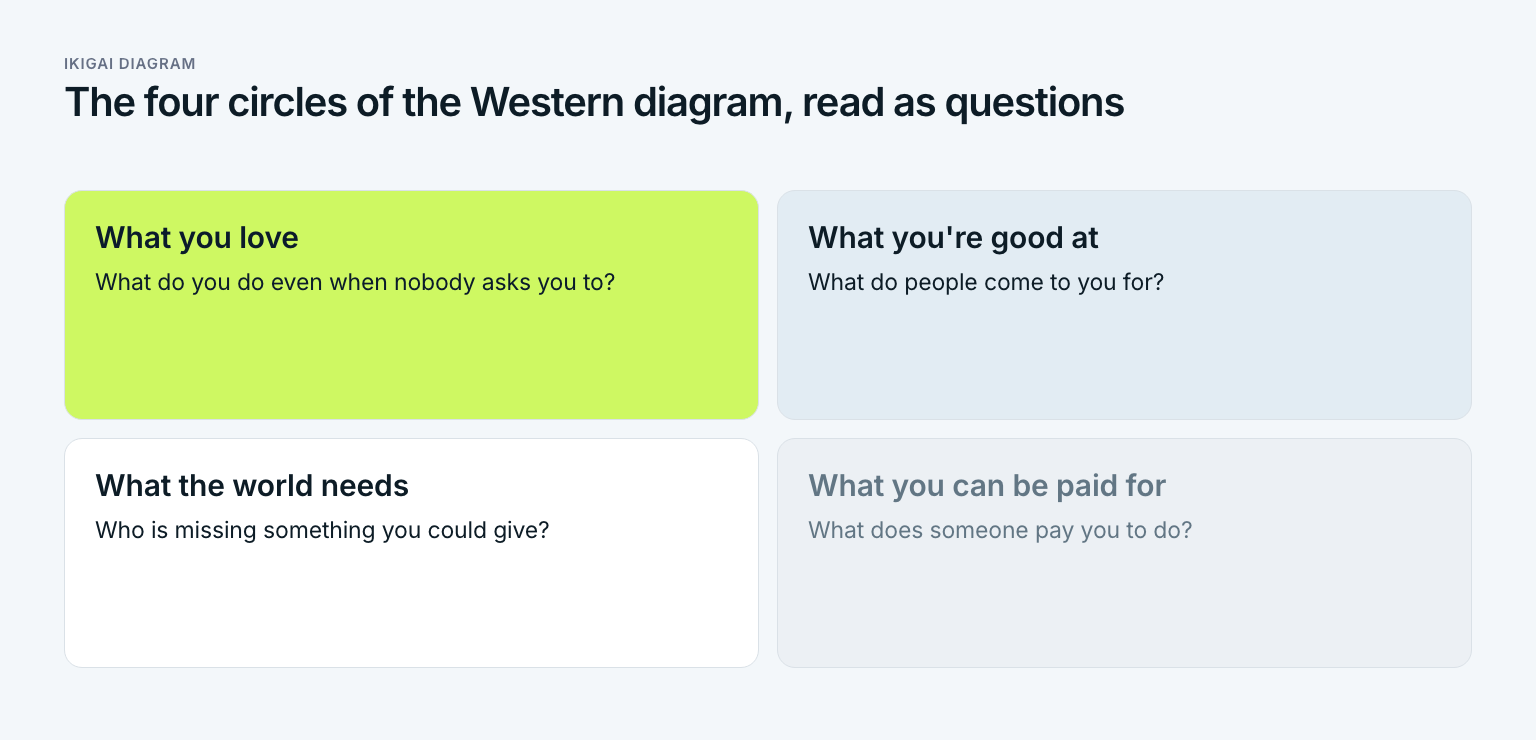
For Priya the picture is clear. Profession and vocation sit inside her job. Passion and mission sit almost entirely outside it. The center is empty. By the diagram's logic, she has no ikigai. By the Japanese meaning, she has at least three, and one of them happens every Sunday in her kitchen.
Japanese ikigai vs the Western diagram
The four-circle diagram is a good tool. Anyone facing a career decision gets four clean questions out of it and a shared language for talking it through with a partner, a coach or a manager. It's just built for a different job than the Japanese word. The differences are less about tone than about substance:
| Aspect | Ikigai in Japan | The Western ikigai diagram |
|---|---|---|
| Origin | Everyday word, studied by psychiatrist Mieko Kamiya in 1966 | Diagram by Andrés Zuzunaga, relabeled ikigai by Marc Winn in 2014 |
| Where it lives | Anywhere: family, hobbies, work, nature, faith | Mostly in your career |
| Role of money | None | One of four circles, so a requirement |
| Size | Often small and everyday | One big calling |
| How many | Several at once | One point in the middle |
| Core question | What makes my day worth it? | What work fits me? |
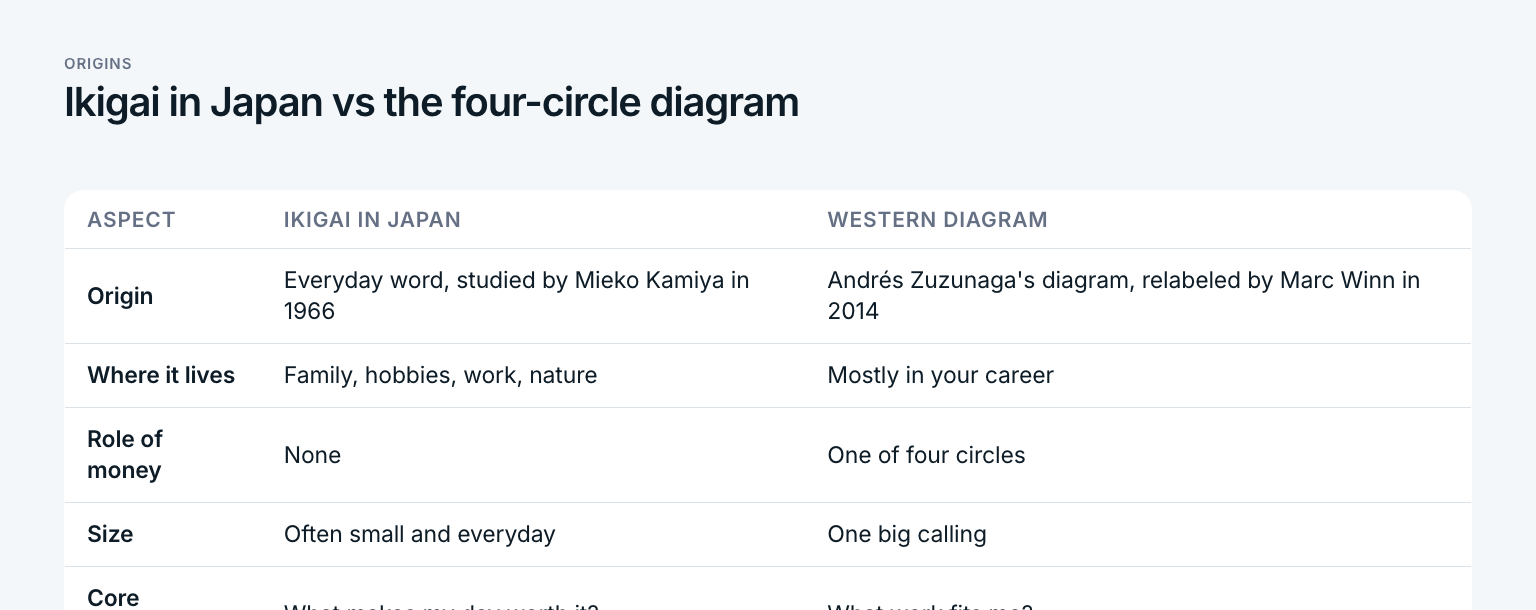
That means: you don't have to pick a side. Use the diagram for questions about work and the Japanese meaning for questions about everyday life. Trouble only starts when the diagram becomes a verdict on your whole life. Why would a home health aide have no ikigai just because her pay circle is small? And why would a retiree have none just because nobody pays him anymore?
Work can absolutely be an ikigai in Japan too. For many in the postwar generation it was the main one. The difference is that work is one possible source among several, not a precondition. Whoever understands that can fill in the diagram without being shaken by the result.
Ken Mogi's five pillars of ikigai
Neuroscientist Ken Mogi, a researcher at Sony Computer Science Laboratories in Tokyo, published a book on ikigai in 2017 that stays close to the Japanese meaning. He describes five pillars. They aren't a checklist. They're attitudes an ikigai rests on:
- Starting small. Ikigai begins with a small step, not a life plan. Anyone who cooks one good meal every Sunday is already practicing.
- Releasing yourself. You don't have to be special to do something with care. Your ego and your need for applause can step back.
- Harmony and sustainability. An ikigai fits the people and the place around you, and it can last for years without pushing anyone aside.
- The joy of little things. The first sip of coffee, the sound of rain, a pot of dal that came out right all count.
- Being in the here and now. Ikigai happens in the present moment, not in some future you still have to earn.
For Priya, the fourth pillar was the real surprise. She had always treated her Sunday cooking as a chore she happened to like. By Mogi's account, that's exactly what an ikigai is: a fixed stretch of time where she isn't performing for anyone and the week feels like hers. Anyone who takes moments like that seriously already has more ikigai than the diagram could ever show.
The first pillar is the most practical. Starting small doesn't mean having small goals. It means making the first step small enough to fit into the life you have now. Anyone whose first move is a resignation letter skips this pillar, and often ends up right back where they started.

The 10 rules of ikigai and the 80% rule
The 10 rules of ikigai that people search for don't come from an old Japanese text. Héctor García and Francesc Miralles put them together in their book “Ikigai: The Japanese Secret to a Long and Happy Life,” first published in Spanish in 2016. The two authors interviewed elderly residents of Ōgimi, a village in northern Okinawa known for its many centenarians. The rules sum up what they observed there. In paraphrase:
- Stay active and never fully stop doing meaningful work, even in retirement.
- Slow down. Rushing costs more than it gives.
- Don't fill your stomach. Stop eating when you're about 80% full.
- Surround yourself with good friends.
- Keep moving a little every day so you're in better shape by your next birthday.
- Smile and be friendly to the people you meet.
- Reconnect with nature.
- Give thanks, for people, for food, for the day.
- Live in the moment.
- Follow your ikigai.
The third rule is the 80% rule in ikigai. In Okinawa it has its own name, hara hachi bu, which roughly means eat until your stomach is eight parts full. Many older Okinawans say it as a reminder before meals. The other rules sound familiar because there's little that's uniquely Japanese about them. Movement, friendship, gratitude and a slower pace show up in almost every guide to aging well. To practice the gratitude from rule eight, the guide to how to start a gratitude journal shows a format that lasts.
In short: the ten rules are a recipe for a long, calm life, written down by two European authors after conversations in one particular village. That doesn't make them wrong. It makes them something other than a definition of ikigai. Strictly speaking, only rule ten is about what your ikigai actually is.
How to find your ikigai in five steps
Finding your ikigai isn't a search for one answer. It means collecting the sources you already have and giving them room. The five steps below use both views: the Japanese meaning for collecting, the diagram for sorting. If you want to dig into why something matters to you, the two-week audit in Finding Purpose goes deeper. This guide stays with ikigai in daily life.
Keep an ikigai log for seven nights
Every evening for a week, write down what you looked forward to that day and what left you better off afterward. Small things count: the coffee, a phone call, a problem you solved. Note how many minutes each one took. Aim for 20 to 30 entries.
Group the entries, 30 minutes
Cluster entries that share a pattern into three to five groups. Name each group with a verb, like explaining, finishing, feeding or being outside. The verb tells you more about your ikigai than any single hobby.
Ask the four circles as questions
Hold each group up to the four circles: do you love it, are you good at it, does someone need it, does anyone pay you for it? Note which circles apply. A group that hits one or two circles isn't a failure. It shows where your ikigai lives today and where it could grow.
Write your ikigai sentence
Put your strongest group into one sentence that starts with “I get up to …” The sentence needs a verb and someone who benefits. It can be small. It just has to be true.
Give it hours on your calendar
Count how many hours a week your strongest group gets today. Decide how many it should get three months from now, and put the first fixed session on your calendar. An ikigai with no time attached stays a nice memory.
Template: the ikigai log
A table with five columns is enough, on paper or in a notes app. Here are two of Priya's evenings:
| Day | What I looked forward to | Minutes | Group | Circles |
|---|---|---|---|---|
| Tuesday | Run on the greenway at 6:30 a.m. before email | 35 | tending | love |
| Tuesday | Walked the new hire Jordan through her first month-end close | 40 | explaining money | love, good at, needed, paid |
| Tuesday | Cousin Anika texted about her first paycheck, explained withholding on a call | 25 | explaining money | love, good at, needed |
| Wednesday | Closed the accounts payable reconciliation with zero open items | 50 | finishing | good at, needed, paid |
| Wednesday | Made a double batch of dal and froze half for the week | 60 | tending | love |
During the week, you only write down what happened. Judging comes later. Anyone who rates entries on the spot tends to cross out the small things before they ever get counted. And the small things are exactly what the diagram misses.
Priya's ikigai: what 24 entries showed
After seven evenings Priya had 24 entries. Nine were about tending: runs, cooking, the plants on her balcony. Ten were about explaining money to someone, at work or in her family. Five were about finishing things cleanly at the office. The split surprised her. She'd assumed her job was the center of her life because it got the most hours. Most of her good moments came from explaining.
| Group | Entries | Hours per week today | Circles |
|---|---|---|---|
| Explaining money: new hires, cousins, friends | 10 | 2 h | love, good at, needed, partly paid |
| Tending: running, cooking, plants | 9 | 5 h | love |
| Finishing: closes and reconciliations | 5 | 10 h | good at, needed, paid |
That's how you know your ikigai: not by a flash of insight but by counting. Priya's sentence reads: “I get up to make money less scary for people nobody ever taught.” It fits her cousin, it fits Jordan, and it doesn't require quitting accounting. It requires moving hours. Two seasons ago she had volunteered once at a free tax clinic run through the IRS Volunteer Income Tax Assistance program, known as VITA, and still remembers the family that left with a refund they didn't know they were owed. That memory gives the sentence a concrete next step.
The tending group stays exactly as it is. It hits only one circle on the diagram, and that's fine. By Mogi's account, it's the core of what ikigai means. Anyone who cuts it because it doesn't score on the diagram cuts the foundation. That means: not every ikigai needs to grow. Some of them only need protecting, mostly from your own ambition.
And the job? It stays too. The finishing group hits three circles, and Priya is very good at it. She doesn't love it, but she likes the moment a reconciliation ties out. That's enough. Anyone who expects a job to fill all four circles loads it with a task that other parts of life can carry.
From ikigai to Tuesday night: the goal chain
An ikigai sentence is a direction, not a goal. To show up in real life, it needs an outcome with a date and a fixed place in your week. How a direction becomes life goals with a year attached is covered in Life Goals. For Priya, a one-year chain is enough to start:
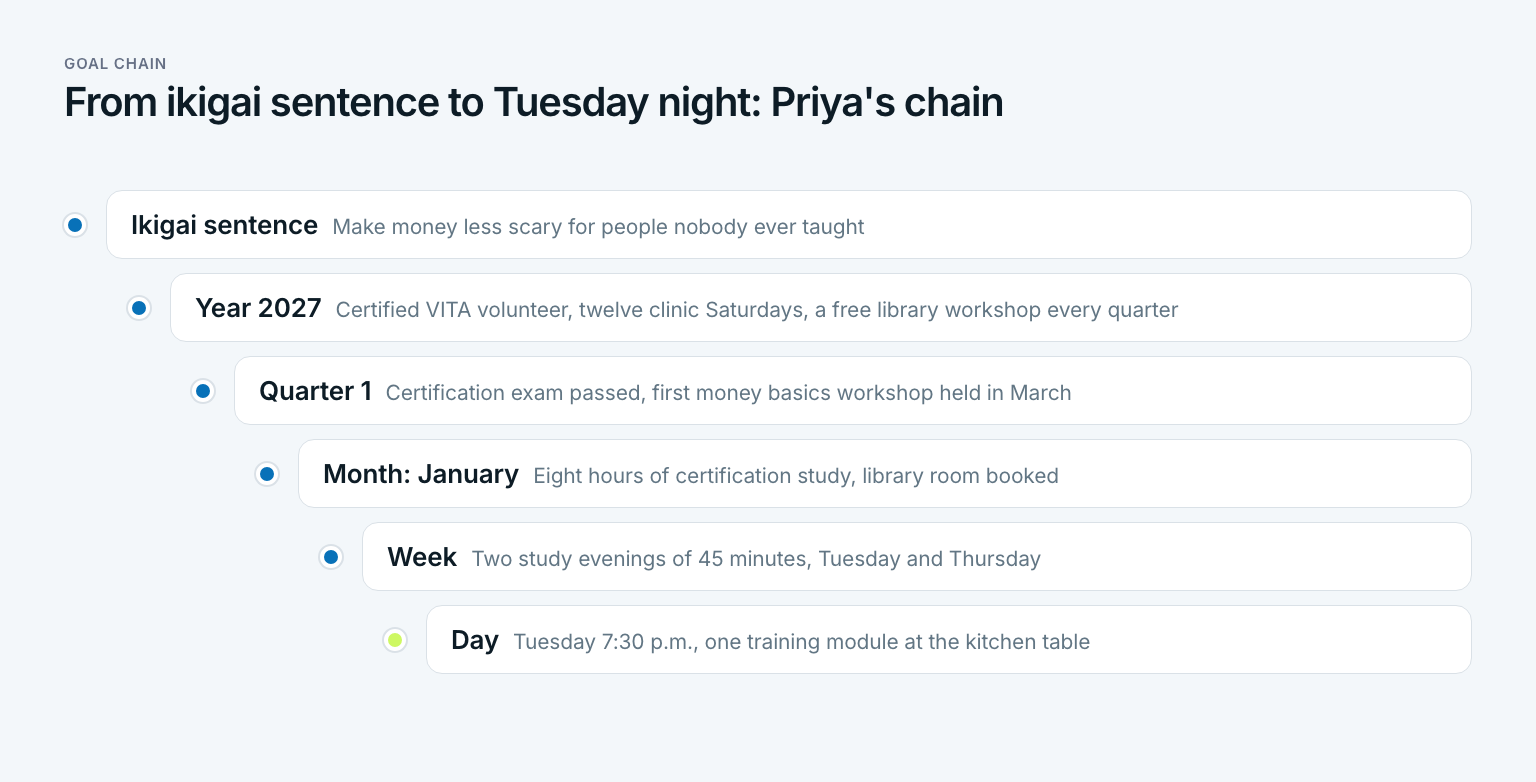
Each level answers a different question. The year says what's true at the end: certified as a VITA volunteer, twelve Saturdays at the clinic during tax season and a free money basics workshop at the county library every quarter. The quarter says what has to happen first: the certification exam and the first workshop in March. The month sets eight hours of study. The week says when, and the day turns it into a session Priya can check off.
In Gaapp, Priya can see at a glance whether her weeks are carrying the quarter. If three study evenings slip in January, she notices in January, not in April when the clinic opens. Anyone who only has the sentence ends the year with a good feeling and the same calendar as before. If you want to build yearly goals this way, start with Yearly Goals.
Three mistakes people make with the ikigai diagram
Most problems with ikigai don't come from the word. They come from the diagram. Three mistakes show up again and again, even among people who plan everything else carefully:
The most common mistake: using the diagram as a test
Anyone who fills in the four circles and finds the center empty tends to conclude: I don't have an ikigai. The diagram can't actually tell you that. It checks whether one single activity meets four conditions at once, and very few people have that. In the Japanese sense, you have an ikigai as soon as something makes your day worth it. Treat the circles as questions, not a verdict.
Second: making money a requirement. The “what you can be paid for” circle is useful for career decisions. As a condition for a meaningful life, it doesn't hold up. Volunteering, raising kids and caring for a parent would all fail the test. Mieko Kamiya wrote her book about people who had been shut out of working life entirely, and many of them had an ikigai anyway.
Third: waiting for the big one. Anyone who believes real ikigai must be one grand life mission overlooks the small sources that are already there. Mogi's first pillar is starting small for a reason. One clinic Saturday is an ikigai. So is a pot of dal on Sunday.
What do all three mistakes have in common? They turn a question into an exam. Exams can't be passed when their conditions don't fit your life. Questions can always be answered, even if the answer turns out smaller than you hoped.
Three questions to ask yourself
Before you start your log, answer three questions. They take five minutes and show you where you stand right now:
- What did I genuinely look forward to in the last seven days, and how many minutes did it take?
- Which of those things would I miss if I dropped it for a month?
- Does what gives me the most get the most hours, or does it get the leftovers?
Anyone who honestly answers the third question with “the leftovers” knows where the first step is. More questions like these are in Self-Reflection. Ikigai isn't a place you arrive at one day. It's what you make time for every week.
Ikigai FAQ
What are the 10 rules of ikigai?
The 10 rules come from the 2016 book “Ikigai” by Héctor García and Francesc Miralles. In short: stay active, slow down, stop eating at 80% full, keep good friends, keep moving, smile, reconnect with nature, give thanks, live in the moment and follow your ikigai. They summarize what the authors observed in Okinawa and are not an ancient Japanese teaching.
What is the ikigai concept?
Ikigai is a Japanese word for what makes life worth living, the thing you look forward to when you wake up. It can be a person, a hobby, a task or your work, and it's often small and everyday. The four-circle diagram is a later Western addition that focuses on careers.
How do I know my ikigai?
Keep a log for one week of everything you looked forward to, with the minutes each took. Group the entries, check each group against the four circles as questions and write one sentence for the strongest group. Then give that group fixed hours on your calendar.
What is the 80% rule in ikigai?
It's the Okinawan habit of hara hachi bu: stop eating when you feel about 80% full. García and Miralles list it as one of their 10 rules of ikigai. It's a guideline for eating and health, not part of the original meaning of the word.
Is the ikigai diagram Japanese?
No. The four-circle diagram goes back to Andrés Zuzunaga in Spain, whose version had the word for purpose in the center. British blogger Marc Winn replaced it with ikigai in 2014. In Japan, ikigai usually refers to everyday joys and roles rather than a career sweet spot.
What does ikigai mean literally?
Iki means life or to live, and gai comes from kai, meaning worth or value. Together it means the worth of living. In practice it's used for whatever makes someone's days feel worthwhile.
Last updated: 14 October 2026
Read next
 Personal Growth
Maslow's Hierarchy of Needs: The 5 Levels Explained
Maslow's hierarchy of needs sorts motivation into five levels. What each level means, what research says today and a needs audit you can run yourself.
14 min read
 Personal Growth
Mindfulness Exercises: 12 for Everyday Life
Mindfulness exercises are not about emptying your mind. 12 techniques for stress and focus, what research shows, and a four-week plan to practice daily.
16 min read
 Personal Growth
Positive Affirmations: 50 Examples You Can Believe
Positive affirmations are not magic words. What research shows, 50 daily affirmations you can believe, and a five-step method with a worked example.
16 min read