Pomodoro Technique: Five Steps and a Worked Week
The Pomodoro Technique splits work into 25-minute rounds with short breaks. Five steps, interruption rules, a worked week with numbers, and a template.

Contents
- 01What the Pomodoro Technique is and why it is named after a tomato
- 02The 5 steps in the Pomodoro Technique
- 03What really happens to your focus: 25 minutes is a measurement, not a rule
- 04How many pomodoros a day: the honest number
- 05Pomodoro method vs time blocking, Flowtime and the 3-3-3 rule
- 06Is the Pomodoro Technique good for ADHD?
- 07Which Pomodoro timer is best: mechanical, cube, or app
- 08The Pomodoro Technique in your goal chain: year, quarter, month, week, day
- 09The three mistakes nobody notices, and a template that catches them
- 10Frequently asked questions about the Pomodoro Technique
The Pomodoro Technique is not a timer trick. It is a method for measuring focus: you choose one task, work on it for 25 minutes without switching, take a five-minute break, and mark the round as done. After four rounds you take a longer break of 15 to 30 minutes. A timer on its own tells you when to stop. The Pomodoro Technique tells you how many of your hours went to the work you actually chose.
Three things make it work: a unit of time that cannot be split, a rule for interruptions, and a sheet where every round is recorded. Without the third, the first two decay into a kitchen timer within a week. All three are shown here on two weeks of Marcus, 31, a freelance web developer in Portland, Oregon, who is recording an online course in the three hours before his client work starts each morning. His numbers, his interruptions, and his template run through this article.
What the Pomodoro Technique is and why it is named after a tomato
The Pomodoro Technique is a time management method developed by Francesco Cirillo in the late 1980s, when he was a university student in Italy who could not study for more than a few minutes at a stretch. He made a deal with himself: ten minutes of real study, timed on a tomato-shaped kitchen timer. Pomodoro is the Italian word for tomato. The deal held, the interval grew to 25 minutes, and the timer gave the method its name. No lab, no committee, one student and a plastic tomato.
The method has four fixed parts. A pomodoro is 25 minutes of work on one task. A short break is five minutes. A set is four pomodoros. A long break after a set is 15 to 30 minutes. Cirillo wrote the method down in 2006 and published the book The Pomodoro Technique in an expanded edition in 2018. Anyone who searches for the tomato technique, the pomodoro method, or simply pomodoro lands on the same four parts.
What gets lost in most summaries is that Cirillo built the method around measurement, not around the timer. The point is the record: how many pomodoros a task took, how many you estimated, and how often you were interrupted. A tomato-shaped timer without a sheet next to it is a kitchen gadget. With the sheet, it is a way of seeing your day in units you can count.
Why a pomodoro is indivisible
A pomodoro has no halves. If you stop at minute 17 to answer a call, the pomodoro is void, and it does not count as 17 minutes of work. The rule sounds harsh, and it is the heart of the method. Anyone who can split a pomodoro will split it every time something feels urgent. The indivisible unit keeps the count honest.
The 5 steps in the Pomodoro Technique
The steps are simple enough to run on the first morning. The difficulty is keeping step four when the timer rings and you are mid-sentence. Marcus started on Monday, October 5, 2026, at 7 a.m., with three hours before his first client call.
Choose one task and write it down
Not a project, a task: “Write the script for lesson 4”, not “work on the course”. A task that only lives in your head swaps itself for an easier one at minute twelve. Marcus wrote: Script lesson 4, estimate two pomodoros.
Set the timer to 25 minutes
Wind a mechanical timer or start a countdown you can see. Setting it is a commitment, and Cirillo made a point of the physical motion. Phone in another room. The only screen open is the one the task needs.
Work until the timer rings, on that task only
If a thought arrives that is not the task, write it on the sheet in one line and return. If a person arrives, inform them you are busy, negotiate a time, and call back. If you must stop, the pomodoro is void and starts again from zero.
Mark the pomodoro and take a five-minute break
Put an X next to the task. Then stand up. The break is not for email. It is for water, the window, or stretching. Five minutes, timed as well.
After four pomodoros, take a long break of 15 to 30 minutes
Four X marks mean a set is complete. Walk, eat, step away from the desk. Then look at the sheet: how many pomodoros has the task taken against the estimate? Adjust before the next set.
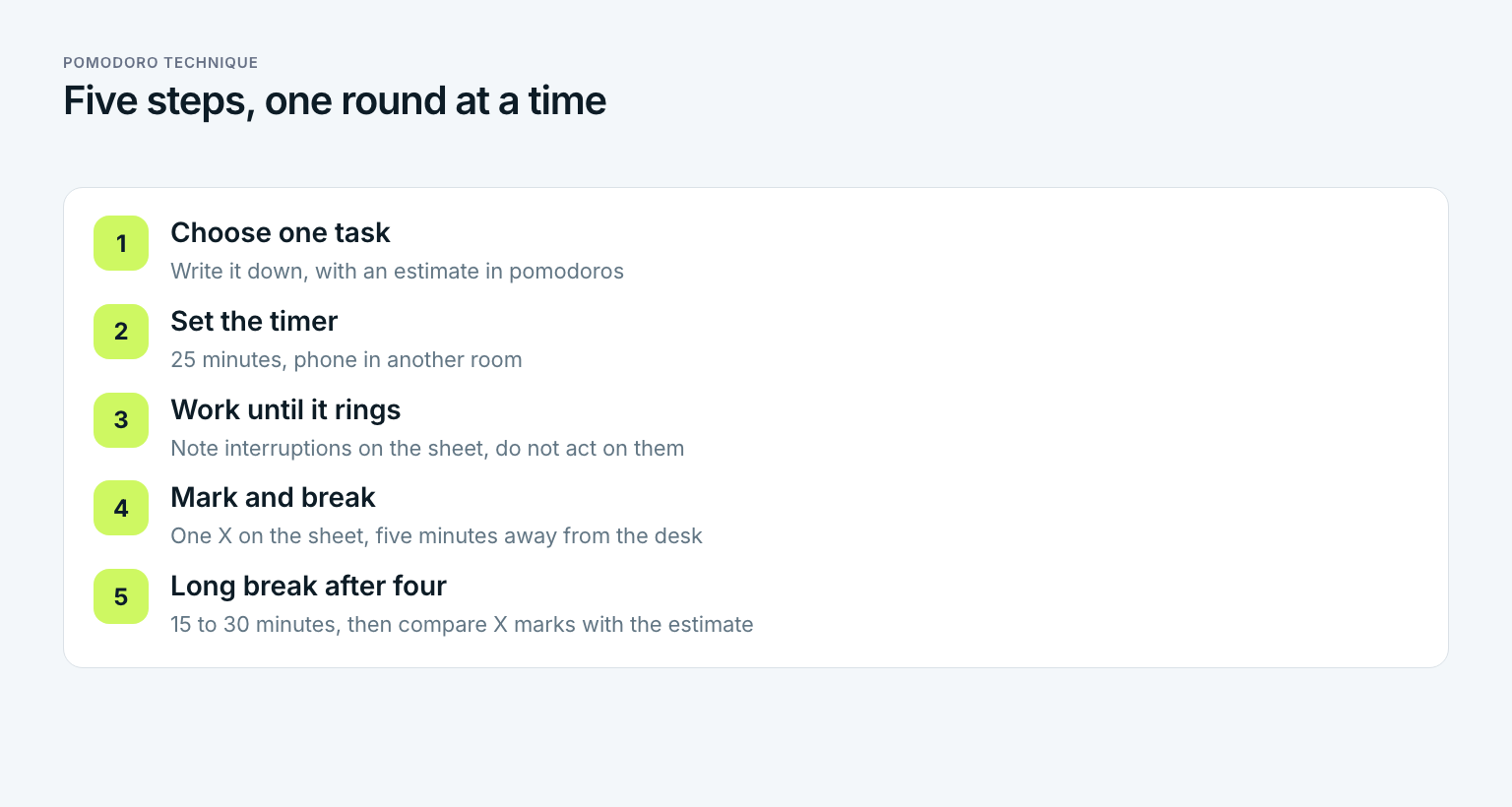
That is the Pomodoro Technique in five steps. Marcus’s first set on Monday ran from 7:00 to a little after 9:00, including the restart of one void pomodoro, and produced three X marks and a script that was not finished. The estimate had been two pomodoros. The sheet already knew something he did not.
What really happens to your focus: 25 minutes is a measurement, not a rule
Most articles present 25 minutes as a magic number. It is not. Cirillo chose it because it was long enough to get into a task and short enough to feel finishable on a bad day. The real finding of the Pomodoro Technique is not what 25 minutes does for your focus. It is what the record shows about where your focus went. The number is almost always lower than expected.
Marcus’s first week makes the point. His plan was six pomodoros each morning, 30 for the week, enough for three lessons at his estimate of two pomodoros to script and two to record. His October goal: twelve lessons scripted and recorded. The week of October 5 was supposed to deliver three. How many of the 30 pomodoros did he complete?
| Day | Planned | Completed | Void | Never started | Interruptions | What happened |
|---|---|---|---|---|---|---|
| Monday | 6 | 4 | 1 | 1 | 5 | Script for lesson 4 not finished |
| Tuesday | 6 | 4 | 2 | 0 | 6 | Client message at 7:40, two pomodoros void |
| Wednesday | 6 | 5 | 1 | 0 | 3 | Best day by count, phone left in the kitchen |
| Thursday | 6 | 2 | 2 | 2 | 6 | Client call moved to 8 a.m. |
| Friday | 6 | 4 | 1 | 1 | 3 | Lesson 4 recorded, late start |
| Week | 30 | 19 | 7 | 4 | 23 | Two lessons scripted, one recorded |
Nineteen whole pomodoros out of 30 planned. Seven voided, most inside the first ten minutes, and four that never started. Of the 23 interruptions, 15 came from Marcus himself: an idea for a client bug, a look at the inbox, a second coffee. Eight came from outside, five of them from a single client on Slack. Output: two lessons scripted, one recorded. The target had been three recorded, and the first script alone had eaten four pomodoros instead of two.
Without the sheet, this would have been a frustrating week with no explanation. With the sheet, it has three explanations, each with a fix. The estimates were wrong by half. The phone was the main source of interruption, and it sat on the desk on four of five days. And the client who messaged at 7:40 had never been told that mornings were closed. That means: the technique did not make Marcus more focused in week one. It made his lack of focus countable, which is the step everyone skips.
Internal and external interruptions: inform, negotiate, call back
Cirillo splits interruptions in two. Internal ones come from you: a thought, an urge, a sudden errand. You mark them with an apostrophe, write the thought in one line, and keep going. External ones come from others, and for those he gives a three-part script: inform the person you are busy, negotiate a time, and call back at that time. Both marks go on the sheet, because an interruption you did not write down is one you will repeat tomorrow.
Week two, with the fixes. Marcus cut the plan to five pomodoros a day, told his main client that he was offline before 10 a.m., and left his phone charging in the kitchen. The numbers: 25 planned, 23 completed, two void, nine interruptions. Output: three lessons scripted and three recorded. The estimate per lesson is now seven pomodoros, four to script and three to record. Twelve lessons means 84 pomodoros, at 23 a week just under four weeks, and October has four working weeks left. In short: the month is possible, and he knows it from the sheet rather than from hope.
How many pomodoros a day: the honest number
Sixteen. That is how many pomodoros fit into an eight-hour day on paper, and nobody reaches it. Meetings, lunch, and email take their share. Whoever plans sixteen will finish the day with a sheet that looks like a failure and quit within a week. The useful question is not how many pomodoros a day are possible. It is how many you can defend.
| Situation | Realistic per day | Why |
|---|---|---|
| Full-time knowledge work with meetings | 6 to 8 | Half the day is already spoken for, and the other half arrives in fragments |
| Exam preparation or thesis writing | 10 to 12 | Few external interruptions, but attention fades after the third set without a real break |
| Side project before or after a job | 4 to 6 | Marcus’s case: three hours, and part of one is lost to warming up and the first interruption |
| Parent working from home with children present | 2 to 4 | Each pomodoro needs a protected window, and two protected windows a day is a good day |
| Team day with shared pomodoros | 4 to 6 | Shared rounds work when everyone agrees on the same ring, which caps the number |
Marcus settled on five: two hours and five minutes of recorded work, plus breaks, inside a three-hour morning. The rest absorbs the late start and the restart of a void pomodoro. Five is also the number he hit on four of five days in week two. A number you hit four days out of five is a plan. A number you hit once is a wish.
There is a second rule hidden in the count. Cirillo suggests that a task estimated at more than five to seven pomodoros is too large and should be split, and a task under one pomodoro should be grouped with others. Marcus splits each lesson into script and recording, two tasks with their own estimates. Anyone who estimates every task before starting learns within a week the exact size of their own optimism, in tomatoes.
Pomodoro method vs time blocking, Flowtime and the 3-3-3 rule
The Pomodoro method is one of several ways to shape a working day, and each is built for something different. Time blocking, which Cal Newport describes in Deep Work from 2016, plans the day in advance as named blocks of 60 to 90 minutes. Flowtime drops the fixed interval: you work until focus fades, note the time, and take a break in proportion to the stretch. The 3-3-3 rule, proposed by the writer Oliver Burkeman, divides the day into three hours on your most important project, three shorter urgent tasks, and three maintenance tasks. None of these is wrong. The question is which one answers the problem you have.
| Method | Unit | Built for | Weak spot |
|---|---|---|---|
| Pomodoro Technique | 25 minutes, fixed | Starting, measuring, and limiting interruptions | The ring can break flow in long creative work |
| Time blocking | Blocks of 60 to 90 minutes, planned ahead | Protecting deep work on the calendar | Collapses on days that do not go as planned |
| Flowtime | Variable, recorded afterwards | Long stretches once you are in | No help with starting, no cap on the stretch |
| 3-3-3 rule | Three hours plus six tasks | Deciding what the day is for | Says nothing about how to get the three hours done |
The methods combine better than they compete. The 3-3-3 rule names the three hours. Time blocking puts them on the calendar. The Pomodoro Technique is how you spend them without drifting: six pomodoros fill three hours almost exactly, breaks included. Marcus runs his morning as one time block with five pomodoros inside, and his client afternoons without a timer, because client calls do not ring on a 25-minute schedule. Who says you have to pick one?
Whoever works in long creative stretches has a fair complaint: the ring at minute 25 can land in the best sentence of the day. Cirillo’s answer is to finish the sentence, mark the pomodoro, and take the break anyway. If that costs more than it gives after two honest weeks, use Flowtime for that work and keep the pomodoro for the tasks you avoid. The technique was built for the work that is hardest to start.
Is the Pomodoro Technique good for ADHD?
Often yes, with adjustments. There is no large clinical trial that proves the Pomodoro Technique works for ADHD, and anyone who claims otherwise is selling a timer. What does exist is a close match between the method’s mechanics and the difficulties many people with ADHD describe: time that is hard to feel passing, tasks that are hard to start, and attention that either will not land or will not let go. A visible timer makes time external. A 25-minute unit makes starting smaller. A scheduled break gives restlessness a legal exit.
The method also has two sharp edges for ADHD. The ring can cut into hyperfocus, the rare state where the task finally has you. And 25 minutes can be too long to start on a hard day, which turns the first pomodoro into the obstacle. Three adjustments address both:
- Shrink the first unit. Start with ten or fifteen minutes for the first pomodoro of the day, and return to 25 once the first X is on the sheet. The method does not break if the unit changes, only if the unit is not recorded.
- One continue rule. If the timer rings during a real flow state, you may continue once, but you write “continued” on the sheet and the next break is doubled. Whoever uses the rule more than once a day is not in flow. They are avoiding the break.
- Make the timer visible and analog. A countdown with a hand that moves shows time as a shrinking quantity, which a number on a phone cannot. For many people with ADHD, that single change does more than the rest of the method combined.
The record matters more here, not less. A week of sheets shows which hour holds the most completed pomodoros, and that hour is where the hardest task belongs. Anyone who has been told their focus is unreliable will find it is reliable in a narrower window than they thought.
Which Pomodoro timer is best: mechanical, cube, or app
The best Pomodoro timer is the one that is not your phone. That answer disappoints people who want a product name, and it is the one Cirillo gives: a mechanical kitchen timer, because winding it is a physical commitment, the ticking reminds you that a pomodoro is running, and the ring cannot be swiped away. A mechanical timer has no notifications. It cannot show you a message at minute 19.
| Timer | Strength | Weakness | Best for |
|---|---|---|---|
| Mechanical kitchen timer | Winding, ticking, ring, no screen | The ticking bothers some people and some roommates | Home office, solo work |
| Cube timer with preset sides | One flip to 25 or 5, silent, visible | No record, presets may not match your unit | Shared offices, quick starts |
| Timer app on the computer | Logs sessions, blocks sites | Lives on the device that holds the distractions | Remote teams, shared pomodoros |
| Phone timer | Always with you | The phone is the interruption you are trying to escape | Emergencies only |
Marcus tried all four. The phone timer lasted one day, Monday, his worst day for internal interruptions. He settled on a cube timer for the countdown, a paper sheet for the marks, and the phone in the kitchen. That means: the question of which timer is best is really a question about where your phone is during the pomodoro, and the answer is another room.
The Pomodoro Technique in your goal chain: year, quarter, month, week, day
A pomodoro is the smallest unit of a working day. On its own it only tells you that 25 minutes passed on one task. Attached to a chain of goals from year to quarter, month, week, and day, it tells you how far the year moved this morning. The pomodoro is the unit in which the daily goal is estimated and recorded.
Marcus’s chain, from the top. Year 2026: a web accessibility course launched with 100 paying students. Fourth quarter: twelve lessons recorded and the course published by December 15. October: all twelve lessons scripted and recorded. Week of October 12: lessons 5, 6, and 7, 21 pomodoros. Tuesday, October 13: record lesson 5, three pomodoros. Each link gets smaller, until it is one task with a number of tomatoes next to it.
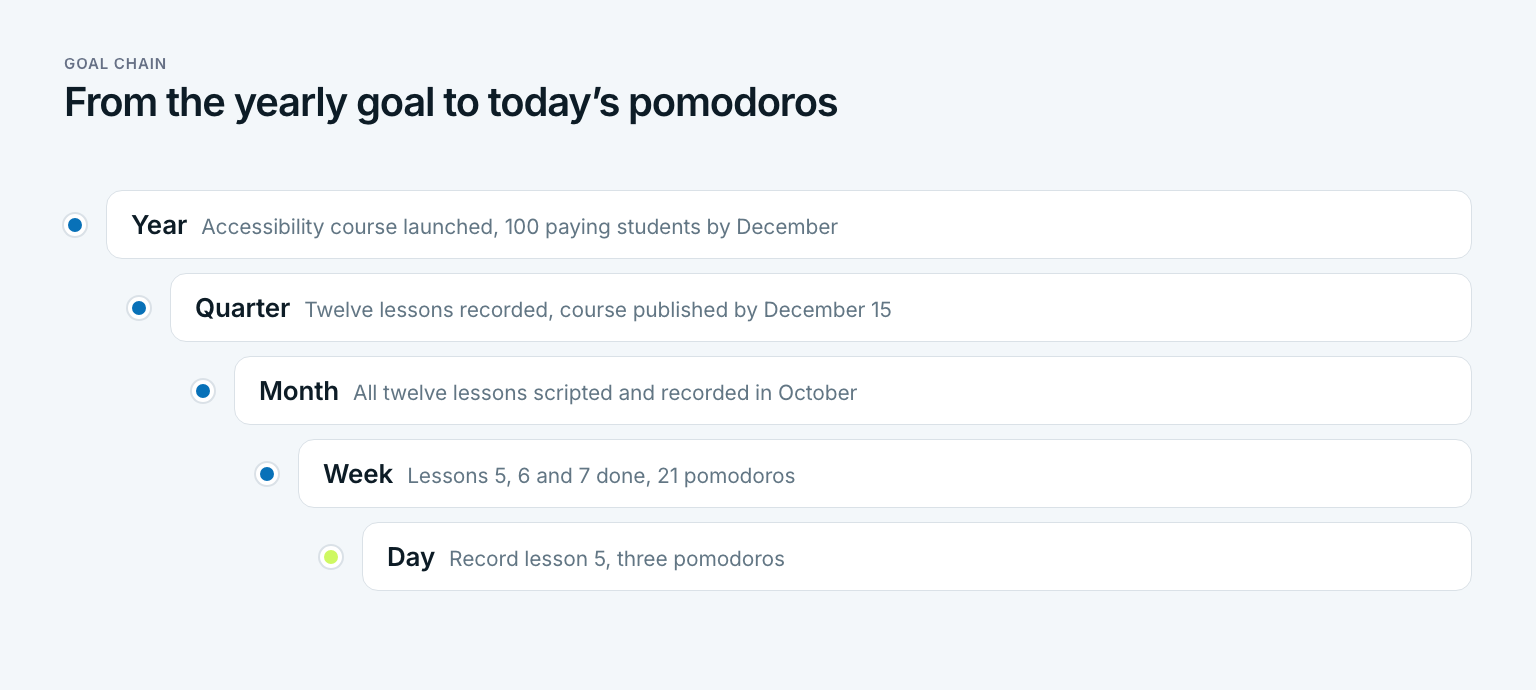
Run the chain upward and the count becomes a forecast. Seven pomodoros per lesson, twelve lessons, 84 for the month. Five a day gives 25 a week and 100 in four weeks, with 16 to spare for retakes and a sick day. If the sheet shows 18 a week instead of 25, the monthly goal will miss, and Marcus knows it on October 16 instead of October 31. Whoever counts pomodoros against a monthly goal has an early warning system. Whoever only counts them against the day has a diary.
In Gaapp this chain is the structure itself: five levels from year to day, each goal attached to a larger one, progress per level as the share of goals completed. The pomodoro sheet lives on the lowest level. A daily goal of “record lesson 5” with three pomodoros next to it is small enough to finish and specific enough to measure, and the article on daily goals shows how to word one. The weekly totals feed the ten-minute weekly review, where the question is not how many pomodoros were done but whether they moved the monthly goal.
Anyone planning in twelve-week cycles has a natural fit: the 12 week year treats each week as a unit that counts, and pomodoros give that week a number. Anyone with more than three goals at any level will find that every task deserves a pomodoro and none gets enough, which is why three goals are enough. The whole chain, explained from the top down, is in the guide on how to achieve goals.
The three mistakes nobody notices, and a template that catches them
The Pomodoro Technique rarely fails on day one. It fails in week two, when the timer still runs and the sheet has quietly disappeared. Three mistakes do most of the damage, and the first deserves its own box.
The most common mistake: working through the ring
The timer rings, you are in the middle of something, and you keep going. It feels like discipline. It is the end of the method. A pomodoro that runs to 40 minutes is open-ended work with a timer in the background, and it produces exactly the fatigue the breaks were built to prevent. The fix is mechanical: finish the sentence, put the X on the sheet, stand up. The task will still be there in five minutes. The method will not be there in a week if you skip them.
- The timer without the sheet. A timer alone measures nothing. It only interrupts. Anyone who runs pomodoros for a week without writing down estimates, X marks, and interruptions ends the week with a feeling and no data. The sheet is the method.
- Pomodoros as a quota. Twelve pomodoros a day sounds like a goal and behaves like a punishment. The count measures what happened, it is not a target, and four pomodoros on the right task beat ten on whatever was easiest. Marcus’s best day in week one by count was Wednesday. His best day by progress was Friday, when four pomodoros finished a recording.
- Breaks that are not breaks. Five minutes in the inbox is a context switch with a timer on it, and the next pomodoro starts with an open loop from an email. Stand up, look away from screens, come back. The break resets attention only if nothing in it asks for attention.
A Pomodoro template: one sheet, five columns
Cirillo’s original system uses three sheets: an inventory of all activities, a to-do-today list, and a records sheet. For most people one sheet with five columns does the job, on paper or in a spreadsheet. Paper has one advantage: it sits next to the timer and never shows a notification.
| Column | What you write | Marcus, Tuesday, October 13 |
|---|---|---|
| Task | One task, verb first, small enough for today | Record lesson 5 |
| Estimate | Pomodoros you expect, drawn as empty boxes | 3 |
| Done | One X per completed pomodoro | X X X |
| Interruptions | An apostrophe per internal one, a circle per external one | ’ ’ o |
| Actual and note | Pomodoros used, plus one line of learning | 3, retake of the intro cost most of one |
At the end of the day, two numbers go to the bottom of the sheet: pomodoros completed and interruptions in total. Whoever keeps the sheet for four weeks has something no app can generate: their own estimate error, their own interruption pattern, and their own best hour.
Three questions before your first pomodoro
Three questions about last week, before you set a timer:
- How many hours of focused work did you do last week, as a number and not a feeling?
- How many times were you interrupted during your most important task, and how many of those interruptions were your own?
- What was the last task you estimated before starting it, and how far off were you?
Anyone who cannot answer the first has a measurement problem, and the sheet fixes it. Anyone who cannot answer the second has an interruption problem, and the apostrophes fix it. Anyone who cannot answer the third has never estimated, and the estimate column will be humbling for one week. In short: the Pomodoro Technique is not a way to work in 25-minute rounds. It is a way to find out, in units you can count, where your focus goes.
Frequently asked questions about the Pomodoro Technique
Which physical pomodoro timer is the best?
The one that is not your phone. A mechanical kitchen timer with a ticking hand and a bell is what Cirillo used and still recommends, because winding it is a commitment and the ring cannot be swiped away. A cube timer with preset sides is the quiet alternative for shared spaces. Whatever you choose, keep a paper sheet next to it for the X marks, because the timer measures nothing on its own.
What is the 3-3-3 rule for productivity?
The 3-3-3 rule, proposed by the writer Oliver Burkeman, divides a workday into three parts: three hours on your most important project, three shorter urgent tasks, and three maintenance activities such as email or admin. It decides what the day is for. The Pomodoro Technique is how you spend the three hours: six pomodoros with breaks fill them almost exactly.
Is Pomodoro good for ADHD?
Often, with adjustments. A visible timer makes time external, a 25-minute unit makes starting smaller, and scheduled breaks give restlessness a legal exit. The sharp edges are the ring landing in hyperfocus and 25 minutes being too long to start on a hard day. Shrink the first pomodoro to ten or fifteen minutes, allow one recorded continue per day, and use an analog timer you can see across the room. No large trial proves it works for ADHD, so run two honest weeks and let your own sheet decide.
What are the 5 steps in the Pomodoro Technique?
Choose one task and write it down. Set the timer to 25 minutes. Work until it rings, marking interruptions on your sheet instead of acting on them. Mark the pomodoro with an X and take a five-minute break. After four pomodoros, take a long break of 15 to 30 minutes and compare the X marks with your estimate.
How many pomodoros a day is realistic?
Sixteen fit into eight hours on paper, and almost nobody reaches it. Six to eight is a strong day for full-time knowledge work with meetings, ten to twelve is possible during exam preparation, and four to six is realistic for a side project before or after a job. Pick the number you can hit four days out of five, not the one you hit once.
Why is it called the Pomodoro Technique?
Pomodoro is Italian for tomato. Francesco Cirillo developed the method in the late 1980s as a student in Italy, using a tomato-shaped kitchen timer to hold himself to short stretches of study. The timer gave the method its name, and the word pomodoro became the unit: one pomodoro is 25 minutes of uninterrupted work on a single task.
Last updated: 19 October 2026
Read next
 Productivity
Feynman Technique: Four Steps to Real Understanding
The Feynman technique is not a memorization trick: four steps, a worked example from a stats class, a one-page template, and what research says.
16 min read
 Productivity
Zettelkasten: How to Turn Notes Into Your Own Ideas
A Zettelkasten is not an archive: Luhmann's method, the three note types, a five-step setup and an Obsidian template, with a worked example.
15 min read
 Productivity
Second Brain: How to Build One You Actually Use
A second brain is not a note archive: Tiago Forte's CODE steps, the PARA method with an example, a five-step setup and the mistakes that sink it.
15 min read